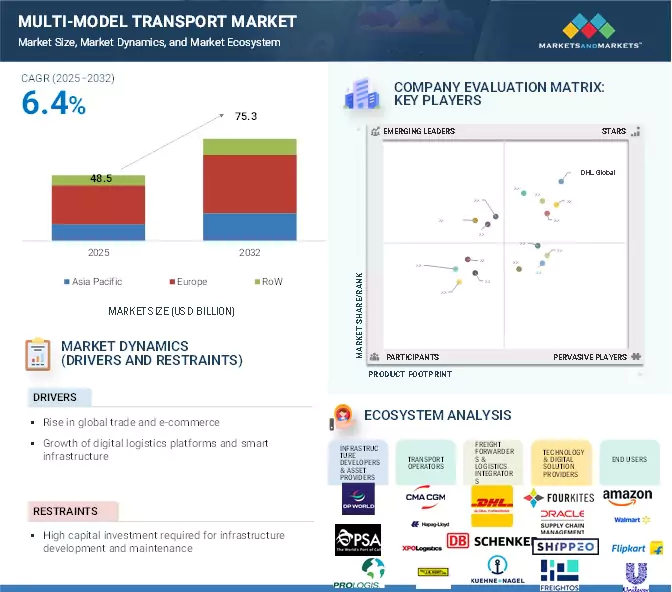
The global multi-model transport market is projected to reach USD 75.3 million by 2032, growing from USD 48.5 million in 2025, at a CAGR of 6.4%. The growth of this market is mainly driven by lower logistics costs, reduced carbon emissions, and improved asset utilization. The shippers can save 10-15% on freight and cut CO2 emissions by 20-30% using rail-road combinations, helping avoid carbon taxes under the EU ETS. Strategic infrastructure corridors like Europe’s TEN-T and India’s Freight Corridors boost throughput by 30-40%, reducing inventory-in-transit costs. Containerized multimodal flows also lower cargo handling losses by up to 25%, enhancing reliability and supply chain ROI over a single-mode transport model.
Attractive Opportunities in the Multi-Model Transport Market
ASIA PACIFIC
Market growth in Asia Pasific is mainly due to Rapid China-Europe Belt & Road corridors, rising intra-Asia trade, and e-commerce demand in India and ASEAN are accelerating multimodal adoption. RCEP trade pact and rising cold-chain demand from pharma and food exports are accelerating multimodal flows across Asia.
Retail is the largest end-use industry for multimodal transport, because of its intensity, global disgribution networks and the rise of e-commerce requiring multimodal integration for both cross-border and last-mile logistics
Freight transport is dominant segment due to rising global trade flows, e-commerce expansion, and integrated supply chains.
Three-Mode Combinations is the emerging market as growth is driven by e-commerce cross-border demand and the need for flexible, time-sensitive flows.
The multi-model transport market in the North America region is projected to grow at a significant rate by 2032
Global Multi-Model Transport Market Dynamics
Driver: Rise in global trade expansion and e-commerce
The rise in global trade volumes continues to be a foundational driver of multimodal transport. Despite geopolitical disruptions and nearshoring trends, global merchandise trade is projected to grow by 2.6% in 2024 and 3.3% in 2025 (WTO, 2024), demanding capacity beyond traditional single-mode supply chains. The rising supply chain demands are pushing logistics networks to be faster, greener, and more cost-effective. Multi-model transport serves as a critical approach that combines rail, road, and waterways allowing shippers to balance costs and manage congestion at major gateways, resulting into enhanced efficiency and resilience.
Trade corridors linking Asia-Europe and Asia-North America particularly benefit from multimodal integration, where rail and inland waterways serve as extensions of congested ports. This approach can reduce freight costs by 10–15%, cut carbon emissions by 20–30%, and increase corridor throughput by up to 40% compared to road-only transport. As a result, more shippers are adopting sea-rail-road combinations to manage costs and ease congestion at major hubs. As global trade lanes grow denser, multimodal transport offers strong financial and compliance benefits. Lower emissions reduce exposure to EU ETS carbon costs (€60–80/ton CO2), while faster transit frees up working capital. It's especially valuable for high-value, time-sensitive goods driving trade growth. Overall, multimodal transport is a strategic tool for shippers to balance cost, compliance, and resilience.
Restraint: High capital investment is required for infrastructure development and maintenance.
High capital expenditure remains a primary restraint for multimodal transport development, as integrated networks demand significant investment in ports, airports, intermodal rail terminals, and digital infrastructure. For example, the construction of a single intermodal freight terminal can cost between USD 150-300 million (World Bank, 2022), while major seaport upgrades regularly exceed USD 1 billion (OECD, 2023). Beyond development, rail maintenance alone can require USD 50,000–100,000 per km annually (European Commission, 2023), creating long-term financial commitments that often stretch public budgets and delay projects in emerging economies.
This investment intensity translates into long payback periods of 10-15 years, discouraging private sector participation without public–private partnerships or state subsidies. Large-scale projects such as India’s Dedicated Freight Corridor (>USD 15 billion, Indian Railways, 2023) and Africa’s LAPSSET Corridor (African Union, 2023) highlight both the scale of ambition and the financing challenges. As a result, while demand for multimodal solutions is accelerating due to global trade and e-commerce growth, infrastructure bottlenecks and funding gaps remain a structural constraint to widespread adoption.
Opportunities: Integration of digital solutions, such as real-time tracking systems, artificial intelligence (AI), and blockchain technology
The integration of digital solutions is transforming multimodal transport by enhancing visibility, efficiency, and trust across complex supply chains. Real-time tracking systems such as Maersk’s Remote Container Management (RCM), which connects over 380,000 refrigerated containers, enable shippers to monitor cargo conditions live, reducing spoilage and improving on-time delivery. Similarly, AI-driven optimization tools like UPS’s ORION platform streamline route planning across networks, saving 10 million gallons of fuel annually and reducing CO2 emissions by 100,000 tons. These technologies ensure seamless coordination between modes such as road, rail, and air, maximizing asset utilization while cutting operational costs.
On the other hand, blockchain platforms are addressing trust and documentation bottlenecks in cross-border logistics. The TradeLens initiative by Maersk and IBM demonstrated up to 40% faster customs clearance times by digitizing bills of lading, while the Port of Rotterdam’s blockchain pilots improved cargo security and transparency. Logistics providers like DHL’s Saloodo! have built digital freight platforms that integrate multiple carriers, offering shippers real-time visibility and simplified booking. Collectively, these advances are shifting multimodal transport toward a more resilient, customer-centric model where reliability, traceability, and sustainability define competitive advantage.
Challenges: Lack of standardization across transportation modes
A persistent challenge in multimodal transport lies in the lack of global standardization across transportation modes. Variations in container sizes, pallet specifications, and loading practices create inefficiencies at intermodal transfer points, often requiring repacking or additional handling. For example, while the 20ft and 40ft ISO containers are globally standardized, regional deviations in road trailer dimensions or rail gauge compatibility continue to disrupt seamless cargo flows. This inconsistency not only raises handling costs but also increases the risk of cargo damage and delays, undermining the efficiency gains that multimodality seeks to deliver.
Equally problematic is the fragmentation of digital systems and documentation standards. Many operators still rely on paper-based or proprietary tracking systems, which are not interoperable across carriers and modes. This lack of integration prevents real-time end-to-end visibility and complicates customs compliance, especially in cross-border trade. Initiatives such as the Electronic Bill of Lading (eBL) adoption by the Digital Container Shipping Association (DCSA) highlight progress, yet uptake remains uneven. Without harmonized standards in both physical and digital layers, multimodal transport networks struggle to achieve the full promise of resilience, transparency, and cost efficiency.
Global Multi-Model Transport Market Ecosystem Analysis
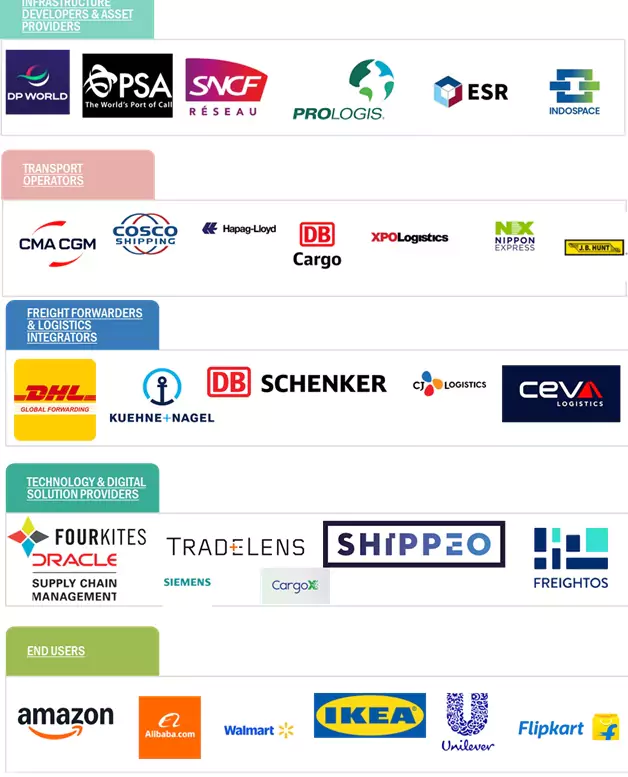
The multimodal transport ecosystem encompasses an integrated network of stakeholders, including port and terminal operators, railways, shipping lines, trucking companies, freight forwarders, air cargo carriers, customs authorities, and digital technology providers. Complementing these are infrastructure developers, financial institutions, insurance providers, and regulatory bodies, which collectively enable the flow of goods across borders and modes. This interconnected framework ensures that freight transitions seamlessly between road, rail, sea, and air while maintaining efficiency, compliance, and cost-effectiveness.
The retail segment will dominate the multi-model transport market.
The retail sector is the largest end-user of multimodal transport in 2025, driven by booming e-commerce and complex global supply chains. According to UNCTAD (2024), cross-border e-commerce surpassed USD 1.2 trillion in sales, accounting for nearly 22% of global retail trade, which continues to reshape multimodal logistics flows. Retail giants like Amazon, Alibaba, and Walmart are using multimodal strategies—air for global routes, rail for regional bulk, and road for last-mile delivery. Examples include Amazon’s sea-rail-road corridors in Europe, Walmart’s intermodal upgrades in North America, and Alibaba’s multimodal hubs in Asia and Europe. In addition, retailers are also aligning with urban multimodal last-mile innovations, such as parcel lockers, e-van + metro cargo partnerships, and shared distribution centers, which strengthen multimodal integration from ports to end customers.
Multi-model transportation enables containerized bulk flows to regional warehouses (via rail/sea) while keeping road transport for the final leg, optimizing cost and delivery reliability. With high volumes, time sensitivity, and dispersed delivery needs, retail aligns well with multimodal efficiency, cutting landed costs by 8-12% versus road-only, and improving delivery speed. Given tight profit margins (2-5%), the cost savings, reduced emissions, and fewer handling losses make multimodal transport especially valuable, positioning retail and e-commerce have emerged as dominant users of multi-model transportation.
The three-mode combinations segment is likely to be a rapidly booming segment by 2032.
Three-mode combinations (such as air-road-rail or sea-railroad) represent the fastest-growing configuration in multimodal transport because they provide the agility needed to meet modern supply chain demands, particularly in the era of cross-border e-commerce and globalized trade flows. The surge in online retail has driven shippers like Amazon, Alibaba, etc. to develop integrated three-mode systems that use air freight for transcontinental trunk routes, road transport for regional hub connectivity, and rail for bulk distribution across large geographies such as North America and Europe.
In addition, this combination offers the best cost-to-service optimization in long-haul trade. For example, Asia-Europe routes can cut transit times by 20-30% vs. sea-road and reduce costs by 10-15% vs. air-road for time-sensitive goods. With over 60% of cargo moving through ports, adding inland rail and last-mile road improves reach and lowers handling. These networks also reduce CO2 emissions by up to 30%, helping shippers manage carbon costs under schemes like EU ETS and FuelEU Maritime.
The China-Europe Belt and Road Initiative has accelerated sea-rail-road use, cutting transit times by 30-40% compared to all-sea routes. Post-COVID, demand for resilient, flexible transport surged, with companies like DHL and DB Schenker expanding three-mode services. Digital platforms like FourKites, CargoSmart, and project44 enhance visibility and allow dynamic mode-switching, reducing delays. Together, e-commerce growth, infrastructure investments, and digital tools make three-mode transport the fastest-scaling and most adaptable multimodal segment for the next decade.
Asia Pacific is projected to be one of the major markets during the forecast period.
Asia Pacific is the largest multimodal transport market, driven by its manufacturing dominance and role in global trade. According to UNCTAD’s Review of Maritime Transport 2024, the region handled over 55% of global maritime volumes, with China, Japan, South Korea, and ASEAN countries leading in container flows. This has spurred strong demand for integrated sea-rail-road-air logistics. China remains central, moving 1.63 million TEUs via China-Europe rail corridors in 2024, reinforcing Belt and Road connectivity. India expanded its Dedicated Freight Corridors, cutting transit times by up to 40% and improving road-rail-port links. Singapore’s Changi Airport moved 2.12 million tonnes of air freight, integrated into regional road networks. Japan and South Korea increased port-rail investments to support key exports like automotive parts and semiconductor components.
Overall, Asia-Pacific’s scale, infrastructure investment, and strategic policy initiatives such as China’s Belt and Road, India’s Dedicated Freight Corridors, and ASEAN cross-border logistics programs consolidate its position as the largest multimodal transport market in 2024. The region not only dominates in volume but also demonstrates a mature integration of sea-rail-road-air networks, ensuring resilience and efficiency in increasingly complex global trade flows. Backed by large trade volumes, infrastructure growth, and strategic policies, the Asia Pacific leads in multi-model adoption, offering efficient, resilient logistics across complex global supply chains.
Recent Developments of Multi-Model Transport Market
In September 2025, Sinotrans expanded its China–Europe Belt & Road corridors by launching new sea–rail–road services through Kazakhstan and Poland. The initiative provides alternative trade routes amid Red Sea disruptions, ensuring resilience for exporters and reducing transit time by 12 days compared to sea-only shipments.
In February 2025, DHL launched a rail–road multimodal service connecting Vietnam and China, aimed at handling fast-growing e-commerce flows. The service reduces lead times by 30% compared to pure road freight and integrates DHL’s digital visibility platform for real-time tracking. It strengthens DHL’s strategy to build resilient ASEAN–China trade corridors.
In January 2025, Kuehne + Nagel rolled out KN OmniChain 2.0, a multimodal logistics orchestration platform integrating sea, air, and road with predictive AI. The platform allows customers to simulate routes, assess carbon impact, and optimize for resilience amid geopolitical disruptions. It reflects the company’s focus on digital-led growth in complex trade networks.
In March 2025, DB Schenker expanded its multimodal green corridors in Europe by integrating electric trucks with rail freight networks across Germany, the Netherlands, and Austria. The initiative supports EU decarbonization goals, enabling shippers to cut CO2 emissions by up to 80% compared to road-only transport.
Key Market Players
List of Top Multi-Model Transport Market Companies
The Multi-Model Transport Market is dominated by a few major players that have a wide regional presence. The major players in the Multi-Model Transport Market are
What is the current size of the Multi-model transport market?
The Multi-model transport market is projected to grow from USD 48.5 billion in 2025 to USD 75.3 billion by 2032, with a CAGR of 6.4%.
Who are the key players in the Multi-model transport market?
DB SCHENKER (Germany), DHL International GmbH (Germany), KUEHNE + NAGEL INTERNATIONAL AG (Switzerland), C & S TRANSPORTATION (US), CEVA LOGISTICS (France) are key players in the multi-model transport market.
Which region is projected to account for the largest share of the Multi-model transport market during the forecast period?
Asia Pacific is projected to hold a dominant position in the multi-model transport market due to the presence of leading 3PL and logistics suppliers, and rise in logistics activities, growth in manufacturing facilities and localized supply chains, government regulations, and a high concentration of key players in multi-model transport and a high network of authorities of sea, port, and air. Alternatively, North America will grow at a faster rate by the end of the forecast period.
Which end-use industry segment is projected to lead the Multi-model transport market by end-use industry during the forecast period?
The retail segment is projected to dominate the Multi-model transport market.
What strategies are companies developing in the multi-model transport market?
Strategic partnerships are a key factor in driving market growth. Companies in the multimodal transport market are developing integrated digital logistics platforms to improve visibility across modes, investing in green corridors with low-emission rail and EV last-mile fleets, and expanding strategic partnerships with ports, rail operators, and airlines. They are also adopting flexible leasing and shared asset models to optimize capacity and reduce capital intensity in high-demand corridors.
Personalize This Research
Triangulate with your Own Data
Get Data as per your Format and Definition
Gain a Deeper Dive on a Specific Application, Geography, Customer or Competitor
Global Provider of Industrial Actuation & Control Solutionswww.weasler.com
Our organization was
interested in learning more about the attractiveness of a particular market space. We contacted
MarketsandMarkets to help us based on previous positive experiences we had with them. The
results did not disappoint! We discussed our objectives with them, and the team at
MarketsandMarkets developed and executed a proposal that met our needs precisely. We were very
impressed by their level of expertise, the quality of the analysis and their insightful
recommendations. We would not hesitate in working with them again in the future.
Matt Kardel,
Vice President
Aptiv,
A global technology company that develops safer, greener and more connected
solutions.www.aptiv.com
We contracted with
MarketsandMarkets to evaluate the value chain and potential go-to-market partners related to our
interest in the Fleet Management space. The team successfully completed the work on time and at the
pricing agreed. MarketsandMarkets listened and understood our objectives and collaborated well with
us to help us get the visibility we needed to make an investment.
We have subsequently used
MarketsandMarkets again related to Smart Cities to good results.















Growth opportunities and latent adjacency in Multi-Model Transport Market