Next Generation Sweeteners Market

Report Code UC-FB-9642
Published in Jan, 2026, By MarketsandMarkets™
Download PDF

Choose License Type

Buy Report Now Inquire Before Buying

Next Generation Sweeteners Market by Type (Nutritive Sweeteners, Non-Nutritive Sweeteners), Source (Plant-Based, Synthetic, Fermentation-Based), Form (Powder, Liquid, Crystals/Granules, Syrup), Application (Food & Beverages, Pharmaceuticals, Nutraceuticals, Personal Care, Animal Feed), and Region - Global Forecast to 2030

Overview

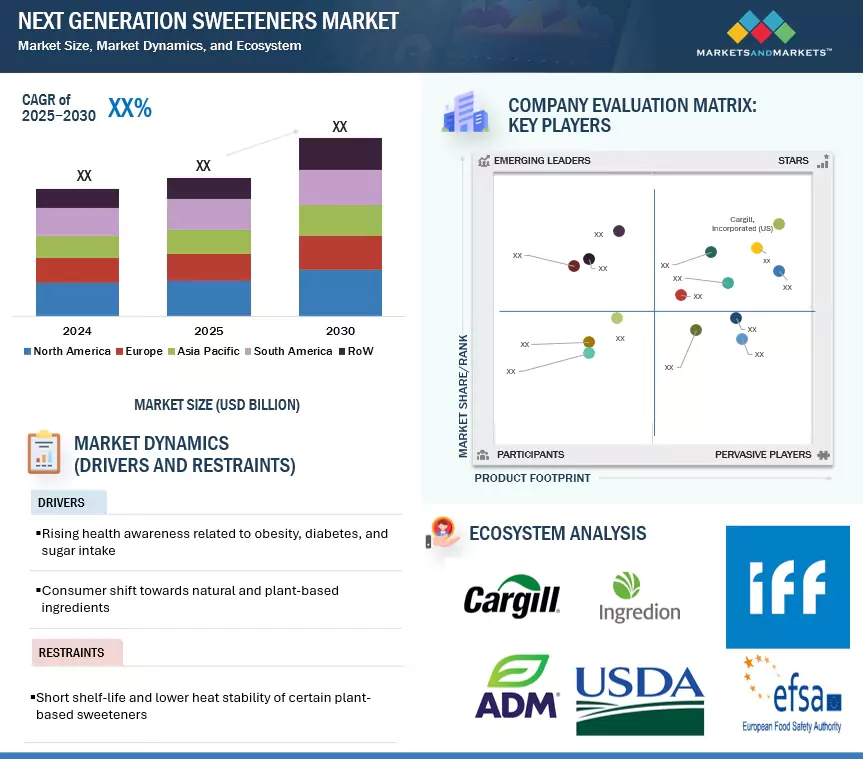
The Next Generation Sweeteners market is projected to expand from USD XX billion in 2025 to USD XX billion by 2030, at a CAGR of XX% during the forecast period. The market for next-generation sweeteners is changing rapidly due to rising consumer demand for healthier, low-calorie alternatives to traditional sugars. Next-generation sweeteners such as stevia, monk fruit, allulose, and tagatose provide a sugar-like taste while containing fewer calories and having a lower glycemic response than sugars. Advances in the fermentation and enzymatic technologies used to produce these sweeteners have allowed for the production of these sweeteners on a large scale, sensorial improvements, and increased applicability across food and beverage products. With the heightened awareness of health issues globally, including obesity, diabetes, and a greater preference for clean labels, we expect manufacturers to increasingly embrace these next-Next Generation Sweeteners for purposes of reformulation of their existing products, leading to impressive growth across markets and product categories for the Gen category.

Next Generation Sweeteners Market

Attractive Opportunities in the Next Generation Sweeteners Market

ASIA PACIFIC

The North American market for next-generation sweeteners is rising due to increasing consumer demand for natural, low-calorie sugar alternatives. Health concerns such as diabetes and obesity are driving the shift toward cleaner, plant-based ingredients.

The market for Next Generation sweeteners is projected to record a CAGR of XX% during the study period, reaching USD XX billion by 2030.

Collaborations and new product launches are expected to present profitable prospects for industry participants in the next five years.

Innovations in fermentation-based and synthetic processes enhance production efficiency and cost-effectiveness.

Major market players are investing and expanding in new markets.

Global Next Generation Sweeteners Market Dynamics

DRIVERS:Rising health awareness related to obesity, diabetes, and sugar intake

Increasing health consciousness around obesity, diabetes, and sugar consumption is driving the growth of the Next Generation Sweeteners market. Consumers are increasingly aware of the long-term health implications of abusing sugar consumption and are actively looking for healthier alternatives. According to the Centers for Disease Control and Prevention CDC, as of September 12, 2024, over 35% of U.S. adults were classified as obese, with all 50 states reporting an adult obesity prevalence of at least 20%. Obesity is a recognized risk factor for type 2 diabetes. Along the same lines, the Centers for Medicare & Medicaid Services stated in its 2024 Diabetes Strategy Report that obesity is the "most important and significant risk factor" for developing type 2 diabetes for people of all ages. Adding to the seriousness of the issue, the CDC's National Diabetes Statistics Report, published on May 15, 2024, revealed that approximately 38 million Americans, or 11.6% of the population, have diabetes. Such statistics compel consumers and manufacturers alike to shift to low-calorie, clean-label sweeteners and create demand for new and innovative sweetening options.

RESTRAINTS: Inconsistent taste profiles in different applications can hinder repeat use

A variable taste profile between products can be a restraint for the Next Generation Sweeteners market. Next generation sweeteners such as stevia, monk fruit, allulose, and tagatose have low- or no-calorie sugar replacements, but there can be extreme variation in their taste performance across different food or beverage matrices. Stevia can have a bitter or metallic aftertaste when used in dairy or acidified beverages, but may perform better in other applications like dry products. These taste variations make it highly difficult for food manufacturers to formulate similar-tasting acceptable products within their portfolio. In many cases, food products utilize additional ingredients to compensate for taste limitations.

These formulation challenges will cause increased costs to produce products and also put consumer satisfaction at risk. If a consumer experiences an off taste or poor flavor in a product using a Gen Sweetener, they may be less likely to try another product using the same ingredient, ultimately leading to lower repeat purchases. In a hypercompetitive market where taste is a key factor, if Next Generation Sweeteners cannot consistently replicate the sensory experience of sugar throughout the entire applications, adoption will be limited, and growth will slow.


OPPORTUNITIES: Increased R&D and biotech innovation

Research and development, and biotech innovation, such as precision fermentation and enzymatic production, are producing exciting opportunities in Next Generation Sweeteners. Specifically, these technologies allow the manufacturer to create sweeteners with efficiency, purity, and sustainability to address some limitations at the source for plant extracts. For example, Sweegen’s Ultratia brazzein was developed, using precision fermentation, as a sweet protein 500-2000 times sweeter than sugar, free of the bitterness from stevia, giving consumer products many options, especially beverage applications and prepared foods. Similarly, Elo Life Systems is already doing molecular farming using monk fruit to produce better taste profiles in monk fruit with more mogroside-V content than currently available, which allows for reduced costs and better yield. Similarly, in the enzymatic innovations, researchers at Jiangsu University for 2024 produced D-tagatose from L-arabinose isomerase with 90% yield in mild conditions. Companies such as Ambrosia Bio, in partnership with Ginkgo Bioworks, have established industrial levels of enzymatic allulose production. Also, in South Korea, Samyang is pushing the limits of allulose production using enzyme innovation and advanced crystallization. These technological innovations not only support clean label diets and sustainable sourcing but also open up potential for similar products in functional foods, beverages, and pharmaceuticals.

CHALLENGES: Confusion between artificial vs. natural sweeteners is affecting trust

The artificial/natural confusion is a big problem for the Next Generation Sweeteners market, especially regarding consumer trust. These next-Next Generation Sweeteners, like stevia, monk fruit, allulose, and tagatose, might be derived from natural sources, or maybe naturally fermented, but most consumers view them as additives that they cannot trust because they do not recognize the chemical name or the labeling is not clear, as in the case of "Rebaudioside M" and "Mogroside V" - at first glance, they may seem synthetic, but they are from a plant. This confusion leads to reluctance to consume anything with Next Generation Sweeteners in it, particularly health-focused consumers who want clean-label products.

Additionally, concerns about artificial sweeteners like aspartame and saccharin have been around for a long time and have contributed to skepticism regarding any low-calorie sweetener regardless of its origin, and can create issues with purchasing decisions, which limit adoption to reformulated food & beverage products. For those in manufacturing, addressing consumer confusion requires an improvement in clarity and labeling on the ingredient statement, and an expanded educational strategy to identify the natural origins, safety, and benefits of Next Generation Sweeteners. Until this confusion is alleviated, even the most modern sweetening technology may struggle to achieve widespread consumer acceptance.

Global Next Generation Sweeteners Market Ecosystem Analysis

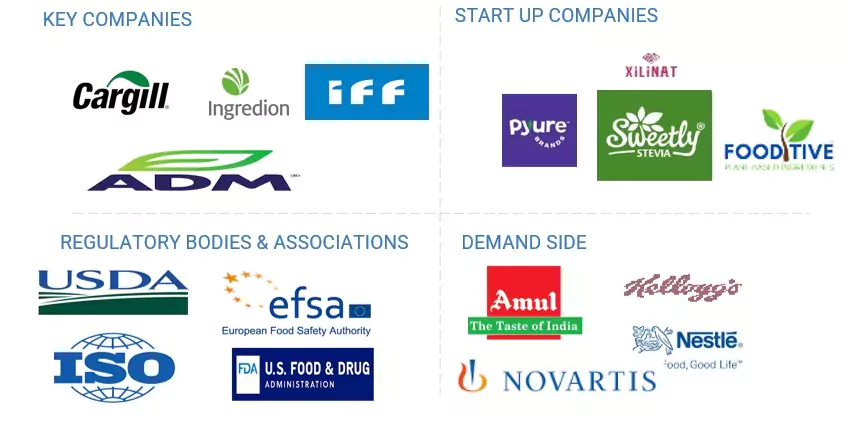
Some of the prominent companies in this market include well-established and financially sound manufacturers of the Next Generation Sweeteners market. These companies have been operational in the market for more than a decade and have diversified portfolios, the latest technologies, and excellent global sales and marketing networks. Some of the prominent companies in this market include Tate & Lyle (UK), dsm-firmenich (Switzerland), Ingredion (US), and International Flavors & Fragrances Inc. (IFF) (US).

Top Companies in Next Generation Sweeteners Market

Note: The above diagram only shows the representation of the Next Generation Sweeteners Market ecosystem; it is not limited to the companies represented above.
Source: Secondary Research and MarketsandMarkets Analysis


By source, the plant source is estimated to grow at a significant CAGR during the forecast period.

The demand for plant-based sweeteners is rising steadily as consumers increasingly prioritize natural, low-calorie alternatives to refined sugar and artificial sweeteners. As recorded in a June 2024 article, each of the companies appeared to capitalize on the ever-increasing interest in plant sweeteners with an avalanche of products in 2024. For example, PureCircle (Ingredion) launched a new line of fermented stevia-based based, and Reb D and Reb M included ingredients which have a more refined, cleaner taste and all met all EU and UK specifications. HOWTIAN introduced SoPure Dorado, as a golden and unrefined stevia extract with clean labelled. NutraEx Food Inc. launched BI-Sugar, which is a plant-based sweetener produced with L-arabinose and stevia, designed to slow sugar digestion while adding negligible calories and keep sugar taste in July 2024. Tate & Lyle announced it had broadened its plant-based sweeteners to include a new natural sweetener blend intended specifically for dairy. The plan to expand dairy options stemmed from consumer demand for sugar-reduced dairy items and dairy-based beverages. From these innovations, it is clear that many companies can capitalize on growing consumer interest in health-promoting and more naturally-sourced ingredients. This shift is related to continued public concern over diabetes, obesity, and other health complications due to excess sugar consumption. Consumers will continue to drive the growing demand for plant-based sweeteners and products across many food and beverage categories, with an increased opportunity size.

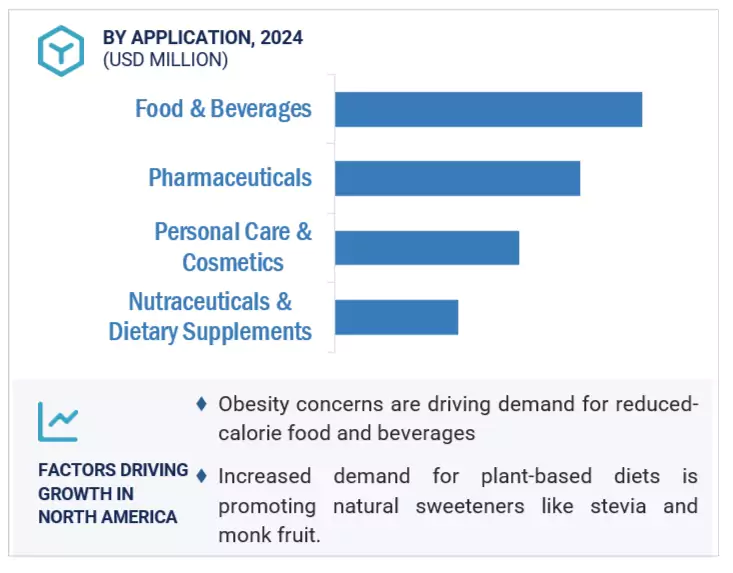
By application, the food & beverages segment is expected to dominate the market during the forecast period.

The Next Generation Sweeteners market has been dominated by the food and beverage industry as the largest segment. As awareness of the health implications of sugar increases, manufacturers are reformulating products to meet the demand for diabetic friendly products by using next-generation sweeteners like stevia, monk fruit, allulose, and tagatose. Allulose, monk fruit, and stevia a widely used in beverages, dairy, baked goods, and confectionery as they can replace the sweetness of sugar and limit calorie impact. In early 2024, Tate & Lyle and Samyang launched powdered and chocolate-grade allulose products fitting for bakery, dairy, and sports nutrition applications. Beverage companies made the foray into allulose with product launches of soft drinks, ready-to-drink teas or coffees, flavored creamers, and other products that want to maintain mouthfeel and flavor without sugar. Blends with stevia and monk fruit are also becoming more common in functional snack bars, dairy-free products, and low-sugar beverages. These trends illustrate how the food and beverage companies are placed at the forefront of the Next Generation Sweeteners market, specifically through product reformulations and modified applications to meet targeted demographic appetites based on health-conscious trends.

North America is estimated to lead the market during the forecast period.

The demand for next-generation sweeteners is increasing in North America due to increasing health concerns and acceptance of low-calorie sweet old comparisons. The CDC's recently published in May 2024, National Diabetes Statistics Report estimates that there are now 38.4 million people in the US. With diabetes (approximately 11.6% of the population), as well as many others at risk, such as those with obesity and individuals who count the amount of sugar they consume. As these health challenges continue to mount, the shift towards natural and low-glycemic sweeteners like stevia, monk fruit, and allulose is gaining acceptance from consumers and manufacturers alike. In 2023, multiple sweeteners were assigned GRAS (Generally Recognized As Safe) status by the FDA, including allulose, rebaudioside M (from stevia), and some monk fruit extracts. This has aided the reformulation of food and beverage products and turned traditional sweeteners into food and beverage ingredients. The labelling of allulose as not being part of added sugar is also motivating food companies to introduce sugar-reduced or sugar-free products without compromising on taste. Clean-label, plant-based ingredient consumers are contributing to increasing interest in next-generation sweeteners, as well. It is becoming commonplace for major North American food companies to reformulate products that include fermented-derived or combined sweeteners, especially to target diabetic, keto, and health-conscious product portfolios.

HIGHEST CAGR MARKET IN 2030
US: FASTEST GROWING MARKET IN THE REGION
Next Generation Sweeteners Market by region

Recent Developments of Next Generation Sweeteners Market

  • In April 2024, Ingredion (US) launched PURECIRCLE Clean Taste Solubility Solution (CTSS), a new stevia-based sweetener developed to be over 100 times more soluble than conventional Reb M stevia. CTSS offered taste performance and supported plant-based, clean-label claims. It would mimic the taste of sugar with zero additives, allowing for complete sugar reduction in products like beverages, syrups, bars, and sauces.
  • In July 2024, In July 2024, Roquette Frères and Bonumose established a global co-operation agreement to scale the production of tagatose, a naturally occurring sweetener with health-beneficial properties, leveraging Roquette's starch-based ingredients expertise and Bonumose's enzyme technology to produce tagatose at a high purity level.

Key Market Players

Scope of the Report

Report Attribute Details
Market size available for years 2025–2030
Base year considered 2024
Forecast period 2025–2030
Forecast units Value (USD)
Segments Covered Type, Source, Form, Application, And Region
Regions covered North America, Europe, Asia Pacific, South America, and Rest of the World (RoW)

Key Questions Addressed by the Report

What is the current size of the Next Generation Sweeteners Market?

The Next Generation Sweeteners market is estimated to be USD XX billion in 2025 and is projected to reach USD XX billion by 2030, registering a CAGR of XX% during the forecast period.

Which are the key players in the market, and how intense is the competition?

Cargill, Incorporated (US), Tate &?Lyle PLC (Germany), and Ingredion Incorporated (US) are some of the key players.
The market for Next Generation Sweeteners is expanding rapidly, with more mergers, acquisitions, and product launches. Companies in this sector are also heavily investing.

Which region is projected to account for the largest share of the Next Generation Sweeteners market?

The next-generation sweeteners market in North America is rising due to increasing rates of diabetes and obesity. Consumers are actively shifting toward low-calorie, plant-based sweeteners like stevia and allulose. Regulatory support, such as the FDA’s GRAS status for these sweeteners, encourages adoption. Additionally, food and beverage companies are reformulating products to meet clean-label and health-conscious demand.

What kind of information is provided in the company profiles section?

The company profiles provided deliver crucial details, including a thorough business summary that covers different segments, financial results, geographic presence, revenue distribution, and business revenue breakdown. They also offer insights into product lines, key achievements, and expert analyst opinions to better illustrate the company's potential.

What are the factors driving the Next Generation Sweeteners Market?

Adoption in functional foods, nutraceuticals, and personal care creates opportunities for natural sweeteners.

Personalize This Research

  • Triangulate with your Own Data
  • Get Data as per your Format and Definition
  • Gain a Deeper Dive on a Specific Application, Geography, Customer or Competitor
  • Any level of Personalization
Request A Free Customisation

Let Us Help You

  • What are the Known and Unknown Adjacencies Impacting the Next Generation Sweeteners Market
  • What will your New Revenue Sources be?
  • Who will be your Top Customer; what will make them switch?
  • Defend your Market Share or Win Competitors
  • Get a Scorecard for Target Partners
Customized Workshop Request

Table of Contents

Exclusive indicates content/data unique to MarketsandMarkets and not available with any competitors.

TITLE
PAGE NO
INTRODUCTION
1
  • 1.1 STUDY OBJECTIVES
  • 1.2 MARKET DEFINITION
  • 1.3 STUDY SCOPE
    MARKET SEGMENTATION
    INCLUSIONS & EXCLUSIONS
    REGIONS COVERED
    YEARS CONSIDERED
  • 1.4 UNIT CONSIDERED
    CURRENCY/ VALUE UNIT
    VOLUME UNIT CONSIDERED
  • 1.5 STAKEHOLDERS
RESEARCH METHODOLOGY
2
  • 2.1 RESEARCH DATA
    SECONDARY DATA
    - KEY DATA FROM SECONDARY SOURCES
    PRIMARY DATA
    - KEY DATA FROM PRIMARY SOURCES
    - KEY INSIGHTS FROM INDUSTRY EXPERTS
    - BREAKDOWN OF PRIMARY INTERVIEWS
    - BOTTOM-UP APPROACH
  • 2.2 MARKET SIZE ESTIMATION
    - TOP-DOWN APPROACH
  • 2.3 DATA TRIANGULATION
  • 2.4 RESEARCH ASSUMPTIONS
  • 2.5 LIMITATIONS AND RISK ASSESSMENT
EXECUTIVE SUMMARY
2
PREMIUM INSIGHTS
3
MARKET OVERVIEW
4
  • 5.1 INTRODUCTION
  • 5.2 MACROECONOMIC OUTLOOK
  • 5.3 MARKET DYNAMICS
    DRIVERS
    RESTRAINTS
    OPPORTUNITIES
    CHALLENGES
  • 5.4 IMPACT OF GEN AI ON NEXT GENERATION SWEETENERS
    INTRODUCTION
    USE OF GEN AI IN NEXT GENERATION SWEETENERS
    CASE STUDY ANALYSIS
    IMPACT ON NEXT GENERATION SWEETENERS MARKET
    ADJACENT ECOSYSTEM WORKING ON GEN AI
INDUSTRY TRENDS
5
  • 6.1 INTRODUCTION
  • 6.2 SUPPLY CHAIN ANALYSIS
  • 6.3 VALUE CHAIN ANALYSIS
  • 6.4 TRADE ANALYSIS
  • 6.5 TECHNOLOGY ANALYSIS
    KEY TECHNOLOGIES
    COMPLEMENTARY TECHNOLOGIES
    ADJACENT TECHNOLOGIES
  • 6.6 PRICING ANALYSIS
    AVERAGE SELLING PRICE TREND OF KEY PLAYERS, BY APPLICATION
    AVERAGE SELLING PRICE TREND, BY REGION
  • 6.7 ECOSYSTEM ANALYSIS/ MARKET MAP
  • 6.8 TRENDS/DISRUPTIONS IMPACTING THE CUSTOMER’S BUSINESS
  • 6.9 PATENT ANALYSIS
    LIST OF MAJOR PATENTS PERTAINING TO THE MARKET
    KEY CONFERENCES & EVENTS IN 2024-2025
    REGULATORY LANDSCAPE
    - REGULATORY BODIES, GOVERNMENT AGENCIES, & OTHER ORGANIZATIONS
    - REGULATORY FRAMEWORK
    PORTER’S FIVE FORCES ANALYSIS
    - INTENSITY OF COMPETITIVE RIVALRY
    - THREAT OF NEW ENTRANTS
    - THREAT OF SUBSTITUTES
    - BARGAINING POWER OF SUPPLIERS
    - BARGAINING POWER OF BUYERS
    KEY STAKEHOLDERS AND BUYING CRITERIA
    - KEY STAKEHOLDERS IN THE BUYING PROCESS
    - BUYING CRITERIA
    CASE STUDY ANALYSIS
    INVESTMENT AND FUNDING SCENARIO
    IMPACT OF 2025 US TARIFF - NEXT GENERATION SWEETENERS MARKET
    - INTRODUCTION
    - KEY TARIFF RATES
    - PRICE IMPACT ANALYSIS
    - IMPACT ON COUNTRY/REGION
    - IMPACT ON END-USE INDUSTRIES
NEXT GENERATION SWEETENERS MARKET, BY TYPE
6
  • 7.1 INTRODUCTION
  • 7.2 NUTRITIVE SWEETENERS (CALORIC)
    SUCROSE
    GLUCOSE
    FRUCTOSE
    MALTOSE
    SUGAR ALCOHOLS
  • 7.3 NON-NUTRITIVE SWEETENERS (LOW/NO CALORIE)
    ARTIFICIAL SWEETENERS
    NATURAL HIGH-INTENSITY SWEETENERS
NEXT GENERATION SWEETENERS MARKET, BY SOURCE
7
  • 8.1 INTRODUCTION
  • 8.2 PLANT-BASED
  • 8.3 SYNTHETIC/CHEMICALLY DERIVED
  • 8.4 FERMENTATION-BASED
NEXT GENERATION SWEETENERS MARKET, BY FORM
8
  • 9.1 INTRODUCTION
  • 9.2 POWDER
  • 9.3 LIQUID
  • 9.4 CRYSTALS/GRANULES
  • 9.5 SYRUP
    NEXT GENERATION SWEETENERS MARKET, BY APPLICATION
NEXT GENERATION SWEETENERS MARKET, BY APPLICATION
9
  • 10.1 INTRODUCTION
  • 10.2 FOOD & BEVERAGES
  • 10.3 PHARMACEUTICALS
  • 10.4 PERSONAL CARE & COSMETICS
  • 10.5 NUTRACEUTICALS & DIETARY SUPPLEMENTS
  • 10.6 ANIMAL FEED
NEXT GENERATION SWEETENERS MARKET, BY REGION
10
  • 11.1 INTRODUCTION
  • 11.2 NORTH AMERICA
    US
    CANADA
    MEXICO
  • 11.3 EUROPE
    UK
    GERMANY
    FRANCE
    ITALY
    SPAIN
    BELIGUM
    SWITZERLAND
    REST OF EUROPE
  • 11.4 ASIA PACIFIC
    CHINA
    JAPAN
    INDIA
    AUSTRALIA & NEW ZEALAND
    REST OF ASIA PACIFIC
  • 11.5 SOUTH AMERICA
    BRAZIL
    ARGENTINA
    REST OF SOUTH AMERICA
  • 11.6 REST OF THE WORLD
    AFRICA
    MIDDLE EAST
    OVERVIEW
COMPETITIVE LANDSCAPE
11
KEY PLAYERS' STRATEGIES/RIGHT TO WIN
REVENUE ANALYSIS, 2021 – 2024
MARKET SHARE ANALYSIS, 2024
COMPANY VALUATION AND FINANCIAL METRICS
BRAND/PRODUCT COMPARISON
COMPANY EVALUATION MATRIX: KEY PLAYERS, 2024
- STARS
- EMERGING LEADERS
- PERVASIVE PLAYERS
- PARTICIPANTS
- COMPANY FOOTPRINT: KEY PLAYERS, 2024
COMPANY EVALUATION MATRIX: STARTUPS/SMES, 2024
- PROGRESSIVE COMPANIES
- RESPONSIVE COMPANIES
- DYNAMIC COMPANIES
- STARTING BLOCKS
- COMPETITIVE BENCHMARKING: KEY STARTUPS/SMES
COMPETITIVE SCENARIO
- PRODUCT LAUNCHES
- DEALS
- EXPANSIONS
- OTHERS
COMPANY PROFILES
12
  • 13.1 KEY PLAYERS
    CARGILL (US)
    TATE & LYLE (UK)
    ARCHER DANIELS MIDLAND – ADM (US)
    INGREDION (US)
    INTERNATIONAL FLAVORS & FRAGRANCES – IFF (US)
    ROQUETTE FRÈRES (FRANCE)
    AJINOMOTO (JAPAN)
    GLG LIFE TECH (CANADA)
    THE NUTRASWEET COMPANY (US)
    - JK SUCRALOSE (CHINA)
    - HYET SWEET (FRANCE)
    - STEVIA CORP. (US)
    - SWEETLEAF – WISDOM NATURAL BRANDS (US)
    - MORITA KAGAKU KOGYO (JAPAN)
    - ZYDUS WELLNESS (INDIA)
  • 13.2 STARTUPS/SMES
    MATSUTANI CHEMICAL INDUSTRY (JAPAN)
    SÜDZUCKER – BENEO (GERMANY)
    CUMBERLAND PACKING CORP. (US)
    NOW HEALTH GROUP (US)
    WHOLE EARTH BRANDS (US)
    AMALGAMATED SUGAR COMPANY (US)
    BIOVITTORIA (NEW ZEALAND)
    ANDERSON ADVANCED INGREDIENTS (US)
    SAVAGE BROS. CO. (US)
    - ZHUCHENG HAOTIAN PHARMA – HTPHA (CHINA)
ADJACENT & RELATED MARKETS
13
APPENDIX
14
  • 15.1 DISCUSSION GUIDE
  • 15.2 KNOWLEDGE STORE: MARKETSANDMARKETS’ SUBSCRIPTION PORTAL
  • 15.3 AVAILABLE CUSTOMIZATIONS
  • 15.4 RELATED REPORTS
  • 15.5 AUTHOR DETAILS
Request for detailed methodology, assumptions & how numbers were triangulated.
Please share your problem/objectives in greater details so that our analyst can verify if they can solve your problem(s).

Previous Versions of this Report

"Our USP is "providing game-changing business opportunities reports with free customization" - so please feel free to provide us with your specific areas of interest / business challenges in much greater detail !!"

We appreciate your interest in this report. Once you fill out the form, you'll be immediately directed to an exclusive solution tailored to your needs. This high-value offering can help boost your revenue by 30% - a must-see opportunity for anyone looking to maximize growth.


By clicking the "Submit" button, you are agreeing to the Terms of Use and Privacy Policy.

Custom Market Research Services

We Will Customise The Research For You, In Case The Report Listed Above Does Not Meet With Your Requirements

Get 10% Free Customisation

Growth opportunities and latent adjacency in Next Generation Sweeteners Market

DMCA.com Protection Status