Plant-based Packaging Market

Report Code UC-FB-9644
Published in Jan, 2026, By MarketsandMarkets™
Download PDF

Choose License Type

Buy Report Now Inquire Before Buying

Plant-based Packaging Market by material type (bioplastics, paper & paperboard, bagasse, bamboo, palm leaves, others), product type (rigid packaging, flexible packaging), end-use industry (food & beverage, personal care & cosmetics, pharmaceuticals, industrial, retail & e-commerce, others), and region - Global Forecast to 2030

Overview

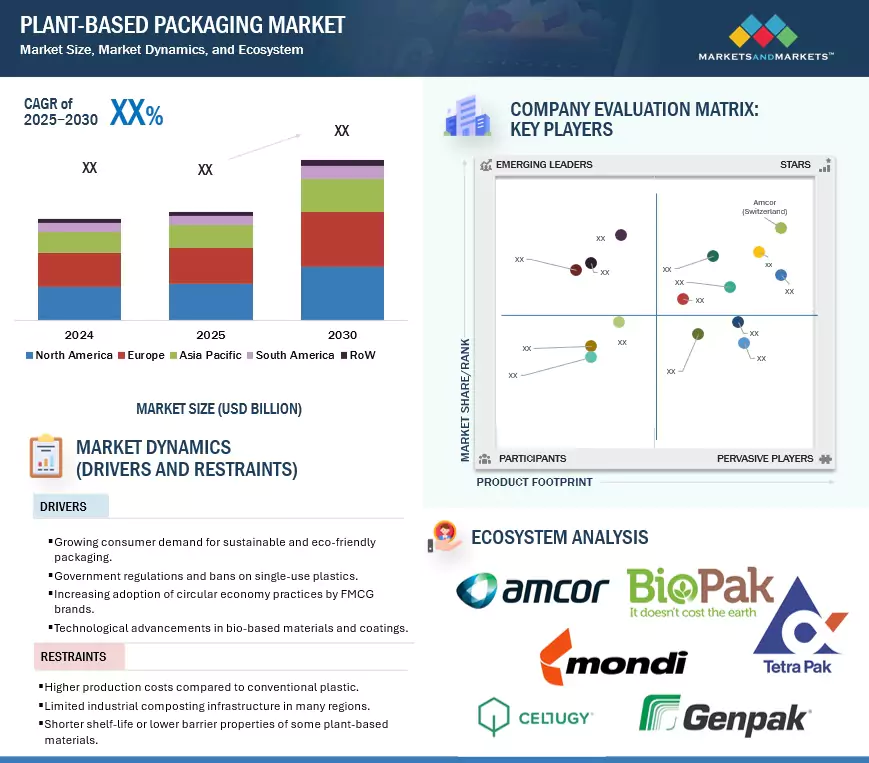
The plant-based packaging market is projected to expand from USD XX million in 2025 to USD XX million by 2030, at a CAGR of XX% during the forecast period. The plant-based packaging market is gaining significant momentum as industries and consumers shift toward sustainable and eco-friendly alternatives to conventional plastic. Derived from renewable resources such as corn starch, sugarcane, seaweed, and agricultural waste, these materials offer lower carbon footprints and better end-of-life disposal options like composting or biodegradation. Increasing regulatory pressures, corporate sustainability goals, and rising environmental awareness are driving adoption across food & beverage, personal care, and retail sectors. While challenges like performance limitations and cost persist, continuous innovation and collaboration across the value chain are helping scale plant-based packaging solutions globally.

Plant-based Packaging Market

Attractive Opportunities in the Plant-based Packaging Market

ASIA PACIFIC

Asia-Pacific is the fastest-growing region, driven by rising environmental regulations, growing e-commerce, and consumer demand for sustainable packaging in countries like India, China, and Japan. The consumption pattern is steadily increasing in many APAC countries, particularly China, Japan, South Korea, and India, due to urbanization, rising disposable incomes, and westernization of lifestyle habits.

Key players in the plant-based packaging market are focusing on innovations such as compostable films, bio-based barriers, and fiber-based materials to improve performance while maintaining environmental sustainability.

Leading brands are integrating plant-based packaging into product lines to align with ESG goals and consumer expectations.

The global shift toward circular economy models is accelerating adoption of compostable and bio-based packaging across foodservice, personal care, and retail sectors.

Consumers and brands are increasingly opting for plant-based packaging as a response to growing environmental concerns and plastic bans.

Global Plant-based Packaging Market Dynamics

DRIVERS: Growing consumer demand for sustainable and eco-friendly packaging

One of the primary drivers of the plant-based packaging market is the growing consumer demand for sustainable and eco-friendly packaging solutions. With increasing environmental awareness and concerns over plastic pollution, consumers are becoming more conscious of the environmental impact of their purchasing decisions. This shift in consumer behavior has led to a strong preference for packaging that is biodegradable, compostable, or made from renewable resources. As a result, brands across food, beverage, cosmetics, and personal care sectors are adopting plant-based packaging to align with consumer expectations and enhance brand image. This demand is further amplified by younger, sustainability-driven demographics who prioritize eco-conscious products, influencing purchasing trends and encouraging companies to invest in greener packaging alternatives.

RESTRAINTS: Shorter shelf-life or lower barrier properties of some plant-based materials

A key restraint in the plant-based packaging market is the shorter shelf-life and lower barrier properties exhibited by some plant-derived materials compared to conventional plastic. Plant-based packaging solutions—such as those made from PLA, starch blends, or molded fiber—often lack the same level of resistance to moisture, oxygen, grease, and UV light. This can compromise the integrity, freshness, and safety of sensitive products, particularly in the food, beverage, and pharmaceutical sectors. As a result, manufacturers may struggle to use plant-based alternatives for items requiring long shelf lives or strict preservation conditions. While research is ongoing to improve bio-barrier coatings and multilayer structures, the current limitations in performance remain a barrier to wider adoption across all packaging applications.


OPPORTUNITIES: Collaboration opportunities with biopolymer and biotech startups

There is significant collaboration potential between established packaging companies and emerging biopolymer and biotech startups, offering a strong opportunity for innovation in the plant-based packaging market. Startups are often at the forefront of developing advanced materials such as algae-based films, bacterial cellulose, and fermentation-derived biopolymers like PHA and PHBV. These innovations can provide improved barrier properties, biodegradability, and compatibility with existing packaging machinery. By partnering with such startups, larger firms can accelerate product development, gain access to proprietary materials, and reduce time-to-market for sustainable solutions. These collaborations also help overcome technical and scalability challenges, enabling commercialization of novel plant-based packaging formats that meet both environmental and performance demands. Strategic alliances, joint ventures, and co-development projects are becoming increasingly common as companies seek to differentiate themselves in a sustainability-driven market.

CHALLENGES: Balancing performance with sustainability (e.g., moisture and oxygen barriers)

A critical challenge in the plant-based packaging market is balancing performance with sustainability, particularly when it comes to moisture and oxygen barriers. While plant-based materials offer eco-friendly benefits like biodegradability and reduced carbon footprint, they often fall short in delivering the same protective qualities as petroleum-based plastics. For products such as perishable foods, beverages, and pharmaceuticals, maintaining freshness, preventing spoilage, and ensuring product integrity are non-negotiable. However, many bio-based materials are more permeable to gases and moisture, which can lead to reduced shelf life and compromised quality. Achieving the ideal balance requires continuous innovation in bio-barrier coatings, multilayer laminates, and material blends—all while keeping the end product compostable or recyclable. This ongoing tension between functionality and environmental performance makes material selection and design a complex task for packaging manufacturers.

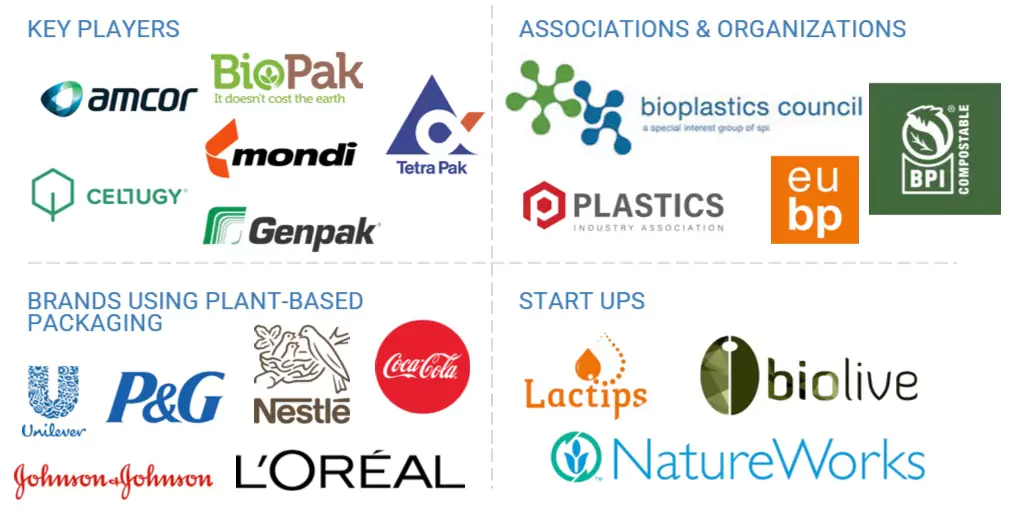
Global Plant-based Packaging Market Ecosystem Analysis

Top Companies in Plant-based Packaging Market

Note: The above diagram only shows the representation of the Plant-based Packaging Market ecosystem; it is not limited to the companies represented above.
Source: Secondary Research and MarketsandMarkets Analysis


Paper and paperboard dominate the plant-based packaging market by material type, accounting for the largest market share.

These materials are favored due to their widespread availability, low cost, ease of recyclability, and biodegradability. They are extensively used in the production of folding cartons, corrugated boxes, paper wraps, and containers, especially in sectors like food service, e-commerce, and personal care. Innovations such as water-based coatings, barrier films, and lamination technologies have significantly improved their functionality by enhancing moisture and grease resistance—making them more suitable for packaging perishable or wet products. Additionally, growing regulations on plastic bans and heightened consumer awareness have accelerated the shift toward fiber-based packaging, cementing paper and paperboard's leading position in the market.

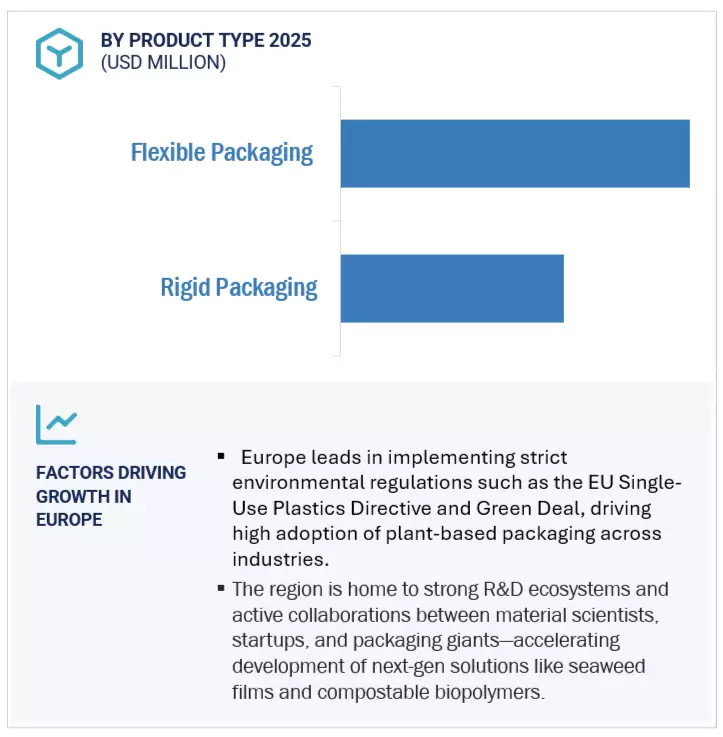
Flexible packaging holds the largest share in the plant-based packaging market by product type,

primarily because of its lightweight, low material use, and adaptability to a variety of applications. It includes pouches, bags, wraps, sachets, and liners made from bio-based films, starch blends, and cellulose. The food & beverage sector, in particular, is a major consumer of flexible formats due to their suitability for snacks, dry goods, beverages, and frozen items. Recent advances in compostable and biodegradable films have addressed previous concerns over shelf life and durability. Brands are also leveraging the reduced environmental impact of flexible packaging—lower carbon footprint during transport and space-saving storage—to meet sustainability targets. As demand for convenient, sustainable, and visually appealing packaging rises, the dominance of flexible plant-based packaging is expected to grow even further.

Europe leads the global plant-based packaging market in terms of regional market share

Driven by stringent environmental regulations, strong institutional support, and growing consumer demand for sustainable packaging. The European Union’s bans on single-use plastics and ambitious circular economy goals have significantly accelerated the shift toward compostable, biodegradable, and recyclable alternatives. Countries like Germany, France, and the Netherlands are at the forefront, supported by widespread public awareness and retail initiatives promoting eco-friendly packaging. Major brands and retailers across Europe are adopting plant-based solutions across food, personal care, and e-commerce packaging to align with EU Green Deal targets. Moreover, innovation hubs across the region are collaborating with startups and research institutions to develop next-generation materials like seaweed films, compostable cellulose layers, and molded fiber packaging, reinforcing Europe's leadership in both market adoption and technology advancement.

LARGEST MARKET SHARE IN 2024
GERMANY: FASTEST GROWING MARKET IN THE REGION
Plant-based Packaging Market by region

Recent Developments of Plant-based Packaging Market

  • In May 2025, Notpla teamed up with Bidfood Catering Supplies to launch seaweed-coated takeaway food boxes across the UK. The products are lined with Notpla’s industrially advanced seaweed-based coating, providing a truly plastic-free, compostable solution available to thousands of foodservice customers.
  • In December 2024, NEXE Innovations Inc., a North American compostable packaging company, secured several new US and Canadian patents for advanced compostable materials and manufacturing techniques—including ultrasonic welding of biopolymers and high-efficiency food-grade containers—positioning them as a leader in next-gen compostable single-use packaging .
  • In September 2024, Notpla raised over €25 million (approx. £20 million) in a Series A+ investment round led by EIT Food, to scale production of its seaweed-based packaging and expand into North American markets .
  • In March 2024, Duni Group, in collaboration with Notpla, introduced the Alga product line—cardboard food packaging coated with renewable seaweed—recognized by Dutch authorities as fully plastic-free. The line includes several mealboxes and trays, offering strong moisture and oil resistance while remaining recyclable or compostable.

Key Market Players

List of Top Plant-based Packaging Market Companies

The Plant-based Packaging Market is dominated by a few major players that have a wide regional presence. The major players in the Plant-based Packaging Market are

  • AMCOR (Switzerland)
  • BIOPAK (Australia)
  • CELLUGY (Denmark)
  • GENPAK (United States)
  • GOOD START PACKAGING (United States)
  • GRAPHIC PACKAGING INTERNATIONAL (United States)
  • HUHTAMAKI (Finland)
  • MONDI (UK)
  • PACTIV EVERGREEN (United States)
  • PAPIER- METTLER (Germany)
  • PLASTIPAK (United States)
  • SEALED AIR (United States)
  • STORA ENSO (Finland)
  • TETRA PAK (Switzerland)
  • VEGWARE (United Kingdom)

Scope of the Report

Report Attribute Details
Market size available for years 2025–2030
Base year considered 2024
Forecast period 2025–2030
Forecast units Value (USD)
Segments Covered By Type, By Product Type, By End-User Industry, and By Region
Regions covered North America, Europe, Asia Pacific, South America, and Rest of the World (RoW)

Key Questions Addressed by the Report

What is the current size of the plant-based packaging market?

The plant-based packaging market is estimated to be USD XX million in 2025 and is projected to reach USD XX million by 2030, registering a CAGR of XX% during the forecast period.

Which are the key players in the market, and how intense is the competition?

Tetra Pak (Switzerland), Amcor (Australia), Notpla (UK), BioPak (Australia), Genpak (US), NatureWorks (US), Earthpac (India), and Huhtamaki (Finland)** are some of the key market players. The competitive landscape is characterized by a mix of global packaging giants and emerging startups innovating with biodegradable, compostable, and bio-based materials. Players are actively engaged in new product developments, partnerships with biotech firms, and scaling production capacities to gain a competitive edge.

Which region is projected to account for the largest share of the plant-based packaging market?

Europe is projected to hold the largest share in the plant-based packaging market. The region benefits from strong regulatory support, sustainability-focused policies like the EU Single-Use Plastics Directive, and high consumer awareness. Major European players and associations are driving advancements in compostable packaging and biopolymer integration across foodservice, retail, and industrial packaging sectors.

What kind of information is provided in the company profiles section?

The company profiles section includes comprehensive details such as business overviews, product portfolios, sustainability strategies, revenue breakdowns by region and segment, and recent developments. It highlights innovations, collaborations, patent filings, and production capacity expansions to provide insights into each player’s competitive position and growth outlook.

What are the factors driving the plant-based packaging market?

Key drivers include growing consumer preference for eco-friendly and plastic-free alternatives, rising environmental concerns, government regulations promoting biodegradable packaging, and advancements in bio-based material technologies. The market is further fueled by the increasing adoption of sustainable packaging in food, personal care, e-commerce, and retail industries.

Personalize This Research

  • Triangulate with your Own Data
  • Get Data as per your Format and Definition
  • Gain a Deeper Dive on a Specific Application, Geography, Customer or Competitor
  • Any level of Personalization
Request A Free Customisation

Let Us Help You

  • What are the Known and Unknown Adjacencies Impacting the Plant-based Packaging Market
  • What will your New Revenue Sources be?
  • Who will be your Top Customer; what will make them switch?
  • Defend your Market Share or Win Competitors
  • Get a Scorecard for Target Partners
Customized Workshop Request

Table of Contents

Exclusive indicates content/data unique to MarketsandMarkets and not available with any competitors.

TITLE
PAGE NO
INTRODUCTION
1
  • 1.1 STUDY OBJECTIVES
  • 1.2 MARKET DEFINITION
  • 1.3 STUDY SCOPE
    MARKET SEGMENTATION
    INCLUSIONS & EXCLUSIONS
    REGIONS COVERED
    YEARS CONSIDERED
  • 1.4 UNIT CONSIDERED
    CURRENCY/ VALUE UNIT
  • 1.5 STAKEHOLDERS
RESEARCH METHODOLOGY
2
  • 2.1 RESEARCH DATA
    SECONDARY DATA
    - Key data from secondary sources
    PRIMARY DATA
    - Key data from primary sources
    - Key primary insights
    - Breakdown of primary interviews
  • 2.2 MARKET SIZE ESTIMATION
    BOTTOM-UP APPROACH
    TOP-DOWN APPROACH
  • 2.3 DATA TRIANGULATION
  • 2.4 RESEARCH ASSUMPTIONS
    ASSUMPTIONS OF THE STUDY
  • 2.5 LIMITATIONS AND RISK ASSESSMENT
EXECUTIVE SUMMARY
3
PREMIUM INSIGHTS
4
MARKET OVERVIEW
5
  • 5.1 INTRODUCTION
  • 5.2 MACROECONOMIC OUTLOOK
  • 5.3 MARKET DYNAMICS
    DRIVERS
    RESTRAINTS
    OPPORTUNITY
    CHALLENGES
  • 5.4 IMPACT OF GEN AI ON PLANT-BASED PACKAGING
    INTRODUCTION
    USE OF GEN AI IN PLANT-BASED PACKAGING
    CASE STUDY ANALYSIS
    IMPACT ON PLANT-BASED PACKAGING MARKET
    ADJACENT ECOSYSTEM WORKING ON GEN AI
INDUSTRY TRENDS
6
  • 6.1 INTRODUCTION
  • 6.2 SUPPLY CHAIN ANALYSIS
  • 6.3 VALUE CHAIN ANALYSIS
  • 6.4 TRADE ANALYSIS
  • 6.5 TECHNOLOGY ANALYSIS
    KEY TECHNOLOGY
    - Biopolymer Production Technologies
    - Biodegradation & Compostability Optimization
    COMPLEMENTARY TECHNOLOGY
    - Active & Intelligent Packaging Tech
    - Digital Printing & Labeling
    ADJACENT TECHNOLOGY
    - Waste Valorization Technologies
  • 6.6 PRICING ANALYSIS
    AVERAGE SELLING PRICE TREND OF KEY PLAYERS,BY TYPE
    AVERAGE SELLING PRICE TREND, BY REGION
  • 6.7 ECOSYSTEM ANALYSIS/ MARKET MAP
    DEMAND SIDE
    SUPPLY SIDE
  • 6.8 TRENDS/DISRUPTIONS IMPACTING THE CUSTOMER’S BUSINESS
  • 6.9 PATENT ANALYSIS
    LIST OF MAJOR PATENTS PERTAINING TO THE MARKET
    KEY CONFERENCES & EVENTS (2024 -2025)
    REGULATORY LANDSCAPE
    - Regulatory Bodies, Government Agencies, & Other Organizations
    PORTER’S FIVE FORCES ANALYSIS
    - Intensity of Competitive rivalry
    - Threat of New Entrants
    - Threat of Substitutes
    - Bargaining power of suppliers
    - Bargaining Power of Buyers
    KEY STAKEHOLDERS AND BUYING CRITERIA
    - Key Stakeholders in the Buying Process
    - Buying Criteria
    CASE STUDY ANALYSIS
    INVESTMENT & FUNDING SCENARIO
    IMPACT OF 2025 US TARIFF – PACKAGING MARKET
    - INTRODUCTION
    - KEY TARIFF RATES
    - PRICE IMPACT ANALYSIS
    - IMPACT ON COUNTRY/REGION
    - IMPACT ON END-USE INDUSTRIES
GLOBAL PLANT-BASED PACKAGING MARKET BY TYPE
7
  • 7.1 INTRODUCTION
  • 7.2 BIOPLASTICS
  • 7.3 PARPER & PAPERBOARD
  • 7.4 BAGASSE
  • 7.5 BAMBOO
  • 7.6 PALM LEAVES
  • 7.7 OTHER TYPES
GLOBAL PLANT-BASED PACKAGING MARKET, BY PRODUCT TYPE
8
  • 8.1 INTRODUCTION
  • 8.2 RIGID PACKAGING
  • 8.3 FLEIXIBLE PACKAGING
GLOBAL PLANT-BASED PACKAGING MARKET, BY END USE INDUSTRY
9
  • 9.1 INTRODUCTION
  • 9.2 FOOD & BEVERGAE
  • 9.3 PHARMACEUTICALS
  • 9.4 PERSONAL CARE & COSMETICS
  • 9.5 INDUSTRIAL
  • 9.6 RETAIL & E-COMMERSE
  • 9.7 OTHER INDUSTRIES
    GLOBAL PLANT-BASED PACKAGING MARKET, BY REGION
GLOBAL PLANT-BASED PACKAGING MARKET, BY REGION
10
  • 10.1 NORTH AMERICA
    US
    CANADA
    MEXICO
  • 10.2 EUROPE
    GERMANY
    UK
    ITALY
    SPAIN
    FRANCE
    REST OF EUROPE
  • 10.3 ASIA PACIFIC
    CHINA
    JAPAN
    INDIA
    AUSTRALIA & NEW ZEALAND
    REST OF ASIA PACIFIC
  • 10.4 S0UTH AMERICA
    BRAZIL
    ARGENTINA
    REST OF SOUTH AMERICA
  • 10.5 REST OF THE WORLD
    MIDDLE EAST
    AFRICA
COMPETITIVE LANDSCAPE
11
  • 11.1 OVERVIEW
  • 11.2 KEY PLAYERS STRATEGIES/RIGHT TO WIN
  • 11.3 REVENUE ANALYSIS, 2020 - 2024
  • 11.4 MARKET SHARE ANALYSIS, 2024
  • 11.5 COMPANY VALUATION AND FINANCIAL METRICS
  • 11.6 BRAND/PRODUCT COMPARISON
  • 11.7 COMPANY EVALUATION MATRIX: KEY PLAYERS, 2024
    STARS
    EMERGING LEADERS
    PERVASIVE PLAYERS
    PARTICIPANTS
    COMPANY FOOTPRINT: KEY PLAYERS,2024
    - Company Footprint
    - Region Footprint
    - Type Footprint
    - Product type Footprint
    - End-User Footprint
  • 11.8 COMPANY EVALUATION MATRIX: STARTUPS/SMES, 2024
    PROGRESSIVE COMPANIES
    RESPONSIVE COMPANIES
    DYNAMIC COMPANIES
    STARTING BLOCKS
    COMPETITIVE BENCHMARKING: KEY STARTUPS/SMES
    - Detailed list of key start-up/SMEs
    - Competitive benchmarking of key start-up/SMEs
  • 11.9 COMPETITIVE SCENARIO
    PRODUCT LAUNCHES
    DEALS
    EXPANSIONS
    OTHERS
COMPANY PROFILES
12
  • 12.1 AMCOR
  • 12.2 BIOPAK
  • 12.3 CELLUGY
  • 12.4 GENPAK
  • 12.5 GOOD START PACKAGING
  • 12.6 GRAPHIC PACKAGING INDUSTRIAL
  • 12.7 HUHTAMAKI
  • 12.8 MONDI
  • 12.9 PACTIV EVERGREEN
    PAPIER- METTLER
    PLASTIPAK
    SEALED AIR
    STORA ENSO
    TETRA PAK
    VEGWARE
    WORLD CENTRIC
ADJACENT & RELATED MARKETS
13
APPENDIX
12
  • 14.1 DISCUSSION GUIDE
  • 14.2 KNOWLEDGE STORE: MARKETSANDMARKETS’ SUBSCRIPTION PORTAL
  • 14.3 AVAILABLE CUSTOMIZATIONS
  • 14.4 RELATED REPORTS
Request for detailed methodology, assumptions & how numbers were triangulated.
Please share your problem/objectives in greater details so that our analyst can verify if they can solve your problem(s).

Previous Versions of this Report

"Our USP is "providing game-changing business opportunities reports with free customization" - so please feel free to provide us with your specific areas of interest / business challenges in much greater detail !!"

We appreciate your interest in this report. Once you fill out the form, you'll be immediately directed to an exclusive solution tailored to your needs. This high-value offering can help boost your revenue by 30% - a must-see opportunity for anyone looking to maximize growth.


By clicking the "Submit" button, you are agreeing to the Terms of Use and Privacy Policy.

Custom Market Research Services

We Will Customise The Research For You, In Case The Report Listed Above Does Not Meet With Your Requirements

Get 10% Free Customisation

Growth opportunities and latent adjacency in Plant-based Packaging Market

DMCA.com Protection Status