Seed Colorant Market

Report Code UC-FB-6938
Published in Jan, 2026, By MarketsandMarkets™
Download PDF

Choose License Type

Buy Report Now Inquire Before Buying

Seed Colorant Market - Global Forecast to 2030

Overview

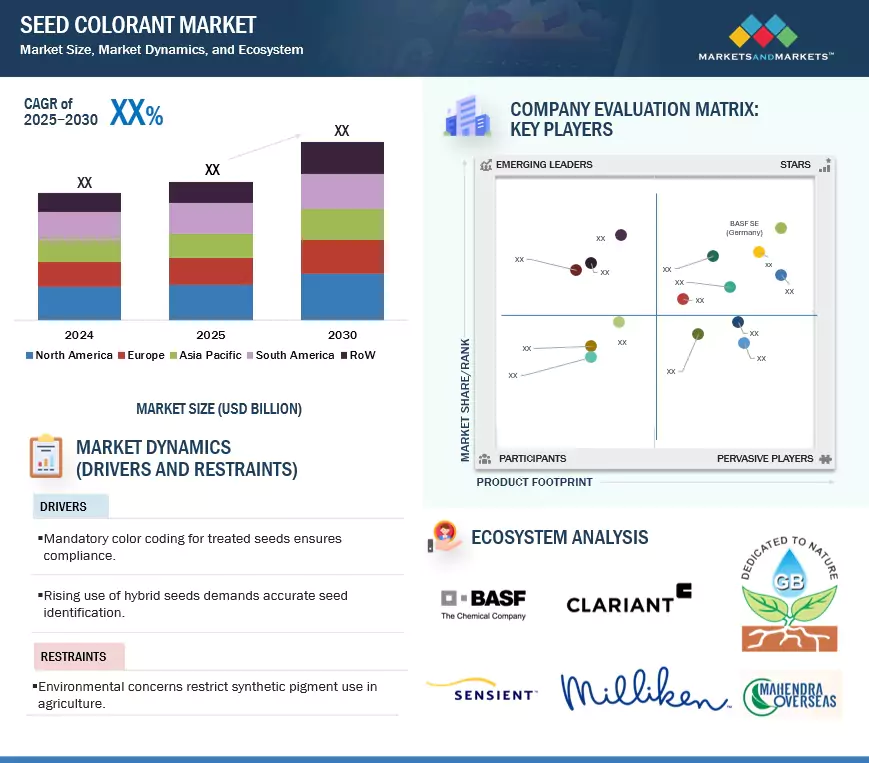
The Seed Colorant market is projected to expand from USD XX billion in 2025 to USD XX billion by 2030, at a CAGR of XX% during the forecast period. The rise of the seed colorant market is attributed to the high demand for precision, safety, and modern agricultural practices. In the current scenario, as farmers have accepted the use of treated seeds to increase crop protection and yield performance, colorants are very useful for differentiating treated seeds from untreated seeds, thus reducing the chances of handling errors and maintaining regulatory standards. Governments and agencies impose color codes for treated seeds to ensure that they are not consumed or used accidentally. Thus, at the commercial level, seed houses use colorants for brand identification while also providing a means to distinguish between different traits or treatments introduced into the seeds. Further, the sustainability angle considered here also enhances the shift from synthetic to natural and biodegradable colorants. On the other hand, technological improvements in seed coating machinery and multitasking coatings, which Imbibe colorants combined with fungicides, insecticides, or micronutrients, work in tandem to boost demand. As the agricultural production ecosystem starts intensifying upon the aspiration of food security, demand in the seed colorant industry can well be traced to the need for easily identifiable, safe, and traceable seeds.

Seed Colorant Market

Attractive Opportunities in the Seed Colorant Market

NORTH AMERICA

Rising demand for eco-friendly farming in the U.S. creates a strong opportunity for biodegradable, plant-based seed colorants, aligning with sustainability goals, organic certification, and regulatory shifts favoring non-toxic agricultural inputs.

Seed companies are leveraging colorant technologies to differentiate product lines and enhance traceability, creating opportunities for customized formulations tailored to specific crops, markets, or regulatory needs.

Rapid mechanization and hybrid seed adoption in countries like India and China offer significant growth potential for seed colorants as precision planting and seed treatment become more widespread.

Growing demand for eco-friendly and biodegradable seed inputs presents strong opportunities for natural seed colorants in organic farming systems across Europe, North America, and emerging eco-certified markets.

Seed colorants combined with biologicals, micronutrients, or polymers can create value-added seed coatings, enabling companies to offer multi-functional solutions that enhance seed performance and traceability.

Global Seed Colorant Market Dynamics

DRIVERS: Compliance with standards and efficiency improvements encourage the introduction of supplemental seed development in modern farming

There is an increased usage of Vitamin Seed in crops as it helps to meet the standards and prevent errors. In many places, seed protectants, on the other hand, taken for instance in North America and Europe for instance, seed protectants are required to be easily recognizable for safe handling, planting, and distribution of the seeds. This can be because, without the colorant, treated seeds meant for use as food can also be used as planting seeds, resulting in crop failures. At the same time, colorants have a preventive effect when they are applied to the commercial seed products. Thus, in cases of hybrid seed production, manufacturing seed, and contract farming, the demand for colorants is almost automatic. The need for this is to be qualified further as beyond just being permitted for seed enhancement, colorants compete even in terms of one’s brand. All these mechanisms together account for the increase in the use of seed colorants not only in large commercial enterprises but for peasant farming.

RESTRAINTS: Negative ecological forces are acting as inhibitors for the synthetic seed coat market.

The decorative use of classical dyes like mineral pigments and the like is under a cloud since it is too deep given certain threats: an exposure towards such menacing substances, a spillage on the ground eventually leading to contamination and concentration of such dyes in layers or droplets of the groundwater. Limited hazardous pigment usage is being regulated by some regional protection policies, with restricted permissible substances used in seed coatings.

The overall occurrence of the above developments requires the manufacturers to ensure that these are included in the seed coating formulations, which also results in higher costs of system compliance because of reformulation requirements. Concerns raised by farmers and seed producers include the effects of such coatings on the biological activity in the soil, such as organic fostering and other methods of improving the long-term soil health. All these elements combine, which explains the limitation in the growth of usage of artificial colouring materials and hence a growing need for more eco-friendly but costly options.


OPPORTUNITIES: Increasing Awareness and Interest in Eco-Friendly Products Has Caused the Growth of Nature-Based Colorants Utilization in Seed Development

With the evolution of agricultural systems to more sustainable and climate-resilient farming, there is a favorable environment for the manufacture and usage of natural seed colorants. The application of bio-degradable and bio-based products in the agriculture value chain is broadly encouraged, promoting not just reduced chemical usage in the environment, but also more efficient utilization of resources in general. Additionally, market demand economics has favored the shifting consumption patterns to green targets such as organic products and farming, which also results in a huge impact on the agriculture and seed industry. Nontoxic melamine colorants with certain biodegradable ores have the ability to gain market share because, with the mineral pigments being abandoned, key companies are working on nature-based products to replace synthetic dyes. More so, those that can deliver natural colorants which are cheap, durable, and suitable for vegetation are likely to experience rapid growth, arising from being the pioneers. As a result, the growth of such innovative alternatives in the U.S., Parts of Europe, and parts of India is expected to fulfill these markets, and the advanced premium market of the product.

CHALLENGES: Stability Aspects Within the Enterprises Having Problems in Particular Relation to the Use of Natural Colorants.

Such issues as achieving uniform and correct application without any damage to natural colorants are considered the main limitations within the sphere of seed colorants. Natural dressings are of particular concern because they are not of the same color, that is, produced with a higher tint, have a shorter storage period, and the colors and the quality are easily changeable depending on the source of the natural color.

Such errors may obstruct the process of seed coating and visualization essential for quality control in the industrialization process, management of the operation layout at the cost of one-by-one processes. And tend to provide some stability, and such a level of application limits may pose a challenge in the application of this type of colorant, as the binding agents used and seed coat polish may react differently with the colorant, depending on temperature, etc. The desires to impose these alternative approaches and technology are achieved through cost-effective and operationally effective processes that are derived with a direct focus on mechanization. Such undertakings are likely to be less successful in the case of natural substitutes due to various operational and technical issues, which require continuous investigations and optimizations.

Global Seed Colorant Market Ecosystem Analysis

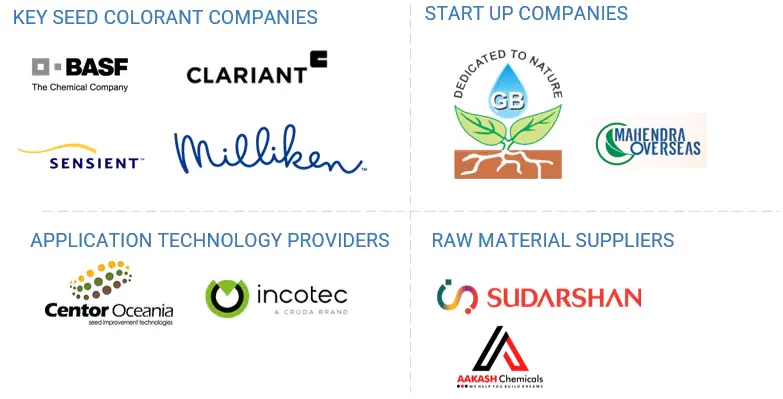
The seed colorant marketplace features an ecosystem composed of different industry players working towards new product designs, creativity, as well as delivery channels. Industries such as seed colorants, wherein companies like BASF, Clariant, Sensient, and Milliken take the lead in the manufacture of colorant systems formulated for seed treatment purposes. Given the new direction in coloring seeds fast, companies such as GB Dedicated to Nature and India Mahendra Overseas have taken prompt actions, with more bio-friendly methods being developed. Those that provide solutions require applications such as inkjet marking on seeds in the case of Centor Oceania disequorum technology, or infusion technology in the form of Treated Seed Churn Incotec. This applied research has been made possible through support furnished by higher learning institutions, more so by the Cancer nito Croda Inc., which encouraged them to wear caps. Something that Sudarshan and Aakash Chemicals address too, because the two manufacture high-performing colorants and texture enhancers that go do unabashedly into the makeup of colorants. When all these functions come together, what happens is the creation of one organized system, the purpose of which is to prevent regulations for treating seeds.

Top Companies in Seed Colorant Market

Note: The above diagram only shows the representation of the Seed Colorant Market ecosystem; it is not limited to the companies represented above.
Source: Secondary Research and MarketsandMarkets Analysis


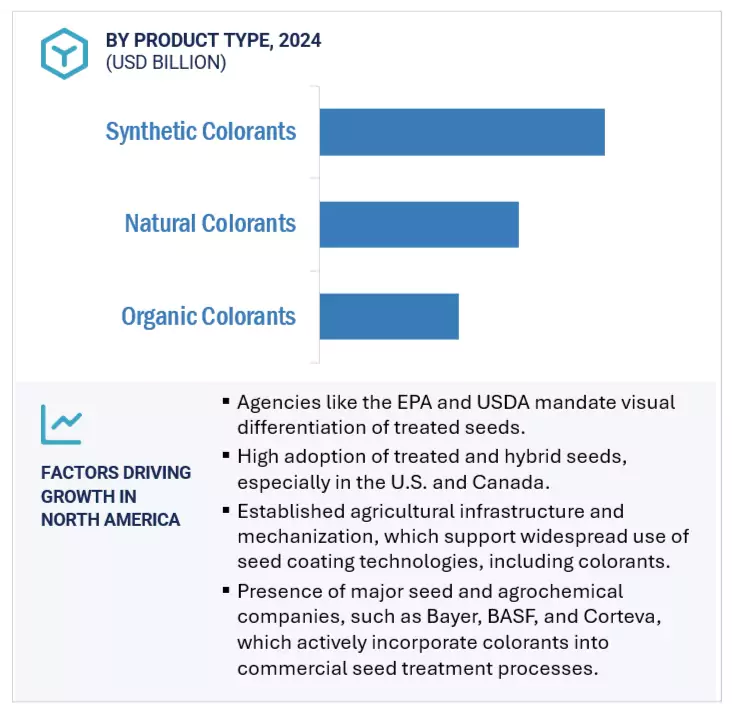
By product type, the Synthetic Colorants segment is estimated to lead the market during the forecast period.

Although Synthetic Colorants dominate the tiny market of coloring seeds and are significantly more intense in color, consistent in use, and cost-efficient, they are also widely applicable in agricultural manufacturing. These dyes are particularly promoted and used by seed plant breeders as well as the farms that do the treatment for the seeds, since these dyes are very easy to combine with other seed dressing forms. The great importance of synthetic dyes is with regard to their ability to sustain their initial color, which they reach after the first treatment, which facilitates even coating for larger-scale commercial purposes.

Moreover, synthetic types are installed in numerous colors and have been developed to meet the requirements of use in seed tagging, which is particularly the case in North American and European countries. The ability to be used in an auto seed coating machine and the reasonable shelf life serve as another reason why such synthetic types are favored by the big agri corporations. Despite the changing trends due to environmental concerns and increased awareness about organic farming practices, artificial dyes attract significant amounts of market share due to the inability of natural dyes to be produced at scale and the higher cost of such dyes.

For instance, major companies like BASF, Clariant, and Sensient Technologies continue to focus on synthetic formulations while exploring greener alternatives. Until natural and organic options that are as efficient and cost-effective as the existing synthetic options are discovered, it can be assumed that the latter will remain prevalent in the market.

By Crop Type, the Oilseeds segment is expected to grow at the fastest CAGR during the forecast period.

Oilseeds have emerged as the fastest-growing crop in the color-coded market, and the increase in global demand for such seeds is anticipated from the rise in storable oil consumption, such as bunking oils, stove oils, and other oils for fats, bio-diesel in the chemicals industry, and proteins complementary for feed additives. Oilseeds like soybean and sunflower, including canola, groundnut, as well as some other oil crops, have mainly been grown for food and other justified uses, and therefore, based on this package of consumption, they continuously spill over to new zones for purposeful production and more tying on seeds.

As the production of oilseeds evolved from the traditional methodologies to more capitalist forms and even more so in countries like India, Brazil, and the United States, a major shift has been made where farmers have opted to use treated hybrid seeds to boost productivity, minimize pests, and adapt to the prevailing weather pattern. In this regard, as mentioned earlier, seed colors are being used in the production system effectively for providing adequate labeling so that all the “dressed” seeds are not just to be seen by the users but can also be used to attach the inputs which will ensure by all means targeted standards can be achieved.

For instance, soy orchards are often subjected to pest and fertilization attacks to manage goods preservation, which includes the addition of pesticides and herbicides to the planting material of the crops in the land subdivision so that applied solutions can enter the zone more quickly. It helps to identify treated seeds in addition to being operated, further reinforcing safety measures. Not only this, but the use of customizable seed mixtures, seed coating, or branding techniques by the producers has led to demand for more colored coatings for easy market segregation and pouching.

North America is estimated to lead the market during the forecast period.

The seed colorant market has achieved the greatest success in North America, as this region has small farms providing high-value crops that are meticulously managed; that is thanks to the GDP-oriented approach, and everywhere seed technologies are practically applied. The relevant authorities of the respective country, such as the US Environmental Protection Agency (EPA), as well as the Department of Agriculture (USDA), ensure, where necessary, that coloured seeds are availed to avoid possible confusion with food, feed, or oil processing. Hence, coloured seed coating is highly sought after in the region to comply with the necessary laws.

Utilization of the hybrid and genetically modified (GE) seeds is also very high in the U.S. and Canadian agricultural practices, especially with grains and oilseeds, such as corn, soybeans, and in some cases, canola, where fungicides, insecticides, and some nutrition (nitrogen, for instance) are commonly used. Bayer CropScience, Becker Underwood, which is a subsidiary of BASF, and Corteva Agriscience are using seed dressings not only as dyes for purposes of tracking, but also to separate products in the market by particular features.

Also, there are advanced liquid seed treatment plants located in North America, where coatings are enriched using perfect techniques such as Precision Coating. For example, Germains Seed Technology provides color coatings that are designed to work alongside functional treatments that meet specific client requirements. With all these combined forces in play, such as strict compliance with the rules, evolution of technologies, and organization of the market itself, there is no doubt concerning the fact that North America has put itself at the forefront of the seed tinting industry.

LARGEST MARKET SHARE IN 2024
MEXICO: FASTEST GROWING MARKET IN THE REGION
Seed Colorant Market by region

Recent Developments of Seed Colorant Market

  • In June 2025, BASF SE introduced new corn hybrids (5575 VT3P, 5747 VIP3CL) and a sunflower hybrid (InSun 2277 CL) at AgroActiva 2025 in Argentina. The launch is part of BASF’s integrated seed and crop protection strategy, showcasing enhanced seed solutions tailored to South American markets.
  • In May 2025, BASF SE launched biomass-balanced automotive refinish coatings in North America. This move supports the company’s sustainability agenda by replacing fossil-based raw materials with renewable feedstocks, demonstrating a commitment to environmentally responsible formulations.
  • In May 2025, BASF SE announced that it plans to list its Agricultural Solutions business via an IPO in 2027. The division aims to expand its footprint in the seed market, particularly in hybrid wheat and pest-resistant soybean offerings across Asia.
  • In April 2025, Sensient Technologies Corporation disclosed strategic investments to transition away from synthetic pigments. The initiative focuses on developing naturally derived seed colorants and food-grade color solutions in response to evolving global regulations and sustainability demands.

Key Market Players

Scope of the Report

Report Attribute Details
Market size available for years 2025–2030
Base year considered 2024
Forecast period 2025–2030
Forecast units Value (USD)
Segments Covered Product Type, Formulation, Crop Type, End User, And Region
Regions covered North America, Europe, Asia Pacific, South America, and Rest of the World (RoW)

Key Questions Addressed by the Report

What is the current size of the Seed Colorant market?

The Seed Colorant market is estimated to be USD XX billion in 2025 and is projected to reach USD XX billion by 2030, registering a CAGR of XX% during the forecast period.

Which type of seed colorant is most widely used and why?

Synthetic colorants for seeds dominate the market and account for high shares due to their good capacity, ease of storage and application, in addition to the low cost of manufacture. They are crop protection compounds before applied to seeds at high doses.

What trends are ultimately responsible for this increased demand for seed colorants at the global level?

The growth of the industry is driven by the increased use of hybrid seeds, control of seed quality, and mechanization and optimization of agricultural processes. Each of these contemporary concerns anticipates that visual substitutes should be used to avoid product damage, protect oneself from infractions of laws, and avoid improper handling or usage.

For which type of crops, the use of colorants for seed treatment increasing the most?

Oilseed processing, such as soybean, sunflower, and canola, appreciably expands as a direct demand arises for vegetable oil for human consumption, bio oils, as well as high protein animal fodder, which entails the use of treated seeds and adequately colored seeds.

What are the challenges faced by the population actors in the field of seed colorants?

Some of the challenges faced in the industry include the backlash on environmentalism with concerns over artificial colours, compatibility of the products with other systemically acting biological treatments and with organic colouration systems, and ensuring the same level of performance in natural or organic dyes. Competitive labor is insensitive to the prevailing practices in the industry, and other development issues entail the proper formulation of rules, since the available knowledge, Dalphin, ENPI, CBSS, is above this level.

Personalize This Research

  • Triangulate with your Own Data
  • Get Data as per your Format and Definition
  • Gain a Deeper Dive on a Specific Application, Geography, Customer or Competitor
  • Any level of Personalization
Request A Free Customisation

Let Us Help You

  • What are the Known and Unknown Adjacencies Impacting the Seed Colorant Market
  • What will your New Revenue Sources be?
  • Who will be your Top Customer; what will make them switch?
  • Defend your Market Share or Win Competitors
  • Get a Scorecard for Target Partners
Customized Workshop Request

Table of Contents

Exclusive indicates content/data unique to MarketsandMarkets and not available with any competitors.

TITLE
PAGE NO
INTRODUCTION
1
  • 1.1 STUDY OBJECTIVES
  • 1.2 MARKET DEFINITION
  • 1.3 STUDY SCOPE
    MARKET SEGMENTATION
    INCLUSIONS & EXCLUSIONS
    REGIONS COVERED
    YEARS CONSIDERED
  • 1.4 UNIT CONSIDERED
    CURRENCY/ VALUE UNIT
    VOLUME UNIT CONSIDERED
  • 1.5 STAKEHOLDERS
RESEARCH METHODOLOGY
2
  • 2.1 RESEARCH DATA
    SECONDARY DATA
    - KEY DATA FROM SECONDARY SOURCES
    PRIMARY DATA
    - KEY DATA FROM PRIMARY SOURCES
    - KEY INSIGHTS FROM INDUSTRY EXPERTS
    - BREAKDOWN OF PRIMARY INTERVIEWS
    - BOTTOM-UP APPROACH
  • 2.2 MARKET SIZE ESTIMATION
    - TOP-DOWN APPROACH
  • 2.3 DATA TRIANGULATION
  • 2.4 RESEARCH ASSUMPTIONS
  • 2.5 LIMITATIONS AND RISK ASSESSMENT
EXECUTIVE SUMMARY
3
PREMIUM INSIGHTS
4
MARKET OVERVIEW
5
  • 5.1 INTRODUCTION
  • 5.2 MACROECONOMIC OUTLOOK
  • 5.3 MARKET DYNAMICS
    DRIVERS
    RESTRAINTS
    OPPORTUNITIES
    CHALLENGES
  • 5.4 IMPACT OF GEN AI ON SEED COLORANT
    INTRODUCTION
    USE OF GEN AI IN SEED COLORANT
    CASE STUDY ANALYSIS
    IMPACT ON SEED COLORANT MARKET
    ADJACENT ECOSYSTEM WORKING ON GEN AI
INDUSTRY TRENDS
6
  • 6.1 INTRODUCTION
  • 6.2 SUPPLY CHAIN ANALYSIS
  • 6.3 VALUE CHAIN ANALYSIS
  • 6.4 TRADE ANALYSIS
  • 6.5 TECHNOLOGY ANALYSIS
    KEY TECHNOLOGIES
    - POLYMER-BASED SEED COATING TECHNOLOGY
    - MICROENCAPSULATION FOR CONTROLLED COLOR RELEASE
    COMPLEMENTARY TECHNOLOGIES
    - SEED TREATMENT FORMULATION AND APPLICATION SYSTEMS
    - BIOLOGICAL SEED ENHANCEMENT AND INOCULANT DELIVERY
  • 6.6 ADJACENT TECHNOLOGIES
  • 6.7 PRICING ANALYSIS
    AVERAGE SELLING PRICE TREND OF KEY PLAYERS, BY PRODUCT TYPE
    AVERAGE SELLING PRICE TREND, BY REGION
  • 6.8 ECOSYSTEM ANALYSIS/ MARKET MAP
    DEMAND SIDE
    SUPPLY SIDE
  • 6.9 TRENDS/DISRUPTIONS IMPACTING THE CUSTOMER’S BUSINESS
    PATENT ANALYSIS
    - LIST OF MAJOR PATENTS PERTAINING TO THE MARKET
    KEY CONFERENCES & EVENTS IN 2024-2025
    - REGULATORY LANDSCAPE
    - REGULATORY BODIES, GOVERNMENT AGENCIES, & OTHER ORGANIZATIONS
    - REGULATORY FRAMEWORK
    PORTER’S FIVE FORCES ANALYSIS
    - INTENSITY OF COMPETITIVE RIVALRY
    - THREAT OF NEW ENTRANTS
    - THREAT OF SUBSTITUTES
    - BARGAINING POWER OF SUPPLIERS
    - BARGAINING POWER OF BUYERS
    KEY STAKEHOLDERS AND BUYING CRITERIA
    - KEY STAKEHOLDERS IN THE BUYING PROCESS
    - BUYING CRITERIA
    CASE STUDY ANALYSIS
    INVESTMENT AND FUNDING SCENARIO
    IMPACT OF 2025 US TARIFF - SEED COLORANT MARKET
    - INTRODUCTION
    - KEY TARIFF RATES
    - PRICE IMPACT ANALYSIS
    - IMPACT ON COUNTRY/REGION
    - IMPACT ON END-USE INDUSTRIES
SEED COLORANT MARKET, BY PRODUCT TYPE
7
  • 7.1 INTRODUCTION
  • 7.2 SYNTHETIC COLORANTS
  • 7.3 NATURAL COLORANTS
SEED COLORANT MARKET, BY FORM
8
  • 8.1 INTRODUCTION
  • 8.2 LIQUID
  • 8.3 POWDER
SEED COLORANT MARKET, BY CROP TYPE
9
  • 9.1 INTRODUCTION
  • 9.2 CEREALS & GRAINS
  • 9.3 OILSEEDS
  • 9.4 VEGETABLES
  • 9.5 PULSES & LEGUMES
  • 9.6 TURF & ORNAMENTALS
    SEED COLORANT MARKET, BY END USER
SEED COLORANT MARKET, BY END USER
10
  • 10.1 INTRODUCTION
  • 10.2 SEED COMPANIES
  • 10.3 FARMERS/GROWERS
  • 10.4 AGRICULTURAL DISTRIBUTORS
SEED COLORANT MARKET, BY REGION
11
  • 11.1 INTRODUCTION
  • 11.2 NORTH AMERICA
    US
    CANADA
    MEXICO
  • 11.3 EUROPE
    GERMANY
    UNITED KINGDOM
    FRANCE
    ITALY
    SPAIN
    REST OF EUROPE
  • 11.4 ASIA PACIFIC
    CHINA
    INDIA
    JAPAN
    VIETNAM
    AUSTRALIA
    REST OF ASIA PACIFIC
  • 11.5 SOUTH AMERICA
    BRAZIL
    ARGENTINA
    REST OF SOUTH AMERICA
  • 11.6 REST OF THE WORLD
    SOUTH AFRICA
    MIDDLE EAST
    REST OF AFRICA
    OVERVIEW
COMPETITIVE LANDSCAPE
12
KEY PLAYERS STRATEGIES/RIGHT TO WIN
REVENUE ANALYSIS, 2021 – 2024
MARKET SHARE ANALYSIS, 2024
COMPANY VALUATION AND FINANCIAL METRICS
BRAND/PRODUCT COMPARISON
COMPANY EVALUATION MATRIX: KEY PLAYERS, 2024
- STARS
- EMERGING LEADERS
- PERVASIVE PLAYERS
- PARTICIPANTS
- COMPANY FOOTPRINT: KEY PLAYERS, 2024
COMPANY EVALUATION MATRIX: STARTUPS/SMES, 2024
- PROGRESSIVE COMPANIES
- RESPONSIVE COMPANIES
- DYNAMIC COMPANIES
- STARTING BLOCKS
- COMPETITIVE BENCHMARKING: KEY STARTUPS/SMES
COMPETITIVE SCENARIO
- PRODUCT LAUNCHES
- DEALS
- EXPANSIONS
- OTHERS
COMPANY PROFILES
13
  • 13.1 KEY PLAYERS
    BASF SE
    SENSIENT TECHNOLOGIES CORPORATION
    CLARIANT AG
    MILLIKEN & COMPANY
    BAYER CROPSCIENCE AG
    CHROMATECH INCORPORATED
    LANXESS AG
    HEUBACH GMBH (FORMERLY CLARIANT PIGMENTS)
    SUN CHEMICAL CORPORATION
    - DYSTAR GROUP
    - GERMAINS SEED TECHNOLOGY
    - BECKER UNDERWOOD (A BASF SUBSIDIARY)
    - BRETTYOUNG SEEDS LIMITED
    - SEED COATING POLYMERS LLC
    - PRECISION LABORATORIES, LLC
  • 13.2 STARTUPS/SMES
    HEUBACH COLOUR PVT. LTD. (INDIA)
    AAKASH CHEMICALS (USA/INDIA)
    MATCHLESS DYES & CHEMICALS (INDIA)
    MAHENDRA OVERSEAS (INDIA)
    KHRISHNA PIGMENTS PVT. LTD. (INDIA)
    DCL CORPORATION (CANADA)
    NEELIKON FOOD DYES & CHEMICALS LTD. (INDIA)
    PYLAM PRODUCTS COMPANY INC. (USA)
    AGRICOATINGS PTY LTD (AUSTRALIA)
    - SANKO AGRO CO., LTD. (JAPAN)
ADJACENT & RELATED MARKETS
14
APPENDIX
15
  • 15.1 DISCUSSION GUIDE
  • 15.2 KNOWLEDGE STORE: MARKETSANDMARKETS’ SUBSCRIPTION PORTAL
  • 15.3 AVAILABLE CUSTOMIZATIONS
  • 15.4 RELATED REPORTS
  • 15.5 AUTHOR DETAILS
Request for detailed methodology, assumptions & how numbers were triangulated.
Please share your problem/objectives in greater details so that our analyst can verify if they can solve your problem(s).

Previous Versions of this Report

"Our USP is "providing game-changing business opportunities reports with free customization" - so please feel free to provide us with your specific areas of interest / business challenges in much greater detail !!"

We appreciate your interest in this report. Once you fill out the form, you'll be immediately directed to an exclusive solution tailored to your needs. This high-value offering can help boost your revenue by 30% - a must-see opportunity for anyone looking to maximize growth.


By clicking the "Submit" button, you are agreeing to the Terms of Use and Privacy Policy.

Custom Market Research Services

We Will Customise The Research For You, In Case The Report Listed Above Does Not Meet With Your Requirements

Get 10% Free Customisation

Growth opportunities and latent adjacency in Seed Colorant Market

DMCA.com Protection Status