South-East Asia e-axle market for electric two-wheelers is expected to reach USD 584 million by 2032, from USD 227 million in 2025, with a CAGR of 14.45%. As OEMs and Tier I suppliers in South-East Asia are actively investing in compact, lightweight, and efficient e-axle systems tailored for electric two-wheelers, driven by the surge in urban e-mobility demand. In February 2024, Vietnam-based VinFast launched a new electric scooter model equipped with a locally manufactured integrated e-axle system, aimed at reducing drivetrain complexity and cost. Similarly, in May 2024, Indonesia’s GESITS partnered with a regional component supplier to co-develop modular. In February 2024, JK Fenner expanded production of fully integrated e-axle systems at its Tamil Nadu facilities. These include BLDC/PMSM motors, gearboxes, and controllers, tailored for electric scooters and light cargo bikes. e-axle units compatible with both scooters and motorcycles, targeting regional scalability. These developments are further supported by regulatory initiatives promoting indigenized EV component manufacturing and simplified drivetrain solutions for cost-effective adoption.
Attractive Opportunities in the South-East Asia Two-wheeler e-Axle Market
INDIA
The demand for two-wheeler e-axles is driven by increased efficiency, reduced prices of vehicle due to integrated components, higher performance of vehicles, adoption of e-axle in e2W by manufacturers and others.
Development of Level 1 and 2 autonomy features, such as adaptive cruise assist and regenerative braking in premium electric two-wheelers, is creating new hardware-software synergy opportunities for e-axle suppliers.
Advancements in compact, integrated e-axle systems which combine motor, power electronics, and transmission are enabling higher efficiency and lower production costs, making them ideal for mass-market two-wheelers
OEMs are aggressively pursuing market share through scalable solutions, leveraging cost-optimized e-axle platforms for electric scooters and motorcycles.
Integration of next-gen E/E architectures and sensor fusion (e.g., IMUs, wheel speed sensors) in two-wheelers is supporting advancements in safety and vehicle intelligence, indirectly boosting demand for intelligent e-axles.
Global South-East Asia Two-wheeler e-Axle Market Dynamics
Driver: Rising Demand for Integrated and Cost-Efficient Powertrain Solutions
The growing shift toward electric two-wheelers is driving demand for compact, integrated, and cost-efficient e-axle solutions that combine motor, transmission, and controller into a single unit. Manufacturers are increasingly adopting such systems to simplify assembly, reduce vehicle weight, and improve energy efficiency. For manufacturers, this trend presents an opportunity to scale modular e-axle platforms across multiple vehicle models and markets. The integration not only lowers production costs but also enhances drivetrain reliability, making it a key growth driver in price-sensitive regions like South-East Asia and India. In January 2024, Musashi Seimitsu Industry Co., Ltd. announced the expansion of its integrated e-axle production line in Vietnam to cater to rising regional demand for high-efficiency powertrain modules.
Restraint: Price Sensitivity of two wheeler e-axle manufacturer
Despite strong growth potential, price sensitivity remains a major barrier in countries such as Vietnam, Indonesia, and the Philippines, where end-users often prioritize upfront affordability over long-term savings. This trend pushes OEMs to adopt low-cost, less efficient e-axle solutions that compromise performance and scalability. Additionally, the lack of uniform EV policies across ASEAN markets creates regulatory uncertainty, discouraging long-term investment by global suppliers. Fragmented government incentives and unclear roadmaps further delay market development. Many countries in the region are still in the early stages of building EV-specific infrastructure. The absence of public charging networks undermines consumer confidence in electric two-wheelers. Dependence on imported motor controllers and rare-earth materials increases input costs and exposes the supply chain to volatility. These factors together limit economies of scale for local e-axle manufacturing. As a result, achieving mass electrification of two-wheelers in the region remains a complex challenge.
Opportunity: Rising Demand for Affordable and Localized E-Axle Solutions
The growing shift toward electric mobility in South-East Asia presents significant opportunities for two-wheeler e-axle manufacturers. Rapid urbanization, rising fuel costs, and government-led electrification targets in countries like Vietnam, Indonesia, and Thailand are accelerating demand for electric two-wheelers, particularly in last-mile delivery and personal mobility segments. This creates a strong pull for efficient, compact, and cost-optimized e-axle solutions. Localization of e-axle production offers manufacturers a chance to reduce costs, avoid import duties, and align with national EV policies. For instance, Musashi has committed an investment of INR 160 crore in its EV business to set up advanced assembly lines for e-axles and EV transmission components, planning to reach a localization level of two-thirds by end of 2025. These moves directly address government mandates on domestic value addition, localization, and attract foreign investment for green technologies. With the region’s high two-wheeler population and low EV penetration, early entrants with scalable, affordable, and modular e-axle systems are well-positioned to capture long-term market share.
Challenge: Supply Chain Reliance
The process starts with sourcing raw materials such as high-grade steel, copper, and magnets, which are then used to manufacture core components like electric motors, gearboxes, and power control units (PCUs). These components are integrated into a complete e-axle system, typically at specialized assembly plants with scalable capacity, such as Musashi’s facility in Bangalore. After rigorous testing and quality assurance, the finished e-axle units are supplied to electric two-wheeler OEMs for vehicle integration. The supply chain is increasingly localized, with a focus on boosting domestic content from around 10% to as much as 60–70%, enhancing resilience and supporting government initiatives like Make in India. Leading global and regional players—including Musashi, Bosch, Rotontek, and JK Fenner play key roles at various stages, ensuring innovation, reliability, and scalability for the rapidly growing electric two-wheeler segment.
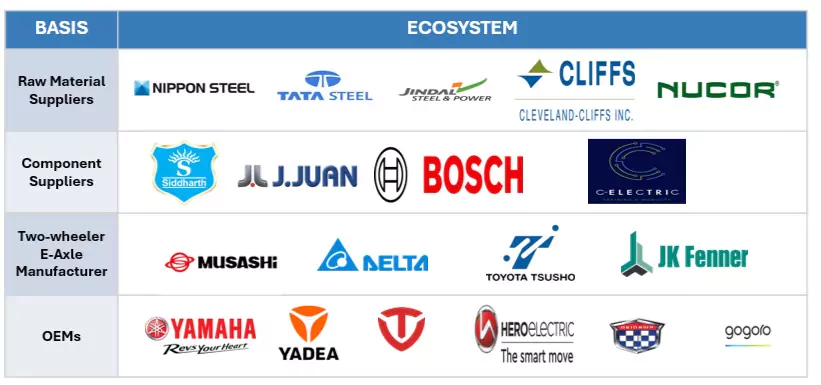
Global South-East Asia Two-wheeler e-Axle Market Ecosystem Analysis
The ecosystem analysis highlights various players represented by raw material suppliers, component Suppliers, Battery Pack Manufacturers, charging Infrastructure Providers, and OEMs. Few major two-wheeler e-axle manufacturers include Musashi Seimitsu Industry Co., Ltd. (Japan), Delta Electronics (Taiwan), Toyota Tsusho Corporation (Japan), Rotontek (China), and JK Fenner (India).
India is projected to demonstrate the highest growth in the South-East Asia Two-wheeler market during the forecast period.”
The growth of India’s two-wheeler e-axle market is being driven by the increasing demand for compact, efficient, and high-performance drivetrain solutions that support vehicle optimization and extended range. As OEMs focus on enhancing system integration and reducing mechanical complexity, e-axles combining the motor, transmission, and controller into a single unit are emerging as a strategic choice for electric two-wheelers. For instance, Musashi began mass production of integrated e-axles in June 2024 at its Bengaluru facility, with an annual target of 120,000 units in Phase I. Similarly, OEMs like BNC Motors are integrating compact e-axle systems into their mid-speed electric scooters to improve performance and reduce total cost of ownership. The rising cost of conventional fuels, along with growing consumer preference for low-maintenance, cost-effective electric mobility solutions, is further accelerating adoption. To meet this evolving demand, suppliers such as Musashi Delta e-Axle India are ramping up localized production capacities, aligning with OEM requirements for scale, quality, and delivery efficiency. Concurrently, policy-driven incentives under India’s Production Linked Incentive (PLI) scheme are fostering capital investment in localized component manufacturing, thereby enhancing supply chain resilience and improving cost structures.
Recent Developments of South-East Asia Two-wheeler e-Axle Market
In June 2025, JK Fenner entered a strategic technology partnership with Korea’s NMC Motors to develop and manufacture e-axles, initially targeting electric three-wheelers and small commercial vehicles, with plans for future expansion into two-wheelers and four-wheelers.
In April 2024, Gogoro (Taiwan) subsidiary Gogoro Philippines introduced Gogoro Pulse, the latest high-performance electric smart scooter from Gogoro, at the Makina Moto Show, Philippines. VinFast will launch six electric motorcycle models in the Philippines in June 2024.
In March 2024, BlueShark (Malaysia), an electric vehicle (EV) tech company, introduced 10 new BlueStation battery swapping points in the country and aims to have 50 BlueStation battery swapping points by the end of 2024.
In February 2024, Ola Electric launched a new scooter, the Ola S1X (4 kWh), in India. The scooter, equipped with a 6 kW motor, offers a driving range of 190 km on a single charge. Additionally, in December 2023, Ola Electric commenced the deliveries of its new S1 X+ electric scooter in the Indian market. The S1 X+ is equipped with a 3 kWh battery, offering a range of 151 km.
Key Market Players
List of Top South-East Asia Two-wheeler e-Axle Market Companies
The South-East Asia Two-wheeler e-Axle Market is dominated by a few major players that have a wide regional presence. The major players in the South-East Asia Two-wheeler e-Axle Market are
Musashi Seimitsu Industry Co., Ltd. (Japan)
Toyota Tsusho Corporation (Japan)
JK Fenner (India)
Key Questions Addressed by the Report
Who are the key players in the South-East Asia Two-wheeler market?
The South-East Asia two-wheeler e-axle market is dominated by Musashi Seimitsu Industry Co., Ltd. (Japan), Toyota Tsusho Corporation (Japan), Rotontek (China), and JK Fenner (India) among others.
What are the offerings of two-wheeler e-axle manufacturers play in the two-wheeler e-axle market?
These companies contribute through specialized offerings such as gear-integrated e-axles, power electronics, supply chain integration, compact motor solutions, and localized e-transmissions for Indian EVs.
Which country will lead the market for two-wheeler e-axles in the coming years?
India will play a leading role, driven by FAME incentives, urban mobility demand, and OEM-local supplier collaborations. China will continue leveraging its scale and EV industrial policy.
What are the key challenges in the two-wheeler e-axle market?
Challenges include thermal load management, cost competitiveness in price-sensitive regions, lack of platform standardization, and rare-earth material dependencies.
What are the key trends impacting the growth of the South-East Asia Two-wheeler e-Axle market?
Key trends include motor-controller integration, modular e-axle platforms, localized value chain development, and lightweighting to improve energy efficiency.
Key Questions Addressed by the Report
What is the current market size of the South-East Asia Two-wheeler e-Axle Market, and how is it expected to grow?
The South-East Asia Two-wheeler e-Axle Market is projected to grow from USD 227 million in 2025 to USD 584 million by 2032, at a CAGR of 14.45% during the forecast period.
What are the key factors driving the growth of the South-East Asia Two-wheeler e-Axle Market?
The market is driven by rising adoption of electric two-wheelers, increasing demand for compact and integrated e-axle systems, government support for EV manufacturing, and the need for cost-efficient powertrain solutions.
Which country is expected to lead the South-East Asia Two-wheeler e-Axle Market during the forecast period?
India is expected to lead the South-East Asia Two-wheeler e-Axle Market due to strong EV adoption, localized manufacturing, supportive government initiatives, and increasing investments in e-axle production.
What are the latest trends shaping the South-East Asia Two-wheeler e-Axle Market?
Key trends include integrated motor-controller e-axle systems, localized manufacturing, lightweight modular e-axles, and increasing adoption of intelligent powertrain technologies for electric two-wheelers.
Who are the leading companies in the South-East Asia Two-wheeler e-Axle Market, and what strategies are they adopting?
Leading companies are focusing on localized production, product innovation, strategic partnerships, and integrated e-axle technologies to improve efficiency, reduce costs, and expand their regional presence.
Personalize This Research
Triangulate with your Own Data
Get Data as per your Format and Definition
Gain a Deeper Dive on a Specific Application, Geography, Customer or Competitor
Global Provider of Industrial Actuation & Control Solutionswww.weasler.com
Our organization was
interested in learning more about the attractiveness of a particular market space. We contacted
MarketsandMarkets to help us based on previous positive experiences we had with them. The
results did not disappoint! We discussed our objectives with them, and the team at
MarketsandMarkets developed and executed a proposal that met our needs precisely. We were very
impressed by their level of expertise, the quality of the analysis and their insightful
recommendations. We would not hesitate in working with them again in the future.
Matt Kardel,
Vice President
Aptiv,
A global technology company that develops safer, greener and more connected
solutions.www.aptiv.com
We contracted with
MarketsandMarkets to evaluate the value chain and potential go-to-market partners related to our
interest in the Fleet Management space. The team successfully completed the work on time and at the
pricing agreed. MarketsandMarkets listened and understood our objectives and collaborated well with
us to help us get the visibility we needed to make an investment.
We have subsequently used
MarketsandMarkets again related to Smart Cities to good results.















Growth opportunities and latent adjacency in South-East Asia Two-wheeler e-Axle Market