7500+ companies worldwide approach us every year for their revenue growth initiatives
2
80% of Fortune 2000 companies rely on our research to identify new revenue sources
3
Top 2000 strategists around the world rely on us for their growth roadmap/initiatives
Wine Testing Market by Type (Chemical, Microbial, Sensory Analysis, Contaminant), Technology (Manual/Wet Chemistry, Spectroscopy, Chromatography, Rapid Detection Kits, AI & Machine Learning), End-User, and Region - Global Forecast to 2030
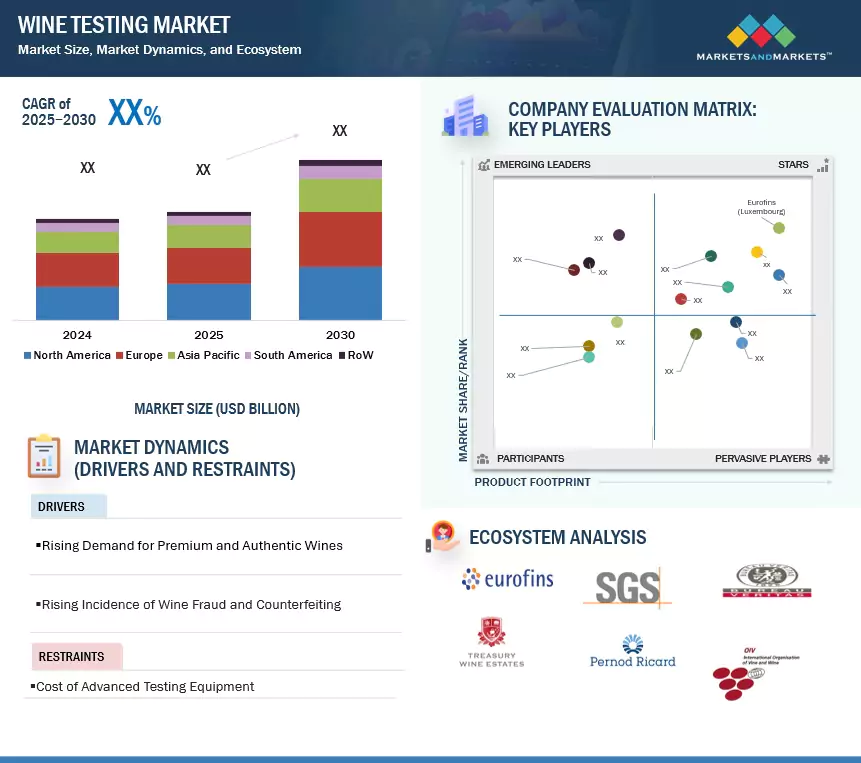
The wine testing market is projected to expand from USD XX million in 2025 to USD XX million by 2030, at a CAGR of XX% during the forecast period. Automation in testing instruments and software integration for real-time analysis will streamline operations, improve efficiency, and reduce manual errors. This is one of the most sought out trends in the wine testing market in the form of advanced analytical methods like gas chromatography, high-performance liquid chromatography (HPLC), mass spectrometry, and near-infrared spectroscopy (NIR). They are increasingly integrated into the quality control systems of wineries for the detection of contaminants, verification of varietal authenticity, and monitoring the aging progression. Wineries are moving towards in-house testing capabilities that utilize small, easy-to-use devices to quickly produce the results that small and medium producers need to have extensive control over quality parameters.
Attractive Opportunities in the Wine Testing Market
ASIA PACIFIC
The wine testing market in APAC is witnessing growth driven by increasing wine consumption, rising domestic production, and greater scrutiny of imports. The consumption of wine is steadily increasing in many APAC countries, particularly China, Japan, South Korea, and India, due to urbanization, rising disposable incomes, and westernization of lifestyle habits.
Mobile/portable tools are slowly gaining interest among boutique wineries for fermentation monitoring and sulfite management.
Collaborations and the introduction of new products are expected to present profitable prospects for industry participants in the coming five years.
Australia and Japan show high adoption of advanced analytical instruments, while China is catching up rapidly with increased investment in lab infrastructure.
Australia and New Zealand continue to be regional leaders, with well-established wine industries and a strong focus on international trade. Wineries in these countries rely on robust testing systems for export certification, ensuring wines comply with standards in the U.S., EU, and Asia.
Global Wine Testing Market Dynamics
DRIVERS: Stringent Regulatory Requirements
Governments and global trade authorities continue to strengthen controls on wine exports, subjecting them to strict testing and certification. The European Union, for instance, imposes strict limits on pesticide residues, heavy metals, and additives, forcing exporters to test their wines prior to export. In the US, the TTB (Alcohol and Tobacco Tax and Trade Bureau) enforces rigorous compliance verification of wine labels and content, making investment in in-house or outsource testing facilities worthwhile. The trend towards organic and biodynamic certification even broadens the range of tests required since these wines have to meet extremely precise levels of impurities and preservatives, unlike regular wines.
RESTRAINTS: Lack of global standardization in testing protocols and reporting
The absence of global standards for testing protocols and the resultant complication in international trade and regulatory compliance hinders market growth. Even if organizations like the OIV disseminate exhaustive methods for wine testing, many countries still have their own protocols. The sulfite methods, for instance, can differ in the EU from those in the U.S. or Japan, requiring exporters to have duplicate tests and usable labels for different markets. Hence, that fragmentation dissuades producers from marketing their products for new territories, and it confuses what is globally recognized regarding testing services or methods. For testing companies, this leads to an increased burden for setting up tailor-made testing packages and often prolongs the time for regulatory approval for such new solutions.
OPPORTUNITIES: Digital transformation of quality control
The wine testing industry is well poised for solid long-term expansion, with plenty of emerging opportunity linked to global consumer trends, technological advance, and sustainability practices. One key opportunity exists in the digitalization of quality control through the use of smart technology and data analytics. Most wineries continue to use manual or semi-automatic quality control systems, and this is a significant white space opportunity for firms providing cloud-based LIMS, AI-based test interpretation, and remote monitoring solutions. Vendors such as LabWare, and Agilent have already established a foothold in this direction, but there is still large untapped opportunity, especially among medium-sized wineries in Latin America, South Africa, and Eastern Europe. These testers are increasingly looking for modular, scalable, and cost-effective platforms that automate testing with traceability and compliance in place — ushering in new opportunities for SaaS-based testing platforms.
CHALLENGES: High cost of advanced testing equipment and services
The price of advanced testing instruments and services represents a barrier in the wine testing market, particularly for small and medium-sized wineries. Advanced technologies, namely high-performance liquid chromatography (HPLC), mass spectrometers, and real time polymerase chain reaction (PCR) systems, require significant upfront capital investment, that can often be restraining factor for smaller companies. Furthermore, using an accredited laboratory, such as Eurofins or ETS Labs, also incurs a cost per sample, which can add up quickly during harvest when numerous samples for testing are obtained. The labs will provide accurate results for specifications, e.g., all residual sugar or microbial stability, but their turnaround time could risk a timely decision for quality or yield in the winemaking process. The high cost of advanced equipment and services remains a barrier, potentially limiting smaller wineries’ ability to compete with larger operations that can be afforded in-house labs or frequent external testing, ultimately affecting their quality control and market competitiveness.
Global Wine Testing Market Ecosystem Analysis
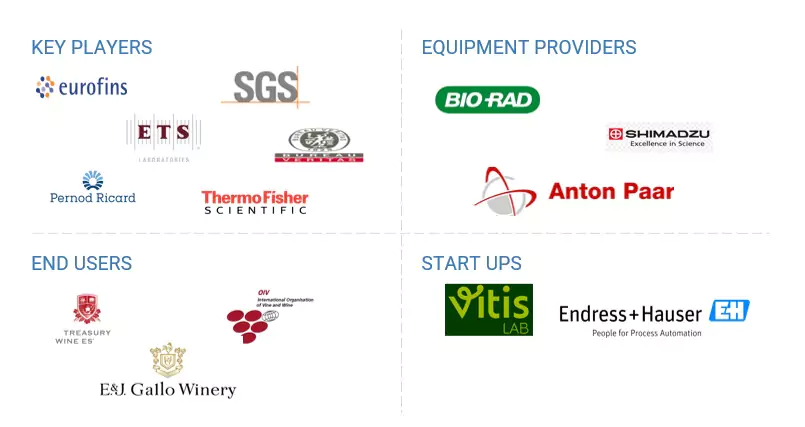
Some of the prominent companies in this market include well-established and financially sound manufacturers of wine testing. These companies have been operational in the market for more than a decade and have diversified portfolios, the latest technologies, and excellent global sales and marketing networks. Some of the prominent companies in this market include ETS Laboratories (US), Enartis USA (US), Brewing and Distilling Analytical Services - BDAS (US), WineChek (US), bioMérieux (France), Agilent (US), Hanna Instruments (US), LabLynx (US), SGS (Switzerland), Eurofins (Luxembourg).
Note: The above diagram only shows the representation of the Wine Testing Market ecosystem; it is not limited to the companies represented above.
Source: Secondary Research and MarketsandMarkets Analysis
Based on technology, the traditional testing segment is estimated to grow at a significant CAGR during the studied period.
The traditional testing methods like titration, distillation, and sensory panels have been the cornerstone of wine analysis for long, especially for small and hand-crafted wineries. All these traditional methodologies quantify important chemical parameters such as pH, titratable acidity (TA), sulfur dioxide (SO2), and alcohol content, along with sensory qualities such as taste and odor. In 2025, traditional testing continues to have a place in the wine testing industry, especially for boutique winemakers and areas with limited infrastructure access, like parts of Latin America or new wine emerging markets like India. Titration, for example, is used extensively to measure acidity levels so that wines remain within the balance needed for consumer acceptance. Sensory panels, made up of trained tasters, gauge flavor profiles and aromas and colors, which is important in the case of artisanal wines where characteristics are an opportunity to sell. Such operations as smaller regional laboratories or winery in-plant staff utilize these techniques because of minimal start-up costs as opposed to high-technology instrumentation such as HPLC systems, which may cost more than $50,000. For instance, a small winery in Argentina's Mendoza region would use titration to track TA during fermentation without necessitating expensive equipment. Traditional methods' lack of complications makes them highly accessible, with little technological infrastructure needed and the tests being performed by winemakers using rudimentary training.
The third-party testing end-user segment in the wine testing market is projected to have a significant share.
Third-party testing labs represent a rapidly expanding end-user category in the wine testing market during 2025, fueled by the growing practice of outsourcing by small and medium-sized wineries with no on-site testing facilities. Eurofins, SGS, ETS Laboratories, and Vinlab are among labs that offer full-service capabilities, ranging from chemical analysis for alcohol and acidity to microbial testing for spoilage organisms, contaminant testing for pesticides, and sensory analysis for flavor profiling. The expansion of the global wine industry drives demand, as wineries look for ISO 17025-certified labs to facilitate compliance with strict export regulations, especially for regions such as the EU, U.S., and China. For example, Eurofins employs gas chromatography-mass spectrometry (GC-MS) to identify pesticide residues, assisting in organic wine certifications, while ETS Laboratories provides HPLC for accurate organic acid testing, which is essential for high-end wines. Organic and natural wine, worth USD 12.4 billion with a CAGR of more than 10%, fuels the market for microbial analysis, with players such as AEMTEK delivering quick PCR-based tools to identify Brettanomyces in low-intervention wines.
The Europe region is anticipated to experience rapid growth between 2025 and 2030.
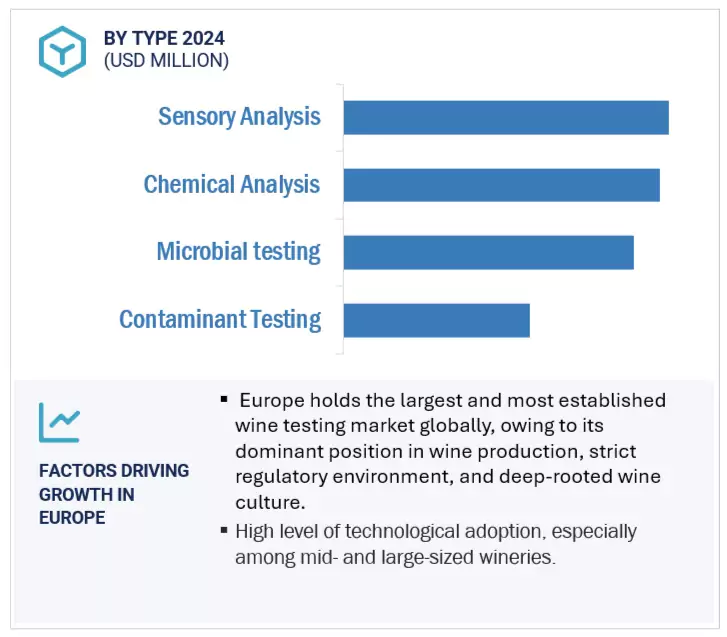
Europe is the world's largest and most developed wine testing market, supported by a rich tradition of winemaking, high-level regulation, and strong quality, origin, and authenticity focus. With France, Italy, Spain, and Germany driving world wine production and export levels, the continent has established a highly integrated infrastructure around wine testing—that ranges from rudimentary fermentation control to sophisticated authenticity and traceability methods.
Regulatory compliance is the foundation of Europe's wine testing requirement. The European Union has some of the most rigorous wine testing and labeling laws in the world, regulated through institutions such as the European Food Safety Authority (EFSA) and aligned to global standards imposed by the International Organization of Vine and Wine (OIV). These regulations embrace a wide variety of quality and safety factors, such as alcohol level, acidity, residual sugar, volatile substances, sulfites, mycotoxins, pesticide residues, and heavy metals. Respect for Protected Designation of Origin (PDO), Protected Geographical Indication (PGI), and organic certification involves full-scale chemical and authenticity analysis—especially for historic wine-producing zones such as Bordeaux, Tuscany, and Rioja.
LARGEST MARKET SHARE IN 2024
GERMANY: FASTEST GROWING MARKET IN THE REGION
Recent Developments of Wine Testing Market
In April 2025, Treasury Wine Estates acquired 75% of Stone & Moon Winery in Ningxia, China. This enables them to integrate regional testing and analysis into Penfolds’ global quality control and winemaking trials.
In January 2025, Benchmark Wine Group (rare/back-vintage wine specialist) acquired Wine Spectrum, enhancing combined tech capabilities. The merger includes a unified platform—likely to integrate data analytics and testing info for provenance verification.
In January 2025, AI-powered wine discovery platform Preferabli acquired Libation Labs, creator of the Cuvée loyalty app for Napa wineries. This adds DTC analytics, loyalty, and experience management tools to wine labs’ consumer insight offerings.
In December 2024, Full Glass Wine Co. acquired Wine Access and Cameron Hughes Wine—both facilitating direct-to-consumer access and analysis via data-driven selections. This reinforces their role in supporting winery quality feedback loops and tasting analytics.
Key Market Players
List of Top Wine Testing Market Companies
The Wine Testing Market is dominated by a few major players that have a wide regional presence. The major players in the Wine Testing Market are
By Type, By Technology, By End-User, and By Region
Regions covered
North America, Europe, Asia Pacific, South America, and Rest of the World (RoW)
Key Questions Addressed by the Report
What is the current size of the wine testing market?
The wine testing market is estimated to be USD XX million in 2025 and is projected to reach USD XX million by 2030, registering a CAGR of XX% during the forecast period.
Which are the key players in the market, and how intense is the competition?
ETS Laboratories (US), Enartis USA (US), Brewing and Distilling Analytical Services - BDAS (US), WineChek (US), bioMérieux (France), Agilent (US), Hanna Instruments (US), LabLynx (US), SGS (Switzerland), Eurofins (Luxembourg) are some of the key market players.
Which region is projected to account for the largest share of the wine testing market?
Europe boasts a strong ecosystem of testing laboratories, equipment manufacturers, and research institutions. Companies like Eurofins Scientific (France), SGS (Switzerland), and Intertek provide accredited third-party testing services widely used by small producers and exporters.
What kind of information is provided in the company profiles section?
The company profiles provided deliver crucial details, including a thorough business summary that covers different segments, financial results, geographic presence, revenue distribution, and business revenue breakdown. They also offer insights into product lines, key achievements, and expert analyst opinions to better illustrate the company's potential.
What are the factors driving the wine testing market?
Rising demand for premium and authentic wines, stringent regulatory requirements, technological advancements in analytical instruments.
Personalize This Research
Triangulate with your Own Data
Get Data as per your Format and Definition
Gain a Deeper Dive on a Specific Application, Geography, Customer or Competitor
Growth opportunities and latent adjacency in Wine Testing Market