

Automated Guided Vehicle (AGV) Market Outlook: Europe, Asia Pacific & North America
Introduction to the Automated Guided Vehicle (AGV) Market
The Automated Guided Vehicle (AGV) market is gaining momentum as manufacturers, warehouse operators, logistics providers, and distribution centers increasingly adopt automation to improve operational efficiency, reduce material-handling costs, and enhance workplace safety. AGVs are driverless industrial vehicles designed to transport raw materials, components, work-in-progress inventory, and finished products along predefined or dynamically managed routes. They use technologies such as laser navigation, magnetic guidance, optical sensors, onboard controllers, and wireless communication systems to move materials with limited human intervention.
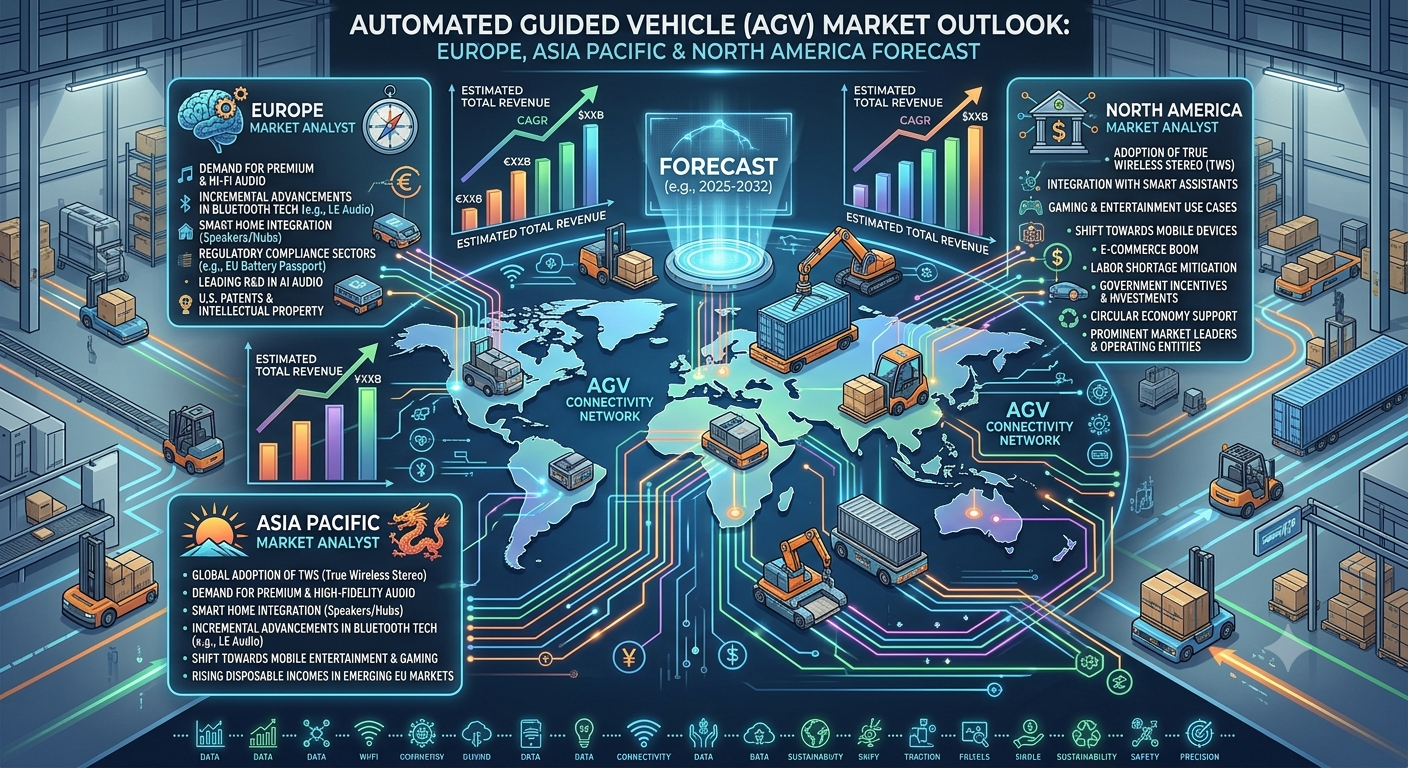
The growing complexity of supply chains, rising labor costs, expanding e-commerce operations, and demand for faster order fulfillment are encouraging organizations to invest in automated material-handling systems. AGVs are increasingly deployed in automotive manufacturing, electronics production, food and beverage processing, pharmaceuticals, retail distribution, and heavy industrial facilities. Their ability to operate consistently, support repetitive transportation tasks, and integrate with warehouse management systems makes them an important component of modern industrial automation.
Download PDF Brochure:
https://www.marketsandmarkets.com/pdfdownloadNew.asp?id=27462395
The market outlook is also being influenced by advances in artificial intelligence (AI), the Internet of Things (IoT), machine vision, battery technology, and fleet management software. These developments are improving vehicle navigation, obstacle detection, charging efficiency, and coordination between multiple vehicles. While Europe, Asia Pacific, and North America are all investing in AGV technology, their adoption patterns differ according to manufacturing structures, labor-market conditions, industrial investment priorities, and the maturity of logistics infrastructure.
Forecast note: This article provides a qualitative regional outlook rather than verified market-size estimates or numerical regional forecasts. Actual market values and growth rates should be supported by a consistent market research dataset.
Global Automated Guided Vehicle Market Outlook
The global AGV market is expected to benefit from the transition toward smart factories, connected warehouses, and digitally managed supply chains. Companies are increasingly evaluating automation not only as a way to reduce labor requirements but also as a strategy to improve inventory visibility, production continuity, throughput, and operational resilience. AGVs can support these objectives by moving materials between production lines, storage areas, loading stations, and packaging operations according to programmed workflows.
A major driver is the growing need to connect material handling with enterprise software. Modern AGV installations can exchange information with warehouse management systems (WMS), manufacturing execution systems (MES), enterprise resource planning (ERP) platforms, and industrial Internet of Things (IIoT) networks. This connectivity allows operators to assign transport tasks, monitor vehicle utilization, identify bottlenecks, and adjust material flows according to changing production requirements.
Another important development is the evolution of navigation and control technologies. Traditional AGVs generally follow fixed or predefined routes, while newer systems can incorporate more flexible navigation methods and sensor-based obstacle avoidance. Depending on the product architecture, some solutions overlap with autonomous mobile robots (AMRs), which typically offer greater route flexibility. Buyers should distinguish between these categories when comparing market forecasts, as research providers may classify them differently.
Battery innovation is also influencing adoption. Lithium-ion batteries, opportunity charging, automated charging stations, and intelligent energy management can reduce downtime and support longer operating schedules. As businesses seek to automate increasingly complex environments, suppliers are focusing on scalable vehicle fleets, integration services, safety systems, and analytics software rather than offering vehicles alone.
Europe Automated Guided Vehicle Market Forecast
Europe is expected to remain an important market for AGVs, supported by its established industrial base, advanced manufacturing capabilities, and increasing emphasis on operational efficiency. Germany, France, Italy, the United Kingdom, and the Netherlands are significant markets for industrial automation, with demand emerging from automotive manufacturing, pharmaceuticals, food processing, electronics, and logistics. European businesses are investing in automation to address workforce constraints, improve production consistency, and modernize intralogistics operations.
According to MarketsandMarkets, the Europe AGV market was valued at approximately USD 1.07 billion in 2025 and is projected to reach USD 1.37 billion by 2030, growing at a CAGR of 7.9%.
The automotive industry is a major contributor to European AGV demand. Vehicle manufacturers and component suppliers use AGVs to move parts, assemblies, and materials between workstations while maintaining consistent production flows. As manufacturers transition toward electric vehicles, battery production, and increasingly digitalized assembly operations, automated transport systems can help improve internal logistics and material traceability.
The pharmaceutical and food processing industries also offer opportunities. These sectors often require controlled material movement, reliable handling procedures, and consistent operating conditions. AGVs can support repetitive transportation tasks while reducing unnecessary manual movement within production and storage facilities.
Industry 4.0 adoption is another important driver. European manufacturers are integrating robotics, connected sensors, industrial software, and real-time monitoring into their production facilities. AGVs connected to manufacturing execution systems and warehouse management platforms can help synchronize inventory movement with production schedules.
Challenges and Opportunities
High initial investment, complex system integration, and the need to modernize existing facilities may slow adoption, particularly among small and medium-sized enterprises. Businesses must also assess vehicle safety, cybersecurity, employee training, and maintenance requirements before deploying large fleets.
Nevertheless, opportunities are emerging in flexible manufacturing, automated warehouses, and AI-enabled fleet management. By 2030, demand is likely to favor AGV solutions that integrate efficiently with existing industrial infrastructure and deliver measurable improvements in throughput, safety, and operating costs.
Asia Pacific Automated Guided Vehicle Market Forecast
Asia Pacific is positioned as a major growth engine for the AGV market because of its extensive manufacturing ecosystem, expanding e-commerce sector, and continued investment in industrial automation. China, Japan, South Korea, India, and Southeast Asian economies are creating opportunities for AGV suppliers across automotive, electronics, semiconductor, consumer goods, and logistics applications.
MarketsandMarkets estimates that the Asia Pacific AGV market was valued at approximately USD 1.27 billion in 2025 and is forecast to reach USD 1.72 billion by 2030, representing a CAGR of 9.9%.
China remains a major center for industrial manufacturing and warehouse automation. Manufacturers are deploying AGVs to transport materials across production lines, storage facilities, and distribution centers. Large-scale industrial operations create demand for vehicle fleets that can coordinate repetitive transport tasks, support continuous production, and reduce material-handling bottlenecks.
Japan and South Korea offer strong opportunities in electronics, automotive manufacturing, and semiconductor production. These industries require reliable movement of components and materials between specialized workstations. AGVs can support repeatable transport processes and help manufacturers maintain consistent operating conditions.
India is also an emerging opportunity as manufacturers expand production capacity and businesses modernize supply chains. Automotive facilities, electronics manufacturers, third-party logistics providers, and large warehouses are potential users of automated material-handling systems. Adoption will depend on implementation costs, facility readiness, integration capabilities, and the availability of technical support.
Southeast Asian economies, including Vietnam, Thailand, Malaysia, and Singapore, offer additional growth opportunities as manufacturing and logistics networks expand. Investments in electronics production, regional distribution centers, and export-oriented manufacturing can increase demand for automated transport systems.
Technology Innovation and Regional Opportunities
The Asia Pacific market is likely to benefit from improvements in navigation, battery performance, fleet coordination, and software integration. Laser-guided vehicles remain relevant for structured industrial environments, while vision-based navigation and sensor-enabled systems can offer greater flexibility where operating conditions change.
AI can help fleet management platforms prioritize transport tasks, identify congestion, and optimize routes. IoT sensors can monitor battery health, vehicle utilization, and component performance, helping operators plan maintenance before failures disrupt production.
Despite these opportunities, adoption may be constrained by capital expenditure, uneven automation readiness, and a shortage of personnel with robotics integration and maintenance skills. Suppliers that offer scalable deployments, localized technical support, and flexible financing models may be better positioned to serve manufacturers across the region.
North America Automated Guided Vehicle Market Forecast
North America represents a significant market for AGVs, driven by warehouse modernization, advanced manufacturing, e-commerce fulfillment, and investment in supply chain resilience. The United States is a major demand center, while Canada and Mexico contribute through manufacturing, industrial distribution, automotive production, and cross-border logistics.
MarketsandMarkets estimates that the North America AGV market was valued at approximately USD 977 million in 2025 and is projected to reach USD 1.28 billion by 2030, growing at a CAGR of 8.8%.
Key Growth Drivers in North America
E-commerce and distribution operations are important areas of adoption. Warehouses must process changing order volumes while maintaining inventory accuracy and fast fulfillment times. AGVs can transport pallets, containers, and goods between receiving, storage, picking, packing, and dispatch areas. These systems can help reduce repetitive manual transport and improve the coordination of warehouse activities.
Manufacturing is another key application area. Automotive, electronics, semiconductor, aerospace, and industrial equipment companies require reliable internal logistics to support production schedules. AGVs can deliver materials to designated workstations, move components between production stages, and transport finished products to storage areas.
Labor availability and operating costs are also influencing automation investment. Businesses are increasingly evaluating AGVs for repetitive, physically demanding, or time-sensitive material-handling tasks. Rather than replacing every manual process, deployments often focus on specific workflows where automation can improve safety, consistency, and productivity.
Role of AI, IoT, and Smart Warehousing
North American companies are increasingly integrating AGVs with warehouse management systems, enterprise resource planning platforms, and industrial analytics tools. AI-supported fleet management can help coordinate multiple vehicles, manage task priorities, and identify inefficient routes. IoT connectivity enables remote monitoring of operating status, battery performance, and maintenance requirements.
The region also offers opportunities for providers that can deliver end-to-end solutions, including vehicles, navigation software, charging infrastructure, safety systems, and integration services. However, high implementation costs, legacy infrastructure, cybersecurity concerns, and the need to train employees remain important considerations.
Through 2030, demand is expected to be influenced by the expansion of automated distribution centers, smart manufacturing projects, and efforts to improve supply chain flexibility. Vendors that demonstrate reliable integration and a clear return on investment are likely to be attractive to industrial buyers.
Key Trends Shaping the AGV Market Through 2030
Several cross-regional developments are expected to influence AGV adoption in Europe, Asia Pacific, and North America.
AI-powered fleet management: AI can support task allocation, traffic coordination, and route optimization across multiple vehicles. These capabilities can improve fleet utilization and reduce unnecessary travel, especially in large warehouses and complex manufacturing facilities.
IoT-enabled predictive maintenance: Connected sensors provide information about battery condition, component wear, vehicle performance, and operating patterns. Analytics platforms can use these insights to identify maintenance needs and help reduce unexpected downtime.
Battery and charging innovation: Lithium-ion batteries, opportunity charging, and automated charging stations can improve vehicle availability. Energy-management systems can schedule charging around operational demand and help facilities maintain continuous material flow.
Flexible navigation and system integration: Laser guidance, magnetic guidance, vision systems, and other navigation technologies serve different operational requirements. AGVs that connect with warehouse and manufacturing software can coordinate material movement with inventory and production needs.
Safety and workforce development: AGV deployments require risk assessment, suitable traffic management, clear operating procedures, and employee training. As facilities introduce automated transport, workers increasingly need skills in fleet supervision, troubleshooting, maintenance, and automation software.
Challenges and Opportunities for AGV Market Participants
Despite the positive outlook, AGV adoption is not equally suitable for every facility. High upfront costs can make projects difficult to justify when transport volumes are low or workflows change frequently. Integration with legacy equipment and enterprise software may require substantial planning, while facility layouts may need modifications to support safe vehicle movement.
Organizations should assess total cost of ownership rather than vehicle purchase price alone. Relevant factors include installation, software licensing, infrastructure changes, maintenance, battery replacement, employee training, and expected productivity gains. Pilot deployments can help companies validate performance and identify integration issues before expanding to larger fleets.
For technology providers, opportunities exist in modular systems, fleet management software, advanced navigation, service contracts, and solutions designed for specific industries. Vendors that can simplify deployment and demonstrate measurable operational benefits may gain an advantage as businesses expand automation programs.
Conclusion: AGV Market Outlook Across Europe, Asia Pacific, and North America
The Automated Guided Vehicle market is expected to continue expanding through 2030 as industrial and logistics organizations invest in more efficient material-handling operations. Europe benefits from advanced manufacturing and Industry 4.0 adoption, Asia Pacific from its large manufacturing base and expanding logistics infrastructure, and North America from warehouse modernization and technology-driven industrial investment.
Based on the cited MarketsandMarkets regional estimates, Asia Pacific is projected to grow fastest among these three regions between 2025 and 2030, with a 9.9% CAGR, compared with 8.8% for North America and 7.9% for Europe.
These figures reflect a specific forecast period and source; other market research providers may report different values because of variations in market definitions and methodology.
As AI, IoT, advanced navigation, and battery technologies continue to develop, AGVs are likely to become increasingly integrated into connected factories and smart warehouses. For businesses, the strongest opportunities will come from selecting systems that address clearly defined operational challenges, integrate with existing workflows, and deliver sustainable improvements in productivity, safety, and material flow.
Frequently Asked Questions About the Automated Guided Vehicle (AGV) Market
1. What is an Automated Guided Vehicle (AGV)?
An Automated Guided Vehicle (AGV) is a self-guided, driverless vehicle used to transport materials, products, and components within industrial facilities, warehouses, distribution centers, and manufacturing plants. AGVs follow predefined routes using technologies such as magnetic strips, lasers, sensors, and navigation systems to automate material handling and improve operational efficiency.
2. What is the outlook for the Automated Guided Vehicle (AGV) market?
The AGV market outlook remains positive as industries increasingly adopt warehouse automation, smart manufacturing, and Industry 4.0 technologies. Growing demand for efficient material transportation, reduced labor dependency, improved workplace safety, and optimized supply chains is expected to support market growth across manufacturing, logistics, automotive, and e-commerce industries.
3. Which factors are driving the growth of the AGV market in Europe?
Europe's AGV market is driven by advanced manufacturing capabilities, rising labor costs, investments in industrial automation, and the adoption of smart factories. Germany, France, Italy, and the United Kingdom are important markets due to their automotive, pharmaceutical, food processing, and logistics industries. The region's focus on productivity, safety, and sustainable industrial operations also supports AGV adoption.
4. What are the major trends shaping the AGV market in Asia Pacific?
The Asia Pacific AGV market is benefiting from rapid industrialization, expanding e-commerce operations, increasing warehouse automation, and investments in electronics and automotive manufacturing. China, Japan, South Korea, and India are important growth markets. The adoption of robotics, artificial intelligence (AI), smart logistics, and automated manufacturing systems is creating new opportunities for AGV suppliers.
5. What is driving the Automated Guided Vehicle market in North America?
North America's AGV market is supported by investments in warehouse modernization, distribution automation, manufacturing reshoring, and advanced logistics infrastructure. The United States is a major contributor, with demand from e-commerce, automotive, food and beverage, and pharmaceutical industries. Businesses are adopting AGVs to improve material flow, address labor shortages, and increase productivity.
6. Which industries are the primary users of Automated Guided Vehicles?
Major AGV end-user industries include automotive, manufacturing, warehousing and distribution, food and beverage, pharmaceuticals, healthcare, electronics, and retail. Automotive manufacturers use AGVs to move components along production lines, while warehouses use them for pallet transportation, order fulfillment, and inventory movement.
7. What technologies are used in Automated Guided Vehicles?
AGVs use technologies such as laser guidance, magnetic navigation, inductive guidance, QR-code navigation, sensors, obstacle detection, and fleet management software. Some systems also incorporate AI, machine vision, and advanced positioning technologies to improve route planning, traffic management, and operational reliability.
8. What is the difference between AGVs and Autonomous Mobile Robots (AMRs)?
AGVs generally follow predefined routes or structured navigation paths, whereas Autonomous Mobile Robots (AMRs) use onboard sensors, mapping, and navigation software to dynamically select routes and navigate around obstacles. Both automate material handling, but AMRs typically offer greater route flexibility, while traditional AGVs can be suitable for repetitive, predictable transportation tasks.
9. What challenges are limiting the adoption of AGVs?
Key challenges include high initial investment costs, integration with existing warehouse management and manufacturing systems, infrastructure modifications, maintenance requirements, and employee training. Operational considerations such as battery charging, fleet coordination, and safe interaction with workers can also affect implementation. Businesses can address these challenges through pilot projects, careful system selection, and phased automation strategies.
10. What are the future opportunities in the global AGV market through 2032?
Future opportunities are expected to emerge from the expansion of smart factories, automated warehouses, e-commerce fulfillment, and AI-enabled material handling. Demand for flexible automation, improved fleet management, energy-efficient batteries, and integration with enterprise software could create growth opportunities across Europe, Asia Pacific, and North America. The market's development through 2032 will depend on technology costs, industrial investment, and the pace of automation adoption.
80% of the Forbes Global 2000 B2B companies rely on MarketsandMarkets to identify growth opportunities in emerging technologies and use cases that will have a positive revenue impact.
- Food Packaging Market Size Set for Strong Growth Through 2030 Amid Rising Demand for Convenience Foods
- Crop Protection Chemical Market Size, Share & Growth Forecast (2025–2030)
- Mulch Films Market: Driving Sustainable Agriculture Through Innovation
- Agricultural Adjuvants Market Analysis, Trends, and Growth Outlook (2026–2031)
- Japan Enterprise Asset Management Market Growth: AI and Smart Infrastructure Drive Demand

