

Collaborative Robot Technology Innovation: Key Trends, Growth Drivers and Opportunities
Introduction to Collaborative Robot Technology
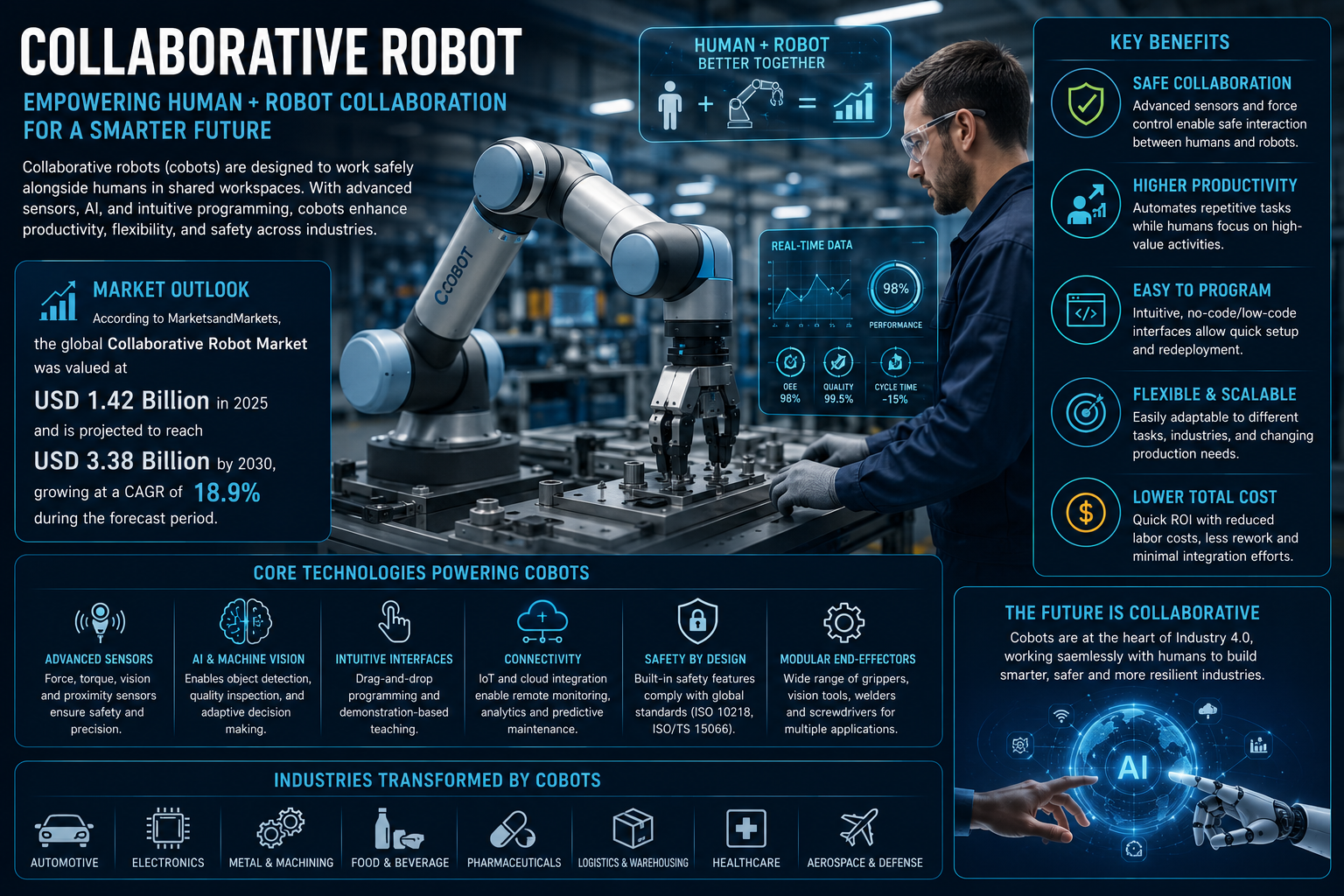
Collaborative robots, commonly known as cobots, are transforming industrial automation by enabling humans and robots to work safely together within shared workspaces. Unlike conventional industrial robots that typically operate in isolated environments, cobots are designed with advanced sensors, force-limiting technologies, artificial intelligence (AI), and machine vision to perform repetitive, precise, and labor-intensive tasks alongside human workers. Their flexibility, ease of programming, and cost-effectiveness make them an ideal automation solution for manufacturers of all sizes. As industries accelerate digital transformation and Industry 4.0 adoption, collaborative robots are becoming a key technology for improving productivity, quality, workplace safety, and operational efficiency across manufacturing, logistics, healthcare, electronics, and food processing industries.
History of Collaborative Robot Technology
The concept of collaborative robotics emerged in the late 1990s when researchers began exploring safer robotic systems capable of working directly with humans. Traditional industrial robots were designed for speed and precision but required protective barriers to ensure worker safety. Advances in force sensing, machine vision, AI algorithms, and lightweight robotic arms enabled the development of collaborative robots that could detect human presence and respond safely during operation. Over the past decade, increasing labor shortages, demand for flexible manufacturing, and rapid advancements in automation technologies have accelerated the global adoption of cobots across diverse industrial and commercial applications.
Benefits of Collaborative Robot Technology
Collaborative robots provide organizations with a flexible and scalable automation solution that improves operational efficiency while maintaining a safe working environment. Their ability to work alongside employees without extensive safety barriers enables businesses to automate repetitive tasks while allowing human workers to focus on higher-value activities. As a result, cobots are helping manufacturers improve productivity, reduce operational costs, and enhance product quality without requiring major infrastructure changes.
Key Benefits Include:
- Enables safe human-robot collaboration through advanced safety sensors and force-limiting technology.
- Improves productivity by automating repetitive, labor-intensive, and precision-based tasks.
- Reduces workplace injuries by assisting with hazardous and physically demanding operations.
- Offers easy programming and rapid deployment, minimizing implementation time.
- Provides flexibility for high-mix, low-volume manufacturing environments.
- Improves product consistency and quality through precise and repeatable operations.
- Lowers operational costs while maximizing manufacturing efficiency.
- Supports small and medium-sized enterprises (SMEs) by offering cost-effective automation solutions.
Current Market Size and Growth Trends of the Collaborative Robot Market
The Collaborative Robot market is experiencing strong growth as manufacturers increasingly invest in flexible automation to address labor shortages, improve operational efficiency, and support smart manufacturing initiatives. The growing adoption of Industry 4.0 technologies, artificial intelligence, Industrial Internet of Things (IIoT), and machine vision is significantly enhancing the capabilities of collaborative robots. Their ability to perform complex tasks safely alongside human workers is driving widespread adoption across automotive, electronics, healthcare, logistics, food & beverage, and consumer goods industries.
According to MarketsandMarkets, the global Collaborative Robot market was valued at USD 1.42 billion in 2025 and is projected to reach USD 3.38 billion by 2030, growing at a CAGR of 18.9% during the forecast period (2025–2030).
Download PDF Brochure: https://www.marketsandmarkets.com/pdfdownloadNew.asp?id=194541294
Key Market Growth Drivers
- Rising adoption of Industry 4.0 and smart factory initiatives.
- Growing labor shortages and increasing demand for flexible automation.
- Rapid advancements in AI, machine vision, force sensing, and edge computing.
- Increasing deployment of cobots in automotive, electronics, logistics, and healthcare industries.
- Rising demand for automation among small and medium-sized enterprises (SMEs).
- Growing focus on improving workplace safety, productivity, and manufacturing efficiency.
- Expansion of collaborative robotics in warehouse automation, packaging, assembly, inspection, and material handling applications.
Key Drivers and Factors Influencing the Future of Collaborative Robot Technology
The future of collaborative robot (cobot) technology is being shaped by the growing need for flexible automation, intelligent manufacturing, and human-centric production environments. As industries embrace Industry 4.0, manufacturers are increasingly deploying cobots to improve productivity, enhance workplace safety, and address skilled labor shortages. Continuous advancements in artificial intelligence (AI), machine learning, machine vision, Industrial Internet of Things (IIoT), edge computing, and digital twin technologies are enabling cobots to perform more complex tasks with greater accuracy, adaptability, and efficiency. These innovations are making collaborative robots an essential component of next-generation smart factories and connected industrial ecosystems.
Key Growth Drivers
- Increasing adoption of Industry 4.0, smart factories, and digital manufacturing initiatives.
- Growing labor shortages and rising labor costs across manufacturing industries.
- Rising demand for flexible automation capable of supporting high-mix, low-volume production.
- Rapid advancements in AI, machine vision, force sensing, and edge computing technologies.
- Increasing deployment of cobots in automotive, electronics, logistics, pharmaceuticals, and food & beverage industries.
- Growing focus on improving workplace safety through human-robot collaboration.
- Rising investments in Industrial IoT (IIoT), cloud robotics, and connected manufacturing systems.
Emerging Trends in Collaborative Robot Technology
Collaborative robot technology is evolving rapidly as manufacturers introduce smarter, more autonomous, and easier-to-deploy robotic solutions. AI-powered perception systems, advanced vision technologies, and cloud-based robotic platforms are enabling cobots to perform increasingly sophisticated tasks with minimal human intervention. At the same time, improvements in intuitive programming, mobile robotics, and predictive analytics are expanding collaborative robot adoption beyond traditional manufacturing into healthcare, logistics, agriculture, and service industries.
Key Emerging Trends
- Integration of Artificial Intelligence (AI) for adaptive learning and intelligent decision-making.
- Increasing adoption of machine vision and 3D imaging for precise object recognition and quality inspection.
- Growth of mobile collaborative robots (Mobile Cobots) for warehouse automation and material transport.
- Expansion of cloud robotics enabling centralized monitoring and remote robot management.
- Increasing use of Digital Twins for robot simulation, optimization, and predictive maintenance.
- Development of low-code and no-code programming platforms for faster cobot deployment.
- Growing integration of cobots with Autonomous Mobile Robots (AMRs) for end-to-end automation.
Opportunities and Challenges in the Collaborative Robot Market
The collaborative robot market presents substantial growth opportunities as organizations seek scalable automation solutions that combine human expertise with robotic precision. Cobots are increasingly being deployed across manufacturing, logistics, healthcare, agriculture, and electronics to improve efficiency and operational flexibility. However, challenges related to system integration, workforce training, cybersecurity, and return on investment continue to influence adoption, particularly among smaller enterprises.
Key Opportunities
- Growing adoption of cobots among small and medium-sized enterprises (SMEs).
- Expansion of warehouse automation, order fulfillment, and e-commerce logistics.
- Increasing deployment in healthcare for laboratory automation, rehabilitation, and pharmaceutical manufacturing.
- Rising applications in food processing, packaging, agriculture, and consumer goods production.
- Growing demand for AI-powered inspection, assembly, welding, palletizing, and pick-and-place operations.
- Expansion of collaborative robots in semiconductor manufacturing and electronics assembly.
Key Challenges
- High initial investment for advanced robotic systems and supporting infrastructure.
- Integration challenges with legacy manufacturing equipment and enterprise software.
- Need for employee training and workforce reskilling to operate collaborative robots effectively.
- Cybersecurity risks associated with connected robotic systems and cloud-based automation.
- Maintaining safety standards while increasing robot speed and payload capacity.
- Difficulty in automating highly customized or unstructured production processes.
Innovations and Advancements in Collaborative Robot Technology
Continuous innovation is making collaborative robots smarter, safer, and more versatile across industrial and commercial applications. AI-driven automation, enhanced sensor technologies, and advanced robotics software are enabling cobots to adapt dynamically to changing production environments while working safely alongside human operators. These advancements are improving manufacturing flexibility, reducing downtime, and accelerating the adoption of intelligent automation across diverse industries.
Recent Innovations
- AI-powered vision-guided robotics for adaptive assembly and quality inspection.
- Advanced force and torque sensors for safer human-robot collaboration.
- Integration of Digital Twin technology for virtual robot commissioning and performance optimization.
- AI-based predictive maintenance using real-time operational analytics.
- Collaborative robots equipped with edge AI processors for faster local decision-making.
- Cloud-connected robotic platforms supporting remote monitoring, diagnostics, and software updates.
- Modular cobot designs with interchangeable end-effectors for welding, packaging, inspection, dispensing, and material handling.
Future Applications and Industries That Will Benefit from Collaborative Robot Technology
Collaborative robot (cobot) technology is expected to become a cornerstone of intelligent manufacturing and next-generation industrial automation. As organizations continue investing in smart factories, digital transformation, and human-centric automation, cobots will evolve beyond repetitive task execution into intelligent systems capable of learning, adapting, and collaborating seamlessly with human workers. The convergence of artificial intelligence (AI), machine vision, Digital Twins, Industrial Internet of Things (IIoT), edge computing, and cloud robotics will significantly expand cobot capabilities across manufacturing, logistics, healthcare, agriculture, and service industries. Their flexibility, scalability, and ease of deployment will make collaborative robots an essential technology for improving productivity, operational resilience, and workforce efficiency.
Key Future Applications
- Smart Manufacturing: Enable intelligent assembly, machine tending, quality inspection, packaging, palletizing, and material handling while supporting flexible, high-mix production environments.
- Automotive Industry: Improve precision welding, component assembly, battery manufacturing, painting, and inspection processes for electric and autonomous vehicles.
- Electronics & Semiconductor Manufacturing: Perform delicate assembly, micro-component handling, testing, inspection, and packaging with exceptional accuracy and consistency.
- Warehouse & Logistics: Automate order picking, sorting, palletizing, inventory management, and goods transportation alongside Autonomous Mobile Robots (AMRs).
- Healthcare & Pharmaceuticals: Assist in laboratory automation, pharmaceutical manufacturing, medical device assembly, sample handling, rehabilitation support, and hospital logistics.
- Food & Beverage Processing: Enhance packaging, labeling, quality inspection, sorting, and hygienic food handling while maintaining regulatory compliance.
- Agriculture & Food Production: Support harvesting, planting, crop monitoring, packaging, greenhouse automation, and precision farming applications.
- Aerospace & Defense: Improve precision assembly, composite material handling, aircraft inspection, and maintenance operations while ensuring strict quality standards.
- Small & Medium-sized Enterprises (SMEs): Provide affordable automation solutions that improve productivity without requiring extensive manufacturing infrastructure.
- Service Robotics: Expand into retail, hospitality, laboratories, education, and customer service environments by assisting with repetitive operational tasks and enhancing customer experiences.
As collaborative robotics continues to mature, cobots will play an increasingly important role in enabling resilient, sustainable, and intelligent industrial ecosystems that combine human creativity with robotic precision.
Conclusion: The Promising Future of Collaborative Robot Technology
Collaborative robot technology is redefining industrial automation by enabling humans and robots to work together safely, efficiently, and productively within shared workspaces. Unlike traditional industrial robots, cobots offer greater flexibility, simplified programming, and rapid deployment, making automation accessible to organizations of all sizes. Their ability to automate repetitive tasks while allowing employees to focus on higher-value activities is transforming manufacturing, logistics, healthcare, electronics, and many other industries.
80% of the Forbes Global 2000 B2B companies rely on MarketsandMarkets to identify growth opportunities in emerging technologies and use cases that will have a positive revenue impact.
- Food Packaging Market Size Set for Strong Growth Through 2030 Amid Rising Demand for Convenience Foods
- Mulch Films Market: Driving Sustainable Agriculture Through Innovation
- Agricultural Adjuvants Market Analysis, Trends, and Growth Outlook (2026–2031)
- Crop Protection Chemical Market Size, Share & Growth Forecast (2025–2030)
- Japan Enterprise Asset Management Market Growth: AI and Smart Infrastructure Drive Demand

