

EMC Shielding and Test Equipment Technology Innovation: Key Trends, Growth Drivers and Opportunities
Introduction to EMC Shielding and Test Equipment Technology
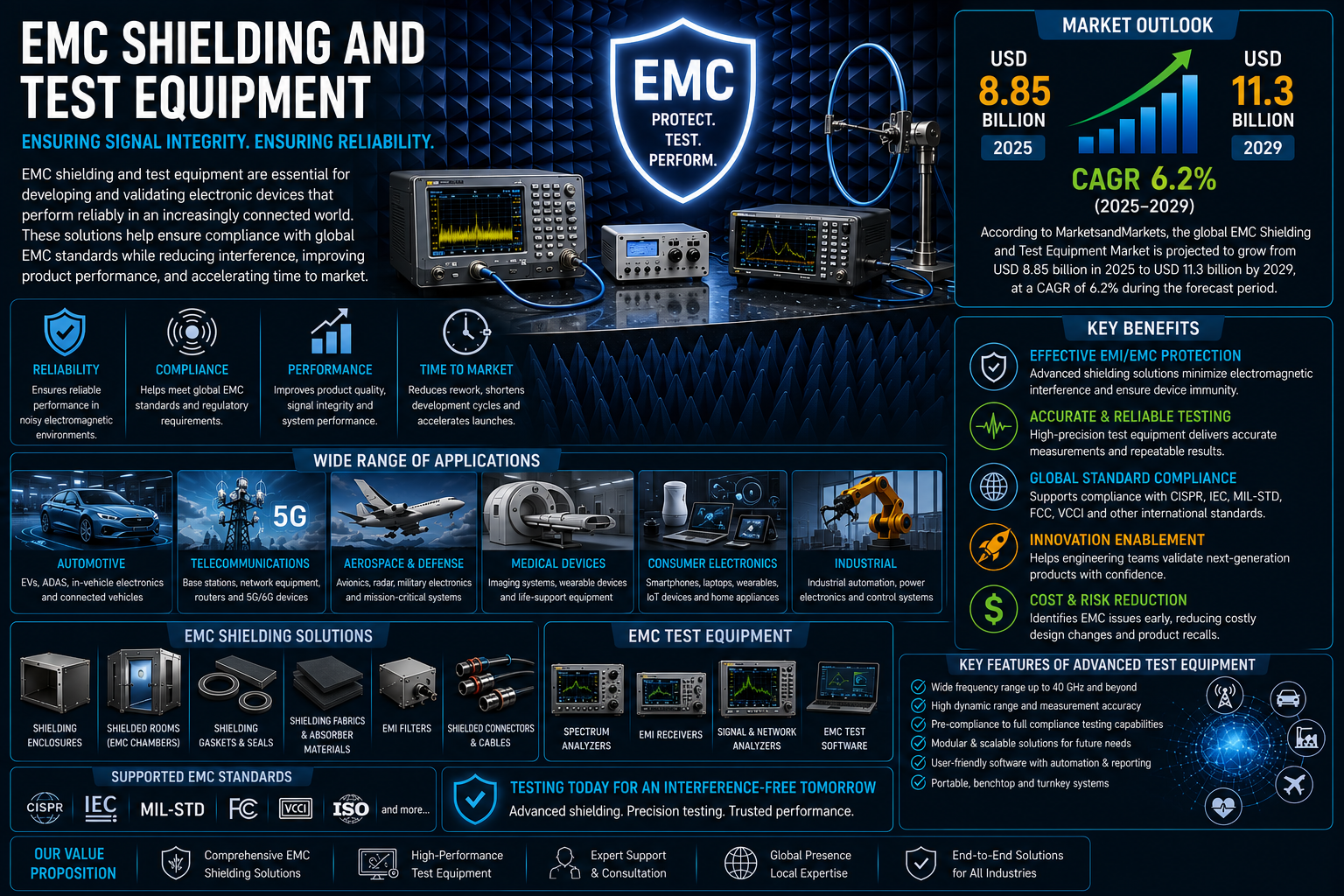
Electromagnetic Compatibility (EMC) shielding and test equipment technology plays a critical role in ensuring that electronic devices operate reliably without causing or experiencing electromagnetic interference (EMI). As modern electronic systems become increasingly compact, interconnected, and high-frequency, the need for advanced shielding materials and precise EMC testing solutions has grown significantly. EMC technologies help manufacturers comply with global regulatory standards while improving product safety, performance, and reliability. With the rapid expansion of electric vehicles (EVs), 5G communications, aerospace systems, industrial automation, medical electronics, and consumer devices, EMC shielding and testing have become indispensable components of product development and quality assurance.
History of EMC Shielding and Test Equipment Technology
The evolution of EMC shielding and testing technology began alongside the rapid growth of radio communications and electronic systems during the mid-20th century. As electronic equipment became more sophisticated, engineers recognized the need to minimize electromagnetic interference that could affect system performance and safety. Regulatory organizations subsequently introduced EMC compliance standards, driving the development of specialized shielding materials, anechoic chambers, spectrum analyzers, and advanced test instruments. Today, AI-assisted testing platforms, automated compliance systems, high-frequency measurement technologies, and simulation software have transformed EMC testing into a highly efficient and intelligent process across multiple industries.
Benefits of EMC Shielding and Test Equipment Technology
EMC shielding and test equipment technologies enable manufacturers to develop reliable electronic products that meet stringent international electromagnetic compatibility standards. By preventing unwanted electromagnetic emissions and improving immunity against external interference, these technologies enhance product performance, operational safety, and regulatory compliance. As electronic devices become more complex and connected, EMC solutions are essential for ensuring seamless operation in demanding industrial, automotive, aerospace, healthcare, and telecommunications environments.
Key Benefits Include:
- Minimizes electromagnetic interference (EMI) between electronic components and systems.
- Improves overall product reliability, operational stability, and signal integrity.
- Supports compliance with international EMC regulations and certification requirements.
- Enhances the performance of 5G communication equipment, IoT devices, and wireless electronics.
- Protects sensitive medical, aerospace, defense, and automotive electronic systems.
- Reduces costly product redesigns by identifying EMC issues during development.
- Improves product quality and accelerates time-to-market through automated EMC testing.
- Supports the development of high-speed electronic systems operating at increasingly higher frequencies.
Current Market Size and Growth Trends of the EMC Shielding and Test Equipment Market
The EMC Shielding and Test Equipment market is experiencing steady growth as industries increasingly prioritize electromagnetic compatibility, product safety, and regulatory compliance. The rapid deployment of electric vehicles, autonomous driving systems, 5G infrastructure, consumer electronics, industrial automation, and medical devices is driving demand for advanced shielding materials and sophisticated EMC testing solutions. In addition, the growing complexity of electronic designs and high-frequency communication technologies is encouraging manufacturers to invest in automated testing platforms, simulation software, and next-generation measurement equipment.
According to MarketsandMarkets, the global EMC Shielding and Test Equipment Market was valued at USD 8.4 billion in 2024 and is projected to grow from USD 8.85 billion in 2025 to USD 11.3 billion by 2029, registering a CAGR of 6.2% during the forecast period.
Key Market Growth Drivers
- Increasing deployment of electric vehicles (EVs) and advanced automotive electronics.
- Rapid expansion of 5G infrastructure, wireless communication, and IoT ecosystems.
- Growing demand for EMC compliance in medical devices, aerospace, and defense systems.
- Rising complexity of high-speed electronic circuits and semiconductor technologies.
- Increasing adoption of AI-enabled automated EMC testing and simulation platforms.
- Growing investments in industrial automation, robotics, and smart manufacturing.
- Strengthening global regulatory standards requiring rigorous EMC certification and product validation.
Key Drivers and Factors Influencing the Future of EMC Shielding and Test Equipment Technology
The future of EMC Shielding and Test Equipment technology is being shaped by the rapid advancement of high-speed electronics, connected devices, and wireless communication systems. As industries adopt electric vehicles (EVs), 5G networks, artificial intelligence (AI), Industrial Internet of Things (IIoT), and advanced semiconductor technologies, ensuring electromagnetic compatibility has become increasingly critical. Manufacturers are investing in intelligent shielding materials, automated testing systems, and AI-powered compliance solutions to reduce electromagnetic interference (EMI), improve product reliability, and meet evolving global regulatory requirements. These trends are driving continuous innovation in EMC technologies across automotive, aerospace, healthcare, telecommunications, and industrial automation sectors.
Key Growth Drivers
- Increasing deployment of electric vehicles (EVs), battery management systems, and vehicle electronics requiring advanced EMC protection.
- Rapid expansion of 5G, Wi-Fi 7, satellite communications, and IoT ecosystems, creating greater demand for high-frequency EMC testing.
- Growing complexity of high-speed semiconductor devices, printed circuit boards (PCBs), and electronic control units (ECUs).
- Rising adoption of AI-powered automated EMC testing and intelligent compliance management platforms.
- Increasing investments in Industry 4.0, industrial automation, robotics, and smart manufacturing.
- Growing demand for EMC compliance in medical devices, aerospace, defense, and consumer electronics.
- Strengthening international EMC regulations and certification standards to ensure product safety and interoperability.
Emerging Trends in EMC Shielding and Test Equipment Technology
EMC shielding and testing technologies are evolving rapidly to support next-generation electronic systems operating at higher frequencies and greater power densities. Manufacturers are developing lightweight shielding materials, AI-assisted testing software, and automated compliance platforms to improve testing accuracy while reducing development time. In parallel, simulation-driven engineering and digital technologies are enabling engineers to identify and resolve EMC issues earlier in the product development lifecycle.
Key Emerging Trends
- Growing adoption of AI and machine learning for automated EMC analysis and test optimization.
- Increasing use of Digital Twin technology for virtual EMC simulation and product validation.
- Development of advanced lightweight conductive shielding materials for EVs, aerospace, and portable electronics.
- Expansion of millimeter-wave (mmWave) and high-frequency EMC testing for 5G and future 6G communications.
- Rising implementation of cloud-connected EMC testing platforms for remote monitoring and collaboration.
- Increasing adoption of automated anechoic chambers, robotic positioning systems, and intelligent test laboratories.
- Integration of real-time spectrum analysis and predictive diagnostics into EMC test equipment.
Opportunities and Challenges in the EMC Shielding and Test Equipment Market
The EMC Shielding and Test Equipment market presents strong growth opportunities as electronic systems become increasingly interconnected and performance-driven. Industries including automotive, telecommunications, aerospace, healthcare, renewable energy, and industrial automation require advanced EMC solutions to ensure reliable operation and regulatory compliance. However, manufacturers also face challenges associated with rising product complexity, evolving compliance standards, and the high cost of advanced testing infrastructure.
Key Opportunities
- Growing deployment of electric and autonomous vehicles requiring comprehensive EMC validation.
- Expansion of 5G, data centers, satellite communications, and next-generation wireless infrastructure.
- Rising demand for EMC testing in medical electronics, wearable devices, and healthcare equipment.
- Increasing adoption of renewable energy systems, smart grids, and energy storage technologies.
- Growth of consumer electronics, AI hardware, edge computing, and Industrial IoT devices.
- Expansion of semiconductor manufacturing and advanced electronic packaging technologies.
Key Challenges
- High investment costs for advanced EMC laboratories, shielding chambers, and precision test equipment.
- Increasing complexity of testing high-frequency and multi-functional electronic systems.
- Frequent updates to international EMC regulations and certification requirements.
- Difficulty integrating EMC validation into accelerated product development cycles.
- Need for highly skilled EMC engineers and specialized testing expertise.
- Balancing product miniaturization with effective electromagnetic shielding performance.
Innovations and Advancements in EMC Shielding and Test Equipment Technology
Continuous innovation is improving the efficiency, accuracy, and scalability of EMC shielding and testing solutions. Artificial intelligence, simulation software, advanced conductive materials, and automated measurement technologies are helping manufacturers identify electromagnetic compatibility issues earlier in the design process while reducing testing costs and accelerating certification. These innovations are supporting the development of highly reliable electronic systems for emerging applications including autonomous vehicles, advanced telecommunications, industrial robotics, and smart healthcare.
Recent Innovations
- AI-powered automated EMC testing with intelligent defect detection and compliance analysis.
- Advanced graphene-, carbon nanotube-, and conductive polymer-based shielding materials offering lightweight, high-performance EMI protection.
- Integration of Digital Twin simulation for virtual EMC validation before physical prototyping.
- Cloud-enabled EMC platforms supporting remote monitoring, collaboration, and automated reporting.
- High-frequency EMC measurement systems designed for 5G, mmWave, radar, and next-generation wireless technologies.
- Robotic automation within EMC laboratories for repeatable, high-precision testing and reduced human error.
- Smart spectrum analyzers and real-time electromagnetic monitoring systems providing predictive diagnostics and continuous compliance assessment.
Future Applications and Industries That Will Benefit from EMC Shielding and Test Equipment Technology
EMC Shielding and Test Equipment technology is expected to play an increasingly critical role in the development of next-generation electronic systems as industries continue adopting connected devices, high-speed communication networks, and intelligent automation. With the proliferation of electric vehicles (EVs), autonomous systems, artificial intelligence (AI), 5G and future 6G networks, Industrial Internet of Things (IIoT), and advanced semiconductor technologies, ensuring electromagnetic compatibility will become even more essential. Future EMC solutions will combine AI-driven testing, Digital Twin simulation, cloud-based compliance management, and advanced shielding materials to improve product reliability, reduce development time, and support regulatory compliance across multiple industries.
Key Future Applications
- Automotive & Electric Vehicles: Enable comprehensive EMC validation for electric powertrains, battery management systems, Advanced Driver Assistance Systems (ADAS), autonomous driving platforms, infotainment systems, and vehicle-to-everything (V2X) communication.
- Telecommunications & 5G/6G Networks: Support the deployment of high-frequency wireless infrastructure, base stations, satellite communications, and next-generation mobile networks through advanced EMC testing and shielding solutions.
- Aerospace & Defense: Protect mission-critical avionics, radar systems, satellite electronics, military communication equipment, and navigation systems from electromagnetic interference in demanding operating environments.
- Healthcare & Medical Devices: Ensure the safe operation of MRI systems, CT scanners, wearable medical devices, implantable electronics, patient monitoring equipment, and robotic surgical systems by minimizing electromagnetic interference.
- Industrial Automation & Smart Manufacturing: Improve the reliability of industrial robots, programmable logic controllers (PLCs), machine vision systems, industrial sensors, and connected production equipment operating in electromagnetic-intensive environments.
- Semiconductor & Electronics Manufacturing: Enable EMC validation for advanced semiconductor devices, printed circuit boards (PCBs), integrated circuits (ICs), consumer electronics, and high-speed computing platforms.
- Renewable Energy & Smart Grids: Support electromagnetic compatibility testing for solar inverters, wind turbines, energy storage systems, EV charging infrastructure, and intelligent power distribution networks.
- Data Centers & Cloud Infrastructure: Protect servers, networking equipment, storage systems, and AI computing hardware from electromagnetic interference while ensuring uninterrupted high-performance operations.
- Consumer Electronics: Improve the electromagnetic performance of smartphones, laptops, gaming systems, wearable devices, AR/VR headsets, and smart home products.
- Rail, Marine & Transportation: Enhance operational safety by validating communication systems, signaling equipment, navigation technologies, and onboard electronic control systems against electromagnetic disturbances.
As digital technologies continue to evolve, EMC Shielding and Test Equipment will remain a foundational technology that enables safe, reliable, and high-performance electronic systems across virtually every technology-driven industry.
Conclusion: The Promising Future of EMC Shielding and Test Equipment Technology
EMC Shielding and Test Equipment technology has become a fundamental requirement for modern electronic product development, ensuring that increasingly complex systems operate safely, efficiently, and without electromagnetic interference. As electronic devices continue to become smaller, faster, and more interconnected, organizations are placing greater emphasis on advanced EMC solutions to improve product quality, accelerate certification, and comply with evolving international standards.
Find More Information on EMC Shielding Technology Innovation @ https://www.marketsandmarkets.com/Market-Reports/electromagnetic-compatibility-emc-shielding-market-512.html
80% of the Forbes Global 2000 B2B companies rely on MarketsandMarkets to identify growth opportunities in emerging technologies and use cases that will have a positive revenue impact.
- Food Packaging Market Size Set for Strong Growth Through 2030 Amid Rising Demand for Convenience Foods
- Mulch Films Market: Driving Sustainable Agriculture Through Innovation
- Agricultural Adjuvants Market Analysis, Trends, and Growth Outlook (2026–2031)
- Crop Protection Chemical Market Size, Share & Growth Forecast (2025–2030)
- Japan Enterprise Asset Management Market Growth: AI and Smart Infrastructure Drive Demand

