

Gesture Recognition and Touchless Sensing Technology Innovation: Key Trends, Growth Drivers and Opportunities
Introduction to Gesture Recognition and Touchless Sensing Technology
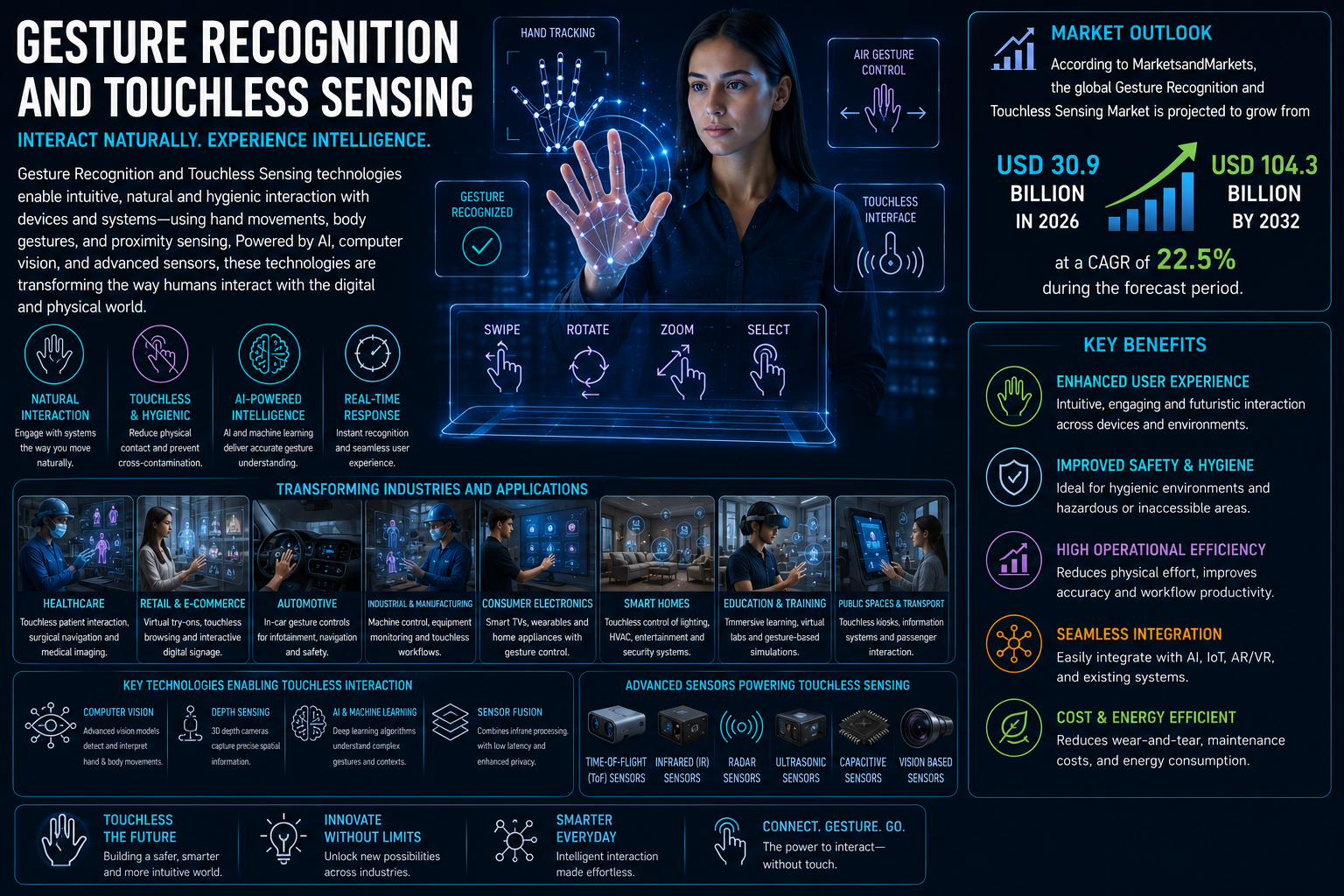
Gesture recognition and touchless sensing technology is transforming human-machine interaction by enabling users to control devices and systems through natural hand gestures, body movements, facial expressions, and voice commands without physical contact. Powered by artificial intelligence (AI), computer vision, machine learning, 3D imaging, radar sensors, LiDAR, infrared sensors, and advanced cameras, touchless sensing solutions are enhancing convenience, safety, and operational efficiency across industries. As demand for intuitive user experiences, smart automation, and hygienic interfaces continues to grow, gesture recognition technology is becoming an essential component of next-generation consumer electronics, automotive systems, healthcare devices, industrial automation, and smart buildings.
History of Gesture Recognition and Touchless Sensing Technology
Gesture recognition technology originated from early computer vision and image-processing research focused on enabling machines to interpret human movements. Initial applications were primarily limited to gaming consoles and research laboratories. Over the years, significant advancements in AI, depth-sensing cameras, radar technology, and edge computing have expanded its capabilities across commercial and industrial sectors. Today, touchless sensing solutions are widely deployed in automotive infotainment systems, medical devices, retail kiosks, smart homes, industrial automation, and public infrastructure, delivering safer, faster, and more intuitive user interactions.
Benefits of Gesture Recognition and Touchless Sensing Technology
Gesture recognition and touchless sensing technologies offer a more natural and contact-free way of interacting with digital systems while improving operational efficiency, accessibility, and user safety. By eliminating the need for physical touch, these technologies reduce contamination risks, simplify user interfaces, and enhance automation across consumer and enterprise applications. Their ability to combine AI-powered perception with real-time sensing is driving innovation across multiple industries.
Key Benefits Include:
- Enables intuitive hands-free interaction with electronic devices and digital systems.
- Reduces physical contact, improving hygiene and user safety in healthcare and public environments.
- Enhances accessibility for elderly individuals and users with physical disabilities.
- Improves driver safety through touchless in-vehicle controls and gesture-based infotainment systems.
- Supports smart manufacturing by enabling contactless machine operation and monitoring.
- Increases operational efficiency through AI-powered automation and real-time sensing.
- Enhances customer experience in retail, hospitality, banking, and self-service kiosks.
- Integrates seamlessly with smart homes, IoT devices, and intelligent building management systems.
Current Market Size and Growth Trends of the Gesture Recognition and Touchless Sensing Market
The Gesture Recognition and Touchless Sensing market is witnessing rapid expansion as organizations increasingly adopt contactless technologies to improve user experience, operational efficiency, and workplace safety. The growing integration of AI, computer vision, 3D imaging, radar sensors, and machine learning is enabling highly accurate gesture detection across consumer electronics, automotive, healthcare, industrial automation, and smart infrastructure. Rising demand for hygienic interfaces, intelligent automation, and immersive digital experiences is expected to further accelerate market growth over the coming years.
According to MarketsandMarkets, the global Gesture Recognition and Touchless Sensing market is projected to grow from USD 30.9 billion in 2026 to USD 104.3 billion by 2032, registering a CAGR of 22.5% during the forecast period.
Key Market Growth Drivers
- Increasing adoption of AI-powered computer vision and machine learning technologies.
- Growing demand for contactless user interfaces across healthcare, retail, and public infrastructure.
- Rising integration of gesture recognition in automotive infotainment and advanced driver assistance systems (ADAS).
- Expansion of smart homes, IoT ecosystems, and intelligent consumer electronics.
- Increasing use of touchless technologies in industrial automation and smart manufacturing.
- Growing deployment of AR/VR, mixed reality, and immersive digital experiences.
- Continuous advancements in 3D cameras, LiDAR, radar sensors, infrared imaging, and edge AI processors.
Key Drivers and Factors Influencing the Future of Gesture Recognition and Touchless Sensing Technology
The future of gesture recognition and touchless sensing technology is being driven by the growing demand for intuitive, contact-free human-machine interaction across consumer and enterprise applications. Rapid advancements in artificial intelligence (AI), computer vision, edge computing, radar sensing, and machine learning are enabling highly accurate gesture detection with faster response times and improved reliability. As industries continue embracing automation, smart devices, and digital transformation, touchless sensing technologies are becoming increasingly important for enhancing user experience, workplace safety, operational efficiency, and accessibility.
Key Growth Drivers
- Growing adoption of AI-powered computer vision and deep learning algorithms for real-time gesture recognition.
- Increasing demand for contactless interfaces in healthcare, retail, banking, hospitality, and public infrastructure.
- Rising integration of gesture controls in automotive infotainment systems and Advanced Driver Assistance Systems (ADAS).
- Expansion of smart homes, IoT ecosystems, and connected consumer electronics.
- Growing investments in industrial automation and Industry 4.0 initiatives.
- Increasing deployment of AR, VR, and Mixed Reality (MR) applications requiring natural user interaction.
- Continuous advancements in 3D cameras, LiDAR, radar sensors, infrared imaging, and edge AI processors.
Emerging Trends in Gesture Recognition and Touchless Sensing Technology
Gesture recognition technology is evolving rapidly with innovations that improve sensing accuracy, environmental adaptability, and seamless integration across digital platforms. Manufacturers are combining AI with advanced sensing technologies to deliver natural, responsive, and personalized user experiences. The convergence of touchless sensing with spatial computing, wearable devices, and smart environments is opening new opportunities for immersive interaction across enterprise and consumer applications.
Key Emerging Trends
- Integration of Generative AI and machine learning for adaptive gesture recognition.
- Increasing adoption of millimeter-wave (mmWave) radar sensing for contactless interaction.
- Expansion of 3D vision and depth-sensing cameras for improved motion tracking.
- Growing use of gesture recognition in AR/VR headsets and spatial computing platforms.
- Development of multi-modal interfaces combining gesture, voice, facial recognition, and eye tracking.
- Rising adoption of touchless biometric authentication for secure user access.
- Increasing deployment of edge AI processing for faster, low-latency gesture recognition.
Opportunities and Challenges in the Gesture Recognition and Touchless Sensing Market
The Gesture Recognition and Touchless Sensing market presents significant opportunities as businesses increasingly invest in smart automation, immersive user experiences, and contactless digital interfaces. Industries including healthcare, automotive, manufacturing, consumer electronics, and retail are adopting touchless technologies to improve operational efficiency and customer engagement. However, achieving high recognition accuracy, ensuring interoperability, and addressing privacy concerns remain important challenges for widespread adoption.
Key Opportunities
- Growing demand for touchless healthcare systems and smart medical devices.
- Expansion of automotive gesture-controlled infotainment and in-cabin monitoring systems.
- Rising adoption in consumer electronics, smart TVs, gaming, and wearable devices.
- Increasing deployment across industrial automation and smart manufacturing facilities.
- Growth of smart retail, self-service kiosks, digital signage, and interactive customer experiences.
- Expanding applications in smart cities, airports, transportation hubs, and public infrastructure.
Key Challenges
- Maintaining high gesture recognition accuracy across different lighting and environmental conditions.
- Privacy and cybersecurity concerns related to AI-powered vision systems.
- Complex integration with existing enterprise software and hardware platforms.
- Higher implementation costs for advanced sensing hardware.
- Lack of standardized gesture recognition protocols across devices and industries.
- Managing power consumption and processing requirements in portable and embedded systems.
Innovations and Advancements in Gesture Recognition and Touchless Sensing Technology
Continuous innovation is enhancing the intelligence, speed, and versatility of gesture recognition and touchless sensing systems. Advances in AI, computer vision, sensor fusion, and edge computing are enabling devices to recognize complex gestures with greater precision while reducing latency. These developments are supporting the adoption of touchless interaction across smart homes, autonomous vehicles, industrial automation, healthcare, and immersive digital environments.
Recent Innovations
- AI-powered real-time hand, body, and facial gesture recognition with improved accuracy.
- Advanced sensor fusion combining cameras, radar, LiDAR, and infrared technologies.
- High-performance edge AI processors enabling faster local gesture processing.
- Contactless biometric authentication using gesture and facial recognition.
- Integration with Digital Twin, IoT, and smart building platforms for intelligent automation.
- Gesture-controlled interfaces for next-generation automotive cockpits and autonomous vehicles.
- Enhanced haptic feedback and spatial interaction for immersive AR and VR applications.
Future Applications and Industries That Will Benefit from Gesture Recognition and Touchless Sensing Technology
Gesture recognition and touchless sensing technology is expected to become a cornerstone of next-generation human-machine interaction as organizations increasingly adopt intelligent, contact-free interfaces across consumer, commercial, and industrial environments. The convergence of artificial intelligence (AI), computer vision, radar sensing, Internet of Things (IoT), edge computing, and spatial computing is enabling more natural, accurate, and responsive interactions between users and digital systems. As businesses continue investing in automation, smart infrastructure, and personalized digital experiences, gesture recognition technology will play a critical role in improving operational efficiency, safety, accessibility, and user engagement across diverse industries.
Key Future Applications
- Healthcare: Enable touchless operation of medical equipment, surgical visualization systems, patient monitoring solutions, and hospital kiosks to improve hygiene, operational efficiency, and patient care.
- Automotive: Power gesture-controlled infotainment systems, climate controls, navigation interfaces, and in-cabin monitoring solutions that enhance driver safety and reduce distractions.
- Consumer Electronics: Support intuitive interaction with smartphones, tablets, smart TVs, gaming consoles, laptops, and wearable devices through natural hand gestures and facial recognition.
- Smart Homes & Smart Buildings: Enable contactless control of lighting, HVAC systems, security devices, elevators, access control systems, and home automation platforms.
- Industrial Automation & Manufacturing: Improve worker safety through touchless machine controls, remote equipment monitoring, digital work instructions, and AI-powered factory automation.
- Retail & Hospitality: Deliver interactive digital kiosks, self-service checkouts, smart mirrors, digital signage, and personalized customer experiences without physical contact.
- Banking & Financial Services: Enable secure touchless ATMs, biometric authentication, customer verification, and self-service banking applications.
- Education & Corporate Training: Support immersive learning, virtual laboratories, AI-assisted classrooms, and interactive training simulations using gesture-based interfaces.
- AR, VR & Spatial Computing: Enhance immersive experiences through natural gesture interaction, hand tracking, eye tracking, and mixed reality collaboration.
- Airports & Smart Cities: Improve passenger processing, ticketing, information kiosks, security checkpoints, and public service delivery through contactless technologies.
As AI-powered sensing technologies continue to evolve, gesture recognition and touchless interfaces will become essential components of future digital ecosystems, enabling safer, smarter, and more intuitive interactions across everyday environments.
Conclusion: The Promising Future of Gesture Recognition and Touchless Sensing Technology
Gesture recognition and touchless sensing technology is fundamentally changing the way people interact with digital systems by replacing traditional physical interfaces with intelligent, contact-free experiences. As industries increasingly embrace automation, artificial intelligence, and connected technologies, touchless interaction is becoming a key driver of innovation across healthcare, automotive, manufacturing, retail, smart homes, financial services, and enterprise applications.
Find More Information on Gesture Recognition Technology Innovation @ https://www.marketsandmarkets.com/Market-Reports/touchless-sensing-gesturing-market-369.html
80% of the Forbes Global 2000 B2B companies rely on MarketsandMarkets to identify growth opportunities in emerging technologies and use cases that will have a positive revenue impact.
- Food Packaging Market Size Set for Strong Growth Through 2030 Amid Rising Demand for Convenience Foods
- Mulch Films Market: Driving Sustainable Agriculture Through Innovation
- Agricultural Adjuvants Market Analysis, Trends, and Growth Outlook (2026–2031)
- Crop Protection Chemical Market Size, Share & Growth Forecast (2025–2030)
- Japan Enterprise Asset Management Market Growth: AI and Smart Infrastructure Drive Demand

