

Head-up Display Technology Innovation: Key Trends, Growth Drivers and Opportunities
Introduction to Head-up Display Technology
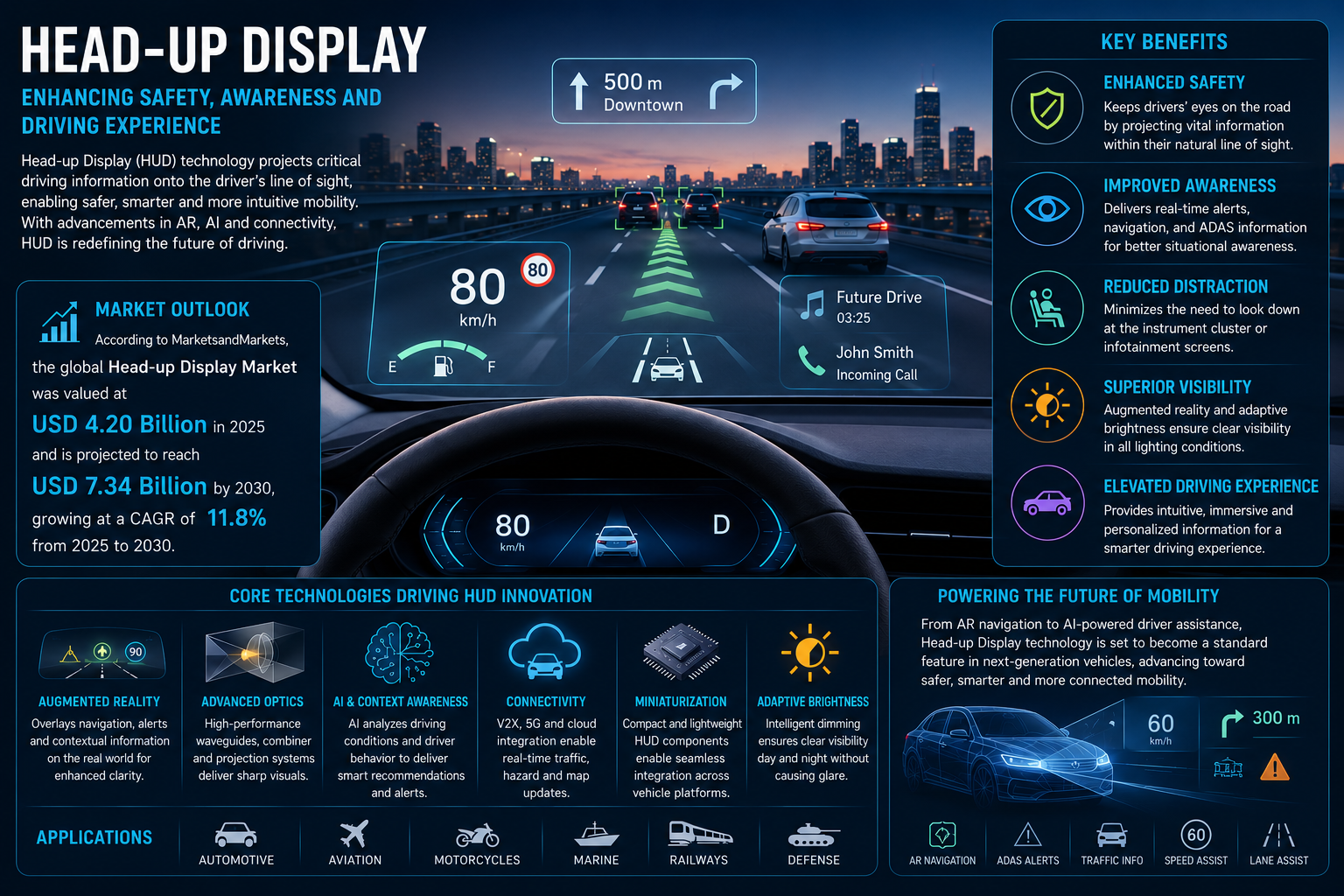
Head-up Display (HUD) technology is revolutionizing the way users access critical information by projecting digital content directly into their field of view without requiring them to look away from their primary task. Originally developed for military aviation, HUD technology has evolved into a key innovation across the automotive, aerospace, defense, and industrial sectors. Modern HUD systems leverage augmented reality (AR), artificial intelligence (AI), advanced optics, and high-resolution display technologies to deliver real-time navigation, safety alerts, vehicle diagnostics, and situational awareness. As demand for connected vehicles, autonomous driving, and immersive user experiences continues to grow, HUD technology is becoming an essential component of next-generation intelligent mobility and digital cockpit solutions.
History of Head-up Display Technology
Head-up Display technology first emerged in military aircraft during the mid-20th century to provide pilots with critical flight information while maintaining visual focus on the surrounding environment. As display technologies advanced, HUD systems expanded into commercial aviation and defense applications before entering the automotive industry. Over the past decade, innovations in projection systems, augmented reality, waveguide optics, and compact display components have significantly enhanced HUD capabilities. Today, head-up displays are increasingly integrated into premium and mid-range vehicles, industrial equipment, and wearable devices, supporting safer and more intuitive human-machine interaction.
Benefits of Head-up Display Technology
Head-up Display technology enhances safety, convenience, and user experience by allowing drivers, pilots, and equipment operators to access essential information without diverting their attention from the road, runway, or workspace. By combining real-time data visualization with intelligent digital interfaces, HUD systems improve decision-making, reduce distractions, and support advanced driver assistance systems (ADAS) and connected mobility solutions.
Key Benefits Include:
- Displays critical information directly within the user's natural field of vision.
- Improves driver and pilot safety by minimizing distractions.
- Enhances situational awareness through real-time navigation and hazard alerts.
- Supports Advanced Driver Assistance Systems (ADAS) and connected vehicle technologies.
- Improves user experience with intuitive and immersive digital interfaces.
- Reduces reaction time by presenting important information instantly.
- Enables seamless integration with AI-powered digital cockpits and infotainment systems.
- Supports augmented reality visualization for navigation, safety, and maintenance applications.
Current Market Size and Growth Trends of the Head-up Display Market
The Head-up Display market is experiencing significant growth as automotive manufacturers, aerospace companies, and industrial equipment providers increasingly adopt intelligent display technologies to improve safety, navigation, and operational efficiency. Growing investments in electric vehicles (EVs), autonomous driving, connected mobility, and augmented reality interfaces are accelerating the adoption of next-generation HUD systems. At the same time, advancements in projection technologies, holographic displays, AI-powered visualization, and high-resolution optics are expanding the commercial potential of HUD solutions across multiple industries.
According to MarketsandMarkets, the global Head-up Display market was valued at USD 4.20 billion in 2025 and is projected to reach USD 7.34 billion by 2030, growing at a CAGR of 11.8% during the forecast period (2025–2030).
Download PDF Brochure: https://www.marketsandmarkets.com/pdfdownloadNew.asp?id=684
Key Market Growth Drivers
- Increasing adoption of Advanced Driver Assistance Systems (ADAS) and connected vehicle technologies.
- Rising production of electric vehicles (EVs) and autonomous vehicles.
- Growing demand for augmented reality (AR)-based head-up displays.
- Expansion of intelligent cockpit and digital dashboard solutions.
- Increasing focus on road safety and driver convenience.
- Technological advancements in projection systems, waveguide optics, and holographic displays.
- Rising adoption of HUD technology across automotive, aerospace, defense, and industrial sectors.
Key Drivers and Factors Influencing the Future of Head-up Display Technology
The future of Head-up Display (HUD) technology is being driven by the rapid evolution of connected mobility, electric vehicles (EVs), autonomous driving, and intelligent cockpit systems. As automotive manufacturers and technology providers focus on improving road safety, driver awareness, and user experience, HUD systems are becoming an integral part of next-generation vehicles. Advancements in augmented reality (AR), artificial intelligence (AI), high-resolution projection systems, and real-time data visualization are enabling more immersive and intuitive display solutions across automotive, aerospace, defense, and industrial applications.
Key Growth Drivers
- Increasing adoption of Advanced Driver Assistance Systems (ADAS) and autonomous driving technologies.
- Rising production and sales of electric vehicles (EVs) equipped with intelligent cockpit systems.
- Growing demand for Augmented Reality Head-up Displays (AR-HUDs) offering real-time navigation and hazard visualization.
- Expansion of connected vehicle ecosystems powered by AI, IoT, and 5G connectivity.
- Increasing focus on driver safety, reduced distraction, and improved situational awareness.
- Continuous advancements in waveguide optics, holographic projection, laser displays, and microLED technologies.
- Strong investments by leading automotive OEMs and Tier-1 suppliers in next-generation digital cockpit solutions.
Emerging Trends in Head-up Display Technology
Head-up Display technology is evolving rapidly as manufacturers introduce larger display areas, higher image quality, and intelligent AR-based visualization. The integration of AI, spatial computing, cloud connectivity, and Digital Twin technologies is enhancing the functionality of HUD systems beyond traditional navigation displays. These advancements are creating immersive driving experiences while supporting predictive safety features and personalized in-vehicle information delivery.
Key Emerging Trends
- Increasing adoption of Augmented Reality Head-up Displays (AR-HUDs) for immersive navigation.
- Development of large field-of-view windshield displays replacing conventional instrument clusters.
- Integration of AI-powered contextual information and predictive driver assistance.
- Growing implementation of microLED, OLED, and laser projection technologies for brighter and sharper images.
- Expansion of HUD integration with Digital Cockpit, infotainment, and voice assistant platforms.
- Rising use of eye-tracking and driver monitoring systems for adaptive information display.
- Cloud-connected HUD platforms enabling real-time software updates and personalized user experiences.
Opportunities and Challenges in the Head-up Display Market
The Head-up Display market offers significant opportunities as automotive manufacturers, aircraft producers, and industrial equipment companies increasingly adopt intelligent display technologies to improve operational safety and user experience. The growing deployment of autonomous vehicles, premium electric vehicles, and smart mobility solutions is expanding the demand for advanced HUD systems. However, challenges related to manufacturing costs, optical complexity, and seamless integration remain important considerations for widespread commercialization.
Key Opportunities
- Growing adoption in electric vehicles (EVs) and software-defined vehicles.
- Expansion of autonomous driving and intelligent transportation systems.
- Rising demand for premium automotive infotainment and digital cockpit solutions.
- Increasing implementation in commercial aviation, defense aircraft, and helicopters.
- Growth opportunities in industrial machinery, heavy equipment, and wearable smart devices.
- Expansion of AR-based navigation for smart cities and connected mobility.
Key Challenges
- High manufacturing and integration costs of advanced HUD systems.
- Complex calibration and alignment of optical projection components.
- Limited windshield compatibility for some AR-HUD implementations.
- Maintaining image clarity under varying lighting and weather conditions.
- Balancing display size with compact hardware design requirements.
- Compliance with evolving automotive safety and regulatory standards.
Innovations and Advancements in Head-up Display Technology
Continuous innovation is enhancing the performance, intelligence, and usability of Head-up Display systems across automotive and aerospace applications. Advances in display technologies, AI-driven visualization, sensor fusion, and connectivity are enabling HUDs to present richer contextual information while minimizing driver distraction. These innovations are accelerating the transition toward fully digital, intelligent, and immersive cockpit environments.
Recent Innovations
- AI-powered predictive navigation and hazard visualization integrated with AR-HUD systems.
- Advanced microLED, OLED, laser projection, and holographic display technologies for improved brightness and image quality.
- Sensor fusion combining cameras, LiDAR, radar, GPS, and ADAS data for real-time situational awareness.
- Large-format windshield projection systems with expanded field of view.
- Integration with Digital Twin, cloud platforms, and connected vehicle ecosystems.
- Adaptive HUD interfaces using eye-tracking and driver behavior analysis for personalized information delivery.
- Lightweight, energy-efficient HUD architectures designed for electric and autonomous vehicles.
Future Applications and Industries That Will Benefit from Head-up Display Technology
Head-up Display (HUD) technology is expected to become a fundamental component of future mobility and intelligent human-machine interaction. As connected vehicles, autonomous driving systems, and smart transportation infrastructure continue to evolve, HUDs will transition from displaying basic driving information to delivering context-aware, AI-powered visual guidance in real time. The convergence of augmented reality (AR), artificial intelligence (AI), Digital Twins, Internet of Things (IoT), and 5G connectivity is enabling highly immersive and personalized display experiences that improve safety, efficiency, and user engagement. Beyond automotive applications, HUD technology is poised to expand into aerospace, defense, industrial automation, healthcare, and smart city ecosystems.
Key Future Applications
- Automotive: Enable next-generation AR-HUDs that provide real-time navigation, lane guidance, hazard detection, pedestrian alerts, and driver assistance information for electric and autonomous vehicles.
- Autonomous Mobility: Support Level 3, Level 4, and Level 5 autonomous driving by displaying vehicle intentions, environmental awareness, and route visualization for improved passenger confidence.
- Commercial Aviation: Enhance pilot situational awareness through advanced flight data visualization, terrain mapping, weather monitoring, and precision landing assistance.
- Defense & Military: Improve battlefield awareness with tactical navigation, mission planning, target identification, and real-time operational intelligence integrated into military aircraft and armored vehicles.
- Industrial Equipment & Heavy Machinery: Assist equipment operators with maintenance guidance, equipment diagnostics, operational alerts, and safety notifications while minimizing downtime.
- Marine & Maritime Navigation: Support ship captains and navigation officers with real-time weather conditions, collision avoidance, route optimization, and port guidance.
- Healthcare: Enable surgeons and medical professionals to visualize patient information, diagnostic imaging, and procedural guidance without diverting attention from clinical tasks.
- Smart Cities & Intelligent Transportation: Integrate HUDs with connected traffic systems to provide real-time traffic updates, infrastructure alerts, smart parking guidance, and emergency notifications.
- Rail Transportation: Improve train operator safety by displaying operational status, speed limits, signaling information, and predictive maintenance alerts.
- Wearable Smart Glasses: Expand enterprise applications through AR-enabled smart glasses for remote collaboration, field service, logistics, warehouse management, and technical training.
As intelligent mobility ecosystems continue to develop, Head-up Display technology will become a key interface connecting users with AI-powered transportation, digital infrastructure, and immersive operational environments.
Conclusion: The Promising Future of Head-up Display Technology
Head-up Display technology is redefining the way drivers, pilots, equipment operators, and industrial professionals access critical information by delivering real-time digital content directly within their field of view. By reducing distraction and improving situational awareness, HUD systems are becoming an essential component of modern transportation, intelligent manufacturing, aviation, and defense applications.
Continuous innovations in augmented reality, artificial intelligence, waveguide optics, holographic projection, microLED displays, and connected vehicle technologies are significantly enhancing HUD capabilities. These advancements are enabling more immersive visualization, personalized user experiences, predictive safety features, and seamless integration with Advanced Driver Assistance Systems (ADAS), Digital Cockpits, and autonomous driving platforms.
Find More Information on Head-up Display Technology Innovation @ https://www.marketsandmarkets.com/Market-Reports/head-up-display-hud-market-684.html
80% of the Forbes Global 2000 B2B companies rely on MarketsandMarkets to identify growth opportunities in emerging technologies and use cases that will have a positive revenue impact.
- Food Packaging Market Size Set for Strong Growth Through 2030 Amid Rising Demand for Convenience Foods
- Mulch Films Market: Driving Sustainable Agriculture Through Innovation
- Agricultural Adjuvants Market Analysis, Trends, and Growth Outlook (2026–2031)
- Crop Protection Chemical Market Size, Share & Growth Forecast (2025–2030)
- Japan Enterprise Asset Management Market Growth: AI and Smart Infrastructure Drive Demand

