



Acoustic Insulation Market
Report Code
CH 3020
Published in
Mar, 2026, By MarketsandMarkets™
Acoustic Insulation Market by Material (Foamed Plastic, Glass Wool, Rock Wool), End-use Industry (Building & Construction, Transportation, Energy & Utilities, Industrial & OEM, Oil & Gas), and Region - Global Forecasts to 2031

USD 23.04 BN
MARKET SIZE, 2031

CAGR 5.3%
(2026-2031)

241
REPORT PAGES

263
MARKET TABLES
ACOUSTIC INSULATION MARKET
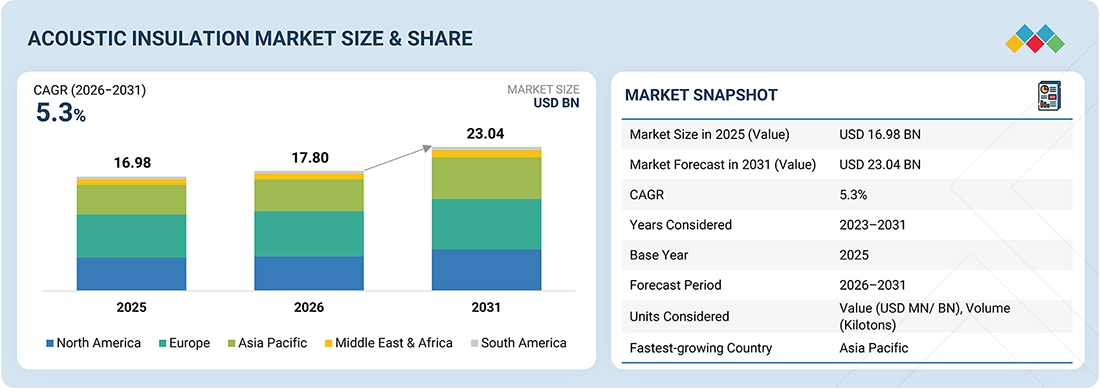
Source: Secondary Research, Interviews with Experts, MarketsandMarkets Analysis | Updated on : June 25, 2026
Acoustic Insulation Market is projected to grow from USD 17.80 billion in 2026 to USD 23.04 billion by 2031, at a CAGR of 5.3% from 2026 to 2031. The market is growing due to increasing demand for noise reduction, rising urbanization, stricter building regulations, and greater focus on indoor comfort and energy efficiency. Growing adoption of EVs and lightweight transportation is also the major factor driving the demand of acoustic insulation solutions.
KEY TAKEAWAYS
-
BY MATERIALBy material, the foamed plastic segment is expected to grow at a CAGR of 5.6% during the forecast period.
-
BY END-USE INDUSTRYBy end-use industry, the building & construction segment is likely to hold a 43.7% share of the acoustic insulation market in 2026.
-
BY REGIONBy region, Europe is anticipated to account for a 36.8% share of the acoustic insulation market in 2026.
-
COMPETITIVE LANDSCAPE-KEY PLAYERSMajor market players have adopted organic and inorganic strategies, including partnerships and investments. The major players are Saint-Gobain, Knauf Insulation, Armacell, Rockwool A/S, Soprema, Huntsman, Owens Corning, Kingspan Group, BASF SE, and Johns Manville.
-
COMPETITIVE LANDSCAPE-STARTUPS/SMEsMajor Startups/SMEs are Getzner Werkstoffe GmbH, Cellofoam International GmbH & Co. KG, Regupol Germany GmbH & Co. KG, 3M, Trelleborg, L'Isolante K-Flex S.P.A., Dow, Siderise, Cabot Corporation, Fletcher Insulation, Hush Acoustics, Primacoustic, Trocellen, Cellecta, and International Cellulose Corporation.
The acoustic insulation market is driven by the use of sustainable and high-performing acoustic materials in green buildings and smart infrastructure construction. Manufacturers of acoustic insulation are increasingly producing environmentally friendly acoustic insulation materials through recycled glass wool, organic materials, and low emission products, considering strict regulations and requirements of green buildings. Another significant trend in the acoustic insulation market is the growing demand for acoustic materials that have aesthetic appeal such as acoustic panels, ceilings, and light-weight insulation materials.
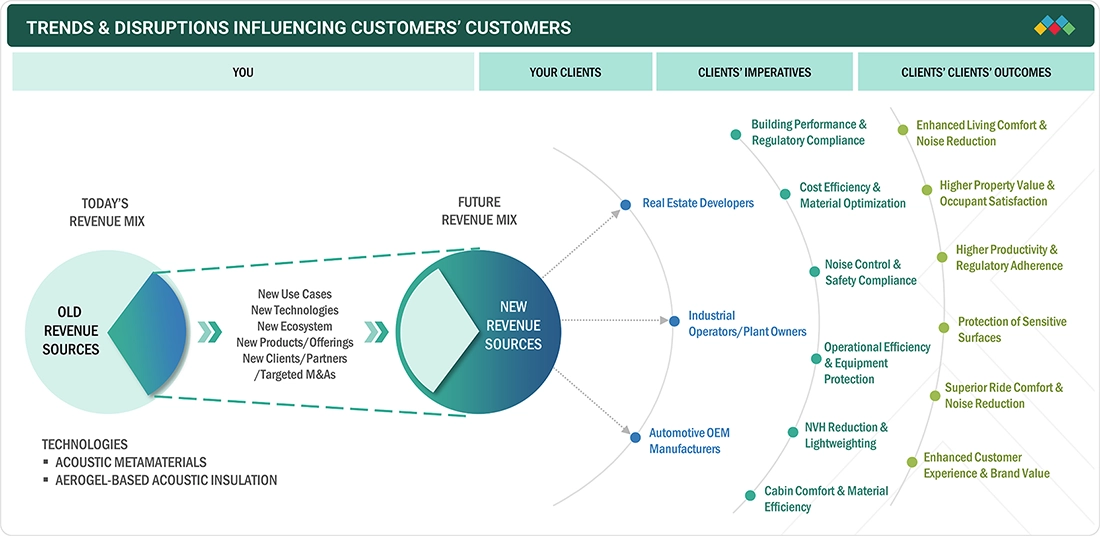
TRENDS & DISRUPTIONS IMPACTING CUSTOMERS' CUSTOMERS
The acoustic insulation market is experiencing a transition due to the growing demand for higher comfort levels, regulatory standards, and material advancements. Traditional sound insulation solutions have been replaced by products that combine several functions to include thermal efficiency, fire resistance, and moisture barriers. New technologies have helped create materials with improved features and easy-to-install products. Meanwhile, the need for environmentally-friendly materials due to sustainable building practices has led to increased adoption of green materials. Various trends including prefabrication, building retrofitting, and incorporation with new technologies have transformed industry dynamics. In addition, emerging areas such as electric vehicle manufacturing and construction of infrastructural facilities are creating additional demand for noise reduction solutions.
Source: Secondary Research, Interviews with Experts, MarketsandMarkets Analysis
MARKET DYNAMICS

Drivers
Impact
Level
Level
-
Rapid Urbanization and Infrastructure Development

-
Expansion of Transportation and Industrial Sectors


RESTRAINTS
Impact
Level
Level
-
High Initial Costs and Limited Cost Sensitivity in Price-Driven Markets

-
Performance Variability and Lack of Standardization Across Applications


OPPORTUNITIES
Impact
Level
Level
-
Growing Retrofit and Renovation Activities

-
Advancements in Material Technology and Sustainable Solutions


CHALLENGES
Impact
Level
Level
-
Complex Installation Requirements and Dependence on Skilled Workforce

-
Trade-Off Between Acoustic Performance and Space Efficiency

Source: Secondary Research, Interviews with Experts, MarketsandMarkets Analysis
Driver: Rapid Urbanization and Infrastructure Development
With increased pace of urbanization, especially in Asia Pacific, the Middle East, and some regions in Africa, the trend is changing the construction industry, and consequently, creating significant demand for acoustic insulation solutions. Due to the expansion of urban areas, there is high probability of residential apartments, mixed-use buildings, and commercial developments constructed in close proximity. From a developer's point of view, there is an increasing trend in which acoustic insulation is becoming an integral part of the development process as it provides added value to the developments. For example, the premium housing or even commercial developments rely on comfort for setting price and occupancy rates. Similarly, there has been an increase in noise mitigation practices during the planning phase of infrastructural development such as airports, metros, highways, and smart cities.
Restraint: High Initial Costs and Limited Cost Sensitivity in Price-Driven Markets
The high costs incurred during the procurement of materials for insulation and their installation is a key factor limiting market expansion, majorly the in cost-sensitive markets. In most cases, advanced methods of insulation incur relatively higher costs compared with conventional ones, making it challenging to adapt such materials in developing countries that rely on budget considerations. Although acoustic insulation provides several advantages in terms of comfort, reduced energy consumption, and durability, consumers tend to prefer less costly products. Cost-effectiveness is a vital determinant when applying acoustic insulation in small-scale building activities and sectors characterized by cost consciousness. Another factor affecting the market growth of acoustic insulation is the lack of knowledge regarding the benefits accrued from their application.
Opportunity: Growing Retrofit and Renovation Activities
With an increase in retrofit and renovation work, significant opportunities have been generated within the acoustic insulation market, especially in developed markets where there are many aged properties. Since most aged properties were constructed at a time when there was no emphasis on acoustic standards in building designs, renovations in such cases provide an opportunity for incorporating acoustic insulation to address noise management issues and make the buildings more comfortable to occupy. Besides, the increasing preference for energy-efficient retrofits and renovations provides an opportunity for acoustic insulations to be incorporated as part of insulation solutions to help save costs on heating and cooling. In particular, office buildings, healthcare facilities, and hotels are undergoing renovations to enhance their user experience, which is driving demand in this market.
Challenge: Complex Installation Requirements and Dependence on Skilled Workforce
Installation complications and the necessity of a competent workforce remain the major problems in the acoustic insulation market. Proper installation of any type of soundproofing materials becomes critical, as their sound-absorption capabilities largely depend on this process. There are many cases when even high-quality acoustic materials cannot effectively soundproof due to improper installation. Specialized methods of installing insulation become necessary when dealing with sophisticated systems, such as heating/cooling systems or building construction with high performance standards. Thus, there exists a high degree of dependency on professional installers, which may negatively affect expenses and duration of the project. The lack of qualified labor forces remains a significant problem in some areas. Moreover, the precision and adherence to standards required during installation make this process more complicated than traditional insulation practices.
ACOUSTIC INSULATION MARKET: COMMERCIAL USE CASES ACROSS INDUSTRIES
| COMPANY | USE CASE DESCRIPTION | BENEFITS |
|---|---|---|
 |
Implements acoustic insulation solutions in large-scale residential, commercial, and infrastructure projects to control indoor and external noise levels | Enhances occupant comfort | Ensures compliance with building standards | Improves overall building quality and value |
 |
Integrates acoustic insulation materials in vehicle cabins and engine compartments to reduce noise and vibration | Improves passenger comfort | Enhances driving experience | Supports compliance with noise regulations |
 |
Applies acoustic insulation in industrial equipment and manufacturing facilities to manage operational noise | Reduces workplace noise levels | Improves worker safety | Enhances operational efficiency |
 |
Uses acoustic insulation in residential and commercial buildings to create quieter indoor environments | Increases property value | Improves tenant satisfaction | Supports premium positioning |
 |
Incorporates acoustic insulation in aircraft cabins and structures to minimize noise during operation | Enhances passenger comfort | Improves cabin experience | Meets aviation noise standards |
Logos and trademarks shown above are the property of their respective owners. Their use here is for informational and illustrative purposes only.
MARKET ECOSYSTEM
The ecosystem of the acoustic insulation market is based on an interconnected web of various stakeholders who make the material development, manufacturing, distribution, and deployment happen altogether. Raw material suppliers provide necessary materials such as glass fibers, mineral wool, polymers, special chemicals, and other materials required for product development, influencing material properties and costs of manufacturing. Manufacturers are the core of the market in question as they are responsible for creating acoustic insulation products of all sorts using the materials provided, as well as innovating the processes and improving performance and environmental friendliness of these materials. Distributors become critical at the moment when products are sold and deployed on the market. Finally, end users, including building & construction industry, transportation sector, manufacturing industries, and energy & utilities providers, create consistent demands due to regulations and urbanization.
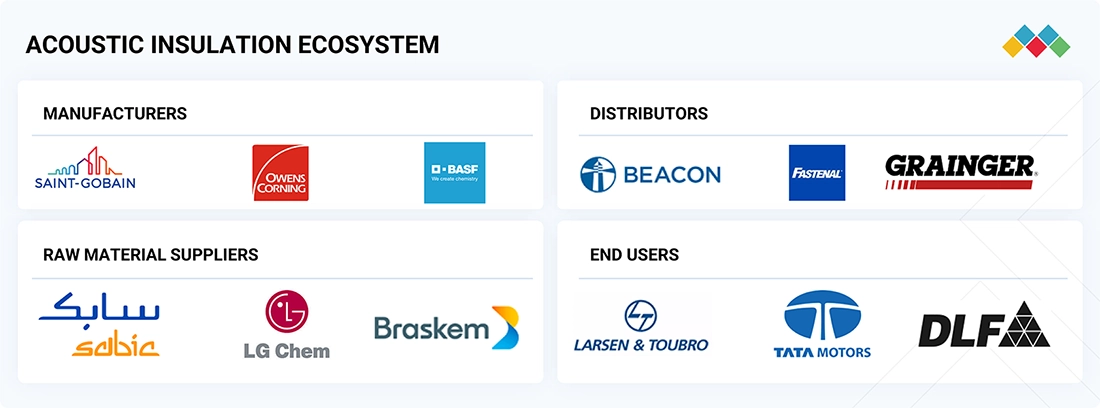
Logos and trademarks shown above are the property of their respective owners. Their use here is for informational and illustrative purposes only.
MARKET SEGMENTS
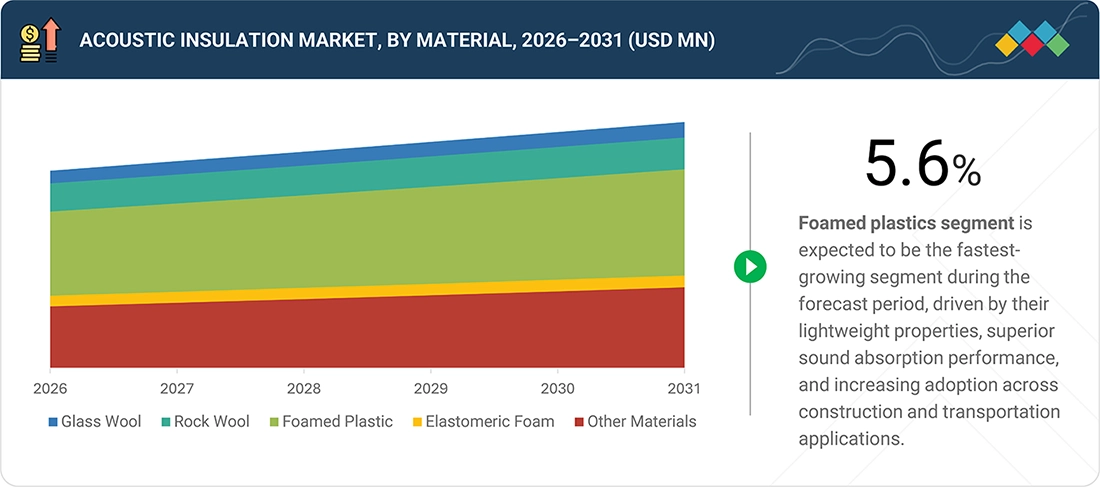
Source: Secondary Research, Interviews with Experts, MarketsandMarkets Analysis
Acoustic Insulation Market, By Material
The glass wool material dominates the acoustic insulation material market due to its consistent and efficient performance in a range of settings and its high degree of acceptance by builders and construction professionals. It serves well in applications that require the material to absorb sounds while not exerting additional loads on the structure. This makes it ideal for use in newly built as well as refurbished buildings. It is extensively used in partition walls, ceiling insulation, and ductwork, which requires balancing acoustic performance and costs. In addition, its compatibility with traditional building techniques and its ease of installation further add to its popularity in the market.
Acoustic Insulation Market, By End-use Industry
The building & construction industry holds the largest market share in the acoustic insulation market owing to the wide usage of acoustic insulating materials in residential and commercial buildings. With increasing trends in building tall buildings, offices, and hybrid projects, the need for sound control in such buildings has gained momentum. Acoustic insulation has been largely used in walls, roofs, and flooring to ensure proper insulation against noise pollution. The rising population in urban areas, along with the need to manage noise pollution in neighboring premises, has led to the higher adoption rates of acoustic insulation in the building & construction industry. Moreover, there has been a significant rise in the demand for such products due to the value addition of buildings.
REGION
Asia Pacific to grow at highest CAGR in global acoustic insulation market during forecast period
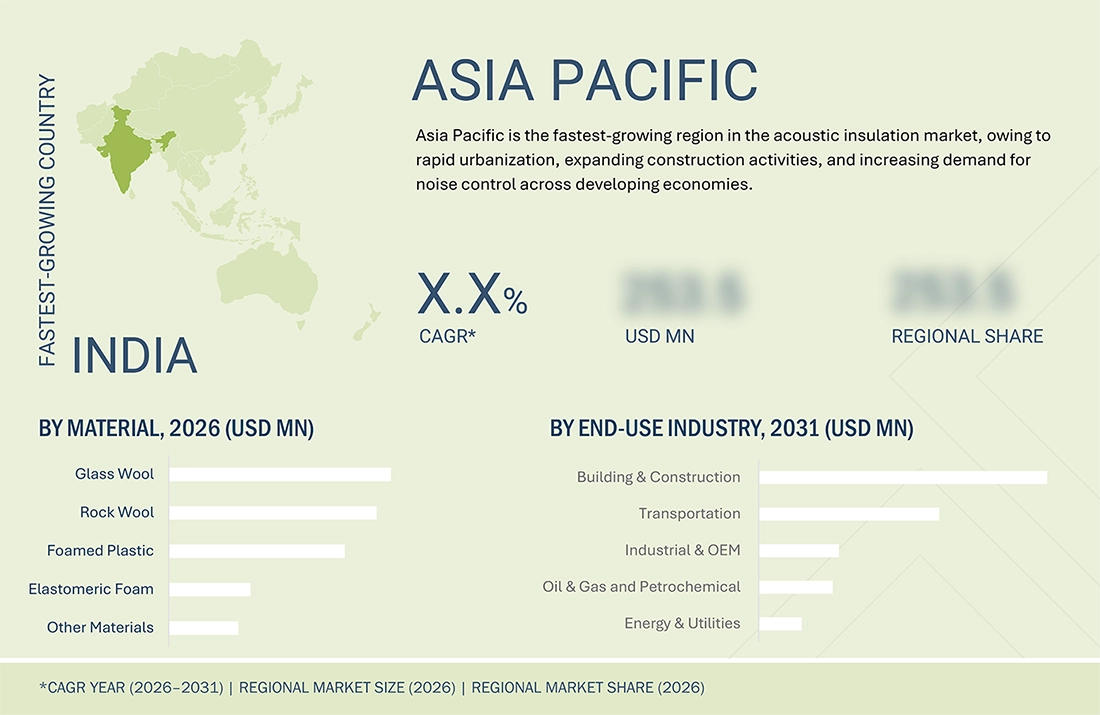
Asia Pacific is expected to witness the fastest growth rate in the acoustic insulation market during the forecast period, owing to the fast-paced urbanization trends, increasing construction operations, and substantial investments made for infrastructure development in China, India, Japan, and some countries in Southeast Asia. The rising demand for residential and commercial constructions, along with strict noise control policies and growing awareness about energy efficiency and sustainable building practices, is driving the use of acoustic insulation products.
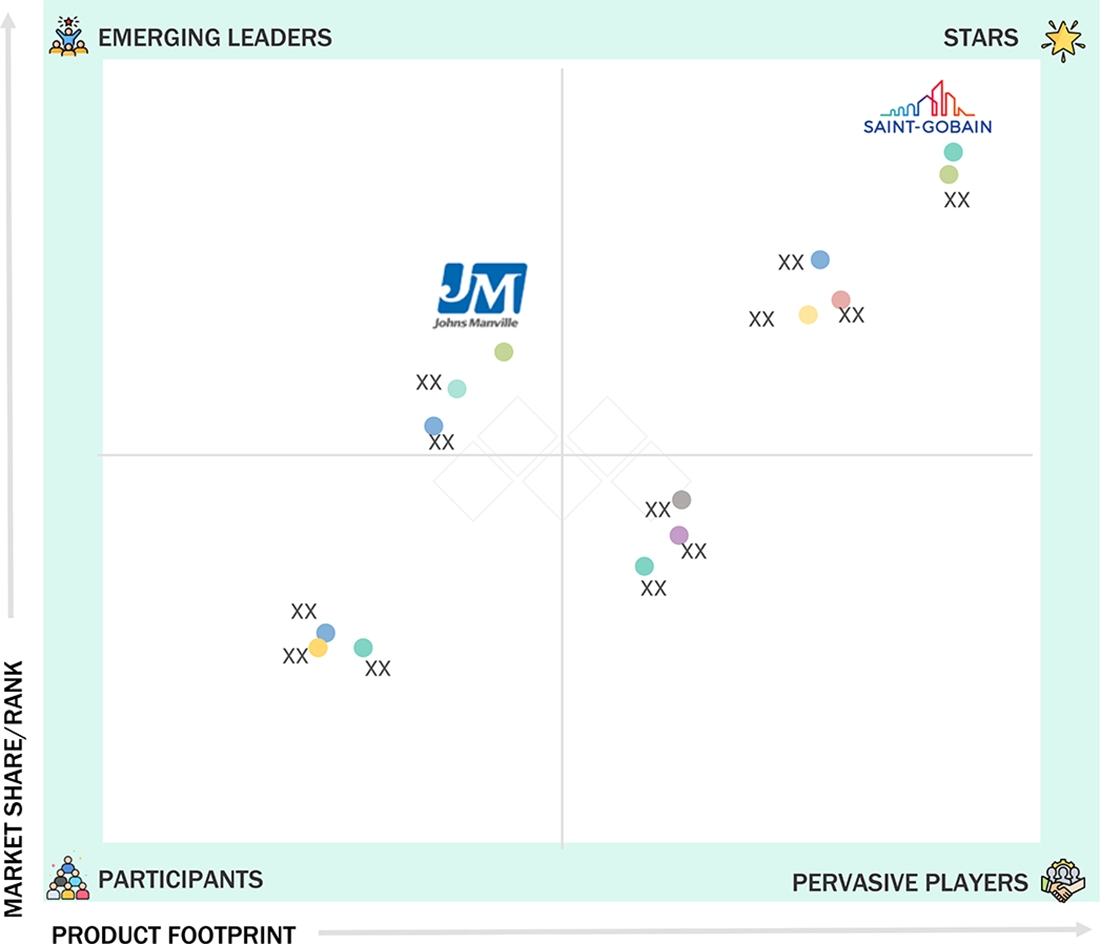
ACOUSTIC INSULATION MARKET: COMPANY EVALUATION MATRIX
In the acoustic insulation market matrix, Saint-Gobain (Star) leads with a strong market share and extensive product footprint, which enables them to serve the most regions. Johns Manville (Emerging Leader) is gaining visibility with its acoustic insulation products in acoustic insulation market, maintaing their position through innovation and niche offerings. While Saint-Gobain dominates through scale and a diverse portfolio, Johns Manville shows significant potential to move toward the leaders’ quadrant as demand for acoustic insulation is rising continuously.
Source: Secondary Research, Interviews with Experts, MarketsandMarkets Analysis
KEY MARKET PLAYERS
- Saint-Gobain (France)
- Knauf Insulation (US)
- Armacell (Germany)
- Rockwool A/S (Denmark)
- Soprema (France)
- Huntsman (US)
- Owens Corning (US)
- Kingspan Group (Ireland)
- BASF SE (Germany)
- Johns Manville (US)
MARKET SCOPE
| REPORT METRIC | DETAILS |
|---|---|
| Market Size in 2025 (Value) | USD 16.98 Billion |
| Market Forecast in 2031 (Value) | USD 23.04 Billion |
| CAGR | CAGR of 5.3% from 2026-2031 |
| Years Considered | 2023-2031 |
| Base Year | 2025 |
| Forecast Period | 2026-2031 |
| Units Considered | Value (USD Million/Billion), Volume (Kilotons) |
| Report Coverage | Revenue forecast, company ranking, competitive landscape, growth factors, and trends |
| Segments Covered |
|
| Regions Covered | North America, Asia Pacific, Europe, the Middle East & Africa, and South America |
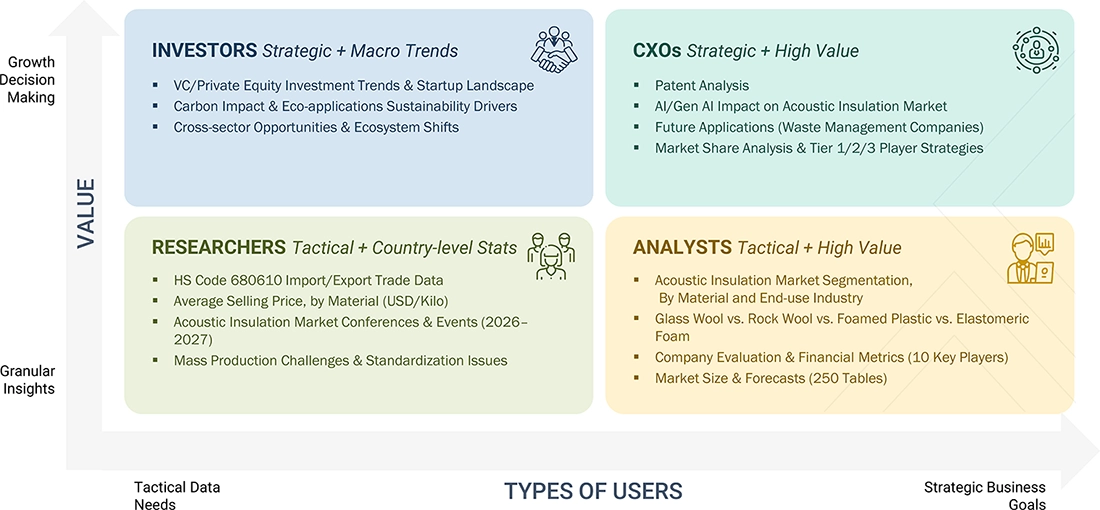
WHAT IS IN IT FOR YOU: ACOUSTIC INSULATION MARKET REPORT CONTENT GUIDE
DELIVERED CUSTOMIZATIONS
We have successfully delivered the following deep-dive customizations:
| CLIENT REQUEST | CUSTOMIZATION DELIVERED | VALUE ADDS |
|---|---|---|
| Asia Pacific based acoustic insulation materials manufacturer |
|
|
| Europe based acoustic insulation materials manufacturer |
|
|
RECENT DEVELOPMENTS
- January 2026 : Rockwool A/S announced plans to establish three new production facilities to expand stone wool manufacturing capacity and strengthen regional presence. The expansion includes development of a Rockfon acoustic ceiling tile facility in the US, supporting acoustic insulation solutions alongside broader insulation applications.
- April 2025 : Saint-Gobain increased production capacity for insulation and interior solutions, indirectly strengthening supply of acoustic insulation materials in Europe.
Table of Contents
 Exclusive indicates content/data unique to MarketsandMarkets and not available with any competitors.
TITLE
PAGE NO
1
INTRODUCTION
26
2
EXECUTIVE SUMMARY
31
3
PREMIUM INSIGHTS
36
4
MARKET OVERVIEW
Urbanization and regulations drive noise control market growth, despite high costs and installation challenges.
38
4.1
INTRODUCTION
4.2
MARKET DYNAMICS
4.2.1
DRIVERS
4.2.1.1
RAPID URBANIZATION AND INFRASTRUCTURE DEVELOPMENT
4.2.1.2
EXPANSION OF TRANSPORTATION AND INDUSTRIAL SECTORS INCREASES NOISE CONTROL REQUIREMENTS
4.2.1.3
STRINGENT BUILDING CODES AND NOISE REGULATIONS TO ACCELERATE MATERIAL ADOPTION
4.2.1.4
INCREASING AWARENESS OF NOISE POLLUTION AND ITS IMPACT ON HEALTH AND PRODUCTIVITY
4.2.2
RESTRAINTS
4.2.2.1
HIGH INITIAL COSTS AND LIMITED COST SENSITIVITY IN PRICE-DRIVEN MARKETS
4.2.2.2
PERFORMANCE VARIABILITY AND LACK OF STANDARDIZATION ACROSS APPLICATIONS
4.2.3
OPPORTUNITIES
4.2.3.1
GROWING RETROFIT AND RENOVATION ACTIVITIES TO CREATE NEW DEMAND AVENUES
4.2.3.2
ADVANCEMENTS IN MATERIAL TECHNOLOGY AND SUSTAINABLE SOLUTIONS
4.2.3.3
EXPANSION OF EMERGING ECONOMIES AND UNTAPPED REGIONAL MARKETS
4.2.4
CHALLENGES
4.2.4.1
COMPLEX INSTALLATION REQUIREMENTS AND DEPENDENCE ON SKILLED WORKFORCE
4.2.4.2
TRADE-OFF BETWEEN ACOUSTIC PERFORMANCE AND SPACE EFFICIENCY
4.3
UNMET NEEDS AND WHITE SPACES
4.3.1
UNMET NEEDS IN ACOUSTIC INSULATION MARKET
4.3.2
WHITE SPACE OPPORTUNITIES
4.4
INTERCONNECTED MARKETS AND CROSS-SECTOR OPPORTUNITIES
4.4.1
INTERCONNECTED MARKETS
4.4.2
CROSS-SECTOR OPPORTUNITIES
4.5
EMERGING BUSINESS MODELS AND ECOSYSTEM SHIFTS
4.5.1
EMERGING BUSINESS MODELS
4.5.2
ECOSYSTEM SHIFTS
4.6
STRATEGIC MOVES BY TIER-1/2/3 PLAYERS
4.6.1
KEY MOVES AND STRATEGIC FOCUS
5
INDUSTRY TRENDS
Navigate competitive pressures and pricing shifts with strategic insights on global acoustic insulation trends.
47
5.1
PORTER’S FIVE FORCES ANALYSIS
5.1.1
THREAT OF NEW ENTRANTS
5.1.2
THREAT OF SUBSTITUTES
5.1.3
BARGAINING POWER OF SUPPLIERS
5.1.4
BARGAINING POWER OF BUYERS
5.1.5
INTENSITY OF COMPETITIVE RIVALRY
5.2
MACROECONOMIC OUTLOOK
5.2.1
GLOBAL GDP TRENDS
5.3
VALUE CHAIN ANALYSIS
5.4
ECOSYSTEM ANALYSIS
5.5
PRICING ANALYSIS
5.5.1
AVERAGE SELLING PRICE TREND, BY REGION
5.5.2
AVERAGE SELLING PRICE TREND, BY MATERIAL
5.6
TRADE ANALYSIS
5.6.1
IMPORT SCENARIO (HS CODE 680610)
5.6.2
EXPORT SCENARIO (HS CODE 680610)
5.7
KEY CONFERENCES AND EVENTS
5.8
TRENDS AND DISRUPTIONS IMPACTING CUSTOMER BUSINESS
5.9
INVESTMENT AND FUNDING SCENARIO
5.10
CASE STUDY ANALYSIS
5.10.1
ACOUSTIC INSULATION IN HIGH-DENSITY RESIDENTIAL DEVELOPMENT
5.10.2
NOISE REDUCTION IN AUTOMOTIVE CABIN DESIGN
5.11
IMPACT OF 2025 US TARIFF – ACOUSTIC INSULATION MARKET
5.11.1
INTRODUCTION
5.11.2
KEY TARIFF RATES
5.11.3
PRICE IMPACT ANALYSIS
5.11.4
IMPACT ON REGIONS
5.11.4.1
NORTH AMERICA
5.11.4.2
EUROPE
5.11.4.3
ASIA PACIFIC
5.11.5
IMPACT ON END-USE INDUSTRIES
6
TECHNOLOGICAL ADVANCEMENTS, AI-DRIVEN IMPACT, PATENTS, AND INNOVATIONS
AI-driven innovations are transforming acoustic insulation with smart materials and predictive modeling.
64
6.1
KEY EMERGING TECHNOLOGIES
6.1.1
ACOUSTIC METAMATERIALS
6.1.2
AEROGEL-BASED ACOUSTIC INSULATION
6.2
COMPLEMENTARY TECHNOLOGIES
6.2.1
VIBRATION DAMPING MATERIALS
6.2.2
ACOUSTIC SEALANTS AND BARRIERS
6.3
ADJACENT TECHNOLOGIES
6.3.1
PHASE CHANGE MATERIAL (PCM)-INTEGRATED INSULATION SYSTEMS
6.3.2
MICRO-PERFORATED PANEL (MPP) TECHNOLOGY
6.4
TECHNOLOGY/PRODUCT ROADMAP
6.4.1
SHORT-TERM (2026–2027)
6.4.2
MID-TERM (2027–2030) | EXPANSION & STANDARDIZATION
6.4.3
LONG-TERM (2030–2035+)
6.5
PATENT ANALYSIS
6.5.1
APPROACH
6.5.2
DOCUMENT TYPE
6.5.3
TOP APPLICANTS
6.5.4
JURISDICTION ANALYSIS
6.6
IMPACT OF AI/GEN AI ON ACOUSTIC INSULATION MARKET
6.6.1
AI-DRIVEN MATERIAL DESIGN AND OPTIMIZATION
6.6.2
SMART MANUFACTURING AND PROCESS AUTOMATION
6.6.3
ACOUSTIC SIMULATION AND PREDICTIVE MODELING
6.6.4
SUPPLY CHAIN OPTIMIZATION AND MARKET INTELLIGENCE
7
REGULATORY LANDSCAPE AND SUSTAINABILITY INITIATIVES
Navigate complex regulations and drive sustainability with strategic eco-material and carbon reduction initiatives.
73
7.1
REGIONAL REGULATIONS AND COMPLIANCE
7.1.1
REGULATORY BODIES, GOVERNMENT AGENCIES, AND OTHER ORGANIZATIONS
7.1.2
INDUSTRY STANDARDS
7.2
REGULATORY POLICY INITIATIVES
7.2.1
SAFETY PROTOCOLS
7.2.2
SUSTAINABLE DEVELOPMENT
7.2.3
STANDARDIZATION
7.2.4
CIRCULAR ECONOMY
7.3
SUSTAINABILITY INITIATIVES
7.3.1
MATERIAL PERFORMANCE, ENVIRONMENT, AND SAFETY INITIATIVES
7.3.1.1
CARBON IMPACT REDUCTION AND ECO-MATERIAL STRATEGIES
7.3.1.2
ECO APPLICATIONS
7.4
SUSTAINABILITY IMPACT & REGULATORY POLICY INITIATIVES
7.5
CERTIFICATIONS, LABELING, AND ECO-STANDARDS
8
CUSTOMER LANDSCAPE & BUYER BEHAVIOR
Identify profit-boosting strategies by understanding key buying criteria and unmet industry needs.
81
8.1
DECISION-MAKING PROCESS
8.2
KEY STAKEHOLDERS AND BUYING CRITERIA
8.2.1
KEY STAKEHOLDERS IN BUYING PROCESS
8.2.2
BUYING CRITERIA
8.3
ADOPTION BARRIERS & INTERNAL CHALLENGES
8.4
UNMET NEEDS IN VARIOUS END-USE INDUSTRIES
8.5
MARKET PROFITABILITY
8.5.1
REVENUE POTENTIAL
8.5.2
COST DYNAMICS
8.5.3
MARGIN OPPORTUNITIES IN KEY END-USE INDUSTRIES
9
ACOUSTIC INSULATION MARKET, BY MATERIAL
Market Size & Growth Rate Forecast Analysis to 2031 in USD Million and Kilotons | 4 Data Tables
89
9.1
INTRODUCTION
9.2
GLASS WOOL
9.2.1
HIGH ACOUSTIC ABSORPTION EFFICIENCY AND COST-PERFORMANCE ADVANTAGE TO DRIVE DEMAND
9.3
ROCK WOOL
9.3.1
EXTENSIVE USE IN SOUND INSULATION TO PROPEL MARKET
9.4
FOAMED PLASTICS
9.4.1
RISING DEMAND FOR LIGHTWEIGHT AND THERMALLY EFFICIENT MATERIALS TO DRIVE ADOPTION
9.5
ELASTOMERIC FOAM
9.5.1
INCREASING HVAC SYSTEM DEPLOYMENT TO DRIVE DEMAND
9.6
OTHER MATERIALS
10
ACOUSTIC INSULATION MARKET, BY END-USE INDUSTRY
Market Size & Growth Rate Forecast Analysis to 2031 in USD Million and Kilotons | 4 Data Tables
95
10.1
INTRODUCTION
10.2
BUILDING & CONSTRUCTION
10.2.1
RAPID URBANIZATION AND STRINGENT BUILDING REGULATIONS TO DRIVE MARKET
10.3
TRANSPORTATION
10.3.1
INCREASING NOISE AND VIBRATION CONTROL REQUIREMENTS IN VEHICLES TO SUPPORT MARKET GROWTH
10.4
OIL & GAS AND PETROCHEMICAL
10.4.1
HIGH-INTENSITY OPERATIONAL NOISE AND STRINGENT SAFETY STANDARDS TO DRIVE DEMAND
10.5
ENERGY & UTILITIES
10.5.1
EXPANSION OF POWER GENERATION INFRASTRUCTURE AND NOISE COMPLIANCE REQUIREMENTS TO DRIVE MARKET
10.6
INDUSTRIAL & OEM
10.6.1
RISING INDUSTRIAL AUTOMATION AND EQUIPMENT NOISE CONTROL REQUIREMENTS TO PROPEL MARKET
11
ACOUSTIC INSULATION MARKET, BY REGION
Comprehensive coverage of 8 Regions with country-level deep-dive of 18 Countries | 180 Data Tables.
101
11.1
INTRODUCTION
11.2
NORTH AMERICA
11.2.1
US
11.2.1.1
STRONG ECONOMIC FOUNDATION TO SUPPORT MARKET GROWTH
11.2.2
CANADA
11.2.2.1
STRONG GROWTH IN CONSTRUCTION INDUSTRY TO FUEL MARKET GROWTH
11.2.3
MEXICO
11.2.3.1
FAVORABLE DEMOGRAPHICS AND INCREASING INVESTMENTS TO DRIVE MARKET
11.3
ASIA PACIFIC
11.3.1
CHINA
11.3.1.1
LARGEST ACOUSTIC INSULATION MARKET IN ASIA PACIFIC
11.3.2
JAPAN
11.3.2.1
STRONG AUTOMOTIVE INDUSTRY TO DRIVE MARKET GROWTH
11.3.3
SOUTH KOREA
11.3.3.1
STRONG ECONOMIC GROWTH TO DRIVE MARKET
11.3.4
INDIA
11.3.4.1
GROWTH IN POWER INDUSTRY TO PROPEL MARKET
11.3.5
AUSTRALIA
11.3.5.1
INCREASING INVESTMENTS IN CONSTRUCTION INDUSTRY TO DRIVE MARKET
11.3.6
ASEAN COUNTRIES
11.3.6.1
BOOMING CONSTRUCTION INDUSTRY TO DRIVE MARKET
11.3.7
REST OF ASIA PACIFIC
11.4
EUROPE
11.4.1
GERMANY
11.4.1.1
STRONG INDUSTRIAL BASE AND EVOLVING AUTOMOTIVE SECTOR TO DRIVE DEMAND
11.4.2
FRANCE
11.4.2.1
WELL-DEVELOPED INDUSTRIAL AND MANUFACTURING BASE TO SUPPORT MARKET GROWTH
11.4.3
UK
11.4.3.1
STRONG CONSTRUCTION ACTIVITY AND EVOLVING MOBILITY TRENDS TO DRIVE DEMAND
11.4.4
ITALY
11.4.4.1
CONSTRUCTION AND INDUSTRIAL ACTIVITIES TO SUPPORT DEMAND
11.4.5
SPAIN
11.4.5.1
EXPANDING CONSTRUCTION AND TRANSPORT INFRASTRUCTURE TO DRIVE DEMAND
11.4.6
NORDIC COUNTRIES
11.4.6.1
SUSTAINABILITY FOCUS AND SMART INFRASTRUCTURE TO DRIVE MARKET
11.4.7
BENELUX
11.4.7.1
GROWING COMMERCIAL SECTOR TO BOOST MARKET GROWTH
11.4.8
POLAND
11.4.8.1
STRONG END-USE INDUSTRY TO BOOST MARKET GROWTH
11.4.9
SWITZERLAND
11.4.9.1
ADVANCED ECONOMY AND CONTINUOUS INFRASTRUCTURE DEVELOPMENT TO PROPEL MARKET
11.4.10
REST OF EUROPE
11.5
MIDDLE EAST & AFRICA
11.5.1
GCC COUNTRIES
11.5.1.1
SAUDI ARABIA
11.5.1.1.1
HIGH INVESTMENTS IN CONSTRUCTION SECTOR TO FUEL MARKET
11.5.1.2
UAE
11.5.1.2.1
RISING INVESTMENTS IN ENERGY AND INFRASTRUCTURE TO DRIVE MARKET
11.5.1.3
REST OF GCC COUNTRIES
11.5.2
TURKEY
11.5.2.1
INCREASED INFRASTRUCTURE DEVELOPMENT TO BOOST MARKET GROWTH
11.5.3
REST OF MIDDLE EAST & AFRICA
11.6
SOUTH AMERICA
11.6.1
BRAZIL
11.6.1.1
RAPIDLY EXPANDING ECONOMY TO SUPPORT MARKET GROWTH
11.6.2
ARGENTINA
11.6.2.1
STRONG AUTOMOTIVE INDUSTRY TO PROPEL MARKET
11.6.3
REST OF SOUTH AMERICA
12
COMPETITIVE LANDSCAPE
Uncover strategic moves and market dominance of key players and startups shaping the future.
181
12.1
INTRODUCTION
12.2
KEY PLAYER STRATEGIES/RIGHT TO WIN, 2021–2025
12.3
REVENUE ANALYSIS, 2021–2025
12.4
MARKET SHARE ANALYSIS, 2025
12.5
BRAND COMPARISON
12.6
COMPANY EVALUATION MATRIX: KEY PLAYERS, 2025
12.6.1
STARS
12.6.2
EMERGING LEADERS
12.6.3
PERVASIVE PLAYERS
12.6.4
PARTICIPANTS
12.6.5
COMPANY FOOTPRINT: KEY PLAYERS, 2025
12.6.5.1
COMPANY FOOTPRINT
12.6.5.2
REGION FOOTPRINT
12.6.5.3
MATERIAL FOOTPRINT
12.6.5.4
END-USE INDUSTRY FOOTPRINT
12.7
COMPANY EVALUATION MATRIX: STARTUPS/SMES, 2025
12.7.1
PROGRESSIVE COMPANIES
12.7.2
RESPONSIVE COMPANIES
12.7.3
DYNAMIC COMPANIES
12.7.4
STARTING BLOCKS
12.7.5
COMPETITIVE BENCHMARKING: STARTUPS/SMES, 2025
12.7.5.1
DETAILED LIST OF KEY STARTUPS/SMES
12.7.5.2
COMPETITIVE BENCHMARKING OF KEY STARTUPS/SMES
12.8
COMPANY VALUATION & FINANCIAL METRICS
12.8.1
FINANCIAL METRICS
12.8.2
COMPANY VALUATION
12.8.3
ENTERPRISE VALUATION
12.9
COMPETITIVE SCENARIO
12.9.1
PRODUCT LAUNCHES
12.9.2
DEALS
12.9.3
EXPANSIONS
13
COMPANY PROFILES
In-depth Company Profiles of Leading Market Players with detailed Business Overview, Product and Service Portfolio, Recent Developments, and Unique Analyst Perspective (MnM View)
200
13.1
KEY PLAYERS
13.1.1
SAINT-GOBAIN
13.1.1.1
BUSINESS OVERVIEW
13.1.1.2
PRODUCTS/SOLUTIONS/SERVICES OFFERED
13.1.1.3
RECENT DEVELOPMENTS
13.1.1.3.1
PRODUCT LAUNCHES
13.1.1.3.2
EXPANSIONS
13.1.1.3.3
DEALS
13.1.1.4
MNM VIEW
13.1.1.4.1
RIGHT TO WIN
13.1.1.4.2
STRATEGIC CHOICES
13.1.1.4.3
WEAKNESSES AND COMPETITIVE THREATS
13.1.2
KNAUF INSULATION
13.1.3
ARMACELL
13.1.4
SOPREMA
13.1.5
ROCKWOOL A/S
13.1.6
HUNTSMAN INTERNATIONAL LLC
13.1.7
OWENS CORNING
13.1.8
KINGSPAN GROUP
13.1.9
BASF SE
13.1.10
JOHNS MANVILLE
13.2
OTHER PLAYERS
13.2.1
GETZNER WERKSTOFFE GMBH
13.2.2
CELLOFOAM INTERNATIONAL GMBH & CO. KG
13.2.3
REGUPOL GERMANY GMBH & CO. KG
13.2.4
3M
13.2.5
TRELLEBORG
13.2.6
L'ISOLANTE K-FLEX S.P.A.
13.2.7
DOW
13.2.8
SIDERISE
13.2.9
CABOT CORPORATION
13.2.10
FLETCHER INSULATION
13.2.11
HUSH ACOUSTICS
13.2.12
PRIMACOUSTIC
13.2.13
TROCELLEN
13.2.14
CELLECTA
13.2.15
INTERNATIONAL CELLULOSE CORPORATION
14
RESEARCH METHODOLOGY
242
14.1
RESEARCH DATA
14.1.1
SECONDARY DATA
14.1.1.1
KEY DATA FROM SECONDARY SOURCES
14.1.2
PRIMARY DATA
14.1.2.1
KEY DATA FROM PRIMARY SOURCES
14.1.2.2
KEY INDUSTRY INSIGHTS
14.1.2.3
BREAKDOWN OF PRIMARY INTERVIEWS
14.2
MARKET SIZE ESTIMATION
14.2.1
BOTTOM-UP APPROACH
14.2.2
TOP-DOWN APPROACH
14.3
DATA TRIANGULATION
14.4
STUDY ASSUMPTIONS
14.5
RESEARCH LIMITATIONS
15
APPENDIX
249
15.1
DISCUSSION GUIDE
15.2
KNOWLEDGESTORE: MARKETSANDMARKETS’ SUBSCRIPTION PORTAL
15.3
CUSTOMIZATION OPTIONS
15.4
RELATED REPORTS
15.5
AUTHOR DETAILS
LIST OF TABLES
TABLE 1
ACOUSTIC INSULATION MARKET: PORTER’S FIVE FORCES ANALYSIS
TABLE 2
PROJECTED REAL GDP GROWTH (ANNUAL PERCENT CHANGE) OF KEY COUNTRIES, 2021–2030
TABLE 3
ROLE OF COMPANIES IN ECOSYSTEM
TABLE 4
AVERAGE SELLING PRICE TREND, BY REGION, 2023–2025 (USD/KG)
TABLE 5
AVERAGE SELLING PRICE TREND, BY MATERIAL, 2023–2025 (USD/KG)
TABLE 6
IMPORT DATA FOR HS CODE 680610-COMPLIANT PRODUCTS, BY COUNTRY, 2021–2025 (USD MILLION)
TABLE 7
EXPORT DATA FOR HS CODE 680610-COMPLIANT PRODUCTS, BY COUNTRY, 2021–2025 (USD MILLION)
TABLE 8
KEY CONFERENCES AND EVENTS, 2026–2027
TABLE 9
INVESTMENT AND FUNDING SCENARIO, 2022–2026 (USD MILLION)
TABLE 10
US-ADJUSTED RECIPROCAL TARIFF RATES
TABLE 11
PATENT STATUS: PATENT APPLICATIONS AND GRANTED PATENTS
TABLE 12
MAJOR PATENTS FOR ACOUSTIC INSULATION
TABLE 13
PATENTS BY AT&T INTELLECTUAL PROPERTY
TABLE 14
PATENTS BY COCHLEAR
TABLE 15
TOP 10 PATENT OWNERS IN US, 2015–2025
TABLE 16
NORTH AMERICA: REGULATORY BODIES, GOVERNMENT AGENCIES, AND OTHER ORGANIZATIONS
TABLE 17
EUROPE: REGULATORY BODIES, GOVERNMENT AGENCIES, AND OTHER ORGANIZATIONS
TABLE 18
ASIA PACIFIC: REGULATORY BODIES, GOVERNMENT AGENCIES, AND OTHER ORGANIZATIONS
TABLE 19
MIDDLE EAST & AFRICA: REGULATORY BODIES, GOVERNMENT AGENCIES, AND OTHER ORGANIZATIONS
TABLE 20
SOUTH AMERICA: REGULATORY BODIES, GOVERNMENT AGENCIES, AND OTHER ORGANIZATIONS
TABLE 21
GLOBAL STANDARDS IN ACOUSTIC INSULATION MARKET
TABLE 22
CERTIFICATIONS, LABELING, AND ECO-STANDARDS IN ACOUSTIC INSULATION MARKET
TABLE 23
INFLUENCE OF STAKEHOLDERS ON BUYING PROCESS, BY END-USE INDUSTRY (%)
TABLE 24
KEY BUYING CRITERIA, BY END-USE FACILITY
TABLE 25
ACOUSTIC INSULATION MARKET: UNMET NEEDS IN KEY END-USE INDUSTRIES
TABLE 26
ACOUSTIC INSULATION MARKET, BY MATERIAL, 2023–2025 (USD MILLION)
TABLE 27
ACOUSTIC INSULATION MARKET, BY MATERIAL, 2026–2031 (USD MILLION)
TABLE 28
ACOUSTIC INSULATION MARKET, BY MATERIAL, 2023–2025 (KILOTON)
TABLE 29
ACOUSTIC INSULATION MARKET, BY MATERIAL, 2026–2031 (KILOTON)
TABLE 30
ACOUSTIC INSULATION MARKET, BY END-USE INDUSTRY, 2023–2025 (USD MILLION)
TABLE 31
ACOUSTIC INSULATION MARKET, BY END-USE INDUSTRY, 2026–2031 (USD MILLION)
TABLE 32
ACOUSTIC INSULATION MARKET, BY END-USE INDUSTRY, 2023–2025 (KILOTON)
TABLE 33
ACOUSTIC INSULATION MARKET, BY END-USE INDUSTRY, 2026–2031 (KILOTON)
TABLE 34
ACOUSTIC INSULATION MARKET, BY REGION, 2023–2025 (USD MILLION)
TABLE 35
ACOUSTIC INSULATION MARKET, BY REGION, 2026–2031 (USD MILLION)
TABLE 36
ACOUSTIC INSULATION MARKET, BY REGION, 2023–2025 (KILOTON)
TABLE 37
ACOUSTIC INSULATION MARKET, BY REGION, 2026–2031 (KILOTON)
TABLE 38
NORTH AMERICA: ACOUSTIC INSULATION MARKET, BY COUNTRY, 2023–2025 (USD MILLION)
TABLE 39
NORTH AMERICA: ACOUSTIC INSULATION MARKET, BY COUNTRY, 2026–2031 (USD MILLION)
TABLE 40
NORTH AMERICA: ACOUSTIC INSULATION MARKET, BY COUNTRY, 2023–2025 (KILOTON)
TABLE 41
NORTH AMERICA: ACOUSTIC INSULATION MARKET, BY COUNTRY, 2026–2031 (KILOTON)
TABLE 42
NORTH AMERICA: ACOUSTIC INSULATION MARKET, BY MATERIAL, 2023–2025 (USD MILLION)
TABLE 43
NORTH AMERICA: ACOUSTIC INSULATION MARKET, BY MATERIAL, 2026–2031 (USD MILLION)
TABLE 44
NORTH AMERICA: ACOUSTIC INSULATION MARKET, BY MATERIAL, 2023–2025 (KILOTON)
TABLE 45
NORTH AMERICA: ACOUSTIC INSULATION MARKET, BY MATERIAL, 2026–2031 (KILOTON)
TABLE 46
NORTH AMERICA: ACOUSTIC INSULATION MARKET, BY END-USE INDUSTRY, 2023–2025 (USD MILLION)
TABLE 47
NORTH AMERICA: ACOUSTIC INSULATION MARKET, BY END-USE INDUSTRY, 2026–2031 (USD MILLION)
TABLE 48
NORTH AMERICA: ACOUSTIC INSULATION MARKET, BY END-USE INDUSTRY, 2023–2025 (KILOTON)
TABLE 49
NORTH AMERICA: ACOUSTIC INSULATION MARKET, BY END-USE INDUSTRY, 2026–2031 (KILOTON)
TABLE 50
US: ACOUSTIC INSULATION MARKET, BY END-USE INDUSTRY, 2023–2025 (USD MILLION)
TABLE 51
US: ACOUSTIC INSULATION MARKET, BY END-USE INDUSTRY, 2026–2031 (USD MILLION)
TABLE 52
US: ACOUSTIC INSULATION MARKET, BY END-USE INDUSTRY, 2023–2025 (KILOTON)
TABLE 53
US: ACOUSTIC INSULATION MARKET, BY END-USE INDUSTRY, 2026–2031 (KILOTON)
TABLE 54
CANADA: ACOUSTIC INSULATION MARKET, BY END-USE INDUSTRY, 2023–2025 (USD MILLION)
TABLE 55
CANADA: ACOUSTIC INSULATION MARKET, BY END-USE INDUSTRY, 2026–2031 (USD MILLION)
TABLE 56
CANADA: ACOUSTIC INSULATION MARKET, BY END-USE INDUSTRY, 2023–2025 (KILOTON)
TABLE 57
CANADA: ACOUSTIC INSULATION MARKET, BY END-USE INDUSTRY, 2026–2031 (KILOTON)
TABLE 58
MEXICO: ACOUSTIC INSULATION MARKET, BY END-USE INDUSTRY, 2023–2025 (USD MILLION)
TABLE 59
MEXICO: ACOUSTIC INSULATION MARKET, BY END-USE INDUSTRY, 2026–2031 (USD MILLION)
TABLE 60
MEXICO: ACOUSTIC INSULATION MARKET, BY END-USE INDUSTRY, 2023–2025 (KILOTON)
TABLE 61
MEXICO: ACOUSTIC INSULATION MARKET, BY END-USE INDUSTRY, 2026–2031 (KILOTON)
TABLE 62
ASIA PACIFIC: ACOUSTIC INSULATION MARKET, BY COUNTRY, 2023–2025 (USD MILLION)
TABLE 63
ASIA PACIFIC: ACOUSTIC INSULATION MARKET, BY COUNTRY, 2026–2031 (USD MILLION)
TABLE 64
ASIA PACIFIC: ACOUSTIC INSULATION MARKET, BY COUNTRY, 2023–2025 (KILOTON)
TABLE 65
ASIA PACIFIC: ACOUSTIC INSULATION MARKET, BY COUNTRY, 2026–2031 (KILOTON)
TABLE 66
ASIA PACIFIC: ACOUSTIC INSULATION MARKET, BY MATERIAL, 2023–2025 (USD MILLION)
TABLE 67
ASIA PACIFIC: ACOUSTIC INSULATION MARKET, BY MATERIAL, 2026–2031 (USD MILLION)
TABLE 68
ASIA PACIFIC: ACOUSTIC INSULATION MARKET, BY MATERIAL, 2023–2025 (KILOTON)
TABLE 69
ASIA PACIFIC: ACOUSTIC INSULATION MARKET, BY MATERIAL, 2026–2031 (KILOTON)
TABLE 70
ASIA PACIFIC: ACOUSTIC INSULATION MARKET, BY END-USE INDUSTRY, 2023–2025 (USD MILLION)
TABLE 71
ASIA PACIFIC: ACOUSTIC INSULATION MARKET, BY END-USE INDUSTRY, 2026–2031 (USD MILLION)
TABLE 72
ASIA PACIFIC: ACOUSTIC INSULATION MARKET, BY END-USE INDUSTRY, 2023–2025 (KILOTON)
TABLE 73
ASIA PACIFIC: ACOUSTIC INSULATION MARKET, BY END-USE INDUSTRY, 2026–2031 (KILOTON)
TABLE 74
CHINA: ACOUSTIC INSULATION MARKET, BY END-USE INDUSTRY, 2023–2025 (USD MILLION)
TABLE 75
CHINA: ACOUSTIC INSULATION MARKET, BY END-USE INDUSTRY, 2026–2031 (USD MILLION)
TABLE 76
CHINA: ACOUSTIC INSULATION MARKET, BY END-USE INDUSTRY, 2023–2025 (KILOTON)
TABLE 77
CHINA: ACOUSTIC INSULATION MARKET, BY END-USE INDUSTRY, 2026–2031 (KILOTON)
TABLE 78
JAPAN: ACOUSTIC INSULATION MARKET, BY END-USE INDUSTRY, 2023–2025 (USD MILLION)
TABLE 79
JAPAN: ACOUSTIC INSULATION MARKET, BY END-USE INDUSTRY, 2026–2031 (USD MILLION)
TABLE 80
JAPAN: ACOUSTIC INSULATION MARKET, BY END-USE INDUSTRY, 2023–2025 (KILOTON)
TABLE 81
JAPAN: ACOUSTIC INSULATION MARKET, BY END-USE INDUSTRY, 2026–2031 (KILOTON)
TABLE 82
SOUTH KOREA: ACOUSTIC INSULATION MARKET, BY END-USE INDUSTRY, 2023–2025 (USD MILLION)
TABLE 83
SOUTH KOREA: ACOUSTIC INSULATION MARKET, BY END-USE INDUSTRY, 2026–2031 (USD MILLION)
TABLE 84
SOUTH KOREA: ACOUSTIC INSULATION MARKET, BY END-USE INDUSTRY, 2023–2025 (KILOTON)
TABLE 85
SOUTH KOREA: ACOUSTIC INSULATION MARKET, BY END-USE INDUSTRY, 2026–2031 (KILOTON)
TABLE 86
INDIA: ACOUSTIC INSULATION MARKET, BY END-USE INDUSTRY, 2023–2025 (USD MILLION)
TABLE 87
INDIA: ACOUSTIC INSULATION MARKET, BY END-USE INDUSTRY, 2026–2031 (USD MILLION)
TABLE 88
INDIA: ACOUSTIC INSULATION MARKET, BY END-USE INDUSTRY, 2023–2025 (KILOTON)
TABLE 89
INDIA: ACOUSTIC INSULATION MARKET, BY END-USE INDUSTRY, 2026–2031 (KILOTON)
TABLE 90
AUSTRALIA: ACOUSTIC INSULATION MARKET, BY END-USE INDUSTRY, 2023–2025 (USD MILLION)
TABLE 91
AUSTRALIA: ACOUSTIC INSULATION MARKET, BY END-USE INDUSTRY, 2026–2031 (USD MILLION)
TABLE 92
AUSTRALIA: ACOUSTIC INSULATION MARKET, BY END-USE INDUSTRY, 2023–2025 (KILOTON)
TABLE 93
AUSTRALIA: ACOUSTIC INSULATION MARKET, BY END-USE INDUSTRY, 2026–2031 (KILOTON)
TABLE 94
ASEAN COUNTRIES: ACOUSTIC INSULATION MARKET, BY END-USE INDUSTRY, 2023–2025 (USD MILLION)
TABLE 95
ASEAN COUNTRIES: ACOUSTIC INSULATION MARKET, BY END-USE INDUSTRY, 2026–2031 (USD MILLION)
TABLE 96
ASEAN COUNTRIES: ACOUSTIC INSULATION MARKET, BY END-USE INDUSTRY, 2023–2025 (KILOTON)
TABLE 97
ASEAN COUNTRIES: ACOUSTIC INSULATION MARKET, BY END-USE INDUSTRY, 2026–2031 (KILOTON)
TABLE 98
REST OF ASIA PACIFIC: ACOUSTIC INSULATION MARKET, BY END-USE INDUSTRY, 2023–2025 (USD MILLION)
TABLE 99
REST OF ASIA PACIFIC: ACOUSTIC INSULATION MARKET, BY END-USE INDUSTRY, 2026–2031 (USD MILLION)
TABLE 100
REST OF ASIA PACIFIC: ACOUSTIC INSULATION MARKET, BY END-USE INDUSTRY, 2023–2025 (KILOTON)
TABLE 101
REST OF ASIA PACIFIC: ACOUSTIC INSULATION MARKET, BY END-USE INDUSTRY, 2026–2031 (KILOTON)
TABLE 102
EUROPE: ACOUSTIC INSULATION MARKET, BY COUNTRY, 2023–2025 (USD MILLION)
TABLE 103
EUROPE: ACOUSTIC INSULATION MARKET, BY COUNTRY, 2026–2031 (USD MILLION)
TABLE 104
EUROPE: ACOUSTIC INSULATION MARKET, BY COUNTRY, 2023–2025 (KILOTON)
TABLE 105
EUROPE: ACOUSTIC INSULATION MARKET, BY COUNTRY, 2026–2031 (KILOTON)
TABLE 106
EUROPE: ACOUSTIC INSULATION MARKET, BY MATERIAL, 2023–2025 (USD MILLION)
TABLE 107
EUROPE: ACOUSTIC INSULATION MARKET, BY MATERIAL, 2026–2031 (USD MILLION)
TABLE 108
EUROPE: ACOUSTIC INSULATION MARKET, BY MATERIAL, 2023–2025 (KILOTON)
TABLE 109
EUROPE: ACOUSTIC INSULATION MARKET, BY MATERIAL, 2026–2031 (KILOTON)
TABLE 110
EUROPE: ACOUSTIC INSULATION MARKET, BY END-USE INDUSTRY, 2023–2025 (USD MILLION)
TABLE 111
EUROPE: ACOUSTIC INSULATION MARKET, BY END-USE INDUSTRY, 2026–2031 (USD MILLION)
TABLE 112
EUROPE: ACOUSTIC INSULATION MARKET, BY END-USE INDUSTRY, 2023–2025 (KILOTON)
TABLE 113
EUROPE: ACOUSTIC INSULATION MARKET, BY END-USE INDUSTRY, 2026–2031 (KILOTON)
TABLE 114
GERMANY: ACOUSTIC INSULATION MARKET, BY END-USE INDUSTRY, 2023–2025 (USD MILLION)
TABLE 115
GERMANY: ACOUSTIC INSULATION MARKET, BY END-USE INDUSTRY, 2026–2031 (USD MILLION)
TABLE 116
GERMANY: ACOUSTIC INSULATION MARKET, BY END-USE INDUSTRY, 2023–2025 (KILOTON)
TABLE 117
GERMANY: ACOUSTIC INSULATION MARKET, BY END-USE INDUSTRY, 2026–2031 (KILOTON)
TABLE 118
FRANCE: ACOUSTIC INSULATION MARKET, BY END-USE INDUSTRY, 2023–2025 (USD MILLION)
TABLE 119
FRANCE: ACOUSTIC INSULATION MARKET, BY END-USE INDUSTRY, 2026–2031 (USD MILLION)
TABLE 120
FRANCE: ACOUSTIC INSULATION MARKET, BY END-USE INDUSTRY, 2023–2025 (KILOTON)
TABLE 121
FRANCE: ACOUSTIC INSULATION MARKET, BY END-USE INDUSTRY, 2026–2031 (KILOTON)
TABLE 122
UK: ACOUSTIC INSULATION MARKET, BY END-USE INDUSTRY, 2023–2025 (USD MILLION)
TABLE 123
UK: ACOUSTIC INSULATION MARKET, BY END-USE INDUSTRY, 2026–2031 (USD MILLION)
TABLE 124
UK: ACOUSTIC INSULATION MARKET, BY END-USE INDUSTRY, 2023–2025 (KILOTON)
TABLE 125
UK: ACOUSTIC INSULATION MARKET, BY END-USE INDUSTRY, 2026–2031 (KILOTON)
TABLE 126
ITALY: ACOUSTIC INSULATION MARKET, BY END-USE INDUSTRY, 2023–2025 (USD MILLION)
TABLE 127
ITALY: ACOUSTIC INSULATION MARKET, BY END-USE INDUSTRY, 2026–2031 (USD MILLION)
TABLE 128
ITALY: ACOUSTIC INSULATION MARKET, BY END-USE INDUSTRY, 2023–2025 (KILOTON)
TABLE 129
ITALY: ACOUSTIC INSULATION MARKET, BY END-USE INDUSTRY, 2026–2031 (KILOTON)
TABLE 130
SPAIN: ACOUSTIC INSULATION MARKET, BY END-USE INDUSTRY, 2023–2025 (USD MILLION)
TABLE 131
SPAIN: ACOUSTIC INSULATION MARKET, BY END-USE INDUSTRY, 2026–2031 (USD MILLION)
TABLE 132
SPAIN: ACOUSTIC INSULATION MARKET, BY END-USE INDUSTRY, 2023–2025 (KILOTON)
TABLE 133
SPAIN: ACOUSTIC INSULATION MARKET, BY END-USE INDUSTRY, 2026–2031 (KILOTON)
TABLE 134
NORDIC COUNTRIES: ACOUSTIC INSULATION MARKET, BY END-USE INDUSTRY, 2023–2025 (USD MILLION)
TABLE 135
NORDIC COUNTRIES: ACOUSTIC INSULATION MARKET, BY END-USE INDUSTRY, 2026–2031 (USD MILLION)
TABLE 136
NORDIC COUNTRIES: ACOUSTIC INSULATION MARKET, BY END-USE INDUSTRY, 2023–2025 (KILOTON)
TABLE 137
NORDIC COUNTRIES: ACOUSTIC INSULATION MARKET, BY END-USE INDUSTRY, 2026–2031 (KILOTON)
TABLE 138
BENELUX: ACOUSTIC INSULATION MARKET, BY END-USE INDUSTRY, 2023–2025 (USD MILLION)
TABLE 139
BENELUX: ACOUSTIC INSULATION MARKET, BY END-USE INDUSTRY, 2026–2031 (USD MILLION)
TABLE 140
BENELUX: ACOUSTIC INSULATION MARKET, BY END-USE INDUSTRY, 2023–2025 (KILOTON)
TABLE 141
BENELUX: ACOUSTIC INSULATION MARKET, BY END-USE INDUSTRY, 2026–2031 (KILOTON)
TABLE 142
POLAND: ACOUSTIC INSULATION MARKET, BY END-USE INDUSTRY, 2023–2025 (USD MILLION)
TABLE 143
POLAND: ACOUSTIC INSULATION MARKET, BY END-USE INDUSTRY, 2026–2031 (USD MILLION)
TABLE 144
POLAND: ACOUSTIC INSULATION MARKET, BY END-USE INDUSTRY, 2023–2025 (KILOTON)
TABLE 145
POLAND: ACOUSTIC INSULATION MARKET, BY END-USE INDUSTRY, 2026–2031 (KILOTON)
TABLE 146
SWITZERLAND: ACOUSTIC INSULATION MARKET, BY END-USE INDUSTRY, 2023–2025 (USD MILLION)
TABLE 147
SWITZERLAND: ACOUSTIC INSULATION MARKET, BY END-USE INDUSTRY, 2026–2031 (USD MILLION)
TABLE 148
SWITZERLAND: ACOUSTIC INSULATION MARKET, BY END-USE INDUSTRY, 2023–2025 (KILOTON)
TABLE 149
SWITZERLAND: ACOUSTIC INSULATION MARKET, BY END-USE INDUSTRY, 2026–2031 (KILOTON)
TABLE 150
REST OF EUROPE: ACOUSTIC INSULATION MARKET, BY END-USE INDUSTRY, 2023–2025 (USD MILLION)
TABLE 151
REST OF EUROPE: ACOUSTIC INSULATION MARKET, BY END-USE INDUSTRY, 2026–2031 (USD MILLION)
TABLE 152
REST OF EUROPE: ACOUSTIC INSULATION MARKET, BY END-USE INDUSTRY, 2023–2025 (KILOTON)
TABLE 153
REST OF EUROPE: ACOUSTIC INSULATION MARKET, BY END-USE INDUSTRY, 2026–2031 (KILOTON)
TABLE 154
MIDDLE EAST & AFRICA: ACOUSTIC INSULATION MARKET, BY COUNTRY, 2023–2025 (USD MILLION)
TABLE 155
MIDDLE EAST & AFRICA: ACOUSTIC INSULATION MARKET, BY COUNTRY, 2026–2031 (USD MILLION)
TABLE 156
MIDDLE EAST & AFRICA: ACOUSTIC INSULATION MARKET, BY COUNTRY, 2023–2025 (KILOTON)
TABLE 157
MIDDLE EAST & AFRICA: ACOUSTIC INSULATION MARKET, BY COUNTRY, 2026–2031 (KILOTON)
TABLE 158
MIDDLE EAST & AFRICA: ACOUSTIC INSULATION MARKET, BY MATERIAL, 2023–2025 (USD MILLION)
TABLE 159
MIDDLE EAST & AFRICA: ACOUSTIC INSULATION MARKET, BY MATERIAL, 2026–2031 (USD MILLION)
TABLE 160
MIDDLE EAST & AFRICA: ACOUSTIC INSULATION MARKET, BY MATERIAL, 2023–2025 (KILOTON)
TABLE 161
MIDDLE EAST & AFRICA: ACOUSTIC INSULATION MARKET, BY MATERIAL, 2026–2031 (KILOTON)
TABLE 162
MIDDLE EAST & AFRICA: ACOUSTIC INSULATION MARKET, BY END-USE INDUSTRY, 2023–2025 (USD MILLION)
TABLE 163
MIDDLE EAST & AFRICA: ACOUSTIC INSULATION MARKET, BY END-USE INDUSTRY, 2026–2031 (USD MILLION)
TABLE 164
MIDDLE EAST & AFRICA: ACOUSTIC INSULATION MARKET, BY END-USE INDUSTRY, 2023–2025 (KILOTON)
TABLE 165
MIDDLE EAST & AFRICA: ACOUSTIC INSULATION MARKET, BY END-USE INDUSTRY, 2026–2031 (KILOTON)
TABLE 166
GCC COUNTRIES: ACOUSTIC INSULATION MARKET, BY END-USE INDUSTRY, 2023–2025 (USD MILLION)
TABLE 167
GCC COUNTRIES: ACOUSTIC INSULATION MARKET, BY END-USE INDUSTRY, 2026–2031 (USD MILLION)
TABLE 168
GCC COUNTRIES: ACOUSTIC INSULATION MARKET, BY END-USE INDUSTRY, 2023–2025 (KILOTON)
TABLE 169
GCC COUNTRIES: ACOUSTIC INSULATION MARKET, BY END-USE INDUSTRY, 2026–2031 (KILOTON)
TABLE 170
SAUDI ARABIA: ACOUSTIC INSULATION MARKET, BY END-USE INDUSTRY, 2023–2025 (USD MILLION)
TABLE 171
SAUDI ARABIA: ACOUSTIC INSULATION MARKET, BY END-USE INDUSTRY, 2026–2031 (USD MILLION)
TABLE 172
SAUDI ARABIA: ACOUSTIC INSULATION MARKET, BY END-USE INDUSTRY, 2023–2025 (KILOTON)
TABLE 173
SAUDI ARABIA: ACOUSTIC INSULATION MARKET, BY END-USE INDUSTRY, 2026–2031 (KILOTON)
TABLE 174
UAE: ACOUSTIC INSULATION MARKET, BY END-USE INDUSTRY, 2023–2025 (USD MILLION)
TABLE 175
UAE: ACOUSTIC INSULATION MARKET, BY END-USE INDUSTRY, 2026–2031 (USD MILLION)
TABLE 176
UAE: ACOUSTIC INSULATION MARKET, BY END-USE INDUSTRY, 2023–2025 (KILOTON)
TABLE 177
UAE: ACOUSTIC INSULATION MARKET, BY END-USE INDUSTRY, 2026–2031 (KILOTON)
TABLE 178
REST OF GCC COUNTRIES: ACOUSTIC INSULATION MARKET, BY END-USE INDUSTRY, 2023–2025 (USD MILLION)
TABLE 179
REST OF GCC COUNTRIES: ACOUSTIC INSULATION MARKET, BY END-USE INDUSTRY, 2026–2031 (USD MILLION)
TABLE 180
REST OF GCC COUNTRIES: ACOUSTIC INSULATION MARKET, BY END-USE INDUSTRY, 2023–2025 (KILOTON)
TABLE 181
REST OF GCC COUNTRIES: ACOUSTIC INSULATION MARKET, BY END-USE INDUSTRY, 2026–2031 (KILOTON)
TABLE 182
TURKEY: ACOUSTIC INSULATION MARKET, BY END-USE INDUSTRY, 2023–2025 (USD MILLION)
TABLE 183
TURKEY: ACOUSTIC INSULATION MARKET, BY END-USE INDUSTRY, 2026–2031 (USD MILLION)
TABLE 184
TURKEY: ACOUSTIC INSULATION MARKET, BY END-USE INDUSTRY, 2023–2025 (KILOTON)
TABLE 185
TURKEY: ACOUSTIC INSULATION MARKET, BY END-USE INDUSTRY, 2026–2031 (KILOTON)
TABLE 186
REST OF MIDDLE EAST & AFRICA: ACOUSTIC INSULATION MARKET, BY END-USE INDUSTRY, 2023–2025 (USD MILLION)
TABLE 187
REST OF MIDDLE EAST & AFRICA: ACOUSTIC INSULATION MARKET, BY END-USE INDUSTRY, 2026–2031 (USD MILLION)
TABLE 188
REST OF MIDDLE EAST & AFRICA: ACOUSTIC INSULATION MARKET, BY END-USE INDUSTRY, 2023–2025 (KILOTON)
TABLE 189
REST OF MIDDLE EAST & AFRICA: ACOUSTIC INSULATION MARKET, BY END-USE INDUSTRY, 2026–2031 (KILOTON)
TABLE 190
SOUTH AMERICA: ACOUSTIC INSULATION MARKET, BY COUNTRY, 2023–2025 (USD MILLION)
TABLE 191
SOUTH AMERICA: ACOUSTIC INSULATION MARKET, BY COUNTRY, 2026–2031 (USD MILLION)
TABLE 192
SOUTH AMERICA: ACOUSTIC INSULATION MARKET, BY COUNTRY, 2023–2025 (KILOTON)
TABLE 193
SOUTH AMERICA: ACOUSTIC INSULATION MARKET, BY COUNTRY, 2026–2031 (KILOTON)
TABLE 194
SOUTH AMERICA: ACOUSTIC INSULATION MARKET, BY MATERIAL, 2023–2025 (USD MILLION)
TABLE 195
SOUTH AMERICA: ACOUSTIC INSULATION MARKET, BY MATERIAL, 2026–2031 (USD MILLION)
TABLE 196
SOUTH AMERICA: ACOUSTIC INSULATION MARKET, BY MATERIAL, 2023–2025 (KILOTON)
TABLE 197
SOUTH AMERICA: ACOUSTIC INSULATION MARKET, BY MATERIAL, 2026–2031 (KILOTON)
TABLE 198
SOUTH AMERICA: ACOUSTIC INSULATION MARKET, BY END-USE INDUSTRY, 2023–2025 (USD MILLION)
TABLE 199
SOUTH AMERICA: ACOUSTIC INSULATION MARKET, BY END-USE INDUSTRY, 2026–2031 (USD MILLION)
TABLE 200
SOUTH AMERICA: ACOUSTIC INSULATION MARKET, BY END-USE INDUSTRY, 2023–2025 (KILOTON)
TABLE 201
SOUTH AMERICA: ACOUSTIC INSULATION MARKET, BY END-USE INDUSTRY, 2026–2031 (KILOTON)
TABLE 202
BRAZIL: ACOUSTIC INSULATION MARKET, BY END-USE INDUSTRY, 2023–2025 (USD MILLION)
TABLE 203
BRAZIL: ACOUSTIC INSULATION MARKET, BY END-USE INDUSTRY, 2026–2031 (USD MILLION)
TABLE 204
BRAZIL: ACOUSTIC INSULATION MARKET, BY END-USE INDUSTRY, 2023–2025 (KILOTON)
TABLE 205
BRAZIL: ACOUSTIC INSULATION MARKET, BY END-USE INDUSTRY, 2026–2031 (KILOTON)
TABLE 206
ARGENTINA: ACOUSTIC INSULATION MARKET, BY END-USE INDUSTRY, 2023–2025 (USD MILLION)
TABLE 207
ARGENTINA: ACOUSTIC INSULATION MARKET, BY END-USE INDUSTRY, 2026–2031 (USD MILLION)
TABLE 208
ARGENTINA: ACOUSTIC INSULATION MARKET, BY END-USE INDUSTRY, 2023–2025 (KILOTON)
TABLE 209
ARGENTINA: ACOUSTIC INSULATION MARKET, BY END-USE INDUSTRY, 2026–2031 (KILOTON)
TABLE 210
REST OF SOUTH AMERICA: ACOUSTIC INSULATION MARKET, BY END-USE INDUSTRY, 2023–2025 (USD MILLION)
TABLE 211
REST OF SOUTH AMERICA: ACOUSTIC INSULATION MARKET, BY END-USE INDUSTRY, 2026–2031 (USD MILLION)
TABLE 212
REST OF SOUTH AMERICA: ACOUSTIC INSULATION MARKET, BY END-USE INDUSTRY, 2023–2025 (KILOTON)
TABLE 213
REST OF SOUTH AMERICA: ACOUSTIC INSULATION MARKET, BY END-USE INDUSTRY, 2026–2031 (KILOTON)
TABLE 214
KEY STRATEGIES ADOPTED BY MAJOR PLAYERS IN ACOUSTIC INSULATION MARKET
TABLE 215
ACOUSTIC INSULATION MARKET: DEGREE OF COMPETITION, 2025
TABLE 216
ACOUSTIC INSULATION MARKET: REGION FOOTPRINT
TABLE 217
ACOUSTIC INSULATION MARKET: MATERIAL FOOTPRINT
TABLE 218
ACOUSTIC INSULATION MARKET: END-USE INDUSTRY FOOTPRINT
TABLE 219
ACOUSTIC INSULATION MARKET: DETAILED LIST OF KEY STARTUPS/SME PLAYERS
TABLE 220
ACOUSTIC INSULATION MARKET: COMPETITIVE BENCHMARKING OF KEY STARTUPS/SME PLAYERS, BY MATERIAL, END-USE INDUSTRY, AND REGION
TABLE 221
ACOUSTIC INSULATION MARKET: PRODUCT LAUNCHES, JANUARY 2020–MARCH 2026
TABLE 222
ACOUSTIC INSULATION MARKET: DEALS, JANUARY 2020–MARCH 2026
TABLE 223
ACOUSTIC INSULATION MARKET: EXPANSIONS, JANUARY 2020–MARCH 2026
TABLE 224
SAINT-GOBAIN: COMPANY OVERVIEW
TABLE 225
SAINT-GOBAIN: PRODUCTS/SOLUTIONS/SERVICES OFFERED
TABLE 226
SAINT-GOBAIN: PRODUCT LAUNCHES
TABLE 227
SAINT-GOBAIN: EXPANSIONS
TABLE 228
SAINT-GOBAIN: DEALS
TABLE 229
KNAUF INSULATION: COMPANY OVERVIEW
TABLE 230
KNAUF INSULATION: PRODUCTS/SOLUTIONS/SERVICES OFFERED
TABLE 231
KNAUF INSULATION: PRODUCT LAUNCHES
TABLE 232
KNAUF INSULATION: EXPANSIONS
TABLE 233
ARMACELL: COMPANY OVERVIEW
TABLE 234
ARMACELL: PRODUCTS/SOLUTIONS/SERVICES OFFERED
TABLE 235
SOPREMA: COMPANY OVERVIEW
TABLE 236
SOPREMA: PRODUCTS/SOLUTIONS/SERVICES OFFERED
TABLE 237
ROCKWOOL A/S: COMPANY OVERVIEW
TABLE 238
ROCKWOOL A/S: PRODUCTS/SOLUTIONS/SERVICES OFFERED
TABLE 239
ROCKWOOL A/S: EXPANSIONS
TABLE 240
HUNTSMAN INTERNATIONAL LLC: COMPANY OVERVIEW
TABLE 241
HUNTSMAN INTERNATIONAL LLC: PRODUCTS/SOLUTIONS/SERVICES OFFERED
TABLE 242
OWENS CORNING: COMPANY OVERVIEW
TABLE 243
OWENS CORNING: PRODUCTS/SOLUTIONS/SERVICES OFFERED
TABLE 244
KINGSPAN GROUP: COMPANY OVERVIEW
TABLE 245
KINGSPAN GROUP: PRODUCTS/SOLUTIONS/SERVICES OFFERED
TABLE 246
BASF SE: COMPANY OVERVIEW
TABLE 247
BASF SE: PRODUCTS/SOLUTIONS/SERVICES OFFERED
TABLE 248
BASF SE: PRODUCT LAUNCHES
TABLE 249
JOHNS MANVILLE: COMPANY OVERVIEW
TABLE 250
JOHNS MANVILLE: PRODUCTS/SOLUTIONS/SERVICES OFFERED
TABLE 251
GETZNER WERKSTOFFE GMBH: COMPANY OVERVIEW
TABLE 252
CELLOFOAM INTERNATIONAL GMBH & CO. KG: COMPANY OVERVIEW
TABLE 253
REGUPOL GERMANY GMBH & CO. KG: COMPANY OVERVIEW
TABLE 254
3M: COMPANY OVERVIEW
TABLE 255
TRELLEBORG: COMPANY OVERVIEW
TABLE 256
L'ISOLANTE K-FLEX S.P.A.: COMPANY OVERVIEW
TABLE 257
DOW: COMPANY OVERVIEW
TABLE 258
SIDERISE: COMPANY OVERVIEW
TABLE 259
CABOT CORPORATION: COMPANY OVERVIEW
TABLE 260
FLETCHER INSULATION: COMPANY OVERVIEW
TABLE 261
HUSH ACOUSTICS: COMPANY OVERVIEW
TABLE 262
PRIMACOUSTIC: COMPANY OVERVIEW
TABLE 263
TROCELLEN: COMPANY OVERVIEW
TABLE 264
CELLECTA: COMPANY OVERVIEW
TABLE 265
INTERNATIONAL CELLULOSE CORPORATION: COMPANY OVERVIEW
LIST OF FIGURES
FIGURE 1
ACOUSTIC INSULATION MARKET SEGMENTATION AND REGIONAL SCOPE
FIGURE 2
MARKET SCENARIO
FIGURE 3
ACOUSTIC INSULATION MARKET, 2023–2031 (USD MILLION)
FIGURE 4
MAJOR STRATEGIES ADOPTED BY KEY PLAYERS IN ACOUSTIC INSULATION MARKET, JANUARY 2020–MARCH 2026
FIGURE 5
DISRUPTIONS INFLUENCING GROWTH OF ACOUSTIC INSULATION MARKET
FIGURE 6
HIGH-GROWTH SEGMENTS IN ACOUSTIC INSULATION MARKET, 2026–2031
FIGURE 7
ASIA PACIFIC TO REGISTER HIGHEST GROWTH RATE DURING FORECAST PERIOD
FIGURE 8
ASIA PACIFIC TO OFFER LUCRATIVE OPPORTUNITIES DURING FORECAST PERIOD
FIGURE 9
GLASS WOOL SEGMENT TO ACCOUNT FOR LARGEST MARKET SHARE, IN TERMS OF VOLUME, IN 2031
FIGURE 10
BUILDING & CONSTRUCTION SEGMENT TO DOMINATE MARKET, IN TERMS OF VOLUME, IN 2031
FIGURE 11
INDIA TO BE MOST LUCRATIVE MARKET GLOBALLY DURING FORECAST PERIOD
FIGURE 12
ACOUSTIC INSULATION MARKET: DRIVERS, RESTRAINTS, OPPORTUNITIES, AND CHALLENGES
FIGURE 13
PORTER’S FIVE FORCES ANALYSIS
FIGURE 14
ACOUSTIC INSULATION MARKET: VALUE CHAIN ANALYSIS
FIGURE 15
ACOUSTIC INSULATION MARKET: ECOSYSTEM ANALYSIS
FIGURE 16
IMPORT DATA FOR HS CODE 680610-COMPLIANT PRODUCTS, BY COUNTRY, 2021–2025 (USD MILLION)
FIGURE 17
EXPORT DATA FOR HS CODE 680610-COMPLIANT PRODUCTS, BY COUNTRY, 2021–2025 (USD MILLION)
FIGURE 18
TRENDS AND DISRUPTIONS IMPACTING CUSTOMER BUSINESS
FIGURE 19
PATENTS REGISTERED, 2015–2025
FIGURE 20
LIST OF MAJOR PATENTS FOR ACOUSTIC INSULATION
FIGURE 21
LEGAL STATUS OF PATENTS FILED IN ACOUSTIC INSULATION MARKET
FIGURE 22
MAXIMUM PATENTS FILED IN JURISDICTION OF US
FIGURE 23
IMPACT OF AI/GEN AI ON ACOUSTIC INSULATION MARKET
FIGURE 24
ACOUSTIC INSULATION MARKET: DECISION-MAKING FACTORS
FIGURE 25
INFLUENCE OF STAKEHOLDERS ON BUYING PROCESS, BY END-USE INDUSTRY
FIGURE 26
KEY BUYING CRITERIA, BY END-USE INDUSTRY
FIGURE 27
ADOPTION BARRIERS & INTERNAL CHALLENGES
FIGURE 28
GLASS WOOL SEGMENT TO DOMINATE MARKET IN 2026
FIGURE 29
BUILDING & CONSTRUCTION SEGMENT TO REGISTER HIGHEST GROWTH BETWEEN 2026 AND 2031
FIGURE 30
INDIA TO REGISTER HIGHEST CAGR DURING FORECAST PERIOD
FIGURE 31
NORTH AMERICA: ACOUSTIC INSULATION MARKET SNAPSHOT
FIGURE 32
ASIA PACIFIC: ACOUSTIC INSULATION MARKET SNAPSHOT
FIGURE 33
EUROPE: ACOUSTIC INSULATION MARKET SNAPSHOT
FIGURE 34
REVENUE ANALYSIS OF KEY PLAYERS IN ACOUSTIC INSULATION MARKET, 2021–2025 (USD BILLION)
FIGURE 35
ACOUSTIC INSULATION MARKET SHARE ANALYSIS, 2025
FIGURE 36
ACOUSTIC INSULATION MARKET: BRAND COMPARATIVE ANALYSIS
FIGURE 37
ACOUSTIC INSULATION MARKET: COMPANY EVALUATION MATRIX (KEY PLAYERS), 2025
FIGURE 38
ACOUSTIC INSULATION MARKET: COMPANY FOOTPRINT
FIGURE 39
ACOUSTIC INSULATION MARKET: COMPANY EVALUATION MATRIX (STARTUPS/SMES), 2025
FIGURE 40
EV/EBITDA OF KEY MANUFACTURERS IN ACOUSTIC INSULATION MARKET
FIGURE 41
YEAR-TO-DATE (YTD) PRICE TOTAL RETURN AND 5-YEAR STOCK BETA OF KEY MANUFACTURERS IN ACOUSTIC INSULATION MARKET
FIGURE 42
ENTERPRISE VALUATION OF KEY PLAYERS IN ACOUSTIC INSULATION MARKET (2025)
FIGURE 43
SAINT-GOBAIN: COMPANY SNAPSHOT
FIGURE 44
ROCKWOOL A/S: COMPANY SNAPSHOT
FIGURE 45
HUNTSMAN INTERNATIONAL LLC: COMPANY SNAPSHOT
FIGURE 46
OWENS CORNING: COMPANY SNAPSHOT
FIGURE 47
KINGSPAN GROUP: COMPANY SNAPSHOT
FIGURE 48
BASF SE: COMPANY SNAPSHOT
FIGURE 49
ACOUSTIC INSULATION MARKET: RESEARCH DESIGN
FIGURE 50
KEY DATA FROM SECONDARY SOURCES
FIGURE 51
BREAKDOWN OF PRIMARY INTERVIEWS, BY COMPANY TYPE, DESIGNATION, AND REGION
FIGURE 52
ACOUSTIC INSULATION MARKET: BOTTOM-UP APPROACH
FIGURE 53
ACOUSTIC INSULATION MARKET: TOP-DOWN APPROACH
FIGURE 54
ACOUSTIC INSULATION MARKET: DATA TRIANGULATION
Methodology
The study involved four major activities in estimating the market size for the acoustic insulation market. Exhaustive secondary research was done to collect information on the market, the peer market, and the parent market. The next step was to validate these findings, assumptions, and sizing with industry experts across the value chain through primary research. Both top-down and bottom-up approaches were employed to estimate the complete market size. After that, the market breakdown and data triangulation procedures were used to estimate the market size of the segments and subsegments.
Secondary Research
Secondary sources used in this study included annual reports, press releases, and investor presentations of companies; white papers; certified publications; articles from recognized authors; and gold-standard and silver-standard websites, such as Factiva, ICIS, and Bloomberg. The findings of this study were verified through primary research, which involved conducting extensive interviews with key officials, including CEOs, VPs, directors, and other executives. The breakdown of profiles of the primary interviewees is illustrated in the figure below.
Primary Research
The acoustic insulation market comprises several stakeholders, such as raw material suppliers, end-product manufacturers, and regulatory organizations in the supply chain. The demand side of this market is characterized by key opinion leaders in various end-use industries for the acoustic insulation market. The supply side is characterized by advancements in technology and diverse application areas. Various primary sources from the supply and demand sides of the market were interviewed to obtain qualitative and quantitative information.
Breakup of Primary Research:

To know about the assumptions considered for the study, download the pdf brochure
Market Size Estimation
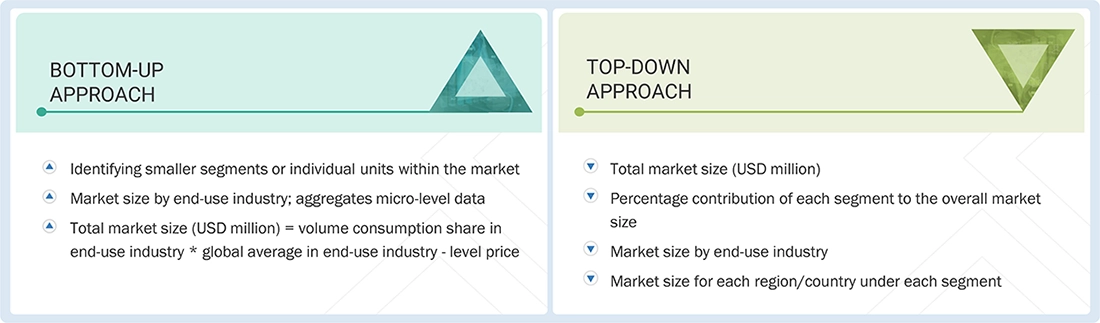
Both top-down and bottom-up approaches were used to estimate and validate the total size of the acoustic insulation market. These methods were also used extensively to estimate the size of various subsegments in the market. The research methodology used to estimate the market size includes the following:
- Key players in the industry have been identified through extensive secondary research
- The supply chain of the industry has been determined through primary and secondary research
- All percentage shares, splits, and breakdowns have been determined using secondary sources and verified through primary sources
- All possible parameters that affect the markets covered in this research study have been accounted for, viewed in extensive detail, verified through primary research, and analyzed to obtain the final quantitative and qualitative data
Acoustic Insulation Market : Top-Down and Bottom-Up Approach
Data Triangulation
After determining the overall market size using the market size estimation processes explained above, the market was divided into several segments and subsegments. To complete the overall market engineering process and determine the exact statistics for each market segment and subsegment, data triangulation and market breakdown procedures were employed, as applicable. The data was triangulated by studying various factors and trends from both the demand and supply sides in the acoustic insulation market.
Market Definition
Acoustic insulation is defined as the ability of the insulation material to reduce the sound pressure with respect to a specified sound source and receptor. It is mainly used to limit or absorb sound for the comfort of receptors. Acoustic insulation is used to reflect or absorb sounds to achieve acoustic comfort and is the most cost-effective measure to achieve energy efficiency. Acoustic insulation products help in reducing noise pollution and provide a comfortable environment for day-to-day life. They mainly reduce noise pollution and provide a safer workplace environment in areas where noise can cause serious hearing damage.
Key Stakeholders
- Acoustic Insulation Manufacturers
- Raw Material Suppliers
- Government and Industry Associations
- Acoustic Insulation Distributors
- End Users
- Government and Research Organizations
- R&D Institutes
Report Objectives
- To analyze and forecast the size of the global acoustic insulation market in terms of value and volume
- To provide detailed information about the key drivers, restraints, challenges, and opportunities influencing market growth
- To define, describe, and segment the market based on material, end-use industry, and region
- To forecast the size of the market segments based on regions such as Asia Pacific, North America, Europe, the Middle East & Africa, and South America
- To strategically analyze the segmented markets with respect to individual growth trends, prospects, and contributions to the overall market
- To identify and analyze opportunities for stakeholders in the market
- To analyze competitive developments such as expansions, partnerships & collaborations, mergers & acquisitions, agreements, and product launches
- To strategically profile the key companies and comprehensively analyze their core competencies
Available customizations:
Along with the given market data, MarketsandMarkets offers customizations according to the company’s specific needs. The following customization options are available for the report:
Regional Analysis
- Further breakdown of a region with respect to a particular country or additional application
Key Questions Addressed by the Report
What is acoustic insulation?
Acoustic insulation comprises materials designed to absorb, block, or dampen sound waves for quieter environments.
How does the acoustic insulation market grow?
The global market expands via urbanization, strict noise regulations, and construction booms, targeting over 4-7% CAGR through 2030.
Which materials dominate in acoustic insulation market?
Foamed plastics like polyurethane lead due to lightweight absorption, affordability, and thermal benefits in buildings and transport.
Why acoustic insulation prioritize it in construction?
It combats urban noise pollution, meets building codes, and boosts occupant comfort amid rising high-density developments.
What challenges exist in acoustic insulation market?
High upfront costs for premium materials and installation deter adoption in budget-constrained projects.
What drives APAC dominance in acoustic insulation market?
Rapid urbanization in China and India fuels 6-7% CAGR growth to $6.31B by 2030 via infrastructure and noise regulations.
Why is Europe a acoustic insulation market leader?
Stringent EU noise-control standards and renovations in dense urban areas sustain its top position despite mature growth.
What boosts NA demand for acoustic insulation?
Health-focused noise reduction in commercial buildings and transport, alongside regulations, drives steady expansion.
Fact checked
Personalize This Research
- Triangulate with your Own Data
- Get Data as per your Format and Definition
- Gain a Deeper Dive on a Specific Application, Geography, Customer or Competitor
- Any level of Personalization
Let Us Help You
- What are the Known and Unknown Adjacencies Impacting the Acoustic Insulation Market
- What will your New Revenue Sources be?
- Who will be your Top Customer; what will make them switch?
- Defend your Market Share or Win Competitors
- Get a Scorecard for Target Partners

Custom Market Research Services
We Will Customise The Research For You, In Case The Report Listed Above Does Not Meet With Your Requirements
Get 10% Free CustomisationTESTIMONIALS

We at Nissan Chemicals Corporation have been clients of MarketsandMarkets for more than a year now. We recently consulted MarketsandMarkets for a study, the team at MarketsandMarkets was extremely professional and organized. The business insights were very detailed and aligned well with our expectations that really helped us formulate the Business Plans and device new strategies for development themes. MarketsandMarkets offers a unique combination of expertise and dedicated engagement model. Their research findings have helped us in designing our Pricing Strategy which will make it easier for us to predict the future sales and profits for the next ten years. We look forward to working with MarketsandMarkets in the future.
VP of Strategy & New Business Development
Leading Specialty Chemical Company
The MarketsandMarkets Engagement Model, composed of both the Knowledge Store and advisory custom research, has greatly helped us in understanding our markets and making strategic decisions. The Knowledge Store is a fast way to allow everyone in our organization to understand more about most any market they are interested in. The ability to then get custom research done and get answers to specific strategic questions and market insight has been spectacular. The Markets and Markets team feel more like colleagues than vendors and their services have helped us change our culture where statements of things like growth opportunities and competitive position are always backed by industry research.

Rich Gibson,
Director, Corporate Strategy
Milliken & Company,
Leading Industrial Manufacturer of specialty chemical, floor covering, performance and protective textile materials, and healthcaremilliken.com
MarketsandMarkets is a trusted resource that helps us to better understand markets that are near-adjacencies-whether its technology, value chain or geography. Their Knowledge Store platform provides a dashboard of markets and their characteristics which is easy to use and saves us time.
Adam Shaw,
Market Development and Strategy Manager
AdvanSix Inc. USA,
An American Leader in Chemicalswww.advansix.com
The Knowledge Store from MarketsandMarkets is a valuable tool which has helped my team acquire greater insight in to the end markets that our business serves. This has enabled us to help our company build stronger strategies throughout our planning process.
TOSHIO KINOSHITA
Senior Chif Consultion Research & Consulting Division
Mitsubishi Chemical Research Corporation,
Leading Manufacturer of Chemical Productswww.mitsubishichem-res.co.jp/en/

We recently engaged with MarketsandMarkets for a study, the team not only clearly understood our business objectives but was also extremely professional in the way they handled the entire project. The study was efficiently conducted in a phase-wise manner, and the engagement model furnished us with high-quality business insights that far exceeded our expectations at each phase. We were especially happy that MarketsandMarkets could provide us with both, an English as well as a Japanese version of the study. A special thanks to the Analyst Team and Client Services Team, whose fluency in Japanese enhanced our comfort level, as we could converse with them in our preferred language.
Independent entrepreneurs
Arrow Precision
We approached MarketsandMarkets for study on Proppants Market, and their work exceeded our expectations. The study conducted was comprehensive and enabled us to view the market through the various dimensions. In addition, the team was extraordinarily responsive throughout the process and resolved our queries on time. I strongly recommend MarketsandMarkets and will certainly consider them for additional market assessments we will need in the future.
Global engineering company, Japan
Deputy Manager,
Strategic Planning OfficeThe high-quality insights shared by the MarketsandMarkets team helped us understand the pharmaceutical plant designers in a specific geography. It also captured the risks that we may likely face in communicating with our potential partners. The study would enable us identify partners, which would impact our future growth.
- South Korea Acoustic Insulation Market
- India Acoustic Insulation Market
- Australia Acoustic Insulation Market
- Saudi Arabia Acoustic Insulation Market
- UAE Acoustic Insulation Market
- Turkey Acoustic Insulation Market
- Brazil Acoustic Insulation Market
- Argentina Acoustic Insulation Market
- South America Acoustic Insulation Market
- Benelux Acoustic Insulation Market
- Nordic Countries Acoustic Insulation Market
- Rest Of Europe Acoustic Insulation Market
- Asean Countries Acoustic Insulation Market
- Rest Of Asia Pacific Acoustic Insulation Market
- GCC Countries Acoustic Insulation Market
- US Acoustic Insulation Market
- Canada Acoustic Insulation Market
- Mexico Acoustic Insulation Market
- Germany Acoustic Insulation Market
- France Acoustic Insulation Market
- UK Acoustic Insulation Market
- Italy Acoustic Insulation Market
- Spain Acoustic Insulation Market
- Poland Acoustic Insulation Market
- Switzerland Acoustic Insulation Market
- China Acoustic Insulation Market
- Japan Acoustic Insulation Market
Growth opportunities and latent adjacency in Acoustic Insulation Market






Jane
Apr, 2026
This report provides a clear and well-structured perspective on the acoustic insulation market, particularly highlighting the growing importance of noise control across construction, transportation, and industrial applications. The linkage with urbanization, stricter building regulations, and rising awareness of occupant comfort is well articulated.An additional dimension worth exploring is the increasing push toward sustainable and low-emission building materials, especially in green construction projects. As ESG considerations gain traction, demand for recyclable and bio-based acoustic insulation solutions could significantly influence product innovation and competitive positioning in the coming years..