AI in Video Surveillance Market Size, Share and Trends

AI in Video Surveillance Market Size, Share & Trends by Offering (AI Camera, PTZ, Dome, Bullet, Panoramic, Fisheye, AI-driven Video Analytics), Function (Training, Inference), Technology (Computer Vision, Deep Learning, Machine Learning, GenAI, NLP) – Global Forecast to 2032




AI IN VIDEO SURVEILLANCE MARKET OVERVIEW
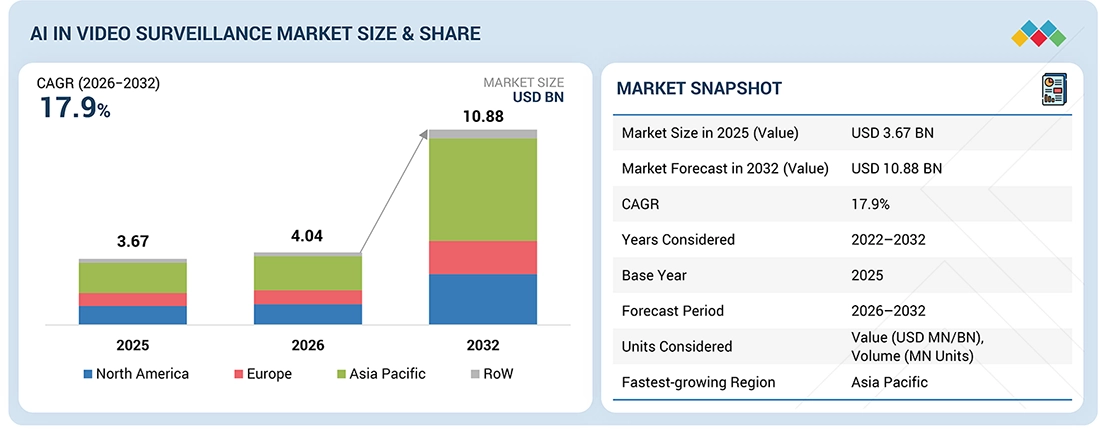
According to Marketsandmarkets, the AI in video surveillance market size is projected to reach USD 10.88 billion by 2032 from USD 4.04 billion in 2026, at a CAGR of 17.9% from 2026 to 2032. The market is growing due to the increasing demand for real-time threat detection, smart city initiatives, and advanced analytics across sectors such as public safety, transportation, retail, and critical infrastructure, as organizations focus on enhancing security, improving operational efficiency, and enabling data-driven decision-making.
REPORT SCOPE
| REPORT METRIC | DETAILS |
|---|---|
| Market Size in 2025 (Value) | USD 3.67 Billion |
| Market Forecast in 2032 (Value) | USD 10.88 Billion |
| Growth Rate | CAGR of 17.9% from 2026–2032 |
| Years Considered | 2022–2032 |
| Base Year | 2025 |
| Forecast Period | 2026–2032 |
| Units Considered | Value (USD Million/Billion), Volume (Thousand Units) |
| Report Coverage | Revenue Forecast, Company Ranking, Competitive Landscape, Growth Factors, and Trends |
| Top Companies |
|
| Growth Driver |
|
| Segments Covered |
|
| Regions Covered | North America, Europe, Asia Pacific, RoW |
KEY TAKEAWAYS
-
BY REGIONBy region, Asia Pacific is expected to dominate the AI in video surveillance market share with 45–50%, in terms of value, in 2026.
-
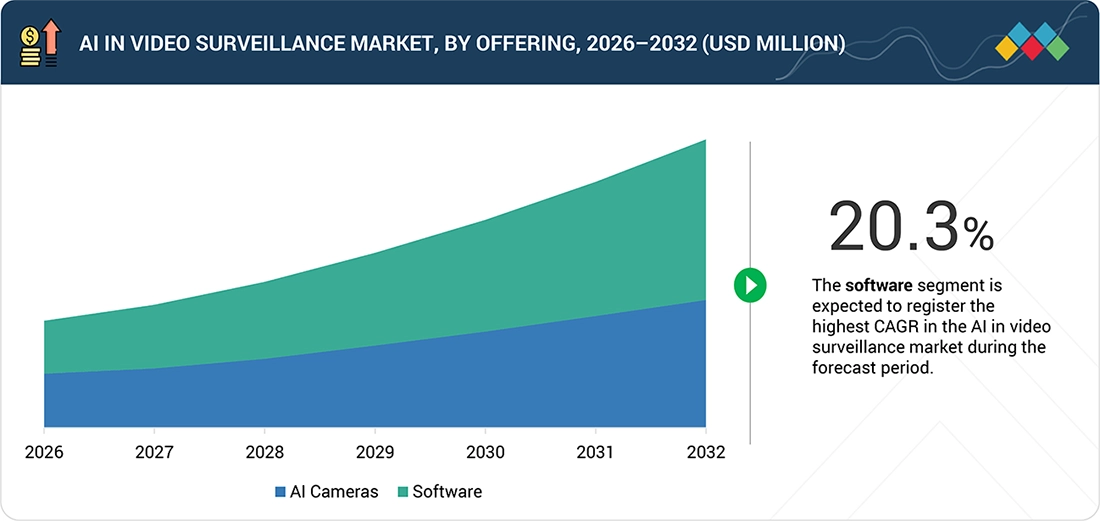
BY OFFERINGBy offering, the software segment is expected to register the highest CAGR of 18–22% between 2026 and 2032.
-
BY DEPLOYMENTBy deployment, the cloud-based segment is expected to register a CAGR of 17–22% during the forecast period.
-
BY FUNCTIONBy function, the inference segment is expected to dominate the market from 2026 to 2032.
-
BY TECHNOLOGYBy technology, the Generative AI segment is expected to record a CAGR of 25–30% during the forecast period.
-
BY VERTICALBy vertical, the government & public facilities segment is expected to dominate the market during the forecast period.
-
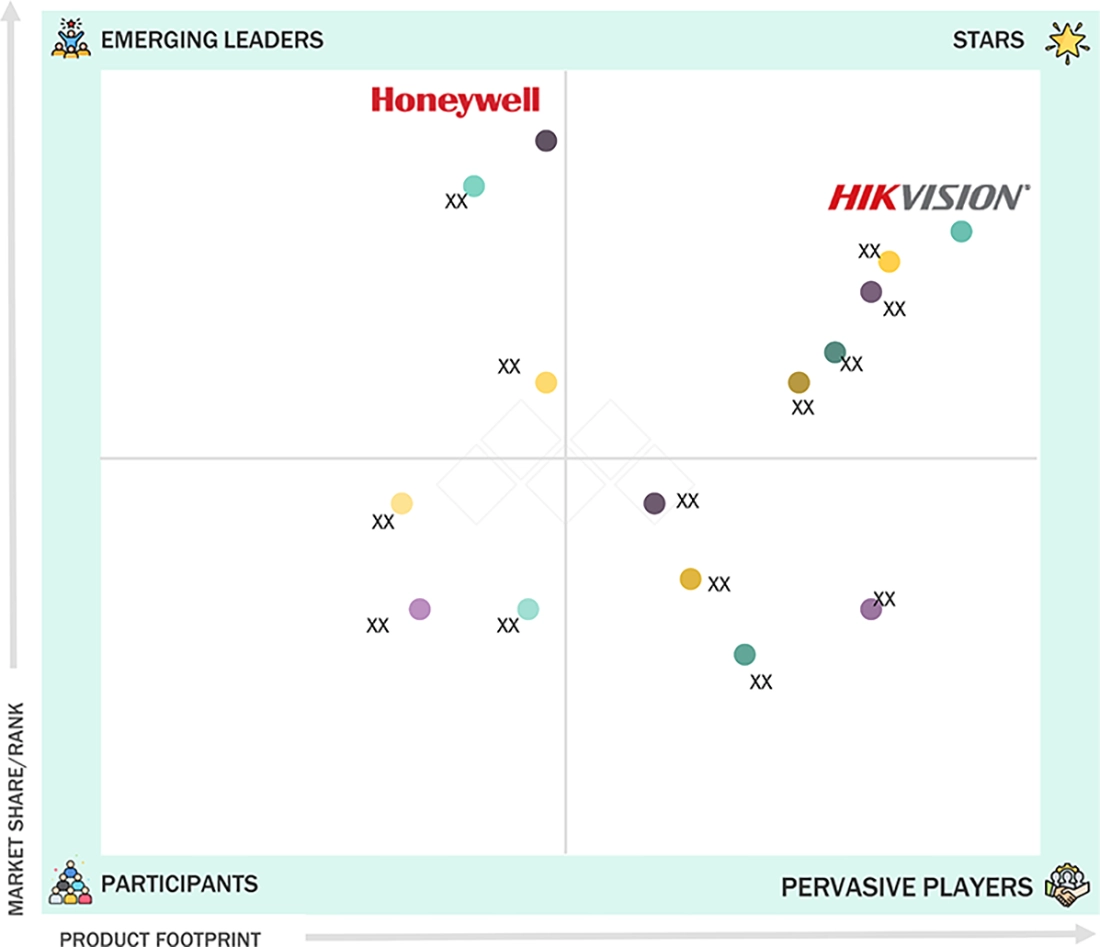
COMPETITIVE LANDSCAPE (KEY PLAYERS)Hangzhou Hikvision Digital Technology Co., Ltd. (China), Dahua Technology Co., Ltd. (China), Axis Communications AB (Sweden), Motorola Solutions, Inc. (US), and Hanwha Vision Co., Ltd. (South Korea) were identified as star players in the AI in video surveillance market due to their strong market share and extensive product footprint.
-
COMPETITIVE LANDSCAPE (STARTUPS/SMES)Verkada Inc. (US), Morphean SA (Switzerland), Bosch Sicherheitssysteme GmbH (US), AxxonSoft (Ireland), and Camcloud (Canada) have distinguished themselves among startups and SMEs by securing strong footholds in specialized niche areas, underscoring their potential as emerging market leaders in the AI in video surveillance market.
The AI in video surveillance industry is expanding as governments and enterprises invest in intelligent monitoring across public safety, transportation, retail, and smart cities, driven by the need for real-time threat detection and operational efficiency. Advancements in AI-driven video analytics, such as facial recognition and anomaly detection, are enhancing proactive security capabilities. Key players, including Hangzhou Hikvision Digital Technology Co., Ltd., Dahua Technology Co., Ltd., Axis Communications AB, Motorola Solutions, Inc., and Hanwha Vision Co., Ltd., are driving innovation through AI cameras, edge analytics, cloud-based platforms, and strategic partnerships, supporting sustained market growth.
Source: Secondary Research, Interviews with Experts, MarketsandMarkets Analysis
TRENDS & DISRUPTIONS IMPACTING CUSTOMERS' CUSTOMERS
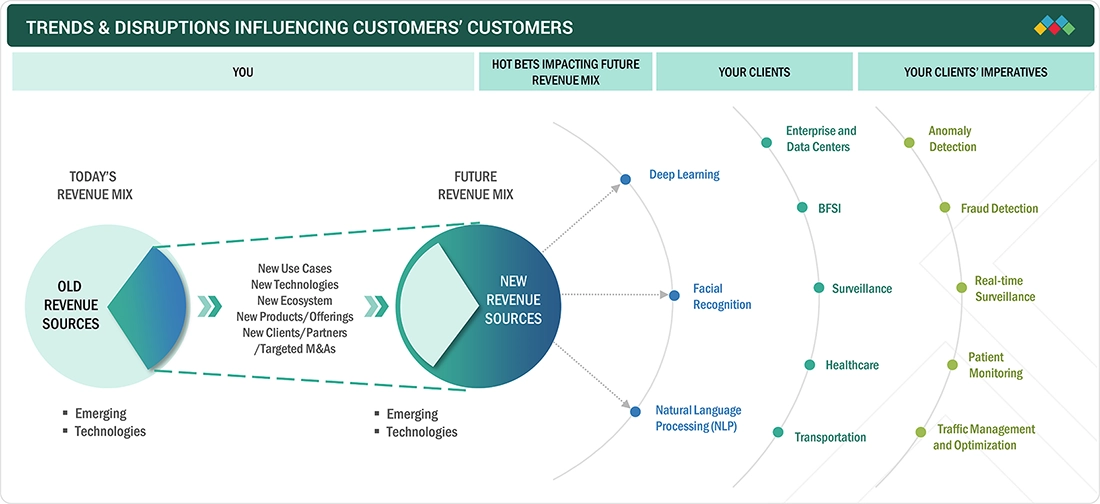
The AI in video surveillance market trends is undergoing a structural shift driven by rapid transition from traditional rule-based monitoring systems to intelligent, data-driven surveillance ecosystems. Advanced technologies, such as deep learning, facial recognition, and natural language processing, are enabling real-time interpretation of video feeds, transforming surveillance from passive recording to proactive decision-making tools. This shift is significantly impacting end-use industries, such as BFSI, healthcare, transportation, and enterprise data centers, where the demand is rising for real-time threat detection, anomaly identification, and automated incident response.
The AI Video Surveillance Market is witnessing robust revenue growth, driven by increasing adoption of AI-powered security solutions across commercial, industrial, government, transportation, healthcare, and smart city applications. Market revenue is expanding as organizations replace conventional CCTV systems with intelligent surveillance platforms that leverage computer vision, deep learning, facial recognition, behavior analytics, and real-time threat detection.
Investment activity in the AI Video Surveillance Market continues to accelerate as technology companies, venture capital firms, governments, and private equity investors increase funding for AI-driven security innovations. Significant investments are being directed toward startups developing advanced video analytics, computer vision algorithms, edge AI chips, autonomous surveillance systems, and cloud-native security platforms.
Source: Secondary Research, Interviews with Experts, MarketsandMarkets Analysis
MARKET DYNAMICS

Level
-
Growing demand for enhanced and intelligent security solutions across sectors

-
Advancements in deep learning and computer vision technologies


Level
-
Concerns related to data privacy and security in AI-enabled surveillance systems

-
High implementation and costs


Level
-
Rising adoption of AI-driven surveillance across retail and transportation sectors

-
Continuous evolution of AI cameras with advanced machine learning capabilities


Level
-
Fragmented and complex data protection regulations across regions

-
Occurrence of false negatives

Source: Secondary Research, Interviews with Experts, MarketsandMarkets Analysis
Driver: Growing demand for enhanced and intelligent security solutions across sectors
The rising need for enhanced security across urban infrastructure, commercial spaces, and critical facilities is accelerating the adoption of AI-powered video surveillance systems. Organizations are increasingly shifting from traditional monitoring to intelligent analytics-based surveillance that enables real-time threat detection, behavior analysis, and predictive alerts. This demand is further amplified by growing urbanization, smart city initiatives, and rising concerns over public safety, pushing continuous investment in advanced, automated surveillance technologies across global markets.
Restraint: Concerns related to data privacy and security in AI-enabled surveillance systems
The deployment of AI in video surveillance faces significant resistance due to growing concerns around privacy infringement and data misuse. Continuous monitoring and facial recognition capabilities raise ethical questions and regulatory scrutiny, particularly in regions with strict data protection frameworks. Additionally, risks of cyberattacks and unauthorized access to sensitive surveillance data further undermine trust. These concerns often slow down large-scale adoption, forcing organizations to invest heavily in compliance, encryption, and governance mechanisms.
Opportunity: Rising adoption of AI-driven surveillance across retail and transportation sectors
The integration of AI-driven video surveillance in retail and transportation sectors presents substantial growth opportunities. In retail, AI enables customer behavior analysis, loss prevention, and optimized store layouts, enhancing operational efficiency and revenue generation. In transportation, it supports traffic monitoring, passenger safety, and congestion management. The expansion of smart retail formats and intelligent transport systems is driving the demand for scalable, real-time surveillance solutions, creating new revenue streams for technology providers.
Challenge: Fragmented and complex data protection regulations across regions
A major challenge for the AI video surveillance market is navigating the complex and fragmented landscape of data protection regulations across different geographies. Laws governing biometric data, video storage, and cross-border data transfer vary significantly, creating compliance difficulties for global deployments. Organizations must adapt systems to meet region-specific requirements, increasing operational complexity and costs. This regulatory inconsistency also slows down standardization and limits the seamless scaling of AI surveillance solutions internationally.
AI IN VIDEO SURVEILLANCE MARKET SIZE, SHARE AND TRENDS, 2025-2032: COMMERCIAL USE CASES ACROSS INDUSTRIES
| COMPANY | USE CASE DESCRIPTION | BENEFITS |
|---|---|---|
 |
Deploys AI-powered cameras and video analytics for large-scale public safety, smart cities, and transportation hubs, enabling real-time facial recognition, traffic monitoring, and anomaly detection | Enhances situational awareness | Improves incident response time | Enables proactive threat detection across urban infrastructure |
 |
Provides AI-enabled surveillance systems for retail, industrial, and city surveillance applications, integrating object detection, perimeter protection, and behavior analysis | Reduces security risks | Optimizes operational monitoring | Improves asset protection through intelligent automation |
 |
Offers network cameras with embedded AI for edge-based analytics in retail stores, airports, and commercial facilities, focusing on people counting and behavioral insights; enables real-time insights, reduces bandwidth usage via edge processing, and enhances customer experience and store efficiency | Enables real-time insights | Reduces bandwidth usage via edge processing | Enhances customer experience and store efficiency |
 |
Delivers integrated AI-driven video management systems (VMS) for law enforcement, critical infrastructure, and enterprise security with advanced analytics and cloud capabilities | Improves coordinated response | Centralizes security operations | Enhances decision-making with actionable intelligence |
 |
Develops AI surveillance solutions for smart cities, manufacturing, and critical infrastructure, including license plate recognition and intrusion detection systems | Strengthens perimeter security | Increases monitoring accuracy | Reduces false alarms through intelligent video analytics |
Logos and trademarks shown above are the property of their respective owners. Their use here is for informational and illustrative purposes only.
MARKET ECOSYSTEM
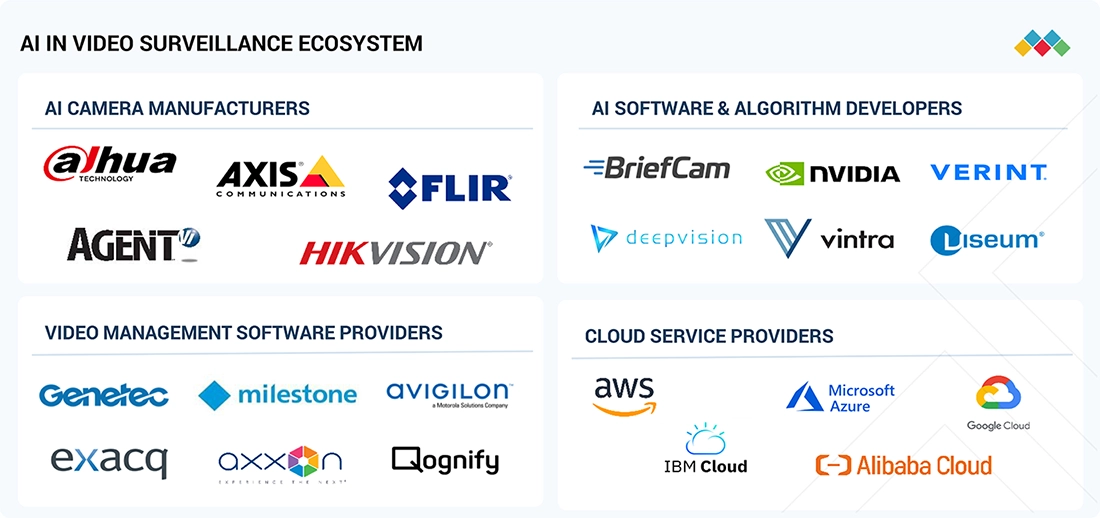
The AI in video surveillance market growth ecosystem comprises four key segments that collectively drive market innovation and growth. AI camera manufacturers, including Dahua, Axis, FLIR, Agent Vi, and Hikvision, form the hardware backbone by delivering intelligent imaging solutions. AI software & algorithm developers, such as BriefCam, NVIDIA, Verint, Deepvision, Vintra, and Liseum, power advanced analytics, deep learning, and real-time threat detection capabilities. Video management software providers, including Genetec, Milestone, Avigilon, Exacq, Axxon, and Qognify, enable seamless video data management and integration. Cloud service providers, such as AWS, Microsoft Azure, Google Cloud, IBM Cloud, and Alibaba Cloud offer scalable infrastructure, ensuring efficient storage, processing, and deployment of AI-driven surveillance solutions.
Logos and trademarks shown above are the property of their respective owners. Their use here is for informational and illustrative purposes only.
MARKET SEGMENTS
Source: Secondary Research, Interviews with Experts, MarketsandMarkets Analysis
AI in Video Surveillance Market, by Offering
The software segment in the AI in video surveillance market is expected to register the highest CAGR during the forecast period. This segment is primarily driven by the increasing adoption of AI-driven video management systems and AI-driven video analytics solutions, encompassing use cases, such as facial recognition, object detection & classification, behavior & anomaly detection, license plate recognition, and weapon & threat detection across diverse verticals.
AI in Video Surveillance Market, by Deployment
The cloud-based deployment segment is expected to register the highest CAGR during the forecast period. Cloud-based deployment enables centralized management of video surveillance infrastructure, offering scalability, remote accessibility, and cost efficiency. Growing demand from commercial, government & public facility, and critical infrastructure verticals is accelerating the shift from traditional on-premise systems toward cloud-based AI surveillance platforms globally.
AI in Video Surveillance Market, by Function
The inference segment is expected to dominate the AI in video surveillance market during the forecast period. Inference functions enable real-time processing and decision-making at edge and cloud levels, supporting applications such as intrusion detection, crowd analytics, and behavior anomaly detection. The rising need for instantaneous threat response and operational efficiency across security, retail, and transportation verticals is fueling the dominance of this segment.
AI in Video Surveillance Market, by Technology
The Generative AI segment is expected to register the highest CAGR during the forecast period. Gen AI's multi-modal capabilities spanning audio, video, and text are revolutionizing surveillance intelligence. Combined with deep learning, convolutional neural networks, and computer vision, Gen AI enables advanced threat detection, predictive analytics, and automated reporting, making it one of the most transformative technology segments within the AI in Video Surveillance Market.
AI in Video Surveillance Market, by Vertical
The government & public facilities segment is expected to dominate the AI in video surveillance market during the forecast period. This dominance is attributed to widespread deployment across law enforcement buildings, transportation facilities, smart city surveillance, healthcare facilities, and education facilities. Increasing government investments in public safety infrastructure, smart city initiatives, and national security programs across North America, Europe, and Asia Pacific are key contributors driving this segment's leadership.
AI IN VIDEO SURVEILLANCE MARKET BY REGION
Asia Pacific to be fastest-growing region in AI in video surveillance market during forecast period
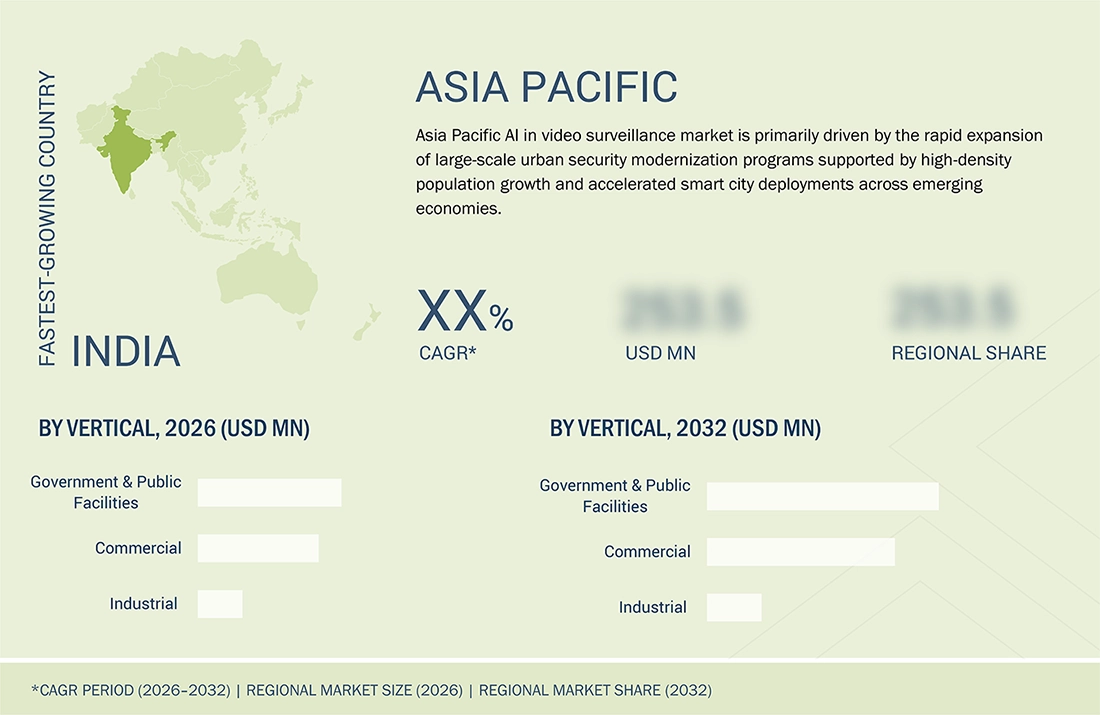
Asia Pacific is expected to dominate the AI in video surveillance market and grow at the fastest rate during the forecast period. This dominance is largely driven by China, which houses leading market players, such as Hangzhou Hikvision Digital Technology Co., Ltd. and Dahua Technology Co., Ltd., along with massive government investments in smart city surveillance, public safety infrastructure, and intelligent transportation systems. India, Japan, South Korea, and Southeast Asia are contributing to regional growth through rapid urbanization, increasing security concerns, and rising adoption of AI-driven video analytics across commercial, industrial, and government & public facility verticals.
China AI in Video Surveillance Market Projected to Grow at a CAGR of 25.60% by 2032
China is one of the global leaders in the deployment and development of advanced surveillance technologies. The country has made substantial investments in smart city infrastructure, public safety initiatives, and AI innovation. As a result, the China AI in Video Surveillance Market is projected to grow at a CAGR of 25.60% through 2032, driven by increasing security concerns, rapid urbanization, and advancements in artificial intelligence.
AI IN VIDEO SURVEILLANCE MARKET SIZE, SHARE AND TRENDS, 2025-2032: COMPANY EVALUATION MATRIX
In the AI in video surveillance companies matrix, Hangzhou Hikvision Digital Technology Co., Ltd. (Star) maintains a dominant position driven by its extensive global installed base, strong edge-AI enabled camera portfolio, and deep integration of computer vision analytics across smart city, transportation, and critical infrastructure applications. The company’s continuous investments in AI chipsets, video management platforms, and large-scale surveillance ecosystems strengthen its leadership across both developed and emerging markets. Honeywell International Inc. (Emerging Leader) is steadily expanding its footprint through integrated security and building management solutions, combining AI-driven video analytics with IoT-enabled enterprise platforms for commercial, industrial, and aviation sectors, focusing on interoperability and cybersecurity.
Source: Secondary Research, Interviews with Experts, MarketsandMarkets Analysis
KEY MARKET PLAYERS
- Hangzhou Hikvision Digital Technology Co., Ltd. (China)
- Dahua Technology Co., Ltd. (China)
- Axis Communications AB (Sweden)
- Motorola Solutions, Inc. (US)
- Hanwha Vision Co., Ltd. (South Korea)
- Milestone Systems A/S (Denmark)
- SenseTime (China)
- Irisity (Sweden)
- NEC Corporation (Japan)
- Genetec Inc. (Canada)
WHAT IS IN IT FOR YOU: AI IN VIDEO SURVEILLANCE MARKET SIZE, SHARE AND TRENDS, 2025-2032 REPORT CONTENT GUIDE
DELIVERED CUSTOMIZATIONS
We have successfully delivered the following deep-dive customizations:
| CLIENT REQUEST | CUSTOMIZATION DELIVERED | VALUE ADDS |
|---|---|---|
| AI Camera OEM / Equipment Manufacturer |
|
|
| Software & Analytics Solution Provider |
|
|
| System Integrator / EPC Firm |
|
|
| Government / Defense / Smart City Enterprise |
|
|
| Private Equity / Investment Firm |
|
|
RECENT DEVELOPMENTS
- July 2026: SenseTime secured the No. 1 position in the global Vision AI market according to Omdia's latest Video Analytics Market Share report, reflecting the company's continued development and commercial expansion in computer-vision and video analytics technologies. The ranking directly relates to AI-driven video analytics, positioning SenseTime as a leading participant in the AI-enabled video surveillance ecosystem.
- July 2026: Hanwha Vision Co., Ltd. established an AI-based video security system at the Dongshimwon facility for disabled infants in Incheon as part of its Vision Zone initiative. Approximately 30 cameras and related equipment were installed, with AI cameras detecting falls and unusual behavior indoors and AI PTZ cameras identifying and tracking objects outdoors, demonstrating a direct deployment of AI video surveillance for safety management.
- June 2026: Hangzhou Hikvision Digital Technology Co., Ltd. advanced AI-driven video surveillance through its Guanlan large-scale AI model, applying semantic analysis to video encoding to distinguish critical objects from low-value scenes. The technology is designed to optimize video storage by analyzing video content rather than applying uniform compression, addressing the growing storage demands of high-resolution surveillance systems.
- May 2026: Dahua Technology Co., Ltd. introduced MultiVision 2.0, an upgraded multi-lens surveillance portfolio combining wider-area coverage, panorama-detail linkage and Xinghan Vision Models for smarter video analytics. The solution is designed to provide more comprehensive and accurate monitoring while reducing blind spots and simplifying deployment across complex security environments, making it a direct advancement in AI-enabled video surveillance.
- April 2026: Axis Communications AB highlighted the evolution of its AI-powered cameras from conventional monitoring devices into intelligent edge systems capable of analyzing video in real time and generating actionable insights. The company described how AI and edge analytics enable cameras to support security, safety and operational decision-making, demonstrating the expanding role of AI directly within video surveillance infrastructure.
Table of Contents
 Exclusive indicates content/data unique to MarketsandMarkets and not available with any competitors.
Methodology
The study involved four major activities in estimating the current size of the AI in video surveillance market. Extensive secondary research was conducted to gather information on the market, adjacent markets, and the broader imaging systems ecosystem. This was followed by primary research with industry stakeholders across the value chain, including manufacturers, distributors, technology providers, and end users, to validate assumptions and market sizing. Both top-down and bottom-up approaches were used to estimate the overall market size. Market breakdown and data triangulation techniques were then applied to derive the size of individual segments and subsegments. Secondary and primary sources were jointly used to support a comprehensive technical and commercial analysis of the AI in video surveillance market.
Secondary Research
Various secondary sources have been referred to in the secondary research process to identify and collect information important for this study. The secondary sources include annual reports, press releases, and investor presentations of companies; white papers; journals and certified publications; and articles from recognized authors, websites, directories, and databases. Secondary research has been conducted to obtain key information about the industry’s supply chain, the market’s value chain, the total pool of key players, market segmentation according to the industry trends (to the bottom-most level), regional markets, and key developments from market- and technology-oriented perspectives. The secondary data has been collected and analyzed to determine the overall market size, further validated by primary research.
Primary Research
Extensive primary research was conducted after gaining knowledge about the current scenario of the AI in video surveillance market through secondary research. Several primary interviews were conducted with experts from the demand and supply sides across four major regions: North America, Europe, Asia Pacific, and RoW. This primary data was collected through questionnaires, emails, and telephonic interviews.
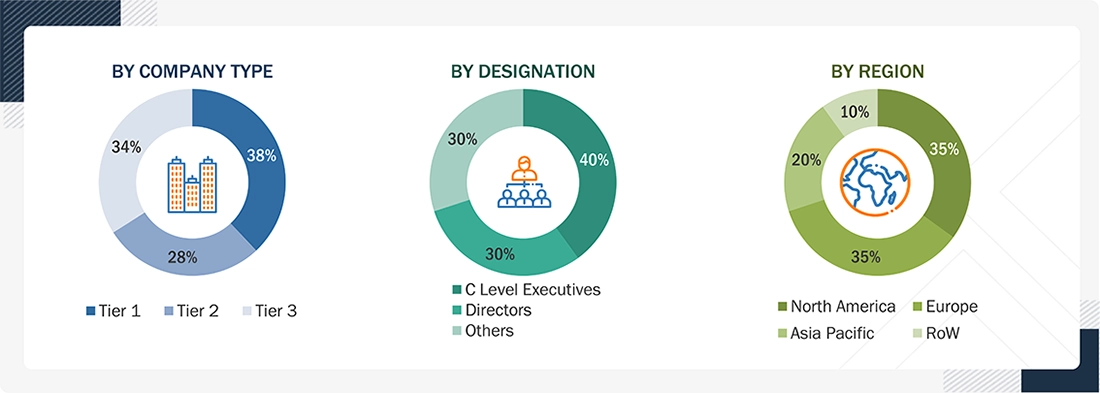
Note: The three tiers of the companies are defined based on their total revenue in 2023: Tier 1 - revenue greater than or equal to USD 1 billion; Tier 2 - revenue between USD 100 million and USD 1 billion; and Tier 3 revenue less than or equal to USD 100 million. Other designations include sales managers, marketing managers, and product managers.
To know about the assumptions considered for the study, download the pdf brochure
Market Size Estimation
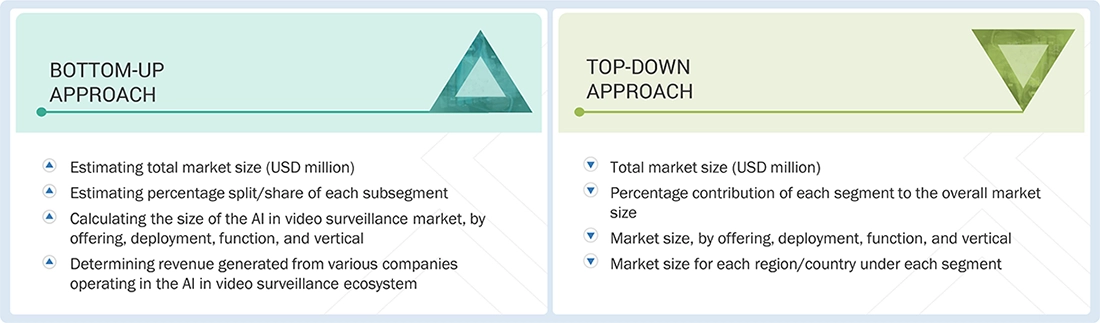
Both top-down and bottom-up approaches have been used to estimate and validate the total size of the AI in video surveillance market. These methods have also been used extensively to estimate the size of various subsegments in the market. The following research methodology has been used to estimate the market size:
- Major players in the industry and markets have been identified through extensive secondary research.
- The industry’s value chain and market size (in terms of value) have been determined through primary and secondary research processes.
- All percentage shares, splits, and breakdowns have been determined using secondary sources and verified through primary sources.
AI in Video Surveillance Market : Top-Down and Bottom-Up Approach
Data Triangulation
After arriving at the overall size of the AI in video surveillance market from the market size estimation process explained above, the total market has been split into several segments and subsegments. Data triangulation and market breakdown procedures have been employed, wherever applicable, to complete the overall market engineering process and arrive at the exact statistics for all segments and subsegments of the market. The data has been triangulated by studying various factors and trends from the demand and supply sides. Along with this, the market size has been validated using both top-down and bottom-up approaches.
Market Definition
The scope of AI in video surveillance encompasses a range of applications and capabilities that revolutionize traditional security systems. AI-powered video surveillance leverages advanced algorithms and machine-learning techniques to analyze vast amounts of real-time visual data. It enables intelligent video analytics, such as object detection, tracking, and recognition, allowing automated identification of suspicious activities, persons of interest, or potential threats. AI algorithms can also enhance video quality, optimize camera placements, and facilitate intelligent search and retrieval of relevant footage.
Additionally, AI-based video surveillance systems can integrate with other technologies, such as facial recognition, biometrics, and data analytics, enabling comprehensive security solutions for various domains, including public spaces, transportation, retail, and critical infrastructure. The scope of AI in video surveillance holds promise for enhancing public safety, crime prevention, and operational efficiency while raising concerns related to privacy, ethical considerations, and the responsible use of such technologies.
Key Stakeholders
- Raw material vendors
- Component (image sensor, lens, and module) providers
- Software providers
- AI-based video surveillance camera and other hardware manufacturers
- Original equipment manufacturers (OEMs)
- AI-based video surveillance system integrators
- Service providers
- Technology standards organizations, forums, alliances, and associations
- Governments, financial institutions, and investment communities
- Research organizations
- Analysts and strategic business planners
- Venture capitalists, private equity firms, and startup companies
- Distributors
- Infrastructure, commercial, institutional, industrial, residential, and other end users
Report Objectives
- To define, describe, and forecast the AI in video surveillance market, by offering, deployment, function, technology, vertical, and region, in terms of value
- To define and describe applications and use cases in the AI in video surveillance market
- To describe and forecast the AI in video surveillance market for AI cameras, in terms of volume
- To forecast the size of the market segments for four major regions, namely North America, Europe, Asia Pacific, and RoW, in terms of value
- To provide detailed information regarding the major factors influencing the market growth, such as drivers, restraints, opportunities, and challenges
- To offer an ecosystem analysis, case study analysis, patent analysis, technology analysis, pricing analysis, Porter’s Five Forces analysis, and regulations pertaining to the market
- To give a detailed overview of the value chain of the AI in video surveillance ecosystem
- To strategically analyze micromarkets1 with respect to individual growth trends, prospects, and contributions to the total market
- To strategically profile the key players and comprehensively analyze their market shares and core competencies
- To analyze the opportunities in the market for stakeholders and describe the competitive landscape of the market
- To study competitive developments, such as collaborations, partnerships, product developments, and acquisitions, in the market
- To provide the macroeconomic outlook for each region that has been covered in the report
Available customizations:
With the given market data, MarketsandMarkets offers customizations according to the company’s specific needs. The following customization options are available for the report:
Company Information:
- Detailed analysis and profiling of additional market players (up to 5)
Key Questions Addressed by the Report
What is the current size of the AI in Video Surveillance market?
The global AI in Video Surveillance market is estimated at USD 4.04 billion in 2026 and is projected to reach USD 10.88 billion by 2032. (MarketsandMarkets)
What is the expected CAGR of the AI in Video Surveillance market?
The market is forecast to grow at a CAGR of 17.9% from 2026 to 2032, driven by increasing adoption of intelligent monitoring and video analytics solutions. (MarketsandMarkets)
What is the primary growth driver of the market?
The key growth driver is the rising demand for real-time threat detection, behavior analytics, facial recognition, and automated surveillance across smart cities, transportation, retail, and critical infrastructure. (MarketsandMarkets)
Which major trend is shaping the AI in Video Surveillance industry?
The integration of Generative AI, edge computing, cloud platforms, and IoT-enabled surveillance systems is emerging as a major market trend, improving analytics accuracy and response times. (MarketsandMarkets)
Which technology segment is expected to grow the fastest?
The Generative AI segment is expected to record the highest growth, with a projected CAGR of 25–30% during 2026–2032. (MarketsandMarkets)
Which region dominates the AI in Video Surveillance market?
Asia Pacific is expected to dominate the market, accounting for 45–50% of global market value in 2026, supported by smart city investments and large-scale surveillance deployments. (MarketsandMarkets)
Which end-user industry leads the market?
The Government & Public Facilities sector is expected to remain the largest end-user segment due to increasing investments in public safety, urban monitoring, and critical infrastructure protection. (MarketsandMarkets)
Who are the leading companies in the AI in Video Surveillance market?
Key companies include Hangzhou Hikvision Digital Technology, Dahua Technology, Axis Communications, Motorola Solutions, and Hanwha Vision. (MarketsandMarkets)
What deployment model is witnessing strong growth?
The cloud-based deployment segment is expected to grow at a CAGR of 17–22%, driven by scalability, remote access, and lower infrastructure costs. (MarketsandMarkets)
What does the MarketsandMarkets report cover?
The report contains 270 pages and over 200 market tables, covering market size, forecasts to 2032, competitive landscape, technology analysis, regional outlook, growth drivers, trends, and strategic opportunities. (MarketsandMarkets)


Personalize This Research
- Triangulate with your Own Data
- Get Data as per your Format and Definition
- Gain a Deeper Dive on a Specific Application, Geography, Customer or Competitor
- Any level of Personalization
Let Us Help You
- What are the Known and Unknown Adjacencies Impacting the AI in Video Surveillance Market
- What will your New Revenue Sources be?
- Who will be your Top Customer; what will make them switch?
- Defend your Market Share or Win Competitors
- Get a Scorecard for Target Partners

Custom Market Research Services
We Will Customise The Research For You, In Case The Report Listed Above Does Not Meet With Your Requirements
Get 10% Free CustomisationTESTIMONIALS

Tetsuya Ohhira
Business Development Manager-Technology Business
Nikon Corporation,
Leading Japanese MNC specializing in optics and imaging productswww.nikon.com
MarketsandMarkets™ response
is quick. Their attitude is flexible and positive. Analyst Insights are globally considered and
significant. Client Services quickly respond to our inquiry and demand. Their wide range of global
surveys help us make our strategic plan.
We hope Knowledge Store will be easier to search
for a report.
VP - Marketing & Business Development
Leading Provider of Process Control Solutions
We engaged with MarketsandMarkets on a study to perform an analysis and recommend a Go-To-Market strategy for metrology and process control in the semiconductor market. The study was tailored to our targets and needs with well-defined milestones. Our overall experience with the MarketsandMarkets team was very good throughout the project in all aspects including the analysis methodologies used, the quality and depth of primary and secondary data sets, the professionalism and flexibility of the team and the ability to meet the target schedule and milestones. We want to thank MarketsandMarkets team for a job well done.
- Canada AI in Video Surveillance Market
- Mexico AI in Video Surveillance Market
- US AI in Video Surveillance Market
- UK AI in Video Surveillance Market
- Germany AI in Video Surveillance Market
- France AI in Video Surveillance Market
- Italy AI in Video Surveillance Market
- Spain AI in Video Surveillance Market
- China AI in Video Surveillance Market
- Japan AI in Video Surveillance Market
- South Korea AI in Video Surveillance Market
- India AI in Video Surveillance Market
- Australia AI in Video Surveillance Market
- Rest Of Europe AI in Video Surveillance Market
- Rest Of Asia Pacific AI in Video Surveillance Market
- Southeast Asia AI in Video Surveillance Market




Growth opportunities and latent adjacency in AI in Video Surveillance Market