Antimony-free Polyesters Market

Report Code CH 9451
Published in Jul, 2025, By MarketsandMarkets™
Download PDF

Choose License Type

Buy Report Now Inquire Before Buying

Antimony-free Polyesters Market by Product Type (Polyethylene Terephthalate (PET), Polytrimethylene Terephthalate (PTT), Polybutylene Terephthalate (PBT)), Catalyst (Titanium-based Catalyst, Aluminum-based Catalyst, Titanium-Magnesium-based Catalyst), End-use Industry (Textile, Packaging, Automotive, Construction), & Region - Global Forecast to 2030

Overview

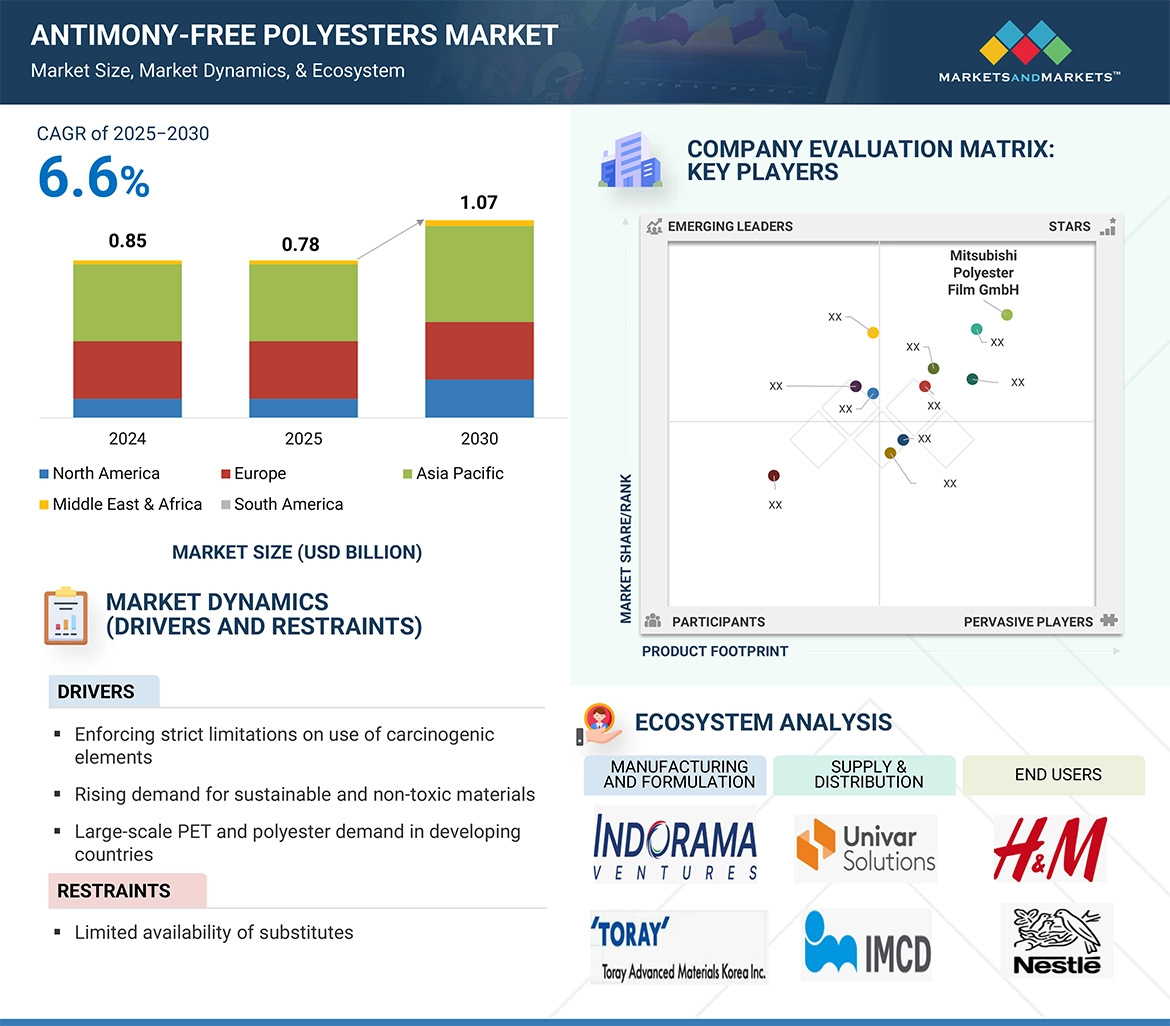
The antimony-free polyesters market is projected to grow from USD 0.78 billion in 2025 to USD 1.07 billion by 2030, at a CAGR of 6.6%. The growth of the antimony-free polyesters market is driven by increasing regulatory and consumer concerns about the use of antimony in polyester production. These polyesters have wide applications across various industries, including construction, textiles, packaging, and automotive, among others. Additionally, the global push for sustainability is fueling the demand for antimony-free polyesters, which serve as an alternative to traditional polyesters that use antimony catalysts. This is particularly relevant in applications such as food and beverages, as well as in the pharmaceutical and medical sectors.

Antimony-free Polyesters Market

Attractive Opportunities in the Antimony-free Polyesters Market

Asia Pacific

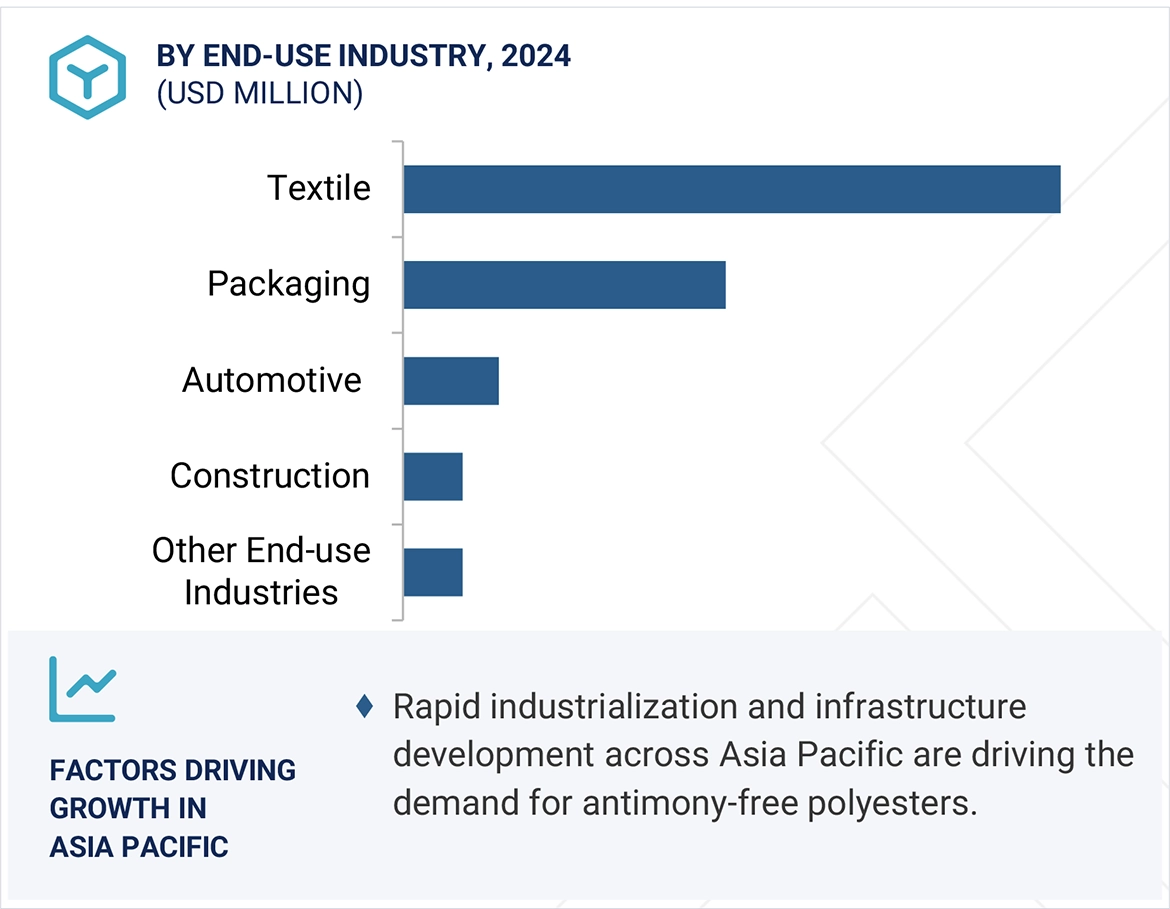
Asia Pacific is witnessing robust demand for antimony-free polyesters in packaging, textiles, and electronics. This growth is supported by industrial expansion, growing exports, and increasing adoption of international safety standards.

Regulatory bodies like the EU and FDA are enforcing stricter limits on carcinogenic elements like antimony, opening doors for safer catalyst alternatives like titanium and germanium.

Antimony-free polyesters are gaining traction due to their non-toxic nature, recyclability, and compliance with circular economy goals. Brands are increasingly shifting to bio-based or low-VOC alternatives, making them ideal for food-contact applications and sustainable textiles.

The global antimony-free polyesters market is projected to grow from USD 0.78 billion in 2025 to USD 1.07 billion by 2030, at a CAGR of 6.6%.

Safety, performance, and recyclability make antimony-free polyesters a go-to solution for future-ready material design.

Global Antimony-free Polyesters Market Dynamics

DRIVER: Enforcing strict limitations on use of carcinogenic elements

The primary driver for the growth of the antimony-free polyesters market is the strict enforcement of regulations limiting the use of carcinogenic materials in polyester production worldwide. Antimony trioxide, a raw material used in the production of polyethylene terephthalate, has been identified as a significant carcinogen by various regulatory bodies, including the International Agency for Research on Cancer (IARC). Evidence indicates that prolonged exposure to these catalysts can lead to adverse health effects such as respiratory irritation, cardiovascular toxicity, and an increased risk of cancer. As a result, governments around the world are implementing restrictions on the use of antimony trioxide in polyester production. Additionally, rising consumer awareness of the harmful side effects associated with these materials is driving the demand for sustainable, non-toxic catalysts in polyester manufacturing.

RESTRAINT: Limited availability of substitutes

There is limited availability of effective alternatives to antimony as a catalyst in polyester manufacturing, which poses a significant barrier to market growth. Antimony trioxide is favored in the industry for its high thermal stability, catalytic efficiency, and cost-effectiveness. Compared to alternative catalysts such as titanium, aluminum, magnesium, and germanium, antimony catalysts are more widely available. However, these alternatives often fall short in performance. For example, titanium-based catalysts can lead to lower intrinsic viscosity and reduced optical clarity in PET production, limiting their adoption in end-use industries like packaging, where optical clarity is crucial. Additionally, germanium is expensive, making commercial mass production unfeasible.


OPPORTUNITY: Expanding use of PET in high-growth regions

There is a growing demand for polyester in emerging regions such as the Asia Pacific, South America, and the Middle East & Africa, which presents significant opportunities for antimony-free polyesters. Urbanization and industrialization in these areas are driving the need for alternatives to traditional polyesters that use antimony as a catalyst, a substance that can be harmful to human health due to its toxic properties. Antimony-based polyesters are used in a variety of applications, including medical, food and beverages, textiles, and other consumer goods. As these emerging economies develop, the demand for sustainable and non-toxic polyester solutions increases, further boosting the need for antimony-free polyesters. Additionally, local manufacturers in these regions are investing in advanced production technologies to adopt alternative catalysts to antimony, thereby creating more opportunities in the antimony-free polyesters market.

CHALLENGES: Higher production cost compared to traditional polyesters

One of the major challenges facing the antimony-free polyesters market is the high production cost associated with alternative catalysts. Antimony trioxide, which is primarily used as a catalyst in polyester production, is more cost-effective compared to titanium or aluminum catalysts, especially for the production of polyethylene terephthalate. Replacing antimony with titanium or germanium increases manufacturing costs. While titanium catalysts are non-toxic and environmentally friendly, they require stricter process controls and precise handling, which further escalates costs. On the other hand, germanium is quite expensive, making large-scale production economically unviable for cost-sensitive applications like packaging.

Global Antimony-free Polyesters Market Ecosystem Analysis

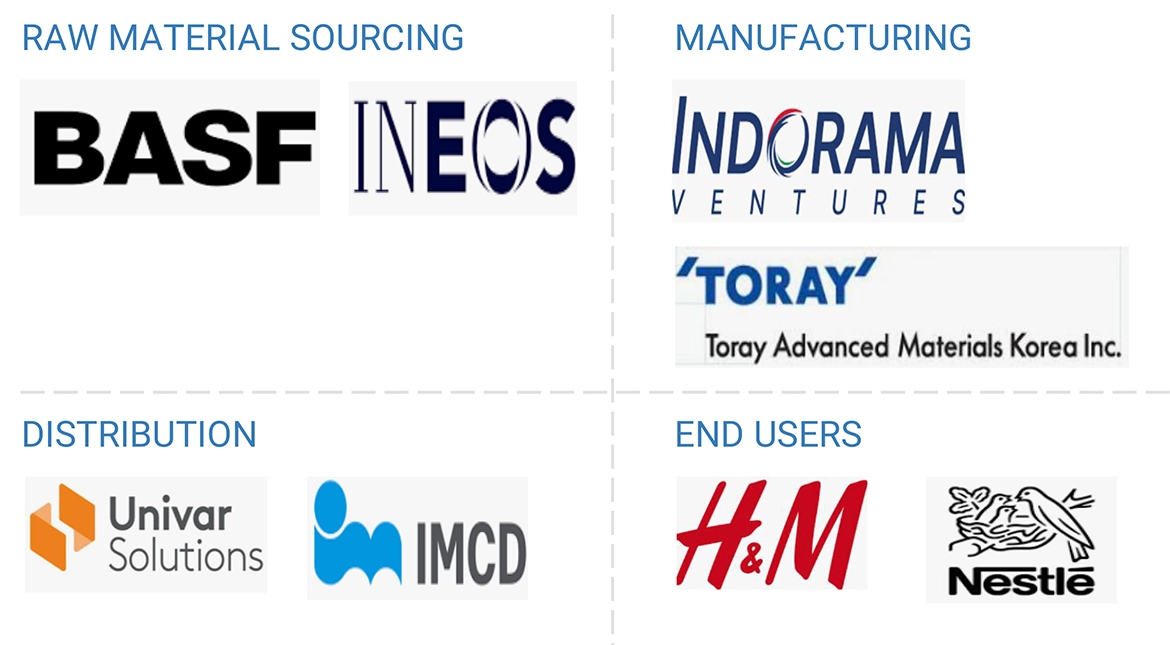
The antimony-free polyesters market is a complex ecosystem that involves various stakeholders. At its core are the raw materials used for production. These raw materials serve as catalysts in creating polyester, especially polyethylene terephthalate. Once produced, antimony-free polyesters are distributed to end-use industries such as construction, automotive, packaging, textiles, and consumer goods.

Antimony-free Polyesters Market
 

Titanium-based catalysts segment to dominate market in 2024

The antimony-free polyesters market is segmented based on type into three categories: titanium-based catalysts, aluminum-based catalysts, and titanium-magnesium-based catalysts. Among these, titanium-based catalysts represent the largest segment due to their cost-effectiveness and higher catalytic activity. These titanium catalysts are generally cheaper than other alternatives, which drives their adoption as a substitute for antimony catalysts in polyester production. They demonstrate reasonable polymerization stability and are non-toxic and non-carcinogenic, further increasing their use in polyester manufacturing. Additionally, their compatibility with existing production infrastructure helps reduce investment costs for manufacturers, contributing to their increased demand and high value within the antimony-free polyesters market.

Polyethylene terephthalate (PET) segment to hold the largest market share in terms of value during the forecast period

The antimony-free polyesters market is divided into three main product types: polyethylene terephthalate (PET), polytrimethylene terephthalate (PTT), and polybutylene terephthalate (PBT). Among these, PET holds the leading position. PET is widely used across various industries, including packaging (such as bottles, containers, and films), textiles (fibers and apparel), and industrial applications (including straps and sheets). The global push to eliminate antimony from polyester textiles and commonly used plastic packaging has significantly increased demand for antimony-free PET products, driven by sustainability and health concerns. This demand has surged especially in food and beverage applications, where safety and the potential for direct contact with products are critical. Antimony-free PET offers similar mechanical properties, clarity, and recyclability as virgin PET products, ensuring no loss in performance. Given the extensive recycling infrastructure for PET, antimony-free PET supports both regulatory requirements and manufacturers’ expectations for a robust circular economy. PET remains the preferred choice due to its low cost, durability, and versatility, providing lightweight, strong, and transparent solutions. As consumers increasingly scrutinize product labels for non-toxic materials and governments enforce strict safety regulations, the popularity of antimony-free PET is rising rapidly. The benefits of PET will continue to enhance its leading role in the antimony-free polyesters market. Furthermore, innovations in catalyst systems, such as titanium-based catalysts with substantial oxygen scavenging properties, may influence the use of antimony-free PET regarding processing and optical characteristics. When compared to conventional PET, these advancements may result in performance traits that are indistinguishable. For the foreseeable future, PET is expected to maintain its position as the leading product type in the antimony-free polyesters market.

Textile segment to hold largest market share in terms of value during the forecast period

The antimony-free polyesters market is segmented by end-use industries into textile, packaging, automotive, construction, and others. The textile industry is the largest consumer of antimony-free polyesters. Increasing concerns about antimony residues in fabrics, particularly in clothing that comes into direct contact with the skin, have heightened consumer awareness regarding the potential hazards of antimony. This has led to a growing demand for sustainable textiles that do not contain harmful substances. Additionally, regulatory pressure in Europe and North America is pushing manufacturers to produce non-toxic fibers. Iconic apparel brands and retailers are increasingly incorporating eco-friendly materials into their product lines, driven by company policies aimed at meeting sustainability targets or in response to consumer demand. Factors such as the expanding global textile industry and emerging markets like India, Bangladesh, and Vietnam indicate a rising demand for cleaner and safer polyester fibers among textile manufacturers. Antimony-free polyesters not only contribute to environmentally conscious trends in fashion but also enhance brands’ reputations while ensuring compliance with international environmental sustainability standards. Thus, the textile sector plays a crucial role in promoting antimony-free and sustainable strategies for the long term.


Asia Pacific to be largest market during the forecast period

The global market for antimony-free polyesters has been segmented by region into Europe, North America, South America, Asia Pacific, and the Middle East & Africa. Among these, Asia Pacific stands out as the largest market for antimony-free polyesters. This is largely due to the region’s significant role in global polyester production and consumption. Countries such as China, India, Japan, South Korea, and those in Southeast Asia have emerged as manufacturing hubs for textiles, packaging, automotive parts, and consumer goods—all key applications of polyester. China’s robust industrial capabilities, coupled with the rapid growth of the middle class in India, urbanization, and increased environmental awareness throughout the region, are major drivers behind the rising demand for safer, non-toxic alternatives to traditional materials. Moreover, stricter environmental regulations in China and India are prompting local manufacturers to adopt antimony-free processes, which will also align with international export requirements. Many global brands sourcing from the Asia Pacific are insisting that their suppliers comply with international safety and sustainability standards. Additionally, the region benefits from easy access to raw materials, affordable labor for production, and a growing industrial infrastructure, all of which facilitate the large-scale production of antimony-free polyesters. Consequently, Asia Pacific’s advantages in both production and consumption are likely to support its ongoing leadership position in the antimony-free polyesters market.

Antimony-free Polyesters Market
HIGHEST CAGR MARKET IN 2024
CHINA IS THE FASTEST-GROWING MARKET IN THE REGION

Recent Developments of Antimony-free Polyesters Market

  • In January 2024, Indorama Ventures Public Company Limited announced an expansion of its antimony-free PET resin production in Thailand. Utilizing titanium-based catalysts, the expansion supports growing demand for safe, sustainable polyester in packaging and textiles. This move reflects Indorama’s commitment to reducing environmental impact and aligning with global safety regulations. The expanded facility enhances the company’s manufacturing capacity in the Asia Pacific region and strengthens its leadership in the sustainable polyester market, allowing it to serve both local and international customers with high-quality, antimony-free materials.
  • In June 2022, Tianjin GT New Material Technology Co., Ltd. introduced antimony-free polyester fibers targeting sensitive applications like children’s clothing and toys. These fibers comply with EU safety standard EN71-3, which restricts hazardous substances in children's products. The launch reflects the company’s commitment to safer, eco-friendly materials and aligns with growing consumer awareness of chemical exposure risks. This innovation enables the company to tap into health-conscious markets while ensuring compliance with international safety regulations, thereby expanding its product portfolio in the antimony-free polyesters segment.
  • In April 2021, Toray Advanced Materials Korea Inc. launched antimony-free polyesters knitted fabrics designed for sustainable apparel. These fabrics offer high performance in moisture control, elasticity, and breathability while eliminating antimony and addressing health and environmental concerns. The innovation targets eco-conscious fashion brands and aligns with Toray’s commitment to cleaner material solutions. This development not only strengthens the company’s sustainable product offerings but also supports the global shift toward safer, non-toxic textiles in performance wear and everyday clothing.
  • In March 2021, Amerex Hubei Decon Polyester Co., Ltd. launched titanium-based antimony-free polyester chips with an annual production capacity of 2,000 tons. This development addresses growing health and environmental concerns tied to antimony usage in polyester manufacturing. The titanium catalyst ensures safer production while maintaining quality standards. With this initiative, the company positions itself to meet rising global demand for sustainable and non-toxic polyester products, particularly in packaging and textiles. It also demonstrates Amerex’s proactive approach toward regulatory compliance and environmentally responsible production within the polyester value chain.

Key Market Players

Scope of the Report

Report Metric Details
Market size available for years 2021-2030
Base Year Considered 2024
Forecast period 2025-2030
Forecast units Value (USD Million/Billion) and Volume (Kiloton)
Segments covered Product Type, Catalyst, End-use Industry, and Region
Geographies covered North America, Europe, Asia Pacific, Middle East & Africa, and South America

Key Questions Addressed by the Report

What are the factors influencing the growth of the antimony-free polyesters market?

The market is driven by strict regulations on carcinogenic substances, increasing demand for sustainable and non-toxic materials, and the growing consumption of PET and polyester in developing nations.

What are antimony-free polyesters?

Antimony-free polyesters use alternative, safer catalysts like titanium, aluminum, or germanium to reduce environmental and health concerns associated with antimony. They include PET, PTT, and PBT types and are widely used in textiles, packaging, automotive, and electronics industries. Their growth is fueled by regulatory demands, sustainability trends, and consumer safety.

Which region is expected to have the largest market share in the antimony-free polyesters market?

The Asia Pacific region is expected to hold the largest share of the antimony-free polyesters market during the forecast period.

Which are the key market players covered in the report?

Key players include Mitsubishi Polyester Film GmbH (Germany), Ester Industries Ltd. (India), Indorama Ventures (Thailand), Toray Advanced Materials Korea Inc. (South Korea), NAN YA PLASTICS CORPORATION (Taiwan), HANGZHOU LEMMEJOY CHEMICAL FIBER CO., LTD. (China), PT Asia Pacific Fibers Tbk (Indonesia), TIANJIN GT NEW MATERIAL TECHNOLOGY CO., LTD. (China), Amerex Hubei Decon Polyester Co., Ltd. (China), and ZHEJIANG DONGTAI NEW MATERIALS CO., LTD. (China).

What is the size of the global antimony-free polyesters market?

The market is projected to grow from USD 0.78 billion in 2025 to USD 1.07 billion by 2030, at a CAGR of 6.6%.

Personalize This Research

  • Triangulate with your Own Data
  • Get Data as per your Format and Definition
  • Gain a Deeper Dive on a Specific Application, Geography, Customer or Competitor
  • Any level of Personalization
Request A Free Customisation

Let Us Help You

  • What are the Known and Unknown Adjacencies Impacting the Antimony-free Polyesters Market
  • What will your New Revenue Sources be?
  • Who will be your Top Customer; what will make them switch?
  • Defend your Market Share or Win Competitors
  • Get a Scorecard for Target Partners
Customized Workshop Request

Table of Contents

Exclusive indicates content/data unique to MarketsandMarkets and not available with any competitors.

TITLE
PAGE NO
INTRODUCTION
24
RESEARCH METHODOLOGY
28
EXECUTIVE SUMMARY
39
PREMIUM INSIGHTS
44
MARKET OVERVIEW
47
  • 5.1 INTRODUCTION
  • 5.2 MARKET DYNAMICS
    DRIVERS
    - Strict limitations on use of carcinogenic elements
    - Rising demand for sustainable and non-toxic materials
    - Large-scale PET and polyester demand in developing countries
    RESTRAINTS
    - Limited availability of substitutes
    OPPORTUNITIES
    - Technological advancements in catalyst development
    CHALLENGES
    - Regulatory compliance across regions for use of toxic chemicals
    - Performance optimization in production of antimony-free polyesters
  • 5.3 IMPACT OF GENERATIVE AI ON ANTIMONY-FREE POLYESTERS MARKET
    INTRODUCTION
    ROLE OF GENERATIVE AI IN SHAPING ANTIMONY-FREE POLYESTERS INDUSTRY
INDUSTRY TRENDS
55
  • 6.1 INTRODUCTION
  • 6.2 TRENDS/DISRUPTIONS IMPACTING CUSTOMER BUSINESS
  • 6.3 IMPACT OF 2025 US TARIFF ON ANTIMONY-FREE POLYESTERS MARKET
    INTRODUCTION
    KEY TARIFF RATES
    PRICE IMPACT ANALYSIS
    IMPACT ON KEY COUNTRY/REGION
    - US
    - Europe
    - Asia Pacific
    IMPACT ON END-USE INDUSTRIES
  • 6.4 SUPPLY CHAIN ANALYSIS
  • 6.5 PRICING ANALYSIS
    AVERAGE SELLING PRICE TREND, BY REGION, 2021–2024
    AVERAGE SELLING PRICE TREND, BY PRODUCT TYPE, 2021–2024
    AVERAGE SELLING PRICE TREND, BY CATALYST, 2021–2024
    AVERAGE SELLING PRICE TREND, BY END-USE INDUSTRY, 2021–2024
    AVERAGE SELLING PRICE TREND OF KEY PLAYER, BY PRODUCT TYPE, 2024
  • 6.6 INVESTMENT AND FUNDING SCENARIO
  • 6.7 ECOSYSTEM ANALYSIS
  • 6.8 TECHNOLOGY ANALYSIS
    KEY TECHNOLOGIES
    COMPLEMENTARY TECHNOLOGIES
    ADJACENT TECHNOLOGIES
  • 6.9 PATENT ANALYSIS
    METHODOLOGY
    PATENTS GRANTED WORLDWIDE
    PATENT PUBLICATION TRENDS
    INSIGHTS
    LEGAL STATUS OF PATENTS
    JURISDICTION ANALYSIS
    TOP APPLICANTS
    LIST OF MAJOR PATENTS
  • 6.10 TRADE ANALYSIS
    IMPORT SCENARIO (HS CODE 282300)
    EXPORT SCENARIO (HS CODE 282300)
  • 6.11 KEY CONFERENCES AND EVENTS
  • 6.12 TARIFF AND REGULATORY LANDSCAPE
    TARIFFS RELATED TO ANTIMONY-FREE POLYESTERS
    REGULATORY BODIES, GOVERNMENT AGENCIES, AND OTHER ORGANIZATIONS
    REGULATIONS AND STANDARDS RELATED TO ANTIMONY-FREE POLYESTERS
  • 6.13 PORTER’S FIVE FORCES ANALYSIS
    THREAT OF NEW ENTRANTS
    THREAT OF SUBSTITUTES
    BARGAINING POWER OF SUPPLIERS
    BARGAINING POWER OF BUYERS
    INTENSITY OF COMPETITIVE RIVALRY
  • 6.14 KEY STAKEHOLDERS AND BUYING CRITERIA
    KEY STAKEHOLDERS IN BUYING PROCESS
    BUYING CRITERIA
  • 6.15 MACROECONOMIC OUTLOOK
    GDP TRENDS AND FORECASTS, BY COUNTRY
  • 6.16 CASE STUDY ANALYSIS
    INNOVATING SUSTAINABILITY WITH HUBEI DECON POLYESTER CO., LTD.
    TWD FIBRES GMBH’S SUSTAINABLE YARN REVOLUTION
    INDORAMA VENTURES’ GLOBAL EXPANSION IN ANTIMONY-FREE PET
ANTIMONY-FREE POLYESTERS MARKET, BY PRODUCT TYPE
91
  • 7.1 INTRODUCTION
  • 7.2 POLYETHYLENE TEREPHTHALATE (PET)
    EXTENSIVE USE IN VARIOUS SECTORS TO DRIVE MARKET
  • 7.3 POLYTRIMETHYLENE TEREPHTHALATE (PTT)
    ELASTICITY, RESILIENCE, AND STAIN RESISTANCE TO DRIVE ADOPTION
  • 7.4 POLYBUTYLENE TEREPHTHALATE (PBT)
    GROWING DEMAND FOR ECO-FRIENDLY ENGINEERING PLASTICS TO DRIVE MARKET
ANTIMONY-FREE POLYESTERS MARKET, BY CATALYST
96
  • 8.1 INTRODUCTION
  • 8.2 TITANIUM-BASED CATALYSTS
    HIGH THERMAL STABILITY, LOW TOXICITY, AND ABILITY TO PRODUCE HIGH-QUALITY, FOOD-SAFE POLYESTER PRODUCTS TO DRIVE MARKET
  • 8.3 ALUMINUM-BASED CATALYSTS
    COST-EFFECTIVE AND ECO-FRIENDLY NATURE TO DRIVE ADOPTION
  • 8.4 TITANIUM-MAGNESIUM-BASED CATALYSTS
    NON-TOXICITY, COMPLIANCE WITH ENVIRONMENTAL REGULATIONS, AND ABILITY TO REDUCE SIDE REACTIONS TO DRIVE MARKET
  • 8.5 OTHER CATALYSTS
    ZINC-BASED CATALYSTS
    GERMANIUM-BASED CATALYSTS
    COBALT-BASED CATALYSTS
    ORGANOMETALLIC COMPOUNDS
    BISMUTH-BASED CATALYSTS
ANTIMONY-FREE POLYESTERS MARKET, BY END-USE INDUSTRY
103
  • 9.1 INTRODUCTION
  • 9.2 TEXTILE
    COST-EFFECTIVE AND ECO-FRIENDLY TEXTILE PRODUCTION WITH ALUMINUM CATALYSTS TO DRIVE MARKET
  • 9.3 PACKAGING
    INCREASING FOCUS ON FOOD SAFETY AND REGULATORY COMPLIANCE TO PROPEL MARKET
  • 9.4 AUTOMOTIVE
    RISING DEMAND FOR LIGHTWEIGHT, THERMALLY STABLE MATERIALS TO ENHANCE FUEL EFFICIENCY AND COMPLY WITH ENVIRONMENTAL REGULATIONS TO DRIVE MARKET
  • 9.5 CONSTRUCTION
    GROWING PREFERENCE FOR SUSTAINABLE, LOW-TOXICITY BUILDING MATERIALS TO SUPPORT MARKET GROWTH
  • 9.6 OTHER END-USE INDUSTRIES
    MEDICAL AND HEALTHCARE
    AEROSPACE
    RENEWABLE ENERGY
    CONSUMER ELECTRONICS
ANTIMONY-FREE POLYESTERS MARKET, BY REGION
110
  • 10.1 INTRODUCTION
  • 10.2 ASIA PACIFIC
    CHINA
    - Regulatory push for sustainability to drive adoption
    JAPAN
    - Technological advancements to propel market growth
    INDIA
    - Sustainability focus to boost market growth
    SOUTH KOREA
    - Technological innovation to accelerate market growth
    REST OF ASIA PACIFIC
  • 10.3 NORTH AMERICA
    US
    - Stringent regulatory framework to drive market growth
    CANADA
    - Sustainability focus to propel market
    MEXICO
    - Industrial growth to fuel demand
  • 10.4 EUROPE
    GERMANY
    - Sustainable packaging solutions to drive demand
    ITALY
    - Green transition to drive demand
    FRANCE
    - Growing demand for PET across packaging, textile, and automotive industries to propel market
    UK
    - Growing focus on renewable energy and alignment with stringent European regulatory standards to drive market
    SPAIN
    - Adherence to stringent European regulations to drive demand
    REST OF EUROPE
  • 10.5 MIDDLE EAST & AFRICA
    GCC COUNTRIES
    - UAE
    - Saudi Arabia
    - Rest of GCC countries
    SOUTH AFRICA
    - Expanding industrial sector to propel market
    REST OF MIDDLE EAST & AFRICA
  • 10.6 SOUTH AMERICA
    BRAZIL
    - Health and safety concerns to drive market
    ARGENTINA
    - Sustainability and circular economy support to propel market
    REST OF SOUTH AMERICA
COMPETITIVE LANDSCAPE
183
  • 11.1 INTRODUCTION
  • 11.2 KEY PLAYER STRATEGIES/RIGHT TO WIN
  • 11.3 MARKET SHARE ANALYSIS
  • 11.4 REVENUE ANALYSIS
  • 11.5 BRAND/PRODUCT COMPARISON
  • 11.6 COMPANY EVALUATION MATRIX: KEY PLAYERS, 2024
    STARS
    EMERGING LEADERS
    PERVASIVE PLAYERS
    PARTICIPANTS
    COMPANY FOOTPRINT: KEY PLAYERS, 2024
    - Company footprint
    - Product type footprint
    - End-use industry footprint
    - Catalyst footprint
    - Region footprint
  • 11.7 COMPANY EVALUATION MATRIX: STARTUPS/SMES, 2024
    PROGRESSIVE COMPANIES
    RESPONSIVE COMPANIES
    DYNAMIC COMPANIES
    STARTING BLOCKS
    COMPETITIVE BENCHMARKING: STARTUPS/SMES, 2024
    - Detailed list of key startups/SMEs
    - Competitive benchmarking of key startups/SMEs
  • 11.8 COMPANY VALUATION AND FINANCIAL METRICS
  • 11.9 COMPETITIVE SCENARIO
    DEALS
    EXPANSIONS
COMPANY PROFILES
204
  • 12.1 KEY PLAYERS
    MITSUBISHI POLYESTER FILM GMBH
    - Business overview
    - Products offered
    - Recent developments
    - MnM view
    INDORAMA VENTURES PUBLIC COMPANY LIMITED
    - Business overview
    - Products offered
    - Recent developments
    - MnM view
    TORAY ADVANCED MATERIALS KOREA INC.
    - Business overview
    - Products offered
    - MnM view
    TEIJIN LIMITED
    - Business overview
    - Products offered
    - Recent developments
    - MnM view
    RELIANCE INDUSTRIES LIMITED
    - Business overview
    - Products offered
    - Recent developments
    - MnM view
    FATRA, A.S.
    - Business overview
    - Products offered
    - MnM view
    POLYPLEX
    - Business overview
    - Products offered
    - MnM view
    NAN YA PLASTICS CORPORATION
    - Business overview
    - Products offered
    - Recent developments
    - MnM view
    UFLEX LIMITED
    - Business overview
    - Products offered
    - Recent developments
    - MnM view
    CHANG CHUN GROUP
    - Business overview
    - Products offered
    - MnM view
  • 12.2 OTHER PLAYERS
    HUBEI DECON POLYESTER CO., LTD.
    TIANJIN GT NEW MATERIAL TECHNOLOGY CO., LTD
    PT ASIA PACIFIC FIBERS TBK.
    HANGZHOU LEMMEJOY CHEMICAL FIBER CO., LTD.
    ZHEJIANG DONGTAI NEW MATERIALS CO., LTD.
    LEADEX & CO.
    ESTER
    JBF BAHRAIN W.L.L.
    SUZHOU CHUNSHENG ENVIRONMENTAL PROTECTION FIBER CO., LTD.
    HANGZHOU DENGTE TEXTILE MACHINERY CO., LTD.
    JUNISH
    TMMFA LIMITED
    NANTONG YANHUANG IMPORT & EXPORT CO., LTD.
APPENDIX
246
  • 13.1 DISCUSSION GUIDE
  • 13.2 KNOWLEDGESTORE: MARKETSANDMARKETS’ SUBSCRIPTION PORTAL
  • 13.3 CUSTOMIZATION OPTIONS
  • 13.4 RELATED REPORTS
  • 13.5 AUTHOR DETAILS
LIST OF TABLES
 
  • TABLE 1 AVERAGE SELLING PRICE TREND OF ANTIMONY-FREE POLYESTERS, BY REGION, 2021–2024 (USD/KG)
  • TABLE 2 AVERAGE SELLING PRICE TREND OF ANTIMONY-FREE POLYESTERS, BY PRODUCT TYPE, 2021–2024 (USD/KG)
  • TABLE 3 AVERAGE SELLING PRICE TREND OF ANTIMONY-FREE POLYESTERS, BY CATALYST, 2021–2024 (USD/KG)
  • TABLE 4 AVERAGE SELLING PRICE TREND OF ANTIMONY-FREE POLYESTERS, BY END-USE INDUSTRY, 2021–2024 (USD/KG)
  • TABLE 5 AVERAGE SELLING PRICE TREND OF ANTIMONY-FREE POLYESTERS OFFERED BY KEY PLAYERS, BY PRODUCT TYPE, 2024 (USD/KG)
  • TABLE 6 ANTIMONY-FREE POLYESTERS MARKET: ROLE OF PLAYERS IN ECOSYSTEM
  • TABLE 7 KEY TECHNOLOGIES IN ANTIMONY-FREE POLYESTERS MARKET
  • TABLE 8 COMPLEMENTARY TECHNOLOGIES IN ANTIMONY-FREE POLYESTERS MARKET
  • TABLE 9 ADJACENT TECHNOLOGIES IN ANTIMONY-FREE POLYESTERS MARKET
  • TABLE 10 ANTIMONY-FREE POLYESTERS MARKET: TOTAL NUMBER OF PATENTS
  • TABLE 11 ANTIMONY-FREE POLYESTERS MARKET: LIST OF MAJOR PATENT OWNERS
  • TABLE 12 ANTIMONY-FREE POLYESTERS MARKET: LIST OF MAJOR PATENTS, 2021–2024
  • TABLE 13 ANTIMONY-FREE POLYESTERS MARKET: LIST OF KEY CONFERENCES AND EVENTS, 2025–2026
  • TABLE 14 TARIFF-RELATED TO ANTIMONY-FREE POLYESTERS
  • TABLE 15 NORTH AMERICA: REGULATORY BODIES, GOVERNMENT AGENCIES, AND OTHER ORGANIZATIONS
  • TABLE 16 EUROPE: REGULATORY BODIES, GOVERNMENT AGENCIES, AND OTHER ORGANIZATIONS
  • TABLE 17 ASIA PACIFIC: REGULATORY BODIES, GOVERNMENT AGENCIES, AND OTHER ORGANIZATIONS
  • TABLE 18 MIDDLE EAST & AFRICA: REGULATORY BODIES, GOVERNMENT AGENCIES, AND OTHER ORGANIZATIONS
  • TABLE 19 SOUTH AMERICA: REGULATORY BODIES, GOVERNMENT AGENCIES, AND OTHER ORGANIZATIONS
  • TABLE 20 ANTIMONY-FREE POLYESTERS MARKET: REGULATIONS AND STANDARDS
  • TABLE 21 ANTIMONY-FREE POLYESTERS MARKET: PORTER’S FIVE FORCES ANALYSIS
  • TABLE 22 INFLUENCE OF STAKEHOLDERS ON BUYING PROCESS FOR TOP THREE END-USE INDUSTRIES
  • TABLE 23 KEY BUYING CRITERIA FOR TOP THREE END-USE INDUSTRIES
  • TABLE 24 GDP TRENDS AND FORECASTS, BY COUNTRY, 2023–2025 (USD MILLION)
  • TABLE 25 ANTIMONY-FREE POLYESTERS MARKET, BY PRODUCT TYPE, 2021–2024 (USD MILLION)
  • TABLE 26 ANTIMONY-FREE POLYESTERS MARKET, BY PRODUCT TYPE, 2025–2030 (USD MILLION)
  • TABLE 27 ANTIMONY-FREE POLYESTERS MARKET, BY PRODUCT TYPE, 2021–2024 (KILOTON)
  • TABLE 28 ANTIMONY-FREE POLYESTERS MARKET, BY PRODUCT TYPE, 2025–2030 (KILOTON)
  • TABLE 29 ANTIMONY-FREE POLYESTERS MARKET, BY CATALYST, 2021–2024 (USD MILLION)
  • TABLE 30 ANTIMONY-FREE POLYESTERS MARKET, BY CATALYST, 2025–2030 (USD MILLION)
  • TABLE 31 ANTIMONY-FREE POLYESTERS MARKET, BY CATALYST, 2021–2024 (KILOTON)
  • TABLE 32 ANTIMONY-FREE POLYESTERS MARKET, BY CATALYST, 2025–2030 (KILOTON)
  • TABLE 33 ANTIMONY-FREE POLYESTERS MARKET, BY END-USE INDUSTRY, 2021–2024 (USD MILLION)
  • TABLE 34 ANTIMONY-FREE POLYESTERS MARKET, BY END-USE INDUSTRY, 2025–2030 (USD MILLION)
  • TABLE 35 ANTIMONY-FREE POLYESTERS MARKET, BY END-USE INDUSTRY, 2021–2024 (KILOTON)
  • TABLE 36 ANTIMONY-FREE POLYESTERS MARKET, BY END-USE INDUSTRY, 2025–2030 (KILOTON)
  • TABLE 37 ANTIMONY-FREE POLYESTERS MARKET, BY REGION, 2021–2024 (USD MILLION)
  • TABLE 38 ANTIMONY-FREE POLYESTERS MARKET, BY REGION, 2025–2030 (USD MILLION)
  • TABLE 39 ANTIMONY-FREE POLYESTERS MARKET, BY REGION, 2021–2024 (KILOTON)
  • TABLE 40 ANTIMONY-FREE POLYESTERS MARKET, BY REGION, 2025–2030 (KILOTON)
  • TABLE 41 ASIA PACIFIC: ANTIMONY-FREE POLYESTERS MARKET, BY COUNTRY, 2021–2024 (USD MILLION)
  • TABLE 42 ASIA PACIFIC: ANTIMONY-FREE POLYESTERS MARKET, BY COUNTRY, 2025–2030 (USD MILLION)
  • TABLE 43 ASIA PACIFIC ANTIMONY-FREE POLYESTERS MARKET, BY COUNTRY, 2021–2024 (KILOTON)
  • TABLE 44 ASIA PACIFIC: ANTIMONY-FREE POLYESTERS MARKET, BY COUNTRY, 2025–2030 (KILOTON)
  • TABLE 45 ASIA PACIFIC: ANTIMONY-FREE POLYESTERS MARKET, BY PRODUCT TYPE, 2021–2024 (USD MILLION)
  • TABLE 46 ASIA PACIFIC: ANTIMONY-FREE POLYESTERS MARKET, BY PRODUCT TYPE, 2025–2030 (USD MILLION)
  • TABLE 47 ASIA PACIFIC: ANTIMONY-FREE POLYESTERS MARKET, BY PRODUCT TYPE, 2021–2024 (KILOTON)
  • TABLE 48 ASIA PACIFIC: ANTIMONY-FREE POLYESTERS MARKET, BY PRODUCT TYPE, 2025–2030 (KILOTON)
  • TABLE 49 ASIA PACIFIC: ANTIMONY-FREE POLYESTERS MARKET, BY CATALYST, 2021–2024 (USD MILLION)
  • TABLE 50 ASIA PACIFIC: ANTIMONY-FREE POLYESTERS MARKET, BY CATALYST, 2025–2030 (USD MILLION)
  • TABLE 51 ASIA PACIFIC: ANTIMONY-FREE POLYESTERS MARKET, BY CATALYST, 2021–2024 (KILOTON)
  • TABLE 52 ASIA PACIFIC: ANTIMONY-FREE POLYESTERS MARKET, BY CATALYST, 2025–2030 (KILOTON)
  • TABLE 53 ASIA PACIFIC: ANTIMONY-FREE POLYESTERS MARKET, BY END-USE INDUSTRY, 2021–2024 (USD MILLION)
  • TABLE 54 ASIA PACIFIC: ANTIMONY-FREE POLYESTERS MARKET, BY END-USE INDUSTRY, 2025–2030 (USD MILLION)
  • TABLE 55 ASIA PACIFIC: ANTIMONY-FREE POLYESTERS MARKET, BY END-USE INDUSTRY, 2021–2024 (KILOTON)
  • TABLE 56 ASIA PACIFIC: ANTIMONY-FREE POLYESTERS MARKET, BY END-USE INDUSTRY, 2025–2030 (KILOTON)
  • TABLE 57 CHINA: ANTIMONY-FREE POLYESTERS MARKET, BY END-USE INDUSTRY, 2021–2024 (USD MILLION)
  • TABLE 58 CHINA: ANTIMONY-FREE POLYESTERS MARKET, BY END-USE INDUSTRY, 2025–2030 (USD MILLION)
  • TABLE 59 CHINA: ANTIMONY-FREE POLYESTERS MARKET, BY END-USE INDUSTRY, 2021–2024 (KILOTON)
  • TABLE 60 CHINA: ANTIMONY-FREE POLYESTERS MARKET, BY END-USE INDUSTRY, 2025–2030 (KILOTON)
  • TABLE 61 JAPAN: ANTIMONY-FREE POLYESTERS MARKET, BY END-USE INDUSTRY, 2021–2024 (USD MILLION)
  • TABLE 62 JAPAN: ANTIMONY-FREE POLYESTERS MARKET, BY END-USE INDUSTRY, 2025–2030 (USD MILLION)
  • TABLE 63 JAPAN: ANTIMONY-FREE POLYESTERS MARKET, BY END-USE INDUSTRY, 2021–2024 (KILOTON)
  • TABLE 64 JAPAN: ANTIMONY-FREE POLYESTERS MARKET, BY END-USE INDUSTRY, 2025–2030 (KILOTON)
  • TABLE 65 INDIA: ANTIMONY-FREE POLYESTERS MARKET, BY END-USE INDUSTRY, 2021–2024 (USD MILLION)
  • TABLE 66 INDIA: ANTIMONY-FREE POLYESTERS MARKET, BY END-USE INDUSTRY, 2025–2030 (USD MILLION)
  • TABLE 67 INDIA: ANTIMONY-FREE POLYESTERS MARKET, BY END-USE INDUSTRY, 2021–2024 (KILOTON)
  • TABLE 68 INDIA: ANTIMONY-FREE POLYESTERS MARKET, BY END-USE INDUSTRY, 2025–2030 (KILOTON)
  • TABLE 69 SOUTH KOREA: ANTIMONY-FREE POLYESTERS MARKET, BY END-USE INDUSTRY, 2021–2024 (USD MILLION)
  • TABLE 70 SOUTH KOREA: ANTIMONY-FREE POLYESTERS MARKET, BY END-USE INDUSTRY, 2025–2030 (USD MILLION)
  • TABLE 71 SOUTH KOREA: ANTIMONY-FREE POLYESTERS MARKET, BY END-USE INDUSTRY, 2021–2024 (KILOTON)
  • TABLE 72 SOUTH KOREA: ANTIMONY-FREE POLYESTERS MARKET, BY END-USE INDUSTRY, 2025–2030 (KILOTON)
  • TABLE 73 REST OF ASIA PACIFIC: ANTIMONY-FREE POLYESTERS MARKET, BY END-USE INDUSTRY, 2021–2024 (USD MILLION)
  • TABLE 74 REST OF ASIA PACIFIC: ANTIMONY-FREE POLYESTERS MARKET, BY END-USE INDUSTRY, 2025–2030 (USD MILLION)
  • TABLE 75 REST OF ASIA PACIFIC: ANTIMONY-FREE POLYESTERS MARKET, BY END-USE INDUSTRY, 2021–2024 (KILOTON)
  • TABLE 76 REST OF ASIA PACIFIC: ANTIMONY-FREE POLYESTERS MARKET, BY END-USE INDUSTRY, 2025–2030 (KILOTON)
  • TABLE 77 NORTH AMERICA: ANTIMONY-FREE POLYESTERS MARKET, BY COUNTRY, 2021–2024 (USD MILLION)
  • TABLE 78 NORTH AMERICA: ANTIMONY-FREE POLYESTERS MARKET, BY COUNTRY, 2025–2030 (USD MILLION)
  • TABLE 79 NORTH AMERICA: ANTIMONY-FREE POLYESTERS MARKET, BY COUNTRY, 2021–2024 (KILOTON)
  • TABLE 80 NORTH AMERICA: ANTIMONY-FREE POLYESTERS MARKET, BY COUNTRY, 2025–2030 (KILOTON)
  • TABLE 81 NORTH AMERICA: ANTIMONY-FREE POLYESTERS MARKET, BY PRODUCT TYPE, 2021–2024 (USD MILLION)
  • TABLE 82 NORTH AMERICA: ANTIMONY-FREE POLYESTERS MARKET, BY PRODUCT TYPE, 2025–2030 (USD MILLION)
  • TABLE 83 NORTH AMERICA: ANTIMONY-FREE POLYESTERS MARKET, BY PRODUCT TYPE, 2021–2024 (KILOTON)
  • TABLE 84 NORTH AMERICA: ANTIMONY-FREE POLYESTERS MARKET, BY PRODUCT TYPE, 2025–2030 (KILOTON)
  • TABLE 85 NORTH AMERICA: ANTIMONY-FREE POLYESTERS MARKET, BY CATALYST, 2021–2024 (USD MILLION)
  • TABLE 86 NORTH AMERICA: ANTIMONY-FREE POLYESTERS MARKET, BY CATALYST, 2025–2030 (USD MILLION)
  • TABLE 87 NORTH AMERICA: ANTIMONY-FREE POLYESTERS MARKET, BY CATALYST, 2021–2024 (KILOTON)
  • TABLE 88 NORTH AMERICA: ANTIMONY-FREE POLYESTERS MARKET, BY CATALYST, 2025–2030 (KILOTON)
  • TABLE 89 NORTH AMERICA: ANTIMONY-FREE POLYESTERS MARKET, BY END-USE INDUSTRY, 2021–2024 (USD MILLION)
  • TABLE 90 NORTH AMERICA: ANTIMONY-FREE POLYESTERS MARKET, BY END-USE INDUSTRY, 2025–2030 (USD MILLION)
  • TABLE 91 NORTH AMERICA: ANTIMONY-FREE POLYESTERS MARKET, BY END-USE INDUSTRY, 2021–2024 (KILOTON)
  • TABLE 92 NORTH AMERICA: ANTIMONY-FREE POLYESTERS MARKET, BY END-USE INDUSTRY, 2025–2030 (KILOTON)
  • TABLE 93 US: ANTIMONY-FREE POLYESTERS MARKET, BY END-USE INDUSTRY, 2021–2024 (USD MILLION)
  • TABLE 94 US: ANTIMONY-FREE POLYESTERS MARKET, BY END-USE INDUSTRY, 2025–2030 (USD MILLION)
  • TABLE 95 US: ANTIMONY-FREE POLYESTERS MARKET, BY END-USE INDUSTRY, 2021–2024 (KILOTON)
  • TABLE 96 US: ANTIMONY-FREE POLYESTERS MARKET, BY END-USE INDUSTRY, 2025–2030 (KILOTON)
  • TABLE 97 CANADA: ANTIMONY-FREE POLYESTERS MARKET, BY END-USE INDUSTRY, 2021–2024 (USD MILLION)
  • TABLE 98 CANADA: ANTIMONY-FREE POLYESTERS MARKET, BY END-USE INDUSTRY, 2025–2030 (USD MILLION)
  • TABLE 99 CANADA: ANTIMONY-FREE POLYESTERS MARKET, BY END-USE INDUSTRY, 2021–2024 (KILOTON)
  • TABLE 100 CANADA: ANTIMONY-FREE POLYESTERS MARKET, BY END-USE INDUSTRY, 2025–2030 (KILOTON)
  • TABLE 101 MEXICO: ANTIMONY-FREE POLYESTERS MARKET, BY END-USE INDUSTRY, 2021–2024 (USD MILLION)
  • TABLE 102 MEXICO: ANTIMONY-FREE POLYESTERS MARKET, BY END-USE INDUSTRY, 2025–2030 (USD MILLION)
  • TABLE 103 MEXICO: ANTIMONY-FREE POLYESTERS MARKET, BY END-USE INDUSTRY, 2021–2024 (KILOTON)
  • TABLE 104 MEXICO: ANTIMONY-FREE POLYESTERS MARKET, BY END-USE INDUSTRY, 2025–2030 (KILOTON)
  • TABLE 105 EUROPE: ANTIMONY-FREE POLYESTERS MARKET, BY COUNTRY, 2021–2024 (USD MILLION)
  • TABLE 106 EUROPE: ANTIMONY-FREE POLYESTERS MARKET, BY COUNTRY, 2025–2030 (USD MILLION)
  • TABLE 107 EUROPE: ANTIMONY-FREE POLYESTERS MARKET, BY COUNTRY, 2021–2024 (KILOTON)
  • TABLE 108 EUROPE: ANTIMONY-FREE POLYESTERS MARKET, BY COUNTRY, 2025–2030 (KILOTON)
  • TABLE 109 EUROPE: ANTIMONY-FREE POLYESTERS MARKET, BY PRODUCT TYPE, 2021–2024 (USD MILLION)
  • TABLE 110 EUROPE: ANTIMONY-FREE POLYESTERS MARKET, BY PRODUCT TYPE, 2025–2030 (USD MILLION)
  • TABLE 111 EUROPE: ANTIMONY-FREE POLYESTERS MARKET, BY PRODUCT TYPE, 2021–2024 (KILOTON)
  • TABLE 112 EUROPE: ANTIMONY-FREE POLYESTERS MARKET, BY PRODUCT TYPE, 2025–2030 (KILOTON)
  • TABLE 113 EUROPE: ANTIMONY-FREE POLYESTERS MARKET, BY CATALYST, 2021–2024 (USD MILLION)
  • TABLE 114 EUROPE: ANTIMONY-FREE POLYESTERS MARKET, BY CATALYST, 2025–2030 (USD MILLION)
  • TABLE 115 EUROPE: ANTIMONY-FREE POLYESTERS MARKET, BY CATALYST, 2021–2024 (KILOTON)
  • TABLE 116 EUROPE: ANTIMONY-FREE POLYESTERS MARKET, BY CATALYST, 2025–2030 (KILOTON)
  • TABLE 117 EUROPE: ANTIMONY-FREE POLYESTERS MARKET, BY END-USE INDUSTRY, 2021–2024 (USD MILLION)
  • TABLE 118 EUROPE: ANTIMONY-FREE POLYESTERS MARKET, BY END-USE INDUSTRY, 2025–2030 (USD MILLION)
  • TABLE 119 EUROPE: ANTIMONY-FREE POLYESTERS MARKET, BY END-USE INDUSTRY, 2021–2024 (KILOTON)
  • TABLE 120 EUROPE: ANTIMONY-FREE POLYESTERS MARKET, BY END-USE INDUSTRY, 2025–2030 (KILOTON)
  • TABLE 121 GERMANY: ANTIMONY-FREE POLYESTERS MARKET, BY END-USE INDUSTRY, 2021–2024 (USD MILLION)
  • TABLE 122 GERMANY: ANTIMONY-FREE POLYESTERS MARKET, BY END-USE INDUSTRY, 2025–2030 (USD MILLION)
  • TABLE 123 GERMANY: ANTIMONY-FREE POLYESTERS MARKET, BY END-USE INDUSTRY, 2021–2024 (KILOTON)
  • TABLE 124 GERMANY: ANTIMONY-FREE POLYESTERS MARKET, BY END-USE INDUSTRY, 2025–2030 (KILOTON)
  • TABLE 125 ITALY: ANTIMONY-FREE POLYESTERS MARKET, BY END-USE INDUSTRY, 2021–2024 (USD MILLION)
  • TABLE 126 ITALY: ANTIMONY-FREE POLYESTERS MARKET, BY END-USE INDUSTRY, 2025–2030 (USD MILLION)
  • TABLE 127 ITALY: ANTIMONY-FREE POLYESTERS MARKET, BY END-USE INDUSTRY, 2021–2024 (KILOTON)
  • TABLE 128 ITALY: ANTIMONY-FREE POLYESTERS MARKET, BY END-USE INDUSTRY, 2025–2030 (KILOTON)
  • TABLE 129 FRANCE: ANTIMONY-FREE POLYESTERS MARKET, BY END-USE INDUSTRY, 2021–2024 (USD MILLION)
  • TABLE 130 FRANCE: ANTIMONY-FREE POLYESTERS MARKET, BY END-USE INDUSTRY, 2025–2030 (USD MILLION)
  • TABLE 131 FRANCE: ANTIMONY-FREE POLYESTERS MARKET, BY END-USE INDUSTRY, 2021–2024 (KILOTON)
  • TABLE 132 FRANCE: ANTIMONY-FREE POLYESTERS MARKET, BY END-USE INDUSTRY, 2025–2030 (KILOTON)
  • TABLE 133 UK: ANTIMONY-FREE POLYESTERS MARKET, BY END-USE INDUSTRY, 2021–2024 (USD MILLION)
  • TABLE 134 UK: ANTIMONY-FREE POLYESTERS MARKET, BY END-USE INDUSTRY, 2025–2030 (USD MILLION)
  • TABLE 135 UK: ANTIMONY-FREE POLYESTERS MARKET, BY END-USE INDUSTRY, 2021–2024 (KILOTON)
  • TABLE 136 UK: ANTIMONY-FREE POLYESTERS MARKET, BY END-USE INDUSTRY, 2025–2030 (KILOTON)
  • TABLE 137 SPAIN: ANTIMONY-FREE POLYESTERS MARKET, BY END-USE INDUSTRY, 2021–2024 (USD MILLION)
  • TABLE 138 SPAIN: ANTIMONY-FREE POLYESTERS MARKET, BY END-USE INDUSTRY, 2025–2030 (USD MILLION)
  • TABLE 139 SPAIN: ANTIMONY-FREE POLYESTERS MARKET, BY END-USE INDUSTRY, 2021–2024 (KILOTON)
  • TABLE 140 SPAIN: ANTIMONY-FREE POLYESTERS MARKET, BY END-USE INDUSTRY, 2025–2030 (KILOTON)
  • TABLE 141 REST OF EUROPE: ANTIMONY-FREE POLYESTERS MARKET, BY END-USE INDUSTRY, 2021–2024 (USD MILLION)
  • TABLE 142 REST OF EUROPE: ANTIMONY-FREE POLYESTERS MARKET, BY END-USE INDUSTRY, 2025–2030 (USD MILLION)
  • TABLE 143 REST OF EUROPE: ANTIMONY-FREE POLYESTERS MARKET, BY END-USE INDUSTRY, 2021–2024 (KILOTON)
  • TABLE 144 REST OF EUROPE: ANTIMONY-FREE POLYESTERS MARKET, BY END-USE INDUSTRY, 2025–2030 (KILOTON)
  • TABLE 145 MIDDLE EAST & AFRICA: ANTIMONY-FREE POLYESTERS MARKET, BY COUNTRY, 2021–2024 (USD MILLION)
  • TABLE 146 MIDDLE EAST & AFRICA: ANTIMONY-FREE POLYESTERS MARKET, BY COUNTRY, 2025–2030 (USD MILLION)
  • TABLE 147 MIDDLE EAST & AFRICA: ANTIMONY-FREE POLYESTERS MARKET, BY COUNTRY, 2021–2024 (KILOTON)
  • TABLE 148 MIDDLE EAST & AFRICA: ANTIMONY-FREE POLYESTERS MARKET, BY COUNTRY, 2025–2030 (KILOTON)
  • TABLE 149 MIDDLE EAST & AFRICA: ANTIMONY-FREE POLYESTERS MARKET, BY PRODUCT TYPE, 2021–2024 (USD MILLION)
  • TABLE 150 MIDDLE EAST & AFRICA: ANTIMONY-FREE POLYESTERS MARKET, BY PRODUCT TYPE, 2025–2030 (USD MILLION)
  • TABLE 151 MIDDLE EAST & AFRICA: ANTIMONY-FREE POLYESTERS MARKET, BY PRODUCT TYPE, 2021–2024 (KILOTON)
  • TABLE 152 MIDDLE EAST & AFRICA: ANTIMONY-FREE POLYESTERS MARKET, BY PRODUCT TYPE, 2025–2030 (KILOTON)
  • TABLE 153 MIDDLE EAST & AFRICA: ANTIMONY-FREE POLYESTERS MARKET, BY CATALYST, 2021–2024 (USD MILLION)
  • TABLE 154 MIDDLE EAST & AFRICA: ANTIMONY-FREE POLYESTERS MARKET, BY CATALYST, 2025–2030 (USD MILLION)
  • TABLE 155 MIDDLE EAST & AFRICA: ANTIMONY-FREE POLYESTERS MARKET, BY CATALYST, 2021–2024 (KILOTON)
  • TABLE 156 MIDDLE EAST & AFRICA: ANTIMONY-FREE POLYESTERS MARKET, BY CATALYST, 2025–2030 (KILOTON)
  • TABLE 157 MIDDLE EAST & AFRICA: ANTIMONY-FREE POLYESTERS MARKET, BY END-USE INDUSTRY, 2021–2024 (USD MILLION)
  • TABLE 158 MIDDLE EAST & AFRICA: ANTIMONY-FREE POLYESTERS MARKET, BY END-USE INDUSTRY, 2025–2030 (USD MILLION)
  • TABLE 159 MIDDLE EAST & AFRICA: ANTIMONY-FREE POLYESTERS MARKET, BY END-USE INDUSTRY, 2021–2024 (KILOTON)
  • TABLE 160 MIDDLE EAST & AFRICA: ANTIMONY-FREE POLYESTERS MARKET, BY END-USE INDUSTRY, 2025–2030 (KILOTON)
  • TABLE 161 UAE: ANTIMONY-FREE POLYESTERS MARKET, BY END-USE INDUSTRY, 2021–2024 (USD MILLION)
  • TABLE 162 UAE: ANTIMONY-FREE POLYESTERS MARKET, BY END-USE INDUSTRY, 2025–2030 (USD MILLION)
  • TABLE 163 UAE: ANTIMONY-FREE POLYESTERS MARKET, BY END-USE INDUSTRY, 2021–2024 (KILOTON)
  • TABLE 164 UAE: ANTIMONY-FREE POLYESTERS MARKET, BY END-USE INDUSTRY, 2025–2030 (KILOTON)
  • TABLE 165 SAUDI ARABIA: ANTIMONY-FREE POLYESTERS MARKET, BY END-USE INDUSTRY, 2021–2024 (USD MILLION)
  • TABLE 166 SAUDI ARABIA: ANTIMONY-FREE POLYESTERS MARKET, BY END-USE INDUSTRY, 2025–2030 (USD MILLION)
  • TABLE 167 SAUDI ARABIA: ANTIMONY-FREE POLYESTERS MARKET, BY END-USE INDUSTRY, 2021–2024 (KILOTON)
  • TABLE 168 SAUDI ARABIA: ANTIMONY-FREE POLYESTERS MARKET, BY END-USE INDUSTRY, 2025–2030 (KILOTON)
  • TABLE 169 REST OF GCC COUNTRIES: ANTIMONY-FREE POLYESTERS MARKET, BY END-USE INDUSTRY, 2021–2024 (USD MILLION)
  • TABLE 170 REST OF GCC COUNTRIES: ANTIMONY-FREE POLYESTERS MARKET, BY END-USE INDUSTRY, 2025–2030 (USD MILLION)
  • TABLE 171 REST OF GCC COUNTRIES: ANTIMONY-FREE POLYESTERS MARKET, BY END-USE INDUSTRY, 2021–2024 (KILOTON)
  • TABLE 172 REST OF GCC COUNTRIES: ANTIMONY-FREE POLYESTERS MARKET, BY END-USE INDUSTRY, 2025–2030 (KILOTON)
  • TABLE 173 SOUTH AFRICA: ANTIMONY-FREE POLYESTERS MARKET, BY END-USE INDUSTRY, 2021–2024 (USD MILLION)
  • TABLE 174 SOUTH AFRICA: ANTIMONY-FREE POLYESTERS MARKET, BY END-USE INDUSTRY, 2025–2030 (USD MILLION)
  • TABLE 175 SOUTH AFRICA: ANTIMONY-FREE POLYESTERS MARKET, BY END-USE INDUSTRY, 2021–2024 (KILOTON)
  • TABLE 176 SOUTH AFRICA: ANTIMONY-FREE POLYESTERS MARKET, BY END-USE INDUSTRY, 2025–2030 (KILOTON)
  • TABLE 177 REST OF MIDDLE EAST & AFRICA: ANTIMONY-FREE POLYESTERS MARKET, BY END-USE INDUSTRY, 2021–2024 (USD MILLION)
  • TABLE 178 REST OF MIDDLE EAST & AFRICA: ANTIMONY-FREE POLYESTERS MARKET, BY END-USE INDUSTRY, 2025–2030 (USD MILLION)
  • TABLE 179 REST OF MIDDLE EAST & AFRICA: ANTIMONY-FREE POLYESTERS MARKET, BY END-USE INDUSTRY, 2021–2024 (KILOTON)
  • TABLE 180 REST OF MIDDLE EAST & AFRICA: ANTIMONY-FREE POLYESTERS MARKET, BY END-USE INDUSTRY, 2025–2030 (KILOTON)
  • TABLE 181 SOUTH AMERICA: ANTIMONY-FREE POLYESTERS MARKET, BY COUNTRY, 2021–2024 (USD MILLION)
  • TABLE 182 SOUTH AMERICA: ANTIMONY-FREE POLYESTERS MARKET, BY COUNTRY, 2025–2030 (USD MILLION)
  • TABLE 183 SOUTH AMERICA: ANTIMONY-FREE POLYESTERS MARKET, BY COUNTRY, 2021–2024 (KILOTON)
  • TABLE 184 SOUTH AMERICA: ANTIMONY-FREE POLYESTERS MARKET, BY COUNTRY, 2025–2030 (KILOTON)
  • TABLE 185 SOUTH AMERICA: ANTIMONY-FREE POLYESTERS MARKET, BY PRODUCT TYPE, 2021–2024 (USD MILLION)
  • TABLE 186 SOUTH AMERICA: ANTIMONY-FREE POLYESTERS MARKET, BY PRODUCT TYPE, 2025–2030 (USD MILLION)
  • TABLE 187 SOUTH AMERICA: ANTIMONY-FREE POLYESTERS MARKET, BY PRODUCT TYPE, 2021–2024 (KILOTON)
  • TABLE 188 SOUTH AMERICA: ANTIMONY-FREE POLYESTERS MARKET, BY PRODUCT TYPE, 2025–2030 (KILOTON)
  • TABLE 189 SOUTH AMERICA: ANTIMONY-FREE POLYESTERS MARKET, BY CATALYST, 2021–2024 (USD MILLION)
  • TABLE 190 SOUTH AMERICA: ANTIMONY-FREE POLYESTERS MARKET, BY CATALYST, 2025–2030 (USD MILLION)
  • TABLE 191 SOUTH AMERICA: ANTIMONY-FREE POLYESTERS MARKET, BY CATALYST, 2021–2024 (KILOTON)
  • TABLE 192 SOUTH AMERICA: ANTIMONY-FREE POLYESTERS MARKET, BY CATALYST, 2025–2030 (KILOTON)
  • TABLE 193 SOUTH AMERICA: ANTIMONY-FREE POLYESTERS MARKET, BY END-USE INDUSTRY, 2021–2024 (USD MILLION)
  • TABLE 194 SOUTH AMERICA: ANTIMONY-FREE POLYESTERS MARKET, BY END-USE INDUSTRY, 2025–2030 (USD MILLION)
  • TABLE 195 SOUTH AMERICA: ANTIMONY-FREE POLYESTERS MARKET, BY END-USE INDUSTRY, 2021–2024 (KILOTON)
  • TABLE 196 SOUTH AMERICA: ANTIMONY-FREE POLYESTERS MARKET, BY END-USE INDUSTRY, 2025–2030 (KILOTON)
  • TABLE 197 BRAZIL: ANTIMONY-FREE POLYESTERS MARKET, BY END-USE INDUSTRY, 2021–2024 (USD MILLION)
  • TABLE 198 BRAZIL: ANTIMONY-FREE POLYESTERS MARKET, BY END-USE INDUSTRY, 2025–2030 (USD MILLION)
  • TABLE 199 BRAZIL: ANTIMONY-FREE POLYESTERS MARKET, BY END-USE INDUSTRY, 2021–2024 (KILOTON)
  • TABLE 200 BRAZIL: ANTIMONY-FREE POLYESTERS MARKET, BY END-USE INDUSTRY, 2025–2030 (KILOTON)
  • TABLE 201 ARGENTINA: ANTIMONY-FREE POLYESTERS MARKET, BY END-USE INDUSTRY, 2021–2024 (USD MILLION)
  • TABLE 202 ARGENTINA: ANTIMONY-FREE POLYESTERS MARKET, BY END-USE INDUSTRY, 2025–2030 (USD MILLION)
  • TABLE 203 ARGENTINA: ANTIMONY-FREE POLYESTERS MARKET, BY END-USE INDUSTRY, 2021–2024 (KILOTON)
  • TABLE 204 ARGENTINA: ANTIMONY-FREE POLYESTERS MARKET, BY END-USE INDUSTRY, 2025–2030 (KILOTON)
  • TABLE 205 REST OF SOUTH AMERICA: ANTIMONY-FREE POLYESTERS MARKET, BY END-USE INDUSTRY, 2021–2024 (USD MILLION)
  • TABLE 206 REST OF SOUTH AMERICA: ANTIMONY-FREE POLYESTERS MARKET, BY END-USE INDUSTRY, 2025–2030 (USD MILLION)
  • TABLE 207 REST OF SOUTH AMERICA: ANTIMONY-FREE POLYESTERS MARKET, BY END-USE INDUSTRY, 2021–2024 (KILOTON)
  • TABLE 208 REST OF SOUTH AMERICA: ANTIMONY-FREE POLYESTERS MARKET, BY END-USE INDUSTRY, 2025–2030 (KILOTON)
  • TABLE 209 ANTIMONY-FREE POLYESTERS MARKET: OVERVIEW OF STRATEGIES ADOPTED BY KEY PLAYERS, JANUARY 2021–MAY 2025
  • TABLE 210 ANTIMONY-FREE POLYESTERS MARKET: DEGREE OF COMPETITION, 2024
  • TABLE 211 ANTIMONY-FREE POLYESTERS MARKET: PRODUCT TYPE FOOTPRINT
  • TABLE 212 ANTIMONY-FREE POLYESTERS MARKET: END-USE INDUSTRY FOOTPRINT
  • TABLE 213 ANTIMONY-FREE POLYESTERS MARKET: CATALYST FOOTPRINT
  • TABLE 214 ANTIMONY-FREE POLYESTERS MARKET: REGION FOOTPRINT
  • TABLE 215 ANTIMONY-FREE POLYESTERS MARKET: LIST OF KEY STARTUPS/SMES
  • TABLE 216 ANTIMONY-FREE POLYESTERS MARKET: COMPETITIVE BENCHMARKING OF KEY STARTUPS/SMES
  • TABLE 217 ANTIMONY-FREE POLYESTERS MARKET: DEALS, JANUARY 2021–MAY 2025
  • TABLE 218 ANTIMONY-FREE POLYESTERS MARKET: EXPANSIONS, JANUARY 2021–MAY 2025
  • TABLE 219 MITSUBISHI POLYESTER FILM GMBH: COMPANY OVERVIEW
  • TABLE 220 MITSUBISHI POLYESTER FILM GMBH: PRODUCTS OFFERED
  • TABLE 221 MITSUBISHI POLYESTER FILM GMBH: EXPANSIONS, JANUARY 2021–MAY 2025
  • TABLE 222 INDORAMA VENTURES PUBLIC COMPANY LIMITED: COMPANY OVERVIEW
  • TABLE 223 INDORAMA VENTURES PUBLIC COMPANY LIMITED: PRODUCTS OFFERED
  • TABLE 224 INDORAMA VENTURES PUBLIC COMPANY LIMITED: DEALS, JANUARY 2021–MAY 2025
  • TABLE 225 TORAY ADVANCED MATERIALS KOREA INC.: COMPANY OVERVIEW
  • TABLE 226 TORAY ADVANCED MATERIALS KOREA INC.: PRODUCTS OFFERED
  • TABLE 227 TEIJIN LIMITED: COMPANY OVERVIEW
  • TABLE 228 TEIJIN LIMITED: PRODUCTS OFFERED
  • TABLE 229 TEIJIN LIMITED: DEALS, JANUARY 2021–MAY 2025
  • TABLE 230 RELIANCE INDUSTRIES LIMITED: COMPANY OVERVIEW
  • TABLE 231 RELIANCE INDUSTRIES LIMITED: PRODUCTS OFFERED
  • TABLE 232 RELIANCE INDUSTRIES LIMITED: DEALS, JANUARY 2021–MAY 2025
  • TABLE 233 FATRA, A.S.: COMPANY OVERVIEW
  • TABLE 234 FATRA, A.S.: PRODUCTS OFFERED
  • TABLE 235 POLYPLEX: COMPANY OVERVIEW
  • TABLE 236 POLYPLEX: PRODUCTS OFFERED
  • TABLE 237 NAN YA PLASTICS CORPORATION: COMPANY OVERVIEW
  • TABLE 238 NAN YA PLASTICS CORPORATION: PRODUCTS OFFERED
  • TABLE 239 NAN YA PLASTICS CORPORATION: DEALS, JANUARY 2021–MAY 2025
  • TABLE 240 UFLEX LIMITED: COMPANY OVERVIEW
  • TABLE 241 UFLEX LIMITED: PRODUCTS OFFERED
  • TABLE 242 UFLEX LIMITED: EXPANSIONS, JANUARY 2021–MAY 2025
  • TABLE 243 CHANG CHUN GROUP: COMPANY OVERVIEW
  • TABLE 244 CHANG CHUN GROUP: PRODUCTS OFFERED
  • TABLE 245 HUBEI DECON POLYESTER CO., LTD.: COMPANY OVERVIEW
  • TABLE 246 TIANJIN GT NEW MATERIAL TECHNOLOGY CO., LTD: COMPANY OVERVIEW
  • TABLE 247 PT ASIA PACIFIC FIBERS TBK.: COMPANY OVERVIEW
  • TABLE 248 HANGZHOU LEMMEJOY CHEMICAL FIBER CO., LTD.: COMPANY OVERVIEW
  • TABLE 249 ZHEJIANG DONGTAI NEW MATERIALS CO., LTD.: COMPANY OVERVIEW
  • TABLE 250 LEADEX & CO.: COMPANY OVERVIEW
  • TABLE 251 ESTER: COMPANY OVERVIEW
  • TABLE 252 JBF BAHRAIN W.L.L.: COMPANY OVERVIEW
  • TABLE 253 SUZHOU CHUNSHENG ENVIRONMENTAL PROTECTION FIBER CO., LTD.: COMPANY OVERVIEW
  • TABLE 254 HANGZHOU DENGTE TEXTILE MACHINERY CO., LTD.: COMPANY OVERVIEW
  • TABLE 255 JUNISH: COMPANY OVERVIEW
  • TABLE 256 TMMFA LIMITED: COMPANY OVERVIEW
  • TABLE 257 NANTONG YANHUANG IMPORT & EXPORT CO., LTD.: COMPANY OVERVIEW
LIST OF FIGURES
 
  • FIGURE 1 ANTIMONY-FREE POLYESTERS MARKET: SEGMENTATION AND REGIONAL SCOPE
  • FIGURE 2 ANTIMONY-FREE POLYESTERS MARKET: RESEARCH DESIGN
  • FIGURE 3 MARKET SIZE ESTIMATION METHODOLOGY: SUPPLY-SIDE APPROACH
  • FIGURE 4 MARKET SIZE ESTIMATION METHODOLOGY: DEMAND-SIDE APPROACH
  • FIGURE 5 MARKET SIZE ESTIMATION METHODOLOGY: BOTTOM-UP APPROACH
  • FIGURE 6 MARKET SIZE ESTIMATION METHODOLOGY: TOP-DOWN APPROACH
  • FIGURE 7 ANTIMONY-FREE POLYESTERS MARKET: DATA TRIANGULATION
  • FIGURE 8 POLYETHYLENE TEREPHTHALATE SEGMENT TO DOMINATE MARKET IN 2025
  • FIGURE 9 TITANIUM-BASED CATALYSTS SEGMENT TO REGISTER HIGHEST GROWTH BETWEEN 2025 AND 2030
  • FIGURE 10 TEXTILE SEGMENT TO DOMINATE MARKET IN 2025
  • FIGURE 11 ASIA PACIFIC ACCOUNTED FOR LARGEST MARKET SHARE IN 2024
  • FIGURE 12 RISING DEMAND FROM AUTOMOTIVE, PACKAGING, AND TEXTILE SECTORS TO DRIVE MARKET
  • FIGURE 13 POLYTRIMETHYLENE TEREPHTHALATE TO BE FASTEST-GROWING PRODUCT TYPE DURING FORECAST PERIOD
  • FIGURE 14 PACKAGING SEGMENT TO REGISTER HIGHEST CAGR DURING FORECAST PERIOD
  • FIGURE 15 TITANIUM-BASED CATALYSTS SEGMENT TO REGISTER HIGHEST GROWTH DURING FORECAST PERIOD
  • FIGURE 16 CHINA TO BE FASTEST-GROWING MARKET DURING FORECAST PERIOD
  • FIGURE 17 ANTIMONY-FREE POLYESTERS MARKET: DRIVERS, RESTRAINTS, OPPORTUNITIES, AND CHALLENGES
  • FIGURE 18 USE OF GENERATIVE AI IN ANTIMONY-FREE POLYESTERS MARKET
  • FIGURE 19 TRENDS/DISRUPTIONS IMPACTING CUSTOMER BUSINESS
  • FIGURE 20 ANTIMONY-FREE POLYESTERS MARKET: SUPPLY CHAIN ANALYSIS
  • FIGURE 21 AVERAGE SELLING PRICE TREND OF ANTIMONY-FREE POLYESTERS, BY REGION, 2021–2024 (USD/KG)
  • FIGURE 22 AVERAGE SELLING PRICE TREND OF ANTIMONY-FREE POLYESTERS OFFERED BY KEY PLAYERS, BY PRODUCT TYPE, 2024 (USD/KG)
  • FIGURE 23 ANTIMONY-FREE POLYESTERS MARKET: INVESTMENT AND FUNDING SCENARIO
  • FIGURE 24 ANTIMONY-FREE POLYESTERS MARKET: ECOSYSTEM ANALYSIS
  • FIGURE 25 NUMBER OF PATENTS GRANTED IN LAST TEN YEARS, 2015−2024
  • FIGURE 26 ANTIMONY-FREE POLYESTERS MARKET: LEGAL STATUS OF PATENTS
  • FIGURE 27 PATENT ANALYSIS FOR ANTIMONY-FREE POLYESTERS, BY JURISDICTION, 2015−2024
  • FIGURE 28 TOP 10 COMPANIES WITH HIGHEST NUMBER OF PATENTS IN LAST 10 YEARS
  • FIGURE 29 IMPORT DATA OF HS CODE 282300–COMPLIANT PRODUCTS, BY COUNTRY, 2021–2024 (USD THOUSAND)
  • FIGURE 30 EXPORT DATA OF HS CODE 282300-COMPLIANT PRODUCTS, BY COUNTRY, 2021–2024 (USD THOUSAND)
  • FIGURE 31 ANTIMONY-FREE POLYESTERS MARKET: PORTER’S FIVE FORCES ANALYSIS
  • FIGURE 32 INFLUENCE OF STAKEHOLDERS ON BUYING PROCESS FOR TOP THREE END-USE INDUSTRIES
  • FIGURE 33 KEY BUYING CRITERIA FOR TOP THREE END-USE INDUSTRIES
  • FIGURE 34 POLYETHYLENE TEREPHTHALATE SEGMENT TO LEAD MARKET DURING FORECAST PERIOD
  • FIGURE 35 TITANIUM-BASED CATALYSTS SEGMENT TO LEAD MARKET IN 2025
  • FIGURE 36 TEXTILE SEGMENT TO LEAD MARKET DURING FORECAST PERIOD
  • FIGURE 37 ASIA PACIFIC TO REGISTER HIGHEST GROWTH DURING FORECAST PERIOD
  • FIGURE 38 ASIA PACIFIC: ANTIMONY-FREE POLYESTERS MARKET SNAPSHOT
  • FIGURE 39 NORTH AMERICA: ANTIMONY-FREE POLYESTERS MARKET SNAPSHOT
  • FIGURE 40 EUROPE: ANTIMONY-FREE POLYESTERS MARKET SNAPSHOT
  • FIGURE 41 ANTIMONY-FREE POLYESTERS MARKET SHARE ANALYSIS, 2024
  • FIGURE 42 ANTIMONY-FREE POLYESTERS MARKET: REVENUE ANALYSIS OF KEY PLAYERS, 2020–2024 (USD MILLION)
  • FIGURE 43 ANTIMONY-FREE POLYESTERS MARKET: BRAND/PRODUCT COMPARATIVE ANALYSIS
  • FIGURE 44 ANTIMONY-FREE POLYESTERS MARKET: COMPANY EVALUATION MATRIX (KEY PLAYERS), 2024
  • FIGURE 45 ANTIMONY-FREE POLYESTERS MARKET: COMPANY FOOTPRINT
  • FIGURE 46 ANTIMONY-FREE POLYESTERS MARKET: COMPANY EVALUATION MATRIX (STARTUPS/SMES), 2024
  • FIGURE 47 ANTIMONY-FREE POLYESTERS MARKET: EV/EBITDA OF KEY VENDORS
  • FIGURE 48 ANTIMONY-FREE POLYESTERS MARKET: YEAR-TO-DATE (YTD) PRICE TOTAL RETURN, 2020–2024
  • FIGURE 49 INDORAMA VENTURES PUBLIC COMPANY LIMITED: COMPANY SNAPSHOT
  • FIGURE 50 TEIJIN LIMITED: COMPANY SNAPSHOT
  • FIGURE 51 RELIANCE INDUSTRIES LIMITED: COMPANY SNAPSHOT
  • FIGURE 52 POLYPLEX: COMPANY SNAPSHOT
  • FIGURE 53 NAN YA PLASTICS CORPORATION: COMPANY SNAPSHOT
  • FIGURE 54 UFLEX LIMITED: COMPANY SNAPSHOT

The study involved four major activities in estimating the market size of the antimony-free polyesters market. Exhaustive secondary research was done to collect information on the market, the peer market, and the parent market. The next step was to validate these findings, assumptions, and sizing with industry experts across the value chain through primary research. Both top-down and bottom-up approaches were employed to estimate the complete market size. Thereafter, the market breakdown and data triangulation procedures were used to estimate the market size of the segments and subsegments.

Secondary Research

In the secondary research process, various secondary sources have been referred to for identifying and collecting information for this study. These secondary sources include annual reports, press releases, investor presentations of companies, white papers, certified publications, trade directories, certified publications, articles from recognized authors, gold standard and silver standard websites, and databases.

Secondary research has been used to obtain key information about the value chain of the industry, monetary chain of the market, the total pool of key players, market classification and segmentation according to industry trends to the bottom-most level, and regional markets. It was also used to obtain information about key developments from a market-oriented perspective.

Primary Research

The antimony-free polyesters market comprises several stakeholders in the value chain, which include raw material suppliers, manufacturers, and end users. Various primary sources from the supply and demand sides of the antimony-free polyesters market have been interviewed to obtain qualitative and quantitative information. The primary interviewees from the demand side include key opinion leaders in end-use sectors. The primary sources from the supply side include manufacturers, associations, and institutions involved in the antimony-free polyesters market industry.

Primary interviews were conducted to gather insights such as market statistics, data of revenue collected from the products and services, market breakdowns, market size estimations, market forecasting, and data triangulation. Primary research also helped in understanding the various trends related to product type, catalyst, end-use industry, and region. Stakeholders from the demand side, such as CIOs, CTOs, and CSOs, were interviewed to understand the buyers’ perspective on the suppliers, products, component providers, and their current usage of antimony-free polyesters in the market and future outlook of their business, which will affect the overall market.

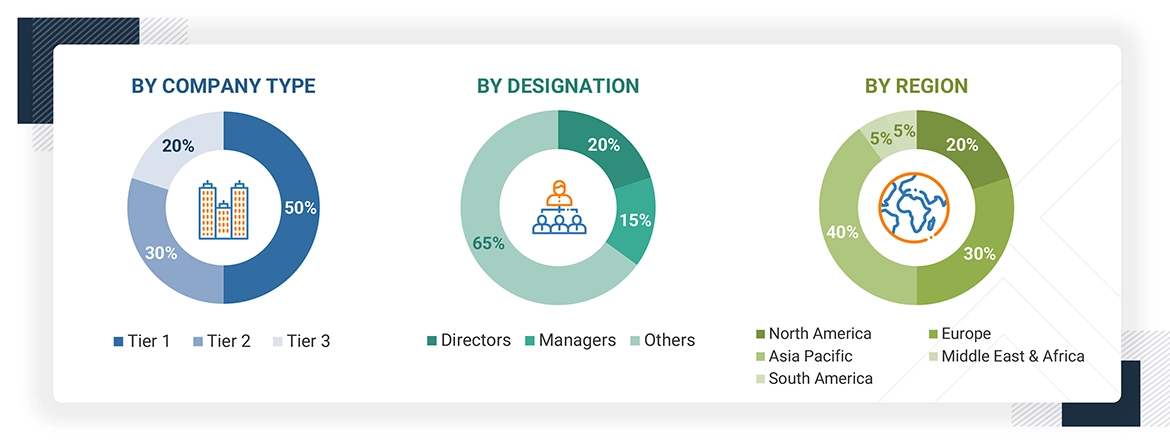
The breakdown of profiles of the primary interviewees is illustrated in the figure below:
Antimony-free Polyesters Market

Note: Tier 1, Tier 2, and Tier 3 companies are classified based on their market revenue in 2024 available in the public domain, product portfolios, and geographical presence.

Other designations include sales representatives, production heads, and technicians.

To know about the assumptions considered for the study, download the pdf brochure

Market Size Estimation

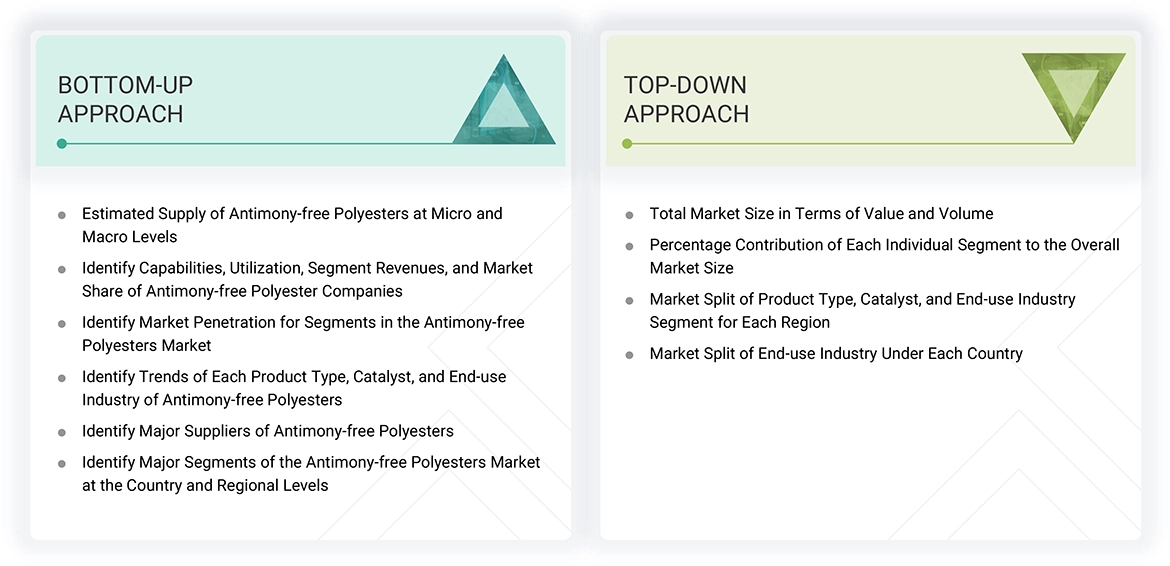
The top-down approach was used to estimate and validate the size of various submarkets for the antimony-free polyesters market for the region. The research methodology used to estimate the market size included the following steps:

  • The key players in the industry have been identified through extensive secondary research.
  • The supply chain of the industry has been determined through primary and secondary research.
  • All percentage shares, splits, and breakdowns based on product type, catalyst, end-use industry, and region were determined using secondary sources and verified through primary sources.
  • All possible parameters that affect the markets covered in this research study were accounted for, viewed in extensive detail, verified through primary research, and analyzed to get the final quantitative and qualitative data. This data was consolidated and added with detailed inputs and analysis, and presented in this report.
Antimony-free Polyesters Market

Data Triangulation

After arriving at the total market size from the estimation process above, the overall market has been split into several segments and subsegments. To complete the overall market engineering process and arrive at the exact statistics for all the segments and subsegments, the data triangulation and market breakdown procedures have been employed, wherever applicable. The data has been triangulated by studying various factors and trends from both the demand and supply sides. Along with this, the market size has been validated by using both the top-down and bottom-up approaches and primary interviews. Hence, for every data segment, there have been three sources: the top-down approach, the bottom-up approach, and expert interviews. The data was assumed correct when the values arrived from the three sources matched.

Market Definition

Antimony-free polyester identifies a class of polyester products that are manufactured without antimony-based catalysts. Antimony-based catalysts were commonly used as catalysts in the polymerization of polyesters such as polyethylene terephthalate (PET), polybutylene terephthalate (PBT), and polytrimethylene terephthalate (PTT). While antimony trioxide is synthesized from the ore antimony, polyesters can be produced using titanium, aluminum, or tin-based catalysts to manufacture comparable polymer material with less residual toxic material and with less environmental impact. The move away from antimony-based polyesters is being fueled by health and environmental concerns, specifically in food packaging and textiles, as well as medical and consumer applications. Antimony-free polyester offers recyclability, and meets global safety standards and the demands of responsible consumers for safer and more sustainable products, making an antimony-free polyester important across the many sectors by offering products and performance that can compete in green and regulated markets without compromising product performance or quality.

Stakeholders

  • Antimony-free Polyester Manufacturers
  • Antimony-free Polyester Traders, Distributors, and Suppliers
  • Raw Material Suppliers
  • Government and Private Research Organizations
  • Associations and Industrial Bodies
  • R&D Institutes
  • Environmental Support Agencies

Report Objectives

  • To define, describe, and forecast the size of the antimony-free polyesters, in terms of value and volume
  • To provide detailed information regarding the major factors (drivers, opportunities, restraints, and challenges) influencing the market growth
  • To estimate and forecast the market size based on product type, catalyst, end-use industry, and region
  • To forecast the size of the market with respect to major regions, namely, North America, Europe, Asia Pacific, the Middle East & Africa, and South America, along with their key countries
  • To strategically analyze micromarkets with respect to individual growth trends, prospects, and their contribution to the overall market
  • To analyze opportunities in the market for stakeholders and provide a competitive landscape of market leaders
  • To track and analyze recent development such as expansions, investments, collaborations, and partnerships in the market
  • To strategically profile the key market players and comprehensively analyze their core competencies

Previous Versions of this Report

"Our USP is "providing game-changing business opportunities reports with free customization" - so please feel free to provide us with your specific areas of interest / business challenges in much greater detail !!"

We appreciate your interest in this report. Once you fill out the form, you'll be immediately directed to an exclusive solution tailored to your needs. This high-value offering can help boost your revenue by 30% - a must-see opportunity for anyone looking to maximize growth.


By clicking the "Submit" button, you are agreeing to the Terms of Use and Privacy Policy.

Custom Market Research Services

We Will Customise The Research For You, In Case The Report Listed Above Does Not Meet With Your Requirements

Get 10% Free Customisation

Growth opportunities and latent adjacency in Antimony-free Polyesters Market

DMCA.com Protection Status