



Cloud Analytics Market Size & Outlook, 2026-2031
Report Code
TC 3598
Published in
Oct, 2026, By MarketsandMarkets™
Cloud Analytics Market by Solution Type (Cloud BI Tools, Data Warehouses, Discovery & Exploration, Visualization, Enterprise Information Management, Enterprise Performance Management, GRC, Advanced Analytics, Predictive Analytics) - Global Forecast to 2031

USD 41.33 BN
MARKET SIZE, 2031

CAGR 9.3%
(2026-2031)

343
REPORT PAGES

333
MARKET TABLES
OVERVIEW
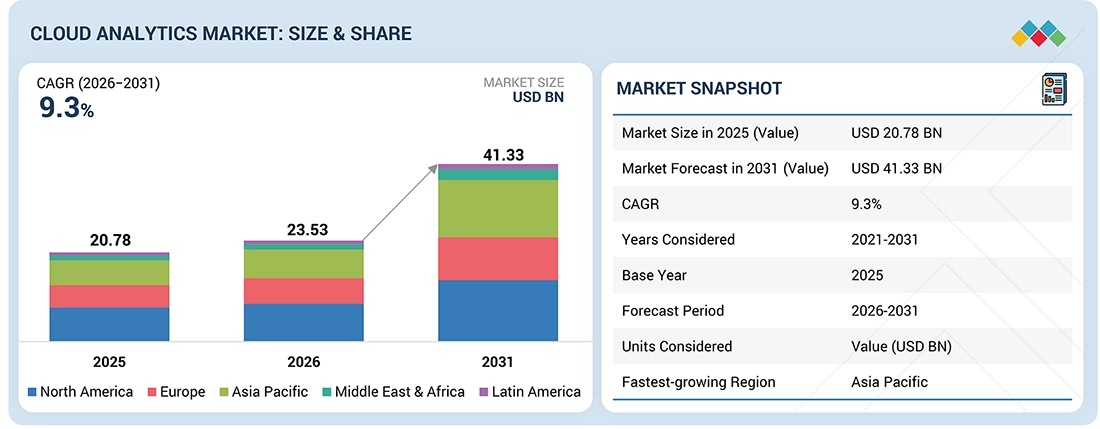
Source: Secondary Research, Interviews with Experts, MarketsandMarkets Analysis
The cloud analytics market is expected to reach USD 41.33 billion by 2031, from USD 23.53 billion in 2026, with a CAGR of 9.3%. Organizations across various industries are generating rising amounts of digital data through enterprise applications, customer platforms, and connected services. Managing and analyzing this data has become a key part of business operations. Many enterprises are adopting cloud analytics platforms to process large datasets and enable faster decision-making. Industries such as financial services, healthcare, retail, and government are increasing their use of cloud analytics to enhance reporting and operational efficiency.
KEY TAKEAWAYS
-
BY REGIONNorth America is estimated to hold the largest market share of 37.71% in 2026.
-
BY OFFERINGCloud BI tools are expected to record a CAGR of 12.0% between 2026 and 2031.
-
BY DATA TYPEUnstructured data is expected to be the largest segment during the forecast period.
-
BY VERTICALHealthcare & life sciences is expected to be the fastest-growing segment, with a CAGR of 14.9%.
-
BY COMPETITIVE LANDSCAPE-Key PlayersMicrosoft, Oracle, and AWS are identified as the leading players in the cloud analytics market, given their strong market share and product footprint.
-
BY COMPETITIVE LANDSCAPE-Startups/SMEsDomo, Sisense, and Denodo have distinguished themselves among other players by securing strong footholds in specialized niche areas, underscoring their potential as emerging leaders.
Technology vendors are expanding their cloud analytics platforms and enhancing integration with cloud environments. Many platforms now include analytics, automation, and data visualization tools. Vendors are also adding governance and security features to meet data privacy and cybersecurity needs. These features assist organizations in managing and analyzing data within cloud environments.
TRENDS & DISRUPTIONS IMPACTING CUSTOMERS' CUSTOMERS
Analytics deployments are shifting from on-premise systems to cloud platforms. Previously, analytics environments relied on separate data warehouses and batch processing systems. Cloud analytics platforms now integrate data storage, processing, and visualization into a single environment. Subscription-based services also enable organizations to scale analytics resources as data volumes increase.
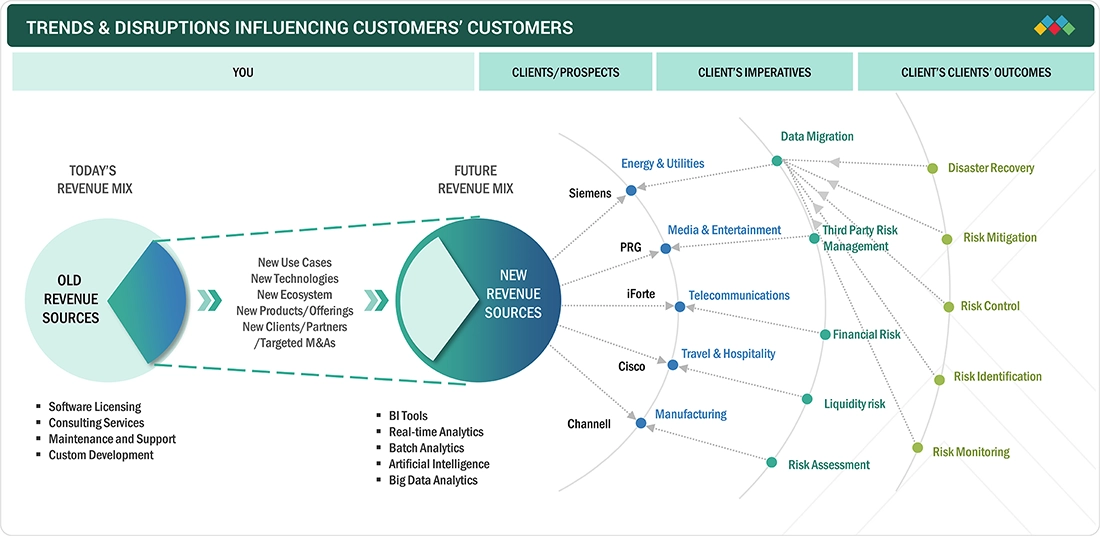
Source: Secondary Research, Interviews with Experts, MarketsandMarkets Analysis
MARKET DYNAMICS

Drivers
Impact
Level
Level
-
Rising demand for faster data insights

-
Increasing enterprise focus on data-driven decision making


RESTRAINTS
Impact
Level
Level
-
Data integration and preparation challenges across multiple data sources

-
High implementation and migration costs for analytics platforms


OPPORTUNITIES
Impact
Level
Level
-
Extensive use of cloud analytics to process unstructured data

-
Integration of AI and machine learning in analytics platforms


CHALLENGES
Impact
Level
Level
-
Data governance, security, and compliance in cloud analytics environments

-
Integrating legacy enterprise systems with cloud analytics platforms

Source: Secondary Research, Interviews with Experts, MarketsandMarkets Analysis
Driver: Rising demand for faster data insights
The demand for quicker data insights is driving increased use of cloud analytics. Organizations utilize analytics to monitor transactions, track operations, and review business activities. Cloud platforms support extensive data processing and near real-time reporting. These tools are employed in areas such as fraud detection, financial analysis, supply chain management, and customer behavior analysis.
Restraint: Data integration and preparation challenges across multiple data sources
Data integration and preparation can slow down cloud analytics projects. Organizations extract data from various sources like enterprise systems, cloud platforms, and external services. The data often comes in different formats. Therefore, teams spend time cleaning and organizing it before analysis. Older systems and fragmented data environments can also cause delays.
Opportunity: Extensive use of cloud analytics to process unstructured data
Unstructured data is increasing in many organizations. This includes multimedia files, social media content, machine-generated data, and application logs. These data types require flexible processing tools and scalable storage solutions. Cloud analytics platforms help manage these datasets and simplify analysis. As unstructured data continues to grow, more organizations are adopting cloud analytics tools.
Challenge: Data governance, security, and compliance in cloud analytics environments
Data governance and security remain crucial in cloud analytics environments. Organizations must protect sensitive business and customer data stored in cloud platforms. Privacy and financial reporting regulations also introduce operational requirements. Many enterprises address this by strengthening governance policies, using encryption, and implementing access controls. Continuous monitoring is also increasingly common in cloud analytics deployments.
CLOUD ANALYTICS MARKET SIZE, SHARE, LATEST TRENDS, GROWTH: COMMERCIAL USE CASES ACROSS INDUSTRIES
| COMPANY | USE CASE DESCRIPTION | BENEFITS |
|---|---|---|
 |
Marriott implemented Cisco Umbrella to enhance guest network security across its hotels. The platform provides DNS-layer protection, web filtering, and SafeSearch controls to block illegal content while safeguarding guest privacy. | The deployment encompasses nearly 5,000 hotels across the US and Canada. It enhanced network security and offered a safer internet experience for guests. |
 |
Cloudera and AWS helped Indonesian telecom provider iForte upgrade its data infrastructure. The project introduced business intelligence and analytics tools to enhance operational visibility. | Data processing time decreased from one to two days to around one hour, enabling the company to gain operational insights more quickly. |
 |
Atos and AWS supported Siemens in migrating SAP HANA workloads to the cloud. | The project involved migration, optimization, and managed services using Amazon EC2 and Amazon S3. System performance increased by over 30%. Availability rose to nearly 98%. The platform also achieved up to 99.9% data durability and enhanced backup and disaster recovery. |
Logos and trademarks shown above are the property of their respective owners. Their use here is for informational and illustrative purposes only.
MARKET ECOSYSTEM
The cloud analytics ecosystem includes various types of participants. Solution vendors create analytics software and data management tools. Cloud service providers offer infrastructure for storing and processing large data volumes. Analytics vendors also develop specialized applications tailored for specific industries. Consulting firms assist organizations with implementation and integration projects.
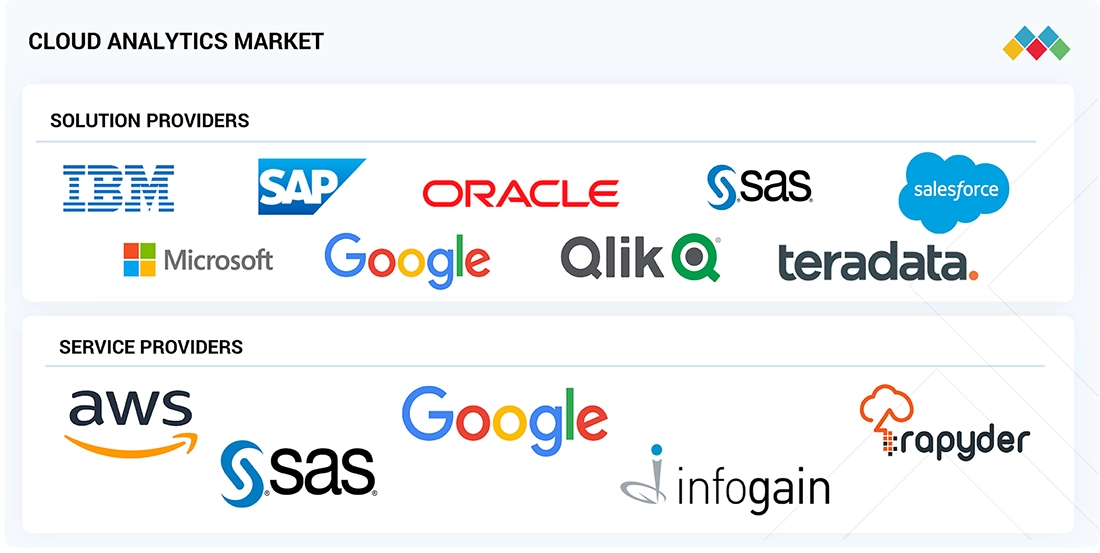
Logos and trademarks shown above are the property of their respective owners. Their use here is for informational and illustrative purposes only.
MARKET SEGMENTS
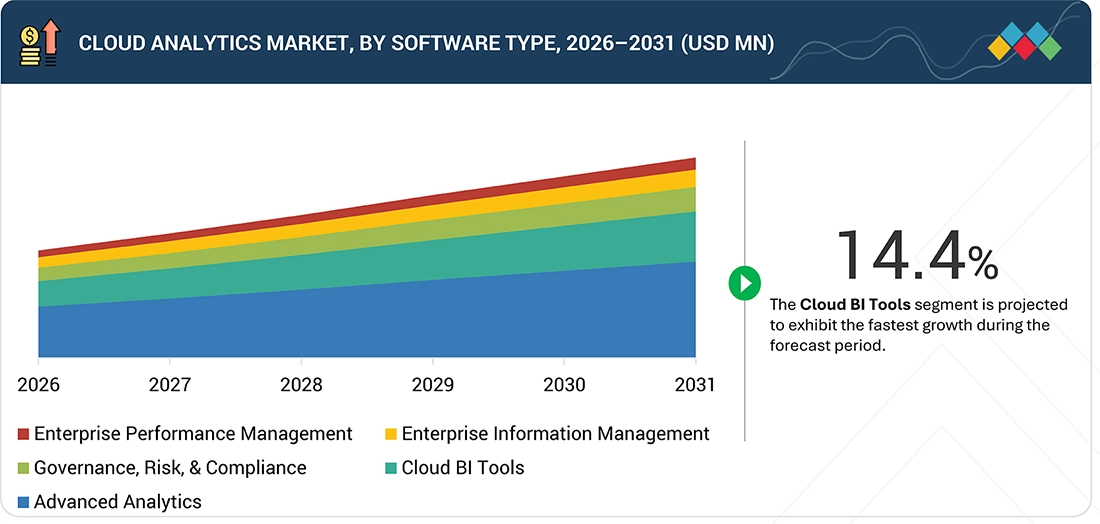
Source: Secondary Research, Interviews with Experts, MarketsandMarkets Analysis
Cloud Analytics Market, By Offering
Among offerings, advanced analytics software makes up the largest part of the cloud analytics market. These tools provide features like predictive analytics, machine learning, and sophisticated data modeling. Organizations use them to gain deeper insights from operational and customer data.
Cloud Analytics Market, By Data Type
Unstructured data is expected to grow the fastest based on data type. The rising volume of social media data, multimedia content, and machine-generated information drives this trend. Therefore, organizations need analytics platforms capable of handling multiple data formats and large datasets.
Cloud Analytics Market, By Vertical
The BFSI sector has the largest share of the cloud analytics market by industry vertical. Financial institutions leverage cloud analytics for transaction monitoring, fraud detection, risk assessment, and regulatory reporting. These capabilities enable improved operational control and customer insights.
REGION
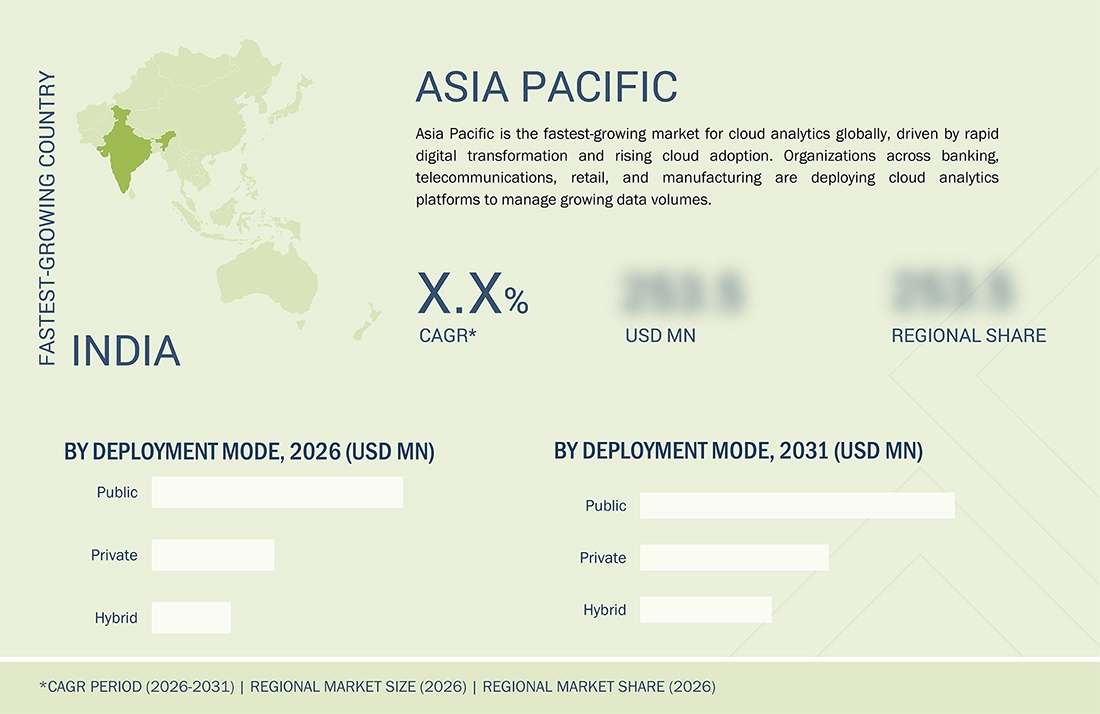
Asia Pacific is projected to be the fastest-growing region in the cloud analytics market
Asia Pacific exhibits the fastest growth in the cloud analytics market. Countries such as China, India, Japan, South Korea, and Australia are boosting their spending on cloud infrastructure and digital platforms. The increase in digital payments, e-commerce, and online services is driving the use of analytics tools in the region.
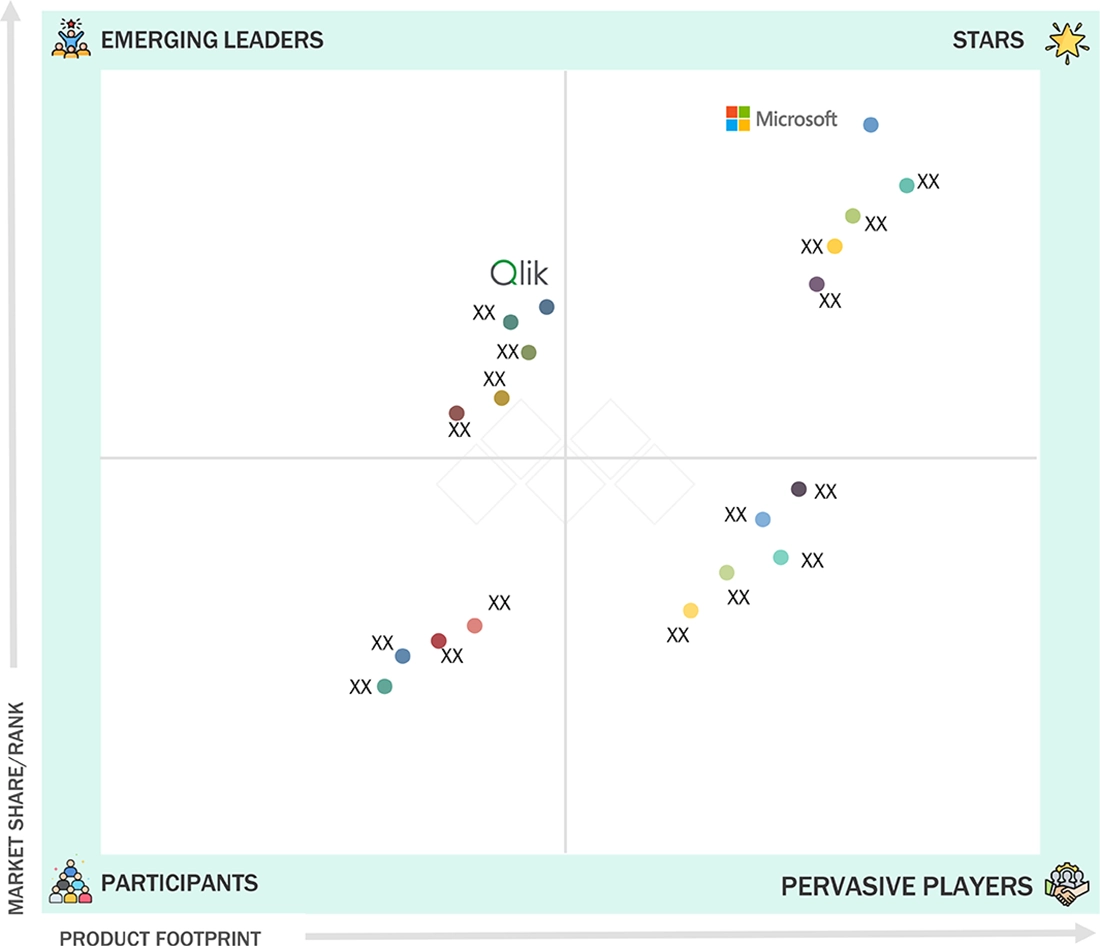
CLOUD ANALYTICS MARKET SIZE, SHARE, LATEST TRENDS, GROWTH: COMPANY EVALUATION MATRIX
In the vendor landscape, Microsoft is positioned in the Stars quadrant. The company’s position is supported by its cloud platform and analytics tools. Qlik is positioned in the Emerging Leaders quadrant. The company is expanding its data integration and cloud analytics portfolio.
Source: Secondary Research, Interviews with Experts, MarketsandMarkets Analysis
KEY MARKET PLAYERS
- IBM (US)
- Google (US)
- Microsoft (US)
- Amazon Web Services (AWS) (US)
- SAP (Germany)
- Oracle (US)
- SAS Institute (US)
- Teradata (US)
- NetApp (US)
- Qlik (US)
- Sisense (US)
- Salesforce (US)
- Atos (France)
- Altair (US)
- MicroStrategy (US)
- TIBCO Software (US)
- Hexaware Technology (India)
- Zoho (India)
- Rackspace Technology (US)
MARKET SCOPE
| REPORT METRIC | DETAILS |
|---|---|
| Market Size in 2025 (Value) | USD 20.78 BN |
| Market Forecast in 2031 (Value) | USD 41.33 BN |
| CAGR | 9.3% (2026-2031) |
| Years Considered | 2021–2031 |
| Base Year | 2025 |
| Forecast Period | 2026–2031 |
| Units Considered | Value (USD MN/BN) |
| Report Coverage | Revenue forecast, company ranking, competitive landscape, growth factors, and trends |
| Segments Covered |
|
| Regions Covered | North America, Asia Pacific, Europe, Middle East & Africa, Latin America |
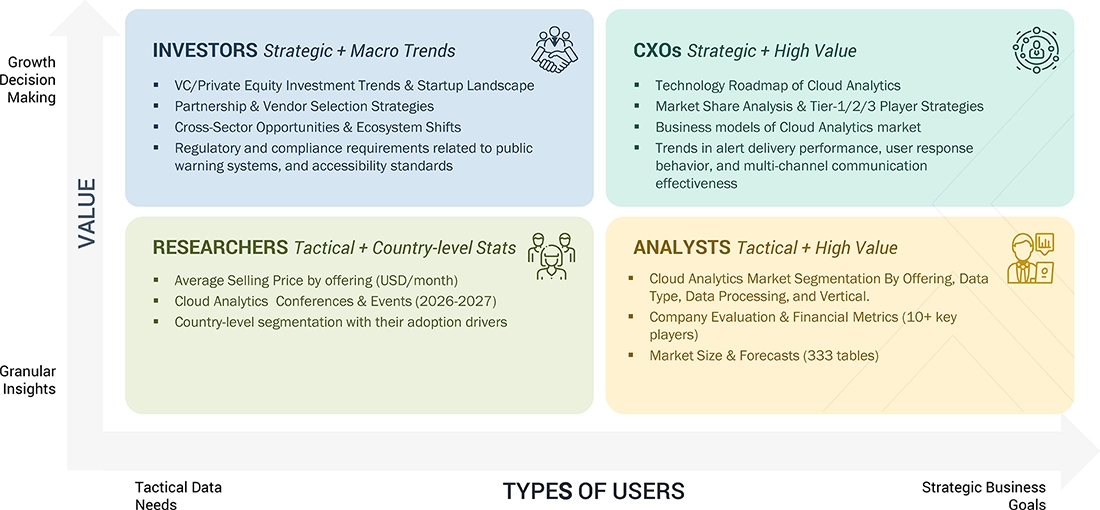
WHAT IS IN IT FOR YOU: CLOUD ANALYTICS MARKET SIZE, SHARE, LATEST TRENDS, GROWTH REPORT CONTENT GUIDE
DELIVERED CUSTOMIZATIONS
We have successfully delivered the following deep-dive customizations:
| CLIENT REQUEST | CUSTOMIZATION DELIVERED | VALUE ADDS |
|---|---|---|
| Cloud Analytics Platform Selection and Deployment Review | A customized assessment of cloud analytics platforms was conducted for enterprises evaluating cloud-based analytics deployments. The analysis focused on scalability, real-time data processing, integration with existing enterprise data sources, and support for AI/ML-driven analytics. Vendors were evaluated based on cloud compatibility, security features, data governance capabilities, and performance across hybrid and multi-cloud environments. | The engagement helped the client shortlist platforms aligned with performance, security, and integration requirements. It reduced deployment risks, improved confidence in long-term scalability, and enabled faster adoption of cloud-based analytics across multiple business functions. |
| Cloud Analytics Vendor Landscape and Capability Assessment | A tailored customization mapped the capabilities of leading cloud analytics vendors and solutions supporting business intelligence, data visualization, predictive analytics, and automated reporting. Vendors were assessed based on their ability to process large-scale structured and unstructured data, support real-time analytics, and provide flexible cloud deployment models. | The customization provided improved visibility into the cloud analytics vendor landscape and supported strategic technology investment decisions. It enabled the client to align analytics capabilities with business objectives while ensuring cost efficiency and scalability for future growth. |
RECENT DEVELOPMENTS
- November 2025 : SAP and Microsoft expanded their collaboration to integrate SAP Business Data Cloud with Microsoft Fabric and Azure services, enabling enterprises to combine SAP business data with cloud analytics and AI tools for unified analytics and faster insights.
- October 2025 : Oracle and Microsoft announced a collaboration to integrate Oracle Fusion Cloud Supply Chain applications with Microsoft Azure IoT and analytics services, helping enterprises use real-time operational data for analytics-driven supply chain decision-making.
- October 2025 : Oracle expanded its partnership with AWS through Oracle Database@AWS, allowing enterprises to run Oracle database workloads directly within AWS environments to support analytics, AI workloads, and cloud-based enterprise applications.
- September 2025 : SAP and Google Cloud introduced new data-sharing capabilities between SAP Business Data Cloud and Google BigQuery, enabling zero-copy data sharing and faster analytics without moving enterprise data between platforms.
- December 2025 : Rackspace Technology strengthened its collaboration with AWS and received the AWS Collaboration Partner of the Year award for delivering multi-cloud analytics and AI solutions that help enterprises build and manage cloud analytics workloads.
Table of Contents
 Exclusive indicates content/data unique to MarketsandMarkets and not available with any competitors.
TITLE
PAGE NO
1
INTRODUCTION
15
2
EXECUTIVE SUMMARY
3
PREMIUM INSIGHTS
4
MARKET OVERVIEW
Provides a snapshot of current market scenario, value chain context, and factors impacting competitive intensity.
4.1
INTRODUCTION
4.2
MARKET DYNAMICS
4.2.1
DRIVERS
4.2.2
RESTRAINTS
4.2.3
OPPORTUNITIES
4.2.4
CHALLENGES
4.3
UNMET NEEDS AND WHITE SPACES
4.4
INTERCONNECTED MARKETS AND CROSS-SECTOR OPPORTUNITIES
4.5
STRATEGIC MOVES BY TIER-1/2/3 PLAYERS
5
INDUSTRY TRENDS
Covers the key developments, trend analysis, and actionable insights to support strategic planning and positioning.
5.1
PORTER’S FIVE FORCES ANALYSIS
5.2
MACROECONOMIC OUTLOOK
5.2.1
GDP TRENDS AND FORECAST
5.2.2
TRENDS IN GLOBAL BIG DATA AND ANALYTICS INDUSTRY
5.2.3
TRENDS IN GLOBAL AI INDUSTRY
5.3
SUPPLY CHAIN ANALYSIS
5.4
ECOSYSTEM ANALYSIS
5.5
PRICING ANALYSIS
5.5.1
AVERAGE SELLING PRICE OF OFFERINGS, BY KEY PLAYER,
5.5.2
AVERAGE SELLING PRICE, BY DATA TYPE,
5.6
KEY CONFERENCES AND EVENTS,
5.7
TRENDS/DISRUPTIONS IMPACTING CUSTOMER BUSINESS
5.8
INVESTMENT AND FUNDING SCENARIO
5.9
CASE STUDY ANALYSIS
6
TECHNOLOGICAL ADVANCEMENTS, AI-DRIVEN IMPACT, PATENTS, AND INNOVATIONS
6.1
KEY TECHNOLOGIES
6.1.1
ARTIFICIAL INTELLIGENCE
6.1.2
CLOUD COMPUTING
6.1.3
BIG DATA ANALYTICS
6.2
COMPLEMENTARY TECHNOLOGIES
6.2.1
AR/VR
6.2.2
5G
6.3
ADJACENT TECHNOLOGIES
6.3.1
EDGE COMPUTING
6.3.2
CYBERSECURITY
6.3.3
INTERNET OF THINGS
6.4
TECHNOLOGY ROADMAP
6.5
PATENT ANALYSIS
6.5.1
METHODOLOGY
6.5.2
PATENTS FILED, BY DOCUMENT TYPE, 2016–2026
6.5.3
INNOVATION AND PATENT APPLICATIONS
6.5.4
TOP APPLICANTS
6.6
IMPACT OF AI/GEN AI
6.6.1
TOP USE CASES AND MARKET POTENTIAL
6.6.2
BEST PRACTICES FOLLOWED BY MANUFACTURERS
6.6.3
CASE STUDIES RELATED TO AI IMPLEMENTATION
6.6.4
INTERCONNECTED ECOSYSTEM AND IMPACT ON MARKET PLAYERS
6.6.5
CLIENTS’ READINESS TO ADOPT AI
7
REGULATORY LANDSCAPE
7.1
REGIONAL REGULATIONS AND COMPLIANCE
7.1.1
REGULATORY BODIES, GOVERNMENT AGENCIES, AND OTHER
7.1.2
INDUSTRY STANDARDS
8
CUSTOMER LANDSCAPE AND BUYER BEHAVIOR
8.1
DECISION-MAKING PROCESS
8.2
KEY STAKEHOLDERS IN BUYING PROCESS AND THEIR EVALUATION CRITERIA
8.2.1
KEY STAKEHOLDERS IN BUYING PROCESS
8.2.2
BUYING CRITERIA
8.3
ADOPTION BARRIERS AND INTERNAL CHALLENGES
8.4
UNMET NEEDS OF INDUSTRY VERTICALS
9
CLOUD ANALYTICS MARKET, BY OFFERING
Market Size, Volume & Forecast – USD Million
9.1
INTRODUCTION
9.2
SOLUTIONS
9.2.1
BY TYPE
9.2.1.1
CLOUD BI TOOLS
9.2.1.1.1
DATA WAREHOUSES
9.2.1.1.2
DATA DISCOVERY & EXPLORATION
9.2.1.1.3
DATA VISUALIZATION
9.2.1.1.4
COMPLEX EVENT PROCESSING
9.2.1.1.5
DATA INTEGRATION TOOLS
9.2.1.1.6
REPORTING & OLAP TOOLS
9.2.1.2
ENTERPRISE INFORMATION MANAGEMENT
9.2.1.3
ENTERPRISE PERFORMANCE MANAGEMENT
9.2.1.4
GOVERNANCE, RISK, & COMPLIANCE
9.2.1.5
ADVANCED ANALYTICS
9.2.1.5.1
DESCRIPTIVE ANALYTICS
9.2.1.5.2
DIAGNOSTIC ANALYTICS
9.2.1.5.3
PREDICTIVE ANALYTICS
9.2.1.5.4
PRESCRIPTIVE ANALYTICS
9.2.2
BY INTEGRATION LEVEL
9.2.2.1
EMBEDDED
9.2.2.2
STANDALONE
9.2.3
BY DEPLOYMENT MODE
9.2.3.1
PUBLIC
9.2.3.2
PRIVATE
9.2.3.3
HYBRID
9.3
SERVICES
9.3.1
PROFESSIONAL SERVICES
9.3.1.1
CONSULTING SERVICES
9.3.1.2
DEPLOYMENT & INTEGRATION
9.3.1.3
SUPPORT & MAINTENANCE
9.3.2
MANAGED SERVICES
10
CLOUD ANALYTICS MARKET, BY DATA TYPE
Market Size, Volume & Forecast – USD Million
10.1
INTRODUCTION
10.2
STRUCTURED
10.3
UNSTRUCTURED
11
CLOUD ANALYTICS MARKET, BY DATA PROCESSING
Market Size, Volume & Forecast – USD Million
11.1
INTRODUCTION
11.2
REAL-TIME ANALYTICS
11.3
BATCH ANALYTICS
12
CLOUD ANALYTICS MARKET, BY VERTICAL
Market Size, Volume & Forecast – USD Million
12.1
INTRODUCTION
12.2
BFSI
12.2.1
ALGORITHMIC TRADING
12.2.2
CUSTOMER CHURN PREDICTION
12.2.3
CREDIT SCORING & UNDERWRITING
12.2.4
FRAUD DETECTION & PREVENTION
12.2.5
OTHERS
12.3
RETAIL & CONSUMER GOODS
12.3.1
CUSTOMER SEGMENTATION & PERSONALIZATION
12.3.2
INVENTORY MANAGEMENT
12.3.3
CUSTOMER FEEDBACK ANALYTICS
12.3.4
PRICE OPTIMIZATION
12.3.5
OTHERS
12.4
HEALTHCARE & LIFE SCIENCES
12.4.1
CLINICAL DATA MANAGEMENT
12.4.2
PERSONALIZED TREATMENT
12.4.3
POPULATION HEALTH MANAGEMENT
12.4.4
DRUG DISCOVERY & DEVELOPMENT
12.4.5
CLINICAL RESEARCH & TRIALS OPTIMIZATION
12.4.6
OTHERS
12.5
TELECOMMUNICATIONS
12.5.1
NETWORK PERFORMANCE MONITORING & OPTIMIZATION
12.5.2
QUALITY OF SERVICE MONITORING
12.5.3
INFRASTRUCTURE PLANNING & OPTIMIZATION
12.5.4
TELECOM REVENUE ASSURANCE
12.5.5
OTHERS
12.6
EDUCATION
12.6.1
STUDENT PERFORMANCE MANAGEMENT
12.6.2
CUSTOMIZED COURSES & PERSONALIZED LEARNING
12.6.3
LEARNING MANAGEMENT SYSTEM ANALYTICS
12.6.4
ADAPTIVE TESTING & GRADING
12.6.5
OTHERS
12.7
AUTOMOTIVE
12.7.1
FUEL EFFICIENCY OPTIMIZATION
12.7.2
CONNECTED CAR ANALYTICS
12.7.3
TELEMATICS & USAGE-BASED INSURANCE
12.7.4
VEHICLE PRODUCTION OPTIMIZATION
12.7.5
OTHERS
12.8
MANUFACTURING
12.8.1
EQUIPMENT & MACHINERY PREDICTIVE MAINTENANCE
12.8.2
QUALITY CONTROL & DEFECT ANALYSIS
12.8.3
SMART MANUFACTURING
12.8.4
ASSET TRACKING & MANAGEMENT
12.8.5
PRODUCTION PROCESS OPTIMIZATION
12.8.6
OTHERS
12.9
TRANSPORTATION & LOGISTICS
12.9.1
ROUTE OPTIMIZATION & TRAFFIC MANAGEMENT
12.9.2
FLEET MANAGEMENT
12.9.3
VEHICLES & EQUIPMENT MAINTENANCE
12.9.4
LOAD BALANCING & CAPACITY PLANNING
12.9.5
OTHERS
12.10
GOVERNMENT & DEFENSE
12.10.1
CYBERSECURITY & THREAT INTELLIGENCE
12.10.2
TAX & WELFARE MANAGEMENT
12.10.3
EMERGENCY RESPONSE OPTIMIZATION
12.10.4
DISASTER RESPONSE & EMERGENCY MANAGEMENT
12.10.5
OTHERS
12.11
OTHER VERTICALS
13
CLOUD ANALYTICS MARKET, BY REGION
Market Size, Volume & Forecast – USD Million
13.1
INTRODUCTION
13.2
NORTH AMERICA
13.2.1
US
13.2.2
CANADA
13.3
EUROPE
13.3.1
UK
13.3.2
GERMANY
13.3.3
FRANCE
13.3.4
ITALY
13.3.5
REST OF EUROPE
13.4
ASIA PACIFIC
13.4.1
CHINA
13.4.2
INDIA
13.4.3
JAPAN
13.4.4
ASEAN
13.4.5
REST OF ASIA PACIFIC
13.5
MIDDLE EAST & AFRICA
13.5.1
KSA
13.5.2
UAE
13.5.3
TURKEY
13.5.4
SOUTH AFRICA
13.5.5
REST OF MIDDLE EAST & AFRICA
13.6
LATIN AMERICA
13.6.1
BRAZIL
13.6.2
MEXICO
13.6.3
REST OF LATIN AMERICA
14
COMPETITIVE LANDSCAPE
14.1
OVERVIEW
14.2
KEY PLAYER STRATEGIES/RIGHT TO WIN, 2021–2025
14.3
REVENUE ANALYSIS, 2021–2025
14.4
MARKET SHARE ANALYSIS,
14.5
BRAND/PRODUCT COMPARISON
14.6
COMPANY EVALUATION MATRIX: KEY PLAYERS,
14.6.1
STARS
14.6.2
EMERGING LEADERS
14.6.3
PERVASIVE PLAYERS
14.6.4
PARTICIPANTS
14.6.5
COMPANY FOOTPRINT: KEY PLAYERS,
14.6.5.1
COMPANY FOOTPRINT
14.6.5.2
REGION FOOTPRINT
14.6.5.3
OFFERING FOOTPRINT
14.6.5.4
DATA TYPE FOOTPRINT
14.6.5.5
VERTICAL FOOTPRINT
14.7
COMPANY EVALUATION MATRIX: START-UPS/SMES,
14.7.1
PROGRESSIVE COMPANIES
14.7.2
RESPONSIVE COMPANIES
14.7.3
DYNAMIC COMPANIES
14.7.4
STARTING BLOCKS
14.7.5
COMPETITIVE BENCHMARKING: START-UPS/SMES,
14.7.5.1
LIST OF START-UPS/SMES
14.7.5.2
COMPETITIVE BENCHMARKING OF START-UPS/SMES
14.8
COMPANY VALUATION AND FINANCIAL METRICS
14.9
COMPETITIVE SCENARIO
14.9.1
PRODUCT LAUNCHES
14.9.2
DEALS
15
COMPANY PROFILES
15.1
INTRODUCTION
15.2
KEY PLAYERS
15.2.1
SAP
15.2.2
GOOGLE
15.2.3
IBM
15.2.4
SAS INSTITUTE
15.2.5
MICROSOFT
15.2.6
TERADATA
15.2.7
HEWLETT PACKARD ENTERPRISE
15.2.8
MICROSTRATEGY
15.2.9
SALESFORCE
15.2.10
AWS
15.2.11
TIBCO SOFTWARE
15.2.12
SISENSE
15.2.13
ATOS
15.2.14
HITACHI VANTARA
15.2.15
CLOUDERA
15.2.16
ZOHO
15.2.17
QLIK
15.2.18
DOMO
15.2.19
NETAPP
15.3
OTHER PLAYERS
15.3.1
SPLUNK
15.3.2
HEXAWARE TECHNOLOGIES
15.3.3
INCORTA
15.3.4
RIDGE
15.3.5
TELLIUS
15.3.6
RAPYDER
15.3.7
RACKSPACE TECHNOLOGY
15.3.8
ALTAIR
15.3.9
DENODO
15.3.10
THOUGHSPOT
15.3.11
GOODDATA
15.3.12
JASPERSOFT
15.3.13
YELLOWFIN
15.3.14
INFOGAIN
15.3.15
BOARD INTERNATIONAL
16
RESEARCH METHODOLOGY
16.1
RESEARCH DATA
16.1.1
SECONDARY DATA
16.1.1.1
KEY DATA FROM SECONDARY SOURCES
16.1.1.2
LIST OF SECONDARY SOURCES
16.1.2
PRIMARY DATA
16.1.2.1
KEY DATA FROM PRIMARY SOURCES
16.1.2.2
LIST OF PRIMARY PARTICIPANTS
16.1.2.3
BREAKDOWN OF PRIMARY INTERVIEWS
16.1.2.4
INSIGHTS FROM INDUSTRY EXPERTS
16.2
MARKET SIZE ESTIMATION
16.2.1
BOTTOM-UP APPROACH
16.2.2
TOP-DOWN APPROACH
16.2.3
MARKET SIZE CALCULATION FOR BASE YEAR
16.3
MARKET FORECAST APPROACH
16.3.1
SUPPLY SIDE
16.3.2
DEMAND SIDE
16.4
DATA TRIANGULATION
16.5
FACTOR ANALYSIS
16.6
RESEARCH ASSUMPTIONS
16.7
RESEARCH LIMITATIONS
16.8
RISK ASSESSMENT
17
APPENDIX
17.1
DISCUSSION GUIDE
17.2
KNOWLEDGESTORE: MARKETANDMARKETS’ SUBSCRIPTION PORTAL
17.3
CUSTOMIZATIONS OPTIONS
17.4
RELATED REPORTS
17.5
AUTHOR DETAILS
Methodology
The research methodology for the cloud analytics market report involved extensive secondary sources and directories, as well as various reputable open-source databases, to identify and collect relevant information for this technical and market-oriented study. In-depth interviews were conducted with various primary respondents, including solutions by type and deployment mode, and high-level executives from multiple companies offering cloud analytics solutions, services, and industry consultants, to obtain and verify critical qualitative and quantitative information and assess market prospects and industry trends.
Secondary Research
During the secondary research process, various secondary sources were consulted to identify and collect information for the study. The secondary sources included annual reports, press releases, and investor presentations of companies, white papers, and certified publications.
Secondary research was used to gather key information on the industry’s value chain, the market’s monetary chain, the overall pool of key players, market classification, and segmentation based on industry trends, regional markets, and key developments from both market- and technology-oriented perspectives.
Primary Research
In the primary research process, a broad set of stakeholders from both the supply and demand sides of the Cloud Analytics ecosystem were interviewed to gather qualitative and quantitative insights specific to this market. From the supply side, key industry experts such as chief executive officers (CEOs), chief technology officers (CTOs), vice presidents (VPs), cloud data architects, analytics platform specialists, and technology directors from companies providing cloud analytics platforms, data warehousing solutions, and AI-driven analytics services were consulted. Additionally, cloud service providers, system integrators, and consulting organizations supporting enterprise cloud transformation initiatives were included in the study. On the demand side, insights were collected from chief data officers (CDOs), IT directors, analytics managers, digital transformation leaders, and business intelligence heads across major industry verticals to understand enterprise adoption patterns, cloud data management strategies, and evolving analytics requirements.
The primary research ensured that all crucial parameters affecting the cloud analytics market, including technological advancements and evolving use cases, as well as regulatory and compliance needs, were considered. Each factor was thoroughly analyzed, verified through primary research, and evaluated to obtain precise quantitative and qualitative data for this market.
Once the initial phase of market engineering was completed, including detailed calculations for market statistics, segment-specific growth forecasts, and data triangulation, a second round of primary research was conducted. This step was crucial for refining and validating critical data points, such as Cloud Analytics platform offerings (solutions & services), industry adoption trends, the competitive landscape, and key market dynamics like demand drivers (exponential increase in unstructured data, rise in digitalization trend), challenges (need for training and upskilling to address knowledge gap, issues related to complexity and diversity of data collected) opportunities (focus on SDN- enabled network integration, growing integration of advanced analytical functionalities), restraints (discrepancy among data sources, data security and privacy concerns).
In the comprehensive market engineering process, the top-down and bottom-up approaches, along with several data triangulation methods, were extensively employed to estimate and forecast the overall market segments and subsegments listed in this report. Extensive qualitative and quantitative analysis was conducted across the complete market engineering process to capture critical information/insights throughout the report.
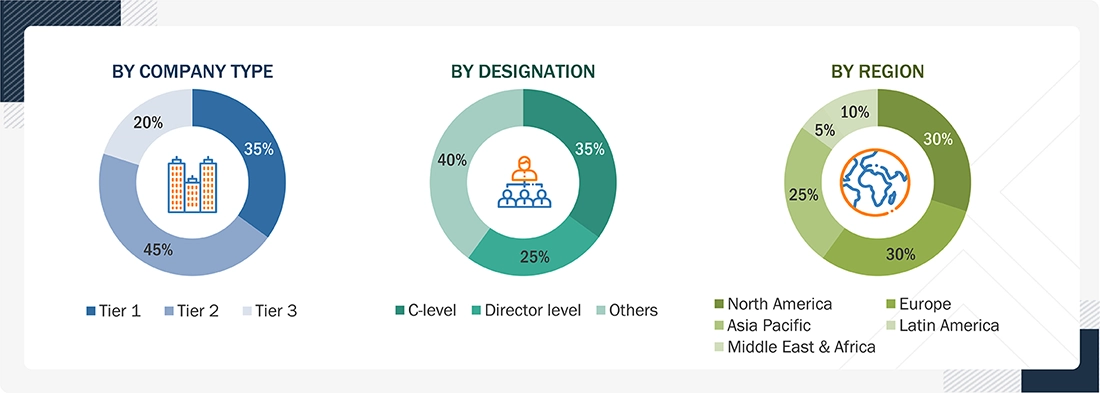
Note: Three tiers of companies are defined based on their total revenue as of 2025.
To know about the assumptions considered for the study, download the pdf brochure
Market Size Estimation
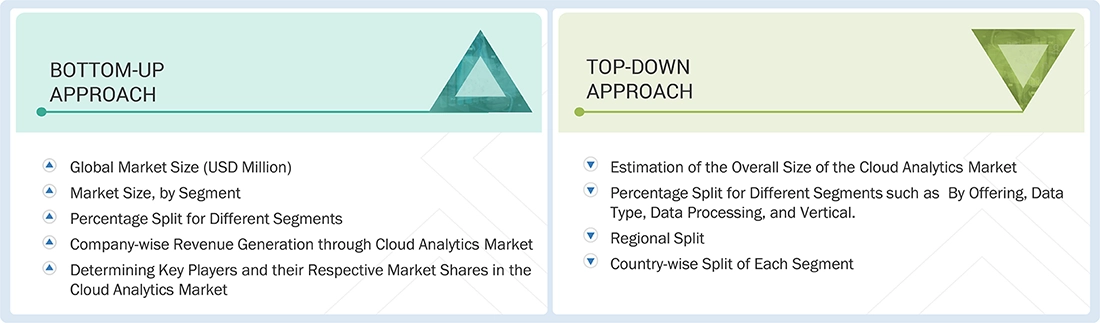
The top-down and bottom-up approaches were employed to estimate and forecast the cloud analytics market and its dependent submarkets. This multi-layered analysis was further reinforced through data triangulation, which incorporated primary and secondary research inputs. The market figures were also validated against the existing MarketsandMarkets repository for accuracy.
Cloud Analytics Market : Top-Down and Bottom-Up Approach
Data Triangulation
The market was divided into several segments and subsegments after determining the overall market size using the market size estimation processes described above. To complete the overall market engineering process and determine the exact statistics for each market segment and subsegment, data triangulation and market segmentation procedures were employed, wherever applicable. The overall market size was then used in the top-down approach to estimate the size of other individual markets by applying percentage splits to the market segmentation.
Market Definition
According to ThoughtSpot, cloud analytics involves scrutinizing data within a cloud-based data platform to uncover actionable business insights. This analytical approach empowers users to delve into extensive datasets stored in the cloud, revealing pertinent trends and patterns, forecasting outcomes, enhancing decision-making processes, and catalyzing business advancement.
Key Stakeholders
- Cloud Analytics Market Solutions Providers
- Cloud Analytics Market Service Providers
- End-user Industries
- System Integrators (SIs)
- Managed Service Providers (MSPs)
- Business Intelligence Solution Providers
- Technology Providers
- Value-added Resellers (VARs)
- Government and Regulatory Bodies
Report Objectives
- To define, describe, and predict the cloud analytics market by offering, data type, data processing, vertical, and region
- To provide detailed information related to major factors (drivers, restraints, opportunities, and industry-specific challenges) influencing market growth
- To analyze opportunities in the market and provide details of the competitive landscape for stakeholders and market leaders
- To forecast the market size of segments with respect to five main regions: North America, Europe, Asia Pacific, Middle East & Africa, and Latin America
- To analyze each submarket with respect to individual growth trends, prospects, and contributions to the overall cloud analytics market
- To analyze the competitive developments, such as partnerships, product launches, and mergers & acquisitions, in the cloud analytics market
- To analyze the impact of macroeconomic factors on the cloud analytics market across all regions
Available customizations:
Using the provided market data, MarketsandMarkets offers customizations tailored to the company’s specific needs. The following customization options are available for the report.
Product Analysis
- Product comparative analysis, which gives a detailed comparison of innovative products being offered by prominent vendors
Regional Analysis
- Further breakup of additional European countries by offering, data type, data processing, and vertical
- Further breakup of additional Asia Pacific countries by offering, data type, data processing, and vertical
- Further breakup of additional Middle East & African countries by offering, data type, data processing, and vertical
- Further breakup of additional Latin American countries by offering, data type, data processing, and vertical
Company Information
- Detailed analysis and profiling of additional market players (up to five)
Key Questions Addressed by the Report
What is the current Cloud-Based Business Analytics Market size?
The cloud analytics market at USD 23.53 billion in 2026, projected to reach USD 41.33 billion by 2031 at a CAGR of 9.3%.
Which solution segment is expected to grow the fastest?
Cloud BI tools are projected to record the highest growth during the forecast period.
Which region is expected to witness the fastest market growth?
Asia Pacific is projected to register the fastest growing region.
What are the key trends shaping the Cloud-Based Business Analytics Market?
AI integration, cloud data warehouses, lakehouse architectures, automation, and enhanced governance are key market trends.
Who are the major players in the Cloud-Based Business Analytics Market?
Key players include Microsoft, Oracle, AWS, IBM, Google, SAP, SAS Institute, Qlik, Salesforce, and Teradata.
Fact checked
Personalize This Research
- Triangulate with your Own Data
- Get Data as per your Format and Definition
- Gain a Deeper Dive on a Specific Application, Geography, Customer or Competitor
- Any level of Personalization
Let Us Help You
- What are the Known and Unknown Adjacencies Impacting the Cloud Analytics Market
- What will your New Revenue Sources be?
- Who will be your Top Customer; what will make them switch?
- Defend your Market Share or Win Competitors
- Get a Scorecard for Target Partners

Custom Market Research Services
We Will Customise The Research For You, In Case The Report Listed Above Does Not Meet With Your Requirements
Get 10% Free CustomisationTESTIMONIALS
- UK Cloud Analytics Market
- CHINA Cloud Analytics Market
- US Cloud Analytics Market
- Canada Cloud Analytics Market
- France Cloud Analytics Market
- Germany Cloud Analytics Market
- Italy Cloud Analytics Market
- Rest Of Europe Cloud Analytics Market
- Spain Cloud Analytics Market
- Anz Cloud Analytics Market
- India Cloud Analytics Market
- Japan Cloud Analytics Market
- Rest Of Apac Cloud Analytics Market
- South Korea Cloud Analytics Market
Growth opportunities and latent adjacency in Cloud Analytics Market






Macro
Apr, 2026
We’re evaluating cloud analytics adoption for BFSI and retail verticals. Does this report provide use-case level insights and can it be customized for specific industries?.
Hardy
Apr, 2026
how effective are cloud-based business analytics platforms in improving real-time data analysis?.