



Cloud Storage Market
Report Code
TC 2410
Published in
Aug, 2026, By MarketsandMarkets™
Cloud Storage Market by Offering (Object Storage, Block Storage, File Storage & Services), Application (Analytics & Data Lake Storage, AI & HPC Workloads, Data Protection, Cloud-Native Applications), Vertical & Region - Global Forecast to 2031

USD 260.66 BN
MARKET SIZE, 2031

CAGR 23.1%
(2026-2031)

380
REPORT PAGES

260
MARKET TABLES
OVERVIEW
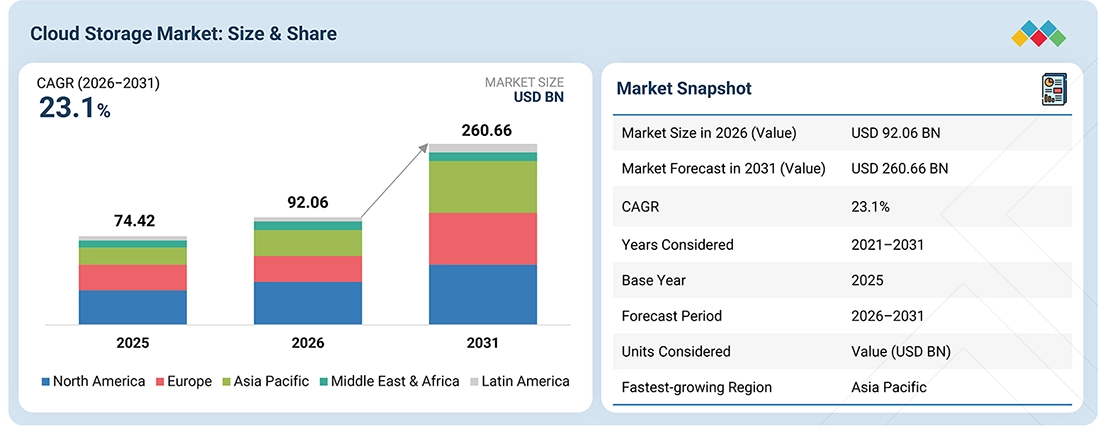
Source: Secondary Research, Interviews with Experts, MarketsandMarkets Analysis
The cloud storage market is projected to reach USD 260.66 billion by 2031 from USD 92.06 billion in 2026, at a CAGR of 23.1%. Rapid growth in enterprise data generation, AI and analytics workloads, cloud-native application adoption, and increasing demand for scalable storage infrastructure are accelerating investments in cloud storage solutions. Organizations are increasingly adopting object, block, and file storage platforms to support business applications, data lakes, artificial intelligence workloads, backup, disaster recovery, and long-term data retention. The integration of intelligent storage management, hybrid cloud architectures, automation, and AI-ready storage capabilities is transforming cloud storage into a strategic data foundation that improves scalability, operational efficiency, data accessibility, and business resilience across modern enterprise environments.
KEY TAKEAWAYS
-
BY OFFERINGBy offering, services are projected to register the highest CAGR of 25.5% during the forecast period, driven by growing demand for implementation, managed observability, and platform optimization expertise.
-
BY STORAGE TYPEBy storage type, file storage is projected to register the fastest growth during the forecast period, with a CAGR of 25.4%, driven by increasing adoption of shared enterprise file systems, AI workloads, cloud-native applications, hybrid cloud environments, and high-performance data access requirements.
-
BY APPLICATIONBy application, AI & high-performance workloads are projected to register the fastest growth during the forecast period, with a CAGR of 37.0%, driven by increasing demand for AI training, AI inference, vector database storage, and high-throughput data processing requirements.
-
BY DEPLOYMENT MODEBy deployment mode, hybrid cloud is expected to register the fastest growth as enterprises balance public-cloud scalability with data sovereignty, workload performance, cost control, and on-premises data requirements.
-
BY ORGANIZATION SIZEBy organization size, SMEs are expected to register faster growth, supported by pay-as-you-go storage, lower infrastructure investment, simplified management, and growing adoption of cloud-native business applications.
-
BY VERTICALBy vertical, retail & consumer goods are expected to record strong growth, supported by e-commerce, omnichannel operations, personalization, digital media, transaction data, analytics, and expanding backup requirements.
-
COMPETITIVE LANDSCAPE – KEY PLAYERSLeading companies in the cloud storage market include AWS, Microsoft, Google Cloud, Alibaba Cloud, and Oracle, which continue to expand storage scale, performance, AI integration, hybrid capabilities, and global infrastructure.
-
COMPETITIVE LANDSCAPE – STARTUPS/SMEsCloud storage specialists, including Wasabi, Backblaze, Scality, MinIO, and Zadara, are intensifying competition through simplified pricing, S3-compatible architectures, hybrid deployments, data sovereignty, and specialized storage capabilities.
The cloud storage market is evolving as enterprises modernize data infrastructure for AI, analytics, cloud-native applications, cyber resilience, and distributed operations. Demand is expanding across object, block, and file storage, alongside services for migration, integration, optimization, and managed storage. Organizations are also adopting hybrid architectures to balance scalability, cost, sovereignty, and performance. High-performance storage for AI and the convergence of storage with vector search, metadata, lakehouse, and intelligent lifecycle capabilities are increasingly moving the market beyond basic capacity toward an integrated enterprise data platform.
TRENDS & DISRUPTIONS IMPACTING CUSTOMERS' CUSTOMERS
The cloud storage market is rapidly evolving from a capacity utility into a foundational data layer for AI, analytics, and distributed applications. Growth in unstructured data, model checkpoints, media, backup copies, and real-time datasets is increasing demand for scalable object, file, and block storage. At the same time, enterprises are adopting hybrid and multi-cloud architectures to balance performance, sovereignty, resilience, and cost. Providers are responding with high-performance object tiers, automated lifecycle management, storage-native vector and metadata services, and deeper integration with lakehouse and AI platforms. These developments improve data accessibility, simplify infrastructure management, and increase the value enterprises can derive from stored information.
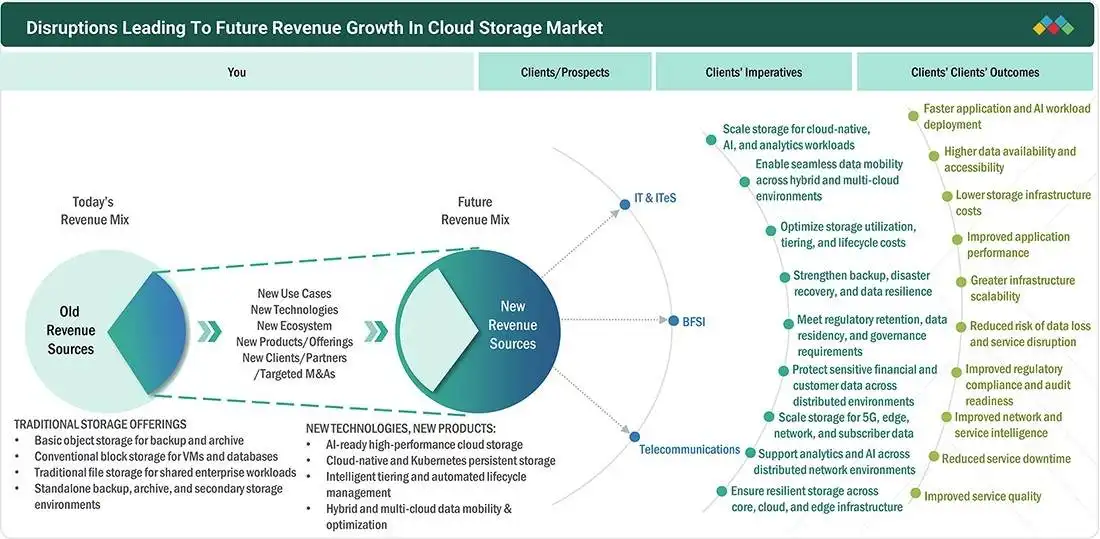
Source: Secondary Research, Interviews with Experts, MarketsandMarkets Analysis
MARKET DYNAMICS

Drivers
Impact
Level
Level
-
AI training, inference, and unstructured data growth are increasing cloud storage capacity and performance requirements

-
Ransomware resilience and immutable backup requirements are expanding replicated, protected, and long-term storage consumption


RESTRAINTS
Impact
Level
Level
-
Egress, retrieval, and operation charges can increase total storage costs and complicate data portability

-
Data gravity, migration complexity, and security concerns can delay movement of large or sensitive datasets to cloud environments


OPPORTUNITIES
Impact
Level
Level
-
Storage-native vector, metadata, and semantic services are creating new monetization opportunities around stored data

-
High-performance object storage and hybrid storage architectures are opening AI, analytics, and regulated workloads to cloud platforms


CHALLENGES
Impact
Level
Level
-
Power constraints and infrastructure investment requirements are increasing the cost of adding cloud storage capacity

-
Storage tiering and customer cost optimization can reduce revenue generated per stored byte despite continued capacity growth

Source: Secondary Research, Interviews with Experts, MarketsandMarkets Analysis
Driver: Increasing storage requirements for AI workloads
AI training and inference require persistent storage for datasets, checkpoints, model artifacts, and multimodal content, while accelerators demand increasingly high throughput. As cloud providers scale object and file storage toward GPU-class performance, AI workloads are expanding both paid storage capacity and consumption of premium, high-performance storage tiers.
Restraint: High data mobility and migration costs
Cloud storage economics extend beyond capacity charges to include retrieval, operations, replication, and data-transfer costs. For large data estates, these expenses and lengthy migration windows can limit multi-cloud mobility, encourage selective on-premises workload retention, and slow the transfer of petabyte-scale datasets to new cloud environments.
Opportunity: Expansion of storage-native AI services
Object storage platforms are adding vector indexing, metadata enrichment, semantic context, and AI-ready retrieval directly to the storage layer. These capabilities let providers monetize intelligent access to data already stored while making enterprise repositories more useful for RAG, AI agents, analytics, and data discovery. AWS reported more than 250,000 S3 vector indexes and over 40 billion vectors within months of launch.
Challenge: Economical expansion of storage capacity
Cloud storage providers must add storage media, power, networking, and redundant infrastructure before generating revenue, while AI compute competes for the same data-center resources. Power availability, capital intensity, and storage-media supply constraints can increase expansion costs and pressure economics for capacity-oriented object, backup, and archive services.
CLOUD STORAGE MARKET: COMMERCIAL USE CASES ACROSS INDUSTRIES
| COMPANY | USE CASE DESCRIPTION | BENEFITS |
|---|---|---|
 |
Woven by Toyota Accelerated AI Training with Cloud Storage FUSE | Reduced AI training time by 14% | Achieved 50% initial cost savings | Reduced storage costs by 97% versus a Luster-like alternative. |
 |
Ryanair Modernized Backup and Archive with Amazon S3 Glacier | Reduced backup costs by 65% | Eliminated ongoing physical tape management | Enabled scalable long-term cloud retention. |
 |
Create Advertising Modernized its 1.5 PB Media Archive | Migrated 1.5 PB of archive data | Cut archive costs approximately in half | Enabled instant retrieval without egress fees. |
Logos and trademarks shown above are the property of their respective owners. Their use here is for informational and illustrative purposes only.
MARKET ECOSYSTEM
The cloud storage ecosystem comprises hyperscale cloud providers, specialized storage vendors, infrastructure providers, and managed storage service providers, enabling scalable storage, data management, and lifecycle optimization.
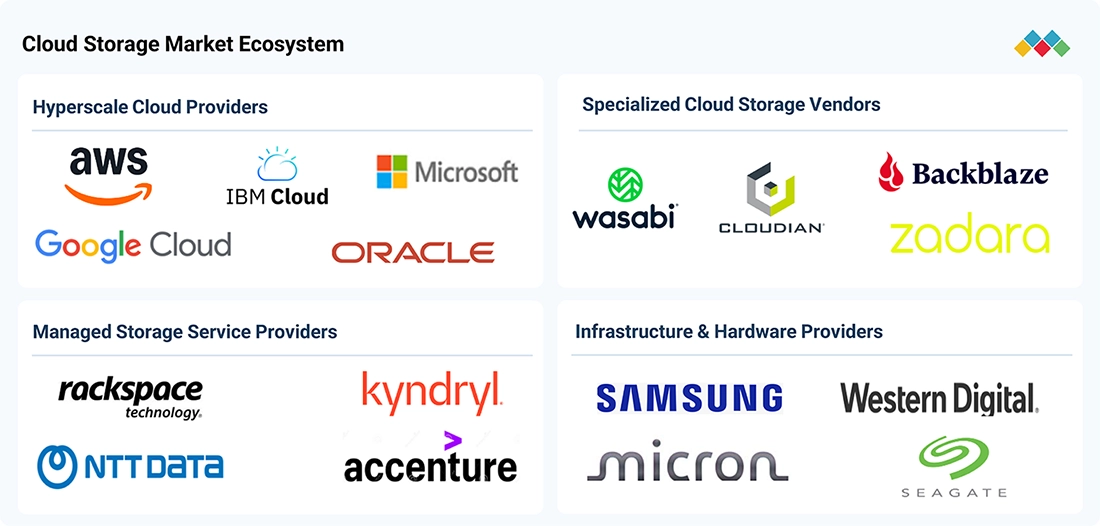
Logos and trademarks shown above are the property of their respective owners. Their use here is for informational and illustrative purposes only.
MARKET SEGMENTS
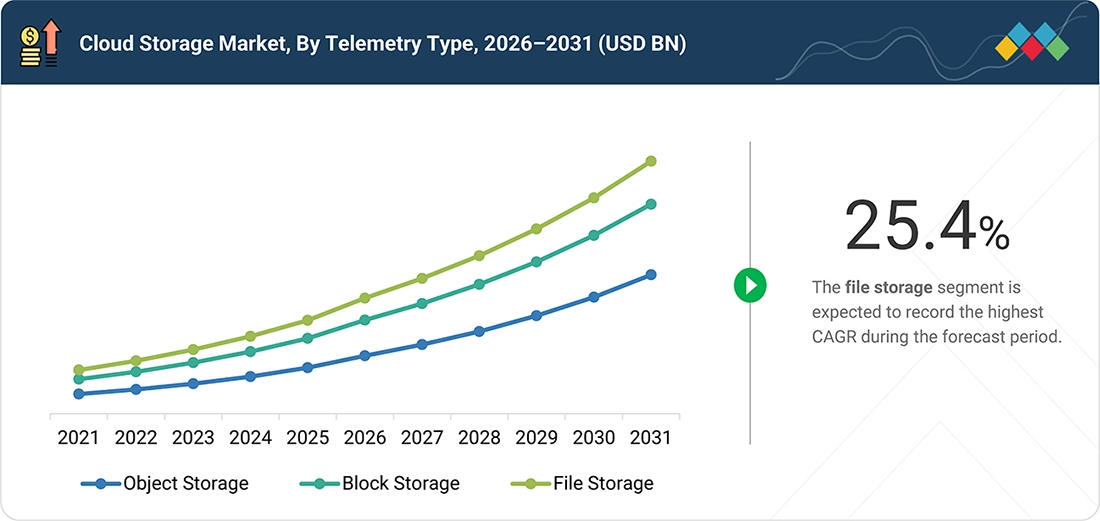
Source: Secondary Research, Interviews with Experts, MarketsandMarkets Analysis
Cloud Storage Market, By Offering
Storage type accounts for the largest share of the cloud storage market because recurring consumption of object, block, and file capacity forms the core of enterprise cloud storage spending. Its position is supported by increasing data generation, application modernization, backup and archive requirements, analytics, AI workloads, and the continuing migration of enterprise datasets to cloud infrastructure.
Cloud Storage Market, By Storage Type
Object storage accounts for the largest share because of its scalability and widespread use across unstructured data, data lakes, backup repositories, archives, media content, cloud-native applications, and AI datasets. Its low-cost scale and increasingly high-performance architectures are expanding object storage beyond traditional archival workloads into analytics and AI infrastructure. AWS currently reports hundreds of exabytes of S3 data and more than 200 million requests per second.
Cloud Storage Market, By Application
Enterprise business applications will be the largest segment as organizations increasingly adopt cloud-based ERP, CRM, HR, collaboration, and other critical business applications, creating strong demand for scalable, secure, and highly available cloud storage that supports application performance, data accessibility, business continuity, integration, and ongoing digital transformation.
Cloud Storage Market, By Deployment Mode
Public cloud accounts for the largest share, as enterprises benefit from elastic capacity, consumption-based pricing, global availability, managed infrastructure, and native integration with cloud applications, analytics, and AI services. Hyperscale platforms also offer extensive object, block, file, backup, archive, replication, and lifecycle-management capabilities within a common environment.
Cloud Storage Market, By Organization Size
Large enterprises account for the largest share because they manage extensive application portfolios, large data estates, multi-region operations, regulatory requirements, and complex backup and disaster recovery environments. Their higher data volumes and greater adoption of analytics, AI, hybrid cloud, and multi-cloud architectures result in substantially higher storage consumption than smaller organizations.
Cloud Storage Market, By Vertical
BFSI accounts for the largest share owing to high volumes of transactional and customer data, stringent retention and recovery requirements, increasing analytics adoption, and strict business-continuity and regulatory obligations. Financial institutions also maintain multiple protected copies of critical data across production, backup, archive, disaster-recovery, and increasingly sovereign or regionally controlled environments.
REGION
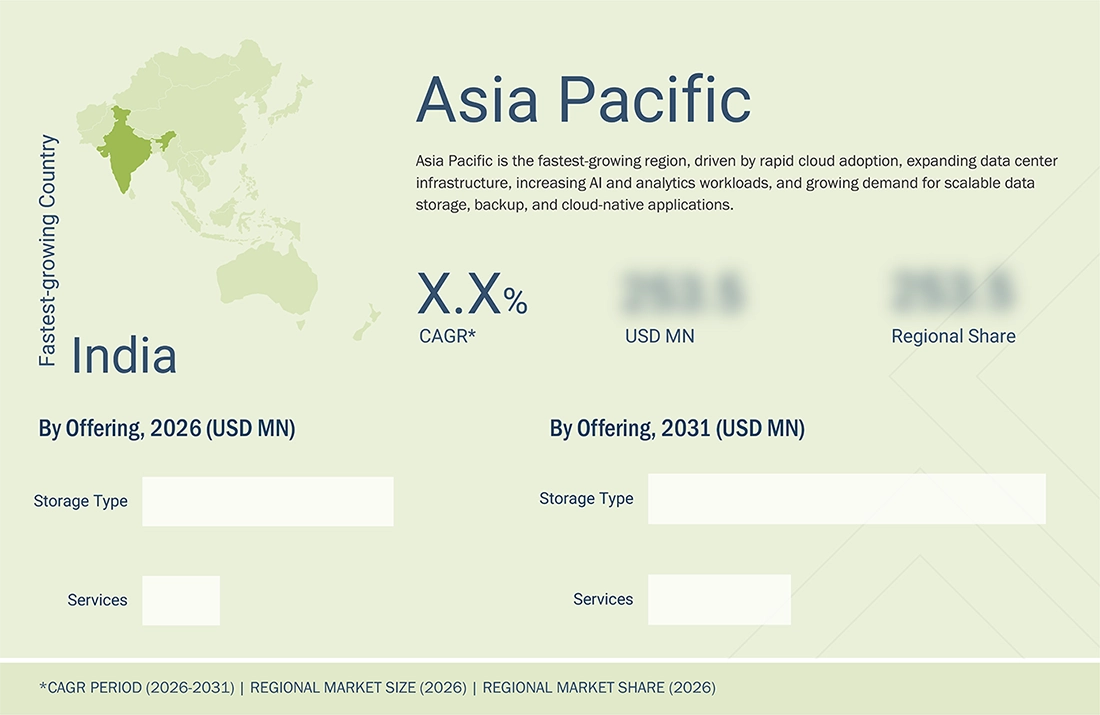
Asia Pacific is expected to emerge as the fastest-growing region in the cloud storage market during the forecast period
Cloud storage revenue in Asia Pacific is expected to grow the fastest, supported by rapid cloud adoption, expanding digital infrastructure, AI investment, and rising enterprise data volumes across China, India, Japan, Australia, South Korea, and Southeast Asia. Organizations are increasing investment in data lakes, backup and disaster recovery, e-commerce, digital banking, media platforms, 5G, and cloud-native applications. Data residency requirements and continued expansion of regional cloud infrastructure are also encouraging enterprises to deploy scalable public, hybrid, and locally controlled storage architectures closer to users and regulated datasets.
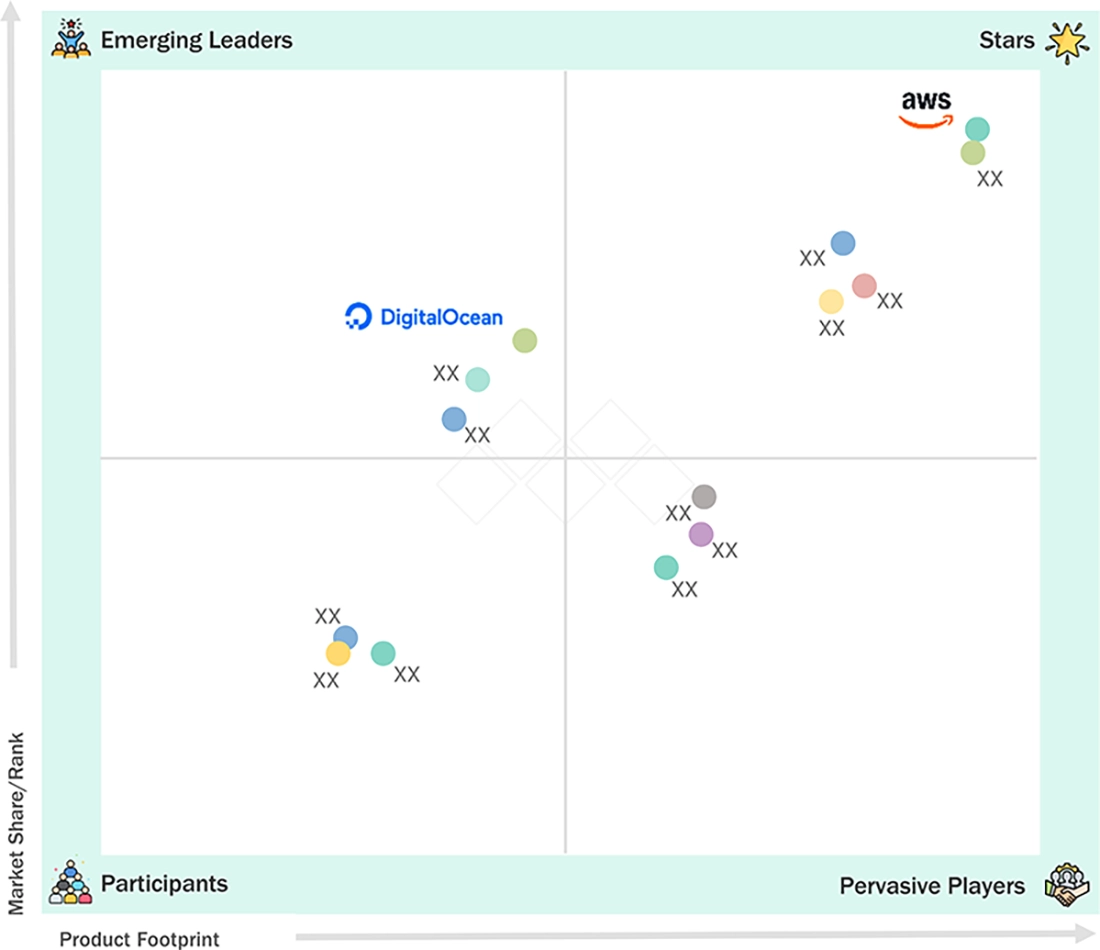
CLOUD STORAGE MARKET: COMPANY EVALUATION MATRIX
AWS (Star) leads in scale and breadth across S3, EBS, and managed file storage, while DigitalOcean (Emerging Leader) is expanding through developer-focused cloud storage services, scalable object storage, and simplified cloud infrastructure offerings.
Source: Secondary Research, Interviews with Experts, MarketsandMarkets Analysis
KEY MARKET PLAYERS
- Microsoft (US)
- Google (US)
- Oracle (US)
- Alibaba (China)
- Huawei Cloud (China)
- Dropbox, Inc (US)
- IBM (US)
- Tencent Cloud (China)
- CoreWeave (US)
- Rackspace Technology (US)
- Wasabi (US)
- OVHcloud (France)
- DigitalOcean (US)
- Akamai (US)
- Backblaze (US)
- Aruba (Italy)
- IONOS Cloud (Germany)
- Vultr (US)
- NAVER (South Korea)
- Selectel (Russia)
- Hetzner (Germany)
- IDrive (US)
- Cloudflare (US)
- Scaleway (France)
- Leaseweb (Netherlands)
- Nebius (Netherlands)
- Gcore (Luxembourg)
- Zadara (US)
- STACKIT (Germany)
- Sync.com, Inc. (Canada)
- phoenixNAP (US)
- UpCloud (Finland)
- Nscale (UK)
- Exoscale (Switzerland)
MARKET SCOPE
| REPORT METRIC | DETAILS |
|---|---|
| Market Size in 2025 (Value) | USD 74.42 Billion |
| Market Size in 2026 (Value) | USD 92.06 Billion |
| Market Forecast in 2031 (Value) | USD 260.66 Billion |
| Growth Rate | 23.1% (CAGR 2026–2031) |
| Years Considered | 2021–2031 |
| Base Year | 2025 |
| Forecast Period | 2026–2031 |
| Units Considered | Value (USD Billion) |
| Report Coverage | Revenue forecast, market segmentation, company ranking, competitive landscape, growth factors, trends, opportunities, ecosystem, use cases, and regional analysis |
| Segments Covered |
|
| Regions Covered | North America, Europe, Asia Pacific, Middle East & Africa, Latin America |
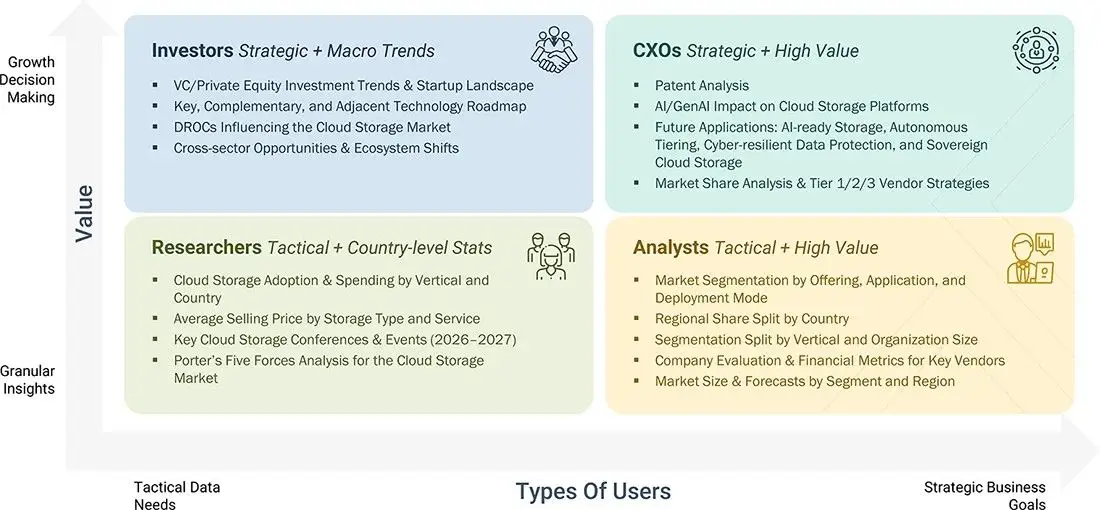
WHAT IS IN IT FOR YOU: CLOUD STORAGE MARKET REPORT CONTENT GUIDE
DELIVERED CUSTOMIZATIONS
We have successfully delivered the following deep-dive customizations:
| CLIENT REQUEST | CUSTOMIZATION DELIVERED | VALUE ADDS |
|---|---|---|
| Global Media & AI Platform Provider (North America) | Customized analysis of high-performance object storage, AI dataset architectures, archival tiers, egress economics, and vendor positioning across hyperscalers and cloud-storage specialists | Supports AI infrastructure planning, storage cost optimization, vendor selection, and workload placement decisions across cloud environments |
| Banking & Digital Services Provider (Asia Pacific) | Benchmarking of public, hybrid, and sovereign cloud storage across data residency, backup and recovery, encryption, lifecycle management, migration, and managed-storage capabilities | Supports compliant cloud migration, resilience planning, partner evaluation, and reduction of data portability and provider concentration risks |
RECENT DEVELOPMENTS
- April 2026 : Google Cloud made Rapid Bucket generally available as a high-performance object storage offering, delivering more than 15 TB/s of bandwidth, 20 million requests per second, and sub-millisecond latency. Google positions the service for AI workloads and reports 50% lower GPU blocked time and 2.5x faster data loading.
- January 2026 : AWS expanded Amazon S3 on Outposts to second-generation Outposts racks, offering 196 TB, 490 TB, and 786 TB storage tiers. The development extends S3-compatible storage to on-premises environments requiring data residency, low latency, local processing, backup, or archival capabilities.
- December 2025 : Microsoft expanded Azure Storage for AI and cloud-native workloads, including Smart Tier for Azure Blob Storage, which automatically moves data across access tiers based on usage. Microsoft also demonstrated a single Blob Storage account exceeding 50 Tbps read throughput, highlighting increasing storage performance for AI-scale workloads.
Table of Contents
 Exclusive indicates content/data unique to MarketsandMarkets and not available with any competitors.
TITLE
PAGE NO
1
INTRODUCTION
30
2
EXECUTIVE SUMMARY
35
3
PREMIUM INSIGHTS
41
4
MARKET OVERVIEW
Ransomware threats and AI demands are reshaping cloud storage with resilience and performance innovations.
44
4.1
INTRODUCTION
4.2
MARKET DYNAMICS
4.2.1
DRIVERS
AI TRAINING AND INFERENCE WORKLOADS ARE INCREASING DEMAND FOR
4.2.1.2
RISING RANSOMWARE ACTIVITY AND RESILIENCE REQUIREMENTS ARE INCREASING DEMAND FOR BACKUP AND IMMUTABLE CLOUD STORAGE
4.2.1.3
CONTINUED GROWTH OF UNSTRUCTURED ENTERPRISE DATA IS EXPANDING OBJECT, ARCHIVE, AND DATA-LAKE STORAGE REQUIREMENTS
4.2.2
RESTRAINTS
4.2.2.1
EGRESS, RETRIEVAL, AND DATA-OPERATION CHARGES CAN INCREASE THE TOTAL COST OF CLOUD STORAGE
4.2.2.2
DATA GRAVITY AND LENGTHY TRANSFER PROCESSES CAN SLOW MIGRATION OF PETABYTE-SCALE DATASETS
4.2.3
OPPORTUNITIES
4.2.3.1
STORAGE-NATIVE VECTOR, METADATA, AND SEMANTIC CAPABILITIES ARE EXPANDING ROLE OF CLOUD STORAGE IN AI APPLICATIONS
4.2.3.2
HIGH-PERFORMANCE OBJECT STORAGE IS EXPANDING INTO AI AND OTHER PERFORMANCE-INTENSIVE WORKLOADS
4.2.4
CHALLENGES
4.2.4.1
POWER AVAILABILITY AND INFRASTRUCTURE REQUIREMENTS ARE INCREASING COMPLEXITY OF CLOUD CAPACITY EXPANSION
4.2.4.2
NEARLINE HDD SUPPLY CONSTRAINTS CAN AFFECT EXPANSION OF MASS-CAPACITY CLOUD STORAGE
4.3
UNMET NEEDS AND WHITE SPACES
4.3.1
UNMET NEEDS IN CLOUD STORAGE MARKET
4.3.2
WHITE SPACE OPPORTUNITIES
4.4
INTERCONNECTED MARKETS AND CROSS-SECTOR OPPORTUNITIES
4.4.1
INTERCONNECTED MARKETS
4.4.2
CROSS-SECTOR OPPORTUNITIES
4.5
EMERGING BUSINESS MODELS AND ECOSYSTEM SHIFTS
4.5.1
EMERGING BUSINESS MODELS
4.5.1.1
CLOUD STORAGE BUSINESS MODELS
4.5.2
ECOSYSTEM SHIFTS
4.6
STRATEGIC MOVES BY TIER-1/2/3 PLAYERS
4.6.1
KEY MOVES AND STRATEGIC FOCUS
5
INDUSTRY TRENDS
Uncover competitive dynamics and macroeconomic shifts shaping cloud and data storage industries.
54
5.1
PORTER’S FIVE FORCES ANALYSIS
5.1.1
THREAT OF NEW ENTRANTS
5.1.2
THREAT OF SUBSTITUTES
5.1.3
BARGAINING POWER OF SUPPLIERS
5.1.4
BARGAINING POWER OF BUYERS
5.1.5
INTENSITY OF COMPETITIVE RIVALRY
5.2
MACROECONOMIC INDICATORS
5.2.1
INTRODUCTION
5.2.2
GDP TRENDS AND FORECASTS
5.2.3
TRENDS IN CLOUD COMPUTING INDUSTRY
5.2.4
TRENDS IN DATA CENTER STORAGE INDUSTRY
5.3
VALUE CHAIN ANALYSIS
5.4
ECOSYSTEM ANALYSIS
5.5
KEY CONFERENCES AND EVENTS, 2026–2027
5.6
TRENDS/DISRUPTIONS IMPACTING CUSTOMER BUSINESS
5.7
CASE STUDY ANALYSIS
5.7.1
AWS ENABLED APOLLO TYRES TO REDUCE BACKUP COSTS AND SCALE HYBRID DATA STORAGE
5.7.2
GOOGLE CLOUD ENABLED HUBX TO ACCELERATE AI MODEL LOADING BY 30X
BACKBLAZE ENABLED MIRAGE TO REDUCE AI STORAGE-RELATED COSTS
5.8
IMPACT OF 2025 US TARIFF – CLOUD STORAGE MARKET
5.8.1
INTRODUCTION
5.8.2
KEY TARIFF RATES
5.8.3
PRICE IMPACT ANALYSIS
5.8.4
IMPACT ON COUNTRY/REGION
5.8.4.1
US
5.8.4.2
EUROPE
5.8.4.3
ASIA PACIFIC
5.8.5
IMPACT ON END-USE INDUSTRIES
5.8.5.1
BFSI
5.8.5.2
IT & ITES
5.8.5.3
TELECOMMUNICATIONS
5.8.5.4
HEALTHCARE & LIFE SCIENCES
5.8.5.5
RETAIL & E-COMMERCE
5.8.5.6
MANUFACTURING
5.8.5.7
GOVERNMENT & PUBLIC SECTOR
5.8.5.8
ENERGY & UTILITIES
5.8.5.9
TRANSPORTATION & LOGISTICS
5.8.5.10
MEDIA & ENTERTAINMENT
6
CUSTOMER LANDSCAPE AND BUYER BEHAVIOR
Unlock hidden revenue by navigating buyer complexities and leveraging emerging storage technologies.
74
6.1
DECISION-MAKING PROCESS
6.2
BUYER STAKEHOLDERS AND BUYING EVALUATION CRITERIA
6.2.1
KEY STAKEHOLDERS IN BUYING PROCESS
6.2.2
BUYING CRITERIA
6.3
ADOPTION BARRIERS AND INTERNAL CHALLENGES
6.4
UNMET NEEDS ACROSS END-USE INDUSTRIES
6.5
MARKET PROFITABILITY
6.5.1
REVENUE POTENTIAL
6.5.2
COST DYNAMICS
6.5.3
MARGIN OPPORTUNITIES IN END-USE INDUSTRIES
STRATEGIC DISRUPTION THROUGH TECHNOLOGY, PATENTS, DIGITAL,
7.1
TECHNOLOGY ANALYSIS
7.1.1
KEY EMERGING TECHNOLOGIES
7.1.1.1
HIGH-PERFORMANCE OBJECT STORAGE FOR AI AND HPC
7.1.1.2
HIERARCHICAL NAMESPACE AND FILE SEMANTICS OVER OBJECT STORAGE
7.1.1.3
TABLE-AWARE OBJECT STORAGE AND OPEN TABLE FORMATS
7.1.1.4
NVME-OF AND DISAGGREGATED FLASH STORAGE
7.1.2
COMPLEMENTARY TECHNOLOGIES
7.1.2.1
AUTOMATED STORAGE TIERING AND LIFECYCLE OPTIMIZATION
7.1.2.2
KUBERNETES CSI AND CONTAINER-NATIVE PERSISTENT STORAGE
7.1.2.3
EDGE CACHING AND DATA LOCALITY
7.1.3
ADJACENT TECHNOLOGIES
7.1.3.1
BACKUP, CYBER RECOVERY, AND IMMUTABLE STORAGE
7.1.3.2
CONTENT DELIVERY NETWORKS AND EDGE DELIVERY
7.1.3.3
LAKEHOUSE AND OPEN DATA ARCHITECTURES
7.2
TECHNOLOGY ROADMAP
7.2.1
SHORT-TERM (2026-2028) | AI-OPTIMIZED, CYBER-RESILIENT, AND AUTOMATED CLOUD STORAGE
7.2.1.1
FOCUS AREAS
7.2.1.1.1
TECHNOLOGY DEVELOPMENT
7.2.1.1.2
PRODUCT/SERVICE INNOVATIONS
7.2.1.1.3
MARKET ADOPTION
7.2.2
MID-TERM (2028-2031) | DATA-AWARE STORAGE, PERFORMANCE ADAPTATION, AND MULTI-CLOUD MOBILITY
7.2.2.1
FOCUS AREAS
7.2.2.1.1
TECHNOLOGY DEVELOPMENT
7.2.2.1.2
PRODUCT/SERVICE INNOVATIONS
7.2.2.1.3
MARKET ADOPTION
7.2.3
LONG-TERM (2031-2035) | SELF-OPTIMIZING, POLICY-DRIVEN, AND INTELLIGENT CLOUD STORAGE
7.2.3.1
FOCUS AREAS
7.2.3.1.1
TECHNOLOGY DEVELOPMENT
7.2.3.1.2
PRODUCT/SERVICE INNOVATIONS
7.2.3.1.3
MARKET ADOPTION
7.3
PATENT ANALYSIS
7.4
FUTURE APPLICATIONS
7.4.1
AI TRAINING, INFERENCE, AND AGENTIC DATA REMEDIATION
7.4.2
AUTONOMOUS STORAGE OPTIMIZATION AND INTELLIGENT DATA PLACEMENT
7.4.3
CYBER-RESILIENT BACKUP, IMMUTABLE RECOVERY, AND LONG-TERM RETENTION
7.4.4
HYBRID, MULTI-CLOUD, AND SOVEREIGN DATA MOBILITY
7.4.5
COMPUTE-NEAR-DATA AND NEXT-GENERATION DATA-INTENSIVE APPLICATIONS
7.5
IMPACT OF AI/GENERATIVE AI ON CLOUD STORAGE MARKET
7.5.1
TOP USE CASES AND MARKET POTENTIAL
7.5.2
BEST PRACTICES IN CLOUD STORAGE
7.5.3
CASE STUDY OF AI IMPLEMENTATION IN CLOUD STORAGE MARKET
7.5.3.1
MICROSOFT AZURE ENABLE EXABYTE-SCALE AI TRAINING STORAGE
7.5.4
INTERCONNECTED ADJACENT ECOSYSTEMS AND IMPACT ON MARKET PLAYERS
7.5.5
CLIENT READINESS TO ADOPT AI/GENERATIVE AI IN CLOUD STORAGE MARKET
7.5.6
GOOGLE CLOUD ENABLES TURBOPUFFER TO BUILD OBJECT-STORAGE-BASED AI SEARCH INFRASTRUCTURE
7.5.7
IBM CLOUD ENABLES ROX HI-TECH TO STRENGTHEN SAP DISASTER RECOVERY WITH CLOUD OBJECT STORAGE
8
REGULATORY LANDSCAPE
Navigate complex global regulations with region-specific insights and key organizational influences.
103
8.1
REGULATORY LANDSCAPE
8.1.1
REGULATORY BODIES, GOVERNMENT AGENCIES, AND OTHER ORGANIZATIONS
8.1.2
INDUSTRY STANDARDS, BY REGION
8.1.2.1
NORTH AMERICA
8.1.2.2
EUROPE
8.1.2.3
ASIA PACIFIC
8.1.2.4
MIDDLE EAST & AFRICA
8.1.2.5
LATIN AMERICA
9
CLOUD STORAGE MARKET, BY OFFERING
Market Size & Growth Rate Forecast Analysis to 2031 in USD Million | 22 Data Tables
112
9.1
INTRODUCTION
9.1.1
OFFERING: CLOUD STORAGE MARKET DRIVERS
9.2
STORAGE TYPE
9.2.1
OBJECT STORAGE
AI DATA PIPELINES PUSH OBJECT STORAGE BEYOND CAPACITY TOWARD
9.2.2
BLOCK STORAGE
9.2.2.1
DATABASE AND STATEFUL WORKLOADS RAISE BLOCK STORAGE SCALE, LATENCY, AND PERFORMANCE THRESHOLDS
9.2.3
FILE STORAGE
9.2.3.1
AI AND HPC WORKLOADS EXTEND CLOUD FILE STORAGE BEYOND TRADITIONAL ENTERPRISE SHARING
9.3
SERVICES
9.3.1
MIGRATION & INTEGRATION
9.3.1.1
CONTINUOUS DATA MOBILITY IS REDEFINING STORAGE MIGRATION ACROSS HYBRID AND MULTI-CLOUD ENVIRONMENTS
9.3.2
MANAGED STORAGE SERVICES
9.3.2.1
DISTRIBUTED STORAGE ESTATES ARE SHIFTING OPERATIONS TOWARD CONTINUOUS MANAGED SERVICE MODELS
9.3.3
SUPPORT & MAINTENANCE
9.3.3.1
PREDICTIVE MONITORING IS SHIFTING STORAGE SUPPORT FROM REACTIVE RESPONSE TO CONTINUOUS RELIABILITY MANAGEMENT
10
CLOUD STORAGE MARKET, BY APPLICATION
Market Size & Growth Rate Forecast Analysis to 2031 in USD Million | 20 Data Tables
125
10.1
INTRODUCTION
10.1.1
APPLICATION: CLOUD STORAGE MARKET DRIVERS
10.2
ANALYTICS & DATA LAKE STORAGE
10.2.1
UNIFIED ANALYTICS ARCHITECTURES ARE CONSOLIDATING ENTERPRISE DATA ONTO SCALABLE CLOUD STORAGE FOUNDATIONS
10.2.2
DATA LAKES
10.2.3
LAKE HOUSES
10.2.4
DATA WAREHOUSES
10.2.5
STREAMING & IOT DATA
10.3
AI & HIGH-PERFORMANCE WORKLOADS
10.3.1
ACCELERATOR-INTENSIVE WORKLOADS ARE SHIFTING CLOUD STORAGE PRIORITIES TOWARD THROUGHPUT, LATENCY, AND DATA LOCALITY
10.3.2
AI TRAINING
10.3.3
AI INFERENCE
10.3.4
VECTOR DATABASE STORAGE
10.3.5
HPC & SCIENTIFIC COMPUTING
10.4
ENTERPRISE BUSINESS APPLICATIONS
10.4.1
CLOUD APPLICATION MODERNIZATION IS SHIFTING OPERATIONAL DATA TOWARD PERSISTENT, RESILIENT STORAGE ARCHITECTURES
10.4.2
DATABASES (OLTP)
10.4.3
ERP
10.4.4
CRM
10.4.5
BUSINESS APPLICATIONS
10.5
CLOUD-NATIVE APPLICATIONS
10.5.1
STATEFUL CLOUD-NATIVE WORKLOADS ARE MAKING PROGRAMMABLE STORAGE INTEGRAL TO APPLICATION ARCHITECTURE
10.5.2
KUBERNETES PERSISTENT STORAGE
10.5.3
CONTAINERS
10.5.4
DEVOPS & CI/CD
10.5.5
MICROSERVICES
10.6
DATA PROTECTION
10.6.1
CYBER RESILIENCE IS SHIFTING CLOUD STORAGE FROM PASSIVE DURABILITY TOWARD ASSURED RECOVERABILITY
10.6.2
BACKUP
10.6.3
DISASTER RECOVERY
10.6.4
REPLICATION
10.7
COMPLIANCE & LONG-TERM RETENTION
10.7.1
REGULATORY RETENTION MANDATES ARE ELEVATING IMMUTABLE STORAGE AND POLICY-DRIVEN LIFECYCLE MANAGEMENT
10.7.2
ARCHIVE
10.7.3
REGULATORY COMPLIANCE
10.7.4
RECORDS MANAGEMENT
10.7.5
LEGAL HOLD
10.8
DIGITAL CONTENT & MEDIA
10.8.1
CONTENT PROLIFERATION IS TURNING CLOUD STORAGE INTO SEARCHABLE AND TIERED MEDIA FOUNDATION
10.8.2
MEDIA PRODUCTION
10.8.3
VIDEO STREAMING
10.8.4
CONTENT DELIVERY
10.8.5
WEB & MOBILE ASSETS
10.9
END USER PRODUCTIVITY
10.9.1
CLOUD-BASED WORK MODELS ARE INCREASING DEMAND FOR SECURE, SYNCHRONIZED, AND PERSISTENT USER STORAGE
10.9.2
FILE SHARING
10.9.3
COLLABORATION
10.9.4
END-USER COMPUTING
10.10
OTHER APPLICATIONS
11
CLOUD STORAGE MARKET, BY DEPLOYMENT MODE
Market Size & Growth Rate Forecast Analysis to 2031 in USD Million | 8 Data Tables
151
11.1
INTRODUCTION
11.1.1
DEPLOYMENT MODE: CLOUD STORAGE MARKET DRIVERS
11.2
PUBLIC CLOUD
11.2.1
SCALABLE PUBLIC CLOUD INFRASTRUCTURE TO SUPPORT ELASTIC STORAGE DEMAND AND DATA-INTENSIVE WORKLOADS
11.3
PRIVATE CLOUD
11.3.1
GREATER DATA CONTROL AND WORKLOAD SOVEREIGNTY TO SUSTAIN PRIVATE CLOUD STORAGE ADOPTION
11.4
HYBRID CLOUD
11.4.1
FLEXIBLE WORKLOAD PLACEMENT AND DATA MOBILITY TO STRENGTHEN HYBRID CLOUD STORAGE ADOPTION
12
CLOUD STORAGE MARKET, BY ORGANIZATION SIZE
Market Size & Growth Rate Forecast Analysis to 2031 in USD Million | 6 Data Tables
158
12.1
INTRODUCTION
12.1.1
ORGANIZATION SIZE: CLOUD STORAGE MARKET DRIVERS
12.2
LARGE ORGANIZATIONS
12.2.1
COMPLEX DATA ESTATES AND AI WORKLOADS ARE STRENGTHENING LARGE ORGANIZATIONS’ RELIANCE ON CLOUD STORAGE
12.3
SMES
12.3.1
PAY-AS-YOU-GO CLOUD STORAGE LOWERS INFRASTRUCTURE BARRIERS FOR DATA-DRIVEN SME OPERATIONS
13
CLOUD STORAGE MARKET, BY VERTICAL
Market Size & Growth Rate Forecast Analysis to 2031 in USD Million | 22 Data Tables
163
13.1
INTRODUCTION
13.1.1
VERTICAL: CLOUD STORAGE MARKET DRIVERS
13.2
BFSI
13.2.1
DIGITAL TRANSACTION GROWTH AND RESILIENCE MANDATES ARE RESHAPING FINANCIAL-SECTOR STORAGE ARCHITECTURES
13.3
IT & ITES
13.3.1
CLOUD-NATIVE SOFTWARE DELIVERY IS INCREASING DEMAND FOR PROGRAMMABLE AND RESILIENT STORAGE
13.4
TELECOMMUNICATIONS
13.4.1
5G TRAFFIC GROWTH IS TURNING DISTRIBUTED STORAGE INTO FOUNDATION FOR NETWORK INTELLIGENCE
13.5
HEALTHCARE & LIFE SCIENCES
13.5.1
INTEROPERABLE CLINICAL DATA IS RAISING REQUIREMENTS FOR SECURE, RECOVERABLE, AND GOVERNED STORAGE
13.6
MEDIA & ENTERTAINMENT
13.6.1
RISING CONTENT VOLUMES ARE PUSHING MEDIA STORAGE TOWARD TIERED, SEARCHABLE CLOUD ARCHITECTURES
13.7
RETAIL & CONSUMER GOODS
13.7.1
OMNICHANNEL COMMERCE IS TRANSFORMING RETAIL STORAGE INTO FOUNDATION FOR REAL-TIME CUSTOMER INTELLIGENCE
13.8
MANUFACTURING
13.8.1
CONNECTED FACTORIES ARE INCREASING DEMAND FOR HYBRID STORAGE ACROSS OPERATIONAL AND ENTERPRISE ENVIRONMENTS
13.9
GOVERNMENT & PUBLIC SECTOR
13.9.1
MULTI-CLOUD MODERNIZATION IS MAKING POLICY-DRIVEN STORAGE CENTRAL TO PUBLIC-SECTOR RESILIENCE
13.10
ENERGY & UTILITIES
13.10.1
GRID DIGITALIZATION IS TURNING OPERATIONAL DATA INTO STRATEGIC CLOUD STORAGE WORKLOAD
13.11
OTHER VERTICALS
14
CLOUD STORAGE MARKET, BY REGION
Comprehensive coverage of 8 Regions with country-level deep-dive of 16 Countries | 124 Data Tables.
177
14.1
INTRODUCTION
14.2
NORTH AMERICA
14.2.1
US
14.2.1.1
HYPERSCALE INVESTMENT AND ENTERPRISE CLOUD MIGRATION EXPAND DEMAND FOR SCALABLE CLOUD STORAGE IN US
14.2.2
CANADA
14.2.2.1
AI ADOPTION AND DOMESTIC CLOUD INVESTMENT STRENGTHEN DEMAND FOR CLOUD STORAGE ACROSS CANADA
14.3
EUROPE
14.3.1
UK
14.3.1.1
GOVERNMENT CLOUD MODERNIZATION PUSHES UK STORAGE TOWARD RESILIENT MULTI-REGION ARCHITECTURES
14.3.2
GERMANY
14.3.2.1
SOVEREIGN INFRASTRUCTURE STRATEGY BRINGS DATA LOCALITY TO CENTER OF GERMAN STORAGE DECISIONS
14.3.3
FRANCE
14.3.3.1
AI MEGAPROJECTS TRANSFORM FRANCE INTO MAJOR EUROPEAN DATA INFRASTRUCTURE HUB
14.3.4
ITALY
14.3.4.1
HIGH CLOUD PENETRATION SHIFTS ITALY TOWARD ANALYTICS- AND AI-INTENSIVE STORAGE CONSUMPTION
14.3.5
REST OF EUROPE
14.4
ASIA PACIFIC
14.4.1
CHINA
14.4.1.1
EXPLOSIVE DATA CREATION MAKES STORAGE INFRASTRUCTURE CENTRAL TO CHINA’S AI AUTOMATION
14.4.2
JAPAN
14.4.2.1
JAPAN LINKS AI COMPUTING GROWTH WITH RESILIENT DOMESTIC CLOUD AND STORAGE INFRASTRUCTURE
14.4.3
INDIA
14.4.3.1
DISTRIBUTED AI COMPUTE ADOPTION BROADENS CLOUD STORAGE REQUIREMENTS ACROSS INDIA
14.4.4
AUSTRALIA
14.4.4.1
DATA CENTER INVESTMENT AND CLOUD-FIRST GOVERNMENT POLICY RESHAPE AUSTRALIA’S STORAGE INFRASTRUCTURE
14.4.5
REST OF ASIA PACIFIC
14.5
MIDDLE EAST & AFRICA
14.5.1
GCC COUNTRIES
14.5.1.1
SAUDI ARABIA
14.5.1.1.1
LOCALIZED CLOUD CAPACITY POSITIONS STORAGE AT CORE OF SAUDI ARABIA’S AI INFRASTRUCTURE BUILD-OUT
14.5.1.2
UNITED ARAB EMIRATES (UAE)
14.5.1.2.1
ABU DHABI’S SOVEREIGN-CLOUD TRANSITION MAKES DATA CONTROL CENTRAL TO UAE STORAGE STRATEGIES
14.5.1.3
OTHER GCC COUNTRIES
14.5.2
SOUTH AFRICA
14.5.2.1
HYPERSCALE CONCENTRATION ESTABLISHES SOUTH AFRICA AS AFRICA’S PRIMARY CLOUD STORAGE HUB
14.5.3
REST OF MIDDLE EAST & AFRICA
14.6
LATIN AMERICA
14.6.1
BRAZIL
14.6.1.1
SOVEREIGN CLOUD POLICY PLACES LOCAL DATA CONTROL AT CENTER OF BRAZIL’S STORAGE MARKET
14.6.2
MEXICO
14.6.2.1
NEW CLOUD REGIONS TURN MEXICO INTO STRATEGIC STORAGE LOCATION FOR REGIONAL WORKLOADS
14.6.3
REST OF LATIN AMERICA
15
COMPETITIVE LANDSCAPE
Discover strategic maneuvers and market shifts shaping the future of cloud storage dominance.
229
15.1
INTRODUCTION
15.2
KEY PLAYER STRATEGIES/RIGHT TO WIN, 2023–2026
15.3
REVENUE ANALYSIS, 2021–2025
15.4
MARKET SHARE ANALYSIS, 2026
15.5
PRODUCT COMPARISON, 2026
15.6
COMPANY EVALUATION MATRIX: KEY PLAYERS, 2026 (CLOUD STORAGE MARKET)
15.6.1
STARS
15.6.2
EMERGING LEADERS
15.6.3
PERVASIVE PLAYERS
15.6.4
PARTICIPANTS
15.6.5
COMPANY FOOTPRINT: KEY PLAYERS, 2025
15.6.5.1
COMPANY FOOTPRINT
15.6.5.2
REGION FOOTPRINT
15.6.5.3
STORAGE TYPE FOOTPRINT
15.6.5.4
SERVICE FOOTPRINT
15.6.5.5
APPLICATION FOOTPRINT
15.6.5.6
VERTICAL FOOTPRINT
15.7
COMPANY EVALUATION MATRIX: STARTUPS/SMES, 2026
15.7.1
PROGRESSIVE COMPANIES
15.7.2
RESPONSIVE COMPANIES
15.7.3
DYNAMIC COMPANIES
15.7.4
STARTING BLOCKS
15.7.5
COMPETITIVE BENCHMARKING: STARTUPS/SMES, 2025
15.7.5.1
DETAILED LIST OF KEY STARTUPS/SMES
15.7.5.2
COMPETITIVE BENCHMARKING OF KEY STARTUPS/SMES
15.8
COMPANY VALUATION AND FINANCIAL METRICS, 2026
15.8.1
COMPANY VALUATION OF KEY VENDORS
15.8.2
FINANCIAL METRICS OF KEY VENDORS
15.9
COMPETITIVE SCENARIO
15.9.1
PRODUCT LAUNCHES
15.9.2
DEALS
16
COMPANY PROFILES
In-depth Company Profiles of Leading Market Players with detailed Business Overview, Product and Service Portfolio, Recent Developments, and Unique Analyst Perspective (MnM View)
266
16.1
INTRODUCTION
16.2
KEY PLAYERS
16.2.1
AMAZON WEB SERVICES (AWS)
16.2.1.1
BUSINESS OVERVIEW
16.2.1.2
PRODUCTS/SOLUTIONS/SERVICES OFFERED
16.2.1.3
RECENT DEVELOPMENTS
16.2.1.3.1
PRODUCT LAUNCHES AND ENHANCEMENTS
16.2.1.3.2
DEALS
16.2.1.4
MNM VIEW
16.2.1.4.1
RIGHT TO WIN
16.2.1.4.2
STRATEGIC CHOICES
16.2.1.4.3
WEAKNESSES AND COMPETITIVE THREATS
16.2.2
MICROSOFT
16.2.3
GOOGLE
16.2.4
ALIBABA CLOUD
16.2.5
ORACLE
16.2.6
HUAWEI
16.2.7
IBM
16.2.8
TENCENT
16.2.9
RACKSPACE TECHNOLOGY
16.2.10
DIGITALOCEAN
16.3
OTHER PLAYERS
16.3.1
CLOUDFLARE
16.3.2
COREWEAVE
16.3.3
VULTR
16.3.4
LEASEWEB
16.3.5
SELECTEL
16.3.6
GCORE
16.3.7
PHOENIXNAP
16.3.8
STACKIT
16.3.9
IONOS CLOUD
16.3.10
ARUBA
16.3.11
OVHCLOUD
16.3.12
AKAMAI TECHNOLOGIES
16.3.13
SYNC.COM
16.3.14
DROPBOX, INC.
16.3.15
WASABI TECHNOLOGIES
16.3.16
BACKBLAZE
16.3.17
NSCALE
16.3.18
NEBIUS
16.3.19
UPCLOUD
16.3.20
ZADARA
16.3.21
SCALEWAY
16.3.22
IDRIVE INC.
16.3.23
HETZNER
16.3.24
NAVER
16.3.25
EXOSCALE
17
RESEARCH METHODOLOGY
365
17.1
RESEARCH DATA
17.1.1
SECONDARY DATA
17.1.1.1
DATA & LIST OF KEY SECONDARY SOURCES
17.1.2
PRIMARY DATA
17.1.2.1
BREAKDOWN OF PRIMARY INTERVIEWS
17.1.2.2
KEY INDUSTRY INSIGHTS
17.1.3
MARKET SIZE ESTIMATION
17.2
DATA TRIANGULATION
17.3
FACTOR ANALYSIS
18
APPENDIX
374
18.1
DISCUSSION GUIDE
18.2
KNOWLEDGESTORE: MARKETSANDMARKETS’ SUBSCRIPTION PORTAL
18.3
CUSTOMIZATION OPTIONS
18.4
RELATED REPORTS
18.5
AUTHOR DETAILS
LIST OF TABLES
TABLE 1
USD EXCHANGE RATES, 2020–2025
TABLE 2
IMPACT OF PORTER’S FIVE FORCES ON CLOUD STORAGE MARKET
TABLE 3
GDP PERCENTAGE CHANGE, BY KEY COUNTRY, 2021–2029
TABLE 4
CLOUD STORAGE MARKET: ROLE OF COMPANIES IN ECOSYSTEM
TABLE 5
CLOUD STORAGE MARKET: LIST OF KEY CONFERENCES AND EVENTS, 2026–2027
TABLE 6
US ADJUSTED RECIPROCAL TARIFF RATES
TABLE 7
INFLUENCE OF STAKEHOLDERS ON BUYING PROCESS FOR TOP THREE VERTICALS (%)
TABLE 8
KEY BUYING CRITERIA FOR TOP THREE VERTICALS
TABLE 9
CLOUD STORAGE MARKET: UNMET NEEDS ACROSS END-USE INDUSTRIES
TABLE 10
LIST OF GRANTED PATENTS IN CLOUD STORAGE MARKET
TABLE 11
TOP USE CASES AND MARKET POTENTIAL
TABLE 12
BEST PRACTICES: COMPANIES IMPLEMENTING USE CASES
TABLE 13
INTERCONNECTED ADJACENT ECOSYSTEMS AND IMPLICATIONS FOR MARKET PLAYERS
TABLE 14
NORTH AMERICA: REGULATORY BODIES, GOVERNMENT AGENCIES, AND OTHER ORGANIZATIONS
TABLE 15
EUROPE: REGULATORY BODIES, GOVERNMENT AGENCIES, AND OTHER ORGANIZATIONS
TABLE 16
ASIA PACIFIC: REGULATORY BODIES, GOVERNMENT AGENCIES, AND OTHER ORGANIZATIONS
TABLE 17
OTHERS: REGULATORY BODIES, GOVERNMENT AGENCIES, AND OTHER ORGANIZATIONS
TABLE 18
CLOUD STORAGE MARKET, BY OFFERING, 2021–2025 (USD MILLION)
TABLE 19
CLOUD STORAGE MARKET, BY OFFERING, 2026–2031 (USD MILLION)
TABLE 20
CLOUD STORAGE MARKET, BY STORAGE TYPE, 2021–2025 (USD MILLION)
TABLE 21
CLOUD STORAGE MARKET, BY STORAGE TYPE, 2026–2031 (USD MILLION)
TABLE 22
STORAGE TYPE: CLOUD STORAGE MARKET, BY REGION, 2021–2025 (USD MILLION)
TABLE 23
STORAGE TYPE: CLOUD STORAGE MARKET, BY REGION, 2026–2031 (USD MILLION)
TABLE 24
OBJECT STORAGE: CLOUD STORAGE MARKET, BY REGION, 2021–2025 (USD MILLION)
TABLE 25
OBJECT STORAGE: CLOUD STORAGE MARKET, BY REGION, 2026–2031 (USD MILLION)
TABLE 26
BLOCK STORAGE: CLOUD STORAGE MARKET, BY REGION, 2021–2025 (USD MILLION)
TABLE 27
BLOCK STORAGE: CLOUD STORAGE MARKET, BY REGION, 2026–2031 (USD MILLION)
TABLE 28
FILE STORAGE: CLOUD STORAGE MARKET, BY REGION, 2021–2025 (USD MILLION)
TABLE 29
FILE STORAGE: CLOUD STORAGE MARKET, BY REGION, 2026–2031 (USD MILLION)
TABLE 30
CLOUD STORAGE MARKET, BY SERVICE, 2021–2025 (USD MILLION)
TABLE 31
CLOUD STORAGE MARKET, BY SERVICE, 2026–2031 (USD MILLION)
TABLE 32
SERVICES: CLOUD STORAGE MARKET, BY REGION, 2021–2025 (USD MILLION)
TABLE 33
SERVICES: CLOUD STORAGE MARKET, BY REGION, 2026–2031 (USD MILLION)
TABLE 34
MIGRATION & INTEGRATION: CLOUD STORAGE MARKET, BY REGION, 2021–2025 (USD MILLION)
TABLE 35
MIGRATION & INTEGRATION: CLOUD STORAGE MARKET, BY REGION, 2026–2031 (USD MILLION)
TABLE 36
MANAGED STORAGE SERVICES: CLOUD STORAGE MARKET, BY REGION, 2021–2025 (USD MILLION)
TABLE 37
MANAGED STORAGE SERVICES: CLOUD STORAGE MARKET, BY REGION, 2026–2031 (USD MILLION)
TABLE 38
SUPPORT & MAINTENANCE: CLOUD STORAGE MARKET, BY REGION, 2021–2025 (USD MILLION)
TABLE 39
SUPPORT & MAINTENANCE: CLOUD STORAGE MARKET, BY REGION, 2026–2031 (USD MILLION)
TABLE 40
CLOUD STORAGE MARKET, BY APPLICATION, 2021–2025 (USD MILLION)
TABLE 41
CLOUD STORAGE MARKET, BY APPLICATION, 2026–2031 (USD MILLION)
TABLE 42
ANALYTICS & DATA LAKE STORAGE: CLOUD STORAGE MARKET, BY REGION, 2021–2025 (USD MILLION)
TABLE 43
ANALYTICS & DATA STORAGE: CLOUD STORAGE MARKET, BY REGION, 2026–2031 (USD MILLION)
TABLE 44
AI & HIGH-PERFORMANCE WORKLOADS: CLOUD STORAGE MARKET, BY REGION, 2021–2025 (USD MILLION)
TABLE 45
AI & HIGH-PERFORMANCE WORKLOADS: CLOUD STORAGE MARKET, BY REGION, 2026–2031 (USD MILLION)
TABLE 46
ENTERPRISE BUSINESS APPLICATIONS: CLOUD STORAGE MARKET, BY REGION, 2021–2025 (USD MILLION)
TABLE 47
ENTERPRISE BUSINESS APPLICATIONS: CLOUD STORAGE MARKET, BY REGION, 2026–2031 (USD MILLION)
TABLE 48
CLOUD-NATIVE APPLICATIONS: CLOUD STORAGE MARKET, BY REGION, 2021–2025 (USD MILLION)
TABLE 49
CLOUD-NATIVE APPLICATIONS: CLOUD STORAGE MARKET, BY REGION, 2026–2031 (USD MILLION)
TABLE 50
DATA PROTECTION: CLOUD STORAGE MARKET, BY REGION, 2021–2025 (USD MILLION)
TABLE 51
DATA PROTECTION: CLOUD STORAGE MARKET, BY REGION, 2026–2031 (USD MILLION)
TABLE 52
COMPLIANCE & LONG-TERM RETENTION: CLOUD STORAGE MARKET, BY REGION, 2021–2025 (USD MILLION)
TABLE 53
COMPLIANCE & LONG-TERM RETENTION: CLOUD STORAGE MARKET, BY REGION, 2026–2031 (USD MILLION)
TABLE 54
DIGITAL CONTENT & MEDIA: CLOUD STORAGE MARKET, BY REGION, 2021–2025 (USD MILLION)
TABLE 55
DIGITAL CONTENT & MEDIA: CLOUD STORAGE MARKET, BY REGION, 2026–2031 (USD MILLION)
TABLE 56
END USER PRODUCTIVITY: CLOUD STORAGE MARKET, BY REGION, 2021–2025 (USD MILLION)
TABLE 57
END USER PRODUCTIVITY: CLOUD STORAGE MARKET, BY REGION, 2026–2031 (USD MILLION)
TABLE 58
OTHER APPLICATIONS: CLOUD STORAGE MARKET, BY REGION, 2021–2025 (USD MILLION)
TABLE 59
OTHER APPLICATIONS: CLOUD STORAGE MARKET, BY REGION, 2026–2031 (USD MILLION)
TABLE 60
CLOUD STORAGE MARKET, BY DEPLOYMENT MODE, 2021–2025 (USD MILLION)
TABLE 61
CLOUD STORAGE MARKET, BY DEPLOYMENT MODE, 2026–2031 (USD MILLION)
TABLE 62
PUBLIC CLOUD: CLOUD STORAGE MARKET, BY REGION, 2021–2025 (USD MILLION)
TABLE 63
PUBLIC CLOUD: CLOUD STORAGE MARKET, BY REGION, 2026–2031 (USD MILLION)
TABLE 64
PRIVATE CLOUD: CLOUD STORAGE MARKET, BY REGION, 2021–2025 (USD MILLION)
TABLE 65
PRIVATE CLOUD: CLOUD STORAGE MARKET, BY REGION, 2026–2031 (USD MILLION)
TABLE 66
HYBRID CLOUD: CLOUD STORAGE MARKET, BY REGION, 2021–2025 (USD MILLION)
TABLE 67
HYBRID CLOUD: CLOUD STORAGE MARKET, BY REGION, 2026–2031 (USD MILLION)
TABLE 68
CLOUD STORAGE MARKET, BY ORGANIZATION SIZE, 2021–2025 (USD MILLION)
TABLE 69
CLOUD STORAGE MARKET, BY ORGANIZATION SIZE, 2026–2031 (USD MILLION)
TABLE 70
LARGE ORGANIZATIONS: CLOUD STORAGE MARKET, BY REGION, 2021–2025 (USD MILLION)
TABLE 71
LARGE ORGANIZATIONS: CLOUD STORAGE MARKET, BY REGION, 2026–2031 (USD MILLION)
TABLE 72
SMES: CLOUD STORAGE MARKET, BY REGION, 2021–2025 (USD MILLION)
TABLE 73
SMES: CLOUD STORAGE MARKET, BY REGION, 2026–2031 (USD MILLION)
TABLE 74
CLOUD STORAGE MARKET, BY VERTICAL, 2021–2025 (USD MILLION)
TABLE 75
CLOUD STORAGE MARKET, BY VERTICAL, 2026–2031 (USD MILLION)
TABLE 76
BFSI: CLOUD STORAGE MARKET, BY REGION, 2021–2025 (USD MILLION)
TABLE 77
BFSI: CLOUD STORAGE MARKET, BY REGION, 2026–2031 (USD MILLION)
TABLE 78
IT & ITES: CLOUD STORAGE MARKET, BY REGION, 2021–2025 (USD MILLION)
TABLE 79
IT & ITES: CLOUD STORAGE MARKET, BY REGION, 2026–2031 (USD MILLION)
TABLE 80
TELECOMMUNICATIONS: CLOUD STORAGE MARKET, BY REGION, 2021–2025 (USD MILLION)
TABLE 81
TELECOMMUNICATIONS: CLOUD STORAGE MARKET, BY REGION, 2026–2031 (USD MILLION)
TABLE 82
HEALTHCARE AND LIFE SCIENCES: CLOUD STORAGE MARKET, BY REGION, 2021–2025 (USD MILLION)
TABLE 83
HEALTHCARE AND LIFE SCIENCES: CLOUD STORAGE MARKET, BY REGION, 2026–2031 (USD MILLION)
TABLE 84
MEDIA & ENTERTAINMENT: CLOUD STORAGE MARKET, BY REGION, 2021–2025 (USD MILLION)
TABLE 85
MEDIA & ENTERTAINMENT: CLOUD STORAGE MARKET, BY REGION, 2026–2031 (USD MILLION)
TABLE 86
RETAIL & CONSUMER GOODS: CLOUD STORAGE MARKET, BY REGION, 2021–2025 (USD MILLION)
TABLE 87
RETAIL & CONSUMER GOODS: CLOUD STORAGE MARKET, BY REGION, 2026–2031 (USD MILLION)
TABLE 88
MANUFACTURING: CLOUD STORAGE MARKET, BY REGION, 2021–2025 (USD MILLION)
TABLE 89
MANUFACTURING: CLOUD STORAGE MARKET, BY REGION, 2026–2031 (USD MILLION)
TABLE 90
GOVERNMENT AND PUBLIC SECTOR: CLOUD STORAGE MARKET, BY REGION, 2021–2025 (USD MILLION)
TABLE 91
GOVERNMENT AND PUBLIC SECTOR: CLOUD STORAGE MARKET, BY REGION, 2026–2031 (USD MILLION)
TABLE 92
ENERGY & UTILITIES: CLOUD STORAGE MARKET, BY REGION, 2021–2025 (USD MILLION)
TABLE 93
ENERGY & UTILITIES: CLOUD STORAGE MARKET, BY REGION, 2026–2031 (USD MILLION)
TABLE 94
OTHER VERTICALS: CLOUD STORAGE MARKET, BY REGION, 2021–2025 (USD MILLION)
TABLE 95
OTHER VERTICALS: CLOUD STORAGE MARKET, BY REGION, 2026–2031 (USD MILLION)
TABLE 96
CLOUD STORAGE MARKET, BY REGION, 2021–2025 (USD MILLION)
TABLE 97
CLOUD STORAGE MARKET, BY REGION, 2026–2031 (USD MILLION)
TABLE 98
NORTH AMERICA: CLOUD STORAGE MARKET, BY OFFERING, 2021–2025 (USD MILLION)
TABLE 99
NORTH AMERICA: CLOUD STORAGE MARKET, BY OFFERING, 2026–2031 (USD MILLION)
TABLE 100
NORTH AMERICA: CLOUD STORAGE MARKET, BY STORAGE TYPE, 2021–2025 (USD MILLION)
TABLE 101
NORTH AMERICA: CLOUD STORAGE MARKET, BY STORAGE TYPE, 2026–2031 (USD MILLION)
TABLE 102
NORTH AMERICA: CLOUD STORAGE MARKET, BY SERVICE, 2021–2025 (USD MILLION)
TABLE 103
NORTH AMERICA: CLOUD STORAGE MARKET, BY SERVICE, 2026–2031 (USD MILLION)
TABLE 104
NORTH AMERICA: CLOUD STORAGE MARKET, BY APPLICATION, 2021–2025 (USD MILLION)
TABLE 105
NORTH AMERICA: CLOUD STORAGE MARKET, BY APPLICATION, 2026–2031 (USD MILLION)
TABLE 106
NORTH AMERICA: CLOUD STORAGE MARKET, BY DEPLOYMENT MODE, 2021–2025 (USD MILLION)
TABLE 107
NORTH AMERICA: CLOUD STORAGE MARKET, BY DEPLOYMENT MODE, 2026–2031 (USD MILLION)
TABLE 108
NORTH AMERICA: CLOUD STORAGE MARKET, BY ORGANIZATION SIZE, 2021–2025 (USD MILLION)
TABLE 109
NORTH AMERICA: CLOUD STORAGE MARKET, BY ORGANIZATION SIZE, 2026–2031 (USD MILLION)
TABLE 110
NORTH AMERICA: CLOUD STORAGE MARKET, BY VERTICAL, 2021–2025 (USD MILLION)
TABLE 111
NORTH AMERICA: CLOUD STORAGE MARKET, BY VERTICAL, 2026–2031 (USD MILLION)
TABLE 112
NORTH AMERICA: CLOUD STORAGE MARKET, BY COUNTRY, 2021–2025 (USD MILLION)
TABLE 113
NORTH AMERICA: CLOUD STORAGE MARKET, BY COUNTRY, 2026–2031 (USD MILLION)
TABLE 114
US: CLOUD STORAGE MARKET, BY OFFERING, 2021–2025 (USD MILLION)
TABLE 115
US: CLOUD STORAGE MARKET, BY OFFERING, 2026–2031 (USD MILLION)
TABLE 116
CANADA: CLOUD STORAGE MARKET, BY OFFERING, 2021–2025 (USD MILLION)
TABLE 117
CANADA: CLOUD STORAGE MARKET, BY OFFERING, 2026–2031 (USD MILLION)
TABLE 118
EUROPE: CLOUD STORAGE MARKET, BY OFFERING, 2021–2025 (USD MILLION)
TABLE 119
EUROPE: CLOUD STORAGE MARKET, BY OFFERING, 2026–2031 (USD MILLION)
TABLE 120
EUROPE: CLOUD STORAGE MARKET, BY STORAGE TYPE, 2021–2025 (USD MILLION)
TABLE 121
EUROPE: CLOUD STORAGE MARKET, BY STORAGE TYPE, 2026–2031 (USD MILLION)
TABLE 122
EUROPE: CLOUD STORAGE MARKET, BY SERVICES, 2021–2025 (USD MILLION)
TABLE 123
EUROPE: CLOUD STORAGE MARKET, BY SERVICES, 2026–2031 (USD MILLION)
TABLE 124
EUROPE: CLOUD STORAGE MARKET, BY APPLICATION, 2021–2025 (USD MILLION)
TABLE 125
EUROPE: CLOUD STORAGE MARKET, BY APPLICATION, 2026–2031 (USD MILLION)
TABLE 126
EUROPE: CLOUD STORAGE MARKET, BY DEPLOYMENT MODE, 2021–2025 (USD MILLION)
TABLE 127
EUROPE: CLOUD STORAGE MARKET, BY DEPLOYMENT MODE, 2026–2031 (USD MILLION)
TABLE 128
EUROPE: CLOUD STORAGE MARKET, BY ORGANIZATION SIZE, 2021–2025 (USD MILLION)
TABLE 129
EUROPE: CLOUD STORAGE MARKET, BY ORGANIZATION SIZE, 2026–2031 (USD MILLION)
TABLE 130
EUROPE: CLOUD STORAGE MARKET, BY VERTICAL, 2021–2025 (USD MILLION)
TABLE 131
EUROPE: CLOUD STORAGE MARKET, BY VERTICAL, 2026–2031 (USD MILLION)
TABLE 132
EUROPE: CLOUD STORAGE MARKET, BY COUNTRY, 2021–2025 (USD MILLION)
TABLE 133
EUROPE: CLOUD STORAGE MARKET, BY COUNTRY, 2026–2031 (USD MILLION)
TABLE 134
UK: CLOUD STORAGE MARKET, BY OFFERING, 2021–2025 (USD MILLION)
TABLE 135
UK: CLOUD STORAGE MARKET, BY OFFERING, 2026–2031 (USD MILLION)
TABLE 136
GERMANY: CLOUD STORAGE MARKET, BY OFFERING, 2021–2025 (USD MILLION)
TABLE 137
GERMANY: CLOUD STORAGE MARKET, BY OFFERING, 2026–2031 (USD MILLION)
TABLE 138
FRANCE: CLOUD STORAGE MARKET, BY OFFERING, 2021–2025 (USD MILLION)
TABLE 139
FRANCE: CLOUD STORAGE MARKET, BY OFFERING, 2026–2031 (USD MILLION)
TABLE 140
ITALY: CLOUD STORAGE MARKET, BY OFFERING, 2021–2025 (USD MILLION)
TABLE 141
ITALY: CLOUD STORAGE MARKET, BY OFFERING, 2026–2031 (USD MILLION)
TABLE 142
REST OF EUROPE: CLOUD STORAGE MARKET, BY OFFERING, 2021–2025 (USD MILLION)
TABLE 143
REST OF EUROPE: CLOUD STORAGE MARKET, BY OFFERING, 2026–2031 (USD MILLION)
TABLE 144
ASIA PACIFIC: CLOUD STORAGE MARKET, BY OFFERING, 2021–2025 (USD MILLION)
TABLE 145
ASIA PACIFIC: CLOUD STORAGE MARKET, BY OFFERING, 2026–2031 (USD MILLION)
TABLE 146
ASIA PACIFIC: CLOUD STORAGE MARKET, BY STORAGE TYPE, 2021–2025 (USD MILLION)
TABLE 147
ASIA PACIFIC: CLOUD STORAGE MARKET, BY STORAGE TYPE, 2026–2031 (USD MILLION)
TABLE 148
ASIA PACIFIC: CLOUD STORAGE MARKET, BY SERVICE, 2021–2025 (USD MILLION)
TABLE 149
ASIA PACIFIC: CLOUD STORAGE MARKET, BY SERVICE, 2026–2031 (USD MILLION)
TABLE 150
ASIA PACIFIC: CLOUD STORAGE MARKET, BY APPLICATION, 2021–2025 (USD MILLION)
TABLE 151
ASIA PACIFIC: CLOUD STORAGE MARKET, BY APPLICATION, 2026–2031 (USD MILLION)
TABLE 152
ASIA PACIFIC: CLOUD STORAGE MARKET, BY DEPLOYMENT MODE, 2021–2025 (USD MILLION)
TABLE 153
ASIA PACIFIC: CLOUD STORAGE MARKET, BY DEPLOYMENT MODE, 2026–2031 (USD MILLION)
TABLE 154
ASIA PACIFIC: CLOUD STORAGE MARKET, BY ORGANIZATION SIZE, 2021–2025 (USD MILLION)
TABLE 155
ASIA PACIFIC: CLOUD STORAGE MARKET, BY ORGANIZATION SIZE, 2026–2031 (USD MILLION)
TABLE 156
ASIA PACIFIC: CLOUD STORAGE MARKET, BY VERTICAL, 2021–2025 (USD MILLION)
TABLE 157
ASIA PACIFIC: CLOUD STORAGE MARKET, BY VERTICAL, 2026–2031 (USD MILLION)
TABLE 158
ASIA PACIFIC: CLOUD STORAGE MARKET, BY COUNTRY, 2021–2025 (USD MILLION)
TABLE 159
ASIA PACIFIC: CLOUD STORAGE MARKET, BY COUNTRY, 2026–2031 (USD MILLION)
TABLE 160
CHINA: CLOUD STORAGE MARKET, BY OFFERING, 2021–2025 (USD MILLION)
TABLE 161
CHINA: CLOUD STORAGE MARKET, BY OFFERING, 2026–2031 (USD MILLION)
TABLE 162
JAPAN: CLOUD STORAGE MARKET, BY OFFERING, 2021–2025 (USD MILLION)
TABLE 163
JAPAN: CLOUD STORAGE MARKET, BY OFFERING, 2026–2031 (USD MILLION)
TABLE 164
INDIA: CLOUD STORAGE MARKET, BY OFFERING, 2021–2025 (USD MILLION)
TABLE 165
INDIA: CLOUD STORAGE MARKET, BY OFFERING, 2026–2031 (USD MILLION)
TABLE 166
AUSTRALIA: CLOUD STORAGE MARKET, BY OFFERING, 2021–2025 (USD MILLION)
TABLE 167
AUSTRALIA: CLOUD STORAGE MARKET, BY OFFERING, 2026–2031 (USD MILLION)
TABLE 168
REST OF ASIA PACIFIC: CLOUD STORAGE MARKET, BY OFFERING, 2021–2025 (USD MILLION)
TABLE 169
REST OF ASIA PACIFIC: CLOUD STORAGE MARKET, BY OFFERING, 2026–2031 (USD MILLION)
TABLE 170
MIDDLE EAST & AFRICA: CLOUD STORAGE MARKET, BY OFFERING, 2021–2025 (USD MILLION)
TABLE 171
MIDDLE EAST & AFRICA: CLOUD STORAGE MARKET, BY OFFERING, 2026–2031 (USD MILLION)
TABLE 172
MIDDLE EAST & AFRICA: CLOUD STORAGE MARKET, BY STORAGE TYPE, 2021–2025 (USD MILLION)
TABLE 173
MIDDLE EAST & AFRICA: CLOUD STORAGE MARKET, BY STORAGE TYPE, 2026–2031 (USD MILLION)
TABLE 174
MIDDLE EAST & AFRICA: CLOUD STORAGE MARKET, BY SERVICE, 2021–2025 (USD MILLION)
TABLE 175
MIDDLE EAST & AFRICA: CLOUD STORAGE MARKET, BY SERVICE, 2026–2031 (USD MILLION)
TABLE 176
MIDDLE EAST & AFRICA: CLOUD STORAGE MARKET, BY APPLICATION, 2021–2025 (USD MILLION)
TABLE 177
MIDDLE EAST & AFRICA: CLOUD STORAGE MARKET, BY APPLICATION, 2026–2031 (USD MILLION)
TABLE 178
MIDDLE EAST & AFRICA: CLOUD STORAGE MARKET, BY DEPLOYMENT MODE, 2021–2025 (USD MILLION)
TABLE 179
MIDDLE EAST & AFRICA: CLOUD STORAGE MARKET, BY DEPLOYMENT MODE, 2026–2031 (USD MILLION)
TABLE 180
MIDDLE EAST & AFRICA: CLOUD STORAGE MARKET, BY ORGANIZATION SIZE, 2021–2025 (USD MILLION)
TABLE 181
MIDDLE EAST & AFRICA: CLOUD STORAGE MARKET, BY ORGANIZATION SIZE, 2026–2031 (USD MILLION)
TABLE 182
MIDDLE EAST & AFRICA: CLOUD STORAGE MARKET, BY VERTICAL, 2021–2025 (USD MILLION)
TABLE 183
MIDDLE EAST & AFRICA: CLOUD STORAGE MARKET, BY VERTICAL, 2026–2031 (USD MILLION)
TABLE 184
MIDDLE EAST & AFRICA: CLOUD STORAGE MARKET, BY COUNTRY, 2021–2025 (USD MILLION)
TABLE 185
MIDDLE EAST & AFRICA: CLOUD STORAGE MARKET, BY COUNTRY, 2026–2031 (USD MILLION)
TABLE 186
GCC COUNTRIES: CLOUD STORAGE MARKET, BY COUNTRY, 2021–2025 (USD MILLION)
TABLE 187
GCC COUNTRIES: CLOUD STORAGE MARKET, BY COUNTRY, 2026–2031 (USD MILLION)
TABLE 188
SAUDI ARABIA: CLOUD STORAGE MARKET, BY OFFERING, 2021–2025 (USD MILLION)
TABLE 189
SAUDI ARABIA: CLOUD STORAGE MARKET, BY OFFERING, 2026–2031 (USD MILLION)
TABLE 190
UAE: CLOUD STORAGE MARKET, BY OFFERING, 2021–2025 (USD MILLION)
TABLE 191
UAE: CLOUD STORAGE MARKET, BY OFFERING, 2026–2031 (USD MILLION)
TABLE 192
OTHER GCC COUNTRIES: CLOUD STORAGE MARKET, BY OFFERING, 2021–2025 (USD MILLION)
TABLE 193
OTHER GCC COUNTRIES: CLOUD STORAGE MARKET, BY OFFERING, 2026–2031 (USD MILLION)
TABLE 194
SOUTH AFRICA: CLOUD STORAGE MARKET, BY OFFERING, 2021–2025 (USD MILLION)
TABLE 195
SOUTH AFRICA: CLOUD STORAGE MARKET, BY OFFERING, 2026–2031 (USD MILLION)
TABLE 196
REST OF MIDDLE EAST & AFRICA: CLOUD STORAGE MARKET, BY OFFERING, 2021–2025 (USD MILLION)
TABLE 197
REST OF MIDDLE EAST & AFRICA: CLOUD STORAGE MARKET, BY OFFERING, 2026–2031 (USD MILLION)
TABLE 198
LATIN AMERICA: CLOUD STORAGE MARKET, BY OFFERING, 2021–2025 (USD MILLION)
TABLE 199
LATIN AMERICA: CLOUD STORAGE MARKET, BY OFFERING, 2026–2031 (USD MILLION)
TABLE 200
LATIN AMERICA: CLOUD STORAGE MARKET, BY STORAGE TYPE, 2021–2025 (USD MILLION)
TABLE 201
LATIN AMERICA: CLOUD STORAGE MARKET, BY STORAGE TYPE, 2026–2031 (USD MILLION)
TABLE 202
LATIN AMERICA: CLOUD STORAGE MARKET, BY SERVICE, 2021–2025 (USD MILLION)
TABLE 203
LATIN AMERICA: CLOUD STORAGE MARKET, BY SERVICE, 2026–2031 (USD MILLION)
TABLE 204
LATIN AMERICA: CLOUD STORAGE MARKET, BY APPLICATION, 2021–2025 (USD MILLION)
TABLE 205
LATIN AMERICA: CLOUD STORAGE MARKET, BY APPLICATION, 2026–2031 (USD MILLION)
TABLE 206
LATIN AMERICA: CLOUD STORAGE MARKET, BY DEPLOYMENT MODE, 2021–2025 (USD MILLION)
TABLE 207
LATIN AMERICA: CLOUD STORAGE MARKET, BY DEPLOYMENT MODE, 2026–2031 (USD MILLION)
TABLE 208
LATIN AMERICA: CLOUD STORAGE MARKET, BY ORGANIZATION SIZE, 2021–2025 (USD MILLION)
TABLE 209
LATIN AMERICA: CLOUD STORAGE MARKET, BY ORGANIZATION SIZE, 2026–2031 (USD MILLION)
TABLE 210
LATIN AMERICA: CLOUD STORAGE MARKET, BY VERTICAL, 2021–2025 (USD MILLION)
TABLE 211
LATIN AMERICA: CLOUD STORAGE MARKET, BY VERTICAL, 2026–2031 (USD MILLION)
TABLE 212
LATIN AMERICA: CLOUD STORAGE MARKET, BY COUNTRY, 2021–2025 (USD MILLION)
TABLE 213
LATIN AMERICA: CLOUD STORAGE MARKET, BY COUNTRY, 2026–2031 (USD MILLION)
TABLE 214
BRAZIL: CLOUD STORAGE MARKET, BY OFFERING, 2021–2025 (USD MILLION)
TABLE 215
BRAZIL: CLOUD STORAGE MARKET, BY OFFERING, 2026–2031 (USD MILLION)
TABLE 216
MEXICO: CLOUD STORAGE MARKET, BY OFFERING, 2021–2025 (USD MILLION)
TABLE 217
MEXICO: CLOUD STORAGE MARKET, BY OFFERING, 2026–2031 (USD MILLION)
TABLE 218
REST OF LATIN AMERICA: CLOUD STORAGE MARKET, BY OFFERING, 2021–2025 (USD MILLION)
TABLE 219
REST OF LATIN AMERICA: CLOUD STORAGE MARKET, BY OFFERING, 2026–2031 (USD MILLION)
TABLE 220
CLOUD STORAGE MARKET: OVERVIEW OF STRATEGIES ADOPTED BY KEY PLAYERS, 2023–2026
TABLE 221
MARKET SHARE OF KEY VENDORS, 2026
TABLE 222
CLOUD STORAGE MARKET: REGION FOOTPRINT
TABLE 223
CLOUD STORAGE MARKET: STORAGE TYPE FOOTPRINT
TABLE 224
CLOUD STORAGE MARKET: SERVICE FOOTPRINT
TABLE 225
CLOUD STORAGE MARKET: APPLICATION FOOTPRINT
TABLE 226
CLOUD STORAGE MARKET: VERTICAL FOOTPRINT
TABLE 227
CLOUD STORAGE MARKET: LIST OF KEY STARTUPS/SMES
TABLE 228
CLOUD STORAGE MARKET: COMPETITIVE BENCHMARKING OF KEY STARTUPS/SMES
TABLE 229
CLOUD STORAGE MARKET: PRODUCT LAUNCHES/ENHANCEMENTS, AUGUST 2023–AUGUST 2026
TABLE 230
CLOUD STORAGE MARKET: DEALS, AUGUST 2023–NOVEMBER 2025
TABLE 231
AMAZON WEB SERVICES (AWS): COMPANY OVERVIEW
TABLE 232
AMAZON WEB SERVICES (AWS): PRODUCTS/SOLUTIONS/SERVICES OFFERED
TABLE 233
AMAZON WEB SERVICES (AWS): PRODUCT LAUNCHES AND ENHANCEMENTS
TABLE 234
AMAZON WEB SERVICES (AWS): DEALS
TABLE 235
MICROSOFT: COMPANY OVERVIEW
TABLE 236
MICROSOFT: PRODUCTS/SOLUTIONS/SERVICES OFFERED
TABLE 237
MICROSOFT: PRODUCT LAUNCHES AND ENHANCEMENTS
TABLE 238
MICROSOFT: DEALS
TABLE 239
GOOGLE: COMPANY OVERVIEW
TABLE 240
GOOGLE: PRODUCTS/SOLUTIONS/SERVICES OFFERED
TABLE 241
GOOGLE: PRODUCT LAUNCHES AND ENHANCEMENTS
TABLE 242
GOOGLE: DEALS
TABLE 243
ALIBABA CLOUD: COMPANY OVERVIEW
TABLE 244
ALIBABA CLOUD: PRODUCTS/SOLUTIONS/SERVICES OFFERED
TABLE 245
ALIBABA CLOUD: PRODUCT LAUNCHES AND ENHANCEMENTS
TABLE 246
ORACLE: COMPANY OVERVIEW
TABLE 247
ORACLE: PRODUCTS/SOLUTIONS/SERVICES OFFERED
TABLE 248
ORACLE: PRODUCT LAUNCHES AND ENHANCEMENTS
TABLE 249
ORACLE: DEALS
TABLE 250
HUAWEI: COMPANY OVERVIEW
TABLE 251
HUAWEI: PRODUCTS/SOLUTIONS/SERVICES OFFERED
TABLE 252
HUAWEI: PRODUCT LAUNCHES AND ENHANCEMENTS
TABLE 253
IBM: COMPANY OVERVIEW
TABLE 254
IBM: PRODUCTS/SOLUTIONS/SERVICES OFFERED
TABLE 255
IBM: PRODUCT LAUNCHES AND ENHANCEMENTS
TABLE 256
IBM: DEALS
TABLE 257
TENCENT: COMPANY OVERVIEW
TABLE 258
TENCENT: PRODUCTS/SOLUTIONS/SERVICES OFFERED
TABLE 259
TENCENT: PRODUCT LAUNCHES AND ENHANCEMENTS
TABLE 260
TENCENT: DEALS
TABLE 261
RACKSPACE TECHNOLOGY: COMPANY OVERVIEW
TABLE 262
RACKSPACE TECHNOLOGY: PRODUCTS/SOLUTIONS/SERVICES OFFERED
TABLE 263
RACKSPACE TECHNOLOGY: PRODUCT LAUNCHES AND ENHANCEMENTS
TABLE 264
RACKSPACE TECHNOLOGY: DEALS
TABLE 265
DIGITALOCEAN: COMPANY OVERVIEW
TABLE 266
DIGITALOCEAN: PRODUCTS/SOLUTIONS/SERVICES OFFERED
TABLE 267
DIGITALOCEAN: PRODUCT LAUNCHES AND ENHANCEMENTS
TABLE 268
FACTOR ANALYSIS
LIST OF FIGURES
FIGURE 1
CLOUD STORAGE MARKET SEGMENTATION AND REGIONAL SCOPE
FIGURE 2
MARKET SCENARIO
FIGURE 3
GLOBAL CLOUD STORAGE MARKET, 2021–2031
FIGURE 4
MAJOR STRATEGIES ADOPTED BY KEY PLAYERS IN CLOUD STORAGE MARKET (2023–2026)
FIGURE 5
DISRUPTIONS INFLUENCING GROWTH OF CLOUD STORAGE MARKET
FIGURE 6
HIGH-GROWTH SEGMENTS IN CLOUD STORAGE MARKET, 2026–2031
FIGURE 7
ASIA PACIFIC TO REGISTER HIGHEST CAGR IN CLOUD STORAGE MARKET DURING FORECAST PERIOD
FIGURE 8
AI WORKLOADS, CLOUD-NATIVE ADOPTION, AND RAPID DATA GROWTH TO ACCELERATE CLOUD STORAGE MARKET EXPANSION
FIGURE 9
STORAGE TYPE TO ACCOUNT FOR LARGEST MARKET SHARE
FIGURE 10
OBJECT STORAGE TO ACCOUNT FOR LARGEST MARKET SHARE
FIGURE 11
MANAGED STORAGE SERVICES TO HOLD LARGEST MARKET SHARE
FIGURE 12
NORTH AMERICA TO EMERGE AS MOST SIGNIFICANT MARKET IN NEXT FIVE YEARS
FIGURE 13
CLOUD STORAGE MARKET: DRIVERS, RESTRAINTS, OPPORTUNITIES, AND CHALLENGES
FIGURE 14
CLOUD STORAGE MARKET: PORTER’S FIVE FORCES ANALYSIS
FIGURE 15
CLOUD STORAGE MARKET: VALUE CHAIN ANALYSIS
FIGURE 16
CLOUD STORAGE MARKET: ECOSYSTEM ANALYSIS
FIGURE 17
TRENDS/DISRUPTIONS IMPACTING CUSTOMER BUSINESS O
FIGURE 18
CLOUD STORAGE MARKET DECISION-MAKING FACTORS
FIGURE 19
KEY BUYING CRITERIA FOR MAJOR CLOUD STORAGE STAKEHOLDER GROUPS
FIGURE 20
KEY BUYING CRITERIA FOR TOP THREE VERTICALS
FIGURE 21
ADOPTION BARRIERS AND INTERNAL CHALLENGES
FIGURE 22
PATENTS GRANTED, 2015–2025
FIGURE 23
FUTURE APPLICATIONS OF CLOUD STORAGE
FIGURE 24
SUCCESS STORIES AND REAL-WORLD APPLICATIONS
FIGURE 25
STORAGE TYPE TO DOMINATE MARKET DURING FORECAST PERIOD
FIGURE 26
ENTERPRISE BUSINESS APPLICATIONS TO DOMINATE MARKET DURING FORECAST PERIOD
FIGURE 27
PUBLIC CLOUD TO DOMINATE MARKET DURING FORECAST PERIOD
FIGURE 28
LARGE ENTERPRISES TO DOMINATE MARKET DURING FORECAST PERIOD
FIGURE 29
BFSI TO DOMINATE MARKET DURING FORECAST PERIOD
FIGURE 30
NORTH AMERICA TO ACCOUNT FOR LARGEST SHARE
FIGURE 31
NORTH AMERICA: CLOUD STORAGE MARKET SNAPSHOT
FIGURE 32
ASIA PACIFIC: CLOUD STORAGE MARKET SNAPSHOT
FIGURE 33
CLOUD STORAGE MARKET: REVENUE ANALYSIS OF KEY VENDORS, 2021–2025
FIGURE 34
CLOUD STORAGE MARKET: MARKET SHARE ANALYSIS, 2026
FIGURE 35
COMPARATIVE ANALYSIS OF LEADING CLOUD STORAGE PROVIDERS
FIGURE 36
COMPANY EVALUATION MATRIX FOR KEY PLAYERS: CRITERIA WEIGHTAGE
FIGURE 37
CLOUD STORAGE MARKET: COMPANY EVALUATION MATRIX (KEY PLAYERS), 2026
FIGURE 38
CLOUD STORAGE MARKET: COMPANY FOOTPRINT
FIGURE 39
COMPANY EVALUATION MATRIX FOR STARTUPS/SMES: CRITERIA WEIGHTAGE
FIGURE 40
CLOUD STORAGE MARKET: COMPANY EVALUATION MATRIX (STARTUPS/SMES), 2026
FIGURE 41
COMPANY VALUATION OF KEY VENDORS
FIGURE 42
EV/EBITDA ANALYSIS OF KEY VENDORS
FIGURE 43
YEAR-TO-DATE (YTD) PRICE TOTAL RETURN AND 5-YEAR STOCK BETA OF KEY VENDORS
FIGURE 44
AMAZON WEB SERVICES (AWS): COMPANY SNAPSHOT
FIGURE 45
MICROSOFT: COMPANY SNAPSHOT
FIGURE 46
GOOGLE: COMPANY SNAPSHOT
FIGURE 47
ORACLE: COMPANY SNAPSHOT
FIGURE 48
IBM: COMPANY SNAPSHOT
FIGURE 49
TENCENT: COMPANY SNAPSHOT
FIGURE 50
RACKSPACE TECHNOLOGY: COMPANY SNAPSHOT
FIGURE 51
DIGITALOCEAN: COMPANY SNAPSHOT
FIGURE 52
CLOUD STORAGE MARKET: RESEARCH DESIGN
FIGURE 53
CLOUD STORAGE MARKET: TOP-DOWN AND BOTTOM-UP APPROACHES
FIGURE 54
MARKET SIZE ESTIMATION METHODOLOGY: SUPPLY-SIDE ANALYSIS
FIGURE 55
MARKET SIZE ESTIMATION METHODOLOGY – APPROACH 1 (DEMAND SIDE): REVENUE GENERATED FROM SOLUTIONS AND SERVICES
FIGURE 56
MARKET SIZE ESTIMATION METHODOLOGY – APPROACH 2 (DEMAND SIDE): CLOUD STORAGE MARKET
FIGURE 57
CLOUD STORAGE MARKET: DATA TRIANGULATION
FIGURE 58
RESEARCH ASSUMPTIONS
Methodology
This research study on the cloud storage market involved extensive secondary and primary research. Secondary sources included company annual reports, regulatory filings, investor presentations, earnings transcripts, product documentation, pricing pages, press releases, technical white papers, government publications, industry associations, cloud architecture documentation, and publicly available data on digital infrastructure and enterprise cloud adoption. Primary sources included industry experts from cloud service providers, enterprise storage vendors, cloud storage specialists, managed service providers, system integrators, technology consulting organizations, and enterprise users. In-depth interviews with market participants and subject-matter experts were conducted to gather and validate critical qualitative and quantitative information, assess vendor positioning, understand storage consumption patterns, and evaluate the market's historical and future growth prospects.
Secondary Research
During the secondary research process, multiple sources were reviewed to identify and collect information relevant to the study. These sources included annual reports, regulatory filings, investor presentations, earnings transcripts, press releases, product portfolios, pricing structures, customer case studies, acquisition announcements, partnership disclosures, and technical documentation from cloud storage vendors. Additional information was gathered from government websites, industry associations, technology standards organizations, cloud provider documentation, data protection and sovereignty regulations, certified technical publications, and publicly available infrastructure statistics. Data on enterprise cloud adoption, storage capacity expansion, unstructured data generation, data lake adoption, artificial intelligence workloads, backup and disaster recovery requirements, cloud-native application deployment, regional cloud infrastructure expansion, and storage pricing was also evaluated. Secondary research was used to establish vendor revenue pools, market boundaries, segmentation assumptions, regional indicators, and the initial market-sizing framework.
Primary Research
During the primary research process, respondents from the supply and demand sides were interviewed to gather qualitative and quantitative market information. Supply-side participants included chief executive officers, vice presidents, directors, product managers, storage architects, engineering leaders, business development executives, marketing executives, and cloud storage specialists. Interviews also included executives from hyperscale cloud providers, enterprise storage vendors, cloud-native storage providers, managed storage service providers, backup and data protection vendors, system integrators, cloud migration specialists, professional service providers, and related technology organizations.
Demand-side participants included CIOs, CTOs, cloud infrastructure leaders, storage administrators, enterprise architects, data platform teams, AI and analytics infrastructure teams, application owners, DevOps and platform engineering teams, backup and disaster recovery leaders, data governance professionals, and enterprise IT decision-makers. Primary research validated storage adoption patterns, pricing assumptions, deployment preferences, application demand, vendor positioning, market segmentation, and regional market estimates.
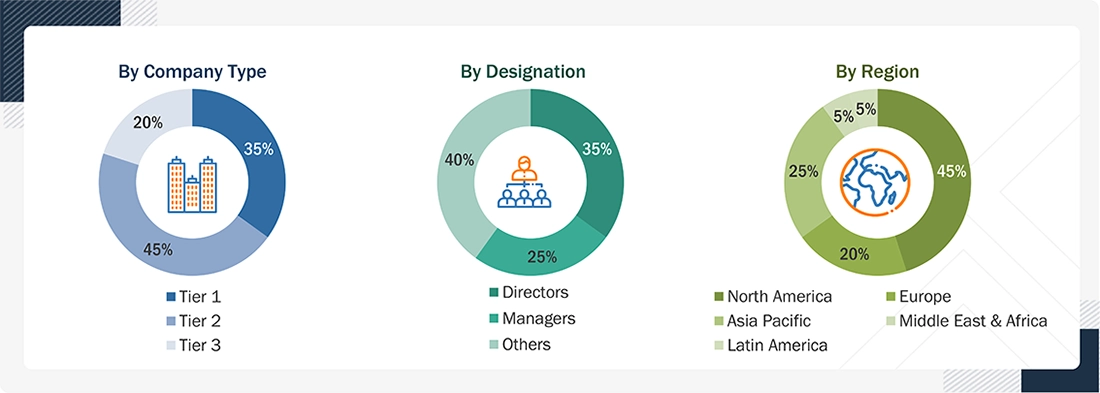
Note: Tier 1 companies have annual revenues of more than USD 1 billion; Tier 2 companies have annual revenues between USD 100 million and USD 1 billion; and Tier 3 companies have annual revenues below USD 100 million. Other designations include professionals working across sales, marketing, engineering, product management, operations, research, cloud architecture, and storage infrastructure.
To know about the assumptions considered for the study, download the pdf brochure
Market Size Estimation
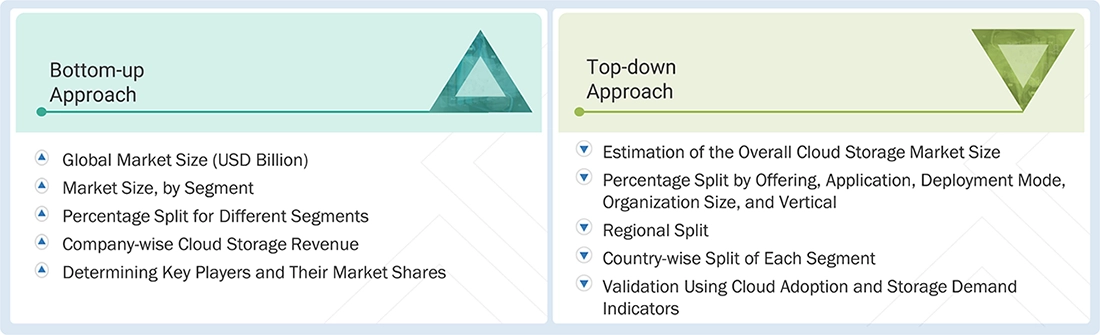
Multiple approaches were used to estimate and forecast the cloud storage market. The first approach estimated market revenue generated by companies from cloud storage infrastructure, cloud storage platforms, and directly associated storage services. Vendor revenues were evaluated and allocated across relevant market segments based on product functionality, storage architecture, deployment model, application exposure, customer profile, geographic presence, and service mix. Only revenue directly attributable to cloud storage was retained, while generic cloud compute, networking, database, cybersecurity, traditional storage hardware, unrelated SaaS, and general IT services were excluded. Estimates were then validated using enterprise cloud adoption, storage capacity requirements, application workload growth, publicly available pricing, customer deployments, regional infrastructure expansion, vendor disclosures, and primary interviews.
Market Size Estimation Methodology: Top-down Approach
The top-down approach began by defining the addressable revenue pool for cloud-based storage infrastructure, platforms, and related services. Publicly disclosed cloud and infrastructure revenues, company filings, storage-specific disclosures, product portfolios, customer deployments, pricing structures, regional infrastructure expansion, and storage service availability were analyzed to distinguish cloud storage from broader compute, networking, database, software, and infrastructure businesses. Storage-relevant revenue was then assessed using indicators such as adoption of object, block, and file storage; backup and archive requirements; artificial intelligence and analytics workloads; cloud-native applications; data protection; and hybrid-cloud storage deployment. The resulting market envelope was segmented by offering, application, deployment model, organization size, vertical, region, and country. The estimates were then cross-validated against vendor-level revenue analysis and primary research findings.
Market Size Estimation Methodology: Bottom-up Approach
The bottom-up approach involved compiling an extensive list of companies providing cloud storage infrastructure, cloud storage platforms, data protection capabilities, storage management, and related services. Each company's relevant revenue was estimated using annual reports, regulatory filings, investor presentations, earnings transcripts, product documentation, pricing information, customer references, acquisition disclosures, and other official company information. Revenue attributable to object storage, block storage, file storage, migration & integration, managed storage services, and support & maintenance was isolated from broader company revenue.
Company-level estimates were aggregated to calculate the global market size and then allocated across applications, deployment models, organization sizes, verticals, and regions. Revenue from generic cloud compute, networking, databases, cybersecurity, traditional non-cloud storage hardware, unrelated SaaS, and generic professional services was excluded. Regional estimates were further validated using cloud infrastructure availability, enterprise adoption, customer deployments, data residency requirements, storage consumption patterns, and primary interviews.
Data Triangulation
After determining the overall market size using top-down and bottom-up estimation methods, the market was segmented into segments and subsegments. Data triangulation and market breakup procedures were used to validate each market segment and subsegment. Vendor revenues, cloud storage portfolios, customer adoption patterns, deployment models, storage types, application workloads, pricing structures, regional indicators, and primary interview findings were compared to identify inconsistencies.
The final market size was determined by reconciling supply-side vendor revenues with demand-side indicators, including cloud adoption, storage consumption, data growth, infrastructure expansion, application modernization, backup requirements, and enterprise technology spending. Validated percentage splits were then applied across the full market segmentation to derive estimates at the segment, regional, and country levels.
Market Definition
The cloud storage market comprises cloud-based storage infrastructure, platforms, and associated services that enable organizations to store, manage, protect, access, migrate, replicate, and retain data across public, private, and hybrid cloud environments. The market includes object, block, and file storage, along with migration and integration, managed storage services, and support and maintenance directly associated with cloud storage deployments.
Cloud storage supports workloads such as analytics and data lakes, artificial intelligence and high-performance computing, enterprise business applications, cloud-native applications, data protection, compliance and long-term retention, digital content and media, and end-user productivity. The market excludes generic cloud compute and networking revenue; database services for which storage revenue cannot be separated; traditional enterprise storage hardware unrelated to cloud deployments; endpoint and consumer storage; unrelated cybersecurity products; general SaaS applications; generic IT outsourcing; and consulting or managed services without a direct cloud storage component.
Key Stakeholders
- Hyperscale cloud service providers
- Cloud storage service providers
- Object storage providers
- Block storage providers
- Managed file storage providers
- Enterprise and hybrid-cloud storage vendors
- Cloud-native storage platform providers
- Backup and disaster recovery providers
- Data protection and archive solution providers
- Managed storage service providers
- Cloud migration and integration service providers
- System integrators and cloud consulting organizations
- Data center and infrastructure service providers supporting cloud storage delivery
- AI, analytics, and data platform infrastructure teams
- Cloud-native application and Kubernetes ecosystem participants
- Enterprise cloud infrastructure and storage teams
Report Objectives
- To define and describe the cloud storage market by offering, application, deployment mode, organization size, vertical, and region
- To provide detailed information on major factors influencing market growth, including drivers, restraints, opportunities, and challenges across the cloud storage ecosystem
- To strategically analyze micro-markets with respect to individual growth trends, storage adoption patterns, workload requirements, and their contribution to the overall cloud storage market
- To analyze market opportunities for stakeholders and present the competitive landscape across hyperscalers, cloud storage specialists, enterprise storage vendors, and storage service providers
- To project market size and submarket value across North America, Europe, Asia Pacific, Middle East & Africa, and Latin America
- To analyze major countries within each region based on cloud adoption, digital infrastructure development, enterprise data growth, storage workload demand, and regulatory requirements
- To strategically profile leading companies and evaluate their product portfolios, storage capabilities, geographic presence, business strategies, and market positioning
- To examine competitive developments, including product launches, storage platform enhancements, partnerships, integrations, acquisitions, regional expansions, and infrastructure investments
- To assess the impact of artificial intelligence, data lakes, cloud-native applications, cyber resilience, data sovereignty, high-performance storage, and hybrid-cloud architectures on market development
Available customizations:
Based on the market data provided, customization can be tailored to the company's specific research requirements. The following customization options can be offered for the report:
Product Analysis
- A product matrix providing a detailed comparison of company portfolios across object, block, and file storage; cloud storage services; deployment models; storage management capabilities; data protection functionality; workload alignment; and geographic availability.
Geographic Analysis based on feasibility
- Further breakup of the North American cloud storage market
- Further breakup of the European cloud storage market
- Further breakup of the Asia Pacific cloud storage market
- Further breakup of the Middle East & African cloud storage market
- Further breakup of the Latin American cloud storage market
Company Information
- Detailed analysis and profiling of additional market players (up to five)
Key Questions Addressed by the Report
What is the current size of the Cloud Storage Market?
The Cloud Storage Market is valued at 92.25 billion in 2026 and is projected to reach USD 261.21 billion by 2031, growing at a CAGR of 23.1% during the forecast period.
What is driving the growth of the Cloud Storage Market?
The market is growing due to rising enterprise data volumes, increasing AI and analytics workloads, and expanding cloud-native application deployments.
Which storage type is expected to grow the fastest in the Cloud Storage Market?
Object storage is projected to witness the highest CAGR during the forecast period due to its scalability for AI, analytics, and unstructured data.
Which offering is expected to register significant growth in the Cloud Storage Market?
The services segment is projected to exhibit significant growth as organizations increasingly require consulting, implementation, and managed cloud storage services.
Which region is expected to witness the fastest growth in the Cloud Storage Market?
Asia Pacific is expected to register the highest CAGR during the forecast period due to accelerating cloud adoption and digital transformation initiatives.
Why is cloud storage becoming essential for enterprises?
Cloud storage enables organizations to securely manage growing data volumes, improve scalability, support AI workloads, and optimize hybrid and multi-cloud environments.
Fact checked
Personalize This Research
- Triangulate with your Own Data
- Get Data as per your Format and Definition
- Gain a Deeper Dive on a Specific Application, Geography, Customer or Competitor
- Any level of Personalization
Let Us Help You
- What are the Known and Unknown Adjacencies Impacting the Cloud Storage Market
- What will your New Revenue Sources be?
- Who will be your Top Customer; what will make them switch?
- Defend your Market Share or Win Competitors
- Get a Scorecard for Target Partners

Custom Market Research Services
We Will Customise The Research For You, In Case The Report Listed Above Does Not Meet With Your Requirements
Get 10% Free CustomisationTESTIMONIALS
- Rest Of Latin America Cloud Storage Market
- Africa Cloud Storage Market
- Middle East Cloud Storage Market
- Bahrain Cloud Storage Market
- Canada Cloud Storage Market
- US Cloud Storage Market
- UK Cloud Storage Market
- Germany Cloud Storage Market
- France Cloud Storage Market
- Italy Cloud Storage Market
- China Cloud Storage Market
- Japan Cloud Storage Market
- Brazil Cloud Storage Market
- Mexico Cloud Storage Market
- Rest Of Europe Cloud Storage Market
- Rest Of Asia Pacific Cloud Storage Market
Growth opportunities and latent adjacency in Cloud Storage Market






Derrick
Apr, 2026
The mix of public, private, and hybrid cloud storage models makes the market quite dynamic, especially for enterprises with different compliance and security requirements..
Martin
Apr, 2026
While adoption is accelerating, managing security and compliance in cloud storage environments still seems like a major consideration for enterprises..