Electrical Steel Market

Electrical Steel Market by Type (Grain-oriented, Non-grain-oriented), Application (Transformers, Motors, Inductors), End-use Industry (Energy, Automotive, Manufacturing, Household Appliances), and Region - Global Forecast to 2031




OVERVIEW
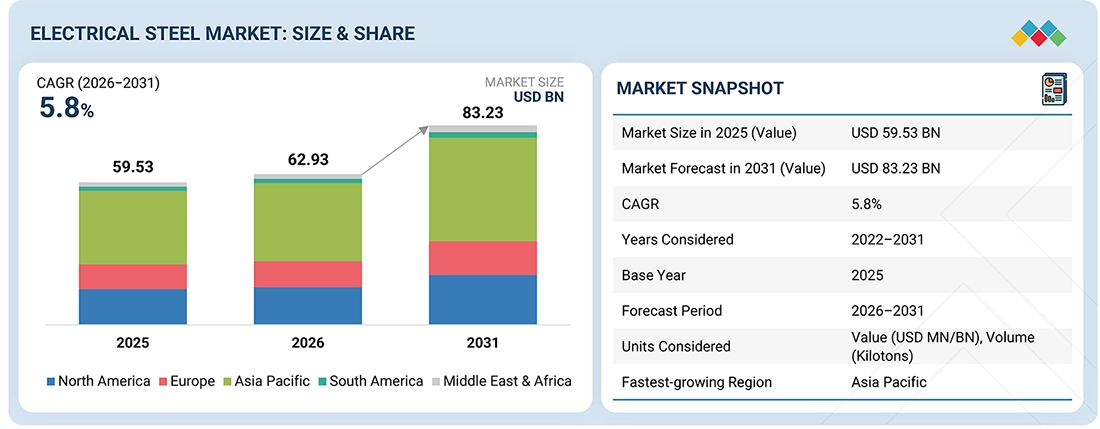
Source: Secondary Research, Interviews with Experts, MarketsandMarkets Analysis
The electrical steel market is projected to grow from USD 62.93 billion in 2026 to USD 83.23 billion by 2031, representing a compound annual growth rate (CAGR) of 5.8% during this period. Demand for electrical steel is driven by accelerating grid modernization, EV motor efficiency requirements, and the integration of renewable energy.
KEY TAKEAWAYS
-
By RegionAsia Pacific accounted for a significant share of 51.6% in 2025.
-
By TypeBy type, the non-grain-oriented electrical steel segment is expected to be the largest in the forecasted period with 69.7% market share in 2025.
-
By ApplicationBy application, the transformers segment is projected to register the highest CAGR of43.9% during the period.
-
By End-Use IndustryBy end-use industry, the energy segment dominated the market in 2025, accounting for 52.9% of the market share.
-
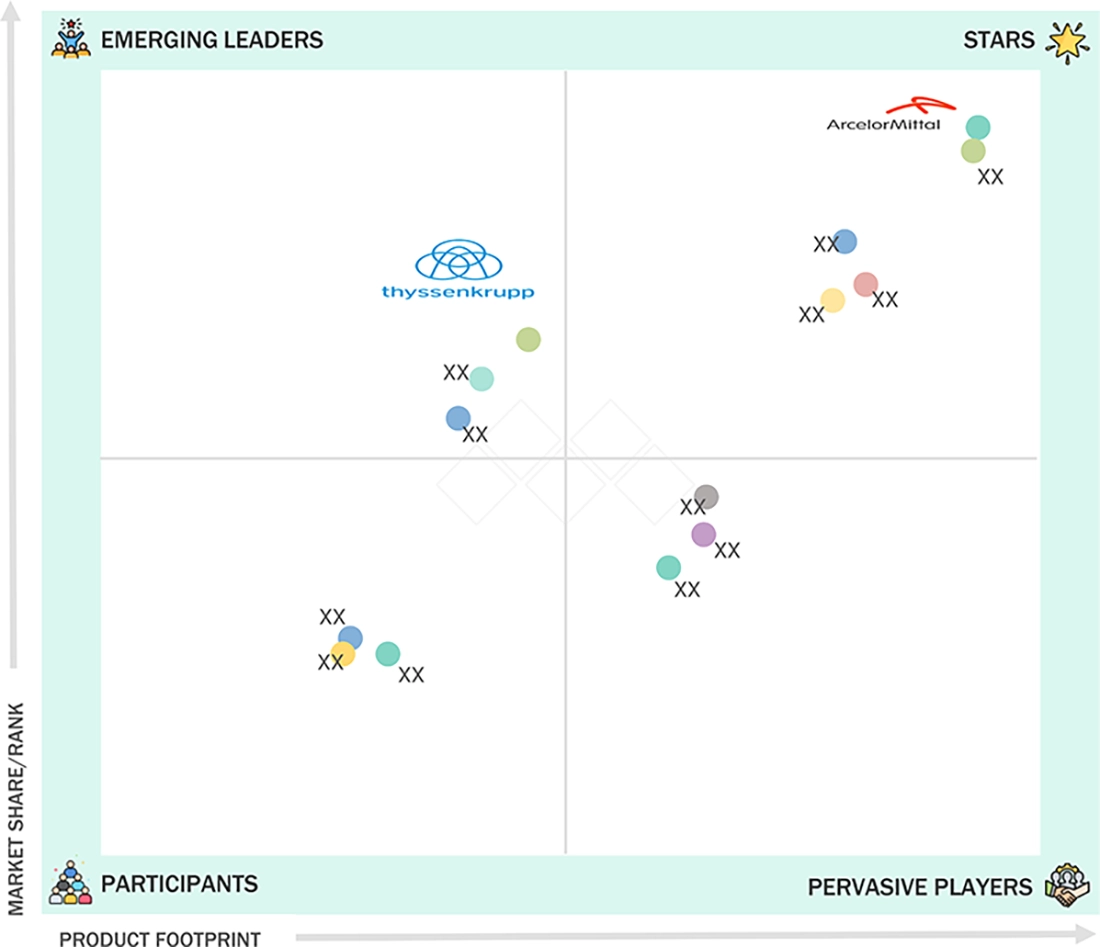
Competitive Landscape - Key PlayersArcelorMittal (Luxembourg), POSCO (South Korea), China Baowu Steel Group Corporation Limited (China), voestalpine AG (Austria), and Nippon Steel Corporation (Japan) were identified as star players in the electrical steel market (global), given their strong market share and product footprint.
-
Competitive Landscape - Startups/SMEsCleveland-Cliffs Inc. (US), Hebei Puyang Iron and Steel Group (China), JSW Steel (India), Angang Steel Company Limited (China) have distinguished themselves among startups and SMEs by securing strong footholds in specialized niche areas, underscoring their potential as emerging market leaders.
The use of electrical steel is gaining traction in industries such as energy and automotive because of its ability to form efficient coils of electrical wire. End-users are replacing conventional steels with value-added, electrically engineered steels that are designed to optimize the magnetic properties of electricity passing through electrical coils. At the same time, improvements in the manufacture of electrical steel (due to advances in domain refinement technology, coating technology, and high-precision rolling methods) are resulting in improved permeability of grain oriented electrical steels (e.g. lower hysteresis losses), enabling the development of higher performing electrical coils when placed under various operating conditions. These improvements are essential to addressing the increasing complexity of today’s electrical power systems as well as high-efficiency electric vehicle drivelines and renewable energy systems and correspondingly to improving the reliability and reducing energy losses of electrical systems.
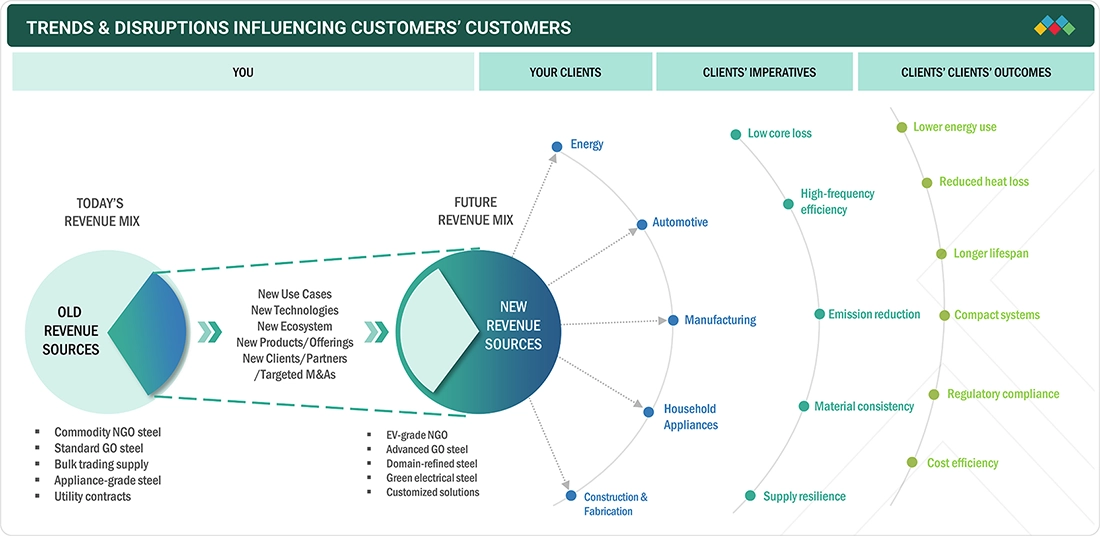
TRENDS & DISRUPTIONS IMPACTING CUSTOMERS' CUSTOMERS
The electrical steel industry is undergoing a structural transformation as end-use sectors shift from conventional steel inputs toward highly engineered, application-specific electrical steel systems designed for energy-efficient performance. The predominant use of traditional electrical steel grades will become less followed by the increasing use of newly developed high-performance, granular/laminated, grain-oriented and non-grain-oriented manufacturing processes with improved magnetic properties resulting in significant reductions in core losses and greater efficiency for transformers, dc and ac electric motors and generators are aligned with the growing demand for electric vehicle technologies, renewable energy systems, and smart grid infrastructure all requiring precise performance and energy optimization of the electrical steel systems that comprise them. In addition, improvements in laser scribing, domain refinement and advanced coating technologies are helping the electrical steel industry to manufacture the most reliable, consistently high-performing products possible under dynamic operating conditions (e.g., temperature, speed, voltage). These developments are also enabling electrical steel systems to be more compactly arranged with less overall energy consumption than typical systems, resulting in longer life expectancies and reduced heat losses. As electrical steel manufacturers attempt to achieve operating efficiencies by reducing or eliminating CO2 emissions, protecting their employees and complying with federal regulations, they continue to innovate to meet the growing demand for next-generation electrical steel solutions that help deliver reliable, efficient and future-ready global transportation and energy supplies.
Source: Secondary Research, Interviews with Experts, MarketsandMarkets Analysis
MARKET DYNAMICS

Level
-
Abundance of iron ore and other minerals for electrical steel production

-
Expansion of urban infrastructure networks


Level
-
Energy-intensive processing with rising decarbonization pressure

-
Volatility in raw material quality and supply security


Level
-
Expansion into EV-specific NGO steel grades

-
Precision control of silicon content above conventional limits


Level
-
Achieving ultra-low core loss at high frequencies

-
Increasingly stringent environmental compliance for hazardous process emissions

Source: Secondary Research, Interviews with Experts, MarketsandMarkets Analysis
Driver: Abundance of Iron Ore and Other Minerals for Electrical Steel Production
The abundance of iron ore and critical alloying minerals provides a foundational supply-side advantage for electrical steel production, supporting scalability amid rising demand from energy and mobility sectors. The availability of high-quality iron ore will also produce consistently low-impurity steel with superior magnetic properties, resulting in the best-quality iron for grain-oriented and non-grain-oriented electrical steel. Furthermore, access to other key raw materials, such as silicon, will enable precise alloy compositions that reduce core losses and improve electrical resistance. The availability of these resources will stabilize raw material costs, reduce supply chain interruptions, and support large-scale investment in manufacturing. Additionally, because there are mineral reserves in key producing regions, it allows for backward integration to enhance cost competitiveness and increase supply security as the demand for electrical steel continues to grow, resulting from expansion of the grid, development of renewable energy sources, and production of electric vehicles.
Restraint: Energy-Intensive Processing with Rising Decarbonization Pressure
Producing electrical steel is very energy-intensive because it requires specific conditions (ultra-thin-gauge rolling, controlled annealing, and precise magnetic domain refinement) to meet the needs of end-user applications. High temperatures are required for each of these processes, and a stable electric supply is required during the high temperature operations; therefore, electrical steel producers have significant exposure to rising energy costs and increasing carbon pricing mechanisms due to the stringent requirements. Electrical steel has a very limited ability to replace processes without negatively affecting the material's magnetic performance, making it increasingly difficult and expensive for producers to meet required emissions reductions. The high-purity raw materials and specialty coatings used in the manufacturing of electrical steel contribute to CO2 emissions. Consequently, producers are being pressured to invest in low-carbon solutions while producing products that perform as required, resulting in cost pressures and delayed growth in production capacity despite increases in demand from the energy and e-mobility markets.
Opportunity: Expansion into EV-Specific NGO Steel Grades
Expansion into EV-specific non-grain-oriented electrical steel grades presents a strong growth opportunity as automakers increasingly demand materials optimized for high-speed, high-frequency motor performance. These new NGO grades offer lower core losses, higher magnetic flux density, and improved thermal stability under dynamic operating conditions, such as in electric drive systems. As EV platforms continue to develop towards greater power density and more compact motor designs, there is a growing demand for ultra-thin gauges and the highest grades of surface coatings, creating opportunities for steel manufacturers to develop differentiated, application-specific solutions that meet OEM specifications. In addition, the trend toward localizing EV supply chains and the increase in investments to support electric mobility infrastructure provide steel mills with access to new regional markets and create opportunities to develop longer-term contracts, while positioning them as key partners in the electrification of automobiles.
Challenge: Achieving Ultra-Low Core Loss at High Frequencies
Achieving ultra-low core loss at high frequencies remains a critical challenge in electrical steel development as modern applications such as EV traction motors and high-efficiency generators operate under increasingly demanding electromagnetic conditions. The increased eddy current losses and hysteresis losses at these frequencies mean that producers of electric steel must extremely control the thickness of the material, the grain structure of the material, and the magnetic domain alignment of the material in order to minimize the core loss when producing electric steel at these frequencies. In addition, providing ultra-thin-gauge electric steel without compromising mechanical properties, such as mechanical strength or surface quality, makes the rolling or annealing processes for ultra-thin gauges that much more complex. Also, if the electric steel has advanced coating systems, these systems must provide electrical insulation against the outside while maintaining thermal stability during continuous operation of the electric steel. Due to the requirements of very high precision manufacturing, plus the increased risk of yield, plus the increased cost of manufacturing, it is very difficult for producers of electric steel to produce high performance grades consistently and meet the very stringent expectations for efficiency in automotive and energy industries.
ELECTRICAL STEEL MARKET: COMMERCIAL USE CASES ACROSS INDUSTRIES
| COMPANY | USE CASE DESCRIPTION | BENEFITS |
|---|---|---|
 |
Developed Hyper NO electrical steel with ultra-low core loss and high magnetic flux density tailored for high-speed EV traction motors. | Improved motor efficiency at high RPM conditions | Enabled compact motor design | Extended EV driving range through reduced energy losses |
 |
Engineered high-grade grain-oriented electrical steel (GOES) with advanced magnetic domain control for ultra-high-efficiency power transformers. | Reduced transmission losses in power grids | Enhanced energy efficiency under variable loads | Supported stable integration of renewable energy sources |
 |
Introduced powercore non-grain-oriented electrical steel optimized for high-frequency applications in industrial motors and generators. | Enabled lower hysteresis and eddy current losses | Improved operational reliability in demanding industrial environments | Reduced overall lifecycle energy consumption |
Logos and trademarks shown above are the property of their respective owners. Their use here is for informational and illustrative purposes only.
MARKET ECOSYSTEM
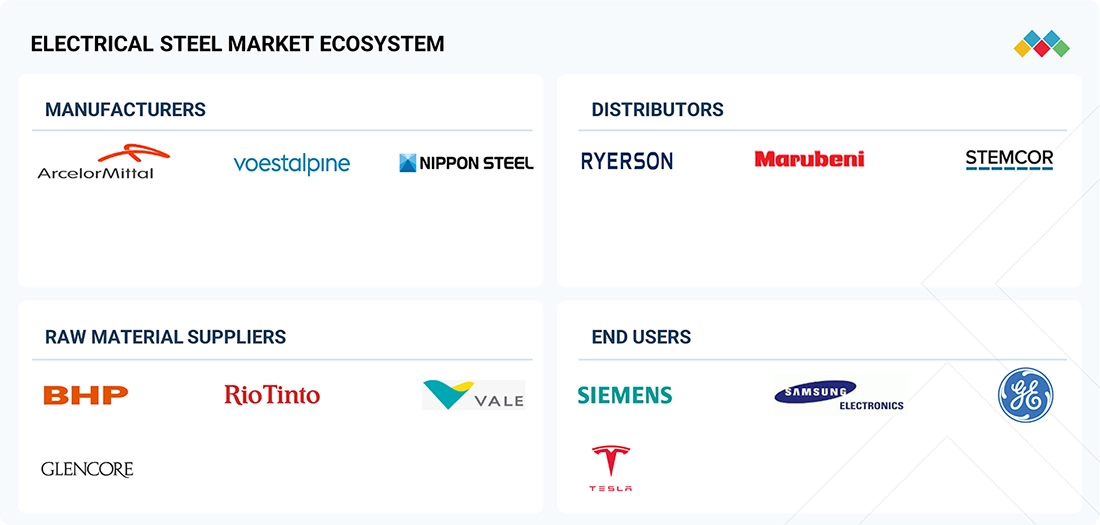
The ecosystem of the electrical steel market builds on a similar upstream foundation, where raw material suppliers such as BHP Group, Rio Tinto, Vale S.A., and Glencore plc ensure the availability of high-grade iron ore and alloying elements essential for producing low-impurity, silicon-rich steel. Manufacturers including ArcelorMittal, Nippon Steel Corporation, POSCO, voestalpine AG, and thyssenkrupp Steel use these materials to create specialized grain-oriented and non-grain-oriented electrical steel types designed for maximum energy transfer and minimal core loss. Distributors such as Ryerson Holding Company, Marubeni-Itochu Steel, and Stemcor Group distribute these products worldwide, ensuring they are ready for use in all regions. Electric vehicles, transformers, motors, and many advanced electronics made by Tesla Inc., Samsung Electronics, Siemens, and General Electric require the integration of electrical steel into their product lines, where energy efficiency and performance are essential. This global network fosters continued innovation and improvements in supply chain reliability while aligning with current trends toward global electrification and the energy transition.
Logos and trademarks shown above are the property of their respective owners. Their use here is for informational and illustrative purposes only.
MARKET SEGMENTS
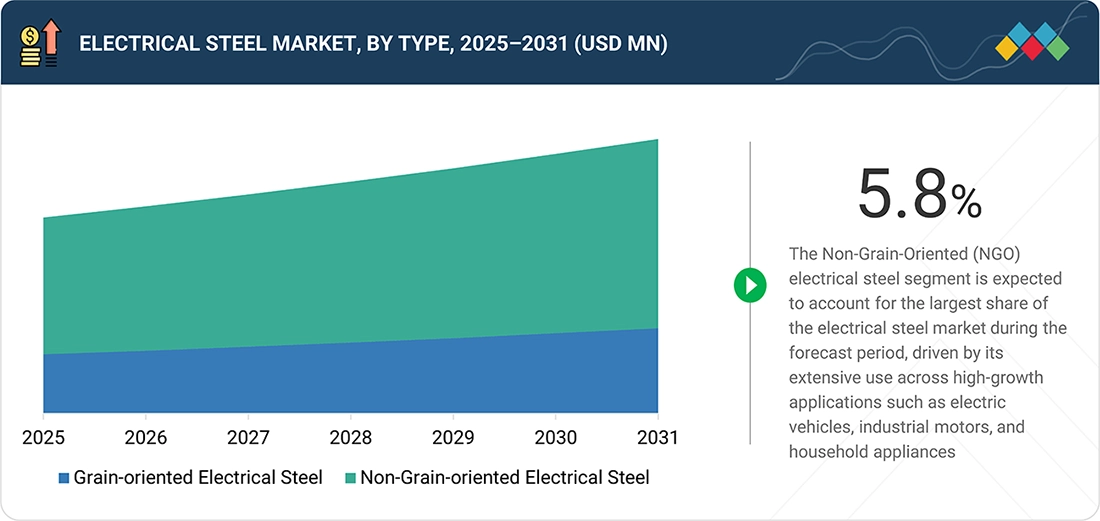
Source: Secondary Research, Interviews with Experts, MarketsandMarkets Analysis
Electrical Steel Market, By Type
The Non-Grain-Oriented (NGO) electrical steel segment is expected to account for the largest share of the electrical steel market during the forecast period, driven by its extensive use in high-growth sectors such as electric vehicles, industrial motors, and domestic white goods. Due to its isotropic magnetic properties, NGO electrical steel will continue to be an excellent candidate for use in rotating equipment operating at variable speed and direction, compared with grain-oriented grades. A further increase in demand for high-performance NGO grades will occur as demand for electric vehicle (EV) production continues to grow rapidly and as the deployment of energy-efficient motors in manufacturing and heating, ventilation, and air conditioning (HVAC) systems expands dramatically. In addition, improvements in thin-gauge processing and coating technologies will result in lower core losses and provide greater efficiency; therefore, the use of NGO Electrical Steel will be a necessary element in the global transition to electrified energy-efficient systems.
Electrical Steel Market, By Application
The transformers segment is expected to account for the largest share of the electrical steel market during the forecast period, supported by ongoing spending on electric transmission and distribution networks. Electrical steel, mainly in grain-orientated grades, is vital for transformers due to its high degree of magnetic permeability and very low core losses. Both of these characteristics have a direct influence on energy efficiency and overall reliability when using the transformer. The continued growth in renewable energy and efforts to modernize the grid are driving the deployment of high-efficiency transformers to accommodate fluctuating power loads and long-distance transmission requirements. There is also an increasing need for electric transformers in the developed world as their existing transformer fleets age, and there is growing demand for electric transformers in developing nations due to electrification efforts. All these elements support the ongoing need for transformer-related applications to create continuance in large-scale global demand.
Electrucal Steel Market, By End-use Industry
The energy segment is expected to account for the largest share of the electrical steel market during the forecast period, driven by increased investment in power generation, transmission, and distribution infrastructure. Electrical steel is an essential component in transformers, generators, and other equipment used in electric grids, since core losses and high magnetic efficiency directly impact energy systems. There are additional drivers of demand for electrical steel, such as the rapid growth of alternative energy sources (e.g., wind and solar), which require advanced electrical steels to accommodate fluctuating power flows and support grid stability. Other drivers include large-scale electrification projects, expansions of rural grid access, and upgrades to existing, outdated power grids/Infrastructure. Together, these factors create an ongoing need for electrical steel on a global basis and position the energy sector as the single largest driver of sustained, high-volume electrical steel demand worldwide.
REGION
Asia Pacific to be the largest region in global electrical steel market during forecast period
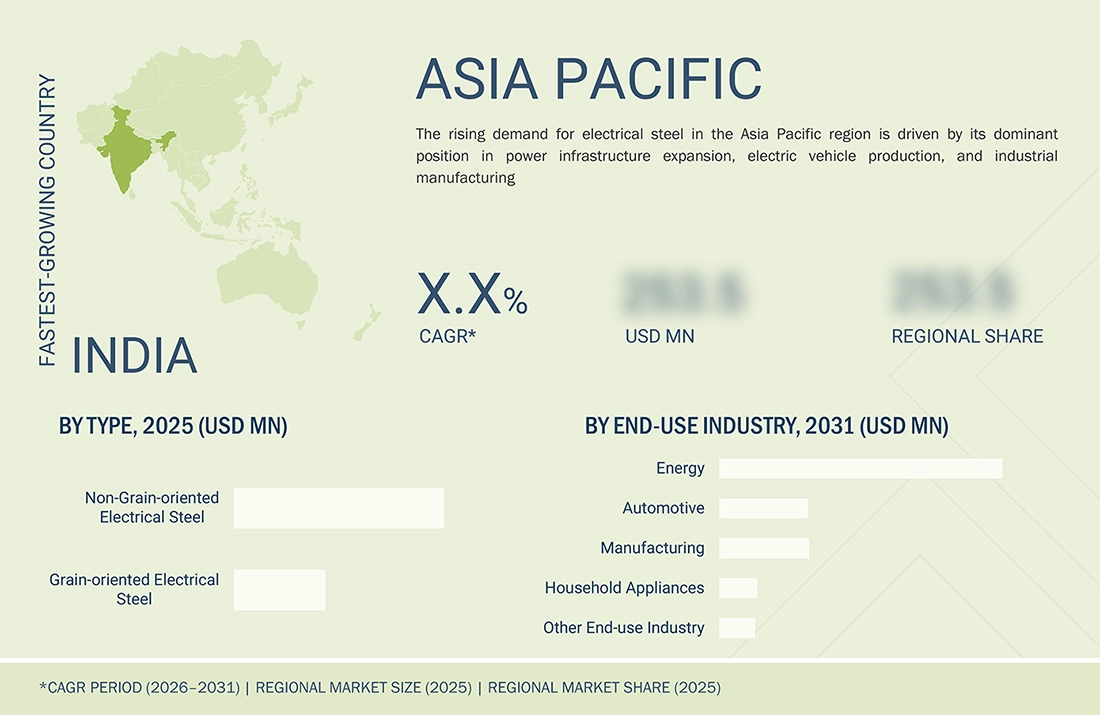
The Asia-Pacific region is expected to hold the largest share of the electrical steel market over the next few years due to its leadership in power infrastructure, manufacturing, and electric vehicle production. There have been a number of large investments in grid modernization and transportation systems for electric vehicles in China, India, Japan, and Korea, while renewable energy will need high-performance electrical steel for transformers, motors, and generators. Asia Pacific possesses strong manufacturing capabilities and established supply chain partnerships, enabling large-scale production of grain-oriented and non-grain-oriented electrical steel. Furthermore, government support for energy-efficient production and domestic electric vehicle production is supporting the growth of electrical steel. Additionally, Asia Pacific is continuing to lead in the increased volume used in the electrical steel industry and also the technology associated with it due to rapid urbanization, an increase in electricity consumption, and the replacement of the old electrical grid infrastructure.
ELECTRICAL STEEL MARKET: COMPANY EVALUATION MATRIX
ArcelorMittal (Star) is one of the world's largest producers of electrical steels, with the best production capabilities and the widest selection of high-performance grades available from any source. With an integrated production system and an ongoing commitment to new processes, such as precision rolling and cutting-edge annealing techniques, the company can produce grain-oriented and non-grain-oriented electrical steels that have superior magnetic properties, resulting in reduced core losses. In addition, ArcelorMittal has a strong commitment to high-growth applications, such as power transformers, electric vehicles (EVs), and industrial motors, which allow it to further differentiate itself from competitors. Also, thanks to substantial investment in research and development (R&D), ArcelorMittal provides energy-efficient, application-specific solutions that support global electrification and decarbonization efforts. At the same time, thyssenkrupp AG (Germany) (Emerging Leader) is also establishing itself in the marketplace by producing high-performance electrical steel under the PowerCore brand, while investing in low-carbon steel-making technologies, digitization of production processes, and sustainable manufacturing, each of which will help support the next generation of energy and mobility applications.
Source: Secondary Research, Interviews with Experts, MarketsandMarkets Analysis
KEY MARKET PLAYERS
- ArcelorMittal (Luxembourg)
- China Baowu Steel Group (China)
- POSCO (South Korea)
- voestalpine AG (Austria)
- Nippon Steel Corporation (Japan)
- United States Steel Corporation (US)
- Tata Steel (India)
- thyssenkrupp AG (Germany)
- JFE Steel Corporation (Japan)
- Cleveland-Cliffs Inc. (US)
- China Steel Corporation (Taiwan)
- Hebei Puyang Iron and Steel Group (China)
- JSW Steel (India)
- NLMK (Russia)
- Angang Steel Company Limited (China)
MARKET SCOPE
| REPORT METRIC | DETAILS |
|---|---|
| Market Size in 2025 (Value) | USD 59.53 Billion |
| Market Size in 2026 (Value) | USD 62.93 Billion |
| Market Size in 2031 (Value) | USD 83.23 Billion |
| Growth Rate | CAGR of 5.8% from 2026 to 2031 |
| Years Considered | 2022–2031 |
| Base Year | 2025 |
| Forecast Period | 2026–2031 |
| Units Considered | Value (USD Million/Billion), Volume (Kilotons) |
| Report Coverage | Revenue forecast, company ranking, competitive landscape, growth factors, and trends |
| Segments Covered |
|
| Regions Covered | North America, Asia Pacific, Europe, South America, Middle East & Africa |
WHAT IS IN IT FOR YOU: ELECTRICAL STEEL MARKET REPORT CONTENT GUIDE
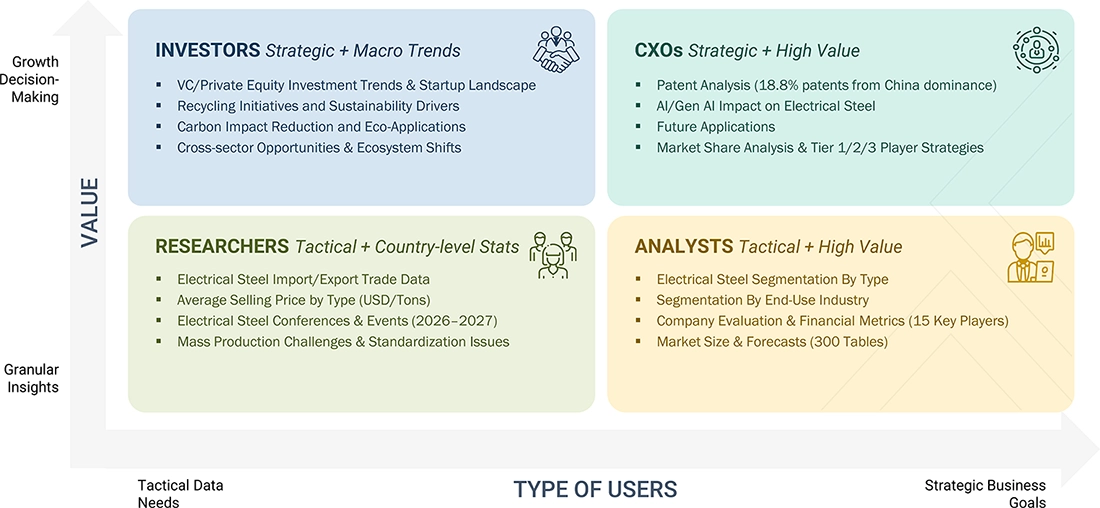
DELIVERED CUSTOMIZATIONS
We have successfully delivered the following deep-dive customizations:
| CLIENT REQUEST | CUSTOMIZATION DELIVERED | VALUE ADDS |
|---|---|---|
| Advanced production route mapping | Technical review of cold-rolling, continuous annealing, and surface coating processes | Identifies opportunities for energy loss reduction and improved magnetic flux density |
| End-use industry application benchmarking | Performance mapping across EV traction motors, industrial generators, and household appliances | Facilitates product portfolio alignment with high-growth electrification demands |
| CLIENT REQUEST | CUSTOMIZATION DELIVERED | VALUE ADDS | | | | | ||
| Deeper analysis of high-growth end-use industries | Detailed demand breakdown for semiconductor, healthcare, metal fabrication, and environmental monitoring sectors | Consumption pattern analysis across industries | Purity requirement mapping for specialt | ||
| Assessment of competitive positioning in specialty gas mixtures | Benchmarking of key players based on blending capabilities, purity levels, distribution models, and technology integration | Comparative analysis of product portfolios and certification cap |
RECENT DEVELOPMENTS
- March 2026 : In March 2026, the electrical steels team at Mardyck successfully produced the first industrial coil on the newly installed production lines. This achievement marks an important step in the project, enabling teams to fine-tune equipment and optimize manufacturing processes for a smooth production ramp-up
- March 2026 : Nippon Steel completed a tender offer for shares of Krosaki Harima Corporation, strengthening its refractory materials business and enhancing vertical integration to support steel manufacturing processes and improve operational efficiency.
- March 2026 : AM/NS India, a joint venture of Nippon Steel, initiated construction of an integrated steel plant in Andhra Pradesh, expanding production capacity in India and strengthening its presence in one of the fastest-growing steel-demand markets globally.
Table of Contents
 Exclusive indicates content/data unique to MarketsandMarkets and not available with any competitors.
Methodology
The study involved four major activities to estimate the current size of the global electrical steel market. Exhaustive secondary research was carried out to collect information on the market, the peer product market, and the parent product group market. The next step was to validate these findings, assumptions, and sizes with industry experts across the electrical steel value chain through primary research. The top-down and bottom-up approaches were employed to estimate the overall size of the electrical steel market. After that, market breakdown and data triangulation procedures were used to determine the size of different segments of the market.
Secondary Research
The market for companies offering electrical steel was determined by studying secondary data from paid and unpaid sources, analyzing the product portfolios of major companies in the ecosystem, and rating companies based on their performance and quality. Various secondary sources, such as Business Standard, Bloomberg, World Bank, and Factiva, were referred to identify and collect information for this study on the electrical steel market. In the secondary research process, various secondary sources were referred to identify and collect information related to the study. Secondary sources included annual reports, press releases, investor presentations, electrical steel distributors, forums, certified publications, and white papers. Secondary research was used to obtain critical information on the industry’s value chain, the total pool of key players, and market classification and segmentation from market- and technology-oriented perspectives.
Primary Research
In the primary research process, various primary sources from the supply and demand sides were interviewed to obtain qualitative and quantitative information for this report. The primary sources from the supply side included industry experts, such as Chief Executive Officers (CEOs), Vice Presidents (VPs), marketing directors, technology and innovation directors, and related key executives from several key companies and organizations operating in the electrical steel market. After the complete market engineering (calculations for market statistics, market breakdown, market size estimations, market forecasting, and data triangulation), extensive primary research was conducted to gather information and verify and validate the critical numbers arrived at. Primary research was also conducted to identify the segmentation types, industry trends, competitive landscape of electrical steel offered by various market players, and key market dynamics, such as drivers, restraints, opportunities, challenges, industry trends, and key player strategies. In the complete market engineering process, top-down and bottom-up approaches, along with several data triangulation methods, were extensively used to estimate and forecast the overall market segments and subsegments listed in this report. Extensive qualitative and quantitative analyses were performed on the complete market engineering process to identify key information/insights throughout the report.
The following is the breakdown of primary respondents:
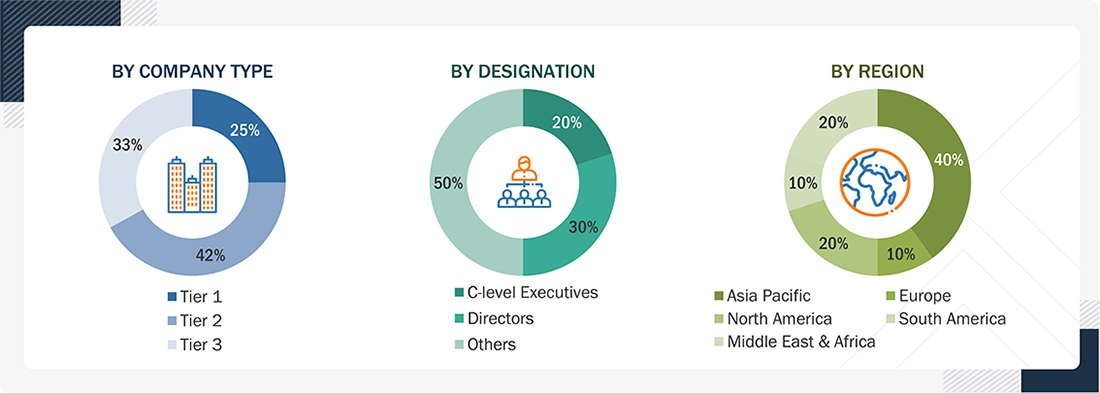
Note: Others include Sales, Marketing, and Product Managers.
Tier 1: > USD 1 billion; Tier 2: USD 500 million–1 billion; and Tier 3: USD 500 million.
To know about the assumptions considered for the study, download the pdf brochure
Market Size Estimation
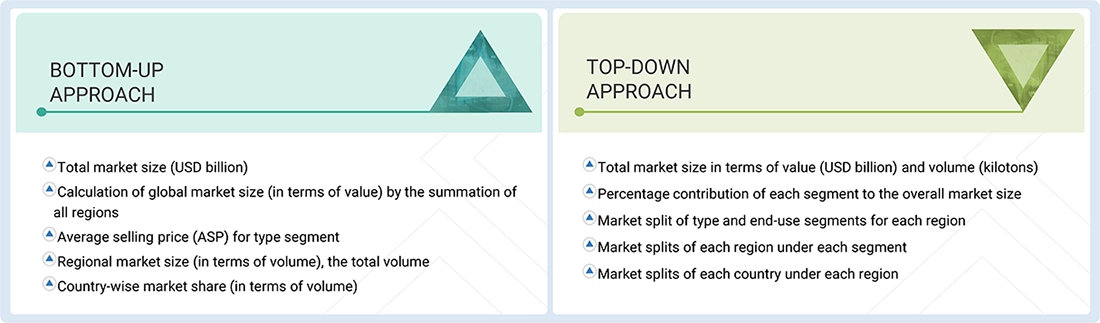
The top-down and bottom-up approaches were used to estimate and validate the size of the global electrical steel market. These approaches were also used extensively to estimate the size of various dependent market segments.
The research methodology used to estimate the market size included the following approaches:
Electrical Steel Market : Top-Down and Bottom-Up Approach
Data Triangulation
After arriving at the overall market size using the market size estimation processes, the market was split into several segments and subsegments. The data triangulation and market breakdown procedures were employed, wherever applicable, to complete the overall market engineering process and arrive at the exact statistics of each market segment and subsegment. The data was triangulated by studying various factors and trends from both the demand and supply sides.
Market Definition
Electrical steel is a specialized steel alloy engineered for superior magnetic performance, primarily used in transformers, motors, and generators. It is produced by adding silicon to steel and processing it through controlled rolling and annealing to achieve low core loss, high permeability, and improved energy efficiency. Available in grain-oriented and non-grain-oriented forms, it is typically manufactured as thin sheets or coils to minimize energy losses, making it essential for efficient power generation, transmission, and electrical equipment operation.
Key Stakeholders
- Raw Material Suppliers
- Regulatory Bodies
- Government and Consulting Firms
- End Users
- Research and Development Organizations
- Electrical Steel Manufacturers, Dealers, Traders, and Suppliers
Report Objectives
- To define, describe, and forecast the size of the global electrical steel market based on type, application, end-use industry, and region in terms of value and volume
- To provide detailed information on the significant drivers, restraints, opportunities, and challenges influencing the market
- To analyze and forecast the market based on type, application, and end-use industry
- To strategically analyze micro markets concerning individual growth trends, prospects, and their contribution to the market
- To assess the growth opportunities in the market for stakeholders and provide details on the competitive landscape for market leaders
- To forecast the market size of segments for North America, Europe, Asia Pacific, South America, and the Middle East & Africa
- To strategically profile key players and comprehensively analyze their market shares and core competencies
- To analyze competitive developments, such as product launches, expansions, partnerships, and acquisitions in the electrical steel market
- To provide the impact of AI on the electrical steel market
Available customizations:
With the given market data, MarketsandMarkets offers customizations according to client-specific needs.
The following customization options are available for the electrical steel report:
Product Analysis
- A product matrix that gives a detailed comparison of the product portfolio of each company
Regional Analysis
- A further breakdown of the electrical steel market for additional countries
Company Information
- Detailed analysis and profiling of additional market players (up to five)


Personalize This Research
- Triangulate with your Own Data
- Get Data as per your Format and Definition
- Gain a Deeper Dive on a Specific Application, Geography, Customer or Competitor
- Any level of Personalization
Let Us Help You
- What are the Known and Unknown Adjacencies Impacting the Electrical Steel Market
- What will your New Revenue Sources be?
- Who will be your Top Customer; what will make them switch?
- Defend your Market Share or Win Competitors
- Get a Scorecard for Target Partners

Custom Market Research Services
We Will Customise The Research For You, In Case The Report Listed Above Does Not Meet With Your Requirements
Get 10% Free CustomisationTESTIMONIALS

We at Nissan Chemicals Corporation have been clients of MarketsandMarkets for more than a year now. We recently consulted MarketsandMarkets for a study, the team at MarketsandMarkets was extremely professional and organized. The business insights were very detailed and aligned well with our expectations that really helped us formulate the Business Plans and device new strategies for development themes. MarketsandMarkets offers a unique combination of expertise and dedicated engagement model. Their research findings have helped us in designing our Pricing Strategy which will make it easier for us to predict the future sales and profits for the next ten years. We look forward to working with MarketsandMarkets in the future.
VP of Strategy & New Business Development
Leading Specialty Chemical Company
The MarketsandMarkets Engagement Model, composed of both the Knowledge Store and advisory custom research, has greatly helped us in understanding our markets and making strategic decisions. The Knowledge Store is a fast way to allow everyone in our organization to understand more about most any market they are interested in. The ability to then get custom research done and get answers to specific strategic questions and market insight has been spectacular. The Markets and Markets team feel more like colleagues than vendors and their services have helped us change our culture where statements of things like growth opportunities and competitive position are always backed by industry research.

Rich Gibson,
Director, Corporate Strategy
Milliken & Company,
Leading Industrial Manufacturer of specialty chemical, floor covering, performance and protective textile materials, and healthcaremilliken.com
MarketsandMarkets is a trusted resource that helps us to better understand markets that are near-adjacencies-whether its technology, value chain or geography. Their Knowledge Store platform provides a dashboard of markets and their characteristics which is easy to use and saves us time.
Adam Shaw,
Market Development and Strategy Manager
AdvanSix Inc. USA,
An American Leader in Chemicalswww.advansix.com
The Knowledge Store from MarketsandMarkets is a valuable tool which has helped my team acquire greater insight in to the end markets that our business serves. This has enabled us to help our company build stronger strategies throughout our planning process.
TOSHIO KINOSHITA
Senior Chif Consultion Research & Consulting Division
Mitsubishi Chemical Research Corporation,
Leading Manufacturer of Chemical Productswww.mitsubishichem-res.co.jp/en/

We recently engaged with MarketsandMarkets for a study, the team not only clearly understood our business objectives but was also extremely professional in the way they handled the entire project. The study was efficiently conducted in a phase-wise manner, and the engagement model furnished us with high-quality business insights that far exceeded our expectations at each phase. We were especially happy that MarketsandMarkets could provide us with both, an English as well as a Japanese version of the study. A special thanks to the Analyst Team and Client Services Team, whose fluency in Japanese enhanced our comfort level, as we could converse with them in our preferred language.
Independent entrepreneurs
Arrow Precision
We approached MarketsandMarkets for study on Proppants Market, and their work exceeded our expectations. The study conducted was comprehensive and enabled us to view the market through the various dimensions. In addition, the team was extraordinarily responsive throughout the process and resolved our queries on time. I strongly recommend MarketsandMarkets and will certainly consider them for additional market assessments we will need in the future.
Global engineering company, Japan
Deputy Manager,
Strategic Planning OfficeThe high-quality insights shared by the MarketsandMarkets team helped us understand the pharmaceutical plant designers in a specific geography. It also captured the risks that we may likely face in communicating with our potential partners. The study would enable us identify partners, which would impact our future growth.
- China Electrical Steel Market
- Japan Electrical Steel Market
- India Electrical Steel Market
- South Korea Electrical Steel Market
- US Electrical Steel Market
- Canada Electrical Steel Market
- Mexico Electrical Steel Market
- Germany Electrical Steel Market
- UK Electrical Steel Market
- France Electrical Steel Market
- Russia Electrical Steel Market
- Brazil Electrical Steel Market
- Argentina Electrical Steel Market
- Peru Electrical Steel Market
- Chile Electrical Steel Market
- Qatar Electrical Steel Market
- South Africa Electrical Steel Market
- Egypt Electrical Steel Market
- Rest Of Asia Pacific Electrical Steel Market




Growth opportunities and latent adjacency in Electrical Steel Market