In-flight Entertainment & Connectivity Market Size, Share & Trends

In-flight Entertainment & Connectivity Market Size, Share and Trends by Offering (IF Entertainment. IF Connectivity), Class (First, Business, Premium Economy, Economy), Platform (Narrow-body Aircraft, Wide-body Aircraft, Business Jet), End Use - Global Forecast to 2031




IN-FLIGHT ENTERTAINMENT & CONNECTIVITY MARKET OVERVIEW
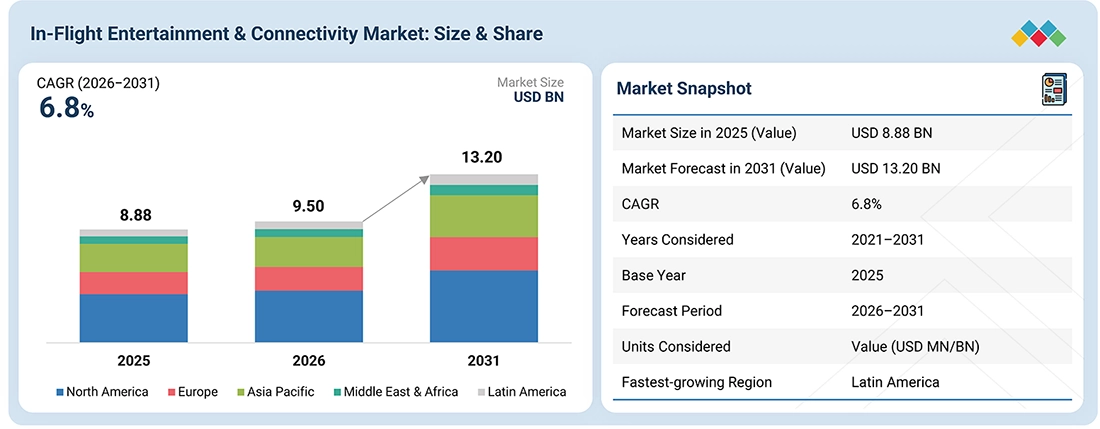
According to Marketsandmarkets, The global In-flight Entertainment and Connectivity (IFEC) Market size was valued at USD 9.50 billion in 2026 and is projected to reach USD 13.20 billion by 2031, growing at a CAGR of 6.8 % from 2026 to 2031. This growth is driven by increasing passenger need for digital entertainment and reliable onboard connectivity. Global passenger demand increased 5.3% in 2025, while 77% of passengers surveyed by Viasat considered in-flight Wi-Fi important. Airlines are therefore expanding high-speed connectivity and integrating Wi-Fi with streaming entertainment, personalized content, and other digital services. The deployment of satellite and hybrid connectivity solutions across aircraft fleets is further supporting demand for IFEC solutions.
REPORT SCOPE
| REPORT METRIC | DETAILS |
|---|---|
| Market Size in 2025 (Value) | USD 8.88 Billion |
| Market Size in 2026 (Value) | USD 9.50 Billion |
| Market Forecast in 2031 (Value) | USD 13.20 Billion |
| Growth Rate | CAGR of 6.8% from 2026 to 2031 |
| Years Considered | 2021–2031 |
| Base Year | 2025 |
| Forecast Period | 2026–2031 |
| Units Considered | USD Billion |
| Report Coverage | Revenue Forecast, Company Ranking, Competitive Landscape, Growth Factors, and Trends |
| Top Companies |
|
| Growth Drivers |
|
| Segments Covered |
|
| Regions Covered | North America, Europe, Asia Pacific, Middle East & Africa, Latin America |
KEY TAKEAWAYS
-
By RegionLatin America is projected to have the highest CAGR during the forecast period.
-
By OfferingBy offering, in-flight entertainment is set to experience a high growth rate of 7.1% during the forecast period.
-
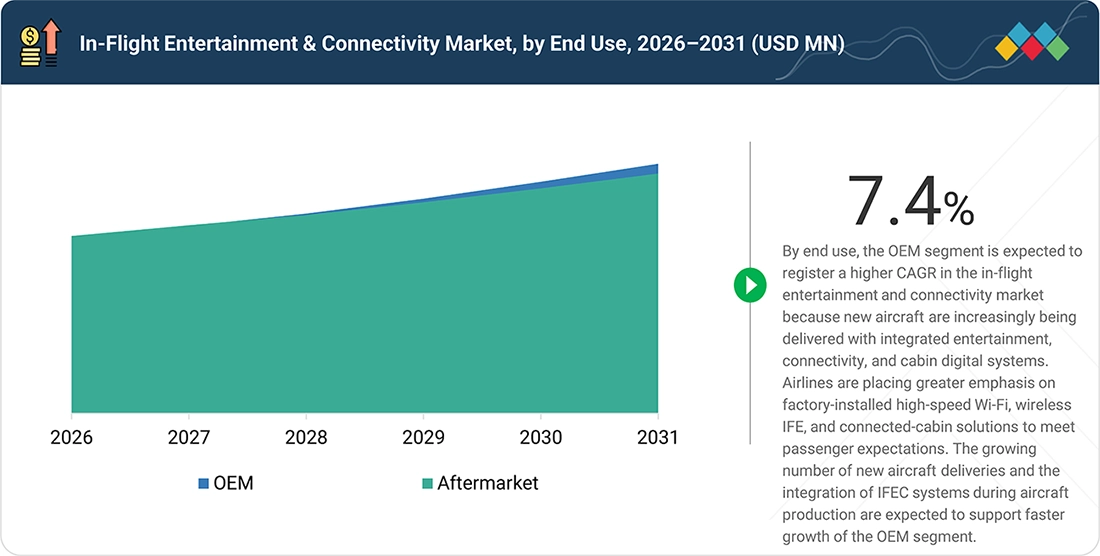
By End UseBy end use, the OEM segment is set to experience a high growth rate of 7.4% during the forecast period.
-
By PlatformBy platform, narrow-body aircraft hold a dominant market share during the forecast period.
-
By ClassBy class, the business class segment holds the largest market share.
-
Competitive Landscape - Key PlayersPanasonic Avionics Corporation(US), Thales (France), and Anuvu (US) were identified as some of the star players in the IFEC market, given their strong market share and product footprint.
-
Competitive Landscape - Startups/SMEsEutelsat Communication SA has identified itself among SMEs by securing strong footholds in specialized niche areas, underscoring its potential as an emerging market leader.
Growth in the In-flight Entertainment & Connectivity Industry is supported by airlines upgrading and improving internet connectivity, onboard entertainment systems, and offering more digital services. Demand is driven by the increasing use of personal devices, the need for reliable in-flight internet, and increasing passenger expectations for easy access to entertainment and online services. The adoption of satellite-based and hybrid connectivity solutions, along with onboard retail and advertising, is further helping the growth of the market.
Source: Secondary Research, Interviews with Experts, MarketsandMarkets Analysis
TRENDS & DISRUPTIONS IMPACTING CUSTOMERS' CUSTOMERS
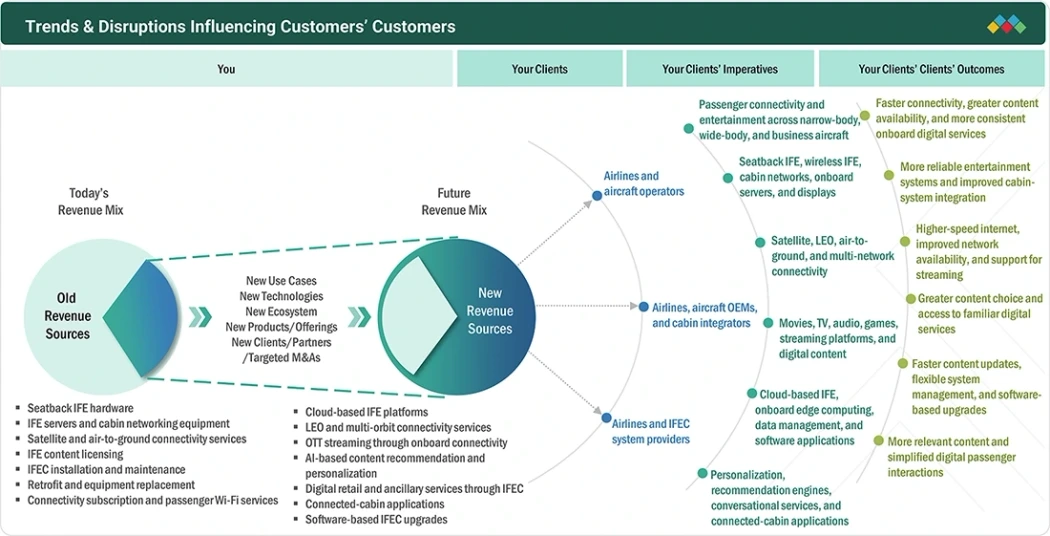
The In-flight entertainment and connectivity market is increasingly influenced by airlines and aircraft operators shifting from traditional, hardware-focused IFE systems toward connected and software-enabled passenger experiences. Historically, the market relied heavily on seatback IFE hardware, content licensing, installation, and maintenance, while newer revenue opportunities are emerging through cloud-based IFE platforms, high-speed connectivity, software upgrades, digital retail, and connected-cabin applications. Demand is being shaped by passengers' growing use of personal devices and expectations for reliable Wi-Fi, streaming, and personalized digital services. At the same time, airlines and aircraft OEMs are moving toward satellite-based, LEO, multi-orbit, and hybrid connectivity solutions to improve speed and coverage. Open digital platforms and AI-based personalization are also creating opportunities to deliver more relevant content, targeted retail and advertising, and connected-cabin services. These changes are shifting the market toward more flexible, connected, and software-driven systems, with airlines, aircraft OEMs, cabin integrators, and IFEC providers becoming increasingly important across the value chain.
Source: Secondary Research, Interviews with Experts, MarketsandMarkets Analysis
MARKET DYNAMICS

Level
-
Rising trend of bring your own device among passengers

-
Rising shift toward cloud services


Level
-
Stringent data privacy regulations

-
Bandwidth limitations


Level
-
Growing collaborations between airlines and content platforms

-
Rising interest in exclusive in-flight offers


Level
-
Complexity of securing content licensing rights for in-flight streaming

-
High cost of installation and integration

Source: Secondary Research, Interviews with Experts, MarketsandMarkets Analysis
Driver: Rising trend of bring your own device among the passengers
The IFEC market is benefiting from the growing use of passengers' personal devices during flights. Viasat reports that 97% of passengers use personal devices in the air, increasing demand for Wi-Fi, streaming, and device-based entertainment. This is encouraging airlines to support personal-device connectivity alongside traditional seatback systems.
Restraint: Stringent data privacy regulations
The IFEC market has data privacy requirements as connected services increasingly collect and process passenger information. Regulations such as the EU GDPR require organizations to follow rules on consent, storage, data minimization, transparency, and security. These requirements can add issues when airlines use data for advertising, personalization, and digital services.
Opportunity: Growing collaborations between airlines and content platforms
The IFEC market has opportunities through collaborations between airlines, IFEC providers, and content platforms. Recent collaborations are enabling airlines to provide streaming services, personalized entertainment, and content across seatback systems and passengers’ personal devices. Such deals can also support continuously updated content and new digital passenger services.
Challenge: Complexity of securing content licensing rights for in-flight streaming
The IFEC market faces issues in obtaining and managing content rights for streaming in aircraft and geographic markets. Airlines and content providers need rights-cleared programming that can be distributed through personal devices and onboard systems. The development of aviation-specific streaming platforms such as BBC Player with Panasonic Avionics highlights the need for dedicated rights-cleared content solutions.
IN-FLIGHT ENTERTAINMENT & CONNECTIVITY MARKET: COMMERCIAL USE CASES ACROSS INDUSTRIES
| COMPANY | USE CASE DESCRIPTION | BENEFITS |
|---|---|---|
 |
Panasonic Avionics provides in-flight entertainment and connectivity solutions that combine seatback entertainment, onboard Wi-Fi, satellite connectivity, and digital passenger services. Its systems support multi-orbit connectivity using 5G, LEO, and GEO networks and allow airlines to manage content, connectivity packages, and onboard services. | Improves passenger connectivity | Supports high-speed onboard internet | Enables flexible content and service management | Supports personalized digital passenger experiences |
 |
Thales provides in-flight entertainment and connectivity systems that combine IFE, high-speed connectivity, content management, and passenger applications. Its FlyEDGE platform uses cloud-hosted architecture and onboard edge computing to support entertainment applications, remote fleet management, and passenger engagement data. | Enables connected passenger experiences | Supports flexible entertainment applications | Improves remote content and system management | Provides passenger engagement information |
 |
Safran developed RAVE In-Flight Entertainment and Connectivity solutions that support seatback and wireless entertainment, personal-device casting, cloud-based content distribution, and onboard edge computing. RAVE Cloud Services enables airlines to distribute content to aircraft through satellite, cellular, Wi-Fi, and other available pathways. | Supports personal-device entertainment | Enables faster content distribution | Reduces dependence on additional onboard hardware | Supports flexible and scalable IFEC services |
Logos and trademarks shown above are the property of their respective owners. Their use here is for informational and illustrative purposes only.
MARKET ECOSYSTEM
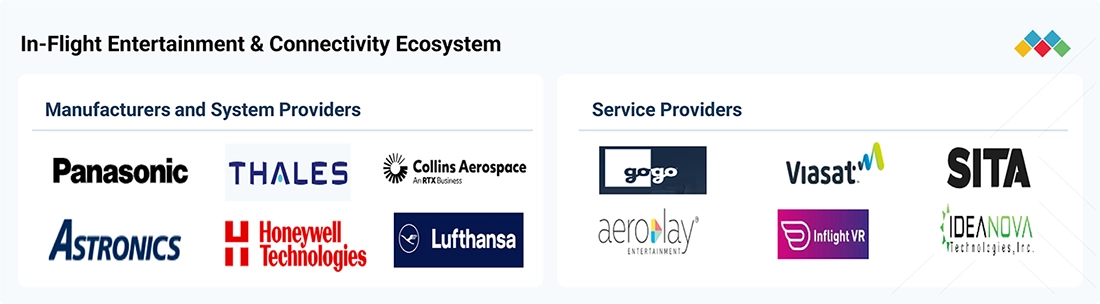
The in-flight entertainment and connectivity market ecosystem consists of manufacturers and system providers, service providers, airlines, aircraft operators, and technology and content partners that contribute to the development, integration, deployment, and delivery of onboard entertainment and connectivity solutions. Prominent manufacturers and system providers such as Panasonic Avionics Corporation, Thales, Collins Aerospace, Astronics Corporation, Honeywell International Inc., Lufthansa Technik, Bluebox Aviation Systems Ltd., AERQ, ECA Group, and Immfly provide in-flight entertainment systems, connectivity equipment, cabin networking, content platforms, and related software and hardware. Service providers such as Anuvu, Viasat Inc., Gogo Business Aviation LLC, SITA, Iridium Communications Inc., Eutelsat Communications SA, Inflight VR, IdeaNova Technologies, SmartSky Networks LLC, AeroPlay Entertainment, and Spafax contribute satellite and air-to-ground connectivity, content delivery, digital entertainment, passenger applications, and media services. Airlines and aircraft operators use these capabilities to provide onboard internet, streaming and stored entertainment, digital services, retail, advertising, and connected-cabin applications, while maintenance and integration providers support installation, retrofit, certification, and system upgrades. This ecosystem is supporting the continued transition of the IFEC market from traditional hardware-based IFE toward wireless, connected, cloud-enabled, and software-driven passenger services.
Logos and trademarks shown above are the property of their respective owners. Their use here is for informational and illustrative purposes only.
MARKET SEGMENTS
Source: Secondary Research, Interviews with Experts, MarketsandMarkets Analysis
In-Flight Entertainment and Connectivity Market, By Offering
The in-flight entertainment segment is expected to account for the largest share of the IFEC market, which is supported by continued airline investment in modern entertainment systems and digital passenger services. Rising passenger expectations for on-demand movies, TV, music, games, and access through personal devices are increasing demand for advanced IFE solutions. The shift toward wireless and personalized entertainment is further supporting the segment’s position.
In-Flight Entertainment and Connectivity Market, By End Use
The OEM segment is expected to account for the largest share of the IFEC market, supported by the increasing installation of IFEC systems during aircraft manufacturing. Airlines increasingly prefer aircraft delivered with integrated connectivity, entertainment, cabin networking, and digital passenger systems to reduce later modification requirements. The growing delivery of new aircraft equipped with factory-installed IFEC solutions is therefore supporting the strong position of the OEM segment.
In-Flight Entertainment and Connectivity Market, By Platform
The narrow-body aircraft segment is expected to register the highest CAGR in the IFEC market, supported by the growing use of narrow-body aircraft on short- and medium-haul routes. Airlines are increasingly equipping these aircraft with wireless IFE, high-speed Wi-Fi, and personal-device connectivity to improve the passenger experience. The large and expanding narrow-body fleet, combined with increasing deployment of connectivity systems on single-aisle aircraft, is expected to support strong segment growth.
In-Flight Entertainment and Connectivity Market, By Class
The business class segment is set to register the highest CAGR in the IFEC market supported by increasing airline investment in premium cabin experiences. Business class passengers have higher expectations for high-speed connectivity, premium entertainment, personal-device connectivity and personalized digital services. Airlines are therefore upgrading business class cabins with advanced IFE, reliable Wi-Fi, larger displays, and connected-cabin services. The growing focus on premium travel and cabin modernization is supporting the need for IFEC solutions in business class.
REGION
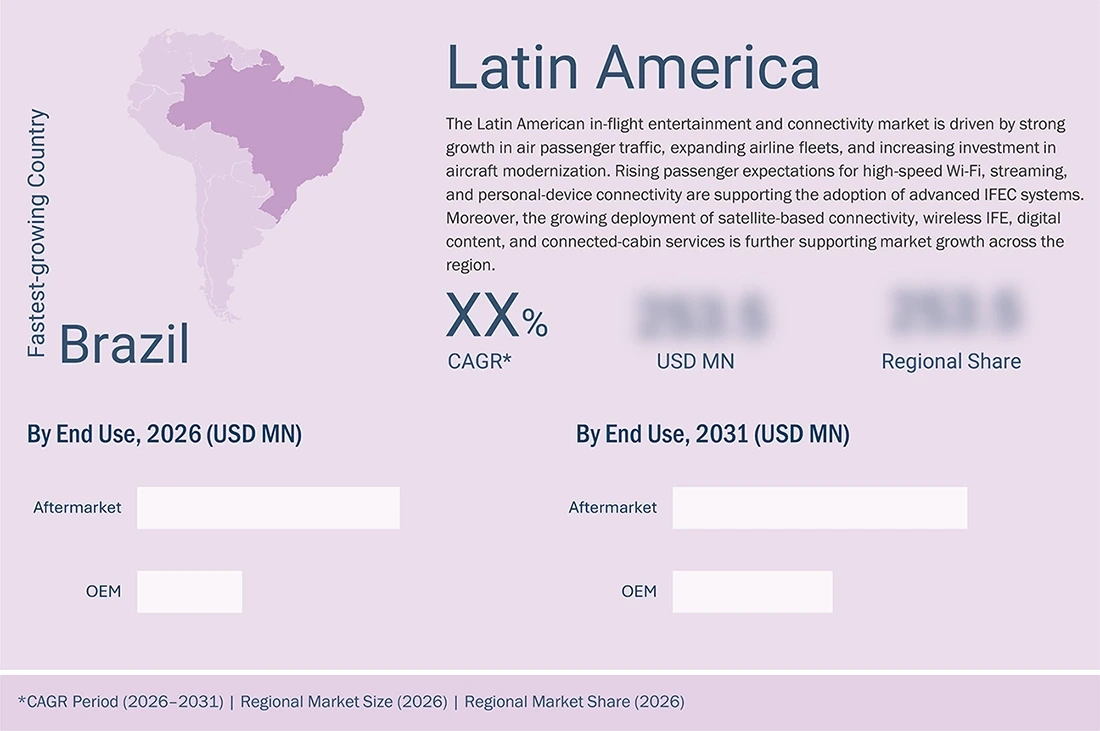
Latin America to be the fastest-growing region in the in-flight entertainment and connectivity market during the forecast period
Latin America is expected to register the highest CAGR in the IFEC market, supported by strong growth in passenger traffic and airline capacity across the region. Increasing international and domestic air travel is encouraging airlines to invest in onboard connectivity, wireless entertainment, and digital passenger services. Rising passenger expectations for reliable Wi-Fi, streaming, and personal-device connectivity, along with the modernization of existing aircraft, are further supporting the adoption of IFEC solutions across Latin America.
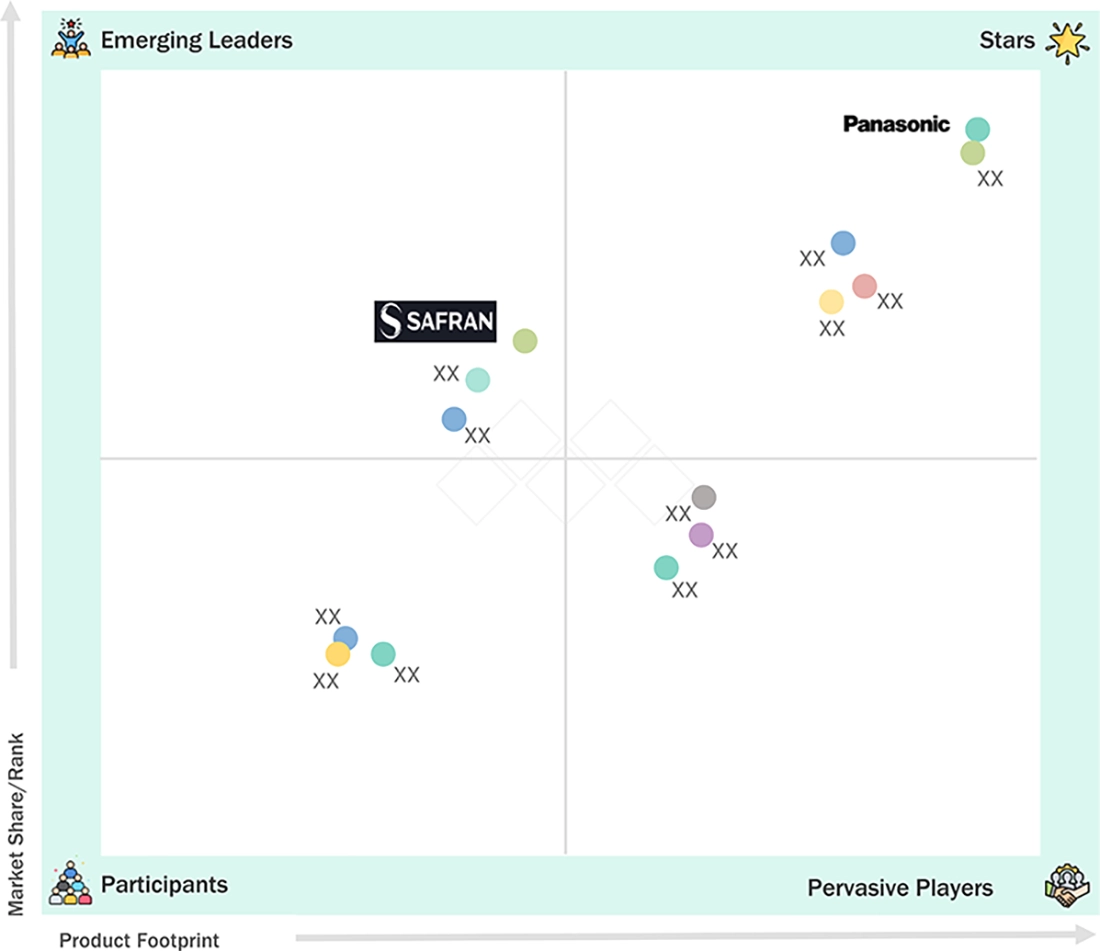
IN-FLIGHT ENTERTAINMENT & CONNECTIVITY MARKET: COMPANY EVALUATION MATRIX
In the in-flight entertainment & connectivity market matrix, Panasonic Avionics Corporation is categorized as a “Star” because of its IFEC portfolio covering in-flight entertainment systems, multi-orbit connectivity, digital solutions, and technical services. Its connectivity portfolio combines LEO, GEO, and 5G networks, while its digital solutions support cloud-based content management, personal-device integration, and software updates, giving Panasonic a strong position across both entertainment and connectivity requirements. Safran is classified as an “Emerging Leader” because of its growing focus on software-based, cloud-enabled, and connected IFE capabilities through its RAVE platform. RAVE Cloud Services supports remote content distribution and edge computing, while newer developments include personal-device casting, edge caching, and integration of new digital services, strengthening Safran’s position in the evolving IFEC market.
Source: Secondary Research, Interviews with Experts, MarketsandMarkets Analysis
KEY MARKET PLAYERS
List of Top In-flight Entertainment & Connectivity (IFEC) Companies
- Panasonic Corporation of North America (US)
- Thales (France)
- Anuvu (US)
- RTX (US)
- Astronics Corporation (US)
- Viasat, Inc. (US)
- Gogo Inc. (US)
- Safran (France)
- Honeywell International Inc. (US)
- SITA (Switzerland)
- ECA Group (France)
- Iridium Communications Inc. (US)
- Lufthansa Systems (Germany)
- AERQ (Germany)
- Bluebox Aviation Systems Ltd. (UK)
WHAT IS IN IT FOR YOU: IN-FLIGHT ENTERTAINMENT & CONNECTIVITY MARKET REPORT CONTENT GUIDE
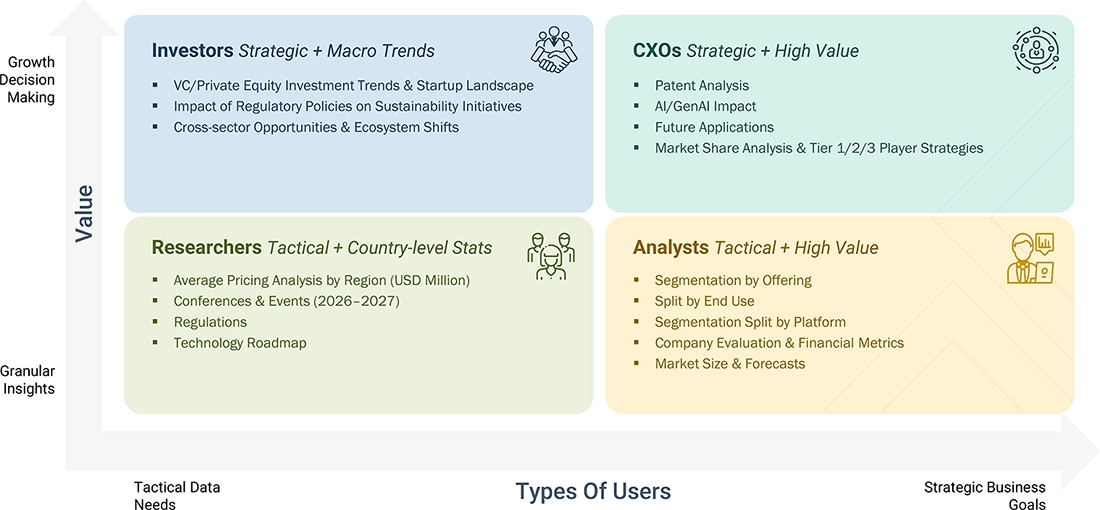
DELIVERED CUSTOMIZATIONS
We have successfully delivered the following deep-dive customizations:
| CLIENT REQUEST | CUSTOMIZATION DELIVERED | VALUE ADDS |
|---|---|---|
| Leading Manufacturer | Additional segment breakdown for countries | Additional country-level market sizing tables for segments/subsegments covered at the regional/global level to gain an understanding of market potential by each country |
| Emerging Leader | Additional company profiles | Competitive information on targeted players to gain granular insights into direct competition |
| Regional Market Leader | Additional country market estimates | Additional country-level deep dive for a more targeted understanding of the total addressable market |
RECENT DEVELOPMENTS
- July 2026 : Gogo announced that Gulfstream Aerospace received FAA Supplemental Type Certificate approval to install Gogo Galileo HDX on Gulfstream G650 and G650ER aircraft. The system uses Eutelsat OneWeb’s LEO network to provide high-speed, low-latency connectivity for streaming, video conferencing, communications, and internet browsing.
- June 2026 : Panasonic Avionics Corporation announced that its Astrova in-flight engagement solution and Modular Interactive platform entered commercial service with Azerbaijan Airlines across its Airbus A320neo family fleet. The deployment covers 22 aircraft through a combination of line-fit and retrofit installations.
- April 2026 : Viasat announced that Jetstar selected its AMARA multi-orbit in-flight connectivity solution for 11 Boeing 787 aircraft. The system is intended to provide reliable onboard internet supporting streaming, messaging, and browsing as part of Jetstar’s cabin modernization program.
Table of Contents
 Exclusive indicates content/data unique to MarketsandMarkets and not available with any competitors.
Methodology
The study involved four major activities to estimate the current size of the in-flight entertainment and connectivity market. Exhaustive secondary research was conducted to gather information on the in-flight entertainment and connectivity market, its adjacent markets, and its parent market. The next step was to validate these findings, assumptions, and sizing with industry experts across the value chain through primary research. Demand-side analysis was conducted to estimate the overall market size. Thereafter, data triangulation procedures were employed to estimate the sizes of various segments and subsegments within the in-flight entertainment and connectivity market.
Secondary Research
During the secondary research process, various sources were consulted to identify and collect information for this study. The secondary sources included government sources, such as SIPRI; corporate filings, including annual reports, press releases, and investor presentations; white papers, journals, and certified publications; and articles from recognized authors, directories, and databases.
Primary Research
Extensive primary research was conducted after acquiring information on the in-flight entertainment and connectivity market through secondary research. Several primary interviews were conducted with market experts from the demand and supply sides across major countries of North America, Europe, Asia Pacific, the Middle East & Africa, and Latin America. Primary data was collected through questionnaires, emails, and telephonic interviews.
Breakdown of Primary Interviews
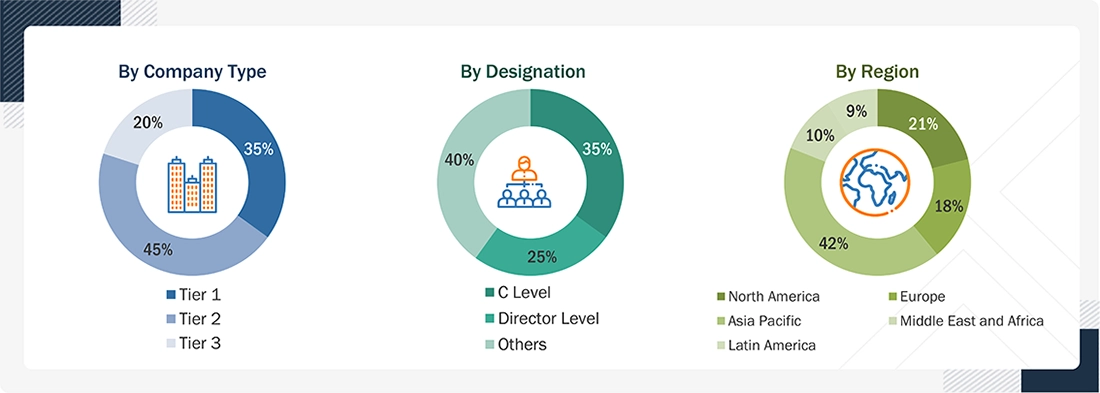
Note: The three tiers of companies are defined based on their total revenue in 2025: Tier 1 - revenue greater than or equal to USD 1 billion; Tier 2 - revenue between USD 100 million and USD 1 billion; and Tier 3 - revenue less than or equal to USD 100 million. Other designations include sales managers, marketing managers, and product managers.
To know about the assumptions considered for the study, download the pdf brochure
Market Size Estimation
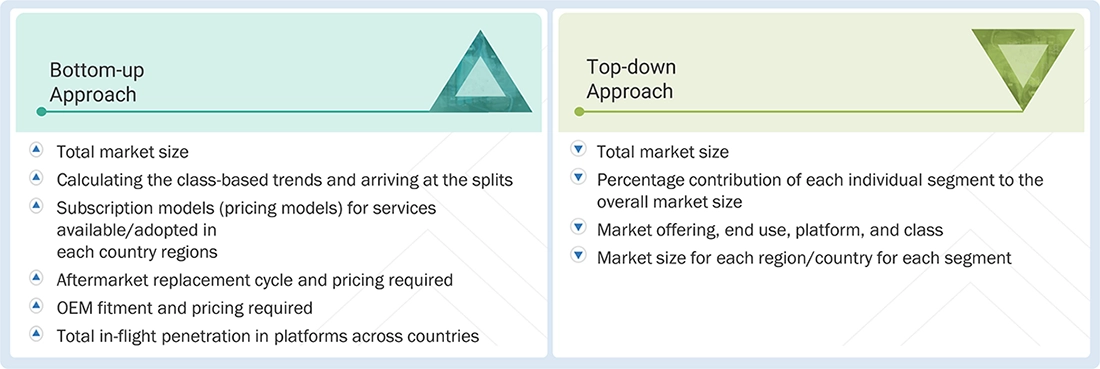
Top-down and bottom-up approaches were used to estimate and validate the size of the in-flight entertainment and connectivity market. The research methodology used to estimate the size of the market included the following details:
- Key players in the in-flight entertainment and connectivity market were identified through secondary research, and their market shares were determined through a combination of primary and secondary research. This included a study of the annual and financial reports of the top market players, as well as extensive interviews with leaders, including directors, engineers, marketing executives, and other key stakeholders of leading companies operating in the market.
- All percentage shares, splits, and breakdowns were determined using secondary sources and verified through primary sources.
- All possible parameters that affect the markets covered in this research study were accounted for, viewed in extensive detail, verified through primary research, and analyzed to obtain the final quantitative and qualitative data on the in-flight entertainment and connectivity market. This data was consolidated, enhanced with detailed input, analyzed by MarketsandMarkets, and presented in this report.
In-flight Entertainment & Connectivity Market : Top-Down and Bottom-Up Approach
Data Triangulation
After determining the overall market size, the total market was classified into several segments and subsegments. The data triangulation and market breakdown procedures explained below were implemented, wherever applicable, to complete the overall market engineering process and arrive at the estimated market numbers for the market segments and subsegments. The data were triangulated by examining various factors and trends on both the demand and supply sides. Additionally, the market size was validated using top-down and bottom-up approaches.
Market Definition
The in-flight entertainment and connectivity (IFEC) market encompasses a range of products and services designed to enhance passenger experiences on commercial flights, including audio and video on demand, live TV, games, moving maps, digital reading materials, and various connectivity options like Wi-Fi and mobile phone services. It involves hardware such as seat-back screens and connectivity equipment, as well as software for content management and user interfaces. Service providers include content suppliers, connectivity providers, and system integrators. Driven by technological advancements and passenger demand for enhanced experiences, the market is seeing trends like personalized content, hybrid systems combining seat-back screens with personal device streaming, and improved connectivity through advancements in satellite and 5G technology.
Key Stakeholders
- Aerostructure Manufacturers
- In-flight Entertainment and Connectivity Solution Developers
- In-flight Entertainment and Connectivity Service Providers
- Subcomponent Suppliers
- Technology Providers
- Airlines
- Government Agencies
- Investors and Financial Community Professionals
- Research Organizations
Report Objectives
- To define, describe, and forecast the in-flight entertainment and connectivity market based on offering, end use, platform, class, and region in terms of value
- To forecast the size of various segments of the market across North America, Europe, Asia Pacific, the Middle East & Africa, and Latin America in terms of value
- To identify and analyze the drivers, restraints, opportunities, and challenges influencing the growth of the market
- To identify industry trends, market trends, and technology trends currently prevailing in the market
- To analyze micromarkets with respect to growth trends, prospects, and their contribution to the overall market
- To analyze opportunities in the market for stakeholders by identifying key market trends
- To profile key market players and comprehensively analyze their market share and core competencies
- To evaluate the degree of competition in the market by analyzing recent developments, such as contracts, agreements, and acquisitions, adopted by leading market players
- To identify detailed financial positions, key products, and unique selling points of leading companies in the market
- To provide a detailed competitive landscape of the market, along with market share analysis and revenue analysis of key players
Available customizations:
MarketsandMarkets offers the following customizations for this market report:
- Additional country-level analysis of the in-flight entertainment and connectivity market
- Profiling of other market players (up to five)
Product Analysis
- Product matrix, which provides a detailed comparison of the product portfolios of each company in the in-flight entertainment and connectivity market
Key Questions Addressed by the Report
What is the projected size of the global In Flight Entertainment and Connectivity Market by 2031?
The global In Flight Entertainment and Connectivity Market was valued at USD 9.50 billion in 2026 and is projected to reach USD 13.20 billion by 2031, growing at a CAGR of 6.8% from 2026 to 2031. Growth is driven by increasing passenger demand for digital entertainment, reliable onboard connectivity, and the deployment of satellite and hybrid connectivity solutions.
What are the major factors driving the In Flight Entertainment and Connectivity Market?
The rising use of personal devices among passengers and the shift toward cloud services are major market drivers. Increasing demand for Wi Fi, streaming, device based entertainment, and digital passenger services is encouraging airlines to expand connected onboard experiences.
Which region is expected to grow the fastest in the IFEC Market?
Latin America is expected to register the highest CAGR during the forecast period. Growth is supported by increasing passenger traffic, airline capacity, international and domestic air travel, aircraft modernization, and rising demand for reliable Wi Fi and streaming services.
Which offering segment is expected to experience the highest growth?
The in flight entertainment segment is set to experience a high growth rate of 7.1% during the forecast period. Demand is supported by airline investment in modern entertainment systems, on demand content, personal device access, and personalized digital passenger services.
Which end use segment is expected to experience the highest growth?
The OEM segment is set to experience a high growth rate of 7.4% during the forecast period. Its growth is supported by the increasing installation of IFEC systems during aircraft manufacturing and airline preference for factory installed connectivity, entertainment, cabin networking, and digital passenger systems.
Which aircraft platform segment dominates the IFEC Market?
Narrow body aircraft hold a dominant market position and are expected to register the highest CAGR. Their large and expanding fleet, use on short and medium haul routes, and increasing adoption of wireless IFE, high speed Wi Fi, and personal device connectivity are supporting growth.
Which passenger class segment is expected to grow the fastest?
The business class segment is set to register the highest CAGR in the IFEC market. Airlines are investing in premium cabin experiences with high speed connectivity, advanced entertainment, larger displays, personal device connectivity, and personalized digital services.
What are the major technology trends shaping the IFEC Market?
The market is shifting from traditional hardware focused IFE toward connected and software enabled passenger experiences. Key trends include satellite based, LEO, multi orbit, and hybrid connectivity, cloud based IFE platforms, AI based personalization, digital retail, connected cabin applications, and personal device integration.
What are the major opportunities in the In Flight Entertainment and Connectivity Market?
Growing collaborations between airlines, IFEC providers, and content platforms represent a major opportunity. Such partnerships can support streaming services, personalized entertainment, continuously updated content, and new digital passenger services across seatback systems and personal devices.
Which companies are the key players in the IFEC Market?
Key players include Panasonic Corporation of North America, Thales, Anuvu, RTX, and Astronics Corporation. Panasonic Avionics Corporation and Thales are among the major market players, while Panasonic is categorized as a Star and Safran as an Emerging Leader in the company evaluation matrix.


Personalize This Research
- Triangulate with your Own Data
- Get Data as per your Format and Definition
- Gain a Deeper Dive on a Specific Application, Geography, Customer or Competitor
- Any level of Personalization
Let Us Help You
- What are the Known and Unknown Adjacencies Impacting the In-flight Entertainment & Connectivity Market
- What will your New Revenue Sources be?
- Who will be your Top Customer; what will make them switch?
- Defend your Market Share or Win Competitors
- Get a Scorecard for Target Partners

Custom Market Research Services
We Will Customise The Research For You, In Case The Report Listed Above Does Not Meet With Your Requirements
Get 10% Free CustomisationTESTIMONIALS
- Australia In-flight Entertainment & Connectivity Market
- UAE In-flight Entertainment & Connectivity Market
- Saudi Arabia In-flight Entertainment & Connectivity Market
- Qatar In-flight Entertainment & Connectivity Market
- Turkey In-flight Entertainment & Connectivity Market
- Brazil In-flight Entertainment & Connectivity Market
- Mexico In-flight Entertainment & Connectivity Market
- South Africa In-flight Entertainment & Connectivity Market
- Rest Of Europe In-flight Entertainment & Connectivity Market
- Rest Of Asia Pacific In-flight Entertainment & Connectivity Market
- Canada In-flight Entertainment & Connectivity Market
- US In-flight Entertainment & Connectivity Market
- UK In-flight Entertainment & Connectivity Market
- Germany In-flight Entertainment & Connectivity Market
- France In-flight Entertainment & Connectivity Market
- Spain In-flight Entertainment & Connectivity Market
- Italy In-flight Entertainment & Connectivity Market
- China In-flight Entertainment & Connectivity Market
- India In-flight Entertainment & Connectivity Market
- Japan In-flight Entertainment & Connectivity Market
- South Korea In-flight Entertainment & Connectivity Market
Growth opportunities and latent adjacency in In-flight Entertainment & Connectivity Market






Abhilash
Jan, 2026
I am a IFE distributer from India want more companies for business collaboration .
Anirudh
Mar, 2019
Trying to assess the value chain revenue share and profitability for the in-flight connectivity market..
spencer
Jan, 2019
I am curious to learn more about in-flight entertainment in the airline industry. How can I gain access to this report?.