IT Service Management (ITSM) Market

IT Service Management Market by Solution (Service Desk, Configuration & Change, Service Portfolio, Analytics), Application (Incident/Problem, Change/Release, Service Request/Catalog, Knowledge/Self-Service), Vertical, And Region – Global Forecast to 2031




OVERVIEW
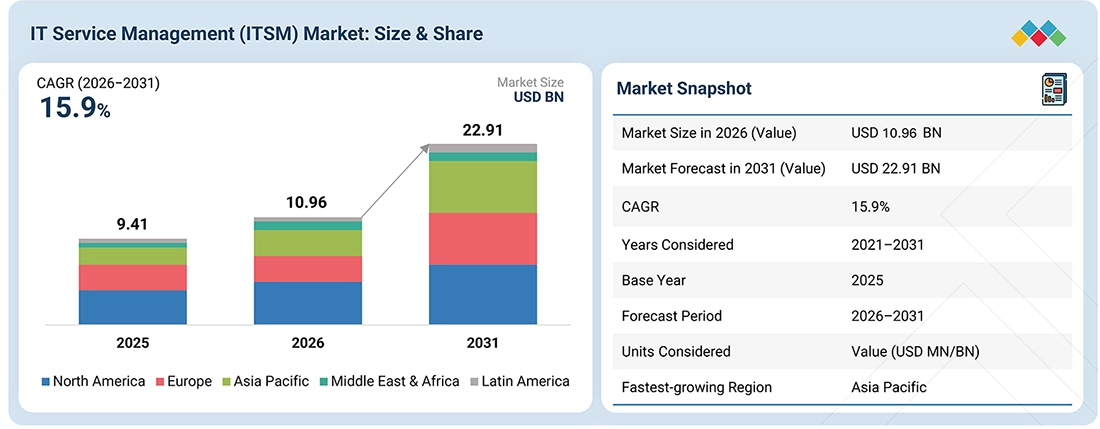
Source: Secondary Research, Interviews with Experts, MarketsandMarkets Analysis
The IT Service Management (ITSM) market is projected to expand from USD 10.96 billion in 2026 to USD 22.91 billion by 2031, at a CAGR of 15.9%. Enterprise demand is being driven by the growing complexity of hybrid IT environments, rising expectations for digital employee experiences, and the need to automate incident, request, change, and service-delivery workflows. Cloud-based ITSM platforms, AI-enabled service desks, self-service, predictive incident management, workflow automation, and integrated service operations are expanding ITSM from traditional ticket management into a strategic platform for improving service availability, workforce productivity, governance, and enterprise resilience.
Market Size and Forecast:
- Market Size in 2025: USD 9.41 Billion
- 2026 Market Size: USD 10.96 Billion
- 2031 Forecasted Market Size: USD 22.91 Billion
- Growth Rate (2026-2031): CAGR of 15.9%
- Forecast period: 2026–2031
Key Market Trends and Insights
- Future Outlook: Multi-cloud complexity, DEX demands, and faster incident resolution drive ITSM adoption across enterprises.
-
Key Trends: Generative AI, agentic automation, cloud delivery, and IT operations integration reshape service management.
- Key Technologies: Conversational AI, virtual agents, workflow automation, and AIOps transform modern ITSM platforms.
- Growth Opportunities: Autonomous ticketing, service automation, and ESM extend ITSM workflows across HR, finance, and facilities.
KEY TAKEAWAYS
-
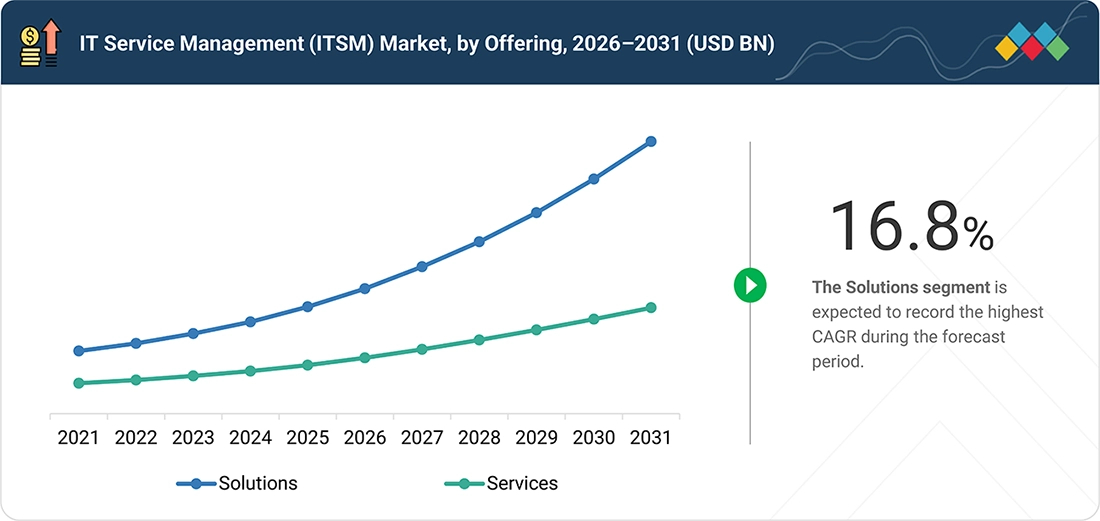
BY OFFERINGSolutions are projected to register the highest CAGR of 16.8% during 2026–2031, driven by continued investment in cloud-based ITSM platforms, workflow automation, AI-enabled service desks, configuration and change management, and integrated service analytics.
-
BY SOLUTIONDashboard, Reporting, and Analytics is projected to register the highest CAGR of 18.8% during 2026–2031, supported by growing demand for real-time service visibility, SLA monitoring, predictive insights, AI-assisted decision-making, and service-performance optimization.
-
BY APPLICATIONKnowledge & Self-Service Management is projected to register the highest CAGR of 21.3% during 2026–2031, driven by conversational AI, virtual agents, intelligent knowledge discovery, automated resolution, and increasing enterprise focus on reducing repetitive Level-1 support workloads.
-
BY SERVICEManaged Services are projected to be the fastest-growing segment, driven by increasing reliance on external specialists for ITSM platform administration, service desk operations, workflow optimization, integrations, upgrades, governance, and continuous service improvement.
-
BY DEPLOYMENT MODECloud is projected to be the fastest-growing segment, supported by faster implementation, subscription-based consumption, continuous feature upgrades, scalability, easier integration, and lower infrastructure-management requirements.
-
BY ORGANIZATION SIZEBy organization size, preconfigured workflows, and increasing access to AI, automation, and self-service capabilities previously concentrated among large enterprises.
-
BY VERTICALHealthcare is projected to be the fastest-growing segment, supported by increasing digitalization of clinical and administrative operations, expanding cloud adoption, growing reliance on connected applications and devices, stringent service-availability requirements, and the need for structured incident, request, change, and asset-related service workflows.
-
COMPETITIVE LANDSCAPE – KEY PLAYERSLeading vendors include ServiceNow, BMC Software, Broadcom, ManageEngine, Ivanti, Atlassian, Zendesk, OpenText, Freshworks, SolarWinds, Microsoft, and IBM, with competition increasingly centered on agentic AI, workflow automation, service operations integration, platform extensibility, enterprise scalability, and total cost of ownership.
-
COMPETITIVE LANDSCAPE – CHALLENGERS/INNOVATORSVendors such as HaloITSM, Aisera, SysAid Technologies, InvGate, Efecte, EasyVista, Xurrent, TeamDynamix, TOPdesk, and Hornbill are strengthening their positions through easier deployment, AI-enabled service experiences, midmarket specialization, flexible pricing, automation, and focused service-management capabilities.
The IT Service Management market is growing rapidly as enterprises accelerate cloud-native adoption, distributed application development, and AI-driven IT operations. Organizations are increasingly investing in unified observability platforms that correlate logs, metrics, traces, profiles, and events to improve operational resilience, reduce downtime, and enhance digital experiences. The growing adoption of OpenTelemetry, AIOps, and automation is transforming observability from a monitoring solution into a strategic platform for proactive performance optimization, faster incident resolution, and intelligent decision-making across hybrid and multi-cloud environments.
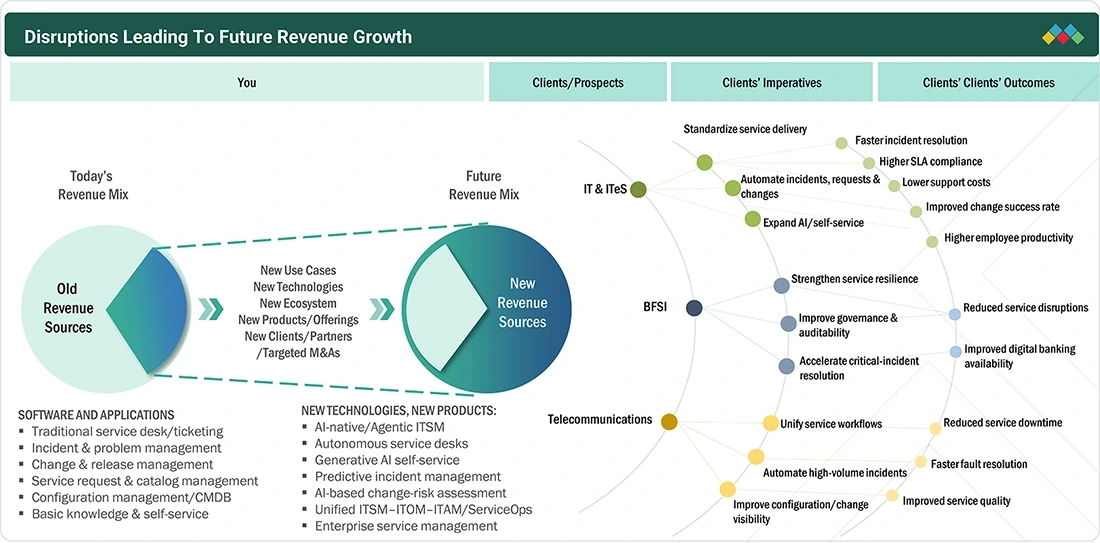
TRENDS & DISRUPTIONS IMPACTING CUSTOMERS' CUSTOMERS
Generative AI, agentic automation, cloud delivery, enterprise self-service, and closer integration between service management and IT operations are reshaping the ITSM industry. AI is increasingly embedded into ticket classification, summarization, knowledge generation, change-risk assessment, virtual agents, incident diagnosis, and automated remediation. At the same time, organizations are consolidating disconnected service desks and extending service-management workflows beyond IT into HR, finance, facilities, and other business functions. Growing infrastructure complexity, distributed workforces, expanding digital services, and pressure to reduce resolution times are further accelerating demand for unified ITSM platforms that combine service context, automation, analytics, governance, and enterprise knowledge.
Source: Secondary Research, Interviews with Experts, MarketsandMarkets Analysis
MARKET DYNAMICS

Level
-
Increasing complexity of hybrid and multi-cloud IT environments is driving demand for centralized, automated IT service management.

-
Growing focus on employee experience, service availability, SLA performance, and faster incident resolution is increasing ITSM investment.


Level
-
High implementation, integration, customization, and migration costs can constrain adoption, particularly for complex enterprises.

-
Shortages of experienced ITSM architects, platform administrators, process owners, and implementation specialists can delay transformation programs.


Level
-
Expansion of generative and agentic AI creates opportunities for autonomous ticket resolution, knowledge creation, change assessment, and service-desk automation.

-
Increasing adoption of enterprise service management enables ITSM platforms to expand into HR, finance, facilities, legal, and other shared-service functions.


Level
-
Integrating ITSM platforms with fragmented legacy applications, monitoring tools, asset repositories, cloud systems, and development environments remains complex.

-
Poor CMDB quality, inconsistent process maturity, organizational silos, and excessive customization can reduce automation effectiveness and platform value.

Source: Secondary Research, Interviews with Experts, MarketsandMarkets Analysis
Driver: Increasing complexity of hybrid IT environments
Enterprises operate increasingly distributed technology estates spanning public cloud, private cloud, SaaS applications, on-premises infrastructure, endpoints, networks, and business applications. ITSM platforms provide standardized processes for incidents, problems, requests, changes, configurations, and service levels, helping organizations coordinate service delivery, reduce downtime, strengthen governance, and improve operational resilience.
Restraint: Implementation and migration complexity
Large ITSM transformations often involve process redesign, data migration, workflow configuration, system integrations, CMDB remediation, user training, and retiring legacy service-desk environments. These requirements can increase implementation costs and time-to-value and create switching barriers for enterprises with heavily customized incumbent platforms.
Opportunity: Expansion of AI-driven service management
Generative AI and autonomous agents can classify and route tickets, generate summaries, retrieve knowledge, recommend resolutions, assess change risk, identify recurring issues, and automate repetitive service-desk activities. This creates opportunities for vendors to improve first-contact resolution, increase self-service, lower service costs, and shift human agents toward more complex work.
Challenge: Fragmented data, tools, and service processes
Many enterprises still operate separate service desks, monitoring platforms, asset repositories, collaboration tools, development systems, and departmental workflows. Inconsistent data and process definitions can limit end-to-end visibility, reduce automation accuracy, complicate AI deployment, and make it difficult to establish a trusted service and configuration context.
IT SERVICE MANAGEMENT (ITSM) MARKET: COMMERCIAL USE CASES ACROSS INDUSTRIES
| COMPANY | USE CASE DESCRIPTION | BENEFITS |
|---|---|---|
 |
Mindsprint deployed ServiceNow ITSM Pro and related workflow automation to create a unified service-management environment, automate ticket routing, improve incident handling, and expand employee self-service. | Up to 95% of incidents automatically remediated | 57% reduction in time to close P0/P1 incidents | 30% reduction in MTTR | 99% ticket-routing accuracy | 40% incident deflection through self-service |
 |
The University of Aberdeen modernized legacy ITSM using Freshservice and Freddy AI to automate routine service-desk activities, improve ticket management, expand self-service, and increase support capacity. | 81% reduction in ticket-resolution time | 10,200 tickets deflected | 208% increase in ticket capacity | Automation generated an estimated 405 working days of annual staff-time savings |
 |
EnerSys implemented ServiceDesk Plus to improve request categorization, automated ticket dispatch, technician assignment, workflow management, and SLA control across its service environment. | Average ticket-resolution time reduced from 48 hours to 5–6 hours | 98.9% SLA compliance | Improved request routing and service visibility |
Logos and trademarks shown above are the property of their respective owners. Their use here is for informational and illustrative purposes only.
MARKET ECOSYSTEM
The ITSM ecosystem comprises ITSM platform providers, implementation & consulting partners, managed service providers, and technology & integration ecosystem providers that collectively enable platform deployment, workflow automation, service integration, ongoing operations, governance, and enterprise-wide service management.
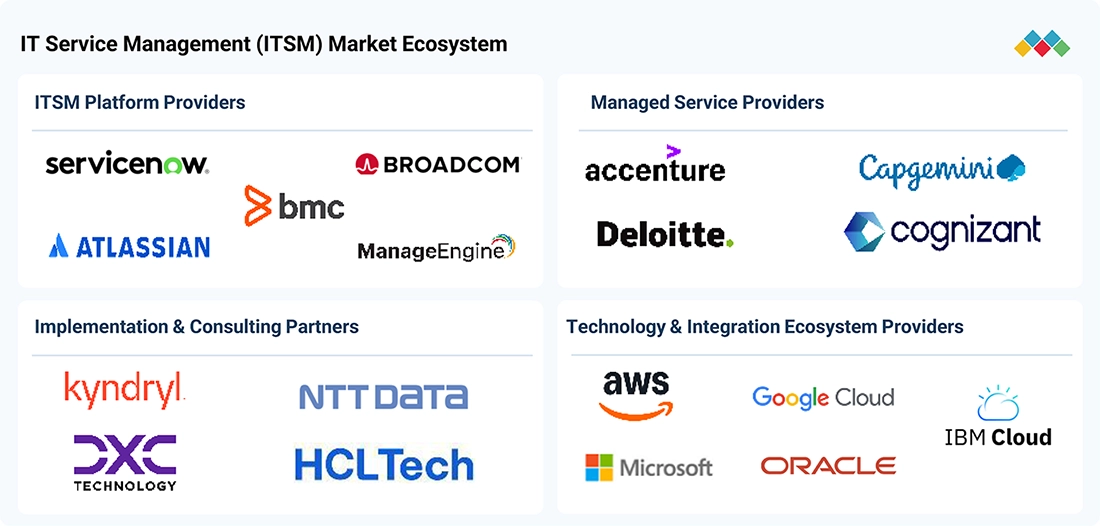
Logos and trademarks shown above are the property of their respective owners. Their use here is for informational and illustrative purposes only.
MARKET SEGMENTS
Source: Secondary Research, Interviews with Experts, MarketsandMarkets Analysis
By Offering
Solutions account for the largest share of the ITSM market because enterprises primarily invest in platforms that directly manage incidents, requests, changes, configurations, service catalogs, workflows, analytics, and service performance. Recurring subscription revenue, expanding cloud deployments, increasing automation, and the broader use of ITSM platforms as enterprise workflow systems reinforce their dominance.
By Solution
Service Desk Software represents the largest solution segment because the service desk remains the primary system of engagement between users and IT. High recurring volumes of incidents and service requests, broad enterprise deployment, omnichannel support requirements, SLA management, workflow automation, and increasing AI-based self-service sustain its leading market position.
By Service
Managed Services represent the largest services segment as enterprises increasingly rely on external specialists for platform administration, workflow optimization, upgrades, integrations, service-desk operations, governance, and continuous improvement. Recurring operating requirements and shortages of specialized ITSM skills further support sustained managed-service spending.
By Application
Incident & Problem Management accounts for the largest application share because restoring disrupted services and preventing recurring failures remain core operational responsibilities of enterprise IT organizations. High incident volumes, availability requirements, SLA commitments, business-continuity concerns, and the financial impact of downtime maintain strong spending on incident and problem workflows.
By Deployment Mode
Cloud accounts for the largest share as organizations increasingly prefer subscription-based ITSM platforms with faster deployment, continuous upgrades, elastic scalability, remote accessibility, reduced infrastructure ownership, and easier integration with modern SaaS and cloud environments.
By Organization Size
Large Enterprises represent the largest market share because their extensive application estates, distributed workforces, high service volumes, complex organizational structures, regulatory requirements, multiple service teams, and formal SLA and governance requirements create substantially greater ITSM spending per organization.
By Vertical
IT & ITeS represents the largest vertical because technology and service providers depend heavily on service availability, structured incident and change processes, high-volume support operations, SLA adherence, rapid software releases, distributed delivery teams, and standardized workflows to manage customer-facing and internal digital services.
REGION
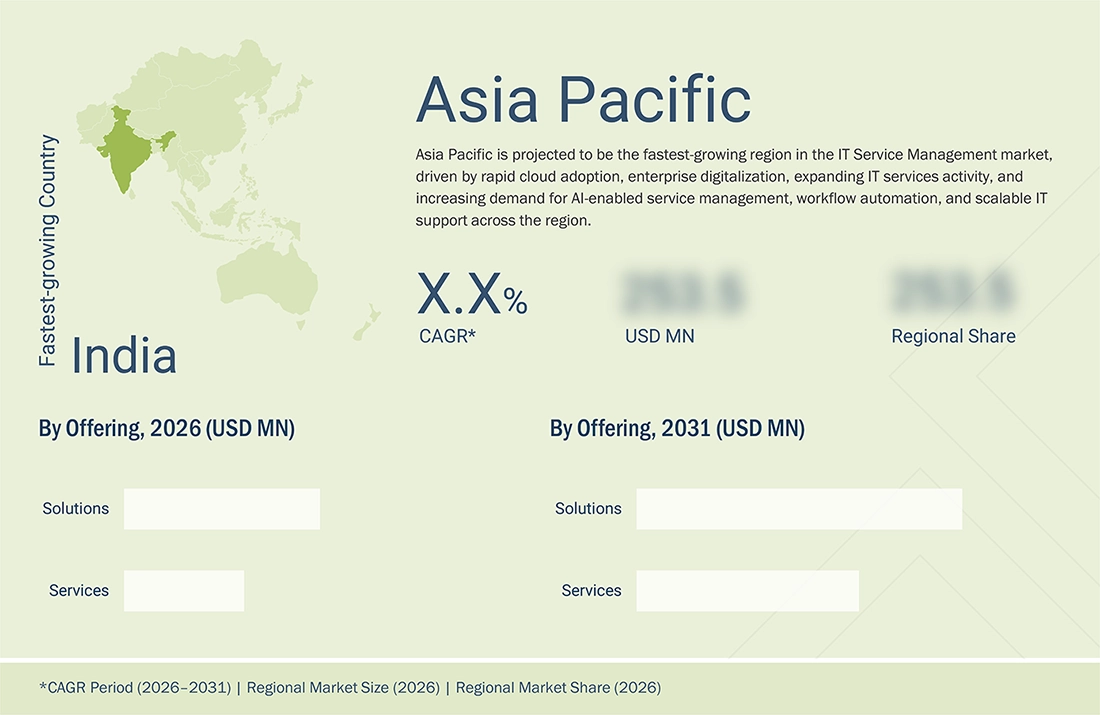
Asia Pacific to be the fastest-growing region in the IT Service Management market during the forecast period
The IT Service Management market in Asia Pacific is expected to expand at the fastest rate, driven by rapid cloud adoption, enterprise digitalization, expanding technology workforces, and modernized IT operations across China, India, Japan, Australia, South Korea, and Southeast Asia. Organizations are increasingly replacing fragmented or legacy service desks with scalable cloud-based ITSM platforms while adopting AI-driven self-service, workflow automation, service catalogs, and integrated service operations. Growth in digital banking, telecommunications, e-commerce, manufacturing, government digital services, and IT-enabled services is further increasing demand for standardized and automated service-management capabilities across the region.
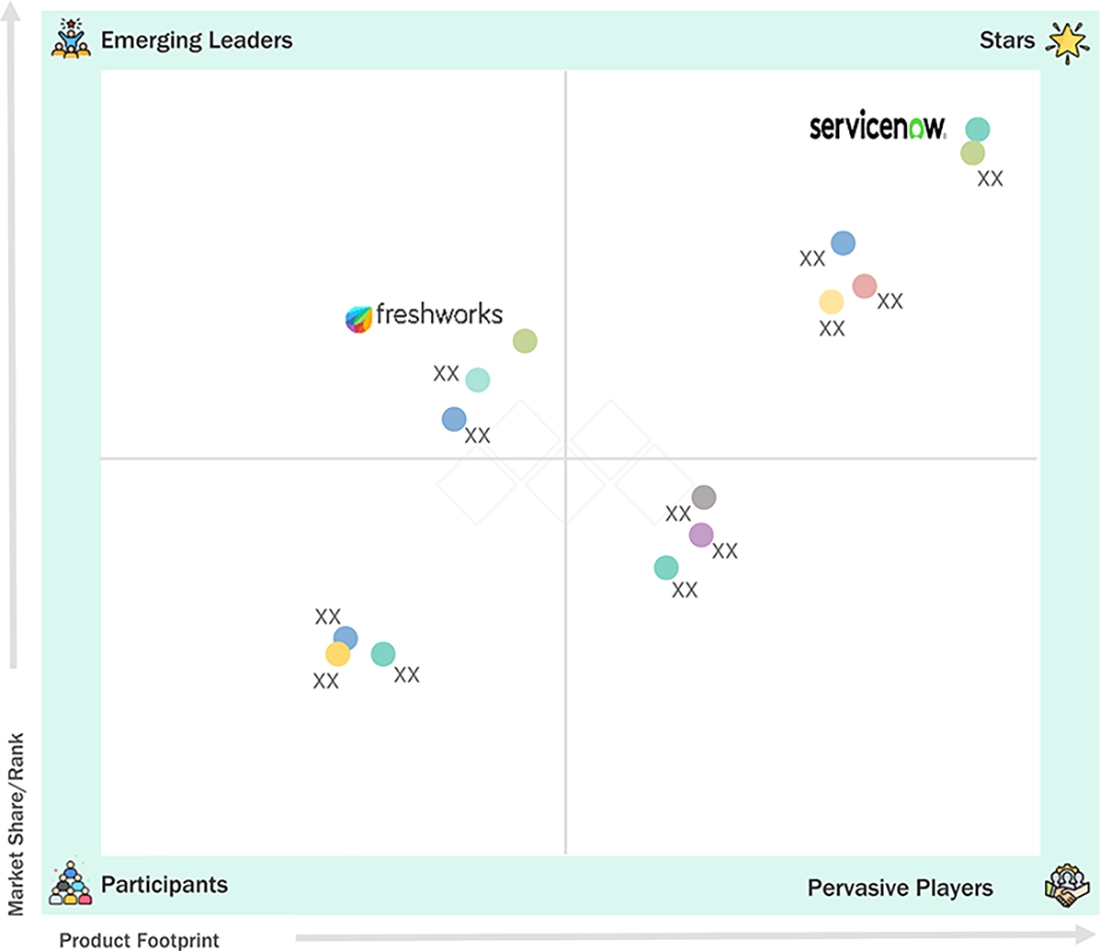
IT SERVICE MANAGEMENT (ITSM) MARKET: COMPANY EVALUATION MATRIX
ServiceNow (Star) leads the IT Service Management market through its broad enterprise platform, strong market presence, extensive workflow capabilities, AI-driven automation, and large partner ecosystem, while Freshworks (Emerging Leader) is strengthening its position through Freshservice, combining AI-powered ITSM, service operations, asset management, enterprise service management, and workflow automation within a comparatively easy-to-deploy platform.
Source: Secondary Research, Interviews with Experts, MarketsandMarkets Analysis
KEY MARKET PLAYERS
- ServiceNow (US)
- BMC Software (US)
- Broadcom (US)
- ManageEngine (US)
- Ivanti (US)
- Zendesk (US)
- GoTo (US)
- SolarWinds (US)
- Atlassian (Australia)
- OpenText (Canada)
- SymphonyAI Summit (US)
- Efecte (Finland)
- Microsoft (US)
- IBM (US)
- IFS (Sweden)
- Freshworks (US)
- EasyVista (US)
- ITarian (US)
- SysAid Technologies (Israel)
- InvGate (US)
- Alemba (UK)
- Hornbill (UK)
- NinjaOne (US)
- HaloITSM (UK)
- Aisera (US)
- 4me
- TOPdesk (Netherlands)
- TeamDynamix (US)
- Salesforce (US)
- Xurrent (US)
- Matrix42 (Germany)
MARKET SCOPE
| REPORT METRIC | DETAILS |
|---|---|
| Market Size in 2025 (Value) | USD 9.41 Billion |
| Market Size in 2026 (Value) | USD 10.96 Billion |
| Market Forecast in 2031 (Value) | USD 22.91 Billion |
| Growth Rate | CAGR of 15.9% from 2026–2031 |
| Years Considered | 2021–2031 |
| Base Year | 2025 |
| Forecast Period | 2026–2031 |
| Units Considered | Value (USD Million/Billion) |
| Report Coverage | Revenue forecast, market segmentation, competitive landscape, company evaluation, growth factors, trends, opportunities, commercial use cases, ecosystem analysis, and regional analysis |
| Segments Covered |
|
| Regions Covered | North America, Europe, Asia Pacific, Middle East & Africa, Latin America |
WHAT IS IN IT FOR YOU: IT SERVICE MANAGEMENT (ITSM) MARKET REPORT CONTENT GUIDE
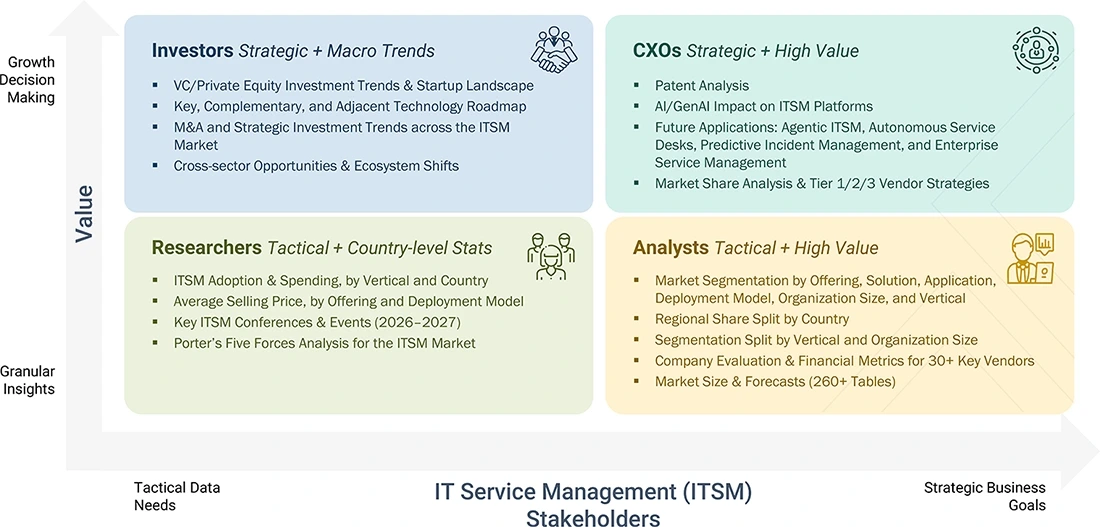
DELIVERED CUSTOMIZATIONS
We have successfully delivered the following deep-dive customizations:
| CLIENT REQUEST | CUSTOMIZATION DELIVERED | VALUE ADDS |
|---|---|---|
| Global ITSM Platform Provider (North America) | Customized market analysis covering ITSM solutions, applications, deployment models, organization size, vertical adoption, competitive positioning, and regional growth opportunities | Identifies high-growth workflow areas, supports portfolio planning and AI/service-management roadmap decisions, strengthens go-to-market prioritization, and improves competitive positioning |
| IT Services & Digital Transformation Provider (Asia Pacific) | Vendor benchmarking across ITSM platforms, implementation models, managed services, cloud deployment, AI-enabled service desks, self-service capabilities, and enterprise-service-management expansion | Supports technology-partner evaluation, managed-service portfolio development, customer migration strategy, regional market entry, and reduction of platform-selection risks |
RECENT DEVELOPMENTS
- September 2026 : ServiceNow introduced out-of-the-box MCP servers for ITSM, ITOM, CMDB, and SPM, enabling supported external AI clients to interact with governed ServiceNow workflows while retaining role-based access, platform logic, and workflow controls. The development strengthens the role of ITSM platforms as systems of action for enterprise AI agents.
- June 2026 : Montagu agreed to acquire a majority stake in BMC Helix through a carve-out transaction from BMC Software, with BMC retaining a minority interest. The transaction establishes BMC Helix as a more focused agentic-AI ServiceOps business while retaining exposure to its established enterprise ITSM customer base.
- May 2026 : Freshworks introduced AI Agent Studio in Freshservice, expanding its agentic service-management capabilities and enabling IT and business teams to build, customize, and deploy domain-specific Freddy AI agents on a unified service-operations foundation.
Table of Contents
 Exclusive indicates content/data unique to MarketsandMarkets and not available with any competitors.
Methodology
This research study on the IT Service Management (ITSM) market involved extensive secondary and primary research. Secondary sources included company annual reports, SEC and regulatory filings, investor presentations, product documentation, pricing pages, press releases, white papers, technology journals, government publications, industry associations, cloud adoption databases, IT service management standards and frameworks, and paid databases. Primary sources primarily included industry experts from ITSM software vendors, managed service providers, system integrators, consulting organizations, cloud service providers, enterprise users, and related technology companies. In-depth interviews with market participants and subject-matter experts were conducted to gather and validate critical qualitative and quantitative information and assess the market’s growth prospects.
Secondary Research
During the secondary research process, multiple sources were reviewed to identify and collect information relevant to the study. These sources included annual reports, regulatory filings, investor presentations, earnings transcripts, press releases, product portfolios, acquisition announcements, pricing pages, customer references, and technology documentation from ITSM vendors.
Additional information was gathered from recognized journals, industry associations, government websites, technology publications, cloud provider materials, and certified publications. Data relating to enterprise IT spending, cloud adoption, digital transformation, service desk modernization, IT outsourcing, managed services, artificial intelligence adoption, workflow automation, cybersecurity spending, and enterprise software expenditure across major countries was also extracted from relevant secondary sources.
Secondary research was used to develop preliminary market estimates, understand competitive positioning, identify vendor offerings, establish market segmentation, analyze technology trends, and determine regional adoption patterns.
Primary Research
During the primary research process, respondents from both the supply and demand sides were interviewed to obtain qualitative and quantitative information about the market. Supply-side participants included chief executive officers, vice presidents, directors, product managers, ITSM platform leaders, engineering executives, business development executives, marketing executives, service-management specialists, implementation consultants, and solution architects.
Breakup of Primary Profiles:
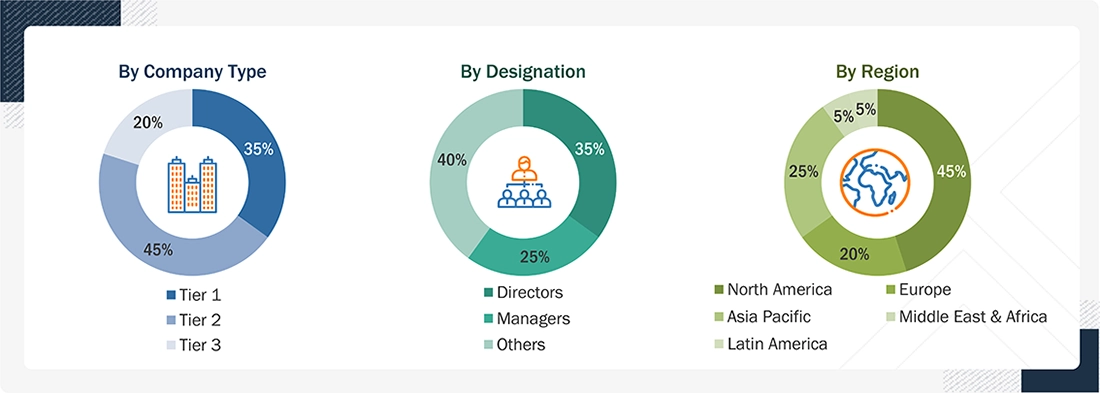
Note: Tier 1 companies’ revenues are more than USD 1 billion; Tier 2 companies’ revenues range between USD 100 million and USD 1 billion; and Tier 3 companies’ revenues range between USD 10 million and USD 100 million. Other designations include sales, marketing, engineering, product, operations, consulting, and research managers.
Source: Industry Experts
To know about the assumptions considered for the study, download the pdf brochure
Market Size Estimation
Multiple approaches were used to estimate and forecast the IT Service Management market. The first approach involved estimating market size based on revenues generated by companies from ITSM software products, platform subscriptions, associated professional services, and managed services.
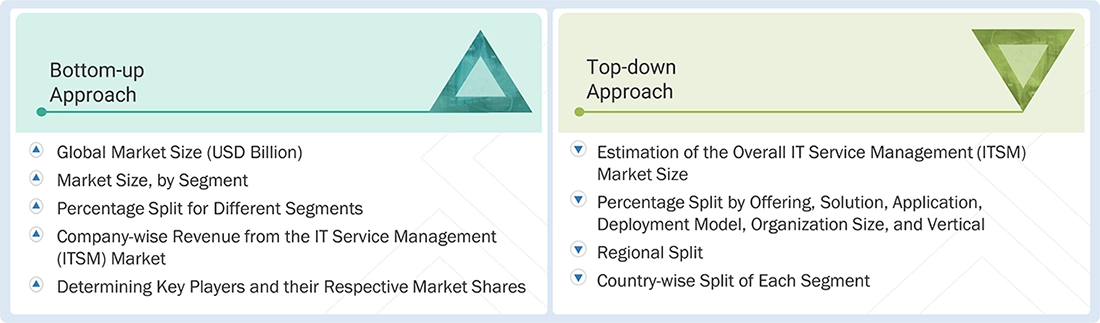
Market Size Estimation Methodology: Top-down Approach
The top-down approach involved preparing an exhaustive list of vendors offering ITSM platforms, service desk software, workflow automation, configuration and change management, service management analytics, managed services, and related offerings.
Market Size Estimation Methodology: Bottom-up Approach
The bottom-up approach assessed the adoption of IT Service Management platforms across major verticals and countries contributing significantly to the market. Enterprise deployments were evaluated across service desk software, incident & problem management, change & release management, service request & catalog management, configuration management, knowledge & self-service management, and service level management. Adoption levels across large enterprises and SMEs were estimated and extrapolated using cloud maturity, enterprise IT spending, service-management penetration, workforce size, service volumes, SaaS adoption, and managed service utilization.
Regional splits were determined through primary and secondary sources. The process included analysis of regional ITSM penetration, enterprise software spending, cloud adoption, digital transformation activity, IT outsourcing, service desk modernization, and managed services adoption. Strategic analysis of major global and regional ITSM vendors, together with their organic and inorganic developments, was also incorporated into the market estimates.
IT Service Management (ITSM) Market : Top-Down and Bottom-Up Approach
Data Triangulation
After determining the overall IT Service Management market size using the top-down and bottom-up estimation approaches, the market was divided into segments and subsegments. Data triangulation and market breakup procedures were applied to validate each market segment and subsegment. Vendor revenues, customer adoption patterns, deployment preferences, application penetration, service revenues, regional indicators, pricing structures, and primary interview findings were compared to identify inconsistencies and refine the estimates. The final market size was then used to estimate individual segments by applying validated percentage splits across the market segmentation. The resulting figures were cross-checked against supply-side revenues, demand-side ITSM adoption indicators, enterprise technology spending, cloud software penetration, managed services usage, product pricing, and regional economic conditions.
Market Definition
The IT Service Management market comprises software solutions and associated services that enable organizations to design, deliver, manage, support, govern, and continuously improve IT services across enterprise environments. ITSM platforms provide structured workflows for incident and problem management, change and release management, service request and catalog management, configuration management, knowledge and self-service management, service-level management, and service portfolio management. These platforms help enterprises standardize service processes, improve service availability, automate repetitive support activities, increase employee productivity, and strengthen governance across increasingly complex technology environments.
ITSM platforms include capabilities such as service desk software, CMDB, service catalogs, workflow orchestration, AI-enabled virtual agents, automated ticket classification and routing, knowledge recommendations, SLA monitoring, service analytics, change-risk assessment, and increasingly agentic and autonomous service-management capabilities. The market includes on-premises and cloud deployment models and supports enterprises operating traditional infrastructure, public cloud, private cloud, hybrid environments, SaaS applications, distributed endpoints, and modern digital workplaces.
Key Stakeholders
- ITSM platform providers
- Service desk software providers
- Service portfolio management vendors
- Configuration and change management vendors
- Managed service providers
- Professional service providers
- System integrators
- Cloud service providers
- IT operations management providers
- IT asset management providers
- AI and automation technology providers
- Enterprise software and workflow automation vendors
- Consulting organizations
- CIOs, CTOs, and enterprise IT leaders
- IT service management and service desk teams
Report Objectives
- To define and describe the IT Service Management market by offering, solution, services, application, deployment model, organization size, vertical, and region.
- To provide detailed information on major factors influencing market growth, including drivers, restraints, opportunities, and challenges across the ITSM ecosystem.
- To strategically analyze micro-markets with respect to individual growth trends, adoption patterns, and their contribution to the overall ITSM market.
- To analyze market opportunities for stakeholders and present the competitive landscape of ITSM platform vendors, managed service providers, enterprise software vendors, and technology partners.
- To project the market size and its submarkets in terms of value across North America, Europe, Asia Pacific, Middle East & Africa, and Latin America.
- To analyze major countries within each region based on cloud adoption, enterprise IT spending, digital maturity, ITSM penetration, and service-management modernization.
- To strategically profile leading companies and evaluate their product portfolios, platform capabilities, geographic presence, growth strategies, and market positioning.
- To examine competitive developments, including product launches, platform enhancements, partnerships, collaborations, acquisitions, investments, and geographic expansions.
- To assess the impact of generative AI, agentic AI, autonomous service desks, enterprise service management, workflow automation, cloud migration, and ITSM–ITOM convergence on market development.
- To analyze adoption across incident & problem management, change & release management, service request & catalog management, configuration management, knowledge & self-service management, and service level management.
- To assess deployment trends across on-premises and cloud environments.
- To identify high-growth segments, emerging use cases, and evolving technology requirements across the ITSM market.
Available customizations:
With the given market data, MarketsandMarkets offers customizations as per the company’s specific needs. The following customization options are available for the report:
Product Analysis
- The product matrix provides a detailed comparison of the product portfolios, ITSM capabilities, deployment models, AI capabilities, and integrations of each company.
Geographic Analysis based on feasibility
- Further breakup of the North American IT Service Management market
- Further breakup of the European IT Service Management market
- Further breakup of the Asia Pacific IT Service Management market
- Further breakup of the Middle East & Africa IT Service Management market
- Further breakup of the Latin American IT Service Management market
Company Information
-
Detailed analysis and profiling of additional market players (up to five)
Key Questions Addressed by the Report
What is the projected size of the IT Service Management Market by 2031?
The global IT Service Management (ITSM) market is projected to grow from USD 10.96 billion in 2026 to USD 22.91 billion by 2031, at a CAGR of 15.9% during 2026–2031.
Which offering segment is projected to grow at the highest CAGR in the IT Service Management Market?
Solutions are projected to register the highest CAGR of 16.8% during 2026–2031, supported by investment in cloud-based ITSM platforms, workflow automation, AI-enabled service desks, configuration and change management, and service analytics.
Which ITSM solution segments are projected to grow fastest?
Dashboard, Reporting, and Analytics is projected to register the highest CAGR among solution segments at 18.8% during 2026–2031.
Which deployment mode is projected to experience the highest growth rate in the IT Service Management market?
Cloud is expected to be the fastest-growing deployment segment in the IT Service Management market.
Which region is expected to lead growth in the IT Service Management market, and what key factors are driving this trend?
Asia Pacific is projected to be the fastest-growing region, driven by widespread cloud adoption, enterprise digitalization, expanding technology workforces, and the modernization of IT operations.
Which companies are profiled in the IT Service Management Market?
The report lists key players including ServiceNow, BMC Software, Broadcom, ManageEngine, Ivanti, Zendesk, GoTo, SolarWinds, Atlassian, OpenText, SymphonyAI Summit, Microsoft, IBM, Freshworks, EasyVista, IFS, ITarian, SysAid Technologies, InvGate, Alemba, Hornbill, NinjaOne, HaloITSM, Aisera, TOPdesk, TeamDynamix, Salesforce, Xurrent, and Matrix42.


Personalize This Research
- Triangulate with your Own Data
- Get Data as per your Format and Definition
- Gain a Deeper Dive on a Specific Application, Geography, Customer or Competitor
- Any level of Personalization
Let Us Help You
- What are the Known and Unknown Adjacencies Impacting the IT Service Management Market
- What will your New Revenue Sources be?
- Who will be your Top Customer; what will make them switch?
- Defend your Market Share or Win Competitors
- Get a Scorecard for Target Partners

Custom Market Research Services
We Will Customise The Research For You, In Case The Report Listed Above Does Not Meet With Your Requirements
Get 10% Free CustomisationTESTIMONIALS
- Canada IT Service Management (ITSM) Market
- US IT Service Management (ITSM) Market
- UK IT Service Management (ITSM) Market
- Germany IT Service Management (ITSM) Market
- France IT Service Management (ITSM) Market
- Netherlands IT Service Management (ITSM) Market
- Italy IT Service Management (ITSM) Market
- China IT Service Management (ITSM) Market
- Japan IT Service Management (ITSM) Market
- Australia IT Service Management (ITSM) Market
- Singapore IT Service Management (ITSM) Market
- South Africa IT Service Management (ITSM) Market
- Brazil IT Service Management (ITSM) Market
- Mexico IT Service Management (ITSM) Market
- Rest Of Europe IT Service Management (ITSM) Market
- Rest Of Asia Pacific IT Service Management (ITSM) Market
- Rest Of Latin America IT Service Management (ITSM) Market
- GCC IT Service Management (ITSM) Market






Growth opportunities and latent adjacency in IT Service Management Market