Trade Management Market

Trade Management Market by Offering (Solutions [Trade Governance & Compliance, Trade Planning & Commercial Optimization], Services), Vertical (Manufacturing & Industrial, Technology, Electronics & Semiconductor), and Region - Global Forecast to 2032




OVERVIEW
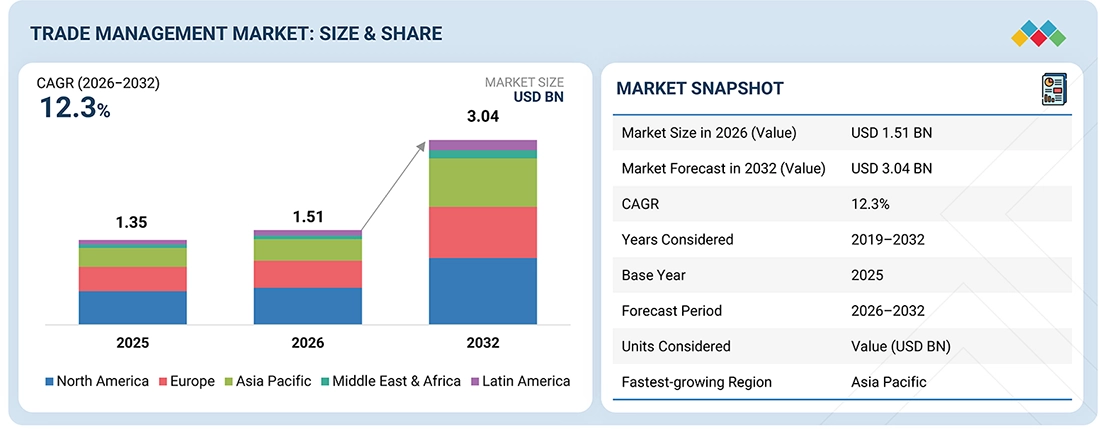
Source: Secondary Research, Interviews with Experts, MarketsandMarkets Analysis
The trade management market is projected to grow from USD 1.51 billion in 2026 to USD 3.04 billion by 2032, registering a CAGR of 12.3% during the forecast period. The increasing complexity of global trade regulations, rising geopolitical uncertainties, and the rapid digitalization of supply chains are accelerating the adoption of trade management solutions. Organizations can now automate customs compliance, trade documentation, and cross-border operations while leveraging AI-driven analytics, risk monitoring, and real-time visibility to improve decision-making. This enables businesses to proactively identify compliance risks, optimize duty costs, and enhance operational efficiency rather than reacting to disruptions after they occur. A major reason trade management has become a strategic priority is its direct impact on supply chain resilience, regulatory compliance, and cost optimization.
KEY TAKEAWAYS
-
By OfferingBy offering, the services segment is projected to be the fastest-growing, registering a CAGR of 13.7% during the forecast period.
-
By VerticalThe manufacturing & industrial vertical is expected to hold the largest market share of 22.8% in 2026.
-
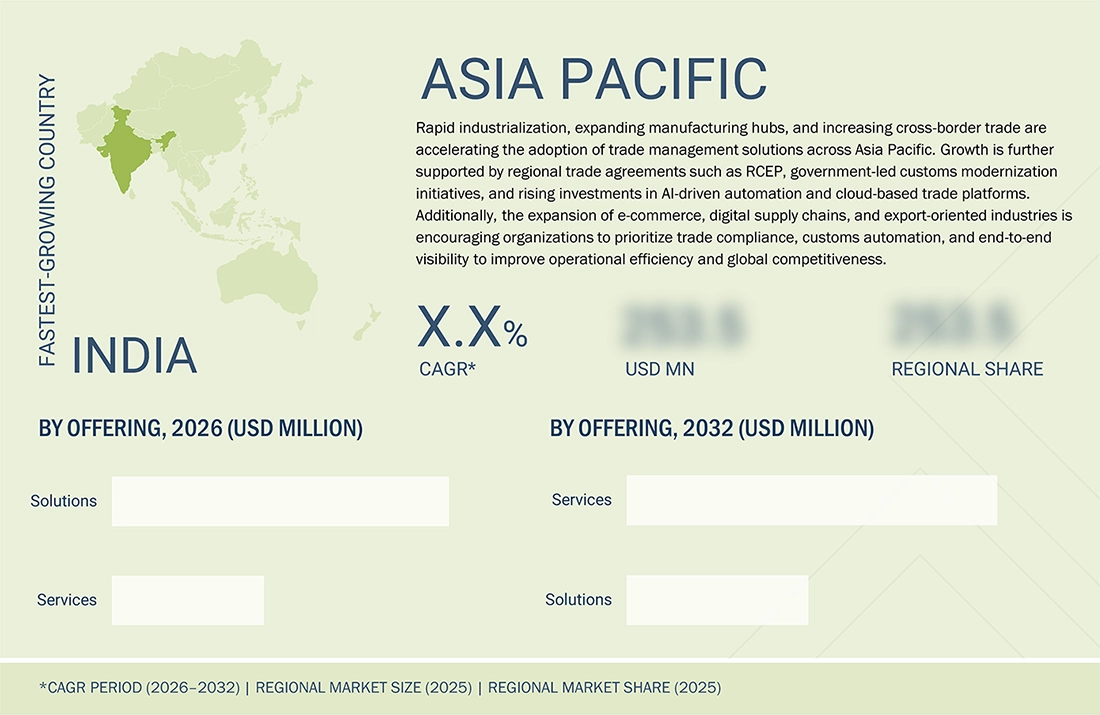
By RegionAsia Pacific is expected to be the fastest-growing region, expanding at a CAGR of 14.9% during the forecast period.
-
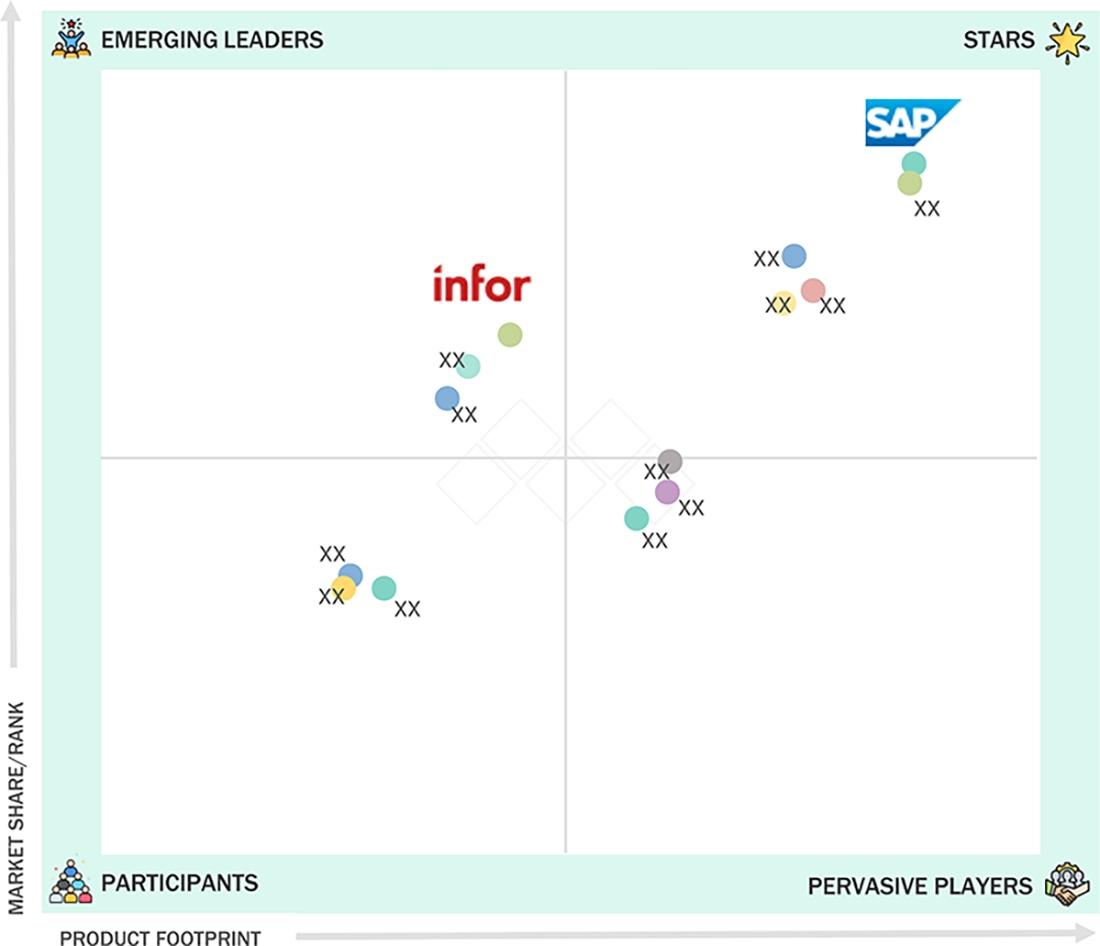
Competitive Landscape - Key PlayersCompanies such as Oracle, Infor, Thomson Reuters, Livingston International, and SAP were identified as some of the star players in the trade management market, given their strong market share and product footprint.
-
Competitive Landscape - Startups/SMEsCompanies such as QAD Precision, 3rdwave, AEB, Shipsy, and Bamboo Rose were identified as some of the startups/SMEs in the trade management market, given their strong market share and product footprint.
Global trade has become more challenging as companies deal with changing regulations, geopolitical disruptions, and increasingly complex supply chains. As a result, many organizations are replacing manual, paper-based trade processes with digital trade management solutions. These platforms provide better control over import and export activities, support customs compliance, and improve coordination with logistics providers and trading partners. They also help businesses reduce shipment delays, avoid costly compliance issues, and gain better visibility into cross-border operations. For companies with international supply chains, trade management is no longer just a compliance function; it has become an important capability for controlling costs, improving operational performance, and supporting long-term business growth.
TRENDS & DISRUPTIONS IMPACTING CUSTOMERS' CUSTOMERS
The trade management market is being transformed by the increasing adoption of artificial intelligence (AI), cloud-based Global Trade Management (GTM) platforms, and real-time supply chain visibility solutions, enabling organizations to streamline cross-border trade operations and improve compliance. Businesses across industries are increasingly investing in trade compliance automation, customs management, trade promotion optimization (TPO), and predictive analytics to enhance operational efficiency, reduce trade risks, and optimize costs. The emergence of generative AI, intelligent document processing (IDP), and machine learning is shifting the market from manual, reactive trade processes to automated, proactive decision-making. At the same time, evolving global trade regulations, geopolitical uncertainties, and the growing complexity of international supply chains are accelerating investments in digital trade platforms, automation, and end-to-end visibility. These trends are creating new revenue opportunities for trade management solution providers while helping enterprises improve compliance, optimize landed costs, enhance supply chain resilience, and accelerate global trade operations.
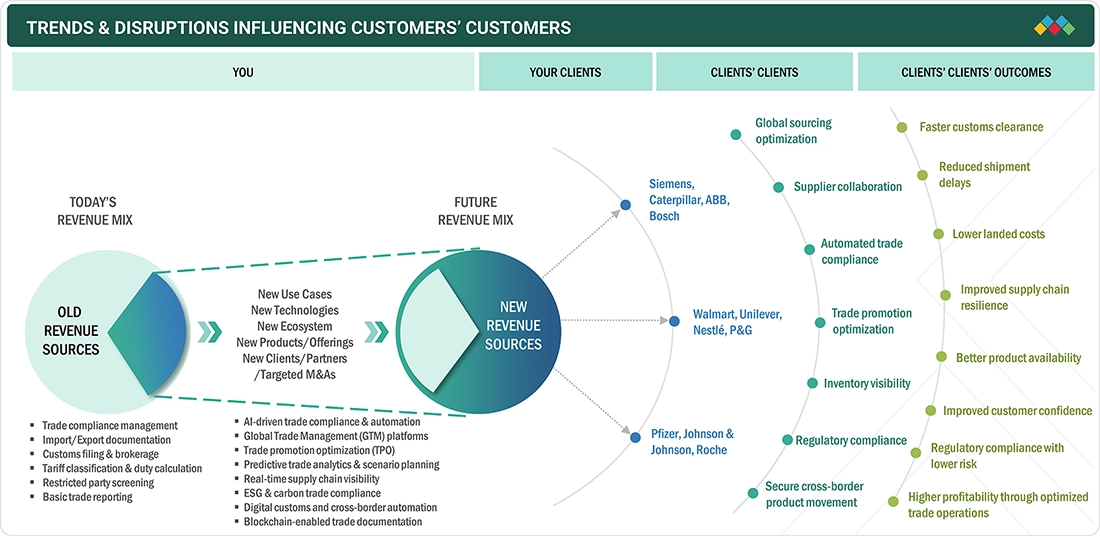
Source: Secondary Research, Interviews with Experts, MarketsandMarkets Analysis
MARKET DYNAMICS

Level
-
Increasing Complexity of Global Trade Regulations and Customs Compliance

-
Expansion of Cross-border Trade and Global Supply Chains


Level
-
High Implementation Costs and Integration Complexity

-
Data Quality and Regulatory Content Maintenance


Level
-
Growth of Cloud-based Trade Management Platforms

-
Expansion of Emerging Markets and Digital Trade


Level
-
Cybersecurity and Sensitive Trade Data Protection

-
Managing Multi-country Regulatory Harmonization

Source: Secondary Research, Interviews with Experts, MarketsandMarkets Analysis
Driver: Increasing Complexity of Global Trade Regulations and Customs Compliance
International trade regulations are becoming more complex due to frequent changes in customs requirements, sanctions, export controls, free trade agreements, and country-specific compliance rules. Organizations engaged in cross-border trade must continuously adapt to these evolving requirements while maintaining accurate documentation and minimizing operational disruptions. Trade management solutions help automate compliance processes, standardize trade documentation, and improve visibility across global trade operations. This reduces the risk of penalties, shipment delays, and compliance violations while enabling businesses to manage international trade more efficiently. As regulatory complexity continues to grow, the need for digital trade management platforms is expected to increase across industries.
Restraint: High Implementation Costs and Integration Complexity
Despite the benefits that trade management platforms can bring, putting them into action can mean spending a lot on software, connecting systems, changing how things are done and teaching workers. Many companies also run into problems when trying to connect these tools with their ERP systems, transportation management systems, customs platforms and other business programs. The problem gets harder for businesses that work in countries with different rules and ways of doing things. For medium-sized companies, the high costs and long time it takes to set everything up can stop them from using these tools. These issues keep getting in the way for companies that don't have much IT help and don't have much money for technology.
Opportunity: Growth of Cloud-based Trade Management Platforms
The growing shift toward cloud-based enterprise applications is creating new opportunities for the trade management market. Cloud deployment offers greater flexibility, faster implementation, and easier access to trade data across global operations without the need for extensive on-premises infrastructure. It also simplifies software updates, supports changing regulatory requirements, and improves collaboration among manufacturers, suppliers, logistics providers, and customs partners. As organizations continue to modernize their supply chain technology, cloud-based trade management platforms are becoming an attractive option for businesses of all sizes. This trend is expected to drive wider adoption, particularly among companies seeking scalable and cost-effective trade management solutions.
Challenge: Cybersecurity and Sensitive Trade Data Protection
Trade management platforms handle large volumes of sensitive business information, including customs declarations, supplier records, shipment details, product classifications, and trade documentation. As these platforms become more connected with ERP systems, logistics providers, customs authorities, and external partners, the risk of cyberattacks and unauthorized data access continues to grow. Organizations must ensure strong security controls, data encryption, access management, and compliance with regional data protection regulations to safeguard critical trade information. Any security breach can disrupt cross-border operations, expose confidential business data, and lead to financial and reputational losses. Addressing cybersecurity concerns remains a key challenge for organizations adopting digital trade management solutions.
TRADE MANAGEMENT MARKET: COMMERCIAL USE CASES ACROSS INDUSTRIES
| COMPANY | USE CASE DESCRIPTION | BENEFITS |
|---|---|---|
 |
J.M. Huber, a global diversified industrial company, implemented ONESOURCE Global Trade Management to modernize its import and export compliance processes across global operations. The solution enabled automated product classification, centralized trade compliance, and standardized customs procedures, helping the company improve regulatory compliance while reducing manual effort and operational risk. | Automated import & export compliance | Centralized product classification | Reduced regulatory risk | Standardized global trade operations |
 |
Evonik, a global specialty chemicals company, leveraged SAP Global Trade Services (GTS) to modernize its international trade operations through automated preference management and digital trade compliance processes. The solution helped simplify customs procedures, improve compliance with changing trade regulations, and unlock financial benefits through more efficient free trade agreement management. | Automated preference management | Improved customs compliance |Optimized free trade agreement utilization | Reduced manual trade processes |
 |
Omron, a global automation company, implemented ONESOURCE Global Trade to centralize HS code classification and standardize trade compliance across more than 60 import and export locations worldwide. The platform replaced spreadsheet-based classification with a centralized system, improving visibility, classification accuracy, and compliance with changing global trade regulations. | Centralized HS code classification| Improved classification accuracy|Standardized global trade compliance| Better visibility across import/export operations |
Logos and trademarks shown above are the property of their respective owners. Their use here is for informational and illustrative purposes only.
MARKET ECOSYSTEM
The trade management ecosystem includes trade management solution/platform providers, service providers, regulatory bodies, and customs and compliance organizations. Platform providers such as Oracle, SAP, Livingston International, Infor, Thomson Reuters, and Descartes offer global trade management solutions for customs compliance, export controls, sanctions screening, tariff and duty optimization, free trade agreement (FTA) management, and trade documentation. Service providers support implementation, integration, managed trade compliance, customs brokerage, and consulting services to help organizations streamline cross-border trade operations. Service providers support implementation, consulting, managed trade compliance, customs brokerage, and regulatory advisory services to help organizations optimize global trade operations.
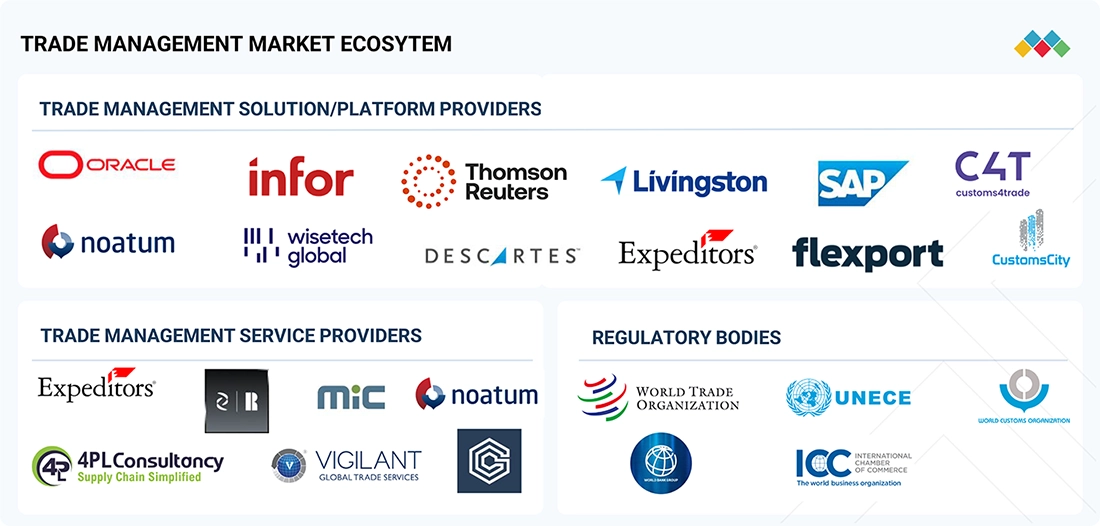
Logos and trademarks shown above are the property of their respective owners. Their use here is for informational and illustrative purposes only.
MARKET SEGMENTS
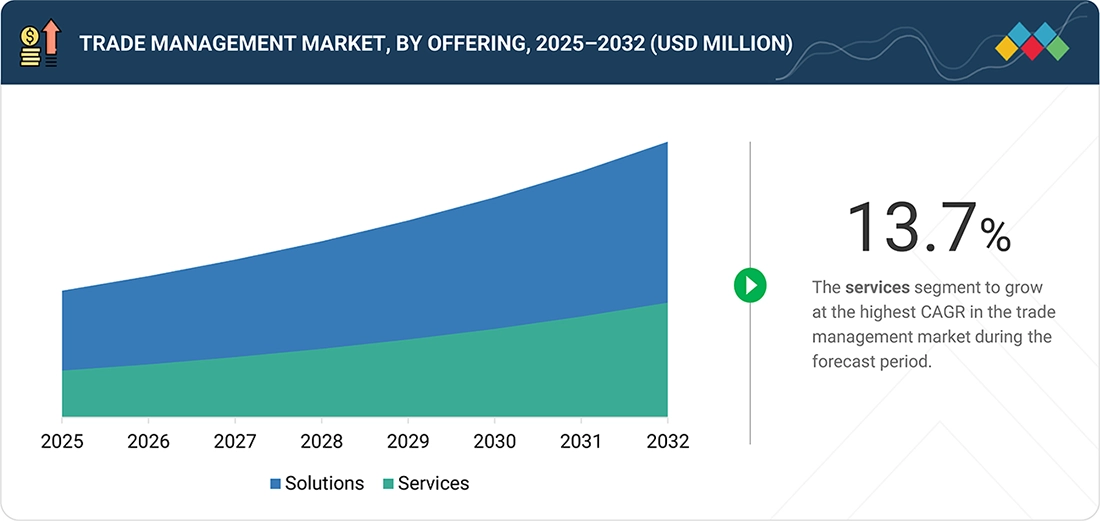
Source: Secondary Research, Interviews with Experts, MarketsandMarkets Analysis
Trade Management Market, By Offering
The solutions segment is expected to hold the largest market size. Trade management solutions have become a critical component of modern global commerce as organizations seek to streamline cross-border operations while ensuring compliance with evolving international trade regulations. These platforms provide an integrated approach to managing import and export processes, customs compliance, product classification, restricted party screening, trade documentation, free trade agreement qualification, and duty optimization from a centralized system. By replacing manual and fragmented trade processes, organizations gain greater visibility across global trade operations, reduce compliance risks, and improve operational efficiency.
Trade Management Market, By Vertical
The technology, electronics, and semiconductors vertical is expected to be the fastest-growing during the forecast period due to increasingly complex global supply chains and cross-border trade operations. Companies in this sector require robust trade management solutions to ensure customs compliance, tariff classification, export control, and restricted party screening. Rising geopolitical tensions and evolving semiconductor export regulations are accelerating the adoption of digital trade compliance platforms. Additionally, AI-driven automation and cloud-based trade management solutions help improve supply chain visibility, reduce compliance risks, optimize duty costs, and enhance operational efficiency.
REGION
Asia Pacific to be fastest-growing region in global trade management market during forecast period
The Asia Pacific region is becoming a strategically important market for trade management solutions due to rapid industrialization, expanding manufacturing capabilities, and increasing participation in global trade. With growing cross-border trade activities, rising exports and imports, and the expansion of regional trade agreements such as RCEP, businesses across the region are investing in digital trade management platforms to streamline customs compliance, tariff classification, export controls, and trade documentation. Rapid growth in e-commerce, logistics networks, and digital customs modernization initiatives across countries such as China, India, Japan, South Korea, and Southeast Asia is accelerating the adoption of cloud-based and AI-driven trade management solutions. Additionally, evolving trade regulations, stricter compliance requirements, and increasing focus on supply chain resilience are driving organizations to adopt integrated trade management platforms that improve operational efficiency, reduce compliance risks, and optimize global trade operations. Together, these factors make Asia Pacific one of the fastest-growing markets for trade management solutions globally.
TRADE MANAGEMENT MARKET: COMPANY EVALUATION MATRIX
In the trade management market matrix, SAP (Star) holds a leading position, supported by its comprehensive Global Trade Services (GTS) portfolio, strong ERP ecosystem, and extensive adoption across manufacturing, automotive, consumer goods, life sciences, and industrial enterprises. Its strength lies in end-to-end trade compliance, customs and export control management, tariff classification, free trade agreement (FTA) qualification, and seamless integration with enterprise supply chain and logistics processes. Infor is positioned as an Emerging Leader, supported by its expanding cloud-based ERP capabilities and growing focus on embedded global trade compliance for manufacturing and distribution industries. Its trade management capabilities are expected to strengthen further as organizations increasingly seek integrated, industry-specific solutions to simplify cross-border trade operations and regulatory compliance.
Source: Secondary Research, Interviews with Experts, MarketsandMarkets Analysis
KEY MARKET PLAYERS
- Oracle (US)
- Infor (US)
- Thomson Reuters (Canada)
- Livingston International (Canada)
- SAP (Germany)
- Aptean (US)
- Noatum Logistics (Spain)
- Wistech Global Group (Australia)
- Descartes (Canada)
- Expeditors (US)
- PSA BDP (US)
- Flexport (US)
- Custom4Trade (Belgium)
- Finastra (UK)
- Sayari (US)
- QAD Precison (US)
- 3RdWave (Canada)
- AEB SE (Germany)
- Shipsy (Netherlands)
- Bamboo Rose (US)
- MIC Customs (Austria)
- Webb Fontaine (UAE)
- Neurored (Spain)
- 4PL Consultancy (UK)
- Global Customs Compliance (Hong Kong)
- Vigilant Global Trade Services (US)
- TradeMo (US)
- Zonos (US)
- Gaia Dynamics (US)
- Caspian (US)
- Tradelanes (US)
- Customs City (Canada)
- Partnerlinq (US)
- Avathon (US)
- Traydstream (UK)
MARKET SCOPE
| REPORT METRIC | DETAILS |
|---|---|
| Market Size in 2025 (Value) | USD 1.35 Billion |
| Market Size in 2026 (Value) | USD 1.51 Billion |
| Market Forecast in 2032 (Value) | USD 3.04 Billion |
| Growth Rate | CAGR of 12.3% from 2026-2032 |
| Years Considered | 2019-2032 |
| Base Year | 2025 |
| Forecast Period | 2026-2032 |
| Units Considered | Value (USD Billion) |
| Report Coverage | Revenue forecast, company ranking, competitive landscape, growth factors, and trends |
| Segments Covered |
|
| Regions Covered | North America, Europe, Asia Pacific, Middle East & Africa, and Latin America |
WHAT IS IN IT FOR YOU: TRADE MANAGEMENT MARKET REPORT CONTENT GUIDE
DELIVERED CUSTOMIZATIONS
We have successfully delivered the following deep-dive customizations:
| CLIENT REQUEST | CUSTOMIZATION DELIVERED | VALUE ADDS |
|---|---|---|
| Leading Service Provider (US) | Regional Analysis: • Further breakdown of the North American trade management market • Further breakdown of the European trade management market • Further breakdown of the Asia Pacific trade management market • Further breakdown of the Middle East & African trade management market • Further breakdown of the Latin American trade management market | • Identifies high-growth regional opportunities, enabling tailored market entry strategies. • Optimizes resource allocation and investment based on region-specific demand and trends. |
| Company Information | Detailed analysis and profiling of additional market players (up to 5) | • Broadens competitive insights, helping clients make informed strategic and investment decisions. • Reveals market gaps and opportunities, supporting differentiation and targeted growth initiatives. |
RECENT DEVELOPMENTS
- June 2026 : Oracle added Inventory Optimization Planning capabilities to Oracle Supply Chain Planning, enabling AI-driven inventory optimization, service-level analysis, safety stock recommendations, and network-wide inventory balancing.
- July 2025 : Infor announced a strategic collaboration with Amazon Web Services (AWS) to accelerate generative AI innovation across Infor CloudSuite applications. The collaboration integrates AWS generative AI services to enhance intelligent automation, decision-making, and productivity across supply chain, manufacturing, and enterprise operations.
- April 2025 : Aptean completed the acquisition of Logility, strengthening its Trade Management and Supply Chain portfolio with AI-driven demand planning, inventory optimization, supply planning, and supply chain analytics capabilities.
- December 2025 : WiseTech Global launched CargoWise Value Packs, introducing a broader set of CargoWise capabilities under a simplified commercial model. The enhancement expands access to customs, trade management, and automation features while simplifying platform adoption for customers.
Table of Contents
 Exclusive indicates content/data unique to MarketsandMarkets and not available with any competitors.
Methodology
This research study involved the extensive use of secondary sources, directories, and databases, such as Dun & Bradstreet (D&B), Hoover's, Bloomberg Businessweek, company annual reports, investor presentations, and official websites, to identify and collect information for a technical, market-oriented, and commercial study of the trade management market. The primary sources mainly included industry experts from trade compliance, customs, logistics, manufacturing, technology providers, distributors, service providers, and organizations across the global trade ecosystem. In-depth interviews were conducted with key industry participants, subject matter experts, C-level executives of leading market players, customs and trade compliance professionals, and industry consultants to obtain and validate critical qualitative and quantitative information across all segments of the trade management market.
Secondary Research
The market for companies offering trade management solutions and services across different industries has been estimated and projected based on extensive secondary research and analysis of vendor product portfolios within the trade management ecosystem. The study also evaluated vendors based on their product capabilities, technology innovation, and market presence. Various secondary sources, including journals published by the Institute of Electrical and Electronics Engineers (IEEE), ScienceDirect, ResearchGate, industry publications, government trade portals, customs authorities, and trade associations, were consulted to collect and validate information related to the trade management market.
The secondary sources included annual reports, SEC filings, investor presentations, company websites, press releases, white papers, technical papers, industry journals, certified publications, recognized authors, directories, and commercial databases. Secondary research was primarily used to identify the overall market size, key market participants, competitive landscape, market segmentation, regional trends, technology developments, regulatory updates, and major business strategies, which were subsequently validated through primary research.
Primary Research
In the primary research process, various stakeholders from both the supply and demand sides were interviewed to obtain qualitative and quantitative insights into the trade management market. On the supply side, respondents included Chief Executive Officers (CEOs), Vice Presidents (VPs), Directors, product managers, business development executives, trade compliance specialists, customs experts, executives from trade management solution vendors, service providers, logistics partners, and industry associations.
Primary interviews were conducted to gather market statistics, revenue insights, market segmentation, growth forecasts, technology trends, and data required for market estimation and triangulation. On the demand side, respondents included Chief Information Officers (CIOs), Chief Supply Chain Officers (CSCOs), Chief Procurement Officers (CPOs), Global Trade Compliance Managers, Logistics & Customs Managers, Import/Export Managers, and end users of trade management solutions to understand purchasing priorities, deployment trends, vendor preferences, and the adoption of trade management technologies across industries.
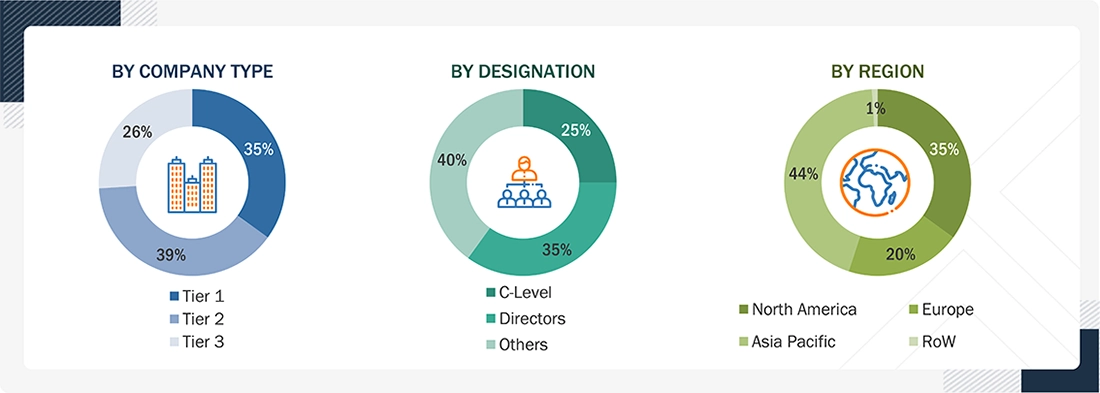
Others include sales managers, marketing managers, and product managers.
Note: Tier 1 companies’ revenue is more than USD 1 billion; Tier 2 companies’ revenue ranges between USD 500 million and 1 billion; and Tier 3 companies’ revenue ranges between USD 100 million and USD 500 million
To know about the assumptions considered for the study, download the pdf brochure
Market Size Estimation
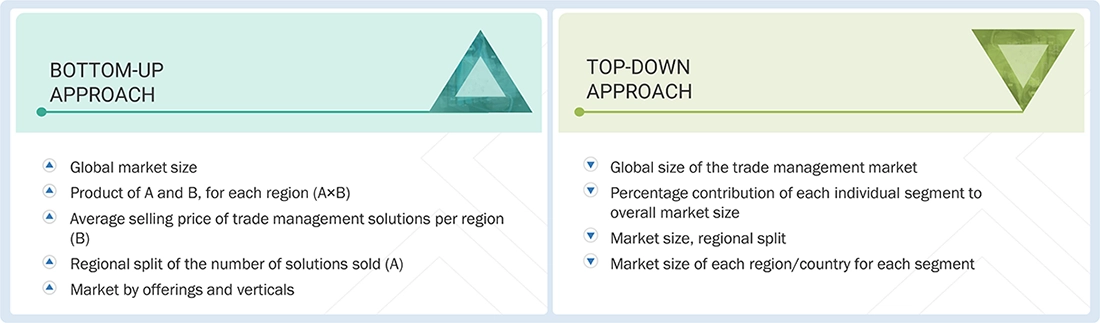
Multiple approaches were adopted to estimate and forecast the size of the trade management market. The first approach involves estimating market size by summing up the revenue generated by companies through the sale of trade management offerings.
Top-down and bottom-up approaches were used to estimate and validate the total size of the trade management market. These methods were used extensively to estimate the size of various market segments. The research methodology used to evaluate the market size is listed below.
- Key players in the market have been identified through extensive secondary research.
- In terms of value, the industry’s supply chain and market size have been determined through primary and secondary research processes.
- All shares, splits, and breakups have been determined using secondary sources and verified through primary sources.
Data Triangulation
After determining the overall market size, the trade management market was segmented into various offerings, verticals, and regions. A data triangulation methodology was applied to validate market estimates and derive accurate statistics for each segment and subsegment. The findings were validated by analyzing demand- and supply-side trends, vendor revenues, adoption patterns, and industry developments. The final market size and forecasts were verified using both top-down and bottom-up approaches to ensure consistency and accuracy across all market segments.
Market Definition
The trade management market comprises software solutions and services that enable organizations to manage and optimize end-to-end trade operations across global supply chains. These solutions support trade governance and compliance, trade planning, execution, trade finance, and trade intelligence by automating customs processes, ensuring regulatory compliance, facilitating import/export documentation, optimizing tariffs and duties, and providing real-time visibility into cross-border trade activities. Trade Management platforms integrate with enterprise systems such as ERP, TMS, WMS, and SCM to improve operational efficiency, mitigate trade risks, and support seamless international commerce.
Key Stakeholders
- Trade management software providers
- Cloud infrastructure providers
- System integrators and consulting firms
- Customs brokers and trade compliance service providers
- Freight forwarders and logistics providers
- Shipping carriers and transportation companies
- Importers and exporters
- Manufacturing, retail, healthcare, technology, automotive, and other end-user enterprises
- Banks and trade finance institutions
- Government customs and regulatory authorities
- ERP, SCM, TMS, and WMS vendors
- Industry associations and research organizations
Report Objectives
- To determine, segment, and forecast the trade management market based on offering, vertical, and region in terms of value
- To forecast the size of the market segments with respect to five main regions: North America, Europe, Asia Pacific, the Middle East & Africa, and Latin America
- To provide detailed information about the major factors (drivers, restraints, opportunities, and challenges) influencing the market growth
- To study the complete supply chain and related industry segments, and perform a supply chain analysis of the market landscape
- To strategically analyze the macro and micromarkets concerning individual growth trends, prospects, and contributions to the total market
- To analyze the industry trends, pricing data, patents, and innovations related to the market
- To analyze the opportunities for stakeholders by identifying the high-growth segments of the market
- To profile the key players in the market and comprehensively analyze their market share/ranking and core competencies
- To track and analyze competitive developments, such as mergers & acquisitions, product launches & developments, partnerships, agreements, collaborations, business expansions, and research & development (R&D) activities
- To provide a macroeconomic outlook for all regions considered under the study
Available customizations:
With the given market data, MarketsandMarkets offers customizations to meet the company’s specific needs. The following customization options are available for the report:
Country-wise information
- Analysis for additional countries (up to five)
Company information
- Detailed analysis and profiling of additional market players (up to 5)


Personalize This Research
- Triangulate with your Own Data
- Get Data as per your Format and Definition
- Gain a Deeper Dive on a Specific Application, Geography, Customer or Competitor
- Any level of Personalization
Let Us Help You
- What are the Known and Unknown Adjacencies Impacting the Trade Management Market
- What will your New Revenue Sources be?
- Who will be your Top Customer; what will make them switch?
- Defend your Market Share or Win Competitors
- Get a Scorecard for Target Partners

Custom Market Research Services
We Will Customise The Research For You, In Case The Report Listed Above Does Not Meet With Your Requirements
Get 10% Free CustomisationTESTIMONIALS
- Canada Trade Management Market
- US Trade Management Market
- UK Trade Management Market
- Germany Trade Management Market
- France Trade Management Market
- China Trade Management Market
- Japan Trade Management Market
- India Trade Management Market
- UAE Trade Management Market
- South Africa Trade Management Market
- Brazil Trade Management Market
- Mexico Trade Management Market
- Rest Of Europe Trade Management Market
- Rest Of Asia Pacific Trade Management Market
- Rest Of Latin America Trade Management Market
- Ksa Trade Management Market






Growth opportunities and latent adjacency in Trade Management Market