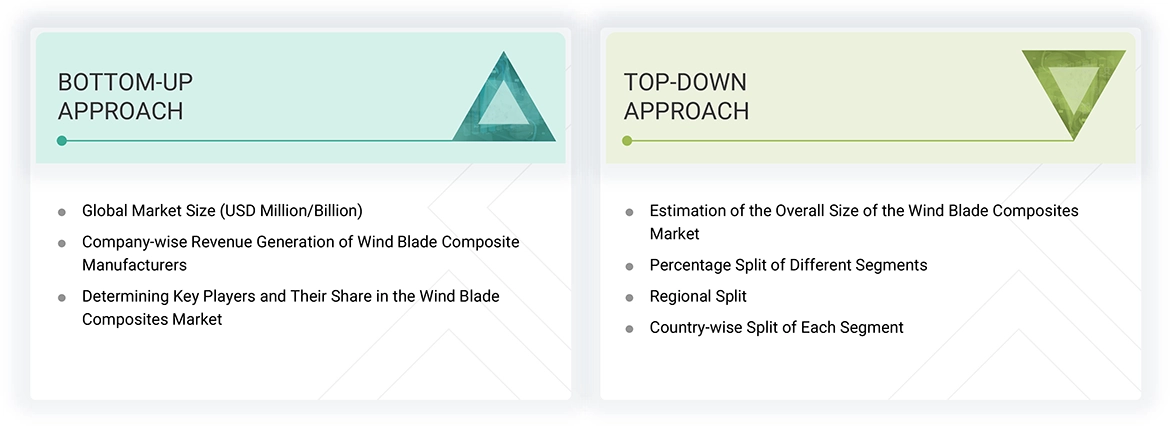
The study involves two major activities in estimating the current market size for the wind blade composites market. Exhaustive secondary research was done to collect information on the market and the peer and parent markets. The next step was to validate these findings, assumptions, and sizing with industry experts across the value chain through primary research. Both top-down and bottom-up approaches were employed to estimate the complete market size. After that, market breakdown and data triangulation were used to estimate the market size of segments and subsegments.
Secondary Research
Secondary sources referred to for this research study include financial statements of companies offering wind blade composites and information from various trade, business, and professional associations. Secondary research has been used to obtain critical information about the industry’s value chain, the total pool of key players, market classification, and segmentation according to industry trends to the bottom-most level and regional markets. Secondary data was collected and analyzed to arrive at the overall size of the wind blade composites market, which was validated through interviews with experts.
Primary Research
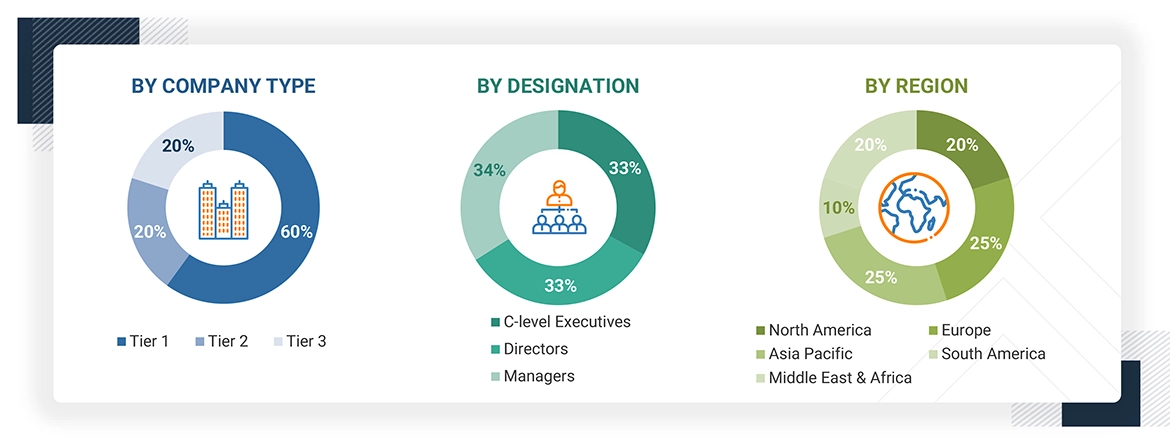
Extensive primary research was conducted after obtaining information regarding the wind blade composites market scenario through secondary research. Several interviews were conducted with market experts from both the demand and supply sides across the major countries of North America, Europe, Asia Pacific, the Middle East & Africa, and South America. Primary data was collected through questionnaires, e-mails, and telephonic interviews. The primary sources from the supply side included various industry experts, such as chief experience officers (CXOs), vice presidents (VPs), business development/marketing directors, product development/innovation teams, related key executives from the wind blade composites industry, system integrators, component providers, distributors, and key opinion leaders. Interviews with experts were conducted to gather insights such as market statistics, data on revenue collected from the products and services, market breakdowns, market size estimations, market forecasting, and data triangulation. Primary research helped in understanding the various trends related to fiber type, resin type, blade size, application, and region. Stakeholders from the demand side (CIOs, CTOs, CSOs, and installation teams of the customers/end users who are wind blade composites services) were interviewed to understand the buyer’s perspective on the suppliers, products, component providers, and their current usage of wind blade composites and future outlook of their business which will affect the overall market.
Breakup of Primary Research
To know about the assumptions considered for the study, download the pdf brochure
Market Size Estimation
The research methodology used to estimate the wind blade composites market size includes the following details. The market sizing was undertaken from the demand side. The market was estimated based on the demand for wind blade composites in different applications at the regional level. Such procurements provide information on the demand aspects of the wind blade composites industry for each application. All possible segments of the wind blade composites market for each application were integrated and mapped.
Data Triangulation
After arriving at the overall size from the market size estimation process explained above, the total market was split into several segments and subsegments. The data triangulation and market breakdown procedures explained below were implemented, wherever applicable, to complete the overall market engineering process and arrive at the exact statistics for various market segments and subsegments. The data was triangulated by studying various factors and trends from the demand and supply sides. The market size was also validated using both the top-down and bottom-up approaches.
Market Definition
Wind blade composites refer to producing and applying advanced composite materials used to manufacture wind turbine blades. These composites are typically reinforced with various fiber types, including glass fiber, carbon fiber, and alternative fibers such as basalt and natural fibers, and are combined with resin systems such as epoxy, polyurethane, and other resins including vinyl ester, thermoplastic, and bio-based resins. Designed to meet the performance demands of both onshore and offshore wind energy installations, these materials are used across various blade sizes, from blades up to 50 meters to those exceeding 50 meters, enabling enhanced structural efficiency and sustainability in wind power generation.
Stakeholders
-
Wind blade composite manufacturers
-
Wind blade composite distributors and suppliers
-
Universities, governments, and research organizations
-
Associations and industrial bodies
-
R&D institutes
-
Environmental support agencies
-
Investment banks and private equity firms
-
Research and consulting firms
Report Objectives
-
To define, describe, and forecast the wind blade composites market size in terms of volume and value
-
To provide detailed information regarding the key factors, such as drivers, restraints, opportunities, and challenges influencing market growth
-
To analyze and project the global wind blade composites market by fiber type, resin type, blade size, application, and region
-
To forecast the market size concerning five main regions (along with country-level data), namely, North America, Europe, Asia Pacific, the Middle East & Africa, and South America, and analyze the significant region-specific trends
-
To strategically analyze micromarkets with respect to individual growth trends, prospects, and contributions of the submarkets to the overall market
-
To analyze the market opportunities and the competitive landscape for stakeholders and market leaders
-
To assess recent market developments and competitive strategies, such as agreements, contracts, acquisitions, and product launches, to draw the competitive landscape
-
To strategically profile the key market players and comprehensively analyze their core competencies


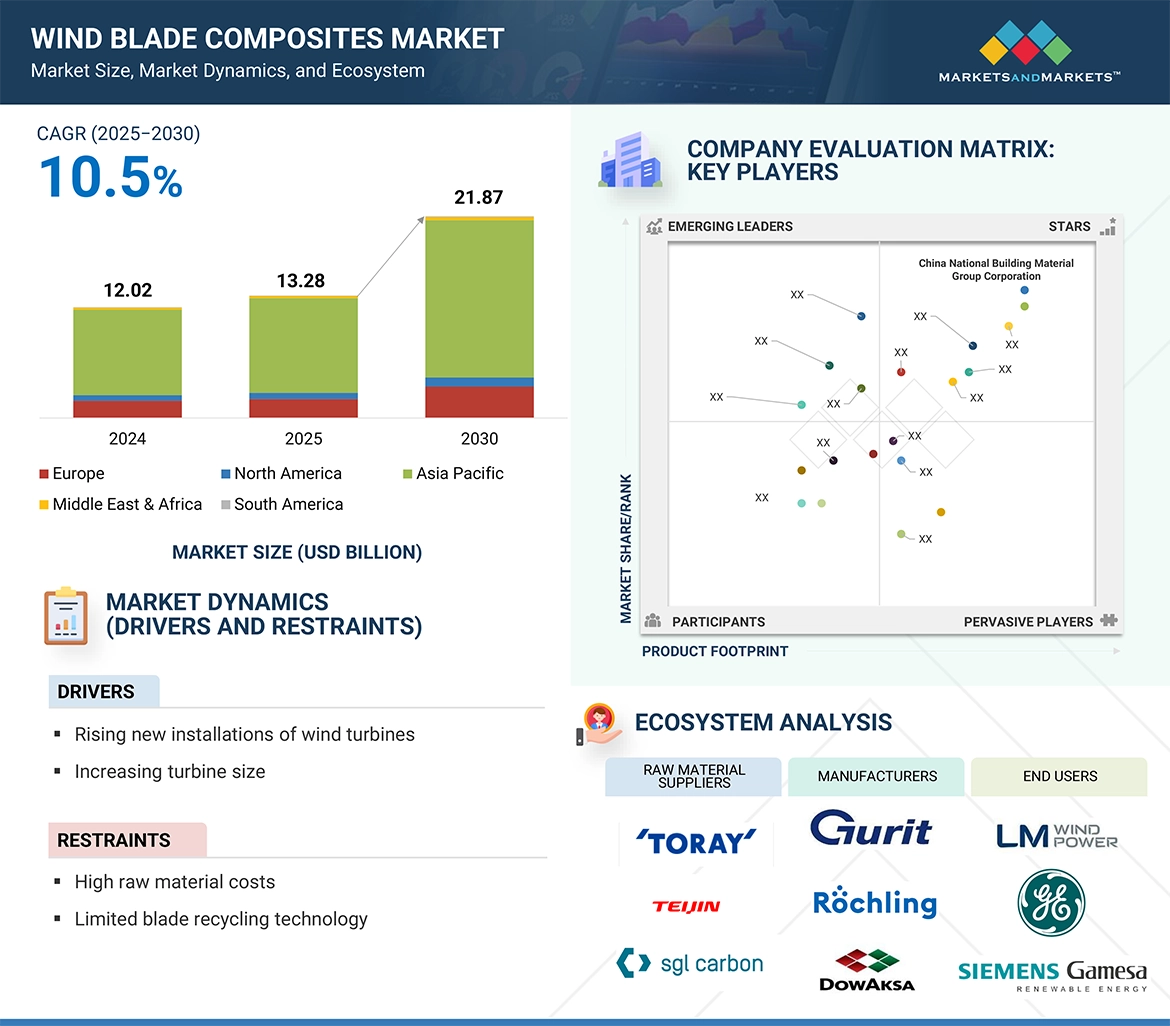


 HIGHEST CAGR MARKET FROM 2025 TO 2030
 INDIA FASTEST-GROWING MARKET IN REGION












Growth opportunities and latent adjacency in Wind Blade Composites Market