

Counter-UAS Market: From Standalone Systems to Layered, AI-Enabled Defense
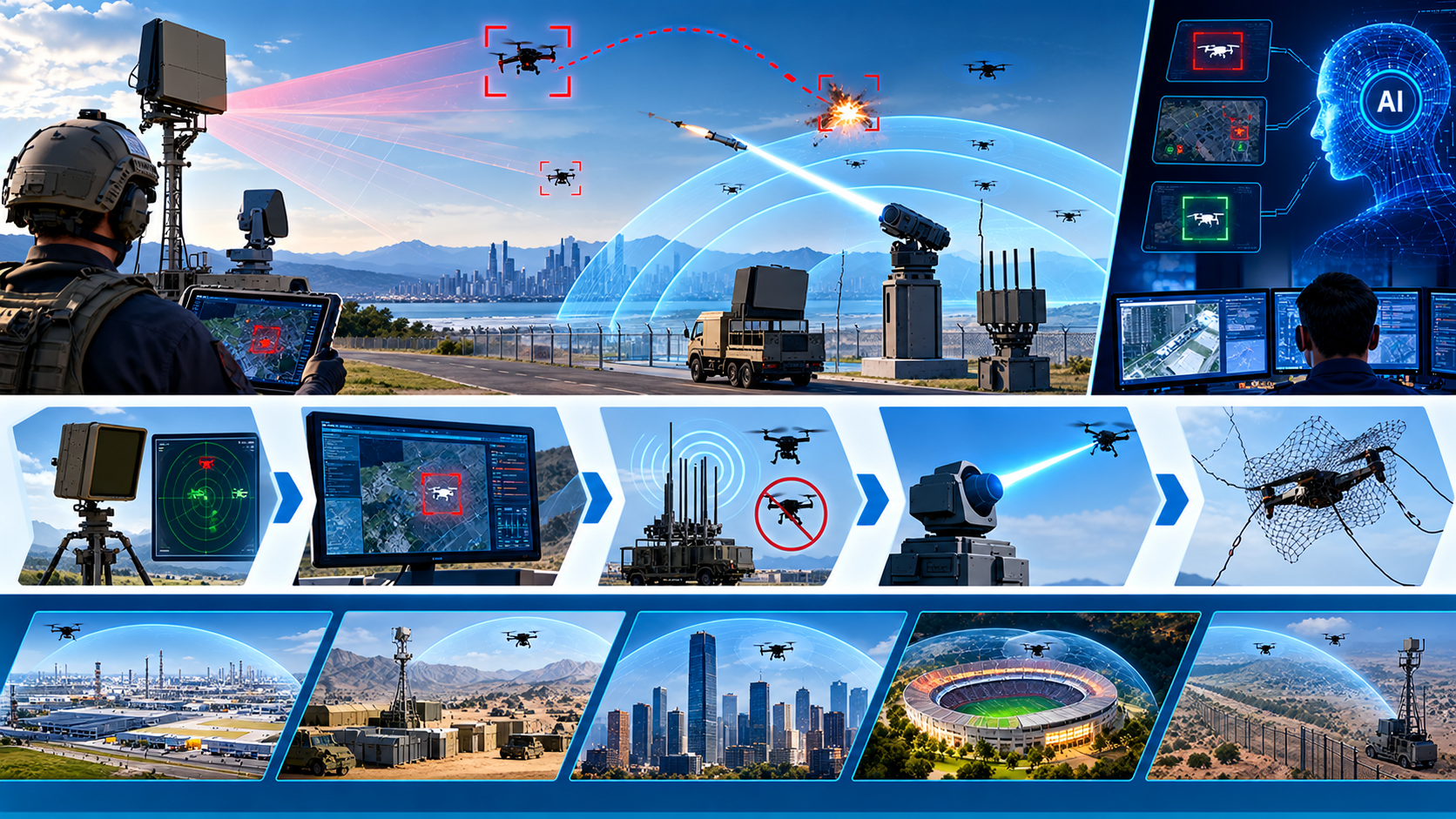
Recent developments, technology trends, and product decision implications
The Counter-Unmanned Aircraft Systems (C-UAS) market is entering a new phase as the proliferation of low-cost drones, autonomous systems, swarm attacks, and increasingly sophisticated unmanned platforms is changing the requirements for air defense. Military forces, critical infrastructure operators, and homeland-security agencies are moving beyond standalone radar or jamming systems toward integrated, layered C-UAS architectures combining detection, identification, tracking, command and control, and multiple defeat mechanisms.
Operational experience in Ukraine and the Middle East has demonstrated the challenge created by low-cost, high-volume, maneuverable and increasingly autonomous UAS threats. Future C-UAS solutions therefore need to address individual drones as well as coordinated attacks, RF-silent threats, low-altitude targets, and more sophisticated UAVs.
MarketsandMarkets Market Sizing & Forecast
According to MarketsandMarkets, the Global Counter-UAS System (C-UAS) Market Size was valued at USD 9.17 billion in 2026 and is projected to reach USD 29.70 billion by 2031, growing at a CAGR of 26.5% from 2026-2031.The strong growth outlook reflects increasing demand for integrated detection, tracking, identification, command-and-control, electronic warfare, kinetic and directed-energy defeat capabilities as defense forces respond to the proliferation of low-cost, autonomous, and increasingly sophisticated unmanned aerial systems.
This market trajectory provides a quantitative basis for assessing product attractiveness and prioritizing investment across C-UAS technologies. The forecast indicates a rapidly expanding addressable market in which suppliers can pursue growth through differentiated sensors, AI-enabled detection and classification, electronic warfare, low-cost interceptors, directed-energy systems, fire-control solutions, and integrated C2 architectures.
Key Trends Shaping the Counter-UAS Market
1. Shift Toward Layered C-UAS Architectures
The market is moving from individual counter-drone products toward layered architectures. Radar, RF detection, EO/IR and acoustic sensors are increasingly combined with electronic warfare, kinetic interceptors, directed-energy weapons, interceptor drones and C2. Recent US Army initiatives around multi-sensor, multi-modal C-UAS systems reinforce demand for integrated architectures and create opportunities for sensor, effector, AI/C2 and integration providers.
2. AI and Multi-Sensor Fusion Becoming Critical
AI is increasingly used for target classification, track management, threat prioritization and engagement decisions. Multi-sensor fusion is becoming essential where small drones operate at low altitude, around terrain or buildings, or with limited RF signatures. Ukraine's reported autonomous interceptor-drone capabilities illustrate the movement toward AI-assisted and increasingly autonomous engagement.
3. Growth of Low-Cost Interceptor Drones
The cost-exchange problem is accelerating interest in low-cost kinetic defeat. Ukraine has scaled interceptor-drone production, creating a new product category between conventional missiles and non-kinetic systems. Opportunities include autonomous/semi-autonomous interceptors, reusable platforms and expendable counter-drone systems designed for mass attacks.
4. Directed Energy and Non-Kinetic Defeat
High-energy lasers and high-power RF systems are gaining attention because of their potential for deep magazines and low marginal engagement cost. Electronic warfare remains important, but autonomous and alternative-control mechanisms mean buyers increasingly require soft-kill and hard-kill capabilities as complementary layers rather than substitutes.
5. Flexible, Product-Agnostic Acquisition
Procurement is increasingly designed to introduce multiple C-UAS technologies rather than rely on one solution. Recent US acquisition activity emphasizes flexibility because no single technology can address the complete drone threat. This favors modular, interoperable products that can integrate third-party sensors, effectors and C2.
Recent Counter-UAS Developments
|
Period |
Development |
Market Signal |
|
2025 |
US Army selected Anduril to advance next-generation C-UAS fire-control capabilities. |
Automation and fire-control are becoming central to C-UAS architectures. |
|
2026 |
US Army/DIU initiatives expanded multi-sensor C-UAS architectures. |
Integrated detection, tracking and defeat are gaining priority. |
|
2026 |
JIATF-401 expanded flexible C-UAS marketplace acquisition approaches. |
Procurement is moving toward modular and rapidly deployable capabilities. |
|
2026 |
$500M US Domestic Shield C-UAS IDIQ awarded to CACI. |
Large-scale demand for RF detection, direction finding and non-kinetic defeat. |
|
2026 |
Ukraine scaled autonomous interceptor-drone capabilities. |
AI-enabled, lower-cost kinetic interception is emerging as a major layer. |
Product Opportunity Areas
The market is shifting from the question 'Which counter-drone product should we buy?' to 'How should multiple technologies work together to provide the required level of protection?' This creates opportunities across:
- AI-enabled detection, classification and sensor fusion
- Compact low-altitude surveillance radar and passive RF detection
- Anti-jamming and RF-resilient detection technologies
- Autonomous and semi-autonomous interceptor drones
- Low-cost kinetic defeat and counter-swarm solutions
- High-energy laser and high-power RF directed-energy systems
- Mobile and vehicle-mounted C-UAS
- Open-architecture C-UAS and interoperable C2 systems
How the Counter-UAS Market Report Supports Product Decisions
Product Portfolio Decisions: Identify which C-UAS technology segments show the strongest demand and where capability gaps remain across sensors, EW, interceptors, directed energy, AI and C2.
Technology Investment Prioritization: Compare technologies by adoption, maturity, procurement activity, operational relevance, competitive intensity and future growth potential to prioritize R&D investment.
Target Customer Identification: Assess demand across military, homeland-security and critical-infrastructure users and identify countries and programs with strong procurement signals.
Competitive Positioning: Benchmark key companies across detection, tracking, C2, EW, kinetic defeat, directed energy and interceptor technologies to identify differentiation opportunities.
Partnership and M&A Strategy: Map ecosystem gaps and identify complementary partners for example, sensor providers with AI/C2 companies or interceptor developers with fire-control providers.
Program and Procurement Prioritization: Track contracts, demonstrations, tenders, trials and government initiatives to distinguish active procurement opportunities from technology hype.
Product Roadmap Development: Translate market direction from standalone jammers toward layered architectures and from manual operation toward AI-assisted decision-making into future product requirements.
Conclusion
Counter-UAS is evolving from a niche defense capability into a core component of modern air-defense and force-protection architectures. The proliferation of drones, increasing autonomy, swarm tactics and the economics of mass attacks are driving defense organizations toward layered solutions that combine multiple sensors, AI-enabled decision-making and diverse defeat mechanisms. For technology providers, the opportunity extends beyond complete C-UAS systems to sensors, AI, fire control, electronic warfare, interceptor drones, directed energy, communications and C2. A detailed Counter-UAS Market report can therefore help companies determine which capability to develop, where to deploy it, which customer segment to target, and which partners or programs to pursue.
|
Metric |
2026 |
2031 |
2026–2031 CAGR |
|
Global C-UAS Market |
USD 9.17 Billion |
USD 20.3 Billion |
26.5% |
Market sizing source: MarketsandMarkets. Figures are reproduced from MarketsandMarkets published market outlook.
80% of the Forbes Global 2000 B2B companies rely on MarketsandMarkets to identify growth opportunities in emerging technologies and use cases that will have a positive revenue impact.
- Food Packaging Market Size Set for Strong Growth Through 2030 Amid Rising Demand for Convenience Foods
- Crop Protection Chemical Market Size, Share & Growth Forecast (2025–2030)
- Mulch Films Market: Driving Sustainable Agriculture Through Innovation
- Agricultural Adjuvants Market Analysis, Trends, and Growth Outlook (2026–2031)
- Japan Enterprise Asset Management Market Growth: AI and Smart Infrastructure Drive Demand


