

Food Encapsulation Market Analysis, Trends, and Future Outlook – 2030
The global food encapsulation market is projected to reach USD 21.79 billion by 2030, up from an estimated USD 14.50 billion in 2025, growing at a CAGR of 8.5% during the forecast period. This market is witnessing rapid growth as the food and nutrition industry increasingly adopts encapsulation technologies to enhance ingredient stability, extend shelf life, and improve functional performance.
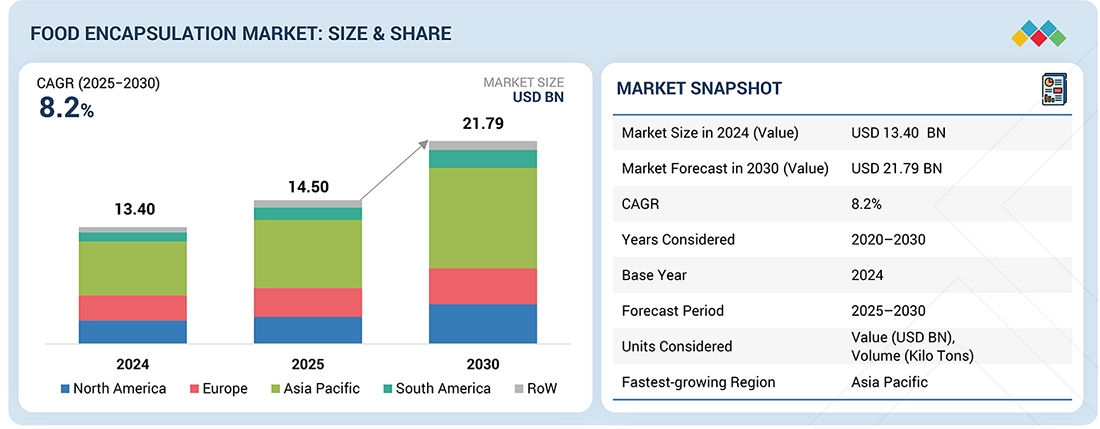
Food encapsulation enables the protection of active ingredients that are sensitive to heat, moisture, oxygen, and other processing stresses, ensuring consistent delivery and maintaining product quality throughout its lifecycle. This technology is particularly valuable for functional foods, fortified foods, dietary supplements, infant nutrition, and pet food, where nutritional efficacy and product consistency are critical.
Food Encapsulation Market Analysis
Overview of Food Encapsulation Technology
Food encapsulation involves enclosing active ingredients within a protective coating or matrix to prevent degradation caused by heat, oxygen, light, or moisture. This technology enables controlled release, improved bioavailability, and masking of undesirable flavors.
Food Encapsulation Market Segmentation
By Technology
- Spray drying
- Emulsification
- Coacervation
- Extrusion
- Nanoencapsulation
Spray drying remains the most widely used technique due to its cost efficiency and scalability in commercial food production.
By Core Material
- Polysaccharides
- Proteins
- Lipids
- Gums & resins
Natural and biodegradable materials are increasingly preferred to meet clean-label and sustainability requirements.
By Application
- Functional foods & beverages
- Nutraceuticals & dietary supplements
- Bakery & confectionery
- Dairy products
- Meat & poultry processing
Key Market Drivers
- Rising demand for functional and fortified foods
- Improved shelf-life and ingredient stability
- Growing health and wellness awareness
- Flavor masking of bitter or sensitive ingredients
- Expansion of nutraceutical and dietary supplement industries
Market Restraints and Challenges
- High production and formulation costs
- Technical complexity in controlled-release systems
- Regulatory variations across regions
- Limited awareness among small-scale food manufacturers
Despite these challenges, continuous R&D investments are helping overcome technological barriers.
Food Encapsulation Market Trends
Clean-Label and Natural Encapsulation Materials: The shift toward clean-label food products is accelerating the adoption of plant-based and natural encapsulating agents such as starch, maltodextrin, and proteins.
Growing Use in Probiotics and Nutraceuticals: Encapsulation plays a critical role in protecting probiotics from harsh processing and digestive environments, ensuring improved viability and efficacy.
Nanoencapsulation for Enhanced Bioavailability: Nanoencapsulation is emerging as a high-growth trend, offering:
- Higher solubility
- Improved nutrient absorption
- Precision release mechanisms
This technology is especially valuable in functional beverages and sports nutrition products.
Encapsulation in Plant-Based and Alternative Foods:
Manufacturers of plant-based foods are using encapsulation to:
- Mask off flavors
- Improve mouthfeel
- Deliver fat-soluble vitamins and omega fatty acids
- Sustainability-Focused Innovations
Eco-friendly encapsulation techniques and biodegradable carrier materials are gaining traction as sustainability becomes a strategic priority.
Food Encapsulation Market Outlook
Market Growth Prospects
The global food encapsulation market is expected to experience steady CAGR growth, supported by:
- Increasing consumption of health-focused foods
- Technological advancements in encapsulation processes
- Rising demand for personalized and targeted nutrition
Regional Outlook
- North America: Strong demand driven by functional food innovation and advanced food processing infrastructure
- Europe: Focus on clean-label, sustainability, and regulatory compliance
- Asia-Pacific: Fastest-growing region due to urbanization, rising incomes, and expanding food & beverage industries
- Latin America & Middle East: Emerging growth opportunities with increasing food fortification initiatives
Future Opportunities:
- Smart and stimulus-responsive encapsulation systems
- Integration with personalized nutrition solutions
- Expansion into pet nutrition and medical foods
- Strategic collaborations between ingredient suppliers and food manufacturers
Related Reports:
80% of the Forbes Global 2000 B2B companies rely on MarketsandMarkets to identify growth opportunities in emerging technologies and use cases that will have a positive revenue impact.
- Food Packaging Market Size Set for Strong Growth Through 2030 Amid Rising Demand for Convenience Foods
- Crop Protection Chemical Market Size, Share & Growth Forecast (2025–2030)
- Mulch Films Market: Driving Sustainable Agriculture Through Innovation
- Agricultural Adjuvants Market Analysis, Trends, and Growth Outlook (2026–2031)
- Japan Enterprise Asset Management Market Growth: AI and Smart Infrastructure Drive Demand

Emerging Trends and Growth Opportunities in the Food Encapsulation Market
For In-depth Analysis on Food Encapsulation Market
