

AI in Video Surveillance Technology Innovation: Key Trends, Growth Drivers and Opportunities
Introduction to AI in Video Surveillance Technology
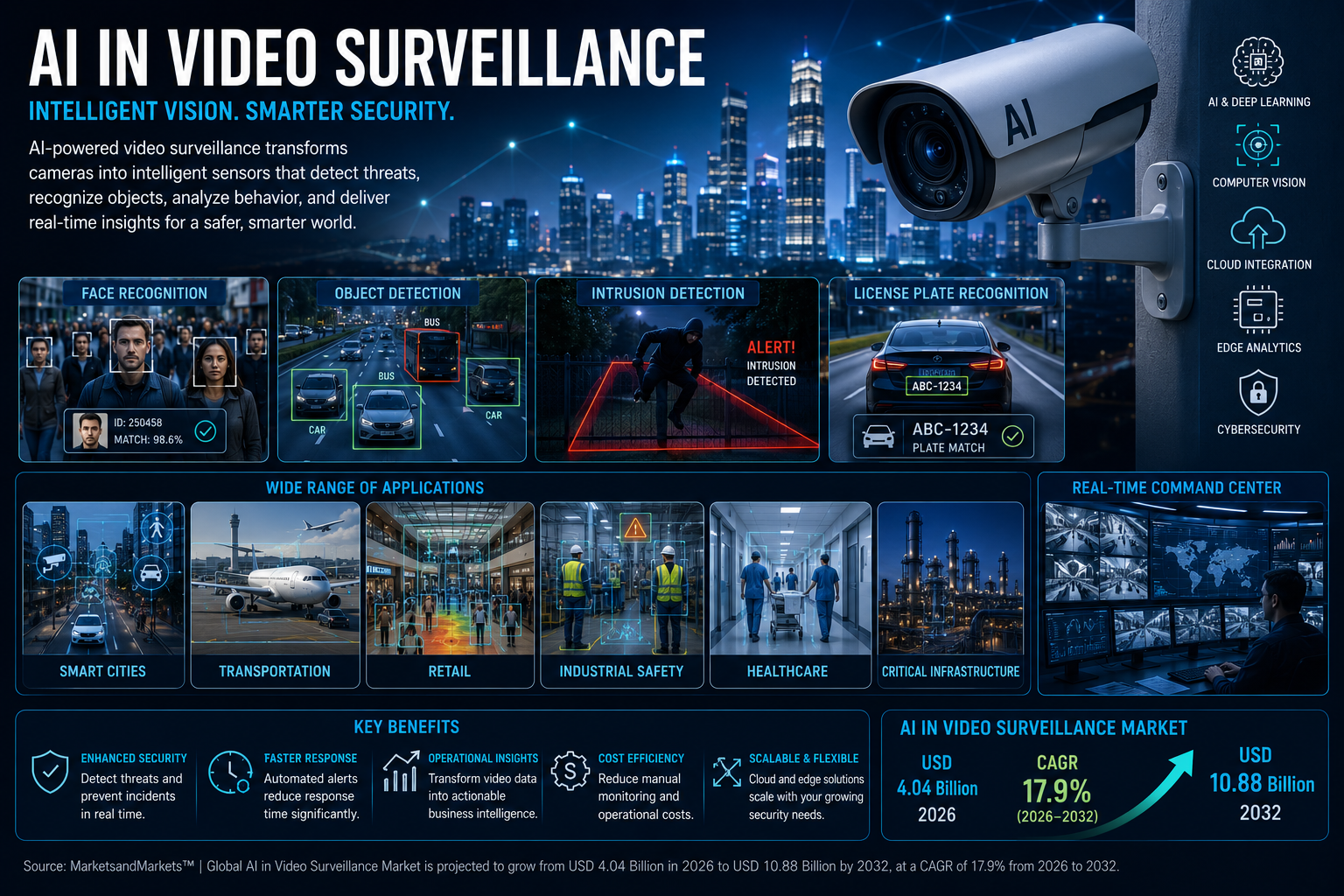
Artificial Intelligence (AI) is transforming the video surveillance industry by enabling intelligent monitoring, real-time threat detection, and automated decision-making. Unlike traditional surveillance systems that rely heavily on manual monitoring, AI-powered video surveillance leverages computer vision, deep learning, machine learning, and edge AI to analyze video streams, recognize objects, detect anomalies, and generate actionable insights. These capabilities help organizations improve security, reduce response times, and optimize operational efficiency. As smart cities, intelligent transportation, critical infrastructure, retail, healthcare, and industrial facilities continue to adopt digital technologies, AI-powered video surveillance is becoming a key component of modern security and public safety strategies.
History of AI in Video Surveillance Technology
Video surveillance technology has evolved significantly from analog CCTV systems to intelligent, AI-driven surveillance platforms. Early surveillance systems primarily recorded footage for later review, requiring continuous human supervision to identify security incidents. The introduction of IP cameras, cloud computing, and advanced analytics marked the beginning of smarter surveillance solutions. Over the past decade, rapid advancements in artificial intelligence, computer vision, neural networks, and edge computing have enabled surveillance systems to automatically recognize faces, detect suspicious behavior, classify objects, and predict potential security threats. Today, AI-powered surveillance is widely used across commercial, industrial, transportation, and government sectors to enhance situational awareness and operational intelligence.
Benefits of AI in Video Surveillance Technology
AI-powered video surveillance delivers far more than traditional security monitoring by transforming video data into real-time intelligence. Automated analytics reduce the burden on security personnel while improving detection accuracy, minimizing false alarms, and accelerating incident response. These systems also generate valuable operational insights that help organizations optimize business processes, ensure regulatory compliance, and improve customer and employee safety.
Key Benefits Include:
- Enables real-time threat detection using AI-powered video analytics.
- Improves security through facial recognition, object detection, and behavioral analysis.
- Reduces false alarms by distinguishing genuine threats from routine activities.
- Supports faster incident response with automated alerts and intelligent event classification.
- Enhances operational efficiency by reducing manual video monitoring requirements.
- Provides actionable business intelligence through occupancy, traffic flow, and customer behavior analysis.
- Integrates seamlessly with IoT devices, access control systems, and smart city infrastructure.
- Supports predictive security and proactive risk management using advanced AI algorithms.
Current Market Size and Growth Trends of the AI in Video Surveillance Market
The AI in Video Surveillance market is experiencing rapid growth as organizations increasingly deploy intelligent surveillance solutions to strengthen security, improve operational efficiency, and support digital transformation initiatives. The widespread adoption of smart cities, connected infrastructure, cloud-based surveillance, and edge AI platforms is driving demand for advanced video analytics across multiple industries. At the same time, growing investments in public safety, critical infrastructure protection, transportation security, and enterprise surveillance are accelerating the integration of AI-powered cameras and intelligent monitoring systems worldwide.
According to MarketsandMarkets, the global AI in Video Surveillance market is projected to grow from USD 4.04 billion in 2026 to USD 10.88 billion by 2032, registering a CAGR of 17.9% from 2026 to 2032.
D0wnload PDF Brochure: https://www.marketsandmarkets.com/pdfdownloadNew.asp?id=84216922
Key Market Growth Drivers
- Rising adoption of AI-powered video analytics for intelligent security monitoring.
- Increasing investments in smart city and public safety initiatives worldwide.
- Growing deployment of edge AI cameras and cloud-based surveillance platforms.
- Rising demand for facial recognition, license plate recognition, and behavioral analytics.
- Expansion of surveillance systems across transportation, retail, healthcare, manufacturing, and critical infrastructure.
- Continuous advancements in computer vision, deep learning, and machine learning technologies.
- Increasing integration of AI surveillance with IoT, 5G connectivity, and smart building management systems.
Key Drivers and Factors Influencing the Future of AI in Video Surveillance Technology
The future of AI in Video Surveillance technology is being driven by rapid advancements in artificial intelligence, computer vision, edge computing, and cloud-based analytics. As organizations seek smarter security solutions that go beyond traditional video recording, AI-powered surveillance systems are becoming capable of detecting threats, recognizing patterns, and providing real-time decision support. Increasing investments in smart cities, critical infrastructure protection, intelligent transportation, and enterprise security are accelerating the deployment of AI-enabled surveillance platforms. At the same time, advancements in deep learning, edge AI processors, 5G connectivity, and predictive analytics are enabling surveillance systems to deliver faster, more accurate, and proactive security intelligence.
Key Growth Drivers
- Growing adoption of AI-powered video analytics for automated threat detection and security monitoring.
- Rising investments in smart cities, intelligent transportation systems, and public safety infrastructure.
- Expansion of edge AI cameras capable of processing video locally with minimal latency.
- Increasing demand for facial recognition, object detection, license plate recognition (LPR), and behavioral analytics.
- Rapid deployment of 5G networks, enabling high-speed video transmission and real-time surveillance.
- Growing need for advanced security across airports, hospitals, manufacturing facilities, retail stores, and critical infrastructure.
- Increasing integration of AI surveillance with IoT devices, access control systems, cybersecurity platforms, and smart building technologies.
Emerging Trends in AI in Video Surveillance Technology
AI in Video Surveillance is evolving rapidly as organizations adopt intelligent analytics that transform surveillance systems into proactive security and operational management tools. Modern surveillance platforms now combine AI, machine learning, cloud computing, and edge intelligence to deliver real-time insights while reducing dependence on manual monitoring. Emerging technologies such as generative AI, Digital Twins, and multimodal analytics are further enhancing the accuracy, scalability, and adaptability of intelligent surveillance solutions across public and private sectors.
Key Emerging Trends
- Increasing adoption of edge AI for real-time video processing and low-latency decision-making.
- Growing implementation of Generative AI to improve incident analysis, video summarization, and intelligent search capabilities.
- Integration of Digital Twin technology for virtual monitoring of smart buildings, factories, and city infrastructure.
- Rising use of predictive analytics to identify suspicious activities before security incidents occur.
- Expansion of cloud-based video surveillance (VSaaS) for centralized management and remote monitoring.
- Increasing deployment of thermal imaging cameras integrated with AI for perimeter security and industrial safety.
- Growing adoption of multimodal AI analytics, combining video, audio, and sensor data for comprehensive situational awareness.
Opportunities and Challenges in the AI in Video Surveillance Market
The AI in Video Surveillance market presents significant opportunities as governments and enterprises continue investing in intelligent security, operational efficiency, and digital transformation. AI-powered surveillance is expanding beyond conventional security applications to support business intelligence, traffic management, workplace safety, healthcare monitoring, and industrial automation. However, concerns related to data privacy, cybersecurity, ethical AI usage, and regulatory compliance remain key challenges that organizations must address to ensure responsible deployment.
Key Opportunities
- Growing deployment across smart cities, urban surveillance, and intelligent traffic management systems.
- Increasing adoption in retail for customer behavior analysis, loss prevention, and store optimization.
- Expansion within healthcare for patient monitoring, hospital security, and asset tracking.
- Rising implementation across manufacturing for workplace safety, quality inspection, and operational monitoring.
- Growing use in airports, railways, ports, and logistics hubs for passenger safety and infrastructure protection.
- Expansion of AI-powered surveillance in banking, education, hospitality, and commercial buildings.
Key Challenges
- Privacy concerns associated with facial recognition and continuous video monitoring.
- Increasing cybersecurity risks targeting cloud-connected surveillance systems.
- Compliance with evolving data protection regulations and AI governance frameworks.
- High implementation costs for enterprise-scale intelligent surveillance deployments.
- Managing large volumes of video data while ensuring processing efficiency and storage optimization.
- Addressing AI bias and improving the accuracy of recognition algorithms across diverse environments.
Innovations and Advancements in AI in Video Surveillance Technology
Continuous innovation is making AI-powered video surveillance systems more intelligent, accurate, and scalable. Advances in deep learning, computer vision, neural processing units, and edge AI are enabling surveillance platforms to recognize complex events, automate threat detection, and deliver predictive security insights. These innovations are transforming surveillance from a passive recording system into an active decision-support platform that enhances safety, operational efficiency, and business intelligence across multiple industries.
Recent Innovations
- AI-powered real-time facial recognition, object tracking, and anomaly detection for enhanced situational awareness.
- Advanced edge AI processors enabling instant analytics without relying on centralized cloud infrastructure.
- Integration of Digital Twin platforms for intelligent monitoring and simulation of physical environments.
- Cloud-native surveillance platforms supporting remote monitoring, centralized management, and scalable video analytics.
- AI-assisted video summarization and natural language search for faster incident investigation.
- Intelligent predictive security analytics using machine learning to identify emerging risks before incidents occur.
- Integration of surveillance systems with IoT sensors, drones, robotics, and autonomous security platforms for comprehensive, real-time security management.
Future Applications and Industries That Will Benefit from AI in Video Surveillance Technology
AI in Video Surveillance technology is expected to become a cornerstone of next-generation security, public safety, and intelligent operations as organizations increasingly adopt digital transformation strategies. Future surveillance systems will move beyond passive monitoring to provide predictive intelligence, autonomous threat detection, and real-time decision support. The convergence of Artificial Intelligence (AI), computer vision, edge computing, cloud platforms, Digital Twins, Internet of Things (IoT), and 5G connectivity will enable highly intelligent surveillance ecosystems capable of identifying risks before incidents occur. As a result, AI-powered video surveillance will continue expanding across government, commercial, industrial, transportation, healthcare, and smart city applications.
Key Future Applications
- Smart Cities: Enable intelligent traffic management, public safety monitoring, crowd analytics, emergency response coordination, and infrastructure security through AI-powered surveillance networks.
- Transportation & Mobility: Improve security across airports, railway stations, metro networks, seaports, highways, and intelligent transportation systems with automated incident detection and traffic flow analysis.
- Retail & Commercial Buildings: Enhance loss prevention, customer behavior analysis, occupancy monitoring, queue management, and personalized shopping experiences using AI-driven analytics.
- Healthcare: Support patient monitoring, hospital security, restricted area surveillance, elderly care, and emergency response while improving operational efficiency in healthcare facilities.
- Manufacturing & Industrial Facilities: Strengthen workplace safety, monitor production lines, detect equipment anomalies, ensure regulatory compliance, and secure critical industrial assets.
- Critical Infrastructure: Protect power plants, oil & gas facilities, water treatment plants, telecommunications infrastructure, and data centers through continuous AI-enabled monitoring and threat detection.
- Banking & Financial Services: Improve branch security, ATM monitoring, fraud prevention, and access control with facial recognition and intelligent video analytics.
- Education: Enhance campus security through intelligent visitor management, emergency detection, perimeter monitoring, and student safety systems.
- Hospitality & Entertainment: Improve guest safety, optimize crowd management, monitor public spaces, and streamline facility operations using AI-powered surveillance.
- Defense & Homeland Security: Strengthen border surveillance, military installations, disaster response, and national security operations with autonomous monitoring systems, drones, and advanced threat analytics.
As AI technologies continue to evolve, video surveillance will become an intelligent decision-support platform capable of delivering predictive security, operational insights, and enhanced situational awareness across a wide range of industries.
Conclusion: The Promising Future of AI in Video Surveillance Technology
AI in Video Surveillance technology is revolutionizing the security industry by transforming traditional camera systems into intelligent platforms capable of analyzing, understanding, and responding to events in real time. By combining artificial intelligence, computer vision, machine learning, and edge computing, organizations can improve security, reduce manual monitoring, accelerate incident response, and generate valuable operational intelligence from video data.
Continuous advancements in deep learning, cloud computing, Digital Twins, edge AI, and predictive analytics are significantly expanding the capabilities of AI-powered surveillance systems. These innovations are enabling faster threat detection, more accurate object recognition, intelligent behavioral analysis, and seamless integration with smart city infrastructure, access control systems, and enterprise security platforms. As a result, AI-powered surveillance is becoming a strategic investment for governments, enterprises, and infrastructure operators seeking to improve safety, efficiency, and resilience.
Find More Information on AI in Video Surveillance Technology Innovation @ https://www.marketsandmarkets.com/Market-Reports/ai-in-video-surveillance-market-84216922.html
80% of the Forbes Global 2000 B2B companies rely on MarketsandMarkets to identify growth opportunities in emerging technologies and use cases that will have a positive revenue impact.
- Food Packaging Market Size Set for Strong Growth Through 2030 Amid Rising Demand for Convenience Foods
- Crop Protection Chemical Market Size, Share & Growth Forecast (2025–2030)
- Mulch Films Market: Driving Sustainable Agriculture Through Innovation
- Agricultural Adjuvants Market Analysis, Trends, and Growth Outlook (2026–2031)
- Japan Enterprise Asset Management Market Growth: AI and Smart Infrastructure Drive Demand

