

Semiconductor and IC Packaging Materials Gains Momentum as Amkor Invests $7B in Arizona
.jpg)
Amkor Technology is making one of the boldest bets yet on America’s semiconductor resurgence, breaking ground on a massive advanced packaging and test campus in Peoria, Arizona, with its total planned investment rocketing to $7 billion. This multi-phase project will create the first high-volume, U.S.-based outsourced advanced packaging and testing facility, expanding the nation’s critical back-end semiconductor manufacturing capabilities. With both phases complete, the sprawling campus will feature over 750,000 square feet of cleanroom space and employ as many as 3,000 high-quality workers, directly reinforcing the domestic chip supply chain and positioning Arizona as a semiconductor powerhouse. Phase one construction is expected to finish in mid-2027, with production beginning in early 2028, while a second greenfield facility will add even greater production scale.
Building a Seamless, End-to-End U.S. Semiconductor Ecosystem, This strategically located site in Arizona’s growing high-tech corridor is designed to complement the front-end wafer fabrication by partners such as TSMC, enabling a seamless end-to-end U.S. manufacturing ecosystem for customers including Apple and NVIDIA. Leveraging smart factory technologies and scalable production lines, Amkor’s facility will meet surging demand for advanced packaging solutions in AI, high-performance computing, mobile communications, and automotive semiconductors — sectors accelerating the global technology race. Backed by support from the Trump Administration’s CHIPS for America Program, the Advanced Manufacturing Investment Tax Credit, and state and local incentives, the project represents a coordinated public-private push to reindustrialize America’s semiconductor value chain.
Apple’s Chief Operating Officer Sabih Khan emphasized the importance of the new facility in building an onshore silicon supply chain, noting that Amkor will package and test chips produced at TSMC Arizona just down the road, unlocking unprecedented speed and integration in domestic production. NVIDIA's CEO Jensen Huang described the investment as a defining milestone, aligning with AI’s explosive growth and America’s mission to bring back strategic manufacturing capabilities. U.S. Secretary of Commerce Howard Lutnick called the venture a critical step in delivering “all stages of semiconductor manufacturing back to the United States,” while Arizona Governor Katie Hobbs hailed it as transformative for the state’s economy and innovation leadership.
Powering Growth in the Semiconductor Packaging Materials Market.
The implications for the semiconductor packaging materials market are significant. According to MarketsandMarkets, the global semiconductor IC packaging materials market — covering substrates, bonding wires, leadframes, encapsulants, and die attach materials — is projected to grow at a robust CAGR through 2027, driven by rising demand for advanced packaging technologies across AI, 5G, EV, and data center applications. Facilities like Amkor’s Arizona campus will be central in capturing this growth, enabling the delivery of smaller, faster, and more energy-efficient chips through innovations such as system-in-package (SiP) and wafer-level processing. As more manufacturing stages come onshore, U.S. suppliers of IC packaging materials could see unprecedented opportunities to serve next-generation device makers domestically and globally.
Industry leaders acknowledge that Arizona is becoming the epicenter of America’s chip industry, adding the Amkor campus to more than $210 billion in semiconductor projects already planned or underway in the state. This ecosystem now includes front-end fabs, advanced packaging, and test facilities — a rare full-stack manufacturing hub within U.S. borders. With geopolitical uncertainties and the global race to dominate AI and semiconductor innovation, such domestic capacity ensures that the country can secure its technology leadership while shortening supply chains and driving down time-to-market for complex devices.
Amkor’s bold expansion sends a clear message — America is not just competing in semiconductor manufacturing; it intends to lead with an integrated, resilient, and technologically advanced ecosystem. This facility will be a cornerstone in meeting future market demands, catalyzing downstream industries, and reinforcing the U.S. position in the global semiconductor landscape. By merging public vision with private execution, Arizona’s “Silicon Oasis” is set to define the next era of chip innovation.
MarketsandMarkets Industry News Desk
 Letter to Editor
Editor's Pick

Healthcare
Cellevate’s Nanofiber Revolution 13× Higher Vaccine Yields, 85% Lower Costs.jpg)
Chemical and Materials
Semiconductor and IC Packaging Materials Gains Momentum as Amkor Invests $7B in Arizona
Information and Communication Technology
AI-Driven Data Center Expansion is Accelerating Innovation in Power Infrastructure WorldwidePODCASTS
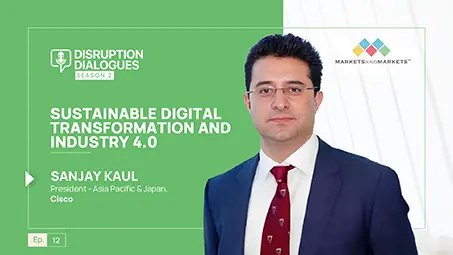
Sustainable Digital Transformation & Industry 4.0
Sanjay Kaul, President-Asia Pacific & Japan, Cisco, and host Aashish Mehra, Chief Research Officer, MarketsandMarkets, in conversation on unraveling 'Sustainable Digital Transformation and Industry 4.0'
11 July 2023|S2E12|Listen Now

Generative AI
Prasad Joshi, Senior Vice President-Emerging Technology Solutions, Infosys, and host, Vinod Chikkareddy, CCO, MarketsandMarkets, in exploring the recent advances in AI and the generative AI space.
7 Nov 2023|S2E13|Listen Now


Semiconductor & IC Packaging Materials Market Trends


Amkor Technology Catalyzes U.S. Semiconductor Packaging Market with Major Arizona Investment
Amkor Technology is expanding its advanced packaging footprint in Arizona, reinforcing the U.S. semiconductor supply chain. MarketsandMarkets highlights this as a major catalyst for the semiconductor packaging materials market.
Semiconductor & IC Packaging Materials Market Analysis
The Semiconductor & IC Packaging Materials Market has evolved alongside the rapid transformation of the global electronics and semiconductor industries. Initially, packaging materials primarily focused on providing basic protection and electrical interconnection for semiconductor devices. Over time, as chip architectures became smaller, faster, and more complex, packaging materials advanced to support high-density interconnects, thermal management, and reliability under extreme conditions.



