Agentic AI Security Market

Agentic AI Security Market by Security Function, Tool (Prompt Security Tools, Guardrail Frameworks, AI Pen Testing & Red Teaming Tools, Guardrail Frameworks), Deployment Layer - Global Forecast to 2032




OVERVIEW
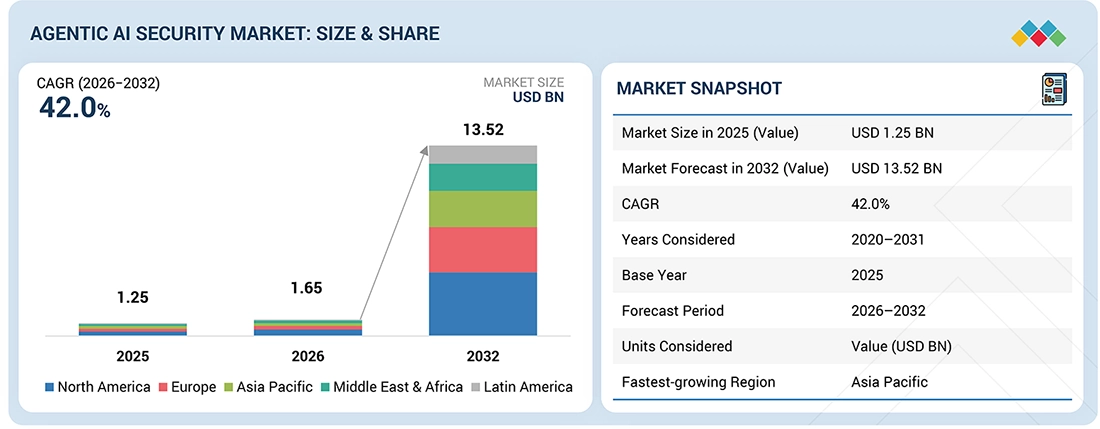
Source: Secondary Research, Interviews with Experts, MarketsandMarkets Analysis
The agentic AI security market is projected to reach USD 13.52 billion by 2032 from USD 1.65 billion in 2026, at a CAGR of 42.0% from 2026 to 2032. The rise of AI-to-AI attacks introduces a new threat layer in which malicious agents autonomously exploit other AI systems via APIs, prompts, or shared environments. These adversarial interactions mimic legitimate behavior, making detection difficult. According to IBM, adversarial attacks and model manipulation are among the top emerging AI security risks, driving demand for agent-specific security, trust validation, and continuous interaction monitoring frameworks.
Market Size and Forecast:
- Market Size Value in 2025: USD 1.25 Billion
- Market Size Value in 2026: USD 1.65 Billion
- Revenue Forecast in 2032: USD 13.52Billion
- Growth Rate: CAGR of 42% from 2026 to 2032
- Data available from 2025 to 2032
- Base year: 2025
- Forecast period: 2025–2032
- Fastest Region: Asia Pacific
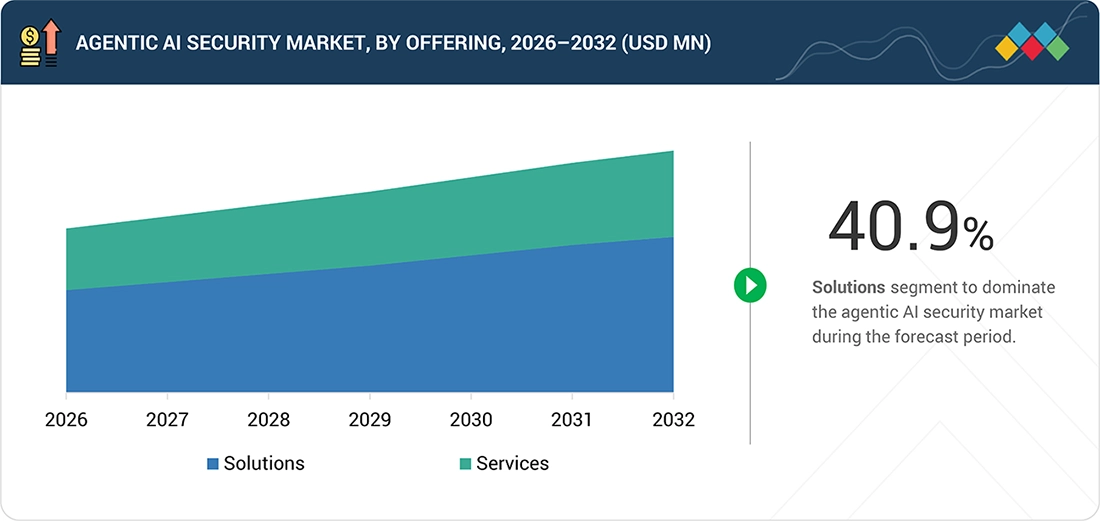
- The solution segments dominates with growing at a CAGR of 40.9%
Key Market Trends and Insights
- Growth Drivers: Rapid enterprise adoption of autonomous agents across critical workflows and the escalating threat of sophisticated AI-to-AI adversarial attacks
-
Opportunities exist: Emergence of AI-native platforms, integration with zero trust frameworks, and rapid expansion in the Asia Pacific region create significant opportunities
- Growing Trends: Rise of autonomous AI-to-AI attacks, vulnerabilities in inference layers, and a heavy enterprise shift toward semi-autonomous (Human-in-the-Loop) guardrails actively shape
- leading companies: Microsoft(US), Palo Alto Networks(US), CrowdStrike(US), Straiker, SentinelOne (US), Okta (US), Cloudflare (US)
KEY TAKEAWAYS
-
BY REGIONNorth America is expected to account for the largest share of 41.92% of the agentic AI security market in 2026.
-
BY SECURITY FUNCTIONBy security function, the threat detection & response segment is expected to dominate the market, accounting for the largest market share of 23.10% in 2026.
-
BY OFFERINGBy offering, the solutions segment is expected to dominate the market, accounting for the largest market share of 71.32% in 2026.
-
BY LEVEL OF AUTONOMYBy level of autonomy, the semi-autonomous systems (Human-in-the-Loop) segment is expected to dominate the market, accounting for the highest market share of 74.40% in 2026.
-
BY DEPLOYMENT LAYERBy deployment layer, the agent/orchestration layer segment will grow at the fastest rate during the forecast period.
-
BY ORGANIZATION SIZEBy organization size, the SMEs segment will register the fastest growth during the forecast period.
-
BY VERTICALBy vertical, the media & entertainment segment is expected to dominate the market, accounting for the largest market share in 2026.
-
COMPETITIVE LANDSCAPE - KEY PLAYERSMicrosoft, Google, and Palo Alto Networks are the major participants in the agentic AI security market. These companies offer AI-based Cybersecurity services on a platform to secure autonomous agents, AI models, and enterprise environments. Their services include threat detection and response, identity security, AI workload protection, and security orchestration. These features enable real-time tracking and the secure automatic activation and deployment of agentic AI systems within enterprise infrastructure.
-
COMPETITIVE LANDSCAPE - STARTUPSProtect Al, HiddenLayer, and Lakera are the Agentic AI security market startups. Such startups aim to achieve AI-native security by leveraging capabilities such as model security, adversarial threat detection, and prompt injection protection. They support the secure and reliable adoption of agentic AI technologies and create solutions to emerging risks across AI pipelines, agent interactions, and runtime environments.
Businesses that utilize agentic AI are increasingly facing legal and financial liability for the autonomous actions of AI Agents, especially in sectors such as finance, medicine, and critical infrastructure. If an AI agent is compromised, it can lead to unauthorized transactions or disruptions in ongoing operations. This situation is prompting organizations to invest in security frameworks that ensure traceability, management, and policy adherence in autonomous systems.
TRENDS & DISRUPTIONS IMPACTING CUSTOMERS' CUSTOMERS
Adoption of agentic AI across industries such as BFSI, healthcare, manufacturing, retail, and energy is reshaping the cybersecurity market. Traditional revenue streams from perimeter security and endpoint protection are shifting toward AI-native security, including agent monitoring, identity-centric controls, and automated response. This transition drives outcomes such as real-time threat mitigation, improved operational resilience, and secure scaling of autonomous enterprise workflows.
The global Agentic AI Security market was valued at approximately USD 1.65 billion in 2026 and is projected to reach USD 13.52 billion by 2032, growing at a CAGR of 42.0%. Revenue growth is being driven by rapid enterprise deployment of autonomous AI agents, increasing AI-to-AI attack vectors, adoption of AI runtime protection and guardrail frameworks, expansion of AI-enabled SOC operations, and growing investments in AI governance, identity security, and compliance solutions.
Investment activity is being complemented by strategic acquisitions as vendors consolidate identity security capabilities. Saviynt raised USD 700 million to expand AI-era identity security, while ServiceNow announced the acquisition of Veza to strengthen AI-native identity governance and access control capabilities for human, machine, and AI identities. These transactions highlight increasing enterprise demand for unified identity security platforms
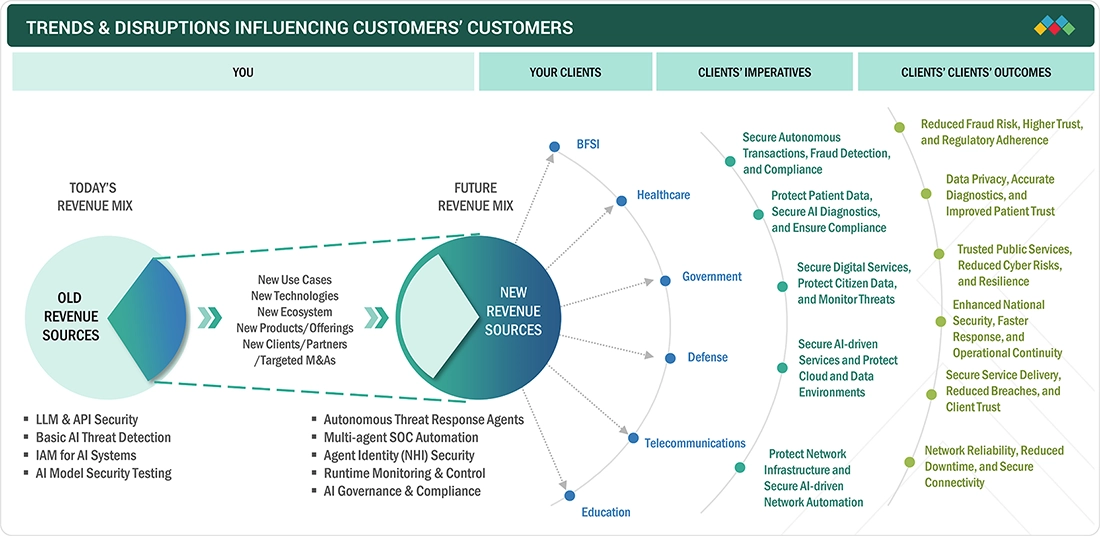
Source: Secondary Research, Interviews with Experts, MarketsandMarkets Analysis
MARKET DYNAMICS

Level
-
Rapid enterprise adoption of autonomous AI agents across critical workflows

-
Increasing risk of AI-to-AI and adversarial attacks targeting agent ecosystems


Level
-
Limited standardization in securing agentic AI architectures and protocols

-
High complexity in securing dynamic, self-learning AI systems


Level
-
Emergence of AI-native security platforms for agent monitoring and governance

-
Integration of agentic AI security with zero trust and identity-first frameworks


Level
-
Lack of visibility into autonomous agent decision-making and behavior

-
Difficulty in detecting and mitigating real-time manipulation of AI agents (e.g., prompt injection, model drift)

Source: Secondary Research, Interviews with Experts, MarketsandMarkets Analysis
Driver: Rapid enterprise adoption of autonomous AI agents across critical workflows
Enterprises are steadily integrating autonomous AI agents into key functions such as finance, customer service, and supply chain operations. These agents are beginning to take on decision-making roles and interact directly with systems. As their presence grows, so does the potential risk, prompting organizations to strengthen cybersecurity measures to ensure these environments remain secure and well-governed.
Restraint: Limited standardization in securing agentic AI architectures and protocols
A major limitation in this market is the lack of widely accepted standards for securing agentic AI systems. Organizations are adopting different architectures and approaches, which makes it challenging to apply consistent security controls. This variation often results in fragmented protection strategies and slows down the ability to implement scalable and unified security across environments.
Opportunity: Emergence of AI-native security platforms for agent monitoring and governance
The emergence of agentic AI is creating a need among agencies for AI-specific security platforms purpose-built to monitor, control, and protect autonomous agents. The platforms will provide real-time insights into agent actions, enforce policy-driven controls, and detect anomalies. As enterprises increase the size of multi-agent systems, these solutions offer substantial expansion potential for specialized cybersecurity vendors.
Challenge: Lack of visibility into autonomous agent decision-making and behavior
The lack of visibility into the decision-making processes and actions of autonomous agents poses significant challenges. There is a low level of transparency among these AI agents, making it difficult for organizations to monitor how decisions are made and actions are carried out. This lack of visibility complicates the detection of threats, the response to incidents, and compliance efforts. Additionally, it is challenging to identify abnormal behavior within systems, which puts security teams at risk of undetected attacks and unforeseen system issues.
AGENTIC AI SECURITY MARKET: COMMERCIAL USE CASES ACROSS INDUSTRIES
| COMPANY | USE CASE DESCRIPTION | BENEFITS |
|---|---|---|
 |
Protect AI secures machine learning models and agent pipelines by scanning for vulnerabilities, monitoring runtime behavior, and protecting against model tampering and supply chain risks in AI systems. | Improved model integrity, reduced risk of AI pipeline attacks, and stronger security across agent-driven environments. |
 |
Lakera provides real-time protection against prompt injection and malicious inputs targeting AI agents and LLM-based systems, ensuring safe interactions within autonomous workflows. | Prevention of prompt-based attacks, safer agent behavior, and improved trust in AI-driven applications. |
 |
Prevention of prompt-based attacks, safer agent behavior, and improved trust in AI-driven applications. | Protection against adversarial threats, enhanced model security, and reduced risk of AI system compromise. |
Logos and trademarks shown above are the property of their respective owners. Their use here is for informational and illustrative purposes only.
MARKET ECOSYSTEM
The agentic AI security ecosystem includes AI-native security vendors, cloud providers, identity and access management players, and SOC automation platforms. It integrates agent governance, runtime monitoring, and behavioral analytics to secure autonomous agents. Service providers support deployment and compliance, while enterprises drive adoption to protect dynamic, AI-driven attack surfaces.
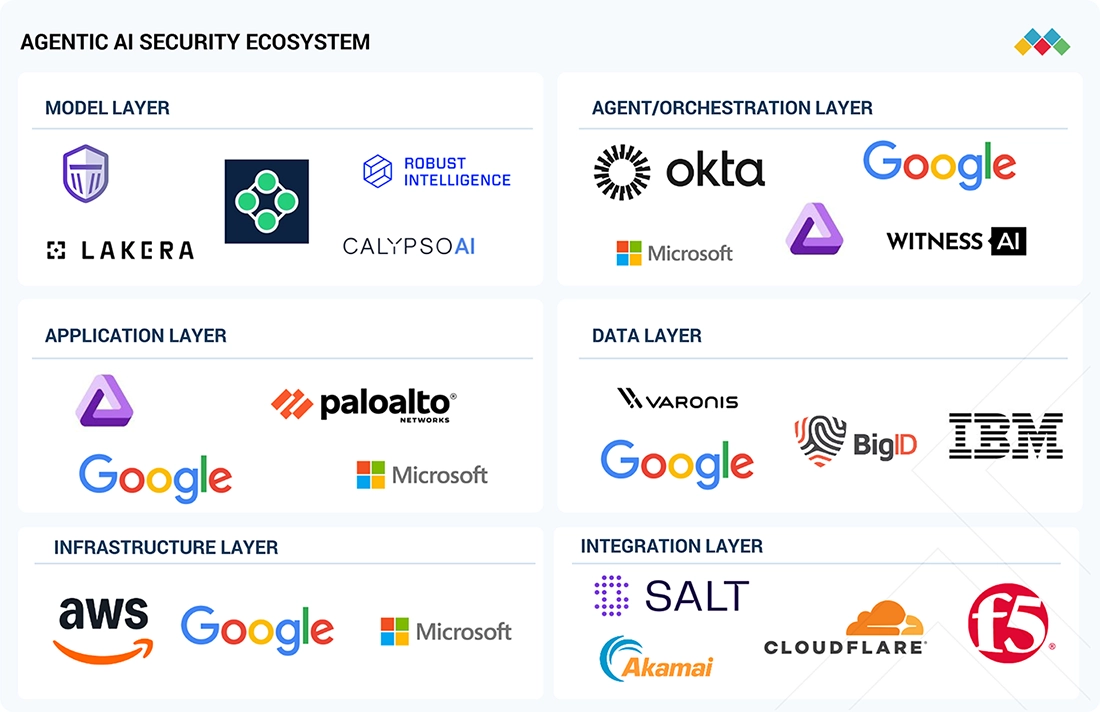
Logos and trademarks shown above are the property of their respective owners. Their use here is for informational and illustrative purposes only.
MARKET SEGMENTS
Source: Secondary Research, Interviews with Experts, MarketsandMarkets Analysis
Agentic AI Security Market, by Security Function
The threat detection and response segment holds the largest share of the agentic AI security market and is expected to continue growing. This growth is primarily due to the real-time monitoring and mitigation of AI-driven threats. As autonomous agents function across enterprise systems, organizations consider continuous detection, behavioral analytics, and automated responses essential for securing dynamic and evolving attack surfaces.
Agentic AI Security Market, by Offering
The solutions segment is expected to account for the largest share of the agentic AI security market as more autonomous system security and AI-native platforms and tools are adopted. All organizations are investing in built-in platforms and specialized tools such as prompt security, guardrails, and red teaming to secure AI agents and ensure the safe, large-scale deployment of AI agents.
Agentic AI Security Market, by Tools & Point Solution
The guardrail frameworks segment is expected to grow at the highest CAGR during the forecast period as organizations seek to establish governance and control over autonomous AI agents. The increasing demand for continuous policy enforcement, output validation, and compliance with evolving AI regulations is driving investments in guardrail frameworks across enterprise environments.
Agentic AI Security Market, by Level of Autonomy
The semi-autonomous systems segment is expected to hold the largest share of the agentic AI security market because businesses will still maintain a human element in key workflows. To balance the benefits of automation with risk management, institutions opt for controlled deployment of AI agents using human-in-the-loop models.
Agentic AI Security Market, by Deployment Layer
The agent/orchestration layer is expected to see the fastest growth in the agentic AI security market as the number of decision-making agents to be secured increases. With increasingly complex agent behavior, communication, and coordination, securing orchestration becomes essential to prevent manipulation, unauthorized actions, and cascading system risks.
Agentic AI Security Market, by Organization Size
The large enterprises segment is expected to hold the largest share in the agentic AI security market because they are the first to implement agentic AI in complex workflows and have greater investment potential. These companies require advanced security solutions to manage large-scale deployments, ensure compliance, and secure critical business operations.
Agentic AI Security Market, by Vertical
The BFSI vertical is expected to hold the largest share in the agentic AI security market, as the use of autonomous agents in fraud detection, risk assessment, and financial operations is rising. The need to protect sensitive data, ensure regulatory compliance, and prevent financial risks is driving the adoption of AI-focused cybersecurity solutions.
REGION
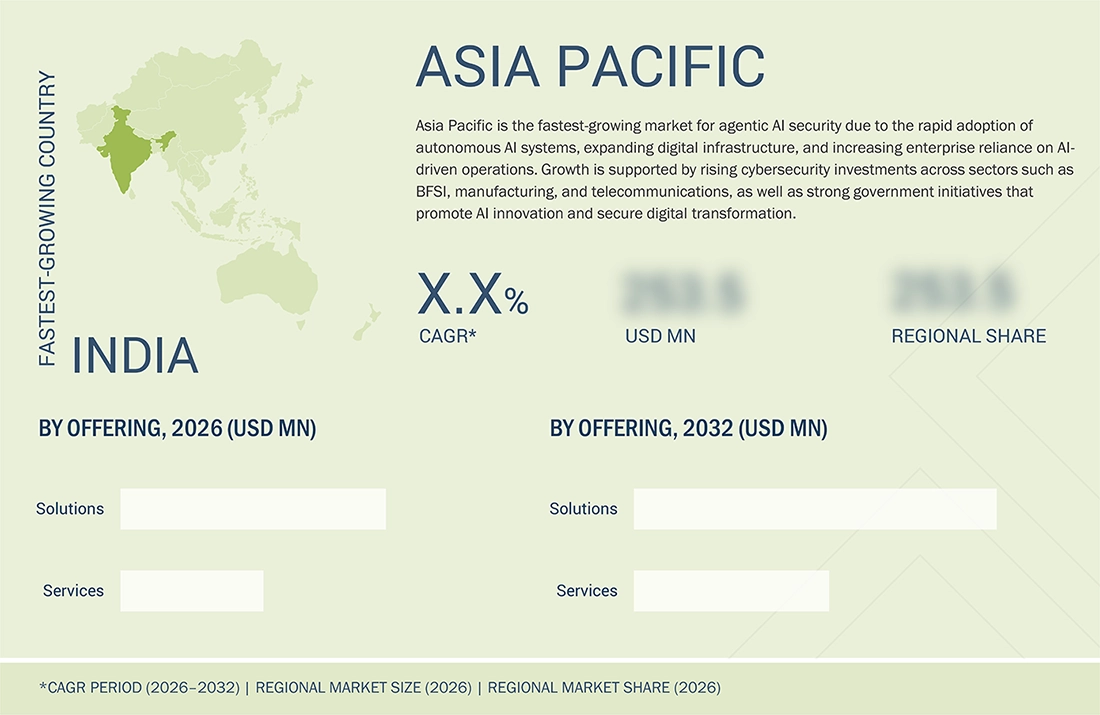
Asia Pacific to be fastest-growing region in agentic AI security market during forecast period
The Asia Pacific region is expected to experience the fastest growth in the agentic AI security market. This growth is driven by the rapid adoption of AI, the expansion of digital infrastructure, increasing cyber threats, and rising investments by enterprises in the security of autonomous and AI-driven systems.
AGENTIC AI SECURITY MARKET: COMPANY EVALUATION MATRIX
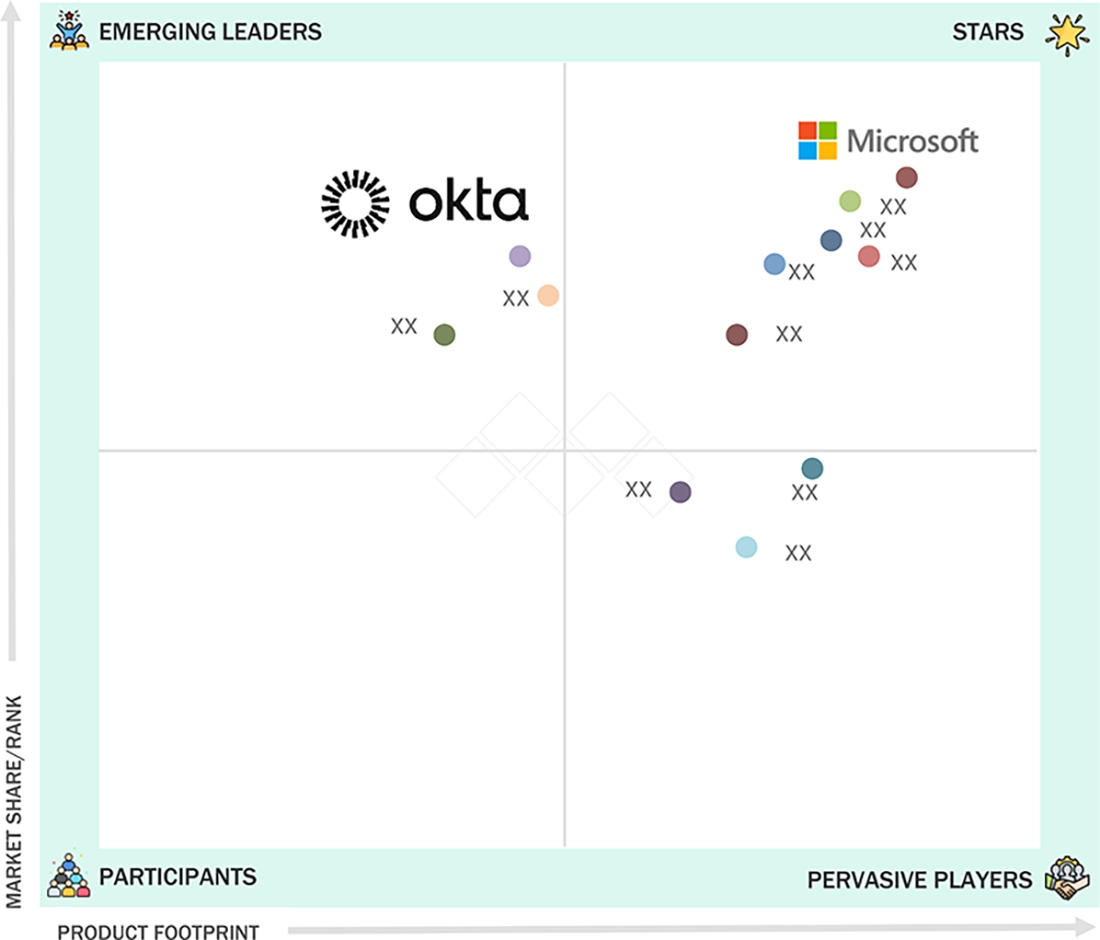
Microsoft (Star Player) is a major player in the agentic AI security market, boasting a formidable range of AI-based security applications, such as threat detection and response, identity security, and AI workload protection, underpinned by its cloud ecosystem and enterprise environment. Okta (Emerging Player) is strengthening its role by focusing on identity-centric security for agentic AI environments, enabling secure authentication, authorization, and lifecycle management for AI agents, as well as adaptive access controls and continuous identity verification across enterprise AI workflows.
Microsoft, Google, Palo Alto Networks, and CrowdStrike are consolidating their market positions by embedding agentic AI security into cloud platforms, SOC automation, and enterprise AI deployments, increasing their share of enterprise AI security spending.
Source: Secondary Research, Interviews with Experts, MarketsandMarkets Analysis
KEY MARKET PLAYERS
- Microsoft (US)
- Palo Alto Networks (US)
- CrowdStrike (US)
- SentinelOne (US)
- Okta (US)
- Cloudflare (US)
- Cato Networks (Israel)
- Check Point Software Technologies (Israel)
- Securiti (US)
- HiddenLayer (US)
- Noma Security (Israel)
- Obsidian Security (US)
- Mindgard (UK)
- DeepKeep (Israel)
- Enkrypt AI (US)
- Pillar Security (US)
- Astrix Security (Israel)
- Natoma (US)
- Trufoundry (US)
- Descope (US)
- Zenity (Israel)
- Fiddler AI (US)
- Openlayer (US)
- Aembit (US)
- Lasso Security (Israel)
- Akto (US)
- Credo AI (US)
- Promptfoo (US)
- Strata Identity (US)
- Holistic AI (UK)
- Geordie AI (UK)
- NeuralTrust (Spain)
- Usercentrics (Germany)
MARKET SCOPE
| REPORT METRIC | DETAILS |
|---|---|
| Market Size in 2026 (Value) | USD 1.65 Billion |
| Market Forecast in 2032 (Value) | USD 13.52 Billion |
| Growth Rate | CAGR of 42.0% from 2026–2032 |
| Key Companies |
|
| Growth Drivers |
|
| Years Considered | 2019–2032 |
| Base Year | 2025 |
| Forecast Period | 2026–2032 |
| Units Considered | Value (USD Billion) |
| Report Coverage | Revenue Forecast, Company Ranking, Competitive Landscape, Growth Factors, and Trends |
| Segments Covered |
|
| Regions Covered | North America, Europe, Asia Pacific, Middle East & Africa, Latin America |
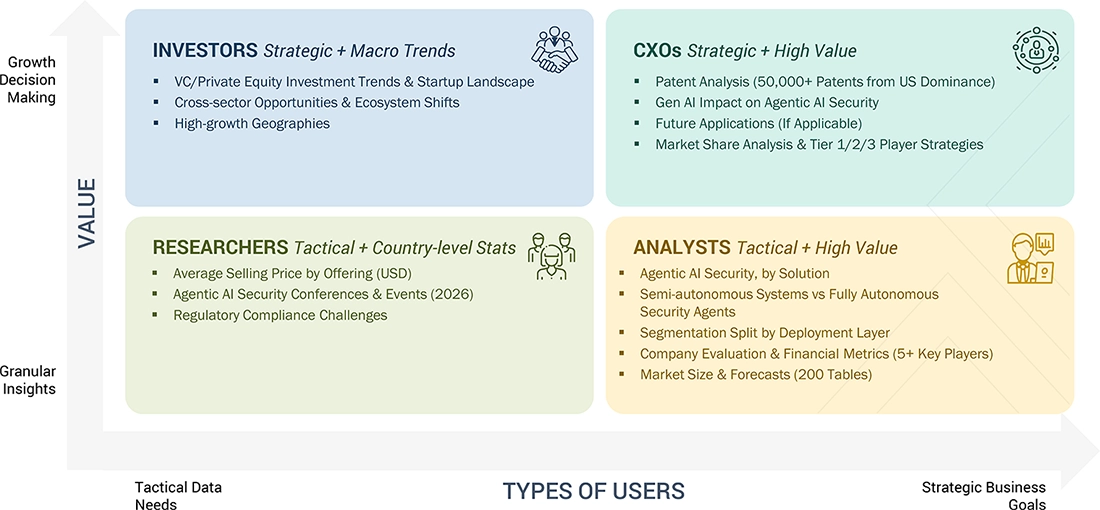
WHAT IS IN IT FOR YOU: AGENTIC AI SECURITY MARKET REPORT CONTENT GUIDE
DELIVERED CUSTOMIZATIONS
We have successfully delivered the following deep-dive customizations:
| CLIENT REQUEST | CUSTOMIZATION DELIVERED | VALUE ADDS |
|---|---|---|
| Leading Solution Provider (US) | Product analysis of the agentic AI security market, including a detailed comparison of vendors’ capabilities across threat detection & response, AI governance, identity security, and agent monitoring platforms. The study also covered AI-native security tools such as prompt security, guardrails, and red teaming, along with deployment capabilities across enterprise AI environments. | Enhanced understanding of competitive positioning in AI-native cybersecurity, visibility into platform capabilities for securing autonomous agents, and insights into evolving security architectures. Supported strategic investment decisions, product alignment, and long-term security strategies for AI-driven enterprise environments. |
| Leading Service Provider (EU) | Comprehensive profiling and evaluation of agentic AI security vendors and service providers, covering AI security platforms, managed AI security operations (AI SOC), integration services, and governance frameworks. The study also analyzed deployment models, partnerships, and adoption trends across industries such as BFSI, healthcare, retail, and energy. | Clear view of the evolving agentic AI security landscape, highlighting demand for AI-native security, growth in autonomous security operations, and vendor differentiation in securing AI systems. Enabled better understanding of market opportunities, service positioning, and enterprise adoption strategies. |
RECENT DEVELOPMENTS
- March 2026 : AWS and NVIDIA expanded their collaboration to support secure deployment of AI models and generative AI workloads. The partnership focuses on enabling scalable and secure infrastructure for AI systems, including agentic AI environments.
- March 2024 : Cisco announced its acquisition of Splunk in 2024 to strengthen its AI-driven security and observability capabilities. The integration focuses on enhancing threat detection, security analytics, and automation across enterprise and cloud environments.
Table of Contents
 Exclusive indicates content/data unique to MarketsandMarkets and not available with any competitors.
Methodology
Secondary research was conducted to collect information useful for this technical, market-oriented, and commercial study of the agentic AI security market. The next step involved validating these findings, assumptions, and sizing with industry experts across the value chain using primary research. Different approaches, including top-down and bottom-up methods, were employed to estimate the total market size. After that, the market breakup and data triangulation procedures were used to estimate the market size of the segments and subsegments of the agentic AI security market.
Secondary Research
During the secondary research process, various secondary sources were consulted to identify and collect information relevant to the study. The secondary sources included annual reports, press releases, investor presentations of Agentic AI security vendors, forums, certified publications, and white papers. The secondary research was mainly used to obtain key information about the industry’s supply chain, the total pool of key players, market classification and segmentation according to industry trends to the bottom-most level, regional markets, and key developments from both market- and technology-oriented perspectives, all of which were further validated by primary sources.
Primary Research
In the primary research process, various primary sources from both the supply and demand sides were interviewed to obtain qualitative and quantitative information for this report. The primary sources from the supply side included various industry experts, including chief executive officers (CEOs), vice presidents (VPs), marketing directors, technology and innovation directors, and related key executives from various key companies and organizations operating in the agentic AI security market.
In the market engineering process, top-down and bottom-up approaches were extensively used, along with several data triangulation methods, to perform market estimation and forecasting for the overall market segments and subsegments listed in this report. Extensive qualitative and quantitative analysis was performed on the complete market engineering process to list key information/insights throughout the report.
After the complete market engineering process (including calculations for market statistics, market breakups, market size estimations, market forecasts, and data triangulation), extensive primary research was conducted to gather information and verify & validate the critical numbers arrived at. The primary research was also conducted to identify the segmentation types, industry trends, competitive landscape of Agentic AI security market players, and key market dynamics, such as drivers, restraints, opportunities, challenges, industry trends, and key strategies.
Following is the breakup of the primary study:
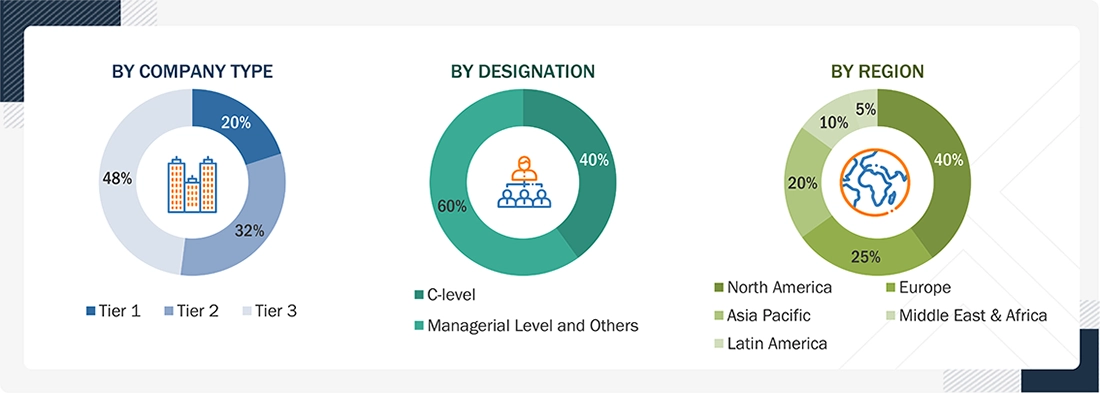
Please note the following classifications for companies based on their revenues:
- Tier 1 companies generate revenues exceeding USD 10 billion.
- Tier 2 companies have revenues ranging from USD 1 billion to USD 10 billion.
- Tier 3 companies earn revenues between USD 500 million and USD 1 billion.
To know about the assumptions considered for the study, download the pdf brochure
Market Size Estimation
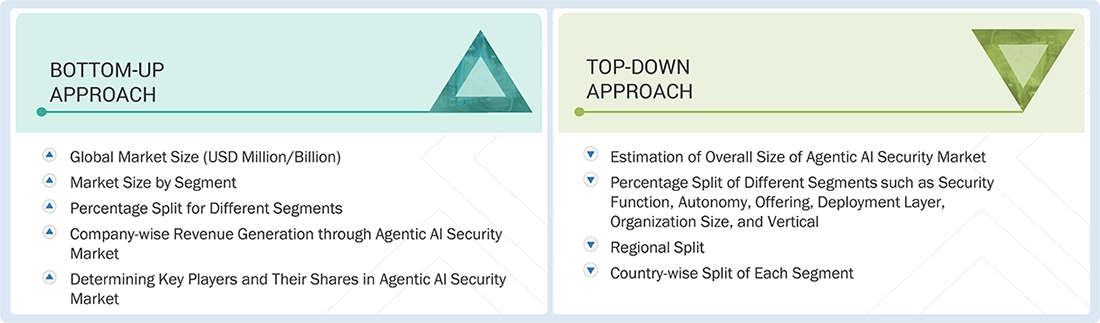
Top-down and bottom-up approaches were employed to estimate and validate the size of the agentic AI security market, as well as the size of various dependent subsegments within the overall agentic AI security market. The research methodology used to estimate the market size includes the following details: critical players in the market were identified through secondary research, and their market shares in the respective regions were determined through primary and secondary research. This entire procedure involved studying the annual and financial reports of the top market players and conducting extensive interviews with key industry leaders, including CEOs, VPs, directors, and marketing executives, to gather valuable insights.
All percentage splits and breakdowns were determined using secondary sources and verified through primary sources. All possible parameters that affect the market covered in this research study were accounted for, viewed in extensive detail, verified through primary research, and analyzed to get the final quantitative and qualitative data. This data was consolidated and added to detailed inputs and analysis from MarketsandMarkets.
Agentic AI Security Market : Top-Down and Bottom-Up Approach
Data Triangulation
The market was split into several segments and subsegments after arriving at the overall market size using the market size estimation processes explained above. The data triangulation and market breakup procedures were employed, wherever applicable, to complete the overall market engineering process and arrive at the exact statistics of each market segment and subsegment. The data was triangulated by studying various factors and trends from both the demand and supply sides.
Market Definition
According to MarketsandMarkets, agentic AI security refers to the set of technologies, solutions, and practices designed to protect autonomous AI agents, models, and their interactions across enterprise environments. It focuses on securing AI decision-making processes, agent behavior, data flows, and system integrations to prevent threats such as manipulation, unauthorized actions, and data leakage in agent-driven systems.
Key Stakeholders
- Chief Technology Officers (CTOs)
- Chief Information Security Officers (CISOs)
- AI and Data Security Leaders
- Cybersecurity Professionals and SOC Teams
- AI/ML Engineers and Developers
- Information Technology (IT) and Cloud Security Professionals
- Government and Regulatory Bodies
- Managed Security Service Providers (MSSPs)
- Consulting and Advisory Firms
- Small and Medium-sized Enterprises (SMEs) and Large Enterprises
- AI Platform, Cloud, and Infrastructure Providers
- Third-party AI Tool and Integration Providers
- Investors and Venture Capital Firms
Report Objectives
- To describe and forecast the agentic AI security market by offering, security function, deployment mode, organization size, vertical, and region from 2026 to 2031, and analyze the various macroeconomic and microeconomic factors that affect market growth
- To forecast the market size of five major regions: North America, Europe, Asia Pacific, the Middle East & Africa, and Latin America
- To analyze the subsegments of the market with respect to individual growth trends, prospects, and contributions to the overall market
- To provide detailed information regarding major factors (drivers, restraints, opportunities, and challenges) influencing the growth of the market
- To analyze opportunities in the market for stakeholders and provide details of the competitive landscape of major players
- To profile key market players, provide a comparative analysis based on the business overviews, regional presence, product offerings, business strategies, and key financials, and illustrate the competitive landscape of the market
- To analyze competitive developments, such as mergers & acquisitions, product developments, partnerships and collaborations, and research & development (R&D) activities, in the market
Customization Options
With the given market data, MarketsandMarkets offers customizations based on company-specific needs. The following customization options are available for the report:
Geographic Analysis
- Further breakup of the Asia Pacific market into countries contributing to the rest of the regional market size
- Further breakup of the North American market into countries contributing to the rest of the regional market size
- Further breakup of the Latin American market into countries contributing to the rest of the regional market size
- Further breakup of the Middle East & African market into countries contributing to the rest of the regional market size
- Further breakup of the European market into countries contributing to the rest of the regional market size
Company information
- Detailed analysis and profiling of additional market players (up to 5)
Key Questions Addressed by the Report
What is the projected growth of the Agentic AI Security Market?
The Agentic AI Security Market is projected to grow from USD 1.65 billion in 2026 to USD 13.52 billion by 2032, at a CAGR of 42.0%.
What is driving investment in the Agentic AI Security Market?
Growing enterprise adoption of autonomous AI agents and rising AI-to-AI adversarial attacks are accelerating investments in specialized security frameworks.
Which offering segment leads the Agentic AI Security Market?
The solutions segment leads the market, accounting for 71.32% share in 2026, driven by demand for prompt security, guardrails, and red teaming tools.
Which region is expected to grow fastest in the Agentic AI Security Market?
Asia Pacific is projected to register the highest CAGR due to rapid AI adoption, digital expansion, and rising cyber threats.
Who are the leading players in the Agentic AI Security Market?
Key players include Microsoft, Palo Alto Networks, CrowdStrike, SentinelOne, Okta, and Cloudflare.
What are the major trends shaping the Agentic AI Security Market?
Major trends include AI-native security platforms, zero-trust integration, prompt injection defense, autonomous agent governance, and human-in-the-loop security controls.


Personalize This Research
- Triangulate with your Own Data
- Get Data as per your Format and Definition
- Gain a Deeper Dive on a Specific Application, Geography, Customer or Competitor
- Any level of Personalization
Let Us Help You
- What are the Known and Unknown Adjacencies Impacting the Agentic AI Security Market
- What will your New Revenue Sources be?
- Who will be your Top Customer; what will make them switch?
- Defend your Market Share or Win Competitors
- Get a Scorecard for Target Partners

Custom Market Research Services
We Will Customise The Research For You, In Case The Report Listed Above Does Not Meet With Your Requirements
Get 10% Free CustomisationTESTIMONIALS
- France Agentic AI Security Market
- China Agentic AI Security Market
- Japan Agentic AI Security Market
- India Agentic AI Security Market
- UAE Agentic AI Security Market
- Rest Of Europe Agentic AI Security Market
- Rest Of Asia Pacific Agentic AI Security Market
- US Agentic AI Security Market
- Canada Agentic AI Security Market
- UK Agentic AI Security Market
- Germany Agentic AI Security Market






Growth opportunities and latent adjacency in Agentic AI Security Market