Agriculture Waste Management Market by Crop Type (Cereals & Grains, Fruits & Vegetables, Oilseeds & Pulses, Horticultural & Specialty crops, Rood & Tuber Crops), Technology Solution Type, End User, and Region – Global Forecast to 2030

icon1
USD 22.50 BN
MARKET SIZE, 2030
icon2
CAGR 9.2%
(2025-2030)
icon3
300
REPORT PAGES
icon4
230
MARKET TABLES

OVERVIEW

Waste Management Market Overview

Source: Secondary Research, Interviews with Experts, MarketsandMarkets Analysis

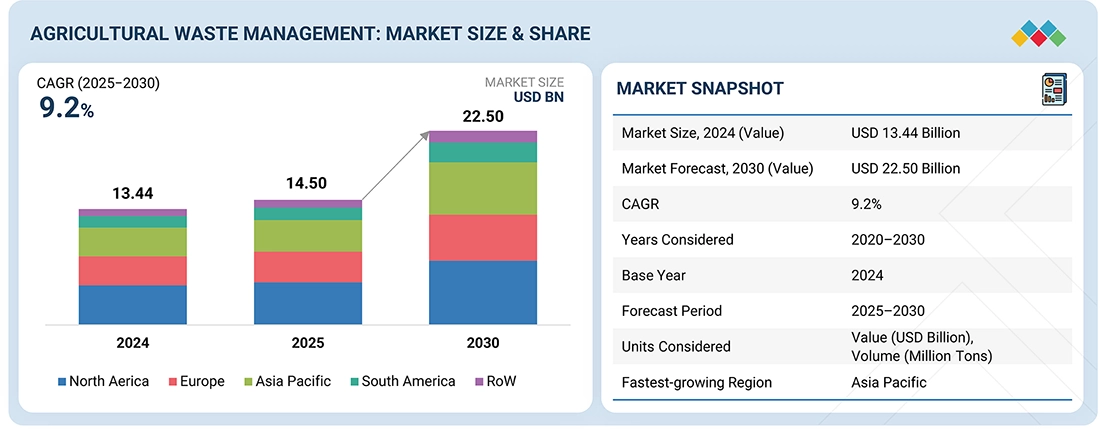
The agricultural waste management market is estimated at USD 14.50 billion in 2025 and is projected to reach USD 22.50 billion by 2030, at a CAGR of 9.2%. The market encompasses a range of technologies, practices, and infrastructure that minimize losses that occur throughout the supply chain, from post-harvest handling to storage, processing, and distribution.

KEY TAKEAWAYS

  • BY CROP TYPE
    Cereals & grains and fruits & vegetables represent the largest segments, driven by their high perishability and global consumption. Technologies targeting fruits & vegetables are in demand due to their short shelf life and susceptibility to post-harvest losses. Oilseeds & pulses require protection during storage and transport to minimize spoilage and contamination. Horticultural and specialty crops, though niche, benefit from customized solutions due to their high market value and export sensitivity.
  • BY SOLUTION TYPE
    Pre-harvest loss prevention technologies are dominating the market with the rise of precision agriculture, helping prevent losses due to weather, pests, and diseases. Post-harvest loss prevention technologies are gaining attention due to improper storage, pest attacks, and inefficient logistics. Harvest technologies, including efficient harvesting machinery and handling systems, support timely harvesting and reduce field-level losses, especially in labor-scarce regions.
  • BY TECHNOLOGY
    Sensor technology plays a pivotal role in monitoring crop conditions, storage environments, and supply chain logistics, enabling timely interventions to prevent loss. Cold chain & refrigeration technologies are crucial for maintaining the quality of perishable products, especially in fruits, vegetables, and dairy-based crops. Data & analytics technology empowers stakeholders with predictive insights to optimize harvesting, storage, and distribution decisions. Robotics & automation are increasingly adopted for mechanized harvesting, sorting, and grading, reducing human error and improving efficiency across the value chain.
  • BY END USER
    Individual and smallholder farmers are gradually adopting low-cost, scalable technologies designed to minimize harvest and post-harvest losses. Commercial farmers invest in integrated systems that cover the entire pre- to post-harvest process to ensure higher yield preservation. Agricultural cooperatives benefit from shared infrastructure and technology solutions, enabling collective reduction in food loss. Logistics and warehousing providers are key to maintaining product quality during transit and storage through cold chain systems and smart tracking. Food processors and manufacturers prioritize loss reduction to ensure a consistent raw material supply and meet sustainability goals.
  • BY REGION
    Asia Pacific is projected to be the fastest-growing region due to the increasing pressure to reduce post-harvest losses, growing food security initiatives, and rising investments in agri-tech solutions. Africa and Latin America are also emerging markets, supported by international development programs and government-led loss prevention strategies. North America and Europe lead in adoption due to advanced infrastructure, precision agriculture practices, and a strong emphasis on sustainability across agricultural value chains.
  • COMPETITIVE LANDSCAPE
    Key players such as AGCO Corporation, John Deere, IBM, and Corteva Agriscience focus on precision farming, AI-based analytics, and cold chain innovations to minimize food losses across the supply chain. Strategic partnerships with agri-tech startups, government-backed initiatives, and investment in smart farming technologies are helping companies expand their presence and offer tailored solutions for diverse crops and climatic conditions.

The agricultural waste management market is estimated at USD 14.50 billion in 2025 and is projected to reach USD 22.50 billion by 2030, at a CAGR of 9.2%. The market encompasses a range of technologies, practices, and infrastructure that minimize losses that occur throughout the supply chain, from post-harvest handling to storage, processing, and distribution. Solutions to food loss tackle various causes such as poor storage, inefficient harvesting, inadequate transport, and lack of market information, thus driving the market. Precision agriculture and cold chain logistics improve efficiency and food security. As sustainability concerns grow, reducing agricultural food loss is increasingly vital for economic and environmental benefits.

TRENDS & DISRUPTIONS IMPACTING CUSTOMERS' CUSTOMERS

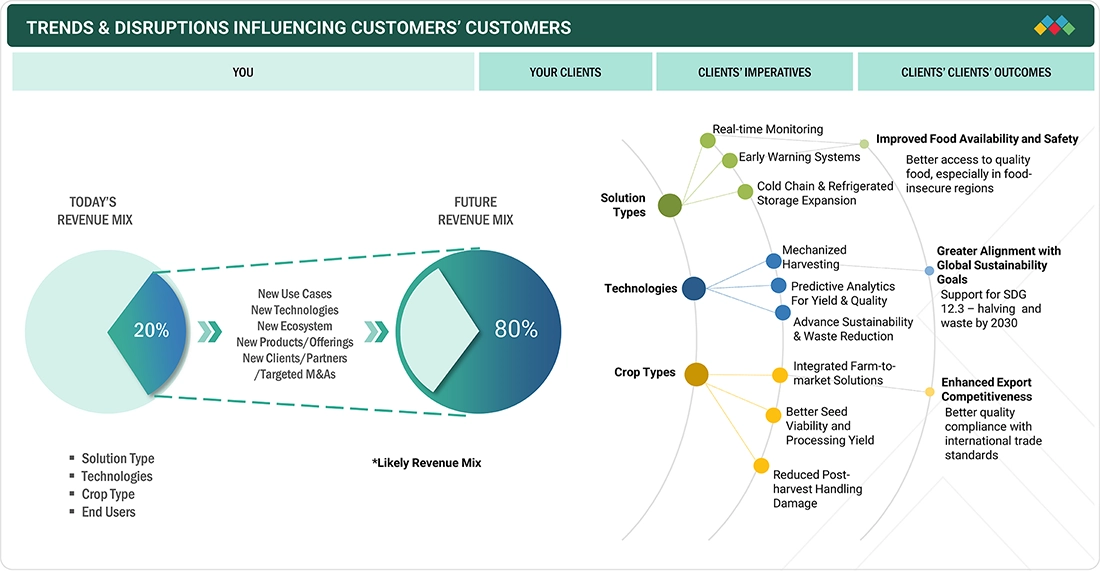
The agricultural waste management market is witnessing transformative shifts as downstream stakeholders—retailers, consumers, governments, and export buyers—increasingly demand fresher, safer, and more sustainably sourced food. Rising global food insecurity, stricter regulations around post-harvest handling, and the pressure to meet sustainability goals such as SDG 12.3 are driving the adoption of innovative loss-prevention technologies. Consumers are pushing for better shelf-life and reduced spoilage, while retailers and food processors seek stable, traceable supply chains. Governments are investing in modern infrastructure, such as cold chains and post-harvest processing, to minimize food waste and boost food security. Additionally, export buyers are demanding higher quality, compliance-ready produce, further accelerating the shift toward smart sensing, data-driven logistics, and automation in handling. These evolving expectations are disrupting traditional practices and compelling agricultural stakeholders to reimagine their loss reduction strategies with a focus on resilience, efficiency, and transparency.

Waste Management Market Disruptions

Source: Secondary Research, Interviews with Experts, MarketsandMarkets Analysis

MARKET DYNAMICS

Drivers
Impact
Level
  • Surge in food losses during farming and transportation
  • Population growth & rising food demand
RESTRAINTS
Impact
Level
  • High capital investment in reefer transport to limit cold chain expansion in rural areas
  • Infrastructure gaps in emerging markets
OPPORTUNITIES
Impact
Level
  • High post-harvest loss rates across crops to create demand for advanced loss-mitigation solutions
  • Circular Economy Model
CHALLENGES
Impact
Level
  • Unpredictable weather patterns and extreme events to affect crop yields
  • Financial Inclusion Barriers

Source: Secondary Research, Interviews with Experts, MarketsandMarkets Analysis

Driver: Surge in food losses during farming and transportation

The surge in food loss, both globally and domestically, is driving demand for agricultural food loss reduction solutions. USDA data indicate that approximately 30% of food in the US remains unconsumed at the retail and consumer level, with significant losses occurring at the farm stage due to unprofitable market prices for additional harvests and labor shortages. Perishable produce is particularly vulnerable, with overripe or cosmetically imperfect items often being excluded from wholesale markets, resulting in significant resource wastage. In October 2024, FAO estimates that approximately 30% of food production is lost or wasted annually, while in India, post-harvest losses cost approximately USD 18.5 billion (INR 1.53 lakh crore) each year, largely due to inadequate infrastructure, low mechanization, and insufficient storage facilities. These losses reduce food availability and exacerbate hunger, malnutrition, and resource inefficiencies while contributing significantly to greenhouse gas emissions, including methane from landfills. Moreover, the International Day of Awareness of Food Loss and Waste highlights the urgency of addressing this issue in line with environmental and climate objectives. This increased awareness, along with the economic and environmental effects of food loss, is driving investments in advanced technologies, infrastructure, and supply chain solutions to reduce losses throughout agricultural value chains.

Restraint: High capital investment in reefer transport to limit cold chain expansion in rural areas

The agricultural waste management market faces a significant restraint due to the high upfront capital requirements for critical infrastructure, including cold rooms, reefer transport vehicles, and packhouse equipment. According to the article published by Natural Storage Solution Pvt Ltd in May 2023, setting up cold storage facilities can cost around USD 127 per square foot, placing a considerable financial burden on stakeholders, particularly in developing markets. Similarly, acquiring reefer trucks and advanced packhouse machinery entails substantial investment in refrigeration technology, energy systems, and ongoing maintenance, further elevating initial costs. These substantial capital requirements stand in sharp contrast to the narrow profit margins of farmers, mainly small and marginal producers who often operate with limited cash reserves and face restricted access to affordable credit. The mismatch between the investment scale and the financial capacity of end users hinders the adoption of these solutions, despite their proven ability to minimize post-harvest losses. These high-cost barriers continue to discourage investment in cold chain and processing infrastructure. As a result, many producers and cooperatives delay or forgo technology adoption, perpetuating post-harvest inefficiencies and wastage, particularly in highly perishable categories such as fruits, vegetables, and dairy products.

Opportunity: High post-harvest loss rates across crops to create demand for advanced loss-mitigation solutions

A 2022 NABCONS study underscores significant post-harvest losses in India—3.89–5.92% for cereals, 5.65–6.74% for pulses, 2.87–7.51% for oilseeds, 6.02–15.05% for fruits, and 4.87–11.61% for vegetables—highlighting a critical market gap for loss-mitigation solutions. This presents a strategic growth opportunity for stakeholders across the agri-value chain to deploy advanced packaging technologies that can materially reduce wastage while enhancing product value. Edible coatings, formulated from biodegradable food-grade materials, act as moisture and gas barriers to slow ripening; vacuum packaging and modified atmosphere packaging (MAP) extend shelf life by controlling oxygen and gas composition; resealable formats maintain freshness through repeated use; and active, antimicrobial, and intelligent packaging solutions inhibit microbial growth and provide real-time freshness monitoring. The adoption of these technologies can result in reduced quantitative losses, prolonged marketability, improved price realization for producers, and higher operational efficiency for distributors and retailers. For packaging manufacturers and agri-tech innovators, this creates a scalable commercial opportunity driven by the dual imperatives of profitability and sustainability. As consumer demand for high-quality fresh produce rises, and with a focus on reducing food loss, market participants integrating solutions into India’s perishable supply chain can achieve competitive differentiation and capture long-term value.

Challenge: Unpredictable weather patterns and extreme events to affect crop yields

Climate change represents a significant challenge for the agricultural waste management market, primarily due to its disruptive impact on crop production and post-harvest management. Increasingly unpredictable weather patterns, including irregular rainfall, prolonged droughts, and unseasonal storms, can adversely affect crop yields and compromise produce quality. Extreme events such as floods, heatwaves, and cyclones further exacerbate losses by damaging standing crops and creating unfavorable conditions for storage, thereby increasing the risk of spoilage and post-harvest waste. Climate-induced uncertainties complicate infrastructure planning for businesses and solution providers. Cold storage facilities and refrigerated transport designed on historical trends may become inefficient, raising operational costs and lowering returns. Additionally, climate variability disrupts harvest schedules and distribution timelines, hindering effective food loss reduction efforts. Small and marginal farmers, who typically operate with constrained financial resources, are particularly vulnerable to climate-related losses, further hindering their ability to adopt advanced cold chain and post-harvest technologies. Consequently, the market faces obstacles in scaling solutions, achieving consistent utilization, and ensuring ROI for investors. Addressing these climate-related risks requires adaptive, resilient infrastructure and strategic planning to maintain effectiveness and drive long-term market growth.

Agriculture Waste Management Market: COMMERCIAL USE CASES ACROSS INDUSTRIES

COMPANY USE CASE DESCRIPTION BENEFITS
Smart harvesting and precision agriculture equipment for cereals and grains Reduced field-level losses, enhanced harvesting efficiency, and better preservation of yields
Mechanized harvesting and baling solutions for horticultural and specialty crops Minimized crop handling damage, faster harvesting, and reduced perishability
Post-harvest grain handling and storage systems Improved storage efficiency, reduced moisture-related spoilage, and maintained grain quality
IoT and sensor-based monitoring systems for cold chain and storage infrastructure Real-time temperature/humidity tracking, reduced spoilage, and improved traceability

Logos and trademarks shown above are the property of their respective owners. Their use here is for informational and illustrative purposes only.

MARKET ECOSYSTEM

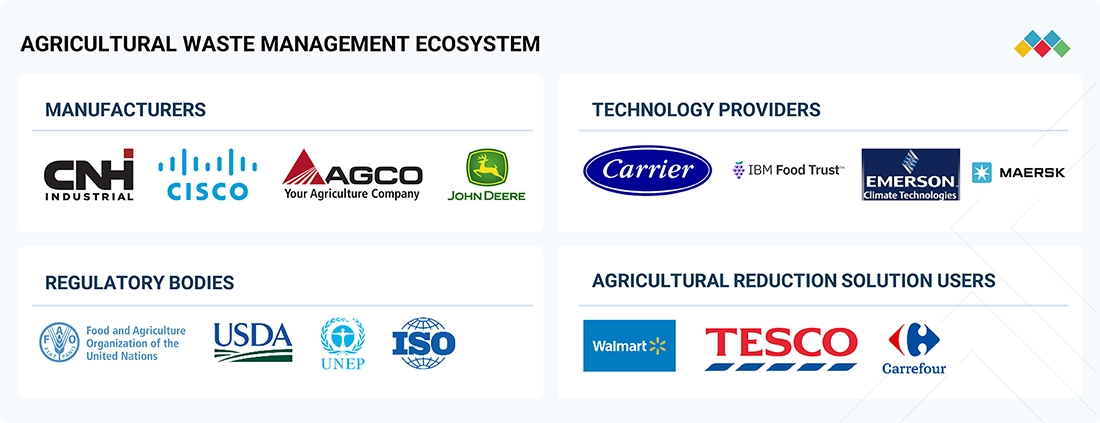
The agricultural waste management market functions within a dynamic and collaborative ecosystem involving multiple stakeholders. Technology providers form the backbone of innovation, offering tools such as cold chain systems, IoT sensors, data analytics platforms, and eco-friendly packaging that help reduce losses across the value chain. Solution developers and service providers work closely with farmers, supply chain operators, and retailers to implement scalable and practical interventions that minimize food waste from field to fork. Regulatory authorities and policymakers play an essential role by setting food safety standards, sustainability goals, and waste reduction policies that drive industry compliance and innovation. Industry enablers such as agricultural cooperatives, research institutions, and NGOs facilitate knowledge transfer, funding, and capacity-building. End users, including smallholders, commercial farms, food processors, logistics providers, and retailers, adopt and integrate these technologies to improve efficiency, reduce waste, and meet quality standards. This interconnected ecosystem fosters synergy across production, post-harvest handling, distribution, and consumption, accelerating the transition toward a more resilient, sustainable, and food-secure future.

Waste Management Market Ecosystem

Logos and trademarks shown above are the property of their respective owners. Their use here is for informational and illustrative purposes only.

MARKET SEGMENTS

Waste Management Market Segments

Source: Secondary Research, Interviews with Experts, MarketsandMarkets Analysis

Agricultural Waste Management Market, by Type

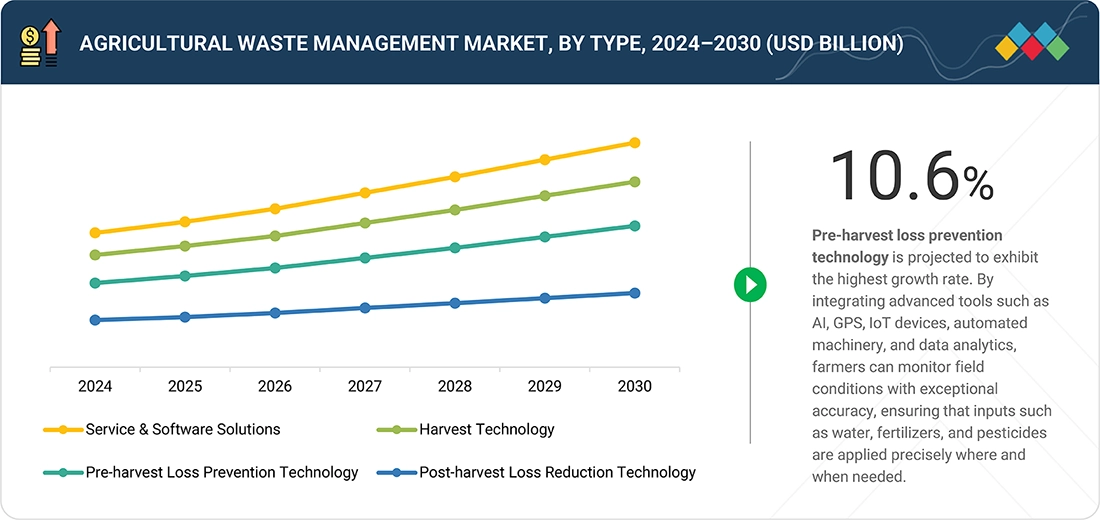
Pre-harvest loss prevention technologies are projected to grow at the highest CAGR in the agricultural food loss reduction market, driven by the increasing adoption of precision farming solutions. Precision agriculture represents a data-driven, technology-centric approach that enables farmers to optimize crop production, enhance sustainability, and improve operational efficiency. By integrating advanced tools such as artificial intelligence (AI), GPS, Internet of Things (IoT) devices, automated machinery, and data analytics, farmers can monitor field conditions with exceptional accuracy, ensuring that inputs such as water, fertilizers, and pesticides are applied precisely where and when needed. Key technologies underpinning this transformation include satellite imagery and remote sensing, which detect variations in crop health, water stress, pest infestations, and nutrient deficiencies at scale. AI-powered platforms analyze large datasets to forecast diseases, optimize yields, and provide tailored recommendations. Autonomous machinery and robotics automate labor-intensive tasks such as planting, fertilization, and pest control, reducing human error and operational costs. Data analytics platforms consolidate field and financial data to support strategic decision-making, while IoT devices and sensors continuously monitor soil, weather, and environmental conditions for targeted interventions. Additionally, drones offer high-resolution mapping for irrigation and pest management, and blockchain technologies enable transparent, tamper-proof traceability from farm to fork.

Agricultural Waste Management Market, by Technology

Cold chain logistics account for a significant share of the agricultural waste management market, driven by the critical need to address transport-related losses. According to the World Food Programme, inadequate transport resulted in a loss of approximately 6,246.624 metric tons of agricultural produce, valued at USD 4.88 million. These transport-associated losses accounted for 47% of pre-delivery losses, underscoring the significant role that logistics inefficiencies play in food wastage. The high proportion of losses occurring during transit highlights the urgent demand for reliable cold chain solutions that maintain optimal temperature and handling conditions from farm to market. By minimizing spoilage during transport, these technologies directly enhance food security and reduce economic losses for growers, distributors, and retailers. Transport inefficiencies significantly contribute to pre-delivery losses, creating a valuable opportunity for investment in cold chain logistics. Optimizing transport conditions can greatly reduce waste, making cold chain solutions a key segment in reducing agricultural food loss.

Agricultural Waste Management Market, by Crop Type

Cereals and grains remain a strategic focus within the agricultural waste management market, as highlighted in the OECD-FAO Agricultural Outlook 2025–2034 (July 2025). Global consumption of coarse grains is projected to increase by approximately 33 million tons, or 1% annually, driven primarily by growth in Africa and Asia. Despite relatively lower losses compared with other commodities, nearly 19% of global cereal production is lost, with the majority occurring across transport, processing, distribution, and household segments. Industry players are adopting targeted, technology-driven approaches to mitigate these losses. In June 2024, Mitsubishi Logistics and Hitachi deployed IoT-enabled monitoring systems in Japanese grain silos to optimize storage and reduce spoilage. Similarly, Sumitomo Corporation invested in moisture-proof packaging for rice and wheat in March 2023, while Ajinomoto partnered with NTT Data in May 2025 to pilot a blockchain-based grain tracking platform, enhancing end-to-end supply chain visibility. Such initiatives, underpinned by public-private collaboration and innovative packaging solutions, are essential to minimizing cereal loss as the food share of global cereal consumption is expected to reach 29% by 2034.

REGION

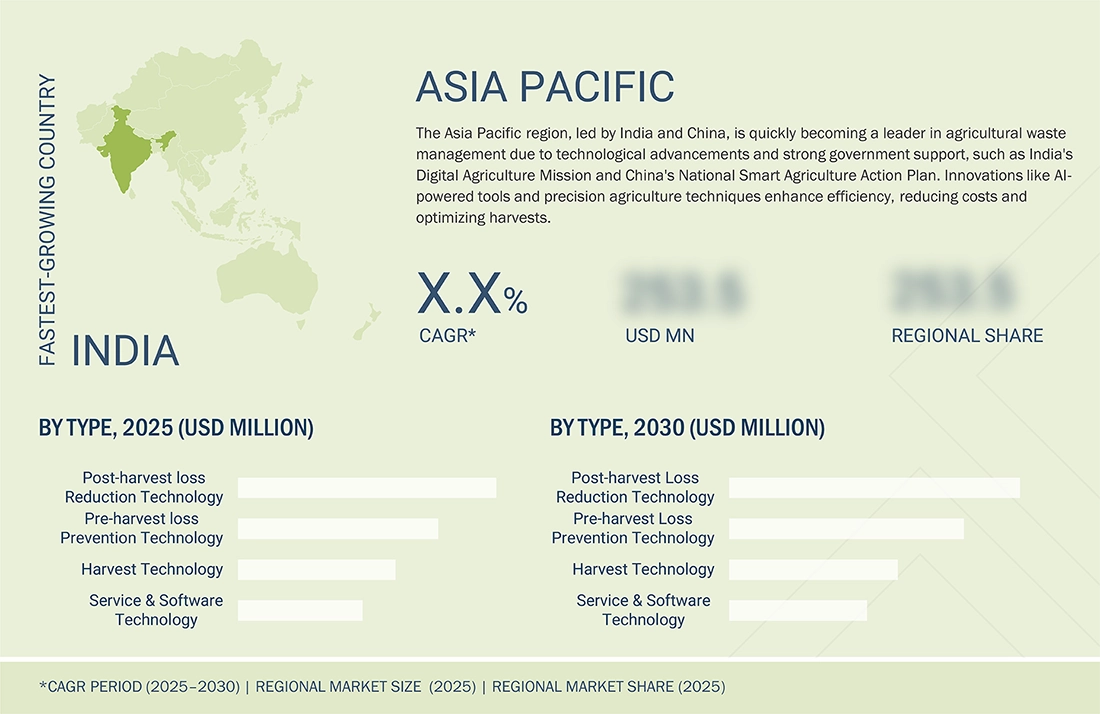
Asia Pacific to be fastest-growing region in global agricultural waste management market during forecast period

Asia Pacific is emerging as the fastest-growing region in the agricultural waste management market, driven by rapid technological adoption and strong government initiatives across key economies such as India and China. In India, Escorts and Mahindra & Mahindra are producing affordable, compact precision harvesters designed for a range of crops, including wheat, rice, sugarcane, and pulses, while partnerships with tech startups are enabling AI-powered yield estimation tools and data-driven maintenance systems. Pilot projects in agricultural hubs such as Punjab, Haryana, and Maharashtra have demonstrated significant efficiency gains and labor savings through semi-autonomous harvesting solutions, further supported by the Digital Agriculture Mission, which equips farmers with real-time weather and market insights to optimize harvest timing and reduce losses. China is accelerating agricultural modernization through the National Smart Agriculture Action Plan (2024–2028), which integrates big data, AI, and GPS technologies to boost yields, cut costs, and improve efficiency. The incorporation of the BeiDou satellite system into precision agriculture applications further enhances machinery guidance, mapping, and timing accuracy, enabling more precise and loss-minimizing operations. Collectively, these advancements position the Asia Pacific region at the forefront of innovation, making it a pivotal growth engine for the agricultural waste management market.

Waste Management Market Region

Agriculture Waste Management Market: COMPANY EVALUATION MATRIX

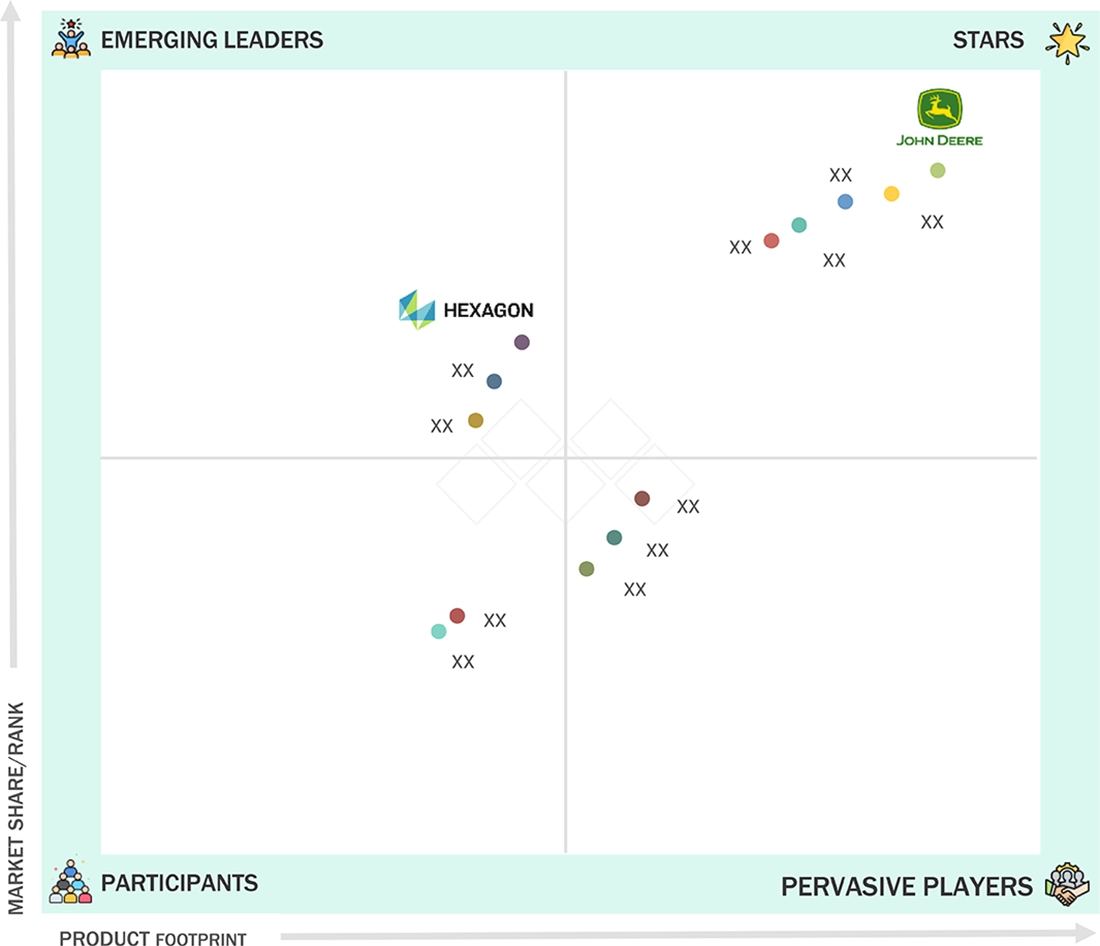
In the agricultural waste management market matrix, Deere & Company (US), positioned as a star player, leads the market with its advanced, technology-driven solutions, including precision farming equipment, storage systems, and supply chain optimization tools. Hexagon AB (Sweden), recognized as an emerging leader, maintains a strong global presence by providing innovative monitoring, IoT-enabled solutions, and data analytics for reducing post-harvest losses. While Deere & Company dominates through its established customer base and comprehensive solution offerings, Hexagon AB continues to expand its capabilities and strategic partnerships, demonstrating strong potential to strengthen its position in the market further.

Waste Management Market Evaluation Matrics

Source: Secondary Research, Interviews with Experts, MarketsandMarkets Analysis

MARKET SCOPE

REPORT METRIC DETAILS
Market Size, 2024 (Value) USD 13.44 Billion
Market Forecast, 2030 (value) USD 22.50 Billion
Growth Rate CAGR of 9.2% from 2025 to 2030
Years Considered 2020–2030
Base Year 2024
Forecast Period 2025–2030
Units Considered Value (USD Million), Volume (Millon Tons)
Report Coverage Revenue forecast, company ranking, competitive landscape, growth factors, and trends
Segments Covered
  • By Crop Type:
    • Cereals & Grains
    • Fruits & Vegetables
    • Oilseeds & Pulses
    • Horticultural & Specialty Crops
    • Other Crop Types
  • By Solution Type:
    • Pre-harvest Loss Prevention Technologies
    • Harvest Technologies
    • Post-Harvest Loss Reduction Technologies
    • Service & Software Solutions
  • By Technology:
    • Sensor Technologies
    • Cold Chain and Refrigeration Technologies
    • Data & Analytics Technologies
    • Robotics and Automation
  • By End User:
    • Individual/Small Holder farmers
    • Commercial farmers & agribusiness
    • Agricultural Co-operatives
    • Logistics & Warehousing Providers
    • Food Processors & Manufacturers
Regions Covered North America, Asia Pacific, Europe, South America, RoW

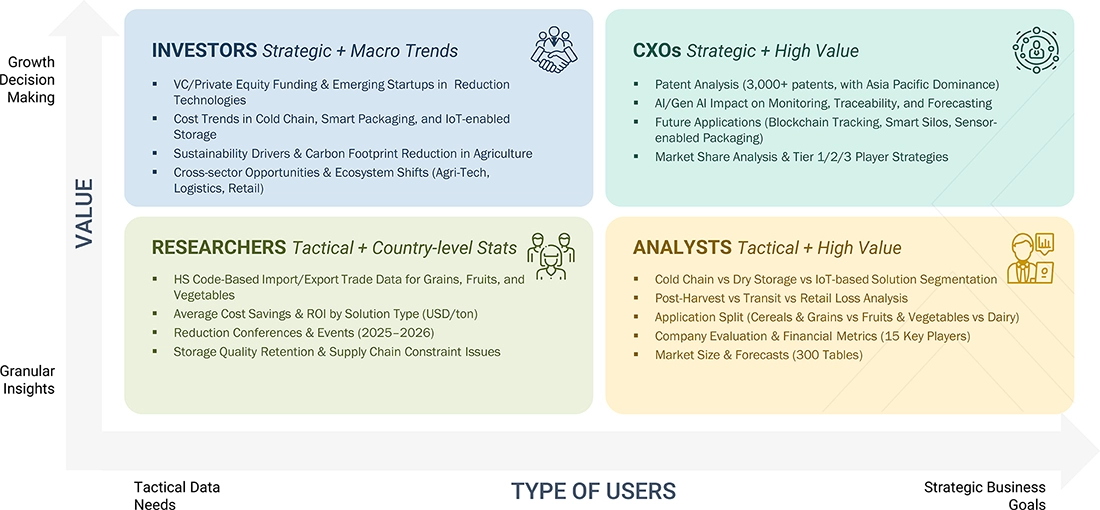
WHAT IS IN IT FOR YOU: Agriculture Waste Management Market REPORT CONTENT GUIDE

Waste Management Market Content Guide

DELIVERED CUSTOMIZATIONS

We have successfully delivered the following deep-dive customizations:

CLIENT REQUEST CUSTOMIZATION DELIVERED VALUE ADDS
Global Grain Producer Detailed food loss reduction forecast by commodity (cereals, coarse grains, pulses, oilseeds) Actionable insights on loss hotspots and targeted intervention strategies
Cold Chain & Logistics Operator Analysis of storage, transport, and distribution losses across regions Analysis of storage, transport, and distribution losses across regions
Agri-Tech & Equipment Manufacturer Mapping of post-harvest solution adoption for storage systems, sensors, and automated handling Enabled product positioning, investment prioritization, and differentiation in the market
Retail & FMCG Companies Food loss reduction analysis for processed and perishable products Strategic insights for shelf-life extension, supply chain transparency, and cost savings

RECENT DEVELOPMENTS

  • May 2025 : Lineage, Inc. (US) expanded its Vejle cold storage facility in Denmark, adding 6,000 sq. meters and boosting capacity to 93,500 EUR pallet positions. Strategically located near key highways and ports, the site enhanced cold chain connectivity across the Nordics and Europe. The facility features advanced energy-efficient technologies, supporting sustainability and food security. This move aligns with Lineage’s strategy to strengthen its cold storage network in Northern Europe.
  • May 2025 : Lineage, Inc. (US) acquired Norway-based cold storage company Permanor AS, strengthening its presence in the Nordic region. The acquisition includes facilities in Haugesund and Brumunddal, offering 24,500 pallet positions and 10,000+ sq. meters of space. These sites support the meat and food industries with freezing, thawing, and logistics, and focus on sustainability through solar-powered operations. This strategic move enhances Lineage’s cold chain capabilities and commitment to energy-efficient, responsible operations in Northern Europe.
  • November 2024 : MaterioBiocatalysts Ltd launched the PlantPro enzyme range to address key challenges in the plant-based food industry. The new enzymes enhanced taste, texture, and functionality in plant-based beverages, meat, and cheese alternatives. Highlighting innovation, the PlantPro 726L enzyme boosted umami flavor naturally, improving sensory appeal without artificial additives. This launch empowered manufacturers to create premium, clean-label plant-based products that meet rising consumer demand and stand out in a competitive market. Beryllium & Composites (subsidiary of Materion Corporation) partnered with Liquidmetal Technologies Inc. and other Certified Liquidmetal Partners to use their alloy production technologies to provide high-quality products and support services to their customers.
  • January 2024 : Amazon Web Services (US) and Carrier (US) announced a collaboration to develop the Lynx digital platform, which aimed to reduce food spoilage across the cold chain. The platform unified fragmented cold chain operations, offering end-to-end visibility, predictive insights, and optimized logistics for refrigerated storage and transport. Using AWS IoT, machine learning, and analytics, Lynx helped match supply with transport, improve fleet utilization, and proactively identify risks to minimize waste.
  • December 2023 : Lineage Inc. (US) officially opened a new cold storage facility in Tauriko, Tauranga, New Zealand, featuring over 3 million cubic feet of space and 16,000+ pallet positions. Strategically located near the Port of Tauranga, the facility enhances export logistics and supply chain efficiency. It incorporated sustainable features such as an 890 kW solar array, rainwater harvesting for refrigeration, and rapid doors to reduce energy loss. With this addition, Lineage operates 25 facilities across New Zealand.


Table of Contents

Exclusive indicates content/data unique to MarketsandMarkets and not available with any competitors.

TITLE
PAGE NO
1
INTRODUCTION


29
2
RESEARCH METHODOLOGY


34
3
EXECUTIVE SUMMARY


44
4
PREMIUM INSIGHTS


49
5
MARKET OVERVIEW
Harness AI and tech innovations to tackle food demand amid rising population and environmental pressures.


54
 
5.1
INTRODUCTION


5.2
MACROECONOMIC INDICATORS


5.2.1
GLOBAL POPULATION GROWTH AND FOOD DEMAND


5.2.2
GOVERNMENT EXPENDITURE AND DEVELOPMENT AID IN FOOD LOSS REDUCTION


5.3
MARKET DYNAMICS


5.3.1
DRIVERS


5.3.1.1
Population growth and rising food demand


5.3.1.2
Climate and environmental pressures


5.3.2
RESTRAINTS


5.3.2.1
High initial investment costs


5.3.2.2
Infrastructure gaps in emerging markets


5.3.3
OPPORTUNITIES


5.3.3.1
Technological innovations


5.3.3.2
Circular economy models


5.3.4
CHALLENGES


5.3.4.1
Fragmented supply chains


5.3.4.2
Financial inclusion barriers
 
 
5.4
IMPACT OF GEN AI ON AGRICULTURAL FOOD LOSS REDUCTION SOLUTIONS


5.4.1
INTRODUCTION


5.4.2
USE OF GEN AI IN AGRICULTURAL FOOD LOSS REDUCTION SOLUTIONS


5.4.3
CASE STUDY ANALYSIS


5.4.3.1
Super Hosokawa Co., Ltd. — AI-driven Demand Forecasting (Japan)


5.4.3.2
Zest AI Tool at Nestlé Factory (United Kingdom)


5.4.4
IMPACT ON AGRICULTURAL FOOD LOSS REDUCTION SOLUTIONS MARKET


5.4.5
ADJACENT ECOSYSTEM WORKING ON GEN AI
 
 
6
INDUSTRY TRENDS
Uncover how cutting-edge technologies reshape supply chains and drive industry pricing trends.


64
 
6.1
INTRODUCTION


6.2
SUPPLY CHAIN ANALYSIS


6.3
VALUE CHAIN ANALYSIS


6.3.1
FARM PRODUCTION & HARVESTING


6.3.2
POST-HARVEST HANDLING


6.3.3
STORAGE & WAREHOUSING


6.3.4
PROCESSING & PACKAGING


6.3.5
TRANSPORTATION & DISTRIBUTION


6.3.6
RETAIL & CONSUMPTION


6.4
TRADE ANALYSIS


6.4.1
EXPORT SCENARIO (HS CODE 8418)


6.4.2
IMPORT SCENARIO (HS CODE 8418)


6.5
TECHNOLOGY ANALYSIS


6.5.1
KEY TECHNOLOGIES


6.5.1.1
Cold Chain and Temperature Control Logistics Technology


6.5.1.2
Sensor and IoT-Based Monitoring & Control


6.5.2
COMPLEMENTARY TECHNOLOGIES


6.5.2.1
Modified Atmosphere Packaging


6.5.3
ADJACENT TECHNOLOGIES


6.5.3.1
Precision Agriculture Technology
 
 
6.6
INDICATIVE PRICING ANALYSIS


6.6.1
INDICATIVE PRICING TREND: SOLUTION TYPE, BY REGION


6.7
ECOSYSTEM ANALYSIS


6.7.1
SUPPLY SIDE


6.7.2
DEMAND SIDE


6.8
TRENDS/DISRUPTIONS IMPACTING CUSTOMER BUSINESS


6.9
PATENT ANALYSIS


6.10
KEY CONFERENCES AND EVENTS, 2025–2026


6.11
REGULATORY LANDSCAPE


6.11.1
REGULATORY BODIES, GOVERNMENT AGENCIES, AND OTHER ORGANIZATIONS


6.12
REGULATORY FRAMEWORK


6.12.1
INTRODUCTION


6.12.2
NORTH AMERICA


6.12.2.1
US


6.12.2.2
Canada


6.12.2.3
Mexico


6.12.3
EUROPE


6.12.3.1
European Union (EU)


6.12.3.2
France


6.12.3.3
Italy


6.12.3.4
Germany


6.12.4
ASIA PACIFIC


6.12.4.1
China


6.12.4.2
India


6.12.4.3
Japan


6.12.4.4
Australia/New Zealand


6.12.4.5
Singapore


6.12.5
SOUTH AMERICA


6.12.5.1
Brazil


6.12.5.2
Argentina


6.12.5.3
Chile


6.12.6
REST OF THE WORLD (ROW)


6.12.6.1
Gulf Cooperation Council (e.g., UAE, Saudi Arabia)


6.12.6.2
South Africa


6.12.6.3
Kenya/East Africa


6.12.6.4
EAEU/CIS (e.g., Kazakhstan, Russia, Belarus)
 
 
6.13
IMPACT OF 2025 US TARIFF – AGRICULTURAL FOOD LOSS REDUCTION SOLUTIONS MARKET


6.13.1
INTRODUCTION


6.13.2
KEY TARIFF RATES


6.13.3
DISRUPTION IN AGRICULTURAL FOOD LOSS REDUCTION SOLUTIONS


6.13.4
PRICE IMPACT ANALYSIS


6.13.5
IMPACT ON COUNTRY/REGION


6.13.5.1
US


6.13.5.2
Canada & Mexico


6.13.5.3
South America


6.13.6
IMPACT ON END-USE INDUSTRY


6.14
PORTER’S FIVE FORCES ANALYSIS


6.14.1
THREAT OF NEW ENTRANTS


6.14.2
THREAT OF SUBSTITUTES


6.14.3
BARGAINING POWER OF SUPPLIERS


6.14.4
BARGAINING POWER OF BUYERS


6.14.5
INTENSITY OF COMPETITIVE RIVALRY


6.15
KEY STAKEHOLDERS AND BUYING CRITERIA


6.15.1
KEY STAKEHOLDERS IN BUYING PROCESS


6.15.2
BUYING CRITERIA


6.16
CASE STUDY ANALYSIS


6.17
INVESTMENT AND FUNDING SCENARIO


7
AGRICULTURAL FOOD LOSS REDUCTION SOLUTIONS MARKET, BY SOLUTION TYPE
Market Size & Growth Rate Forecast Analysis to 2030 in USD Million | 18 Data Tables


98
 
7.1
INTRODUCTION


7.2
PRE-HARVEST LOSS PREVENTION TECHNOLOGIES


7.2.1
PRECISION AGRICULTURE TOOLS


7.2.1.1
Driving smarter food loss reduction across farming systems


7.2.2
PEST AND DISEASE FORECASTING SYSTEMS


7.2.2.1
Helping farmers cut losses via timely, predictive actions


7.2.3
SOIL HEALTH MONITORING SENSORS


7.2.3.1
Safeguarding food systems and reducing agricultural loss


7.2.4
NUTRIENT MANAGEMENT SOLUTIONS


7.2.4.1
Minimizing losses and enhancing sustainable crop productivity
 
 
7.3
HARVEST TECHNOLOGIES


7.3.1
MECHANIZED HARVESTERS


7.3.1.1
Driving efficiency and minimizing waste with mechanized harvesters


7.3.2
RIPENESS AND MATURITY DETECTORS


7.3.2.1
Driving efficiency, reducing food waste, and improving profitability


7.3.3
MANUAL HARVESTING TOOLS


7.3.3.1
Supporting smallholder farmers, reducing crop losses, and boosting productivity
 
 
7.4
POST-HARVEST LOSS REDUCTION TECHNOLOGIES


7.4.1
COLD-CHAIN & LOGISTICS INFRASTRUCTURE


7.4.1.1
Ensuring global food security, sustainability, and loss reduction


7.4.2
HERMETIC STORAGE SOLUTIONS


7.4.2.1
Safeguarding harvests, cutting grain losses, and boosting global food security


7.4.3
MODIFIED ATMOSPHERE PACKAGING


7.4.3.1
Extending cereal shelf life, minimizing food loss


7.4.4
CONTROLLED ATMOSPHERE STORAGE


7.4.4.1
Extending grain life, reducing losses, and ensuring food security


7.4.5
DRYING, CURING, & EVAPORATIVE COOLING TECHNOLOGIES


7.4.5.1
Extending shelf life and preventing spoilage


7.4.6
BIO-PRESERVATION & TREATMENT TECHNOLOGIES


7.4.6.1
Extending freshness, reducing waste, and securing food quality
 
 
7.5
SERVICE & SOFTWARE SOLUTIONS


7.5.1
SUPPLY CHAIN TRACEABILITY SOLUTIONS


7.5.1.1
Enhancing food loss reduction


7.5.2
REMOTE SENSING AND IOT-BASED LOSS DETECTION SYSTEMS


7.5.2.1
Driving agricultural food loss prevention


7.5.3
AI-BASED FARM ADVISORY AND DECISION SUPPORT


7.5.3.1
Reducing crop losses and boosting sustainability


7.5.4
DATA ANALYTICS AND FORECASTING TOOLS


7.5.4.1
Minimizing post-harvest food loss
 
8
AGRICULTURAL FOOD LOSS REDUCTION SOLUTIONS MARKET, BY TECHNOLOGY
Market Size & Growth Rate Forecast Analysis to 2030 in USD Million | 16 Data Tables


114
 
8.1
INTRODUCTION


8.2
SENSOR TECHNOLOGIES


8.2.1
IOT SENSORS


8.2.1.1
Empowering global food waste reduction across supply chains


8.2.2
RFID AND QR CODES SYSTEMS


8.2.2.1
Revolutionizing food waste reduction through smarter tracking, pricing, and freshness monitoring


8.2.3
SATELLITE AND DRONE IMAGING


8.2.3.1
Driving food waste reduction through smarter monitoring
 
 
8.3
COLD CHAIN AND REFRIGERATION TECHNOLOGIES


8.3.1
SAFEGUARDING FOOD QUALITY AND CUTTING WASTE ACROSS GLOBAL SUPPLY CHAINS


8.4
DATA & ANALYTICS TECHNOLOGIES


8.4.1
MACHINE LEARNING AND BIG DATA ANALYTICS


8.4.1.1
Unlocking smarter solutions for global food loss reduction


8.4.2
PREDICTIVE MODELING AND YIELD FORECASTING


8.4.2.1
Driving smarter agriculture and reducing global food waste
 
 
8.5
ROBOTICS AND AUTOMATION


8.5.1
AUTOMATED HARVESTING SYSTEMS


8.5.1.1
Driving efficiency to reduce post-harvest agricultural food losses


8.5.2
SORTING AND GRADING ROBOTS


8.5.2.1
Transforming post-harvest food loss reduction
 
9
AGRICULTURAL FOOD LOSS REDUCTION SOLUTIONS MARKET, BY CROP TYPE
Market Size & Growth Rate Forecast Analysis to 2030 in USD Million and Kilotons | 14 Data Tables


125
 
9.1
INTRODUCTION


9.2
CEREALS & GRAINS


9.2.1
ADVANCING COLLABORATIVE TECH AND PARTNERSHIPS FOR SUSTAINABLE SOLUTIONS TO DRIVE MARKET


9.3
FRUITS & VEGETABLES


9.3.1
TRANSFORMING SUPPLY CHAINS TO CUT FRUITS & VEGETABLES WASTE


9.4
OILSEEDS & PULSES


9.4.1
DRIVING DIGITAL INNOVATIONS TO MINIMIZE OILSEED AND PULSE LOSSES FOR SUSTAINABLE FOOD SECURITY AND PROFITABILITY


9.5
HORTICULTURAL & SPECIALTY CROPS


9.5.1
HARNESSING DIGITAL TOOLS TO REDUCE LOSSES IN HORTICULTURAL AND SPECIALTY CROPS GLOBALLY


9.6
OTHER CROP TYPES


9.6.1
ADVANCING POST-HARVEST INNOVATIONS TO REDUCE LOSSES IN ROOT AND TUBER CROPS WORLDWIDE
 
 
10
AGRICULTURAL FOOD LOSS REDUCTION SOLUTIONS MARKET, BY END USER
Market Size & Growth Rate Forecast Analysis to 2030 in USD Million | 2 Data Tables


134
 
10.1
INTRODUCTION


10.2
INDIVIDUAL/SMALLHOLDER FARMERS


10.2.1
EMPOWERING SMALLHOLDER FARMERS TO DRIVE FOOD LOSS REDUCTION


10.3
COMMERCIAL FARMERS & AGRIBUSINESSES


10.3.1
BUILDING SMARTER, EFFICIENT SUPPLY CHAINS TO TACKLE GLOBAL FOOD WASTE


10.4
AGRICULTURAL CO-OPERATIVES


10.4.1
REDUCING FOOD WASTE, ENHANCING FARMER INCOMES, AND DRIVING SUSTAINABLE GROWTH GLOBALLY


10.5
LOGISTICS & WAREHOUSING PROVIDERS


10.5.1
ENHANCING FOOD SECURITY THROUGH SMARTER LOGISTICS, COLD CHAINS, AND DIGITAL WAREHOUSING


10.6
FOOD PROCESSORS & MANUFACTURERS


10.6.1
EMPOWERING FOOD PROCESSORS WITH INNOVATIVE TECHNOLOGIES FOR EFFECTIVE LOSS REDUCTION
 
 
11
AGRICULTURAL FOOD LOSS REDUCTION SOLUTIONS MARKET, BY REGION
Market Size & Growth Rate Forecast Analysis to 2030 in USD Million and Tons | 120 Data Tables


138
 
11.1
INTRODUCTION


11.2
NORTH AMERICA


11.2.1
US


11.2.1.1
Federal and industry collaboration to halve food loss and waste by 2030


11.2.2
CANADA


11.2.2.1
Canada accelerates food waste reduction with innovation, upcycling, and annual loss prevention efforts


11.2.3
MEXICO


11.2.3.1
Mexico advances food loss solutions with public-private partnerships, tech innovation, and global sustainability goals
 
 
11.3
EUROPE


11.3.1
GERMANY


11.3.1.1
Germany scales food waste reduction with national strategy, retail innovation, and sustainable supply chain partnerships


11.3.2
UK


11.3.2.1
UK combats food waste with agritech innovation, retail leadership, and national reduction roadmap


11.3.3
FRANCE


11.3.3.1
France accelerates food waste reduction with circular economy solutions


11.3.4
SPAIN


11.3.4.1
Spain’s food waste law spurs innovation in agricultural food loss reduction and retail sustainability


11.3.5
ITALY


11.3.5.1
Italy’s food waste initiatives drive market growth in agricultural loss reduction and retail sustainability


11.3.6
REST OF EUROPE


11.4
ASIA PACIFIC


11.4.1
CHINA


11.4.1.1
China advances agricultural food loss reduction with policy and innovation


11.4.2
INDIA


11.4.2.1
India accelerates cold chain innovation to cut food loss and strengthen farmer incomes


11.4.3
JAPAN


11.4.3.1
Collaborative insurance, business, and community models driving Japan’s food loss reduction


11.4.4
AUSTRALIA & NEW ZEALAND


11.4.4.1
Driving food loss reduction with national strategies, innovation, and community partnerships


11.4.5
REST OF ASIA PACIFIC


11.5
SOUTH AMERICA


11.5.1
BRAZIL


11.5.1.1
Brazil strengthens food loss reduction with tech innovations, policy reforms, and global partnerships


11.5.2
ARGENTINA


11.5.2.1
Argentina advances food loss reduction with AI, waste innovation, and strategic food bank partnerships


11.5.3
REST OF SOUTH AMERICA


11.6
REST OF THE WORLD


11.6.1
MIDDLE EAST


11.6.1.1
Awareness campaigns, technological innovation, and sustainable waste policies driving market growth


11.6.2
AFRICA


11.6.2.1
Tackling Africa’s food loss crisis through innovation, policy, and strategic partnerships
 
12
COMPETITIVE LANDSCAPE
Discover which companies dominate market share and valuation through strategic competitive benchmarking.


190
 
12.1
OVERVIEW


12.2
KEY PLAYER STRATEGIES/RIGHT TO WIN


12.3
REVENUE ANALYSIS, 2022–2024


12.4
MARKET SHARE ANALYSIS, 2024


12.4.1
MARKET RANKING ANALYSIS


12.5
COMPANY VALUATION AND FINANCIAL METRICS


12.5.1
COMPANY VALUATION


12.5.2
EV/EBITDA


12.6
BRAND/PRODUCT COMPARISON ANALYSIS


12.7
COMPANY EVALUATION MATRIX: KEY PLAYERS, 2024


12.7.1
STARS


12.7.2
EMERGING LEADERS


12.7.3
PERVASIVE PLAYERS


12.7.4
PARTICIPANTS


12.7.5
COMPANY FOOTPRINT: KEY PLAYERS, 2024


12.7.5.1
Company footprint


12.7.5.2
Region footprint


12.7.5.3
Technology footprint


12.7.5.4
Solution type footprint
 
 
12.8
COMPANY EVALUATION MATRIX: STARTUPS/SMES, 2024


12.8.1
PROGRESSIVE COMPANIES


12.8.2
RESPONSIVE COMPANIES


12.8.3
DYNAMIC COMPANIES


12.8.4
STARTING BLOCKS


12.8.5
COMPETITIVE BENCHMARKING


12.8.5.1
Detailed list of key startups/SMEs


12.8.5.2
Competitive benchmarking of key startups/SMEs
 
 
12.9
COMPETITIVE SCENARIO AND TRENDS


12.9.1
PRODUCT LAUNCHES


12.9.2
DEALS
 
 
13
COMPANY PROFILES
In-depth Company Profiles of Leading Market Players with detailed Business Overview, Product and Service Portfolio, Recent Developments, and Unique Analyst Perspective (MnM View)


213
 
13.1
KEY PLAYERS


13.1.1
DEERE & COMPANY


13.1.1.1
Business overview


13.1.1.2
Products/Services/Solutions offered


13.1.1.3
Recent developments


13.1.1.4
MnM view


13.1.2
CNH INDUSTRIAL N.V.


13.1.3
AGCO


13.1.4
CARRIER


13.1.5
CISCO SYSTEMS, INC.


13.1.6
ORBCOMM


13.1.7
HEXAGON AB AND/OR ITS SUBSIDIARIES


13.1.8
METOS BY PESSL INSTRUMENTS


13.1.9
ECOROBOTIX


13.1.10
TEEJET TECHNOLOGIES


13.1.11
DJI


13.1.12
AGEAGLE AERIAL SYSTEMS INC.


13.1.13
MONNIT CORPORATION


13.1.14
INFRATAB, INC


13.1.15
SAP SE OR AN SAP AFFILIATE COMPANY


13.2
OTHER PLAYERS


13.2.1
NAÏO TECHNOLOGIES INC


13.2.2
ROBOTICS PLUS


13.2.3
FFROBOTICS


13.2.4
XAG CO., LTD.


13.2.5
PHENOLITE BY HIPHEN


13.2.6
TEMPCUBE


13.2.7
VERIGO


13.2.8
AGROBOT


13.2.9
HARVESTCROO


13.2.10
ONETHIRD
 
 
14
ADJACENT AND RELATED MARKET


269
 
14.1
INTRODUCTION


14.2
LIMITATIONS


14.3
COLD CHAIN MARKET


14.3.1
MARKET DEFINITION


14.3.2
MARKET OVERVIEW
 
 
15
APPENDIX


271
 
15.1
DISCUSSION GUIDE


15.2
KNOWLEDGESTORE: MARKETSANDMARKETS’ SUBSCRIPTION PORTAL


15.3
CUSTOMIZATION OPTIONS


15.4
RELATED REPORTS


15.5
AUTHOR DETAILS


LIST OF TABLES


TABLE 1
USD EXCHANGE RATES, 2020–2024


TABLE 2
RESEARCH ASSUMPTIONS


TABLE 3
RESEARCH LIMITATIONS


TABLE 4
AGRICULTURAL FOOD LOSS REDUCTION SOLUTIONS MARKET SNAPSHOT, 2025 VS. 2030


TABLE 5
KEY FUNDING COMMITMENTS


TABLE 6
EXPORT SCENARIO FOR HS CODE 8418: TOP 5 COUNTRIES, 2020–2024 (USD THOUSAND)


TABLE 7
EXPORT SCENARIO FOR HS CODE 8418: TOP 5 COUNTRIES, 2020–2024 (TONS)


TABLE 8
IMPORT SCENARIO FOR HS CODE 8418: TOP 5 COUNTRIES, 2020–2024 (USD THOUSAND)


TABLE 9
IMPORT SCENARIO OF HS CODE 8418: TOP 5 COUNTRIES, 2020–2024 (TONS)


TABLE 10
AVERAGE SELLING PRICE TREND, BY SOURCE, 2020–2024 (USD THOUSAND/PER UNIT OR ANNUALIZED COSTS)


TABLE 11
ROLE OF COMPANIES IN ECOSYSTEM


TABLE 12
PATENTS PERTAINING TO AGRICULTURAL FOOD LOSS REDUCTION SOLUTIONS MARKET AND RELATED PATENTS, 2021–2024


TABLE 13
AGRICULTURAL FOOD LOSS REDUCTION SOLUTIONS MARKET: KEY CONFERENCES AND EVENTS, 2025–2026


TABLE 14
NORTH AMERICA: LIST OF REGULATORY BODIES, GOVERNMENT AGENCIES, AND OTHER ORGANIZATIONS


TABLE 15
EUROPE: LIST OF REGULATORY BODIES, GOVERNMENT AGENCIES, AND OTHER ORGANIZATIONS


TABLE 16
ASIA PACIFIC: LIST OF REGULATORY BODIES, GOVERNMENT AGENCIES, AND OTHER ORGANIZATIONS


TABLE 17
SOUTH AMERICA: LIST OF REGULATORY BODIES, GOVERNMENT AGENCIES, AND OTHER ORGANIZATIONS


TABLE 18
REST OF THE WORLD: LIST OF REGULATORY BODIES, GOVERNMENT AGENCIES, AND OTHER ORGANIZATIONS


TABLE 19
US ADJUSTED RECIPROCAL TARIFF RATES


TABLE 20
EXPECTED IMPACT LEVEL ON TARGET PRODUCTS WITH RELEVANT HS CODES DUE TO TRUMP TARIFF IMPACT


TABLE 21
EXPECTED TARIFF IMPACT ON END-USE INDUSTRIES: AGRICULTURE FOOD LOSS REDUCTION SOLUTIONS


TABLE 22
IMPACT OF PORTER’S FIVE FORCES ON AGRICULTURAL FOOD LOSS REDUCTION SOLUTIONS MARKET


TABLE 23
INFLUENCE OF STAKEHOLDERS ON BUYING PROCESS FOR TOP THREE TECHNOLOGIES (%)


TABLE 24
KEY BUYING CRITERIA FOR TOP THREE CROP TYPES


TABLE 25
WALMART USED BLOCKCHAIN TO REVOLUTIONIZE FOOD TRACEABILITY


TABLE 26
ECOTUTU’S SOLAR-POWERED COLD STORAGE TACKLED POST-HARVEST LOSSES IN NIGERIA


TABLE 27
APEEL SCIENCES TACKLED FOOD WASTE WITH PLANT-BASED EDIBLE COATING THAT EXTENDS FRESH PRODUCE SHELF LIFE


TABLE 28
AGRICULTURAL FOOD LOSS REDUCTION SOLUTIONS MARKET, BY SOLUTION TYPE, 2020–2024 (USD MILLION)


TABLE 29
AGRICULTURAL FOOD LOSS REDUCTION SOLUTIONS MARKET, BY SOLUTION TYPE, 2025–2030 (USD MILLION)


TABLE 30
PRE-HARVEST LOSS PREVENTION TECHNOLOGIES: AGRICULTURAL FOOD LOSS REDUCTION SOLUTIONS MARKET, BY REGION, 2020–2024 (USD MILLION)


TABLE 31
PRE-HARVEST LOSS PREVENTION TECHNOLOGIES: AGRICULTURAL FOOD LOSS REDUCTION SOLUTIONS MARKET, BY REGION, 2025–2030 (USD MILLION)


TABLE 32
PRE-HARVEST LOSS PREVENTION TECHNOLOGIES: AGRICULTURAL FOOD LOSS REDUCTION SOLUTIONS MARKET, BY SUB-SEGMENT, 2020–2024 (USD MILLION)


TABLE 33
PRE-HARVEST LOSS PREVENTION TECHNOLOGIES: AGRICULTURAL FOOD LOSS REDUCTION SOLUTIONS MARKET, BY SUB-SEGMENT, 2025–2030 (USD MILLION)


TABLE 34
HARVEST TECHNOLOGIES: AGRICULTURAL FOOD LOSS REDUCTION SOLUTIONS MARKET, BY REGION, 2020–2024 (USD MILLION)


TABLE 35
HARVEST TECHNOLOGIES: AGRICULTURAL FOOD LOSS REDUCTION SOLUTIONS MARKET, BY REGION, 2025–2030 (USD MILLION)


TABLE 36
HARVEST TECHNOLOGIES: AGRICULTURAL FOOD LOSS REDUCTION SOLUTIONS MARKET, BY SUB-SEGMENT, 2020–2024 (USD MILLION)


TABLE 37
HARVEST TECHNOLOGIES: AGRICULTURAL FOOD LOSS REDUCTION SOLUTIONS MARKET, BY SUB-SEGMENT, 2025–2030 (USD MILLION)


TABLE 38
POST-HARVEST LOSS REDUCTION TECHNOLOGIES: AGRICULTURAL FOOD LOSS REDUCTION SOLUTIONS MARKET, BY REGION, 2020–2024 (USD MILLION)


TABLE 39
POST-HARVEST LOSS REDUCTION TECHNOLOGIES: AGRICULTURAL FOOD LOSS REDUCTION SOLUTIONS MARKET, BY REGION, 2025–2030 (USD MILLION)


TABLE 40
POST-HARVEST LOSS REDUCTION TECHNOLOGIES: AGRICULTURAL FOOD LOSS REDUCTION SOLUTIONS MARKET, BY SUB-SEGMENT, 2020–2024 (USD MILLION)


TABLE 41
POST-HARVEST LOSS REDUCTION TECHNOLOGIES: AGRICULTURAL FOOD LOSS REDUCTION SOLUTIONS MARKET, BY SUB-SEGMENT, 2025–2030 (USD MILLION)


TABLE 42
SERVICE & SOFTWARE SOLUTIONS: AGRICULTURAL FOOD LOSS REDUCTION SOLUTIONS MARKET, BY REGION, 2020–2024 (USD MILLION)


TABLE 43
SERVICE & SOFTWARE SOLUTIONS: AGRICULTURAL FOOD LOSS REDUCTION SOLUTIONS MARKET, BY REGION, 2025–2030 (USD MILLION)


TABLE 44
SERVICE & SOFTWARE SOLUTIONS: AGRICULTURAL FOOD LOSS REDUCTION SOLUTIONS MARKET, BY SUB-SEGMENT, 2020–2024 (USD MILLION)


TABLE 45
SERVICE & SOFTWARE SOLUTIONS: AGRICULTURAL FOOD LOSS REDUCTION SOLUTIONS MARKET, BY SUB-SEGMENT, 2025–2030 (USD MILLION)


TABLE 46
AGRICULTURAL FOOD LOSS REDUCTION SOLUTIONS MARKET, BY TECHNOLOGY, 2020–2024 (USD MILLION)


TABLE 47
AGRICULTURAL FOOD LOSS REDUCTION SOLUTIONS MARKET, BY TECHNOLOGY, 2025–2030 (USD MILLION)


TABLE 48
SENSOR TECHNOLOGIES: AGRICULTURAL FOOD LOSS REDUCTION SOLUTIONS MARKET, BY REGION, 2020–2024 (USD MILLION)


TABLE 49
SENSOR TECHNOLOGIES: AGRICULTURAL FOOD LOSS REDUCTION SOLUTIONS MARKET, BY REGION, 2025–2030 (USD MILLION)


TABLE 50
SENSOR TECHNOLOGIES: AGRICULTURAL FOOD LOSS REDUCTION SOLUTIONS MARKET, BY SUB-SEGMENT, 2020–2024 (USD MILLION)


TABLE 51
SENSOR TECHNOLOGIES: AGRICULTURAL FOOD LOSS REDUCTION SOLUTIONS MARKET, BY SUB-SEGMENT, 2025–2030 (USD MILLION)


TABLE 52
COLD CHAIN AND REFRIGERATION TECHNOLOGIES: AGRICULTURAL FOOD LOSS REDUCTION SOLUTIONS MARKET, BY REGION, 2020–2024 (USD MILLION)


TABLE 53
COLD CHAIN AND REFRIGERATION TECHNOLOGIES: AGRICULTURAL FOOD LOSS REDUCTION SOLUTIONS MARKET, BY REGION, 2025–2030 (USD MILLION)


TABLE 54
DATA & ANALYTICS TECHNOLOGIES: AGRICULTURAL FOOD LOSS REDUCTION SOLUTIONS MARKET, BY REGION, 2020–2024 (USD MILLION)


TABLE 55
DATA & ANALYTICS TECHNOLOGIES: AGRICULTURAL FOOD LOSS REDUCTION SOLUTIONS MARKET, BY REGION, 2025–2030 (USD MILLION)


TABLE 56
DATA & ANALYTICS TECHNOLOGIES: AGRICULTURAL FOOD LOSS REDUCTION SOLUTIONS MARKET, BY SUB-SEGMENT, 2020–2024 (USD MILLION)


TABLE 57
DATA & ANALYTICS TECHNOLOGIES: AGRICULTURAL FOOD LOSS REDUCTION SOLUTIONS MARKET, BY SUB-SEGMENT, 2025–2030 (USD MILLION)


TABLE 58
ROBOTICS AND AUTOMATION: AGRICULTURAL FOOD LOSS REDUCTION SOLUTIONS MARKET, BY REGION, 2020–2024 (USD MILLION)


TABLE 59
ROBOTICS AND AUTOMATION: AGRICULTURAL FOOD LOSS REDUCTION SOLUTIONS MARKET, BY REGION, 2025–2030 (USD MILLION)


TABLE 60
ROBOTICS AND AUTOMATION: AGRICULTURAL FOOD LOSS REDUCTION SOLUTIONS MARKET, BY SUB-SEGMENT, 2020–2024 (USD MILLION)


TABLE 61
ROBOTICS AND AUTOMATION: AGRICULTURAL FOOD LOSS REDUCTION SOLUTIONS MARKET, BY SUB-SEGMENT, 2025–2030 (USD MILLION)


TABLE 62
AGRICULTURAL FOOD LOSS REDUCTION SOLUTIONS MARKET, BY CROP TYPE, 2020–2024 (USD MILLION)


TABLE 63
AGRICULTURAL FOOD LOSS REDUCTION SOLUTIONS MARKET, BY CROP TYPE, 2025–2030 (USD MILLION)


TABLE 64
AGRICULTURAL FOOD LOSS REDUCTION SOLUTIONS MARKET, BY CROP TYPE, 2020–2024 (KT)


TABLE 65
AGRICULTURAL FOOD LOSS REDUCTION SOLUTIONS MARKET, BY CROP TYPE, 2025–2030 (KT)


TABLE 66
CEREALS & GRAINS: AGRICULTURAL FOOD LOSS REDUCTION SOLUTIONS MARKET, BY REGION, 2020–2024 (USD MILLION)


TABLE 67
CEREALS & GRAINS: AGRICULTURAL FOOD LOSS REDUCTION SOLUTIONS MARKET, BY REGION, 2025–2030 (USD MILLION)


TABLE 68
FRUITS & VEGETABLES: AGRICULTURAL FOOD LOSS REDUCTION SOLUTIONS MARKET, BY REGION, 2020–2024 (USD MILLION)


TABLE 69
FRUITS & VEGETABLES: AGRICULTURAL FOOD LOSS REDUCTION SOLUTIONS MARKET, BY REGION, 2025–2030 (USD MILLION)


TABLE 70
OILSEEDS & PULSES: AGRICULTURAL FOOD LOSS REDUCTION SOLUTIONS MARKET, BY REGION, 2020–2024 (USD MILLION)


TABLE 71
OILSEEDS & PULSES: AGRICULTURAL FOOD LOSS REDUCTION SOLUTIONS MARKET, BY REGION, 2025–2030 (USD MILLION)


TABLE 72
HORTICULTURAL & SPECIALTY CROPS: AGRICULTURAL FOOD LOSS REDUCTION SOLUTIONS MARKET, BY REGION, 2020–2024 (USD MILLION)


TABLE 73
HORTICULTURAL & SPECIALTY CROPS: AGRICULTURAL FOOD LOSS REDUCTION SOLUTIONS MARKET, BY REGION, 2025–2030 (USD MILLION)


TABLE 74
OTHER CROP TYPES: AGRICULTURAL FOOD LOSS REDUCTION SOLUTIONS MARKET, BY REGION, 2020–2024 (USD MILLION)


TABLE 75
OTHER CROP TYPES: AGRICULTURAL FOOD LOSS REDUCTION SOLUTIONS MARKET, BY REGION, 2025–2030 (USD MILLION)


TABLE 76
AGRICULTURAL FOOD LOSS REDUCTION SOLUTIONS MARKET, BY END USER, 2020–2024 (USD MILLION)


TABLE 77
AGRICULTURAL FOOD LOSS REDUCTION SOLUTIONS MARKET, BY END USER, 2025–2030 (USD MILLION)


TABLE 78
AGRICULTURAL FOOD LOSS REDUCTION SOLUTIONS MARKET, BY REGION, 2020–2024 (USD MILLION)


TABLE 79
AGRICULTURAL FOOD LOSS REDUCTION SOLUTIONS MARKET, BY REGION, 2025–2030 (USD MILLION)


TABLE 80
AGRICULTURAL FOOD LOSS REDUCTION SOLUTIONS MARKET, BY REGION, 2020–2024 (MILLION TONS)


TABLE 81
AGRICULTURAL FOOD LOSS REDUCTION SOLUTIONS MARKET, BY REGION, 2025–2030 (MILLION TONS)


TABLE 82
NORTH AMERICA: AGRICULTURAL FOOD LOSS REDUCTION SOLUTIONS MARKET, BY COUNTRY, 2020–2024 (USD MILLION)


TABLE 83
NORTH AMERICA: AGRICULTURAL FOOD LOSS REDUCTION SOLUTIONS MARKET, BY COUNTRY, 2025–2030 (USD MILLION)


TABLE 84
NORTH AMERICA: AGRICULTURAL FOOD LOSS REDUCTION SOLUTIONS MARKET, BY CROP TYPE, 2020–2024 (USD MILLION)


TABLE 85
NORTH AMERICA: AGRICULTURAL FOOD LOSS REDUCTION SOLUTIONS MARKET, BY CROP TYPE, 2025–2030 (USD MILLION)


TABLE 86
NORTH AMERICA: AGRICULTURAL FOOD LOSS REDUCTION SOLUTIONS MARKET, BY SOLUTION TYPE, 2020–2024 (USD MILLION)


TABLE 87
NORTH AMERICA: AGRICULTURAL FOOD LOSS REDUCTION SOLUTIONS MARKET, BY SOLUTION TYPE, 2025–2030 (USD MILLION)


TABLE 88
NORTH AMERICA: AGRICULTURAL FOOD LOSS REDUCTION SOLUTIONS MARKET, BY TECHNOLOGY, 2020–2024 (USD MILLION)


TABLE 89
NORTH AMERICA: AGRICULTURAL FOOD LOSS REDUCTION SOLUTIONS MARKET, BY TECHNOLOGY, 2025–2030 (USD MILLION)


TABLE 90
US: AGRICULTURAL FOOD LOSS REDUCTION SOLUTIONS MARKET, BY CROP TYPE, 2020–2024 (USD MILLION)


TABLE 91
US: AGRICULTURAL FOOD LOSS REDUCTION SOLUTIONS MARKET, BY CROP TYPE, 2025–2030 (USD MILLION)


TABLE 92
US: AGRICULTURAL FOOD LOSS REDUCTION SOLUTIONS MARKET, BY SOLUTION TYPE, 2020–2024 (USD MILLION)


TABLE 93
US: AGRICULTURAL FOOD LOSS REDUCTION SOLUTIONS MARKET, BY SOLUTION TYPE, 2025–2030 (USD MILLION)


TABLE 94
CANADA: AGRICULTURAL FOOD LOSS REDUCTION SOLUTIONS MARKET, BY CROP TYPE, 2020–2024 (USD MILLION)


TABLE 95
CANADA: AGRICULTURAL FOOD LOSS REDUCTION SOLUTIONS MARKET, BY CROP TYPE, 2025–2030 (USD MILLION)


TABLE 96
CANADA: AGRICULTURAL FOOD LOSS REDUCTION SOLUTIONS MARKET, BY SOLUTION TYPE, 2020–2024 (USD MILLION)


TABLE 97
CANADA: AGRICULTURAL FOOD LOSS REDUCTION SOLUTIONS MARKET, BY SOLUTION TYPE, 2025–2030 (USD MILLION)


TABLE 98
MEXICO: AGRICULTURAL FOOD LOSS REDUCTION SOLUTIONS MARKET, BY CROP TYPE, 2020–2024 (USD MILLION)


TABLE 99
MEXICO: AGRICULTURAL FOOD LOSS REDUCTION SOLUTIONS MARKET, BY CROP TYPE, 2025–2030 (USD MILLION)


TABLE 100
MEXICO: AGRICULTURAL FOOD LOSS REDUCTION SOLUTIONS MARKET, BY SOLUTION TYPE, 2020–2024 (USD MILLION)


TABLE 101
MEXICO: AGRICULTURAL FOOD LOSS REDUCTION SOLUTIONS MARKET, BY SOLUTION TYPE, 2025–2030 (USD MILLION)


TABLE 102
EUROPE: AGRICULTURAL FOOD LOSS REDUCTION SOLUTIONS MARKET, BY COUNTRY, 2020–2024 (USD MILLION)


TABLE 103
EUROPE: AGRICULTURAL FOOD LOSS REDUCTION SOLUTIONS MARKET, BY COUNTRY, 2025–2030 (USD MILLION)


TABLE 104
EUROPE: AGRICULTURAL FOOD LOSS REDUCTION SOLUTIONS MARKET, BY CROP TYPE, 2020–2024 (USD MILLION)


TABLE 105
EUROPE: AGRICULTURAL FOOD LOSS REDUCTION SOLUTIONS MARKET, BY CROP TYPE, 2025–2030 (USD MILLION)


TABLE 106
EUROPE: AGRICULTURAL FOOD LOSS REDUCTION SOLUTIONS MARKET, BY SOLUTION TYPE, 2020–2024 (USD MILLION)


TABLE 107
EUROPE: AGRICULTURAL FOOD LOSS REDUCTION SOLUTIONS MARKET, BY SOLUTION TYPE, 2025–2030 (USD MILLION)


TABLE 108
EUROPE: AGRICULTURAL FOOD LOSS REDUCTION SOLUTIONS MARKET, BY TECHNOLOGY, 2020–2024 (USD MILLION)


TABLE 109
EUROPE: AGRICULTURAL FOOD LOSS REDUCTION SOLUTIONS MARKET, BY TECHNOLOGY, 2025–2030 (USD MILLION)


TABLE 110
GERMANY: AGRICULTURAL FOOD LOSS REDUCTION SOLUTIONS MARKET, BY CROP TYPE, 2020–2024 (USD MILLION)


TABLE 111
GERMANY: AGRICULTURAL FOOD LOSS REDUCTION SOLUTIONS MARKET, BY CROP TYPE, 2025–2030 (USD MILLION)


TABLE 112
GERMANY: AGRICULTURAL FOOD LOSS REDUCTION SOLUTIONS MARKET, BY SOLUTION TYPE, 2020–2024 (USD MILLION)


TABLE 113
GERMANY: AGRICULTURAL FOOD LOSS REDUCTION SOLUTIONS MARKET, BY SOLUTION TYPE, 2025–2030 (USD MILLION)


TABLE 114
UK: AGRICULTURAL FOOD LOSS REDUCTION SOLUTIONS MARKET, BY CROP TYPE, 2020–2024 (USD MILLION)


TABLE 115
UK: AGRICULTURAL FOOD LOSS REDUCTION SOLUTIONS MARKET, BY CROP TYPE, 2025–2030 (USD MILLION)


TABLE 116
UK: AGRICULTURAL FOOD LOSS REDUCTION SOLUTIONS MARKET, BY SOLUTION TYPE, 2020–2024 (USD MILLION)


TABLE 117
UK: AGRICULTURAL FOOD LOSS REDUCTION SOLUTIONS MARKET, BY SOLUTION TYPE, 2025–2030 (USD MILLION)


TABLE 118
FRANCE: AGRICULTURAL FOOD LOSS REDUCTION SOLUTIONS MARKET, BY CROP TYPE, 2020–2024 (USD MILLION)


TABLE 119
FRANCE: AGRICULTURAL FOOD LOSS REDUCTION SOLUTIONS MARKET, BY CROP TYPE, 2025–2030 (USD MILLION)


TABLE 120
FRANCE: AGRICULTURAL FOOD LOSS REDUCTION SOLUTIONS MARKET, BY SOLUTION TYPE, 2020–2024 (USD MILLION)


TABLE 121
FRANCE: AGRICULTURAL FOOD LOSS REDUCTION SOLUTIONS MARKET, BY SOLUTION TYPE, 2025–2030 (USD MILLION)


TABLE 122
SPAIN: AGRICULTURAL FOOD LOSS REDUCTION SOLUTIONS MARKET, BY CROP TYPE, 2020–2024 (USD MILLION)


TABLE 123
SPAIN: AGRICULTURAL FOOD LOSS REDUCTION SOLUTIONS MARKET, BY CROP TYPE, 2025–2030 (USD MILLION)


TABLE 124
SPAIN: AGRICULTURAL FOOD LOSS REDUCTION SOLUTIONS MARKET, BY SOLUTION TYPE, 2020–2024 (USD MILLION)


TABLE 125
SPAIN: AGRICULTURAL FOOD LOSS REDUCTION SOLUTIONS MARKET, BY SOLUTION TYPE, 2025–2030 (USD MILLION)


TABLE 126
ITALY: AGRICULTURAL FOOD LOSS REDUCTION SOLUTIONS MARKET, BY CROP TYPE, 2020–2024 (USD MILLION)


TABLE 127
ITALY: AGRICULTURAL FOOD LOSS REDUCTION SOLUTIONS MARKET, BY CROP TYPE, 2025–2030 (USD MILLION)


TABLE 128
ITALY: AGRICULTURAL FOOD LOSS REDUCTION SOLUTIONS MARKET, BY SOLUTION TYPE, 2020–2024 (USD MILLION)


TABLE 129
ITALY: AGRICULTURAL FOOD LOSS REDUCTION SOLUTIONS MARKET, BY SOLUTION TYPE, 2025–2030 (USD MILLION)


TABLE 130
REST OF EUROPE: AGRICULTURAL FOOD LOSS REDUCTION SOLUTIONS MARKET, BY CROP TYPE, 2020–2024 (USD MILLION)


TABLE 131
REST OF EUROPE: AGRICULTURAL FOOD LOSS REDUCTION SOLUTIONS MARKET, BY CROP TYPE, 2025–2030 (USD MILLION)


TABLE 132
REST OF EUROPE: AGRICULTURAL FOOD LOSS REDUCTION SOLUTIONS MARKET, BY SOLUTION TYPE, 2020–2024 (USD MILLION)


TABLE 133
REST OF EUROPE: AGRICULTURAL FOOD LOSS REDUCTION SOLUTIONS MARKET, BY SOLUTION TYPE, 2025–2030 (USD MILLION)


TABLE 134
ASIA PACIFIC: AGRICULTURAL FOOD LOSS REDUCTION SOLUTIONS MARKET, BY COUNTRY, 2020–2024 (USD MILLION)


TABLE 135
ASIA PACIFIC: AGRICULTURAL FOOD LOSS REDUCTION SOLUTIONS MARKET, BY COUNTRY, 2025–2030 (USD MILLION)


TABLE 136
ASIA PACIFIC: AGRICULTURAL FOOD LOSS REDUCTION SOLUTIONS MARKET, BY CROP TYPE, 2020–2024 (USD MILLION)


TABLE 137
ASIA PACIFIC: AGRICULTURAL FOOD LOSS REDUCTION SOLUTIONS MARKET, BY CROP TYPE, 2025–2030 (USD MILLION)


TABLE 138
ASIA PACIFIC: AGRICULTURAL FOOD LOSS REDUCTION SOLUTIONS MARKET, BY SOLUTION TYPE, 2020–2024 (USD MILLION)


TABLE 139
ASIA PACIFIC: AGRICULTURAL FOOD LOSS REDUCTION SOLUTIONS MARKET, BY SOLUTION TYPE, 2025–2030 (USD MILLION)


TABLE 140
ASIA PACIFIC: AGRICULTURAL FOOD LOSS REDUCTION SOLUTIONS MARKET, BY TECHNOLOGY, 2020–2024 (USD MILLION)


TABLE 141
ASIA PACIFIC: AGRICULTURAL FOOD LOSS REDUCTION SOLUTIONS MARKET, BY TECHNOLOGY, 2025–2030 (USD MILLION)


TABLE 142
CHINA: AGRICULTURAL FOOD LOSS REDUCTION SOLUTIONS MARKET, BY CROP TYPE, 2020–2024 (USD MILLION)


TABLE 143
CHINA: AGRICULTURAL FOOD LOSS REDUCTION SOLUTIONS MARKET, BY CROP TYPE, 2025–2030 (USD MILLION)


TABLE 144
CHINA: AGRICULTURAL FOOD LOSS REDUCTION SOLUTIONS MARKET, BY SOLUTION TYPE, 2020–2024 (USD MILLION)


TABLE 145
CHINA: AGRICULTURAL FOOD LOSS REDUCTION SOLUTIONS MARKET, BY SOLUTION TYPE, 2025–2030 (USD MILLION)


TABLE 146
INDIA: AGRICULTURAL FOOD LOSS REDUCTION SOLUTIONS MARKET, BY CROP TYPE, 2020–2024 (USD MILLION)


TABLE 147
INDIA: AGRICULTURAL FOOD LOSS REDUCTION SOLUTIONS MARKET, BY CROP TYPE, 2025–2030 (USD MILLION)


TABLE 148
INDIA: AGRICULTURAL FOOD LOSS REDUCTION SOLUTIONS MARKET, BY SOLUTION TYPE, 2020–2024 (USD MILLION)


TABLE 149
INDIA: AGRICULTURAL FOOD LOSS REDUCTION SOLUTIONS MARKET, BY SOLUTION TYPE, 2025–2030 (USD MILLION)


TABLE 150
JAPAN: AGRICULTURAL FOOD LOSS REDUCTION SOLUTIONS MARKET, BY CROP TYPE, 2020–2024 (USD MILLION)


TABLE 151
JAPAN: AGRICULTURAL FOOD LOSS REDUCTION SOLUTIONS MARKET, BY CROP TYPE, 2025–2030 (USD MILLION)


TABLE 152
JAPAN: AGRICULTURAL FOOD LOSS REDUCTION SOLUTIONS MARKET, BY SOLUTION TYPE, 2020–2024 (USD MILLION)


TABLE 153
JAPAN: AGRICULTURAL FOOD LOSS REDUCTION SOLUTIONS MARKET, BY SOLUTION TYPE, 2025–2030 (USD MILLION)


TABLE 154
AUSTRALIA & NEW ZEALAND: AGRICULTURAL FOOD LOSS REDUCTION SOLUTIONS MARKET, BY CROP TYPE, 2020–2024 (USD MILLION)


TABLE 155
AUSTRALIA & NEW ZEALAND: AGRICULTURAL FOOD LOSS REDUCTION SOLUTIONS MARKET, BY CROP TYPE, 2025–2030 (USD MILLION)


TABLE 156
AUSTRALIA & NEW ZEALAND: AGRICULTURAL FOOD LOSS REDUCTION SOLUTIONS MARKET, BY SOLUTION TYPE, 2020–2024 (USD MILLION)


TABLE 157
AUSTRALIA & NEW ZEALAND: AGRICULTURAL FOOD LOSS REDUCTION SOLUTIONS MARKET, BY SOLUTION TYPE, 2025–2030 (USD MILLION)


TABLE 158
REST OF ASIA PACIFIC: AGRICULTURAL FOOD LOSS REDUCTION SOLUTIONS MARKET, BY CROP TYPE, 2020–2024 (USD MILLION)


TABLE 159
REST OF ASIA PACIFIC: AGRICULTURAL FOOD LOSS REDUCTION SOLUTIONS MARKET, BY CROP TYPE, 2025–2030 (USD MILLION)


TABLE 160
REST OF ASIA PACIFIC: AGRICULTURAL FOOD LOSS REDUCTION SOLUTIONS MARKET, BY SOLUTION TYPE, 2020–2024 (USD MILLION)


TABLE 161
REST OF ASIA PACIFIC: AGRICULTURAL FOOD LOSS REDUCTION SOLUTIONS MARKET, BY SOLUTION TYPE, 2025–2030 (USD MILLION)


TABLE 162
SOUTH AMERICA: AGRICULTURAL FOOD LOSS REDUCTION SOLUTIONS MARKET, BY COUNTRY, 2020–2024 (USD MILLION)


TABLE 163
SOUTH AMERICA: AGRICULTURAL FOOD LOSS REDUCTION SOLUTIONS MARKET, BY COUNTRY, 2025–2030 (USD MILLION)


TABLE 164
SOUTH AMERICA: AGRICULTURAL FOOD LOSS REDUCTION SOLUTIONS MARKET, BY CROP TYPE, 2020–2024 (USD MILLION)


TABLE 165
SOUTH AMERICA: AGRICULTURAL FOOD LOSS REDUCTION SOLUTIONS MARKET, BY CROP TYPE, 2025–2030 (USD MILLION)


TABLE 166
SOUTH AMERICA: AGRICULTURAL FOOD LOSS REDUCTION SOLUTIONS MARKET, BY SOLUTION TYPE, 2020–2024 (USD MILLION)


TABLE 167
SOUTH AMERICA: AGRICULTURAL FOOD LOSS REDUCTION SOLUTIONS MARKET, BY SOLUTION TYPE, 2025–2030 (USD MILLION)


TABLE 168
SOUTH AMERICA: AGRICULTURAL FOOD LOSS REDUCTION SOLUTIONS MARKET, BY TECHNOLOGY, 2020–2024 (USD MILLION)


TABLE 169
SOUTH AMERICA: AGRICULTURAL FOOD LOSS REDUCTION SOLUTIONS MARKET, BY TECHNOLOGY, 2025–2030 (USD MILLION)


TABLE 170
BRAZIL: AGRICULTURAL FOOD LOSS REDUCTION SOLUTIONS MARKET, BY CROP TYPE, 2020–2024 (USD MILLION)


TABLE 171
BRAZIL: AGRICULTURAL FOOD LOSS REDUCTION SOLUTIONS MARKET, BY CROP TYPE, 2025–2030 (USD MILLION)


TABLE 172
BRAZIL: AGRICULTURAL FOOD LOSS REDUCTION SOLUTIONS MARKET, BY SOLUTION TYPE, 2020–2024 (USD MILLION)


TABLE 173
BRAZIL: AGRICULTURAL FOOD LOSS REDUCTION SOLUTIONS MARKET, BY SOLUTION TYPE, 2025–2030 (USD MILLION)


TABLE 174
ARGENTINA: AGRICULTURAL FOOD LOSS REDUCTION SOLUTIONS MARKET, BY CROP TYPE, 2020–2024 (USD MILLION)


TABLE 175
ARGENTINA: AGRICULTURAL FOOD LOSS REDUCTION SOLUTIONS MARKET, BY CROP TYPE, 2025–2030 (USD MILLION)


TABLE 176
ARGENTINA: AGRICULTURAL FOOD LOSS REDUCTION SOLUTIONS MARKET, BY SOLUTION TYPE, 2020–2024 (USD MILLION)


TABLE 177
ARGENTINA: AGRICULTURAL FOOD LOSS REDUCTION SOLUTIONS MARKET, BY SOLUTION TYPE, 2025–2030 (USD MILLION)


TABLE 178
REST OF SOUTH AMERICA: AGRICULTURAL FOOD LOSS REDUCTION SOLUTIONS MARKET, BY CROP TYPE, 2020–2024 (USD MILLION)


TABLE 179
REST OF SOUTH AMERICA: AGRICULTURAL FOOD LOSS REDUCTION SOLUTIONS MARKET, BY CROP TYPE, 2025–2030 (USD MILLION)


TABLE 180
REST OF SOUTH AMERICA: AGRICULTURAL FOOD LOSS REDUCTION SOLUTIONS MARKET, BY SOLUTION TYPE, 2020–2024 (USD MILLION)


TABLE 181
REST OF SOUTH AMERICA: AGRICULTURAL FOOD LOSS REDUCTION SOLUTIONS MARKET, BY SOLUTION TYPE, 2025–2030 (USD MILLION)


TABLE 182
ROW: AGRICULTURAL FOOD LOSS REDUCTION SOLUTIONS MARKET, BY REGION, 2020–2024 (USD MILLION)


TABLE 183
ROW: AGRICULTURAL FOOD LOSS REDUCTION SOLUTIONS MARKET, BY REGION, 2025–2030 (USD MILLION)


TABLE 184
ROW: AGRICULTURAL FOOD LOSS REDUCTION SOLUTIONS MARKET, BY CROP TYPE, 2020–2024 (USD MILLION)


TABLE 185
ROW: AGRICULTURAL FOOD LOSS REDUCTION SOLUTIONS MARKET, BY CROP TYPE, 2025–2030 (USD MILLION)


TABLE 186
ROW: AGRICULTURAL FOOD LOSS REDUCTION SOLUTIONS MARKET, BY SOLUTION TYPE, 2020–2024 (USD MILLION)


TABLE 187
ROW: AGRICULTURAL FOOD LOSS REDUCTION SOLUTIONS MARKET, BY SOLUTION TYPE, 2025–2030 (USD MILLION)


TABLE 188
ROW: AGRICULTURAL FOOD LOSS REDUCTION SOLUTIONS MARKET, BY TECHNOLOGY, 2020–2024 (USD MILLION)


TABLE 189
ROW: AGRICULTURAL FOOD LOSS REDUCTION SOLUTIONS MARKET, BY TECHNOLOGY, 2025–2030 (USD MILLION)


TABLE 190
MIDDLE EAST: AGRICULTURAL FOOD LOSS REDUCTION SOLUTIONS MARKET, BY CROP TYPE, 2020–2024 (USD MILLION)


TABLE 191
MIDDLE EAST: AGRICULTURAL FOOD LOSS REDUCTION SOLUTIONS MARKET, BY CROP TYPE, 2025–2030 (USD MILLION)


TABLE 192
MIDDLE EAST: AGRICULTURAL FOOD LOSS REDUCTION SOLUTIONS MARKET, BY SOLUTION TYPE, 2020–2024 (USD MILLION)


TABLE 193
MIDDLE EAST: AGRICULTURAL FOOD LOSS REDUCTION SOLUTIONS MARKET, BY SOLUTION TYPE, 2025–2030 (USD MILLION)


TABLE 194
AFRICA: AGRICULTURAL FOOD LOSS REDUCTION SOLUTIONS MARKET, BY CROP TYPE, 2020–2024 (USD MILLION)


TABLE 195
AFRICA: AGRICULTURAL FOOD LOSS REDUCTION SOLUTIONS MARKET, BY CROP TYPE, 2025–2030 (USD MILLION)


TABLE 196
AFRICA: AGRICULTURAL FOOD LOSS REDUCTION SOLUTIONS MARKET, BY SOLUTION TYPE, 2020–2024 (USD MILLION)


TABLE 197
AFRICA: AGRICULTURAL FOOD LOSS REDUCTION SOLUTIONS MARKET, BY SOLUTION TYPE, 2025–2030 (USD MILLION)


TABLE 198
OVERVIEW OF STRATEGIES ADOPTED BY KEY AGRICULTURAL FOOD LOSS REDUCTION SOLUTIONS VENDORS


TABLE 199
AGRICULTURAL FOOD LOSS REDUCTION SOLUTIONS MARKET: DEGREE OF COMPETITION


TABLE 200
AGRICULTURAL FOOD LOSS REDUCTION SOLUTIONS MARKET: REGION FOOTPRINT


TABLE 201
AGRICULTURAL FOOD LOSS REDUCTION SOLUTIONS MARKET: TECHNOLOGY FOOTPRINT


TABLE 202
AGRICULTURAL FOOD LOSS REDUCTION SOLUTIONS MARKET: SOLUTION TYPE FOOTPRINT


TABLE 203
AGRICULTURAL FOOD LOSS REDUCTION SOLUTIONS MARKET: DETAILED LIST OF KEY STARTUPS/SMES, 2024


TABLE 204
AGRICULTURAL FOOD LOSS REDUCTION SOLUTIONS MARKET: COMPETITIVE BENCHMARKING OF KEY STARTUPS/SMES (1/2)


TABLE 205
AGRICULTURAL FOOD LOSS REDUCTION SOLUTIONS MARKET: COMPETITIVE BENCHMARKING OF KEY STARTUPS/SMES (2/2)


TABLE 206
AGRICULTURAL FOOD LOSS REDUCTION SOLUTIONS MARKET: PRODUCT LAUNCHES, MAY 2023–JULY 2025


TABLE 207
AGRICULTURAL FOOD LOSS REDUCTION SOLUTIONS MARKET: DEALS, DECEMBER 2022–JUNE 2025


TABLE 208
DEERE & COMPANY: COMPANY OVERVIEW


TABLE 209
DEERE & COMPANY: PRODUCTS/SERVICES/SOLUTIONS OFFERED


TABLE 210
DEERE & COMPANY: DEALS


TABLE 211
CNH INDUSTRIAL N.V.: COMPANY OVERVIEW


TABLE 212
CNH INDUSTRIAL N.V.: PRODUCTS/SERVICES/SOLUTIONS OFFERED


TABLE 213
CNH INDUSTRIAL N.V.: DEALS


TABLE 214
AGCO: COMPANY OVERVIEW


TABLE 215
AGCO: PRODUCTS/SERVICES/SOLUTIONS OFFERED


TABLE 216
AGCO: DEALS


TABLE 217
CARRIER: COMPANY OVERVIEW


TABLE 218
CARRIER: PRODUCTS/SERVICES/SOLUTIONS OFFERED


TABLE 219
CISCO SYSTEMS, INC.: COMPANY OVERVIEW


TABLE 220
CISCO SYSTEMS, INC.: PRODUCTS/SOLUTIONS/SERVICES OFFERED


TABLE 221
CISCO SYSTEMS INC.: DEALS


TABLE 222
ORBCOMM: COMPANY OVERVIEW


TABLE 223
ORBCOMM: PRODUCTS/SOLUTIONS/SERVICES OFFERED


TABLE 224
HEXAGON AB AND/OR ITS SUBSIDIARIES: COMPANY OVERVIEW


TABLE 225
HEXAGON AB AND/OR ITS SUBSIDIARIES: PRODUCTS/SOLUTIONS/SERVICES OFFERED


TABLE 226
HEXAGON AB AND/OR ITS SUBSIDIARIES: DEALS


TABLE 227
METOS BY PESSL INSTRUMENTS: COMPANY OVERVIEW


TABLE 228
METOS BY PESSL INSTRUMENTS: PRODUCTS/SOLUTIONS/SERVICES OFFERED


TABLE 229
METOS BY PESSL INSTRUMENTS: PRODUCT LAUNCHES


TABLE 230
ECOROBOTIX: COMPANY OVERVIEW


TABLE 231
ECOROBOTIX: PRODUCTS/SOLUTIONS/SERVICES OFFERED


TABLE 232
ECOROBOTIX: DEALS


TABLE 233
TEEJET TECHNOLOGIES: COMPANY OVERVIEW


TABLE 234
TEEJET TECHNOLOGIES: PRODUCTS/SOLUTIONS/SERVICES OFFERED


TABLE 235
DJI: COMPANY OVERVIEW


TABLE 236
DJI: PRODUCTS/SOLUTIONS/SERVICES OFFERED


TABLE 237
DJI: PRODUCT LAUNCHES


TABLE 238
AGEAGLE AERIAL SYSTEMS INC.: COMPANY OVERVIEW


TABLE 239
AGEAGLE AERIAL SYSTEMS INC.: PRODUCTS/SOLUTIONS/SERVICES OFFERED


TABLE 240
AGEAGLE AERIAL SYSTEMS INC.: DEALS


TABLE 241
MONNIT CORPORATION: COMPANY OVERVIEW


TABLE 242
MONNIT CORPORATION: PRODUCTS/SOLUTIONS/SERVICES OFFERED


TABLE 243
INFRATAB, INC.: COMPANY OVERVIEW


TABLE 244
INFRATAB, INC.: PRODUCTS/SOLUTIONS/SERVICES OFFERED


TABLE 245
SAP SE OR AN SAP AFFILIATE COMPANY: COMPANY OVERVIEW


TABLE 246
SAP SE OR AN SAP AFFILIATE COMPANY: PRODUCTS/SOLUTIONS/SERVICES OFFERED


TABLE 247
NAÏO TECHNOLOGIES INC: COMPANY OVERVIEW


TABLE 248
NAÏO TECHNOLOGIES INC: PRODUCTS/SOLUTIONS/SERVICES OFFERED


TABLE 249
ROBOTICS PLUS: COMPANY OVERVIEW


TABLE 250
ROBOTICS PLUS: PRODUCTS/SOLUTIONS/SERVICES OFFERED


TABLE 251
FFROBOTICS: COMPANY OVERVIEW


TABLE 252
FFROBOTICS: PRODUCTS/SOLUTIONS/SERVICES OFFERED


TABLE 253
XAG CO., LTD.: COMPANY OVERVIEW


TABLE 254
XAG CO., LTD.: PRODUCTS/SOLUTIONS/SERVICES OFFERED


TABLE 255
XAG CO., LTD.: PRODUCT LAUNCHES


TABLE 256
PHENOLITE BY HIPHEN: COMPANY OVERVIEW


TABLE 257
PHENOLITE BY HIPHEN: PRODUCTS/SOLUTIONS/SERVICES OFFERED


TABLE 258
PHENOLITE BY HIPHEN: DEALS


TABLE 259
TEMPCUBE: COMPANY OVERVIEW


TABLE 260
VERIGO: COMPANY OVERVIEW


TABLE 261
AGROBOT: COMPANY OVERVIEW


TABLE 262
HARVESTCROO: COMPANY OVERVIEW


TABLE 263
ONETHIRD: COMPANY OVERVIEW


TABLE 264
ADJACENT MARKET TO AGRICULTURAL FOOD LOSS REDUCTION SOLUTIONS MARKET


TABLE 265
COLD CHAIN MARKET, BY REGION, 2019–2023 (USD MILLION)


TABLE 266
COLD CHAIN MARKET, BY REGION, 2024–2029 (USD MILLION)


LIST OF FIGURES


FIGURE 1
AGRICULTURAL FOOD LOSS REDUCTION SOLUTIONS MARKET: RESEARCH DESIGN


FIGURE 2
KEY DATA FROM SECONDARY SOURCES


FIGURE 3
KEY INDUSTRY INSIGHTS


FIGURE 4
BREAKDOWN OF PRIMARY INTERVIEWS, BY COMPANY, DESIGNATION, AND REGION


FIGURE 5
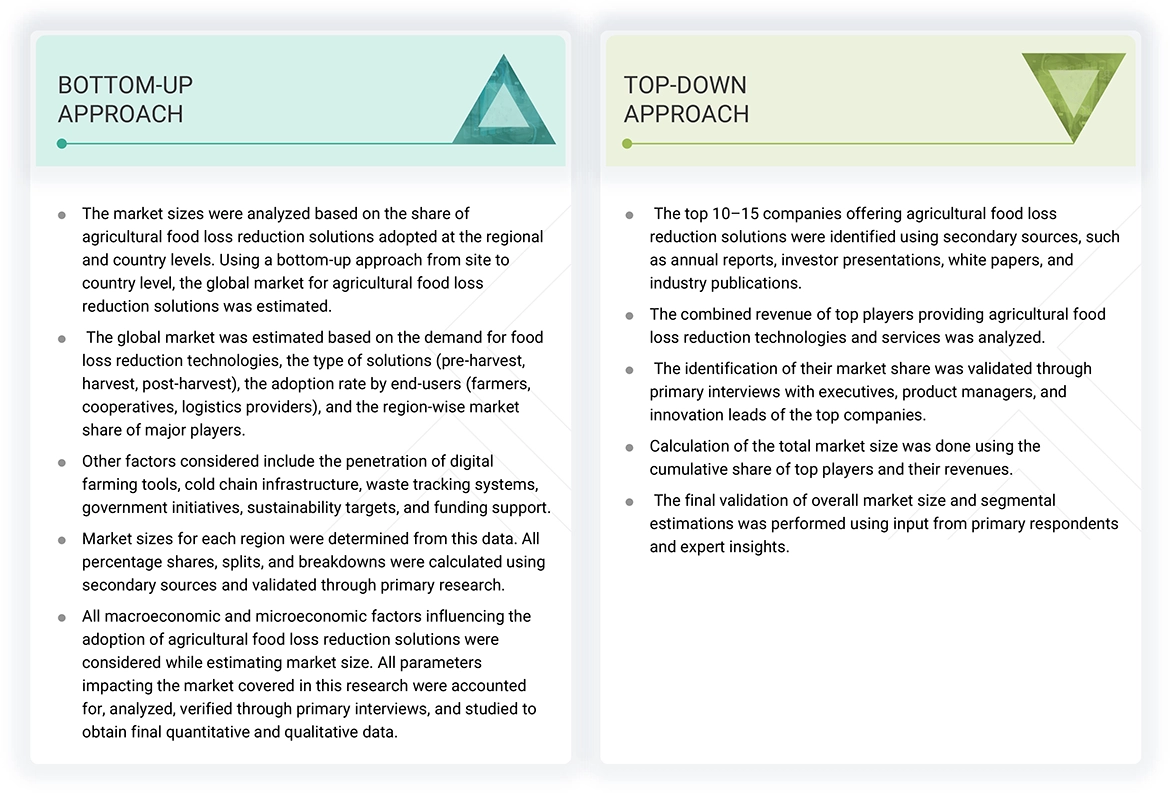
AGRICULTURAL FOOD LOSS REDUCTION SOLUTIONS: MARKET SIZE ESTIMATION – BOTTOM-UP APPROACH


FIGURE 6
AGRICULTURAL FOOD LOSS REDUCTION SOLUTIONS: MARKET SIZE ESTIMATION – TOP-DOWN APPROACH


FIGURE 7
DATA TRIANGULATION METHODOLOGY


FIGURE 8
DATA TRIANGULATION: SUPPLY-SIDE


FIGURE 9
DATA TRIANGULATION: DEMAND-SIDE


FIGURE 10
AGRICULTURAL FOOD LOSS REDUCTION SOLUTIONS MARKET, BY CROP TYPE, 2025 VS. 2030 (USD MILLION)


FIGURE 11
AGRICULTURAL FOOD LOSS REDUCTION SOLUTIONS MARKET, BY SOLUTION TYPE, 2025 VS. 2030 (USD MILLION)


FIGURE 12
AGRICULTURAL FOOD LOSS REDUCTION SOLUTIONS MARKET, BY TECHNOLOGY, 2025 VS. 2030 (USD MILLION)


FIGURE 13
AGRICULTURAL FOOD LOSS REDUCTION SOLUTIONS MARKET, BY END USER, 2025 VS. 2030 (USD MILLION)


FIGURE 14
AGRICULTURAL FOOD LOSS REDUCTION SOLUTIONS MARKET, BY REGION


FIGURE 15
ROBUST GOVERNMENT POLICIES AND FUNDING PROGRAMS TO SUPPORT WIDESPREAD IMPLEMENTATION OF POST-HARVEST TECHNOLOGIES


FIGURE 16
US ACCOUNTED FOR LARGEST MARKET SHARE IN 2024


FIGURE 17
POST-HARVEST LOSS REDUCTION TECHNOLOGIES SEGMENT AND US TO ACCOUNT FOR LARGEST MARKET SHARES IN NORTH AMERICA IN 2025


FIGURE 18
SENSOR TECHNOLOGY SEGMENT TO DOMINATE MARKET IN ASIA PACIFIC DURING FORECAST PERIOD


FIGURE 19
POST-HARVEST LOSS REDUCTION TECHNOLOGIES SEGMENT TO LEAD MARKET DURING FORECAST PERIOD


FIGURE 20
CEREALS & GRAINS TO DOMINATE MARKET DURING FORECAST PERIOD


FIGURE 21
LOGISTICS & WAREHOUSING PROVIDERS SEGMENT TO LEAD MARKET BY 2030


FIGURE 22
HISTORIC AND PROJECTED GLOBAL POPULATION


FIGURE 23
AGRICULTURAL FOOD LOSS REDUCTION SOLUTIONS MARKET DYNAMICS


FIGURE 24
ADOPTION OF GEN AI IN AGRICULTURAL FOOD LOSS REDUCTION SOLUTIONS


FIGURE 25
AGRICULTURAL FOOD LOSS REDUCTION SOLUTIONS MARKET: SUPPLY CHAIN ANALYSIS


FIGURE 26
AGRICULTURAL FOOD LOSS REDUCTION SOLUTIONS MARKET: VALUE CHAIN ANALYSIS


FIGURE 27
EXPORT DATA FOR HS CODE 8418: TOP 5 COUNTRIES, 2020–2024 (USD THOUSAND)


FIGURE 28
IMPORT DATA FOR HS CODE 8418: TOP 5 COUNTRIES, 2020–2024 (USD THOUSAND)


FIGURE 29
AGRICULTURAL FOOD LOSS REDUCTION SOLUTIONS MARKET: ECOSYSTEM


FIGURE 30
TRENDS/DISRUPTIONS IMPACTING CUSTOMER BUSINESS


FIGURE 31
PATENTS APPLIED AND GRANTED, 2014–2024


FIGURE 32
REGIONAL ANALYSIS OF PATENTS GRANTED FOR AGRICULTURAL FOOD LOSS REDUCTION SOLUTIONS AND RELATED MARKETS, 2014–2024


FIGURE 33
PORTER’S FIVE FORCES ANALYSIS: AGRICULTURAL FOOD LOSS REDUCTION SOLUTIONS MARKET


FIGURE 34
INFLUENCE OF STAKEHOLDERS ON BUYING PROCESS FOR TOP THREE TECHNOLOGIES


FIGURE 35
KEY BUYING CRITERIA FOR TOP THREE CROP TYPES


FIGURE 36
INVESTMENT AND FUNDING SCENARIO, 2021–2025


FIGURE 37
AGRICULTURAL FOOD LOSS REDUCTION SOLUTIONS MARKET, BY SOLUTION TYPE, 2025 VS. 2030 (USD MILLION)


FIGURE 38
AGRICULTURAL FOOD LOSS REDUCTION SOLUTIONS MARKET, BY TECHNOLOGY, 2025 VS. 2030 (USD MILLION)


FIGURE 39
AGRICULTURAL FOOD LOSS REDUCTION SOLUTIONS MARKET, BY CROP TYPE, 2025 VS. 2030 (USD MILLION)


FIGURE 40
AGRICULTURAL FOOD LOSS REDUCTION SOLUTIONS MARKET, BY END USER, 2025 VS. 2030 (USD BILLION)


FIGURE 41
INDIA TO RECORD FASTEST GROWTH FROM 2025 TO 2030


FIGURE 42
NORTH AMERICA: MARKET SNAPSHOT


FIGURE 43
ASIA PACIFIC: MARKET SNAPSHOT


FIGURE 44
REVENUE ANALYSIS FOR KEY COMPANIES IN LAST THREE YEARS, 2022–2024 (USD BILLION)


FIGURE 45
SHARE OF LEADING COMPANIES IN AGRICULTURAL FOOD LOSS REDUCTION SOLUTIONS MARKET, 2024


FIGURE 46
RANKING OF TOP FIVE PLAYERS IN AGRICULTURAL FOOD LOSS REDUCTION SOLUTIONS MARKET, 2024


FIGURE 47
COMPANY VALUATION OF KEY AGRICULTURAL FOOD LOSS REDUCTION SOLUTIONS VENDORS


FIGURE 48
EV/EBITDA OF KEY COMPANIES


FIGURE 49
BRAND/PRODUCT COMPARISON ANALYSIS, BY SOLUTION TYPE


FIGURE 50
AGRICULTURAL FOOD LOSS REDUCTION SOLUTIONS MARKET: COMPANY EVALUATION MATRIX (KEY PLAYERS), 2024


FIGURE 51
AGRICULTURAL FOOD LOSS REDUCTION SOLUTIONS MARKET: COMPANY FOOTPRINT


FIGURE 52
AGRICULTURAL FOOD LOSS REDUCTION SOLUTIONS MARKET: COMPANY EVALUATION MATRIX (STARTUPS/SMES), 2024


FIGURE 53
DEERE & COMPANY: COMPANY SNAPSHOT


FIGURE 54
CNH INDUSTRIAL N.V.: COMPANY SNAPSHOT


FIGURE 55
AGCO: COMPANY SNAPSHOT


FIGURE 56
CARRIER: COMPANY SNAPSHOT


FIGURE 57
CISCO SYSTEMS, INC.: COMPANY SNAPSHOT


FIGURE 58
HEXAGON AB AND/OR ITS SUBSIDIARIES: COMPANY SNAPSHOT


FIGURE 59
AGEAGLE AERIAL SYSTEMS INC.: COMPANY SNAPSHOT


FIGURE 60
SAP SE OR AN SAP AFFILIATE COMPANY: COMPANY SNAPSHOT


Methodology

The study involved two major approaches in estimating the current size of the agricultural food loss reduction solutions market. Exhaustive secondary research collected information on the market, crop type, by technology, solution type, and end user. The next step was to validate these findings, assumptions, and sizing with industry experts across the value chain through primary research. The top-down and bottom-up approaches were employed to estimate the complete market size. Data triangulation was used to estimate the market size of segments and subsegments.

Secondary Research

This research study involved extensive secondary sources—directories and databases such as Bloomberg Businessweek and Factiva—to identify and collect valuable information for a technical, market-oriented, and commercial market study. In the secondary research process, sources such as annual reports, press releases & investor presentations of companies, white papers, food journals, certified publications, articles from recognized authors, directories, and databases were referred to identify and collect information. Secondary research was mainly used to obtain key information about the industry’s supply chain, the pool of key players, and market classification and segmentation based on the industry trends to the bottom-most level, regional markets, and key developments from market- and technology-oriented perspectives.

Primary Research

Extensive primary research was conducted after obtaining information regarding the agricultural food loss reduction solutions scenario through secondary research. Several primary interviews were conducted with market experts from the demand and supply sides across major countries of North America, Europe, Asia Pacific, South America, and the Rest of the World. Primary data was collected through questionnaires, emails, and telephonic interviews. The primary sources from the supply side included various industry experts, such as chief officers (CXOs), vice presidents (VPs), directors from business development, marketing, research, and development teams, and related key executives from distributors and key opinion leaders.

Primary interviews were conducted to gather insights such as market statistics, data on revenue collected from the products and services, market breakdowns, market size estimations, market forecasting, and data triangulation. It also helped understand the solution type, technology, crop type, end user, and region trends. Stakeholders from the demand side, such as farmers & growers, food processing companies, and cold chain logistics providers, were interviewed to understand the buyers’ perspective on the suppliers, products, and their business outlook, which will affect the overall market.

Agricultural Food Loss Reduction Solutions Market Size, and Share

Note: The three tiers of the companies are defined based on their total revenues in 2023 or 2024,
as per the availability of financial data: Tier 1: Revenue > USD 1 billion; Tier 2: USD 100 million = revenue = USD 1
billion; Tier 3: Revenue < USD 100 million

To know about the assumptions considered for the study, download the pdf brochure

COMPANY NAME

DESIGNATION

Deere & Company (US)

Product Development Manager

DJI (China)

Senior R&D Scientist

AGCO (US)

Marketing Director

CNH Industrial (UK)

Sales Head

 Hexagon AB (US)

Senior Research Executive

Market Size Estimation

The top-down and bottom-up approaches were used to estimate and validate the total size of the agricultural food loss reduction solutions market. These approaches were also used extensively to determine the size of various subsegments in the market. The research methodology used to estimate the market size includes the following details:

  • The key players in the industry and the overall markets were identified through extensive secondary research.
  • All shares, splits, and breakdowns were determined using secondary sources and verified through primary sources.
  • All possible parameters that affect the market covered in this research study were accounted for, viewed in extensive detail, verified through primary research, and analyzed to obtain final quantitative and qualitative data.
  • The research included the study of reports, reviews, and newsletters of top market players, along with extensive interviews for opinions from leaders, such as CEOs, directors, and marketing executives.

Agricultural Food Loss Reduction Solutions Market : Top-Down and Bottom-Up Approach

Agricultural Food Loss Reduction Solutions Market Top Down and Bottom Up Approach

Data Triangulation

After determining the overall market size from the estimation process explained above, the total market was split into several segments and subsegments. The data triangulation procedure was employed, wherever applicable, to estimate the overall agricultural food loss reduction solutions market and determine the exact statistics for all segments and subsegments. The data was triangulated by studying various factors and trends from the demand and supply sides. The market size was also validated using the top-down and bottom-up approaches.

Market Definition

According to the FAO, Food losses refer to the decrease in edible food mass throughout the part of the supply chain that specifically leads to edible food for human consumption. Food losses occur at production, postharvest, and processing stages in the food supply chain. Food losses occurring at the end of the food chain (retail and final consumption) are often called “food waste,” which relates to retailers’ and consumers’ behavior.

The agricultural food loss reduction solutions market refers to the collection of technologies, equipment, services, and practices aimed at minimizing food loss during pre-harvest, harvest, post-harvest, storage, processing, and transportation stages of the agricultural supply chain.

Stakeholders

  • Farmers & Growers
  • Agri-tech Companies
  • Equipment & Machinery Manufacturers
  • Cold Chain Logistics Providers
  • Food Processing Companies
  • Government & Regulatory Bodies
  • NGOs & International Agencies
  • Research & Academic Institutions
  • Investors & Funding Agencies
  • Retailers & Wholesalers

Report Objectives

  • To determine and project the size of the agricultural food loss reduction solutions market based on solution type, crop type, technology, end user, and region over five years, ranging from 2025 to 2030
  • To identify the attractive opportunities in the market by determining the largest and fastest-growing segments across regions
  • To provide detailed information about the key factors influencing market growth (drivers, restraints, opportunities, and challenges)
  • To analyze the opportunities in the market for stakeholders and provide details of the competitive landscape for market leaders
  • To analyze the micro markets concerning individual growth trends, prospects, and their contribution to the total market
  • To identify and profile the key players in the agricultural food loss reduction solutions market
  • To understand the competitive landscape and identify the major growth strategies adopted by players across the key regions

Available Customizations

With the given market data, MarketsandMarkets offers customizations according to company-specific scientific needs.

The following customization options are available for the report:

Product Analysis

  • A product matrix, which gives a detailed comparison of the product portfolio of each company.

Geographic Analysis as per Feasibility

With the given market data, MarketsandMarkets offers customizations according to company-specific scientific needs.

  • Further breakdown of the Rest of the European agricultural food loss reduction solutions into key countries
  • Further breakdown of the Rest of Asia Pacific agricultural food loss reduction solutions into key countries
  • Further breakdown of the Rest of the South American agricultural food loss reduction solutions into key countries

Company Information

  • Detailed analyses and profiling of additional market players (up to five)


Key Questions Addressed by the Report

What is the projected size of the agricultural food loss reduction solutions market?

The market is estimated at USD 14.50 billion in 2025 and is projected to reach USD 22.50 billion by 2030, at a CAGR of 9.2%.

Which are the key players in the market, and how intense is the competition?

The key players are Deere & Company (US), DJI (China), AGCO (US), and CNH Industrial (UK). The market competition is intense, with continuous R&D investments, mergers, acquisitions, and innovations in storage technologies.

What are the growth prospects for the market in the next five years?

The Agricultural food loss reduction solutions market is expected to grow robustly over the next five years, driven by the global demand for clean & hygienic foods.

What kind of information is provided in the company profiles section?

The company profiles offer valuable information, such as a comprehensive business overview, including details on the company’s various business segments, financial performance, geographical reach, revenue composition, and the breakdown of their business revenue. Additionally, these profiles offer insights into the company’s product offerings, significant milestones, and expert analyst perspectives to further explain the company’s potential.

How is the Asia Pacific region contributing to market growth?

The Asia Pacific region is becoming a key growth driver for the Agricultural food loss reduction solutions market. India, China, and Vietnam are significantly increasing their logistics sectors to meet domestic and export demands.

Personalize This Research

  • Triangulate with your Own Data
  • Get Data as per your Format and Definition
  • Gain a Deeper Dive on a Specific Application, Geography, Customer or Competitor
  • Any level of Personalization
Request A Free Customisation

Let Us Help You

  • What are the Known and Unknown Adjacencies Impacting the Agriculture Waste Management Market

  • What will your New Revenue Sources be?
  • Who will be your Top Customer; what will make them switch?
  • Defend your Market Share or Win Competitors
  • Get a Scorecard for Target Partners
Customized Workshop Request

Custom Market Research Services

We Will Customise The Research For You, In Case The Report Listed Above Does Not Meet With Your Requirements

Get 10% Free Customisation

Growth opportunities and latent adjacency in Agriculture Waste Management Market

DMCA.com Protection Status