AI Data Center Liquid Cooling Market

AI Data Center Liquid Cooling Market by Cooling Type (Direct-to-chip cooling, Immersion cooling), Data Center Type (Hyperscale, Colocation, Enterprise), Component (Solutions, Services), Rack Density and Region - Global Forecast To 2032




OVERVIEW
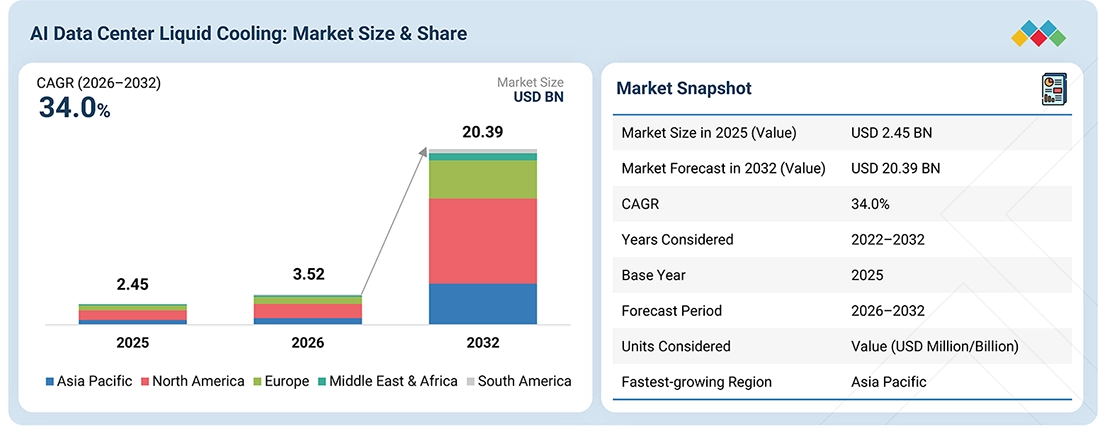
Source: Secondary Research, Interviews with Experts, MarketsandMarkets Analysis
The global AI data center liquid cooling market is projected to grow from USD 3.52 billion in 2026 to USD 20.39 billion in 2032, at a CAGR of 34.0% during the forecast period. There is increased demand for AI data center liquid cooling solutions due to the rising use of high-performance GPUs and AI servers, which produce more heat than traditional air-based cooling methods can dissipate. There has been an increase in the use of technologies such as direct-to-chip cooling and cooling distribution units as rack power densities increase, ensuring a consistent operating temperature while maintaining high levels of computing capability.
KEY TAKEAWAYS
-
BY REGIONAsia Pacific is expected to register the highest CAGR (35.2%) during the forecast period.
-
BY RACK DENSITY150 kW & above segment is projected to grow at the highest CAGR (78.0%) during the forecast period.
-
BY DATA CENTER TYPEThe hyperscale segment is projected to grow at the highest CAGR (34.7%) during the forecast period.
-
BY COMPONENTThe solutions segment will dominate the market during the forecast period.
-
BY COOLING TYPEThe direct-to-chip segment will dominate the market during the forecast period.
-
Competitive Landscape - Key PlayersVertiv Group Corp. (US), Schneider Electric (France), and Super Micro Computer, Inc. (US) were identified as leading players in the AI data center liquid cooling market, given their strong market share and product portfolios.
-
Competitive Landscape - StartupsKollance Inc. (US), GIGA-BYTE Technology Co., Ltd. (Taiwan), and Teimmers (Netherlands) are leading startups or SMEs by identifying niche gaps early and delivering solutions that precisely match unmet customer needs. Their agility, faster decision-making, and continuous innovation allow them to outperform larger, less flexible competitors.
The major trends contributing to the expansion of the global AI data center liquid cooling market include the rapid growth of AI and GPU-intensive data centers, rising rack power density, increasing adoption of direct-to-chip and other liquid cooling architectures, and the growing focus on energy and water efficiency. The deployment of high-performance AI hardware is pushing rack densities well beyond the levels that conventional air cooling can efficiently support, creating greater demand for liquid-based thermal management systems. Meanwhile, the shift toward purpose-built AI data centers and modernization of existing facilities is encouraging operators to adopt hybrid and modular liquid cooling systems that can support higher compute densities while allowing infrastructure to scale with evolving AI workloads.
TRENDS & DISRUPTIONS IMPACTING CUSTOMERS' CUSTOMERS
The impact on consumers' businesses arises from evolving customer trends or market disruptions. Megatrends such as sustainability and digital transformation, alongside disruptions such as AI, supply chain localization, and the energy transition, are significantly reshaping customer priorities and business models. Traditionally, revenue mixes were dominated by legacy products and processes focused on volume and cost. Today, customers are shifting toward high-margin, innovation-driven, and sustainable solutions to remain competitive and future-proof. This transition is prompting businesses to adapt quickly, invest in cleaner technologies, and enhance agility, with suppliers expected to deliver compliant, efficient, and tech-enabled offerings that align with evolving market demands.
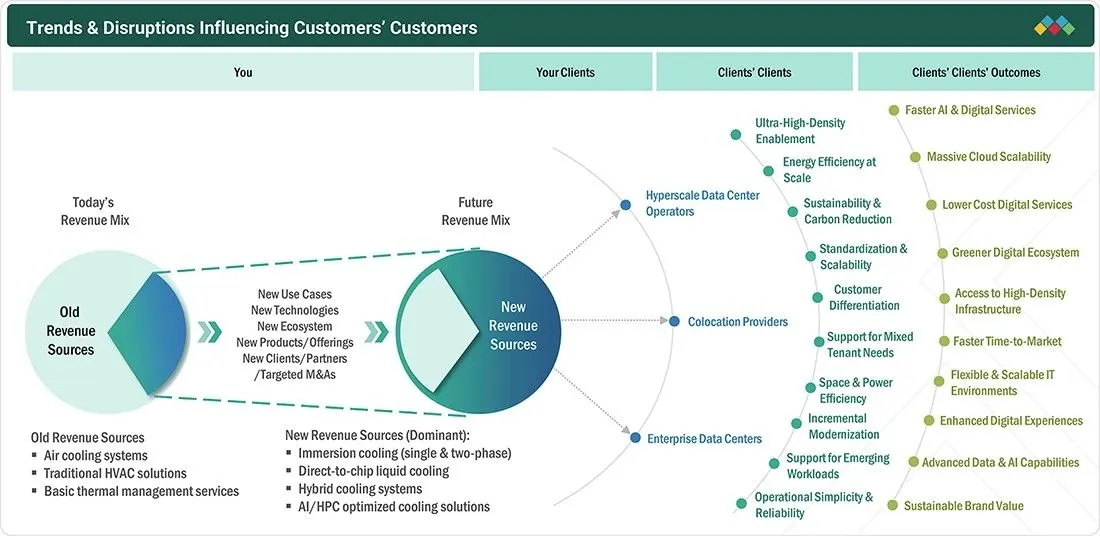
Source: Secondary Research, Interviews with Experts, MarketsandMarkets Analysis
MARKET DYNAMICS

Level
-
•Increasing number of data centers and server density

-
•Growing need for energy-efficient cooling solutions


Level
-
•High capital expenditure and maintenance requirements

-
•Slow recognition from end users


Level
-
•Emergence of AI, blockchain, and other advanced technologies

-
•Adoption of immersion cooling solutions in low-density data centers


Level
-
•Lack of standardization

-
•High investments in existing infrastructure

Source: Secondary Research, Interviews with Experts, MarketsandMarkets Analysis
Driver: Increasing number of data centers and server density
With the rise in demand for data storage capacity, computing capability, and applications of digital devices, the number of data centers, as well as server density, has been on the rise. There has been an exponential increase in the volume of digital data owing to social media and the Internet of Things devices as well as the digitization of different industries. Therefore, there has been an increase in the number of data centers in order to store and analyze the data produced. Technological advances in server technology including efficient CPU chips, as well as more advanced storage technologies including solid-state drives, have increased the server density. There has also been a need for energy efficiency as far as the environment is concerned in data centers. Server density can be increased using less energy through liquid cooling and proper power distribution, as well as advanced cooling techniques. Data centers are increasingly being required because of the growth, complexity, and density of data servers due to the increased demands for storage, networking, and computing capability. Top 15 countries according to CloudScene in terms of having the highest number of data centers by March 2024 include the US (5,387), Germany (522), the UK (517), China (449), and Canada (336). Other significant countries include France (315), Australia (306), and the Netherlands (300). Important data center countries also include Russia and Japan with 255 and 219 data centers, respectively. Other countries are Italy, Mexico, Brazil, India, and Poland. India has 152 data centers, particularly around Mumbai.
Restraint: High capital expenditure and maintenance requirements
In comparison to conventional air cooling systems, the implementation of liquid cooling systems in data centers demands large amounts of capital investment. The reason for this is that liquid cooling systems require special equipment and infrastructure that also requires maintenance. Electronic components need to be cooled through the use of special equipment such as heat sinks, cold plates, or immersion cooling systems. The acquisition and installation of these devices is much more costly than any other cooling system. Components of liquid cooling systems cost more. Inappropriate maintenance of the liquid leads to issues of sedimentation, contamination, and bacterial growth. The system needs to be constructed using rare metals and alloys such as bronze, cupronickel, or titanium. This also leads to higher costs of liquid cooling systems. In addition, the required infrastructure for monitoring and alarm transmission concerning flow, pressure, and leakage adds up to the maintenance costs.
Opportunity: Emergence of artificial intelligence (AI), blockchain, and other advanced technologies
The technologies of artificial intelligence (AI), machine learning, and blockchain have started to get popularity very quickly. In the first place, these technologies need the use of many processing units like GPUs and TPUs, whose hardware accelerators are able to work with much higher temperatures. Also, there are such blockchain and high-frequency trading applications that require ultrahigh-performance CPUs and GPUs, thus, causing overheating. The liquid cooling is needed for businesses who want to benefit from these technologies and get considerable performance boost.
Challenge: Lack of standardization
Liquid cooling technology is advancing at an exponential rate, with new technologies, solutions, and methods arising. It is challenging for industry participants to keep pace due to the enormous rate of innovation. Liquid cooling has different methods, including direct-to-chip, immersion, and cold plate cooling. Application of common methods to all methodologies is challenging since every methodology has specifications, components, and considerations. Lack of regulation and industry standards for liquid cooling is a significant barrier to the widespread use of this technology. Standardization is beneficial in heterogeneous computing environments as it ensures product compatibility. Incompatible proprietary systems are a market obstacle; thus, it is required to set specifications and standards to enable the global adoption of liquid cooling for data center equipment to function harmoniously.
AI DATA CENTER LIQUID COOLING MARKET: COMMERCIAL USE CASES ACROSS INDUSTRIES
| COMPANY | USE CASE DESCRIPTION | BENEFITS |
|---|---|---|
 |
Vertiv provides liquid cooling infrastructure for AI and high-density data centers through CoolChip CDUs, CoolPhase CDUs, fluid networks, and rear-door heat exchangers. Its solutions support direct-to-chip cooling of high-power CPUs/GPUs and hybrid cooling configurations across hyperscale, colocation, and enterprise facilities. | Its solutions support high-density AI racks. |
 |
Schneider Electric provides end-to-end liquid cooling solutions for AI data centers, including direct-to-chip cooling, CDUs, rear-door heat exchangers, and heat-rejection systems. Its solutions are used in both new and existing facilities to accommodate high-density GPU infrastructure and retrofit air-cooled data centers for AI workloads. | Its solutions enable higher rack densities. |
 |
Super Micro Computer integrates direct liquid cooling (DLC) into GPU-optimized AI server and rack-scale platforms, including NVIDIA HGX and GB200 NVL72 systems. Its liquid-cooled architectures incorporate cold plates, CDUs, and coolant distribution manifolds to provide rack-level thermal management for dense AI/LLM deployments. | Its solutions support high-density GPU deployment. |
 |
DCX Liquid Cooling Systems develops facility, in-rack, and equipment-level liquid cooling systems for AI, HPC, hyperscale, colocation, and enterprise data centers. Its portfolio includes ECDU, FDU, and InRack CDU platforms, with facility-level systems designed to provide multi-megawatt cooling capacity for high-density AI data halls. | Its solutions support large-scale AI and HPC deployments. |
 |
CoolIT Systems provides scalable direct liquid cooling systems for AI and high-performance computing, including cold plates, CDUs, manifolds, and rack-level cooling architectures. Its solutions are designed to remove heat directly from high-power processors and support increasingly dense AI compute clusters. | Its solutions enable high-density AI computing. |
Logos and trademarks shown above are the property of their respective owners. Their use here is for informational and illustrative purposes only.
MARKET ECOSYSTEM
The AI data center liquid cooling market ecosystem consists of raw material suppliers (e.g., Shell, Chemours, engineered fluids), manufacturers (e.g., LiquidCool Solutions, Asperitas, DCX Liquid Cooling Systems), distributors (e.g., KROHNE), and end users (e.g., Microsoft, Google, Lenovo). AI data center liquid cooling solutions maintain optimal thermal conditions, maximize energy efficiency, and support next-generation workloads like cloud computing, AI, and blockchain applications.
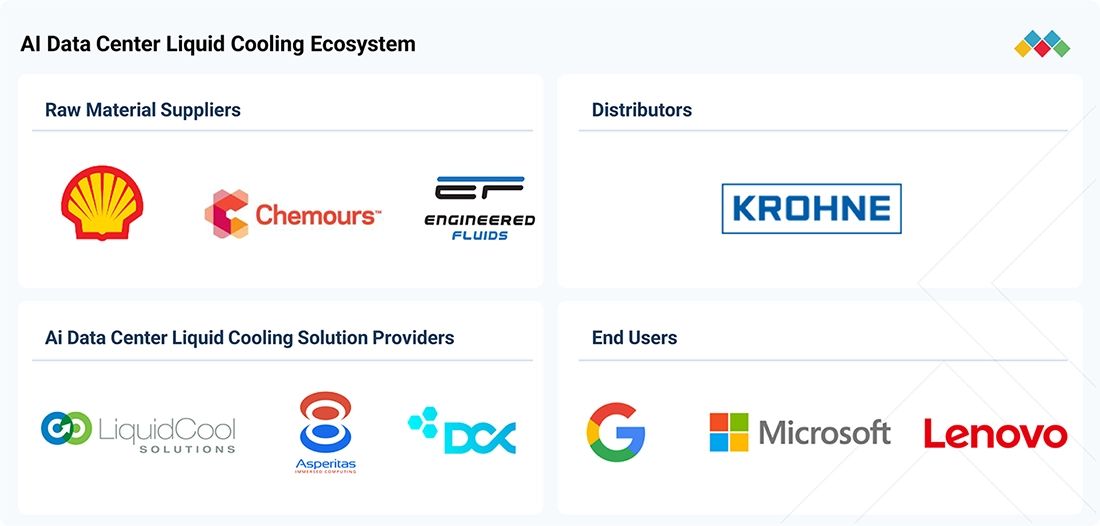
Logos and trademarks shown above are the property of their respective owners. Their use here is for informational and illustrative purposes only.
MARKET SEGMENTS
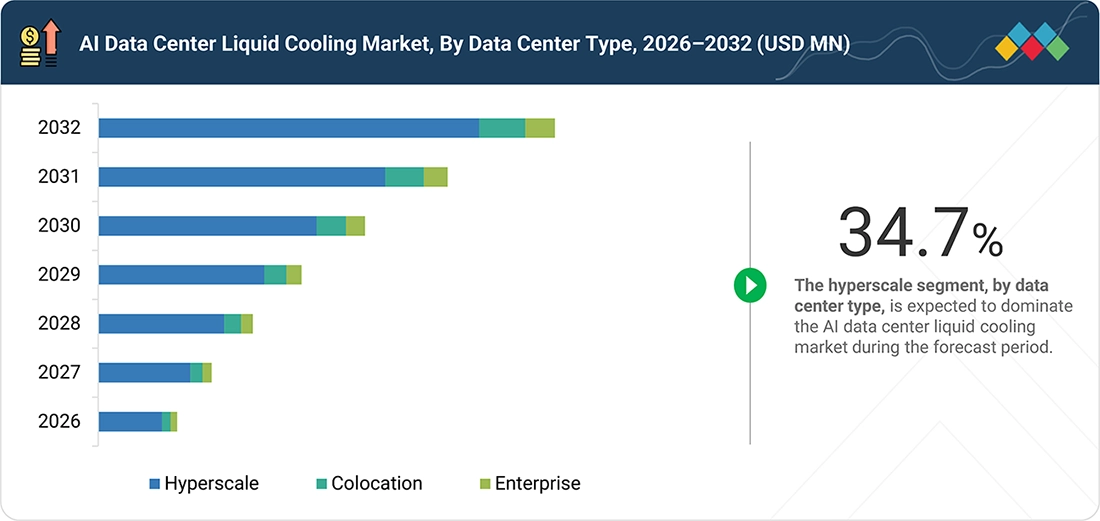
Source: Secondary Research, Interviews with Experts, MarketsandMarkets Analysis
AI Data Center Liquid Cooling Market, By Data Center Type
Hyperscale is expected to be the fastest-growing sector within the AI data center liquid cooling market due to the rapid rise in the development of AI infrastructures and the increased installation of high-density GPU clusters. Hyperscale AI data centers are being developed with much higher power consumption needs than before, with the IEA highlighting that AI-oriented hyperscale data centers have the capacity to exceed 100 MW. In terms of rack power, the rapid increase in AI server power density is leading to thermal management challenges that cannot be handled effectively using traditional air-cooling systems.
AI Data Center Liquid Cooling Market, By Cooling Type
The immersion cooling segment will experience the highest CAGR among all segments within the AI data center liquid cooling market, owing to the rapid rise in AI workloads, GPU power density, and high-density rack installations. In contrast to direct chip cooling, which uses an indirect technique to cool systems, immersion cooling involves immersing servers in a dielectric coolant, providing even heating removal from GPUs, CPUs, memory, and other components without depending on the server fan and traditional air-cooling systems. Because of its capability to handle high rack density, provide thermal management, decrease cooling energy use, and conserve water, immersion cooling is becoming more applicable in AI and HPC.
REGION
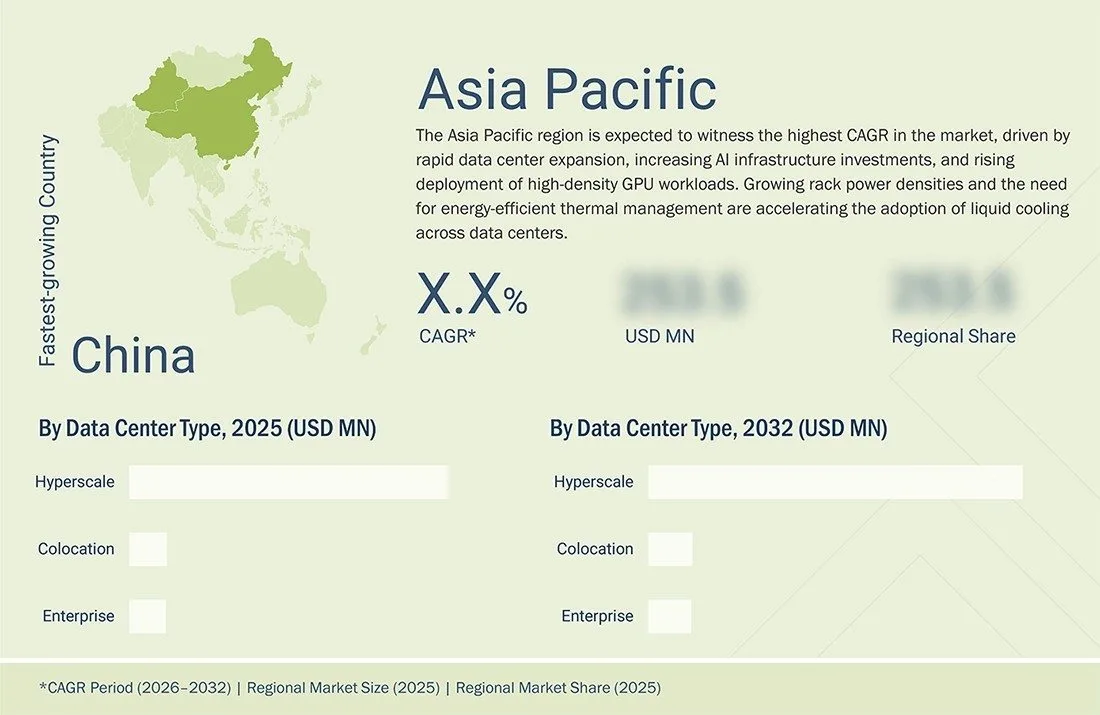
Asia Pacific to be fastest-growing region in AI data center liquid cooling market during forecast period
Asia Pacific is projected to have the fastest CAGR in the AI data center liquid cooling market due to fast growth in the capacity of the data center industry, adoption of AI technology, and increased investments in the hyperscale and colocation data center industry in countries like China, India, Japan, Singapore, and South Korea. Asia Pacific has emerged as an important region for next-generation AI infrastructure because of the increased usage of GPU workloads and high-density AI clusters, which have increased demand for better thermal management solutions. Increasing AI infrastructure development at OCP within Asia Pacific, including liquid cooling and high-density AI data centers, highlights this trend. With increased power of the AI accelerator and densities per rack, there has been a shift from traditional air cooling to liquid cooling.
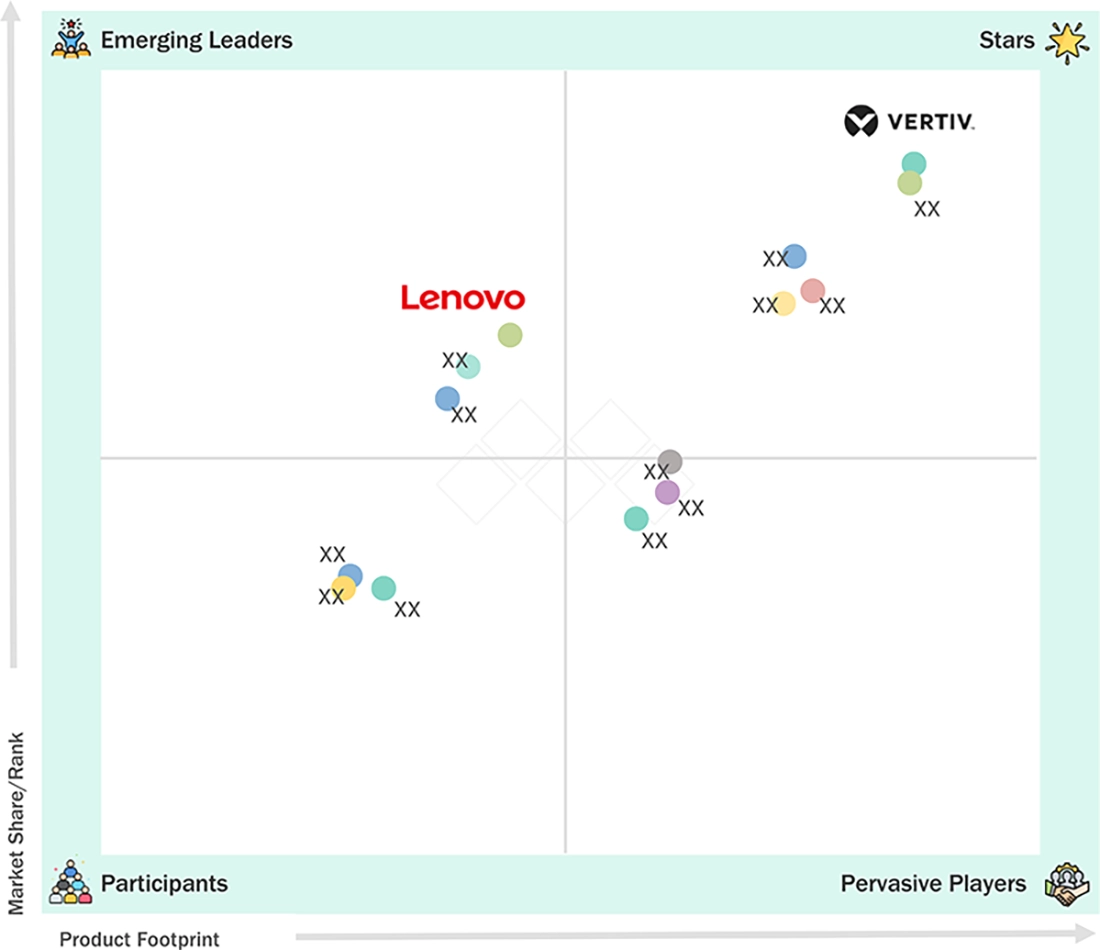
AI DATA CENTER LIQUID COOLING MARKET: COMPANY EVALUATION MATRIX
In the AI data center liquid cooling market matrix, Vertiv (Star) leads with a strong market share and extensive product footprint, driven by its data center liquid cooling solutions, which are adopted by various end users. Lenovo (Emerging Leader) demonstrates substantial product innovations compared to its competitors. While Vertiv dominates through scale and a diversified portfolio, Lenovo’s data center liquid cooling shows significant potential to move toward the leaders’ quadrant as demand for AI data center liquid cooling continues to rise.
Source: Secondary Research, Interviews with Experts, MarketsandMarkets Analysis
KEY MARKET PLAYERS
- Vertiv Group Corp. (US)
- Schneider Electric (France)
- Super Micro Computer, Inc. (US)
- DCX Liquid Cooling Systems (Poland)
- CoolIT Systems (Canada)
- Modine Manufacturing Company (US)
- Green Revolution Cooling (US)
- Submer Group Ltd. (Spain)
- Asperitas (Netherlands)
- Iceotope (UK)
- Rittal GmbH & Co. KG (Germany)
- Midas Immersion Cooling (US)
- Trane Technologies plc (Ireland)
- Daikin Industries, Ltd. (Japan)
- Baltimore Aircoil Company, Inc. (US)
- STULZ GmbH (Germany)
- LiquidCool Solutions (US)
- Delta Power Solutions (Taiwan)
- ZutaCore, Inc. (Israel)
- Eaton (Ireland)
- Kaori Heat Treatment Co., Ltd. (Taiwan)
- Flex Ltd. (Singapore)
- Lenovo (China)
- Dawning Information Industry Co., Ltd. (China)
- nVent (UK)
- Taisol Electronics Co., Ltd. (Taiwan)
- Wiwynn Corporation (Taiwan)
- Accelsius LLC (US)
- Refroid Technologies (India)
- Inspur Co., Ltd. (China)
MARKET SCOPE
| REPORT METRIC | DETAILS |
|---|---|
| Market Size in 2025 (Value) | USD 2.45 Billion |
| Market Forecast in 2032 (Value) | USD 20.39 Billion |
| CAGR (2026–2032) | 34.0% |
| Years Considered | 2022–2032 |
| Base Year | 2025 |
| Forecast Period | 2026–2032 |
| Units Considered | Value (USD Million/Billion) |
| Report Coverage | Revenue forecast, competitive landscape, growth factors, and trends |
| Segments Covered |
|
| Regions Covered | North America, Europe, Asia Pacific, Middle East & Africa, South America |
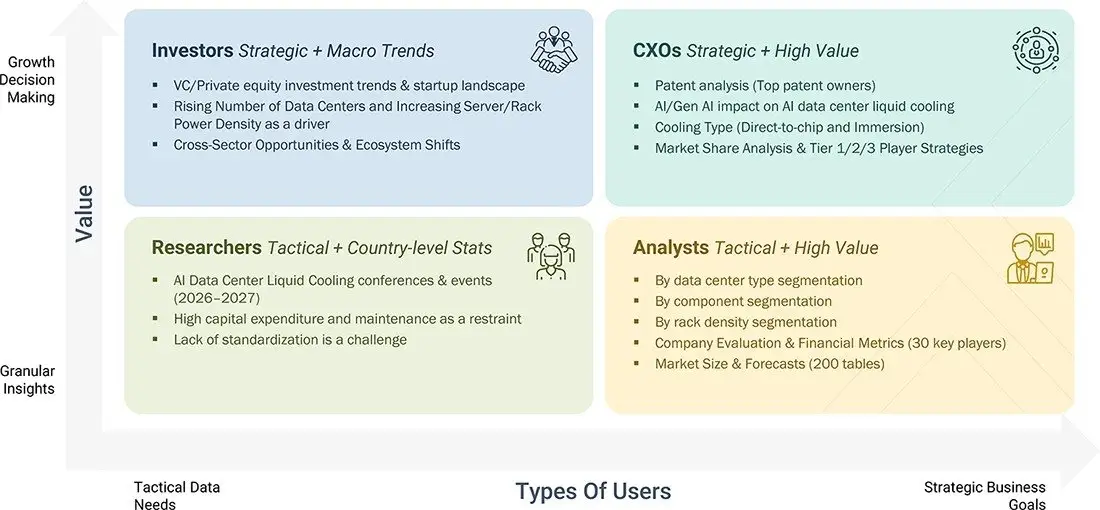
WHAT IS IN IT FOR YOU: AI DATA CENTER LIQUID COOLING MARKET REPORT CONTENT GUIDE
DELIVERED CUSTOMIZATIONS
We have successfully delivered the following deep-dive customizations:
| CLIENT REQUEST | CUSTOMIZATION DELIVERED | VALUE ADDS |
|---|---|---|
| Hyperscale & Enterprise Data Center Operators |
|
|
| Colocation Providers & SMEs |
|
|
| Hybrid Cooling Integration | Integration of liquid cooling with existing air-cooled infrastructures for hybrid environments | Seamless transition, optimized cooling efficiency, and cost benefits |
| Coolant Compatibility Testing | Technical testing of coolant materials for thermal efficiency and corrosion resistance | Increased system reliability and longevity |
| Sustainability Reporting | Customized reporting on reductions in energy use and water consumption | Evidence for sustainability goals and regulatory compliance |
RECENT DEVELOPMENTS
- March 2026 : Eaton acquired Boyd Thermal for USD 9.5 billion, roughly 22.5x estimated 2026 EBITDA, adding liquid-ready thermal components, CDUs, and manufacturing scale to its power and cooling portfolio for AI data centers.
- March 2026 : Ecolab agreed to acquire CoolIT Systems from KKR for USD 4.75 billion, expanding into direct-to-chip liquid cooling to complement its existing water treatment and air handling offerings.
- October 2025 : Schneider Electric acquired a 75% controlling stake in Motivair for USD 850 million, adding cooling distribution units, rear-door heat exchangers, and chillers used alongside air handling systems in high-density facilities.
Table of Contents
 Exclusive indicates content/data unique to MarketsandMarkets and not available with any competitors.
Methodology
The study involved four major activities in estimating the current size of the AI data center liquid cooling market. Exhaustive secondary research was done to collect information on the market, peer markets, and parent market. The next step was to validate these findings, assumptions, and sizing with industry experts across the AI data center liquid cooling value chain through primary research. Both top-down and bottom-up approaches were employed to estimate the complete market size. Thereafter, market breakdown and data triangulation were used to estimate the market size of segments and subsegments.
Secondary Research
Secondary sources for this research study include annual reports, press releases, and investor presentations of companies; white papers; certified publications; and articles by recognized authors; gold- and silver-standard websites; AI data center liquid cooling manufacturing companies, regulatory bodies, trade directories, and databases. The secondary research was mainly used to obtain key information about the industry’s supply chain, the total pool of key players, market classification, and segmentation according to industry trends to the bottom-most level and regional markets. It has also been used to obtain information about key developments from a market-oriented perspective.
Primary Research
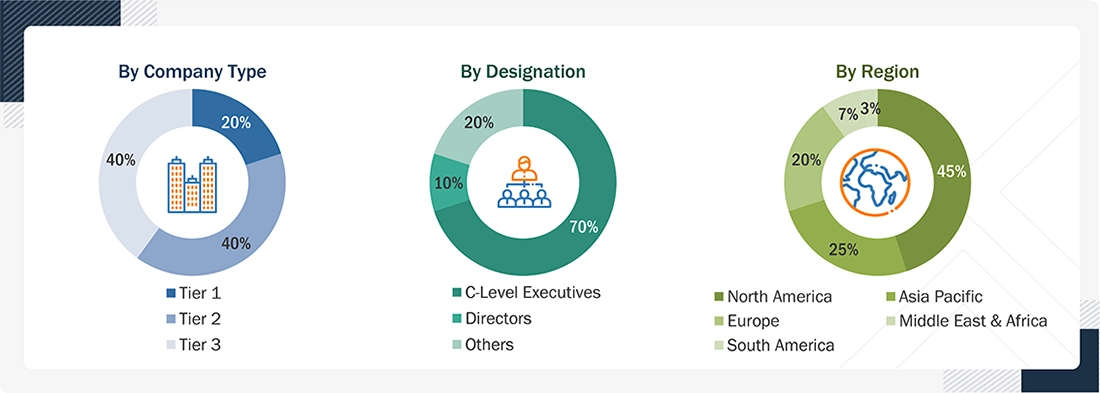
The AI data center liquid cooling market comprises several stakeholders, such as raw material suppliers, technology support providers, data center cooling equipment manufacturers, and regulatory organizations in the supply chain. Various primary sources from both the supply and demand sides of the market were interviewed to obtain qualitative and quantitative information. Primary sources from the supply side included industry experts such as chief executive officers (CEOs), vice presidents, marketing directors, technology and innovation directors, and related key executives from various key companies and organizations operating in the AI data center liquid cooling market. Primary sources from the demand side included directors, marketing heads, and purchase managers from various sourcing industries. The following is the breakdown of the primary respondents:
Breakdown of Primary Profiles
To know about the assumptions considered for the study, download the pdf brochure
Market Size Estimation
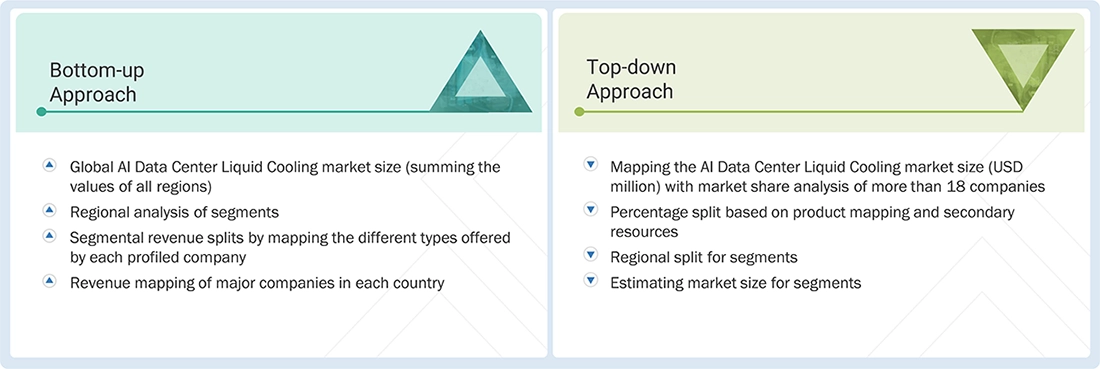
The top-down and bottom-up approaches have been employed to estimate and validate the total size of the AI data center liquid cooling market. These approaches have also been used extensively to estimate the size of various dependent market subsegments. The research methodology used to estimate the market size included the following:
The following segments provide details about the overall market size estimation process employed in this study:
- Extensive primary and secondary research was done to identify the key players.
- The value chain and market size of the AI data center liquid cooling market, in terms of value, were determined through primary and secondary research.
- All percentage shares, splits, and breakdowns were collected through secondary sources and verified through primary sources.
- All possible parameters that affect the market were covered in this research study and are viewed in extensive detail, verified through primary research, and analyzed to obtain the final quantitative and qualitative data.
- The study of reports, reviews, and newsletters of top market players, along with extensive interviews for opinions from key leaders, such as CEOs, directors, and marketing executives, is included in this research.
Global AI data center liquid cooling Market Size: Bottom-up & Top-down Approach
Data Triangulation
After arriving at the overall market size using the market size estimation processes as explained above, the market was split into several segments and subsegments. To complete the overall market engineering process and arrive at the exact statistics of each market segment and subsegment, the data triangulation and market breakdown procedures were employed, wherever applicable. The data was triangulated by studying various factors and trends from both the demand and supply sides.
Market Definition
AI data center liquid cooling refers to a range of cooling solutions designed to manage the heat generated by increasingly powerful AI processors and computing systems. These solutions provide targeted thermal management for high-density infrastructure and can be integrated into new or existing data center environments. Market growth is being supported by the rapid deployment of AI and accelerated computing, increasing computational workloads, higher equipment density, and the need for dependable cooling infrastructure. The expansion of hyperscale, colocation, and enterprise data centers is expected to create further opportunities for liquid cooling technologies.
Key Stakeholders
- AI data center liquid cooling manufacturers, processors, and recycling technology providers
- Research institutions, standards organizations, and regulatory agencies such as ASTM, ISO, and others
- NGOs, governments, investment banks, venture capitalists, and private equity firms
Report Objectives
- To define, describe, and forecast the market size of AI data center liquid cooling in terms of value
- To provide detailed information regarding the key factors, such as drivers, restraints, opportunities, and industry-specific challenges, influencing the growth of the AI data center liquid cooling market
- To analyze and forecast the global AI data center liquid cooling market on the basis of cooling type, rack density, component, data center type, and region
- To analyze the opportunities in the market for stakeholders and provide details of a competitive landscape for market leaders
- To forecast the size of various market segments based on four major regions: North America, Asia Pacific, Europe, and Rest of the World, along with their respective key countries
- To track and analyze the competitive developments, such as product launches, expansions, and others, in the market
- To strategically profile the key players and comprehensively analyze their market shares and core competencies
Available customizations:
With the given market data, MarketsandMarkets offers customizations according to the client-specific needs.
The following customization options are available for the report:
- Additional country-level analysis of the AI data center liquid cooling market
- Profiling of additional market players (up to five)
Product Analysis
- Product matrix, which provides a detailed comparison of each company's product portfolio


Personalize This Research
- Triangulate with your Own Data
- Get Data as per your Format and Definition
- Gain a Deeper Dive on a Specific Application, Geography, Customer or Competitor
- Any level of Personalization
Let Us Help You
- What are the Known and Unknown Adjacencies Impacting the AI Data Center Liquid Cooling Market
- What will your New Revenue Sources be?
- Who will be your Top Customer; what will make them switch?
- Defend your Market Share or Win Competitors
- Get a Scorecard for Target Partners

Custom Market Research Services
We Will Customise The Research For You, In Case The Report Listed Above Does Not Meet With Your Requirements
Get 10% Free CustomisationTESTIMONIALS
We at Nissan Chemicals Corporation have been clients of MarketsandMarkets for more than a year now. We recently consulted MarketsandMarkets for a study, the team at MarketsandMarkets was extremely professional and organized. The business insights were very detailed and aligned well with our expectations that really helped us formulate the Business Plans and device new strategies for development themes. MarketsandMarkets offers a unique combination of expertise and dedicated engagement model. Their research findings have helped us in designing our Pricing Strategy which will make it easier for us to predict the future sales and profits for the next ten years. We look forward to working with MarketsandMarkets in the future.
VP of Strategy & New Business Development
Leading Specialty Chemical Company
The MarketsandMarkets Engagement Model, composed of both the Knowledge Store and advisory custom research, has greatly helped us in understanding our markets and making strategic decisions. The Knowledge Store is a fast way to allow everyone in our organization to understand more about most any market they are interested in. The ability to then get custom research done and get answers to specific strategic questions and market insight has been spectacular. The Markets and Markets team feel more like colleagues than vendors and their services have helped us change our culture where statements of things like growth opportunities and competitive position are always backed by industry research.

Rich Gibson,
Director, Corporate Strategy
Milliken & Company,
Leading Industrial Manufacturer of specialty chemical, floor covering, performance and protective textile materials, and healthcaremilliken.com
MarketsandMarkets is a trusted resource that helps us to better understand markets that are near-adjacencies-whether its technology, value chain or geography. Their Knowledge Store platform provides a dashboard of markets and their characteristics which is easy to use and saves us time.
Adam Shaw,
Market Development and Strategy Manager
AdvanSix Inc. USA,
An American Leader in Chemicalswww.advansix.com
The Knowledge Store from MarketsandMarkets is a valuable tool which has helped my team acquire greater insight in to the end markets that our business serves. This has enabled us to help our company build stronger strategies throughout our planning process.
TOSHIO KINOSHITA
Senior Chif Consultion Research & Consulting Division
Mitsubishi Chemical Research Corporation,
Leading Manufacturer of Chemical Productswww.mitsubishichem-res.co.jp/en/

We recently engaged with MarketsandMarkets for a study, the team not only clearly understood our business objectives but was also extremely professional in the way they handled the entire project. The study was efficiently conducted in a phase-wise manner, and the engagement model furnished us with high-quality business insights that far exceeded our expectations at each phase. We were especially happy that MarketsandMarkets could provide us with both, an English as well as a Japanese version of the study. A special thanks to the Analyst Team and Client Services Team, whose fluency in Japanese enhanced our comfort level, as we could converse with them in our preferred language.
Independent entrepreneurs
Arrow Precision
We approached MarketsandMarkets for study on Proppants Market, and their work exceeded our expectations. The study conducted was comprehensive and enabled us to view the market through the various dimensions. In addition, the team was extraordinarily responsive throughout the process and resolved our queries on time. I strongly recommend MarketsandMarkets and will certainly consider them for additional market assessments we will need in the future.
Global engineering company, Japan
Deputy Manager,
Strategic Planning OfficeThe high-quality insights shared by the MarketsandMarkets team helped us understand the pharmaceutical plant designers in a specific geography. It also captured the risks that we may likely face in communicating with our potential partners. The study would enable us identify partners, which would impact our future growth.






Growth opportunities and latent adjacency in AI Data Center Liquid Cooling Market