AI Video Analytics for Smart Cities Market

AI Video Analytics for Smart Cities Market by Offering, Application (Public Safety & Law Enforcement, Intelligent Traffic Management), Deployment (On-Premises, Cloud, Hybrid), Vertical (Commercial, Government & Public Safety) - Global Forecast to 2030




AI VIDEO ANALYTICS FOR SMART CITIES MARKET OVERVIEW
According to Marketsandmarkets, the Global AI Video Analytics for Smart Cities Market Size is projected to grow from USD 1.14 billion in 2026 to USD 3.34 billion by 2031, growing at a CAGR of 24.0% from 2026-2031. The AI Video Analytics in Smart Cities Market is witnessing strong growth due to increasing investments in smart city infrastructure, public safety modernization, and intelligent transportation systems. Cities are increasingly deploying AI-powered video analytics to enable real-time threat detection, traffic optimization, crowd monitoring, and critical infrastructure protection. Advancements in edge AI, cloud computing, 5G connectivity, and computer vision technologies are enhancing analytics capabilities and scalability.
REPORT SCOPE
| REPORT METRIC | DETAILS |
|---|---|
| Market Size in 2024 (Value) | USD 6.66 Billion |
| Market Size in 2025 (Value) | USD 8.50 Billion |
| Market Forecast in 2030 (Value) | USD 28.76 Billion |
| CAGR | CAGR of 27.6% from 2025-2030 |
| Years Considered | 2020-2030 |
| Base Year | 2024 |
| Forecast Period | 2025-2030 |
| Units | USD Billion |
| Report Coverage | Revenue Forecast, Company Ranking, Competitive Landscape, Growth Factors, and Trends |
| Top Companies |
|
| Growth Drivers |
|
| Segments Covered |
|
| Regions Covered | North America, Europe, Asia Pacific, RoW |
KEY TAKEAWAYS
-
BY OFFERINGBy offering, the hardware segment is expected to account for the largest market share in 2025, supported by widespread deployment of AI-enabled cameras, storage systems, monitoring equipment, and edge surveillance infrastructure across smart city projects.
-
BY APPLICATIONBy application, the public safety and law enforcement segment is expected to hold the largest market share in 2025, owing to increasing demand for real-time threat detection, crime prevention, crowd monitoring, and emergency response management.
-
BY SYSTEM TYPEBy system type, the IP video surveillance systems segment is expected to dominate the market in 2025 due to growing adoption of network-connected, AI-enabled surveillance architectures capable of supporting advanced analytics and centralized monitoring.
-
BY ANALYTICS TYPEBy analytics type, the real-time analytics segment is expected to register the highest growth during the forecast period, driven by increasing demand for instant incident detection, traffic management, and proactive public safety operations.
-
BY DEPLOYMENT MODEBy deployment mode, the edge-based segment is expected to grow at the highest CAGR during the forecast period due to its ability to deliver low-latency processing, reduced bandwidth requirements, and real-time decision-making capabilities.
-
BY VERTICALBy vertical, the government and public safety segment is expected to dominate the AI Video Analytics in Smart Cities Market throughout the forecast period, supported by increasing investments in smart surveillance, city command centers, and critical infrastructure protection.
-
COMPETITIVE LANDSCAPE - KEY PLAYERSAxis Communications AB, Motorola Solutions, Inc., Hangzhou Hikvision Digital Technology Co., Ltd., and Dahua Technology Co., Ltd. were identified as some of the key players in the AI Video Analytics in Smart Cities Market, given their extensive product portfolios, strong global presence, and broad smart surveillance offerings.
-
COMPETITIVE LANDSCAPE - INNOVATORSBriefCam Ltd., Ipsotek Ltd., Axyon AI, Vaidio (IronYun), and Graymatics Pte. Ltd., among others, have established strong positions in specialized AI video analytics applications, highlighting their potential as emerging innovators within the smart city surveillance ecosystem.

Source: Secondary Research, Interviews with Experts, MarketsandMarkets Analysis
TRENDS & DISRUPTIONS IMPACTING CUSTOMERS' CUSTOMERS
The AI Video Analytics in Smart Cities Industry is undergoing significant transformation as traditional surveillance systems evolve into intelligent, AI-driven urban monitoring platforms. Revenue generation is shifting from conventional CCTV infrastructure and basic video management systems toward generative AI-powered video intelligence, edge analytics, and real-time threat detection solutions. Technology providers are increasingly serving smart city authorities, law enforcement agencies, transportation operators, utilities, and critical infrastructure managers seeking enhanced operational visibility. These deployments enable improved public safety, traffic optimization, infrastructure resilience, automated operations, and data-driven urban planning, positioning AI video analytics as a foundational technology for next-generation smart city ecosystems.

Source: Secondary Research, Interviews with Experts, MarketsandMarkets Analysis
AI VIDEO ANALYTICS FOR SMART CITIES MARKET DYNAMICS

Level
-
Global smart city initiatives

-
AI and deep learning advances in real-time computer vision


Level
-
Privacy concerns and surveillance ethics debates

-
High infrastructure costs for city-wide camera deployment


Level
-
Privacy-preserving AI and federated learning for urban analytics

-
Digital twin cities combining video analytics with simulation


Level
-
Data governance and regulatory compliance across jurisdictions

-
Interoperability across multi-vendor camera and platform environments

Source: Secondary Research, Interviews with Experts, MarketsandMarkets Analysis
Driver: Smart city initiatives
The global smart cities market is projected to exceed USD 3.7 trillion by 2030. Intelligent transportation and public safety are the fastest-growing segments, directly driving demand for AI video analytics infrastructure.
Restraint: Privacy concerns and surveillance ethics debates
AI-powered surveillance raises significant privacy and civil liberties concerns. GDPR in Europe and similar regulations worldwide require privacy-by-design approaches including data anonymization, access controls, and transparent use policies.
Opportunity: Digital twin cities combining video analytics with simulation
Digital twin platforms combining real-time video analytics with 3D city models enable simulation-based planning, predictive incident management, and optimized urban service delivery.
Challenge: Interoperability across multi-vendor camera and platform environments
Cities deploy cameras and analytics from multiple vendors, creating integration challenges. Open standards and unified command center platforms are critical for cross-vendor interoperability.
AI VIDEO ANALYTICS FOR SMART CITIES MARKET: COMMERCIAL USE CASES ACROSS INDUSTRIES
| COMPANY | USE CASE DESCRIPTION | BENEFITS |
|---|---|---|
 |
Self-learning video analytics for municipal surveillance; integration with body cameras, communications, and command centers; AI-powered anomaly detection | Self-learning AI | Public safety ecosystem | Command center |
 |
Security Center unified platform integrating video, ANPR, access control, and IoT for city-wide operations; cloud-hybrid architecture; privacy-by-design | Unified platform | ANPR integration | Privacy-by-design |
 |
Biometric and video analytics for smart cities; NeoFace facial recognition for law enforcement and border control; deployed across global smart city projects | Biometric leader | NeoFace technology | Global smart city deployments |
 |
AI-powered edge cameras with embedded deep learning for traffic monitoring, crowd analytics, and incident detection at city scale | Largest camera shipments | Edge AI embedded | City-scale deployment |
 |
Open platform network cameras with ACAP analytics framework; partner ecosystem enabling third-party AI apps on Axis hardware | Open platform | ACAP framework | Partner AI ecosystem |
Logos and trademarks shown above are the property of their respective owners. Their use here is for informational and illustrative purposes only.
AI VIDEO ANALYTICS FOR SMART CITIES MARKET ECOSYSTEM
The AI Video Analytics in Smart Cities Market ecosystem consists of hardware manufacturers, software and AI platform providers, system integrators, and end users working together to enable intelligent urban surveillance and monitoring. Hardware providers supply cameras, storage systems, and surveillance infrastructure, while software vendors deliver video management, computer vision, and AI analytics capabilities that convert video data into actionable insights. System integrators facilitate the deployment and integration of these solutions across smart city environments. End users, including municipal authorities, transportation agencies, and critical infrastructure operators, leverage these technologies to enhance public safety, optimize traffic management, improve operational efficiency, and support data-driven urban governance.

Logos and trademarks shown above are the property of their respective owners. Their use here is for informational and illustrative purposes only.
AI VIDEO ANALYTICS FOR SMART CITIES MARKET SEGMENTS

Source: Secondary Research, Interviews with Experts, MarketsandMarkets Analysis
AI Video Analytics in Smart Cities Market, By Offering
Hardware is expected to hold the largest market share during the forecast period due to the extensive deployment of AI-enabled cameras, storage systems, monitoring equipment, and edge surveillance infrastructure across smart city projects. Growing investments in public safety modernization, intelligent transportation systems, and city-wide surveillance networks continue to drive demand for advanced hardware solutions. The expansion of smart city initiatives globally is further strengthening the segment’s market position.
AI Video Analytics in Smart Cities Market, By Application
Public Safety and Law Enforcement is expected to dominate the market due to increasing deployment of AI-powered surveillance systems for crime prevention, crowd monitoring, and emergency response management. Governments and law enforcement agencies are investing heavily in intelligent video analytics to enhance situational awareness and public safety outcomes. The growing need for proactive threat detection continues to support segment leadership.
AI Video Analytics in Smart Cities Market, By System Type
IP Video Surveillance Systems are expected to dominate the market due to their ability to support high-resolution video, remote accessibility, and advanced AI analytics capabilities. Smart city projects increasingly favor IP-based architectures for scalable and centralized monitoring operations. The rapid deployment of connected surveillance infrastructure is reinforcing segment leadership.
AI Video Analytics in Smart Cities Market, By Vertical
Government and Public Safety is expected to dominate the market due to extensive investments in surveillance infrastructure, crime prevention, emergency response, and smart city command centers. Public sector organizations remain the primary adopters of AI video analytics solutions worldwide. Increasing focus on urban security continues to drive segment growth.
AI VIDEO ANALYTICS FOR SMART CITIES MARKET REGION
North America holds the largest revenue share for AI video analytics in smart cities
North America is expected to dominate the AI Video Analytics in Smart Cities Market due to strong investments in smart city infrastructure, public safety modernization, and intelligent transportation systems. The region is witnessing rapid adoption of AI-powered surveillance, real-time video analytics, and edge-based monitoring solutions across municipal authorities, transportation agencies, and critical infrastructure operators.

AI VIDEO ANALYTICS FOR SMART CITIES MARKET: COMPANY EVALUATION MATRIX
In the AI Video Analytics in Smart Cities Market matrix, Motorola Solutions, Inc. emerges as a Star player due to its strong AI-powered video security portfolio, extensive market presence, and broad smart city surveillance capabilities. NEC Corporation is recognized as an Emerging Leader, supported by its expertise in AI, biometrics, and intelligent urban monitoring solutions, which are strengthening its position in smart city and public safety deployments.

Source: Secondary Research, Interviews with Experts, MarketsandMarkets Analysis
KEY AI VIDEO ANALYTICS FOR SMART CITIES MARKET PLAYERS
List of Top AI Video Analytics for Smart Cities Market Companies
- Hangzhou Hikvision Digital Technology Co., Ltd. (China)
- Dahua Technology Co., Ltd (China)
- Motorola Solutions, Inc. (US)
- Honeywell International Inc. (US)
- Huawei Technologies Co., Ltd. (China)
- NEC Corporation (Japan)
- Genetec (Canada)
- BriefCam (Israel)
- Axis Communications (Sweden)
- Milestone Systems (Denmark)
WHAT IS IN IT FOR YOU: AI VIDEO ANALYTICS FOR SMART CITIES MARKET REPORT CONTENT GUIDE

DELIVERED CUSTOMIZATIONS
We have successfully delivered the following deep-dive customizations:
| CLIENT REQUEST | CUSTOMIZATION DELIVERED | VALUE ADDS |
|---|---|---|
| City Government / Municipal Authority |
|
Inform smart city AI video analytics procurement and command center platform selection |
| Law Enforcement / Public Safety Agency |
|
Support public safety technology procurement with balanced capability and ethics assessment |
| Systems Integrator / Smart City Consultant |
|
Inform smart city project design and vendor recommendation strategy |
| Smart City Investor |
|
Support investment decisions in smart city AI video analytics startups and growth companies |
RECENT DEVELOPMENTS
- June 2025 : Genetec introduced new capabilities for its Security Center SaaS platform, enhancing support for direct-to-cloud cameras, edge recording, and third-party analytics integrations. The updates strengthen hybrid and cloud-based security operations while enabling scalable AI-powered video surveillance, forensic search, and intrusion monitoring for smart city and public safety applications.
- April 2025 : Hikvision launched its Guanlan Large-Scale AI Models, a new suite of vision, language, and multimodal AI models designed to power next-generation AIoT applications. The platform enhances intelligent video analytics capabilities through advanced perception, flexible deployment options, and scenario-based digitalization across smart city, transportation, and infrastructure environments.
- March 2025 : NEC Corporation India unveiled enhanced smart city solutions under its Global Smart City Suite, including integrated command and control, intelligent video analytics, citizen engagement, and operational management platforms. The launch aims to improve urban governance, operational visibility, and decision-making capabilities for governments and city authorities.
- March 2023 : Lumeo launched the Universal AI Bridge, enabling organizations to add cloud-based AI video analytics to existing IP cameras and NVRs without deploying additional hardware. The solution allows legacy surveillance infrastructure to leverage advanced capabilities such as facial recognition, license plate recognition, anomaly detection, and video verification through cloud-based analytics.
Table of Contents
 Exclusive indicates content/data unique to MarketsandMarkets and not available with any competitors.
Methodology
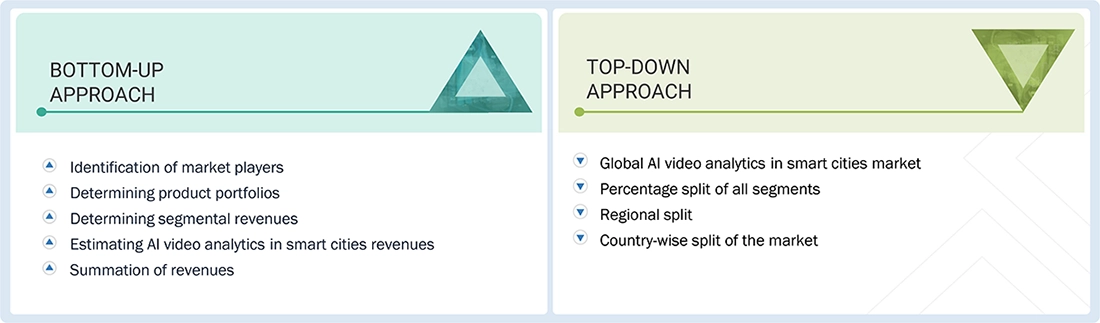
The study involved four major activities in estimating the current size of the AI Video Analytics in Smart Cities Market. Exhaustive secondary research collected information on the market, peer, and parent markets. The next step was to validate these findings, assumptions, and sizing with industry experts across the value chain through primary research. Both top-down and bottom-up approaches were employed to estimate the complete market size. After that, market breakdown and data triangulation techniques were used to estimate the market size of segments and subsegments.
Secondary Research
The secondary research process has referred to various secondary sources to identify and collect necessary information for this study. The secondary sources include annual reports, press releases, and investor presentations of companies; white papers; journals and certified publications; and articles from recognized authors, websites, directories, and databases. Secondary research was mainly used to obtain key information about the supply chain of the industry, the total pool of market players, classification of the market according to industry trends to the bottom-most level, regional markets, and key developments from the market and technology-oriented perspectives. Secondary data was collected and analyzed to determine the overall market size, which was further validated through primary research.
Primary Research
Extensive primary research was conducted after gaining knowledge about the current scenario of the AI Video Analytics in Smart Cities Market through secondary research. Several primary interviews were conducted with experts from the demand and supply sides across four major regions: North America, Europe, the Asia Pacific, and the Rest of the World (RoW). This primary data was collected through questionnaires, emails, and telephone interviews.
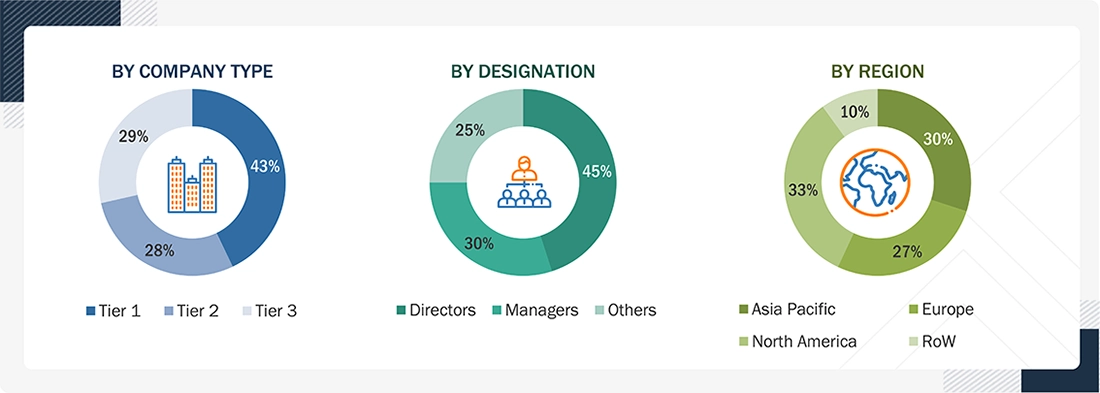
Note: Tier 1 companies’ revenue is more than USD 10 billion; Tier 2 companies’ revenue ranges between USD 1 and 10 billion; and Tier 3 companies’ revenue ranges between USD 500 million and USD 1 billion
To know about the assumptions considered for the study, download the pdf brochure
Market Size Estimation
In the complete market engineering process, top-down and bottom-up approaches and several data triangulation methods were used to estimate and forecast the overall market segments and subsegments listed in this report. Key players in the market were identified through secondary research, and their market shares in the respective regions were determined through primary and secondary research. This entire procedure includes the study of annual and financial reports of the top market players and extensive interviews for key insights (quantitative and qualitative) with industry experts (CEOs, VPs, directors, and marketing executives). All percentage shares, splits, and breakdowns were determined using secondary sources and verified through primary sources. All the parameters affecting the markets covered in this research study were accounted for, viewed in detail, verified through primary research, and analyzed to obtain the final quantitative and qualitative data. This data was consolidated and supplemented with detailed inputs and analysis and presented in this report.
Approach to arrive at market size using bottom-up analysis (supply side)
- Key providers of AI video analytics solutions, surveillance hardware, video management software, and smart city platforms were identified through secondary research and validated through primary discussions.
- Major market segments were mapped based on offering, application, system type, analytics type, deployment mode, vertical, and region.
- Revenue generated from AI-enabled cameras, video analytics software, video management systems, edge analytics platforms, and related services was analyzed across leading market participants.
- Product portfolios and smart city-focused deployments were assessed across hardware manufacturers, software providers, system integrators, and managed service providers.
- Adoption volumes of AI video analytics solutions were evaluated across public safety, transportation, critical infrastructure, environmental monitoring, and commercial applications.
- Deployment trends were analyzed across IP surveillance systems, cloud-based platforms, hybrid architectures, and edge-based analytics environments.
- Regional adoption patterns were studied across North America, Europe, Asia Pacific, and RoW based on smart city investments, surveillance infrastructure maturity, and public sector digitalization initiatives.
- Percentage splits for each segment and subsegment were derived through secondary research and validated through primary interviews with industry stakeholders.
- The global AI Video Analytics in Smart Cities Market size was estimated by aggregating revenues generated across identified companies, technologies, applications, and regions.
- CAGR was estimated based on increasing investments in smart city infrastructure, AI-powered public safety systems, intelligent transportation networks, and edge AI deployments.
- Market estimates were validated through discussions with CEOs, vice presidents, business development managers, smart city consultants, surveillance technology experts, and system integrators.
- Various paid and unpaid information sources, including annual reports, investor presentations, press releases, white papers, government publications, and industry databases, were studied.
Approach to arrive at market size using top-down analysis (demand side)
- Focusing on the adoption of AI video analytics across smart city ecosystems, public safety programs, intelligent transportation systems, and critical infrastructure monitoring applications.
- Identifying overall demand trends for AI-powered surveillance, real-time video analytics, crowd monitoring, traffic management, and urban intelligence solutions across major regions.
- Conducting discussions with city authorities, transportation agencies, public safety organizations, utility operators, technology providers, and industry experts involved in smart city deployments.
- Estimating the market split based on offering, application, system type, analytics type, deployment mode, and vertical by considering deployment intensity and spending patterns.
- Assessing video analytics adoption across government & public safety, transportation & logistics, infrastructure & utilities, commercial, industrial, residential, defense, healthcare, and education sectors.
- Evaluating the impact of AI, computer vision, edge computing, cloud platforms, and 5G connectivity on smart city surveillance investments.
- Estimating regional market shares using secondary sources based on smart city spending, urbanization trends, surveillance infrastructure investments, and digital transformation initiatives.
- Analyzing country-level demand across major markets by considering smart city projects, public safety budgets, transportation modernization programs, and critical infrastructure investments.
- Determining segmental and regional percentage splits through demand-side assessments and validating findings through expert interviews.
- Triangulating data from public sector spending, smart city project investments, technology adoption rates, and industry revenues to estimate the overall market size.
- Cross-verifying market estimates with municipal authorities, surveillance solution providers, transportation agencies, smart city consultants, and industry associations.
- Validating final market figures through a combination of secondary research, primary interviews, and market engineering techniques.
Data Triangulation
After arriving at the overall market size, the market was split into several segments and subsegments using the market size estimation processes explained above. Data triangulation and market breakdown procedures were employed to complete the entire market engineering process and determine the exact statistics of each market segment and subsegment. The data was triangulated by studying various factors and trends from the demand and supply sides in the AI video analytics for smart cities market.
Market Definition
The AI video analytics for smart cities market comprises AI-powered software platforms, edge-embedded cameras, cloud analytics services, and integrated command center solutions that enable real-time intelligent video processing for urban applications including traffic management, public safety, crowd monitoring, environmental sensing, and urban planning. The ecosystem includes AI analytics engine developers, camera and edge hardware manufacturers, video management system providers, cloud platform operators, systems integrators, city government IT departments, and law enforcement agencies.
Key Stakeholders
- AI Video Analytics Software Developers
- Edge AI Camera Manufacturers
- Video Management System (VMS) Providers
- Cloud Platform Operators
- City Governments & Municipal Authorities
- Law Enforcement & Public Safety Agencies
- Transportation Authorities
- Systems Integrators & Smart City Consultants
- Privacy & Civil Liberties Organizations
Report Objectives
- To describe and forecast the size of the AI video analytics for smart cities market, by offering, application, system type, analytics type, deployment mode, and vertical, in terms of value
- To forecast the size of market segments with respect to four regions, namely North America, Europe, Asia Pacific, and RoW, in terms of value
- To identify and analyze key drivers, restraints, opportunities, and challenges influencing the market growth
- To offer an ecosystem analysis, value chain analysis, case study analysis, patent analysis, technology analysis, pricing analysis, Porter’s five forces analysis, and regulations pertaining to the market
- To strategically analyze micromarkets with respect to individual growth trends, prospects, and contributions to the total market
- To strategically profile key players and comprehensively analyze their market shares and core competencies
- To analyze the opportunities in the market for stakeholders and describe the competitive landscape of the market
- To study competitive developments, such as collaborations, partnerships, product launches/developments, and acquisitions, in the market
Available customizations:
With the given market data, MarketsandMarkets offers customizations according to the specific requirements of companies. The following customization options are available for the report:
- Country-wise Information: Additional country-wise breakdown for North America, Europe, the Asia Pacific, and the Rest of the World
- Company Information: Detailed analysis and profiling of additional market players (up to five)
Key Questions Addressed by the Report
What is the projected size of the AI video analytics for smart cities market by 2031?
According to MarketsandMarkets, the global AI video analytics in smart cities market is projected to grow from USD 1.14 billion in 2026 to USD 3.34 billion by 2031, registering a CAGR of 24.0%. Increasing investments in smart city infrastructure, public safety modernization, and intelligent transportation systems are driving market growth.
What are the major factors driving the AI video analytics in smart cities market?
Global smart city initiatives and advances in AI and deep learning for real time computer vision are major market drivers. Growing demand for real time threat detection, traffic optimization, crowd monitoring, and critical infrastructure protection is accelerating adoption.
Which region holds the largest revenue share in the AI video analytics in smart cities market?
North America holds the largest revenue share, supported by investments in smart city infrastructure, public safety modernization, and intelligent transportation systems. Adoption of AI powered surveillance, real time video analytics, and edge based monitoring is strengthening the region's market position.
Which offering segment is expected to dominate the market?
The hardware segment is expected to account for the largest market share. Widespread deployment of AI enabled cameras, storage systems, monitoring equipment, and edge surveillance infrastructure across smart city projects is supporting its dominance.
Which application segment is expected to hold the largest market share?
Public safety and law enforcement is expected to dominate the market. Increasing use of AI powered surveillance for crime prevention, crowd monitoring, real time threat detection, and emergency response management is driving demand.
What are the key technology trends in the AI video analytics in smart cities market?
Key trends include edge AI, cloud computing, 5G connectivity, computer vision, generative AI powered video intelligence, and real time threat detection. These technologies support faster incident detection, improved traffic management, and more scalable urban monitoring systems.
What opportunities exist in the AI video analytics in smart cities market?
Privacy preserving AI, federated learning, and digital twin cities present significant opportunities. Combining real time video analytics with 3D city models can support simulation based planning, predictive incident management, and more efficient urban service delivery.
What are the major restraints affecting the AI video analytics in smart cities market?
Privacy concerns and surveillance ethics debates are major restraints, as AI powered surveillance raises concerns about privacy and civil liberties. High infrastructure costs for city wide camera deployment can also limit adoption.
Which analytics and deployment segments are expected to grow fastest?
Real time analytics is expected to register the highest growth among analytics types because of increasing demand for instant incident detection and proactive public safety operations. Edge based deployment is expected to grow at the highest CAGR due to low latency processing, reduced bandwidth requirements, and real time decision making.
Who are the key players in the AI video analytics in smart cities market?
Key players include Axis Communications, Motorola Solutions, Hikvision, Dahua Technology, Honeywell, Huawei, NEC Corporation, Genetec, BriefCam, and Milestone Systems. Motorola Solutions is identified as a Star player, while NEC Corporation is recognized as an Emerging Leader in the company evaluation matrix.


Personalize This Research
- Triangulate with your Own Data
- Get Data as per your Format and Definition
- Gain a Deeper Dive on a Specific Application, Geography, Customer or Competitor
- Any level of Personalization
Let Us Help You
- What are the Known and Unknown Adjacencies Impacting the AI Video Analytics for Smart Cities Market
- What will your New Revenue Sources be?
- Who will be your Top Customer; what will make them switch?
- Defend your Market Share or Win Competitors
- Get a Scorecard for Target Partners

Custom Market Research Services
We Will Customise The Research For You, In Case The Report Listed Above Does Not Meet With Your Requirements
Get 10% Free CustomisationTESTIMONIALS

Tetsuya Ohhira
Business Development Manager-Technology Business
Nikon Corporation,
Leading Japanese MNC specializing in optics and imaging productswww.nikon.com
MarketsandMarkets™ response
is quick. Their attitude is flexible and positive. Analyst Insights are globally considered and
significant. Client Services quickly respond to our inquiry and demand. Their wide range of global
surveys help us make our strategic plan.
We hope Knowledge Store will be easier to search
for a report.
VP - Marketing & Business Development
Leading Provider of Process Control Solutions
We engaged with MarketsandMarkets on a study to perform an analysis and recommend a Go-To-Market strategy for metrology and process control in the semiconductor market. The study was tailored to our targets and needs with well-defined milestones. Our overall experience with the MarketsandMarkets team was very good throughout the project in all aspects including the analysis methodologies used, the quality and depth of primary and secondary data sets, the professionalism and flexibility of the team and the ability to meet the target schedule and milestones. We want to thank MarketsandMarkets team for a job well done.






Growth opportunities and latent adjacency in AI Video Analytics for Smart Cities Market