APAC Indoor Location Market Size, Share, Trends, Growth & Opportunities

Indoor Location Market in Asia Pacific by Technology (BLE, UWB, Wi-Fi, RFID, Magnetic Positioning), Solutions [Indoor Tracking (Asset & People Tracking, Indoor Location Analytics), Indoor Navigation, Database Management System] - Forecast to 2030




OVERVIEW
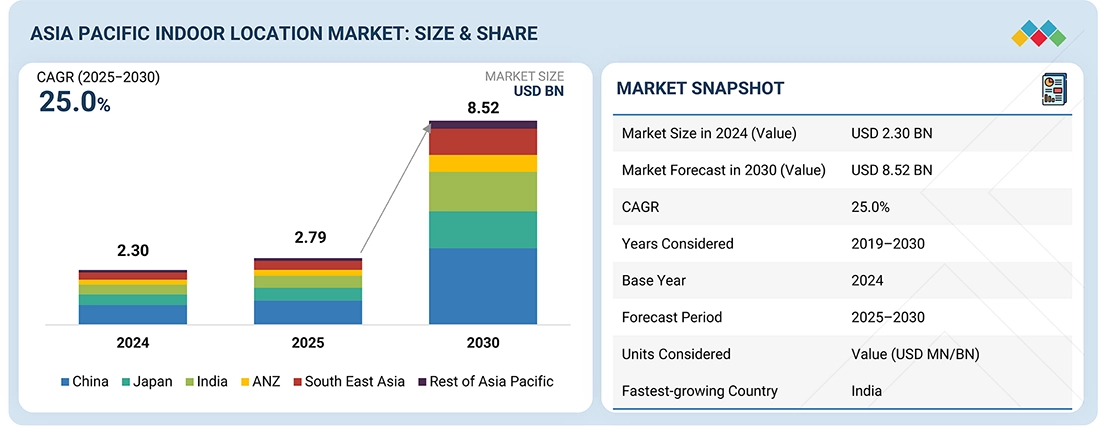
Source: Secondary Research, Interviews with Experts, MarketsandMarkets Analysis
KEY TAKEAWAYS
-
By OfferingBy offering, the services segment is expected to register the highest CAGR of 27.2% during the forecast period.
-
By TechnologyBy technology, the BLE segment is projected to be valued at USD 2,600.5 million in 2030.
-
By ApplicationBy application, the remote monitoring segment is projected to grow at the highest CAGR of 26.3%.
-
By VerticalBy vertical, the retail segment is projected to hold the largest market size.
-
Competitive LandscapeCisco, Zebra Technologies, Google, Microsoft, HPE, Apple, ESRI, and Inpixon were identified as some of the star players in the indoor location market (global), given their strong market share and product footprint.
-
Competitive LandscapeRannlab, Digital Matter, and MOKO Smart are some of the progressive companies that stand out by offering specialized, industry-tailored Indoor Location solutions.
The rapid expansion of e-commerce, modernization of warehousing facilities, automation of healthcare processes, and government initiatives for smart buildings have contributed to the growth of the indoor location market across the Asia Pacific. The significant decrease in hardware costs, as well as the increased availability of cloud-based software and localised ecosystems in Japan, China, India, and Southeast Asia, have contributed to the accelerated rollout of indoor location products and services.
TRENDS & DISRUPTIONS IMPACTING CUSTOMERS' CUSTOMERS
The impact on consumers' business in the indoor location market in the Asia Pacific stems from evolving customer needs and industry disruptions. Hotbets are UWB, BLE AoA, Wi-Fi RTT, computer vision, sensor fusion, and edge analytics are shifting indoor positioning from approximate tracking to centimetre-accurate, context-aware services and monetizable location platforms. Disruptions include dense sensor deployments, privacy concerns, and standards fragmentation. End users gain better asset utilization, personalized experiences, faster fulfilment, and reduced shrinkage.
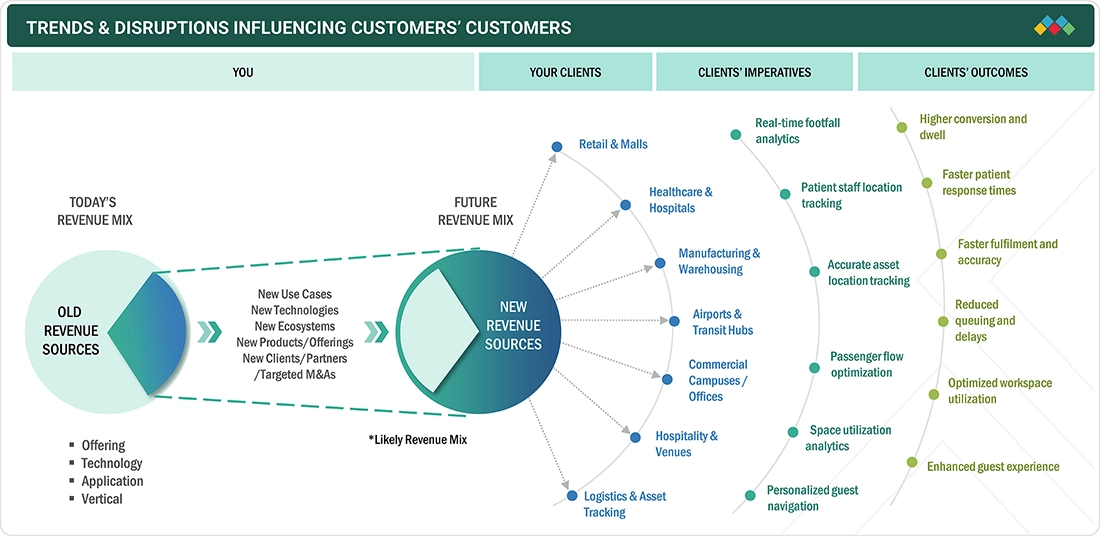
Source: Secondary Research, Interviews with Experts, MarketsandMarkets Analysis
MARKET DYNAMICS

Level
-
Acceleration of Smart City Projects and Infrastructure Development

-
Proliferation of Smartphones and "Super Apps"


Level
-
High Capital Expenditure Sensitivity in Emerging Economies

-
Fragmented Regulatory Landscape Regarding Data Privacy


Level
-
Industrial Automation and "Industry 4.0" in Manufacturing Hubs

-
Integration with 5G Network Rollouts


Level
-
Signal Interference in High-Density Urban Environments

-
Lack of Standardization and Interoperability

Source: Secondary Research, Interviews with Experts, MarketsandMarkets Analysis
Driver: Acceleration of Smart City Projects and Infrastructure Development
The Asia Pacific region is undergoing rapid urbanization, which is expected to drive government investments in smart city initiatives, particularly in China, India, Singapore, and South Korea. This creates a direct demand for indoor location technologies to manage complex public spaces such as transit hubs, airports, and mega malls. There is a surge in "greenfield" projects where indoor positioning systems (IPS) are integrated into the architectural design phase. This is expected to increase the adoption of indoor location for navigation, crowd control, and emergency response optimization.
Restraint: High Capital Expenditure Sensitivity in Emerging Economies
While developed nations like Japan and Australia are quick to adopt new tech, the rest of the Asia Pacific market includes price-sensitive emerging economies. The high initial cost of deployment acts as a major restraint for these countries. The implementation of an indoor location system often requires a dense network of hardware that includes beacons, gateways, etc., and a significant amount of labor. For small and medium enterprises (SMEs) in Southeast Asia and India, this upfront Capital Expenditure (CAPEX) is often difficult to justify against the perceived Return on Investment (ROI). This slows down widespread market penetration in lower-tier cities.
Opportunity: Industrial Automation and "Industry 4.0" in Manufacturing Hubs
As a manufacturing hub, the Asia Pacific offers immense opportunities for indoor location solutions in the industrial and logistics sectors. Countries like China, Vietnam, and Thailand are aggressively transitioning toward Industry 4.0, automating their vast manufacturing bases. There is a growing, untapped market for high-precision asset-tracking and workforce-safety monitoring solutions in these environments. Using technologies like UWB or BLE to create digital twins of factories allows Asian manufacturers to optimize supply chains and reduce downtime, presenting a lucrative B2B revenue stream for market players.
Challenge: Signal Interference in High-Density Urban Environments
The architectural landscape of major Asian cities, characterized by extreme vertical density, underground complexes, and heavy use of reinforced concrete, poses a severe technical challenge for RF-based location technologies. Signals from Wi-Fi and Bluetooth often suffer from multipath interference (reflection and scattering) in these environments, leading to reduced accuracy. Overcoming these physical limitations to provide the seamless blue dot experience requires complex proprietary algorithms and expensive site calibration, which complicates scalability.
INDOOR LOCATION MARKET: COMMERCIAL USE CASES ACROSS INDUSTRIES
| COMPANY | USE CASE DESCRIPTION | BENEFITS |
|---|---|---|
 |
RTLS for hospitals, factories and warehouses to track assets. | Improved asset visibility, reduced search times, higher operational efficiency. |
 |
Smartphone magnetic-field positioning for wayfinding and contextual services. | Low-cost deployment, no hardware, quick pilots, improved navigation. |
 |
Indoor mapping and positioning for malls, transit hubs and buildings. | Accurate maps, accessibility features, better navigation and venue analytics. |
 |
Battery-powered Wi-Fi/ BLE/LoRa beacons and hybrid tracking devices. | Reliable indoor/outdoor visibility, long battery life, integrated telemetry and low TCO. |
 |
Bluetooth AoA RTLS for manufacturing, healthcare and logistics asset tracking. | High accuracy, scalable deployments, lower costs, enhanced operational visibility. |
Logos and trademarks shown above are the property of their respective owners. Their use here is for informational and illustrative purposes only.
MARKET ECOSYSTEM
The Asia Pacific indoor location market ecosystem consists of global providers (Microsoft, HPE/Aruba, Cisco, Zebra, Google) supplying core infrastructure, cloud platforms, AP-based positioning, enterprise radios, tags, and mapping SDKs, and Regional Providers (Syook, Oriient, Mapxus, BlueIoT, Skycube) delivering localized RTLS, magnetic, BLE AoA positioning, indoor maps, and industry solutions.
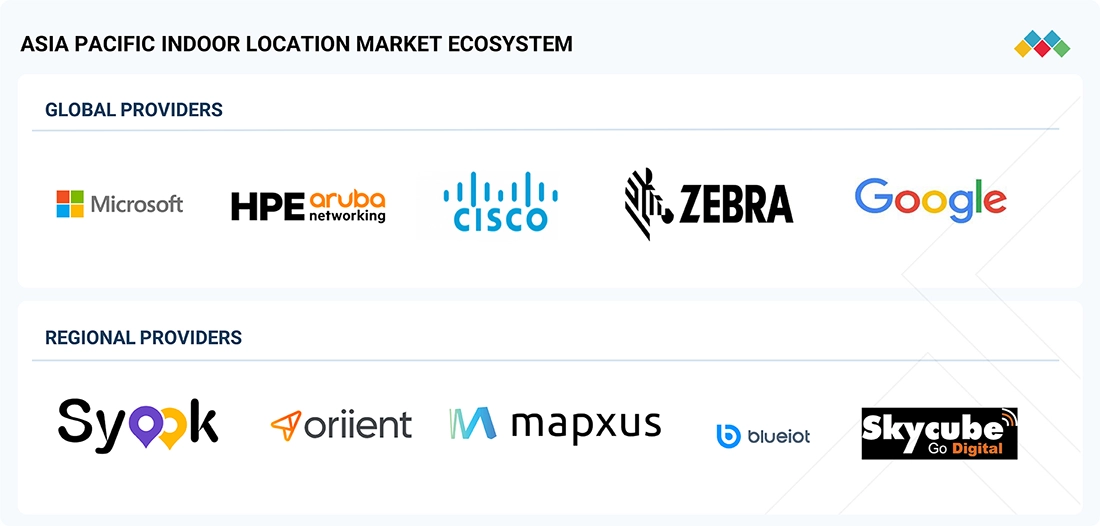
Logos and trademarks shown above are the property of their respective owners. Their use here is for informational and illustrative purposes only.
MARKET SEGMENTS
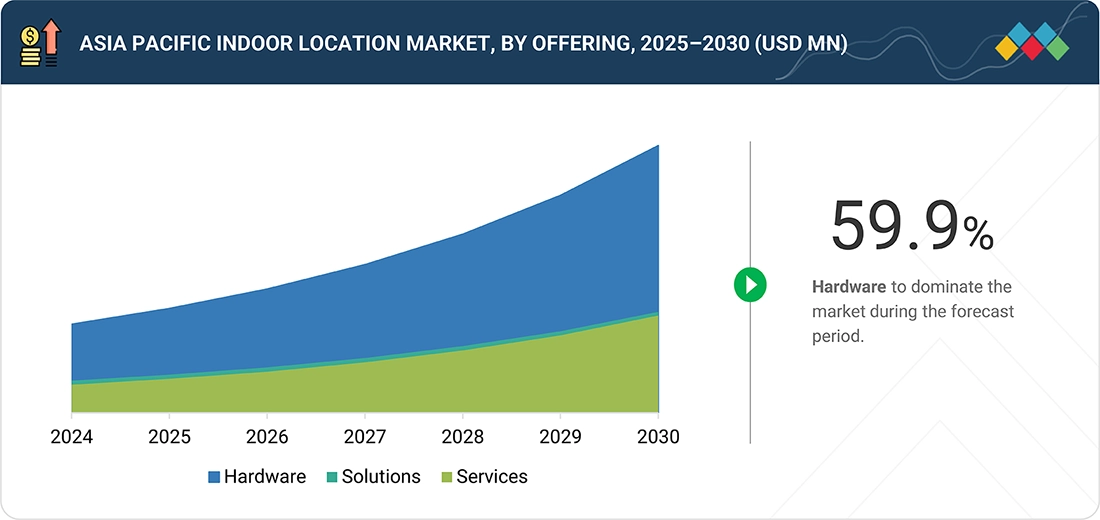
Source: Secondary Research, Interviews with Experts, MarketsandMarkets Analysis
Indoor Location Market in Asia Pacific, By Offering
In the Asia Pacific market, the hardware segment currently holds the largest share of revenue, primarily driven by the sheer scale of physical infrastructure projects. The region has a very large manufacturing and logistics sectors that require large volumes of asset tags, beacons, and receivers to be deployed. Additionally, the prevalence of greenfield construction projects in the region necessitates the deployment of new infrastructure rather than software-only upgrades. While software revenue is growing, the immediate demand remains focused on the physical sensors and gateways required to establish the basic network grid.
Indoor Location Market in Asia Pacific, By Technology
The BLE technology offers an optimal balance of cost, battery life, and smartphone compatibility, which enables it to grow at the fastest rate. The Asia Pacific region demands a cost-efficient option, and BLE beacons offer a low-cost alternative to expensive Wi-Fi arrays or UWB systems. Furthermore, the strong manufacturing base for electronics in China and Taiwan has driven down the unit cost of BLE beacons, making them accessible even to smaller retailers and independent venue owners. This accessibility has made BLE the standard for proximity marketing and indoor navigation in the region's retail sector.
Indoor Location Market in Asia Pacific, By Application
The Remote Monitoring application is gaining significant traction in APAC, driven largely by two factors: industrial safety and elder care. In industrial zones across Southeast Asia, remote monitoring is used to track environmental conditions and worker locations at hazardous sites to prevent accidents. Concurrently, in rapidly aging societies like Japan and increasingly China, remote monitoring solutions are being deployed in elder care facilities to track patient movements and prevent wandering. This demand from the industrial and healthcare sectors positions remote monitoring as a critical, high-value application in the region.
Indoor Location Market in Asia Pacific, By Vertical
The Retail vertical is a dominant adopter of indoor location in the Asia Pacific. Unlike the US focus on big-box stores, Asian retail is centered around massive, multi-story mega-malls that function as social hubs. These complex environments create a high demand for indoor navigation apps to help shoppers find stores, parking, and amenities. Retailers are leveraging this technology not just for wayfinding, but to push hyper-local promotions to shoppers' smartphones based on their micro-location within the mall, capitalizing on the high consumer acceptance of mobile commerce in the region.
INDOOR LOCATION MARKET: COMPANY EVALUATION MATRIX
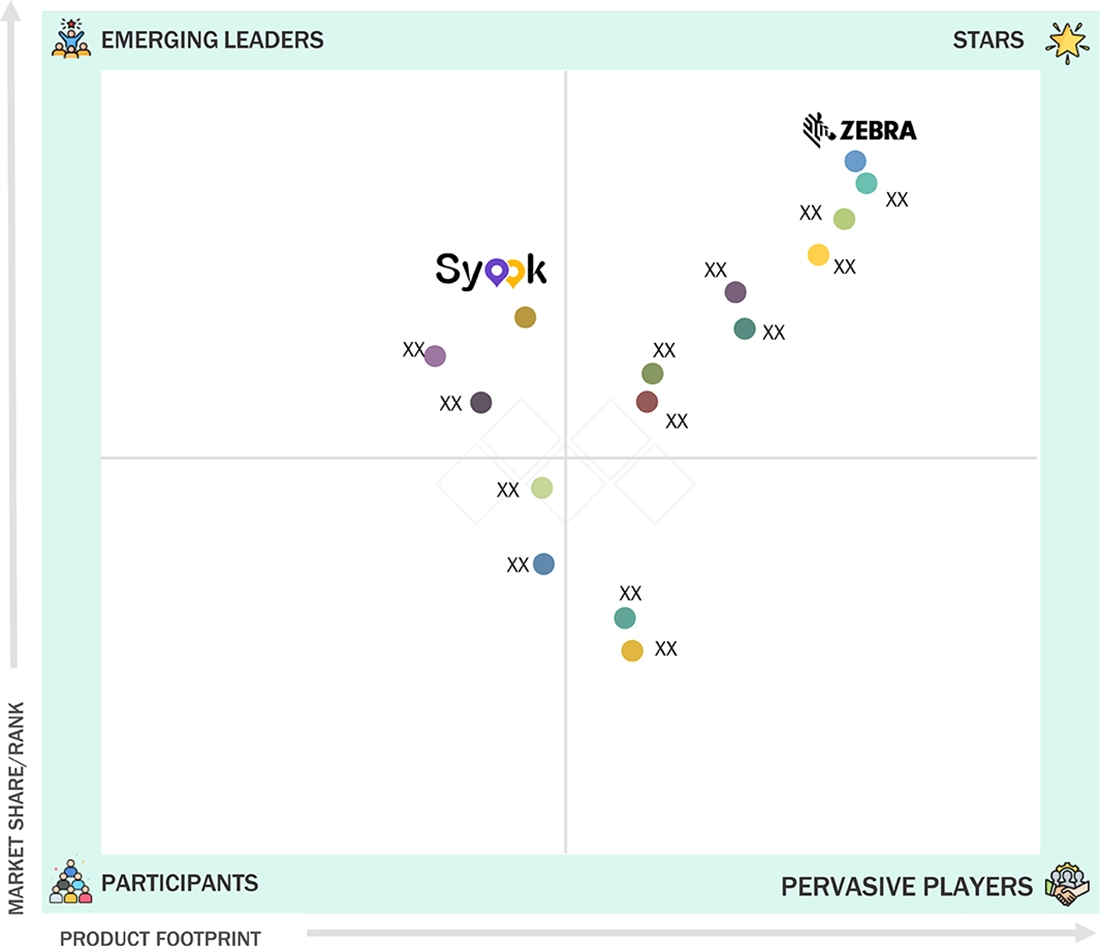
In the Asia Pacific indoor location market matrix, Zebra (Star) leads with a strong market share and extensive product footprint, driven by broad, enterprise-grade hardware (RFID, UWB, BLE tags, scanners) and deep vertical focus in healthcare, retail, manufacturing, and logistics. Syook (Emerging Leader) is gaining visibility by offering localized, SaaS RTLS (BLE-first), fast pilot rollouts, deep hospital/manufacturing integrations, and strong local SI partnerships.
Source: Secondary Research, Interviews with Experts, MarketsandMarkets Analysis
KEY MARKET PLAYERS
- Zebra Technologies (US)
- Cisco (US)
- Google (US)
- Microsoft (US)
- HPE (US)
- Syook (India)
- Oriient (Israel)
- Mapxus (Hong Kong)
- BlueIoT (China)
- beComap (India)
- Skycube (India)
- RannLab (India)
- Digital Matter (Australia)
- Mokosmart (China)
- G-Matrix Hong Kong Limited (Hong Kong)
MARKET SCOPE
| REPORT METRIC | DETAILS |
|---|---|
| Market Size in 2024 (Value) | USD 2.30 Billion |
| Market Forecast in 2030 (Value) | USD 8.52 Billion |
| Growth Rate | CAGR of 25.0% from 2025-2030 |
| Years Considered | 2019-2030 |
| Base Year | 2024 |
| Forecast Period | 2025-2030 |
| Units Considered | Value (USD Million/Billion) |
| Report Coverage | Revenue forecast, company ranking, competitive landscape, growth factors, and trends |
| Segments Covered |
|
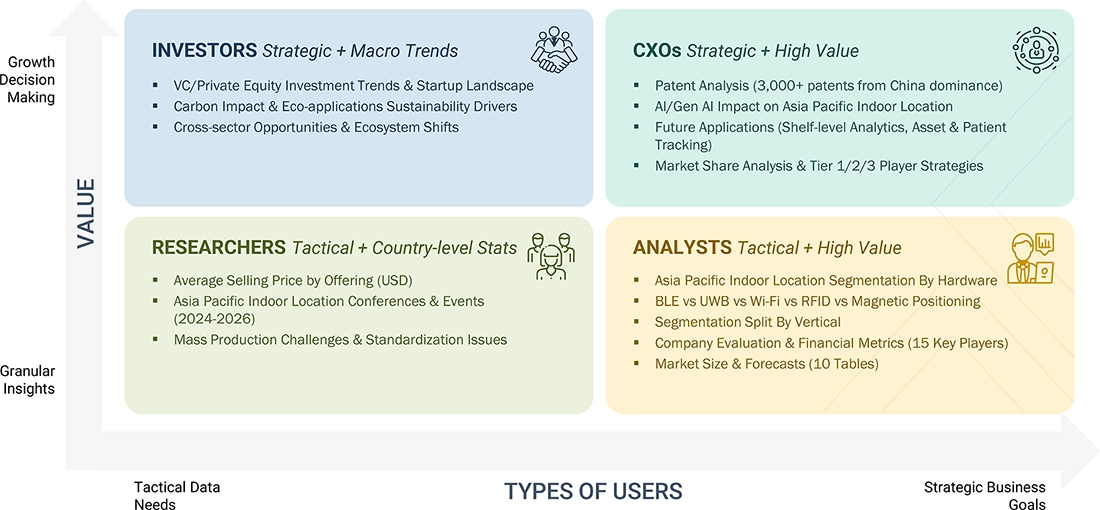
WHAT IS IN IT FOR YOU: INDOOR LOCATION MARKET REPORT CONTENT GUIDE
DELIVERED CUSTOMIZATIONS
We have successfully delivered the following deep-dive customizations:
| CLIENT REQUEST | CUSTOMIZATION DELIVERED | VALUE ADDS |
|---|---|---|
| Leading Solution Provider (Asia Pacific) | Product Analysis: Product Matrix, which gives a detailed comparison of the product portfolio of each company | Enhanced understanding of competitive positioning and product offerings |
| Leading Service Provider (Asia Pacific) | Company Information: Detailed analysis and profiling of additional market players (up to 5) | Deeper insights into market dynamics and potential strategic partnerships |
RECENT DEVELOPMENTS
- July 2025 : Mapxus Technology partnered with Ricoh Company, Ltd. to create a huge impact in the indoor digital mapping and 360-degree panoramic applications. The partnership integrates Ricoh's RH360 platform and RICOH THETA 360-degree cameras with Mapxus's indoor mapping services. This would enable efficient indoor data collection, streamlined navigation system development, and virtual tour creation.
- October 2024 : Mapxus showcased a proof-of-concept for accessible indoor navigation at the Taipei Smart City Innovation Pilot Project. Hosted by the Taipei City Government's Department of Information Technology, the demonstration featured digital twin indoor maps for Taipei Main Station with rich point-of-interest information, barrier-free navigation routes, multilingual support (Traditional Chinese, English, Japanese), and real-time location sharing. The solution required no additional hardware infrastructure, enabling rapid deployment of cost-effective, high-precision indoor maps.
- June 2024 : Quuppa, a leading provider of Real-Time Locating Systems (RTLS), partnered with Twinzo, a no-code live digital twin platform. The collaboration integrates Quuppa's high-precision BLE-based positioning technology with Twinzo's digital twin solutions for industrial applications, particularly in track-and-trace, fleet management, and order automation. Twinzo's technology optimizes intra-logistics by an average of 20% and reduces idle time in production facilities by 95%, with Quuppa providing the foundational real-time location data layer.
Table of Contents
 Exclusive indicates content/data unique to MarketsandMarkets and not available with any competitors.
Methodology
The study involved four major activities in estimating the current size of the Asia Pacific indoor location location market. Exhaustive secondary research was done to collect information on the market, peer, and parent markets. The next step was to validate these findings, assumptions, and sizing with industry experts across the value chain through primary research. Both top-down and bottom-up approaches were employed to estimate the total Asia Pacific indoor location location market size. After that, the market breakup and data triangulation techniques were used to estimate the market size of segments and subsegments.
Secondary Research
Various secondary sources, such as Bloomberg and BusinessWeek, were referred to in the secondary research process to identify and collect information for this study. The secondary sources included company annual reports, press releases, and investor presentations; white papers; journals, such as Linux Journal and Container Journal; and articles from recognized authors, directories, and databases.
Primary Research
In the primary research process, various sources from both the supply and demand sides were interviewed to obtain qualitative and quantitative information for the report. The primary sources from the supply side included industry experts, such as Chief Executive Officers (CEOs), Chief Technology Officers (CTOs), Chief Operating Officers (COOs), Vice Presidents (VPs), marketing directors, technology and innovation directors, and related key executives from various key companies and organizations operating in the Asia Pacific indoor location location market. The primary sources from the demand side included Indoor location end users, network administrators/consultants/specialists, Chief Information Officers (CIOs), and subject-matter experts from enterprises and government associations.
Market Size Estimation
The top-down and bottom-up approaches were used to make market estimates and forecast the Asia Pacific indoor location location market, as well as other dependent submarkets. The bottom-up procedure was used to arrive at the overall market size of the Asia Pacific indoor location location market using key companies’ revenue and their offerings in the market. The research methodology used to estimate the market size includes the following:
- The key players in the Asia Pacific indoor location location market have been identified through extensive secondary research.
- In terms of value, the market size has been determined through primary and secondary research processes.
- All percentage shares, splits, and breakups have been determined using secondary sources and verified through primary sources.
Data Triangulation
This study determined and confirmed the exact value of the overall parent market size through data triangulation and validation through primary interviews. The overall market size was then used in the top-down procedure to estimate the size of other individual markets via percentage splits of the market segmentation.
Market Definition
Indoor location or indoor positioning technology facilitates the navigation and tracking of objects and people in a building using sensory information captured by mobile devices. It includes hardware, software, and service components to provide indoor location services to various vertical organizations. Indoor location solutions may collect location data using Radio Frequency (RF), Visible Light Communication (VLC), Sound Navigation and Ranging (Sonar), Light Detection and Ranging (Lidar), or any technology or a combination of technologies.
Key Stakeholders
- Indoor location solution providers
- Independent Software Vendors (ISVs)
- Investors and Venture Capitalists (VCs)
- Support and maintenance service providers
- Value-added Resellers (VARs) and distributors
Report Objectives
- To determine and forecast the Asia Pacific indoor location location market by offering (hardware, solutions, and services), application, technology, vertical, and region from 2024 to 2029, and analyze the various macroeconomic and microeconomic factors that affect the market growth.
- To provide detailed information about the major factors (drivers, restraints, opportunities, and challenges) influencing the growth of the Asia Pacific indoor location location market.
- To analyze each submarket for individual growth trends, prospects, and contributions to the overall Asia Pacific indoor location location market.
- To analyze the opportunities in the market for stakeholders by identifying the high-growth segments of the Asia Pacific indoor location location market.
- To profile the key market players; provide a comparative analysis based on business overviews, regional presence, product offerings, business strategies, and key financials; and illustrate the market's competitive landscape.
- Track and analyze competitive developments in the market, such as mergers and acquisitions, product developments, partnerships and collaborations, and Research and Development (R&D) activities.
Available Customizations
With the given market data, MarketsandMarkets offers customizations as per the company’s specific needs. The following customization options are available for the report:
Company Information
- Detailed analysis and profiling of two additional market players
Key Questions Addressed by the Report
What is the projected size of the APAC Indoor Location Market by 2030?
The APAC Indoor Location Market is projected to grow from USD 2.8 billion in 2025 to USD 8.5 billion by 2030 at a CAGR of 25.0%.
What is driving growth in the APAC Indoor Location Market?
Key growth drivers include smart city initiatives, warehouse automation, e-commerce growth, and rising demand for real-time asset visibility.
Which technology segment leads the APAC Indoor Location Market?
BLE is expected to dominate the technology segment, reaching approximately USD 2.6 billion by 2030 due to cost efficiency and scalability.
Which industries are adopting indoor location solutions fastest in APAC?
Retail, healthcare, manufacturing, logistics, and transportation are the fastest adopters due to navigation and asset-tracking requirements.
Which application segment offers the biggest revenue opportunity in APAC?
Supply chain management holds the largest market share as manufacturers and logistics providers prioritize operational visibility.
Which countries are contributing the most to APAC Indoor Location growth?
China, Japan, India, South Korea, and Southeast Asian nations are leading due to industrial digitization and smart infrastructure programs.
What are the emerging trends in the APAC Indoor Location Market?
UWB, Wi-Fi RTT, BLE AoA, edge analytics, and AI-powered indoor mapping are key trends shaping market evolution.
Who are the leading players in the APAC Indoor Location Market?
Major players include Cisco, Zebra Technologies, Google, Microsoft, and HPE.


Personalize This Research
- Triangulate with your Own Data
- Get Data as per your Format and Definition
- Gain a Deeper Dive on a Specific Application, Geography, Customer or Competitor
- Any level of Personalization
Let Us Help You
- What are the Known and Unknown Adjacencies Impacting the Indoor Location Market
- What will your New Revenue Sources be?
- Who will be your Top Customer; what will make them switch?
- Defend your Market Share or Win Competitors
- Get a Scorecard for Target Partners

Custom Market Research Services
We Will Customise The Research For You, In Case The Report Listed Above Does Not Meet With Your Requirements
Get 10% Free CustomisationTESTIMONIALS






Growth opportunities and latent adjacency in Indoor Location Market