AR Glass Market by Standalone AR Glass, Tethered AR Glass, Markerless Augmented Reality, Marker-based Augmented Reality, Display, Sensor, Lens, Processor & Memory, Controller, Camera, Case & Connector and Region - Global Forecast to 2030

icon1
USD 9.98 BN
MARKET SIZE, 2030
icon2
CAGR 59%
(2025-2030)
icon3
275
REPORT PAGES
icon4
231
MARKET TABLES

OVERVIEW

AR Glass Market Overview

Source: Secondary Research, Interviews with Experts, MarketsandMarkets Analysis

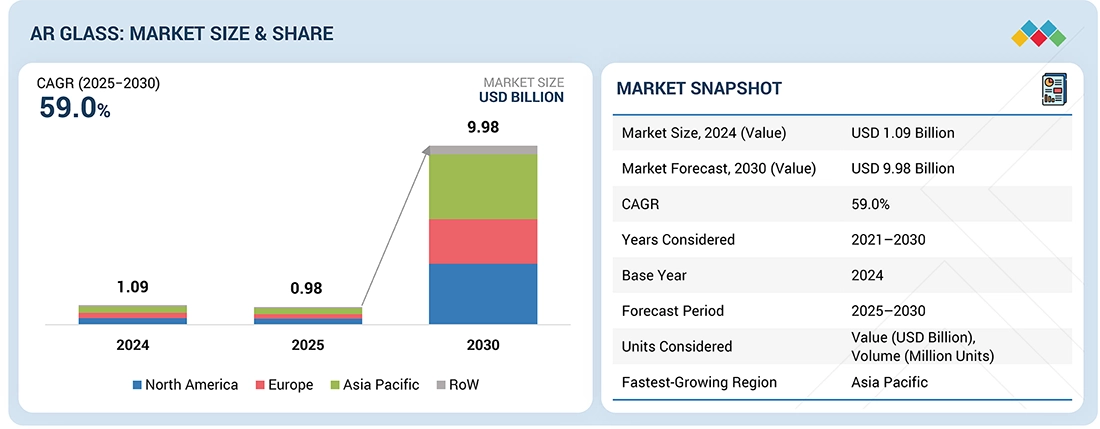
The AR glass market is anticipated to grow from USD 0.98 billion in 2025 to USD 9.98 billion by 2030, at a CAGR of 59.0%. Increasing adoption in industrial and enterprise environments, rapid advancements in display and sensor technologies, and rising investments from leading technology companies are key factors driving the growth of the AR glass market. In addition, expanding applications in healthcare, aerospace, and defense industries, and the integration with AI and emerging technologies are expected to provide ample opportunities for payers in the AR glass market.

KEY TAKEAWAYS

  • BY COMPONENT
    The AR glass market is segmented into displays, sensors, lenses, processors & memory controllers, cameras, cases & connectors, and other components. Displays are estimated to account for the largest share, driven by advancements in microdisplay technologies, high resolution, and energy-efficient designs suitable for both consumer and industrial applications. Increasing demand for compact and lightweight AR glasses with high visual clarity is fueling growth across other component categories as well.
  • BY TECHNOLOGY
    The market is categorized into marker-based AR and markerless AR, with markerless AR capturing the largest share. This growth is propelled by enhanced user experience, the ability to operate in diverse environments without reliance on predefined markers, and increasing adoption in enterprise, healthcare, and commercial applications.
  • BY CONNECTIVITY
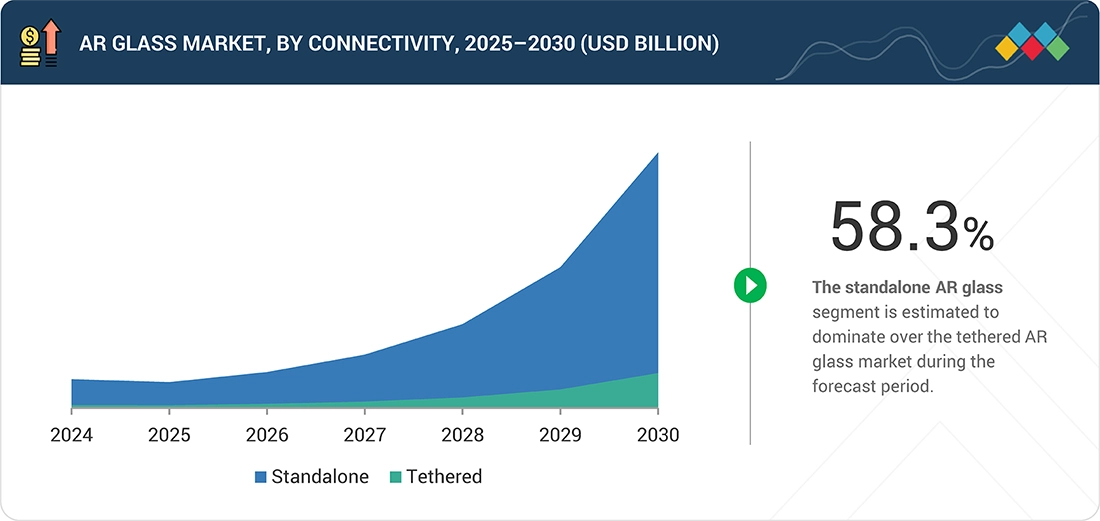
    AR glasses are segmented into tethered and standalone types. Standalone AR glasses dominate the market, supported by improvements in embedded processors, battery life, and wireless communication standards that allow untethered usage for industrial, commercial, and consumer applications.
  • BY APPLICATION
    The market is divided into consumer, commercial, enterprise & industrial, healthcare, aerospace & defense, automotive, energy, and other applications. Enterprise & industrial applications are set to account for the largest share, driven by use cases such as remote assistance, training, maintenance, and productivity enhancements across manufacturing, logistics, and field services.
  • BY REGION
    The AR glass market is segmented into North America, Europe, Asia Pacific, and Rest of the World (RoW). North America is estimated to dominate the market, supported by high technology adoption, robust digital infrastructure, strong enterprise use cases, and the presence of key AR hardware and software providers.
  • COMPETITIVE LANDSCAPE
    Key players in the AR Glass market include XReal, Inc. (China), Magic Leap, Inc. (US), Microsoft Corporation (US), Seiko Epson Corporation (Japan), and Rokid (US). These companies are actively focusing on developing lightweight, high-performance AR glasses with advanced optics, improved display brightness, and seamless spatial computing capabilities. Continuous innovation in microdisplay integration, AI-based user interaction, and edge processing is driving product differentiation. Strategic partnerships with enterprise clients and ecosystem collaborations with software developers and component suppliers are further strengthening their market presence and enhancing user experience across consumer and industrial applications.

The AR glass market is expected to experience robust growth in the coming years, driven by the rising adoption of augmented reality across consumer, enterprise, and industrial sectors. Increasing demand for lightweight, high-performance smart glasses with advanced optical engines, high brightness, and improved field of view is fueling market expansion. The integration of AI, spatial computing, and 5G connectivity is enhancing user experience and enabling real-time data visualization for applications in manufacturing, healthcare, logistics, and defense. Growing investments in immersive enterprise solutions, digital transformation initiatives, and hands-free computing are further accelerating adoption. As a key enabler of the next wave of extended reality (XR) applications, AR glass technology is poised to transform how users interact with digital content in both professional and everyday environments.

TRENDS & DISRUPTIONS IMPACTING CUSTOMERS' CUSTOMERS

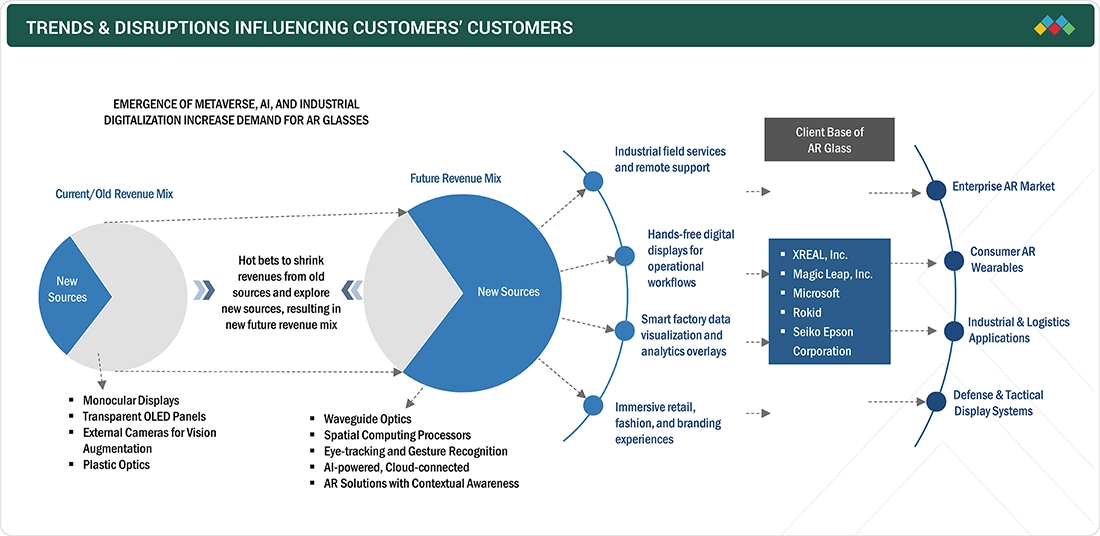
The AR glass market is evolving rapidly as industries transition from conventional screens and handheld devices to immersive, hands-free interfaces powered by augmented reality. Rising demand for operational efficiency, remote collaboration, and enhanced user experience drives the adoption across industrial, healthcare, defense, and enterprise sectors. Players such as XREAL, Inc. (China), Magic Leap Inc. (US), Microsoft (US), Seiko Epson Corporation (Japan), and Rokid (China) are spearheading this transformation by launching lightweight, high-resolution AR glasses equipped with spatial computing capabilities, AI integration, and seamless connectivity with mobile and cloud-based platforms. These innovations enable real-time data overlays, interactive training, and smart collaboration in fieldwork and on-site operations. The market shift aligns with a broader digital transformation trend, where AR wearables are vital in enabling smarter workflows and safer work environments. As more enterprises modernize their infrastructure, the demand for scalable and ergonomic AR solutions continues to rise, opening new growth opportunities across developed and emerging regions.
AR Glass Market Disruptions

Source: Secondary Research, Interviews with Experts, MarketsandMarkets Analysis

MARKET DYNAMICS

Drivers
Impact
Level
  • Growing adoption of AR in industrial and enterprise applications
  • Rapid advances in display and sensor technologies
RESTRAINTS
Impact
Level
  • High costs of AR devices
  • Privacy and security concerns
OPPORTUNITIES
Impact
Level
  • Expanding applications in healthcare and aerospace & defense industries
  • Integration with AI and emerging technologies
CHALLENGES
Impact
Level
  • Lack of robust and scalable software ecosystem
  • Latency and real-time performance barriers

Source: Secondary Research, Interviews with Experts, MarketsandMarkets Analysis

Driver: Growing adoption of AR in industrial and enterprise applications

AR glasses are rapidly gaining traction in industrial and enterprise environments due to their ability to enhance productivity, accuracy, and safety. In manufacturing, logistics, and utilities, they provide hands-free access to data, real-time collaboration, and visual overlays for maintenance and training. Integration with IoT and enterprise platforms further optimizes workflows, reducing downtime and errors. As digital transformation accelerates, enterprise adoption of AR glasses continues to expand globally.

Restraint: High costs of AR devices

The high cost of AR glasses remains a major barrier to mass adoption, primarily due to expensive components such as sensors, processors, and microdisplays. Additional costs arise from software customization, system integration, and maintenance. These expenses limit affordability for small and mid-sized enterprises. Until economies of scale are achieved and component prices fall, adoption will remain concentrated in high-value sectors such as defense, manufacturing, and industrial training.

Opportunity: Integration with AI and emerging technologies

Integrating augmented reality (AR) glasses with artificial intelligence (AI) is significantly expanding their functionality across industrial and consumer applications. AI-driven features such as object recognition, real-time task guidance, and voice command interaction make AR glasses more intuitive and efficient. For instance, Vuzix’s 2025 partnership with Germany-based AI startup Rambir introduced AI task assistants for its M400 glasses, improving accuracy and task completion speed. Similarly, Meta’s Orion AR glasses demonstrated AI-enabled contextual assistance, showcasing how AI integration enhances usability, productivity, and human-computer interaction across diverse environments.

Challenge: Lack of robust and scalable software ecosystem

A limited and fragmented AR software ecosystem remains a major challenge in the AR glass market. Unlike established mobile platforms, many AR devices rely on proprietary operating systems with fewer developers and minimal third-party support. Building AR-specific applications demands expertise in 3D modeling, spatial computing, and real-time rendering, increasing development costs and timelines. Even advanced devices like Magic Leap 2 have struggled due to a lack of engaging content and limited enterprise software ecosystems. Without a mature, developer-friendly AR platform, innovation and large-scale adoption remain constrained, slowing market expansion.

AR Glass Market: COMMERCIAL USE CASES ACROSS INDUSTRIES

COMPANY USE CASE DESCRIPTION BENEFITS
Uses AR glasses to guide technicians during complex aircraft wire assembly, displaying 3D wiring diagrams and step-by-step instructions directly in the worker’s field of view Reduces wiring time by up to 25%, minimizes human error, and enhances worker efficiency and training accuracy
Employs AR glasses for remote maintenance and quality inspections in manufacturing plants, allowing experts to assist on-site technicians through live AR annotations Decreases machine downtime, improves inspection precision, and reduces travel costs for technical support teams.
Integrates AR glasses for vehicle assembly and logistics operations, providing visual instructions and real-time component positioning to line workers Improves assembly accuracy, reduces rework, and enhances production line throughput and safety
Deploys AR smartglasses in warehouses for “vision picking,” where workers receive item locations and picking lists through head-up displays Increases order-picking speed by 15–20%, minimizes manual errors, and improves worker ergonomics
Uses AR glasses for remote client demonstrations and immersive training sessions, allowing teams to visualize digital twins and simulated environments in real-time Boosts client engagement, reduces training costs, and enables interactive collaboration across global teams

Logos and trademarks shown above are the property of their respective owners. Their use here is for informational and illustrative purposes only.

MARKET ECOSYSTEM

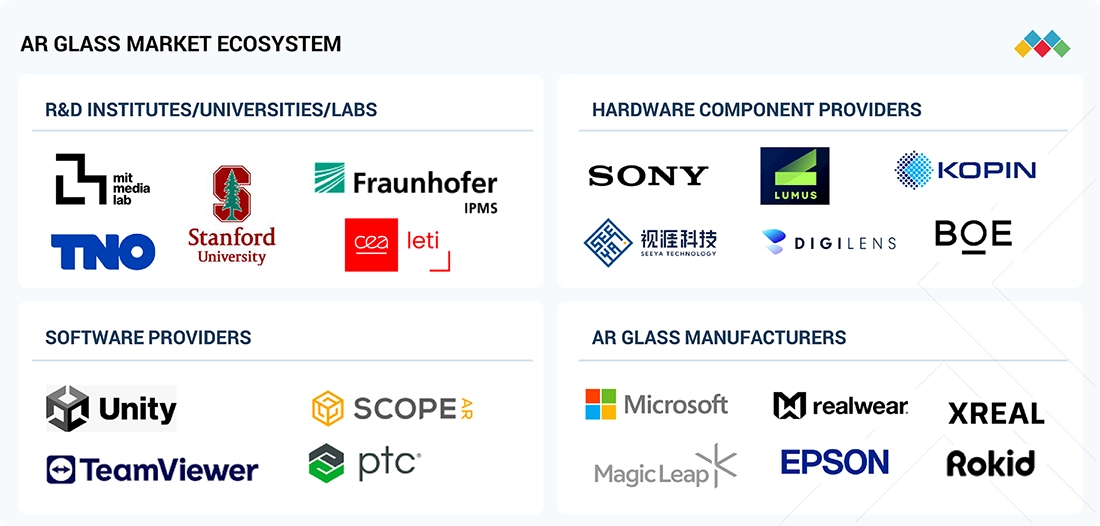
The AR glass ecosystem comprises R&D institutes/universities/labs, hardware component providers, software providers, and AR glass manufacturers. Major players operating in the AR glass market with a significant global presence include XReal, Inc. (China), Magic Leap, Inc. (US), Microsoft (US), Seiko Epson Corporation (Japan), Rokid (US), MEIZU (China), RealWear Inc. (US), RayNeo (China), Red Six Aerospace, Inc. (US), and Hong Kong Lawaken Technology Limited (China).
AR Glass Market Ecosystem

Logos and trademarks shown above are the property of their respective owners. Their use here is for informational and illustrative purposes only.

MARKET SEGMENTS
AR Glass Market Segments

Source: Secondary Research, Interviews with Experts, MarketsandMarkets Analysis

AR Glass Market, by Technology

The markerless AR segment is estimated to lead due to its ability to deliver dynamic, context-aware visualization without the need for physical markers. This technology supports spatial mapping and object tracking, enabling hands-free operation in complex industrial and healthcare environments. Markerless AR is gaining strong traction in enterprise applications for training, inspection, and remote assistance. Meanwhile, marker-based AR remains relevant in controlled scenarios such as retail demonstrations and education. Continuous advances in AI, SLAM, and 3D modeling are enhancing AR glasses’ accuracy, interactivity, and adaptability across diverse environments.

AR Glass Market, by Component

AR glass displays are set to lead, driven by the rapid advancements in microdisplay technologies such as OLED-on-silicon (OLEDoS) and MicroLED. These displays offer superior brightness, resolution, and contrast, making them suitable for both consumer and enterprise AR applications. The demand for compact, lightweight, and power-efficient display modules is accelerating as manufacturers focus on improving visual clarity and comfort. Other components, such as sensors, lenses, cameras, and processors, are also evolving, integrating AI and computer vision capabilities to enable real-time environmental interaction and seamless user experiences.

AR Glass Market, by Connectivity

Standalone AR glasses dominated the market, attributed to their independence from external computing devices and growing hardware sophistication. Standalone AR glasses integrate onboard processors, batteries, and sensors, providing a seamless, untethered user experience. These glasses are widely adopted in enterprise and defense applications, where mobility and ease of use are critical. Tethered models continue to find use in consumer entertainment and design visualization, where high performance and real-time rendering are priorities. Continuous improvements in wireless connectivity, battery efficiency, and on-device computing are propelling standalone AR glass adoption.

AR Glass Market, by Application

The enterprise & industrial segment application of AR glass is estimated to lead, fueled by demand across manufacturing, logistics, energy, and utilities. AR glasses enhance workforce productivity by enabling real-time data visualization, remote guidance, and immersive training. Consumer adoption is also growing, driven by entertainment, navigation, and lifestyle applications. The healthcare sector increasingly uses AR glasses for surgical assistance and patient care visualization, while defense and automotive industries leverage them for simulation and operational efficiency. The growing integration of AR glasses with AI, IoT, and digital twin technologies is expanding their application scope globally.

REGION

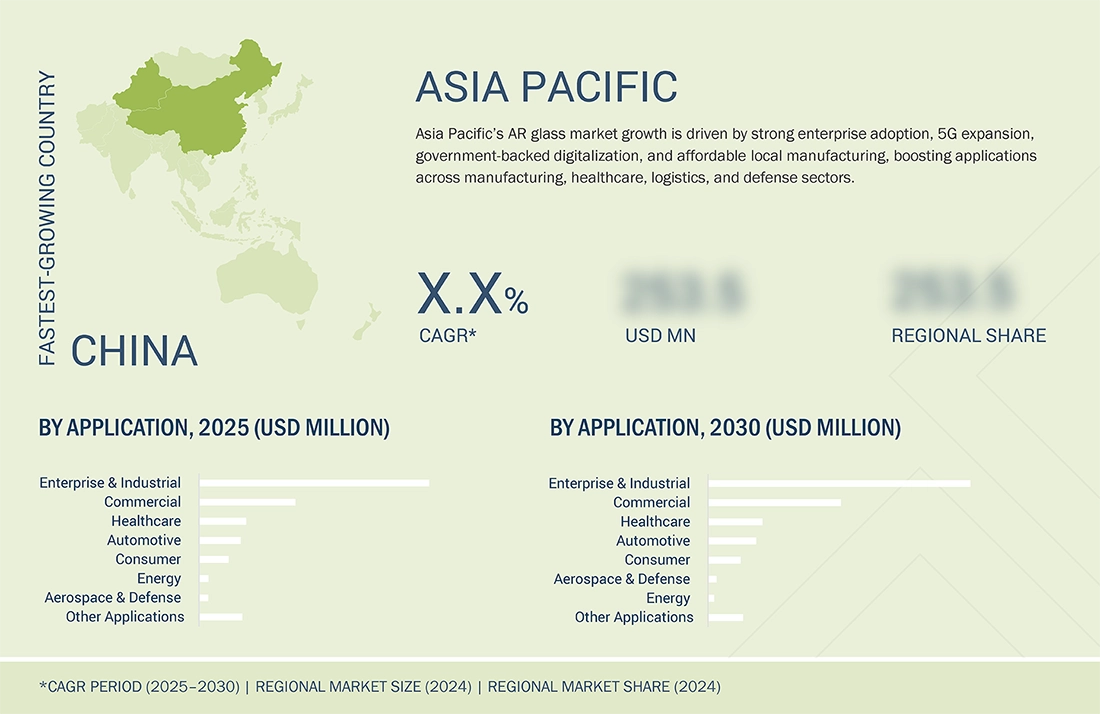
Asia Pacific to be fastest-growing region in global near-eye display market during forecast period

Asia Pacific is projected to emerge as the fastest-growing region in the AR Glass market, driven by the rapid adoption of augmented reality technologies across China, Japan, South Korea, and India. Strong demand for AR glasses in manufacturing, logistics, healthcare, and defense is supported by government initiatives promoting digital transformation, Industry 4.0, and smart infrastructure. China’s robust electronics and optical component manufacturing base, Japan’s leadership in consumer and industrial innovation, South Korea’s thriving entertainment and gaming ecosystem, and India’s expanding enterprise digitalization initiatives are key growth contributors. Additionally, strategic collaborations between AR glass manufacturers, semiconductor suppliers, and software developers are accelerating product innovation and strengthening the region’s position as a global hub for AR technology development.
AR Glass Market Region

AR Glass Market: COMPANY EVALUATION MATRIX

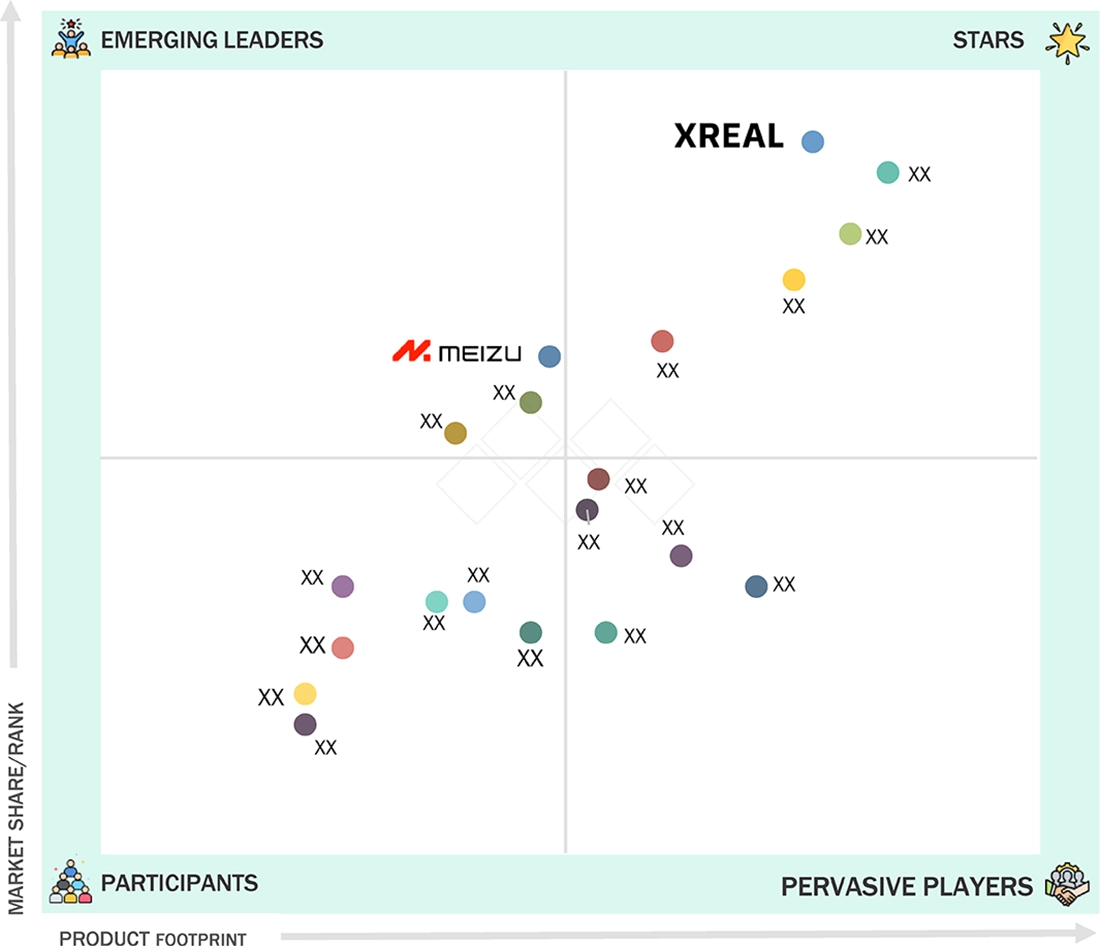
In the AR Glass market matrix, XREAL, Inc. (China) leads with a strong market presence, offering high-performance smart glasses with advanced optics, AI-assisted features, and standalone operation capabilities. XREAL’s comprehensive ecosystem, combined with strategic collaborations with enterprise and consumer AR developers, positions it as a dominant force driving large-scale adoption of AR glasses globally. MEIZU (China), as an emerging leader, is gaining traction with innovative lightweight AR glasses and integrated software solutions. While XREAL dominates through product performance and enterprise partnerships, MEIZU demonstrates strong potential to move toward the leaders’ quadrant by scaling its hardware innovations and expanding adoption across consumer and industrial applications.
AR Glass Market Evaluation Metrics

Source: Secondary Research, Interviews with Experts, MarketsandMarkets Analysis

MARKET SCOPE

REPORT METRIC DETAILS
Market Size, 2024 (Value) USD 1.09 Billion
Market Forecast, 2030 (Value) USD 9.98 Billion
Growth Rate CAGR of 59.0% from 2025 to 2030
Years Considered 2021–2030
Base Year 2024
Forecast Period 2025–2030
Units Considered Value (USD Million/Billion), Volume (Million Units)
Report Coverage Revenue forecast, company ranking, competitive landscape, growth factors, and trends
Segments Covered
  • By Component:
    • Displays
    • Sensors
    • Lenses
    • Processors & Memory Controllers
    • Cameras
    • Cases & Connectors
    • Other Components
  • By Technology:
    • Marker-based AR
    • Markerless AR
  • By Connectivity:
    • Tethered
    • Standalone
  • By Application:
    • Consumer
    • Commercial
    • Enterprise & Industrial
    • Healthcare
    • Aerospace & Defense
    • Automotive
    • Energy
    • Other Applications
Regional Scope North America, Europe, Asia Pacific, Rest of the World

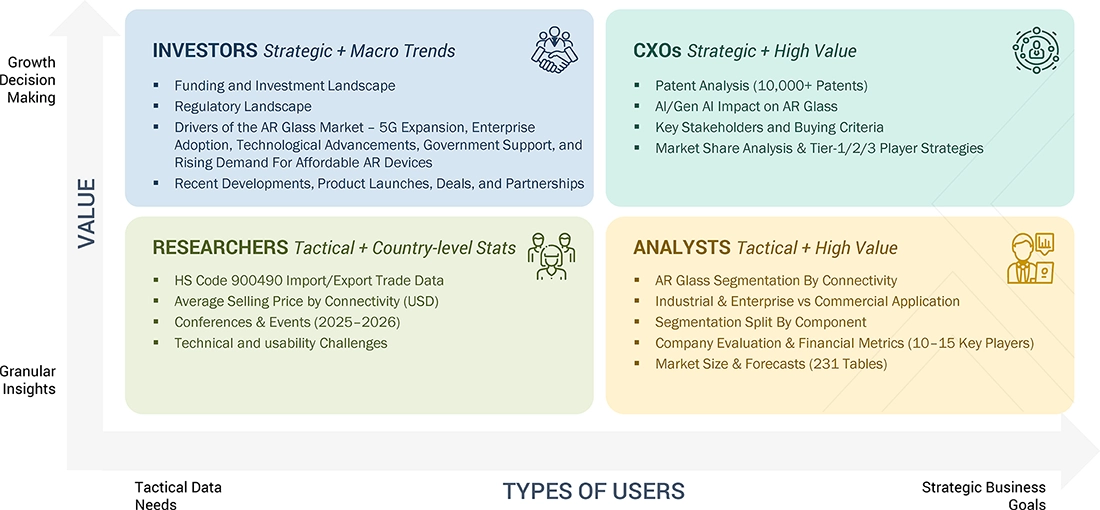
WHAT IS IN IT FOR YOU: AR Glass Market REPORT CONTENT GUIDE
AR Glass Market Content Guide

DELIVERED CUSTOMIZATIONS

We have successfully delivered the following deep-dive customizations:

CLIENT REQUEST CUSTOMIZATION DELIVERED VALUE ADDS
AR Glass Manufacturers
  • Benchmarking of optical engine technologies (Waveguide, Birdbath, Freeform Prism, Holographic Combiners)
  • Comparison of design parameters such as transparency, FOV, brightness, and weight across consumer and enterprise AR glasses
  • Identify optimal display architecture for target use cases
  • Highlight differentiation opportunities for next-gen lightweight AR glasses
  • Support product roadmap planning and optical design improvements
Enterprise & Industrial Solution Providers
  • Mapping of AR glass adoption by use case (remote assistance, maintenance, logistics, healthcare)
  • Evaluation of hardware performance (battery life, thermal management, connectivity) in enterprise environments
  • Enable selection of AR devices best suited for specific industrial tasks
  • Improve workforce efficiency and reduce operational downtime
  • Inform procurement and deployment strategy
Component & Optics Suppliers
  • Market sizing and growth forecast for AR glass components (waveguides, projectors, sensors, optics)
  • Competitive benchmarking of key suppliers and pricing trends
  • Identify high-demand component categories
  • Support strategic sourcing, investment, and capacity planning
  • Guide long-term R&D and partnership strategies
AR Software & Content Developers
  • Assessment of AR glass compatibility with operating systems, SDKs, and rendering engines
  • Evaluation of performance impact on FOV, latency, and tracking accuracy
  • Optimize AR applications for better device interoperability
  • Enhance user experience through improved tracking and visual stability
  • Inform software design and UI/UX improvements
Investors & Venture Capital Firms
  • Market opportunity analysis for AR glass ecosystem
  • Identification of key startups, technology breakthroughs, and partnership/M&A opportunities
  • Enable data-driven investment decisions
  • Highlight emerging segments with strong growth potential
  • Support portfolio diversification and risk mitigation

RECENT DEVELOPMENTS

  • May 2025 : RayNeo launched its flagship X3 Pro AR glasses at the “See the Extraordinary” event in China. Powered by the Qualcomm AR1 platform, the X3 Pro features a cinematic 43-inch full-color 3D display enabled by nano-lithography waveguides and RayNeo’s proprietary micro-LED light engine.
  • January 2024 : RayNeo unveiled its X2 Lite AR glasses at CES 2024, marking their official debut following a preview at the Qualcomm Snapdragon Summit 2023. Designed for consumer use, the glasses feature full-color 3D AR visuals and advanced AI integration in an ultra-light form factor.
  • May 2023 : Rokid launched its latest consumer AR glasses, Rokid Max, positioned as a high-performance virtual display device. Featuring 1080p micro-OLED displays with a 120Hz refresh rate and a 50° field of view, the glasses offer an immersive viewing experience equivalent to a 215-inch screen from 19 feet away. They support 3D mode and include manual diopter adjustments for users with vision needs.


Table of Contents

Exclusive indicates content/data unique to MarketsandMarkets and not available with any competitors.

TITLE
PAGE NO
1
INTRODUCTION


25
2
RESEARCH METHODOLOGY


29
3
EXECUTIVE SUMMARY


41
4
PREMIUM INSIGHTS


47
5
MARKET OVERVIEW
AR market poised for growth with tech advances, despite high costs and software challenges.


50
 
5.1
INTRODUCTION


5.2
MARKET DYNAMICS


5.2.1
DRIVERS


5.2.1.1
GROWING ADOPTION OF AR IN INDUSTRIAL AND ENTERPRISE APPLICATIONS


5.2.1.2
RAPID ADVANCES IN DISPLAY AND SENSOR TECHNOLOGIES


5.2.1.3
INCREASING INVESTMENT IN ADVANCED TECHNOLOGIES


5.2.1.4
SURGING DEMAND FOR HANDS-FREE OPERATIONS


5.2.2
RESTRAINTS


5.2.2.1
HIGH COSTS OF AR DEVICES


5.2.2.2
PRIVACY AND SECURITY CONCERNS


5.2.2.3
LIMITED BATTERY LIFE AND HEAT DISSIPATION ISSUES


5.2.3
OPPORTUNITIES


5.2.3.1
EXPANDING APPLICATIONS IN HEALTHCARE AND AEROSPACE & DEFENSE INDUSTRIES


5.2.3.2
INTEGRATION WITH AI AND EMERGING TECHNOLOGIES


5.2.3.3
GROWING PREFERENCE FOR HYBRID AND REMOTE WORK ENVIRONMENTS


5.2.4
CHALLENGES


5.2.4.1
LACK OF ROBUST AND SCALABLE SOFTWARE ECOSYSTEM


5.2.4.2
LATENCY AND REAL-TIME PERFORMANCE BARRIERS
 
 
5.3
SUPPLY CHAIN ANALYSIS


5.4
ECOSYSTEM ANALYSIS


5.5
TECHNOLOGY ANALYSIS


5.5.1
KEY TECHNOLOGIES


5.5.1.1
WAVEGUIDE OPTICS


5.5.1.2
MICROLED AND OLED-ON-SILICON (OLEDOS)


5.5.2
COMPLEMENTARY TECHNOLOGIES


5.5.2.1
EYE TRACKING AND FOVEATED RENDERING TECHNOLOGIES


5.5.2.2
SPATIAL AUDIO


5.5.3
ADJACENT TECHNOLOGIES


5.5.3.1
CONTEXT-AWARE AI ASSISTANTS


5.5.3.2
COMPUTER VISION AND SIMULTANEOUS LOCALIZATION AND MAPPING (SLAM)
 
 
5.6
PORTER’S FIVE FORCES ANALYSIS


5.6.1
INTENSITY OF COMPETITIVE RIVALRY


5.6.2
BARGAINING POWER OF SUPPLIERS


5.6.3
BARGAINING POWER OF BUYERS


5.6.4
THREAT OF NEW ENTRANTS


5.6.5
THREAT OF SUBSTITUTES


5.7
KEY STAKEHOLDERS AND BUYING CRITERIA


5.7.1
KEY STAKEHOLDERS IN BUYING PROCESS


5.7.2
BUYING CRITERIA


5.8
INVESTMENT AND FUNDING SCENARIO


5.9
PRICING ANALYSIS


5.9.1
AVERAGE SELLING PRICE TREND OF AR GLASS OFFERED BY KEY PLAYERS, BY CONNECTIVITY, 2021–2024


5.9.2
AVERAGE SELLING PRICE TREND OF AR GLASS, BY REGION, 2021–2024


5.10
TRADE ANALYSIS


5.10.1
IMPORT SCENARIO (HS CODE 900490)


5.10.2
EXPORT SCENARIO (HS CODE 900490)


5.11
TRENDS/DISRUPTIONS IMPACTING CUSTOMER BUSINESS


5.12
CASE STUDY ANALYSIS


5.12.1
SASTESA WATER TREATMENT PLANT USES INNOVAE’S SAAM POWERED BY MICROSOFT HOLOLENS TO OPTIMIZE MAINTENANCE WORKFLOWS


5.12.2
CLOROX IMPLEMENTS VUZIX M400 SMART GLASS TO OPTIMIZE MANUFACTURING SITE AUDITS


5.12.3
TOTALENERGIES INTEGRATES REALWEAR HMT-1Z1 SMART GLASS WITH MICROSOFT TEAMS TO MODERNIZE FIELD MAINTENANCE


5.12.4
CHI MEI MEDICAL CENTER ADOPTS VUZIX M400 SMART GLASS TO TRANSFORM EMERGENCY RESPONSE


5.12.5
BMW DEPLOYS REALWEAR HMT-1 SMART GLASS INTEGRATED WITH TEAMVIEWER TO INCREASE SERVICE EFFICIENCY


5.13
PATENT ANALYSIS


5.14
REGULATORY LANDSCAPE


5.14.1
REGULATORY BODIES, GOVERNMENT AGENCIES, AND OTHER ORGANIZATIONS


5.14.2
REGULATIONS


5.14.3
STANDARDS


5.15
KEY CONFERENCES AND EVENTS, 2025


5.16
IMPACT OF AI/GEN AI ON AR GLASS MARKET


5.17
IMPACT OF 2025 US TARIFF ON AR GLASS MARKET


5.17.1
INTRODUCTION


5.17.2
KEY TARIFF RATES


5.17.3
PRICE IMPACT ANALYSIS


5.17.4
IMPACT ON COUNTRIES/REGIONS


5.17.4.1
US


5.17.4.2
EUROPE


5.17.4.3
ASIA PACIFIC


5.17.5
IMPACT ON APPLICATIONS
 
 
6
TYPES OF AR DEVICES
Discover the diverse functionalities of head-mounted and eyewear AR devices transforming user experiences.


87
 
6.1
INTRODUCTION


6.2
HEAD-MOUNTED


6.3
EYEWEAR


7
AR GLASS MARKET, BY CONNECTIVITY
Market Size & Growth Rate Forecast Analysis to 2030 in USD Million and Units | 4 Data Tables


89
 
7.1
INTRODUCTION


7.2
TETHERED


7.2.1
RAPID ADVANCES IN 5G AND EDGE COMPUTING INFRASTRUCTURE TO FOSTER SEGMENTAL GROWTH


7.3
STANDALONE


7.3.1
GROWING POPULARITY OF HYBRID WORK ENVIRONMENTS AND DIGITAL FIELD SERVICES TO BOLSTER SEGMENTAL GROWTH
 
 
8
AR GLASS MARKET, BY COMPONENT
Market Size & Growth Rate Forecast Analysis to 2030 in USD Million | 2 Data Tables


94
 
8.1
INTRODUCTION


8.2
DISPLAYS


8.2.1
EMPHASIS ON MINIATURIZATION FOR LIGHTWEIGHT WEARABLE FORM FACTORS TO AUGMENT SEGMENTAL GROWTH


8.3
SENSORS


8.3.1
ABILITY TO PROVIDE REAL-TIME SPATIAL AWARENESS, GESTURE INTERACTION, AND HEAD TRACKING TO BOOST SEGMENTAL GROWTH


8.3.2
MAGNETOMETERS


8.3.3
ACCELEROMETERS


8.3.4
GYROSCOPES


8.3.5
PROXIMITY SENSORS


8.4
LENSES


8.4.1
USE TO DETERMINE VISUAL CLARITY, IMAGE PROJECTION, AND OVERALL USER COMFORT TO ACCELERATE SEGMENTAL GROWTH


8.5
PROCESSORS & MEMORY


8.5.1
MOUNTING DEMAND FOR LIGHTWEIGHT AND ENERGY-EFFICIENT COMPONENTS FOR WEARABLE DEVICES TO FUEL SEGMENTAL GROWTH


8.6
CONTROLLERS


8.6.1
INTEGRATION OF HAPTIC FEEDBACK, 6DOF TRACKING, AND AI-BASED GESTURE RECOGNITION TO BOLSTER SEGMENTAL GROWTH


8.7
CAMERAS


8.7.1
ADVANCES IN AI AND SPATIAL COMPUTING TO CONTRIBUTE TO SEGMENTAL GROWTH


8.8
CASES & CONNECTORS


8.8.1
FOCUS ON SLEEK INDUSTRIAL DESIGN FOR HARSH AND MOBILE ENVIRONMENTS TO EXPEDITE SEGMENTAL GROWTH


8.9
OTHER COMPONENTS


9
AR GLASS MARKET, BY TECHNOLOGY
Market Size & Growth Rate Forecast Analysis to 2030 in USD Million | 2 Data Tables


101
 
9.1
INTRODUCTION


9.2
MARKERLESS AR


9.2.1
HIGH DEMAND FOR HANDS-FREE, REAL-TIME DATA ACCESS TO FUEL SEGMENTAL GROWTH


9.3
MARKER-BASED AR


9.3.1
EASE OF DEPLOYMENT, LOWER PROCESSING OVERHEAD, AND RELATIVELY SIMPLE SETUP TO DRIVE MARKET
 
 
10
AR GLASS MARKET, BY APPLICATION
Market Size & Growth Rate Forecast Analysis to 2030 in USD Million | 82 Data Tables


104
 
10.1
INTRODUCTION


10.2
CONSUMER


10.2.1
RISING EMPHASIS ON IMMERSIVE AND INTERACTIVE EXPERIENCES IN GAMING AND ENTERTAINMENT INDUSTRY TO BOOST SEGMENTAL GROWTH


10.3
AEROSPACE & DEFENSE


10.3.1
GROWING FOCUS ON ENHANCING COMBAT PREPAREDNESS, OPERATIONAL COORDINATION, AND BATTLEFIELD VISUALIZATION IN REAL TIME TO DRIVE MARKET


10.4
HEALTHCARE


10.4.1
RISING NEED FOR ENHANCED VISUALIZATION, REMOTE COLLABORATION, AND IMPROVED SURGICAL PRECISION TO FUEL SEGMENTAL GROWTH


10.5
ENTERPRISE & INDUSTRIAL


10.5.1
GROWING FOCUS ON HANDS-FREE DATA ACCESS AND REAL-TIME COLLABORATION TO FOSTER SEGMENTAL GROWTH


10.6
COMMERCIAL


10.6.1
RISING ADOPTION OF AR GLASS IN ADVERTISING, RETAIL, AND TOURISM INDUSTRIES TO AUGMENT SEGMENTAL GROWTH


10.7
AUTOMOTIVE


10.7.1
INCREASING NEED FOR VEHICLE MANUFACTURING, MAINTENANCE, AND REMOTE TECHNICAL SUPPORT TO ACCELERATE SEGMENTAL GROWTH


10.8
ENERGY


10.8.1
RISING FOCUS ON OPERATIONAL EFFICIENCY AND REMOTE COLLABORATION IN HAZARD-PRONE ENVIRONMENTS TO FUEL SEGMENTAL GROWTH


10.9
OTHER APPLICATIONS


11
AR GLASS MARKET, BY REGION
Comprehensive coverage of 8 Regions with country-level deep-dive of 21 Countries | 70 Data Tables.


142
 
11.1
INTRODUCTION


11.2
NORTH AMERICA


11.2.1
MACROECONOMIC OUTLOOK FOR NORTH AMERICA


11.2.2
US


11.2.2.1
MOUNTING ADOPTION OF SMART GLASS FOR INDUSTRIAL INSPECTION, TRAINING, SIMULATION, AND REMOTE ASSISTANCE TO DRIVE MARKET


11.2.3
CANADA


11.2.3.1
HIGH-SPEED INTERNET COVERAGE AND FAVORABLE REGULATORY ENVIRONMENT FOR EMERGING TECHNOLOGIES TO AUGMENT MARKET GROWTH


11.2.4
MEXICO


11.2.4.1
RISING PUSH TOWARD SMART FACTORIES AND WORKFORCE AUGMENTATION TO BOLSTER MARKET GROWTH
 
 
11.3
EUROPE


11.3.1
MACROECONOMIC OUTLOOK FOR EUROPE


11.3.2
UK


11.3.2.1
RAPID EXPANSION OF 5G NETWORKS AND INVESTMENTS IN CLOUD CONNECTIVITY TO AUGMENT MARKET GROWTH


11.3.3
GERMANY


11.3.3.1
RISING FOCUS ON REDUCING OPERATIONAL ERRORS AND SUPPORTING CROSS-SITE COLLABORATIONS ACROSS ENTERPRISES TO FUEL MARKET GROWTH


11.3.4
FRANCE


11.3.4.1
GROWING EFFORTS TO DRIVE DIGITAL TRANSFORMATION TO CONTRIBUTE TO MARKET GROWTH


11.3.5
SPAIN


11.3.5.1
INCREASING RELIANCE ON ADVANCED TECHNOLOGIES TO STREAMLINE INVENTORY MANAGEMENT IN LOGISTICS SECTOR TO DRIVE MARKET


11.3.6
ITALY


11.3.6.1
RISING DEPLOYMENT OF TECHNOLOGIES TO ENABLE REAL-TIME DATA VISUALIZATION AND IOT INTEGRATION IN INDUSTRIES TO FUEL MARKET GROWTH


11.3.7
POLAND


11.3.7.1
INCREASING ADOPTION OF SMART GLASS IN LOGISTICS, ENERGY, AND INDUSTRIAL MAINTENANCE TO EXPEDITE MARKET GROWTH


11.3.8
NORDICS


11.3.8.1
GOVERNMENT SUPPORT FOR DIGITALIZATION TO CONTRIBUTE TO MARKET GROWTH


11.3.9
REST OF EUROPE


11.4
ASIA PACIFIC


11.4.1
MACROECONOMIC OUTLOOK FOR ASIA PACIFIC


11.4.2
CHINA


11.4.2.1
ROBUST MANUFACTURING BASE AND RISING ENTERPRISE DIGITALIZATION TO BOOST MARKET GROWTH


11.4.3
JAPAN


11.4.3.1
STRONG 5G AND FIBER-OPTIC INFRASTRUCTURE TO ACCELERATE MARKET GROWTH


11.4.4
SOUTH KOREA


11.4.4.1
NATIONAL DIGITAL STRATEGIES AND INNOVATION-DRIVEN INDUSTRY COLLABORATIONS TO BOOST MARKET GROWTH


11.4.5
INDIA


11.4.5.1
RISING EMPHASIS ON IMMERSIVE EDUCATION AND HEALTHCARE SOLUTIONS TO AUGMENT MARKET GROWTH


11.4.6
AUSTRALIA


11.4.6.1
GOVERNMENT-LED INVESTMENTS IN DIGITAL TECHNOLOGIES AND DEFENSE MODERNIZATION TO BOLSTER MARKET GROWTH


11.4.7
INDONESIA


11.4.7.1
GROWING EMPHASIS ON MODERNIZING INDUSTRIAL CAPABILITIES THROUGH ADVANCED TECHNOLOGIES TO DRIVE MARKET


11.4.8
MALAYSIA


11.4.8.1
DIGITAL TRANSFORMATION PROGRAMS AND WORKFORCE MODERNIZATION INITIATIVES TO FUEL MARKET GROWTH


11.4.9
THAILAND


11.4.9.1
INCREASING AUTOMATION IN MANUFACTURING AND LOGISTICS SECTORS TO EXPEDITE MARKET GROWTH


11.4.10
VIETNAM


11.4.10.1
RISING IMPLEMENTATION OF DIGITAL TRANSFORMATION PROGRAMS TO ACCELERATE MARKET GROWTH


11.4.11
REST OF ASIA PACIFIC


11.5
ROW


11.5.1
MACROECONOMIC OUTLOOK FOR ROW


11.5.2
MIDDLE EAST


11.5.2.1
BAHRAIN


11.5.2.2
KUWAIT


11.5.2.3
OMAN


11.5.2.4
QATAR


11.5.2.5
SAUDI ARABIA


11.5.2.6
UAE


11.5.2.7
REST OF MIDDLE EAST


11.5.3
AFRICA


11.5.3.1
SOUTH AFRICA


11.5.3.2
OTHER AFRICAN COUNTRIES


11.5.4
SOUTH AMERICA


11.5.4.1
INDUSTRIAL INNOVATION AND LOCAL AR CONTENT DEVELOPMENT TO BOOST MARKET GROWTH
 
12
COMPETITIVE LANDSCAPE
Discover key players' winning strategies and market dominance shaping the competitive landscape.


195
 
12.1
INTRODUCTION


12.2
KEY PLAYER STRATEGIES/RIGHT TO WIN, 2022–2025


12.3
MARKET SHARE ANALYSIS, 2024


12.4
REVENUE ANALYSIS, 2022–2024


12.5
COMPANY VALUATION AND FINANCIAL METRICS


12.6
PRODUCT COMPARISON


12.7
COMPANY EVALUATION MATRIX: KEY PLAYERS, 2024


12.7.1
STARS


12.7.2
EMERGING LEADERS


12.7.3
PERVASIVE PLAYERS


12.7.4
PARTICIPANTS


12.7.5
COMPANY FOOTPRINT: KEY PLAYERS, 2024


12.7.5.1
COMPANY FOOTPRINT


12.7.5.2
REGION FOOTPRINT


12.7.5.3
CONNECTIVITY FOOTPRINT


12.7.5.4
TECHNOLOGY FOOTPRINT


12.7.5.5
APPLICATION FOOTPRINT
 
 
12.8
COMPANY EVALUATION MATRIX: STARTUPS/SMES, 2024


12.8.1
PROGRESSIVE COMPANIES


12.8.2
RESPONSIVE COMPANIES


12.8.3
DYNAMIC COMPANIES


12.8.4
STARTING BLOCKS


12.8.5
COMPETITIVE BENCHMARKING: STARTUPS/SMES, 2024


12.8.5.1
DETAILED LIST OF KEY STARTUPS/SMES


12.8.5.2
COMPETITIVE BENCHMARKING OF KEY STARTUPS/SMES
 
 
12.9
COMPETITIVE SCENARIO


12.9.1
PRODUCT LAUNCHES


12.9.2
DEALS


12.9.3
EXPANSIONS
 
 
13
COMPANY PROFILES
In-depth Company Profiles of Leading Market Players with detailed Business Overview, Product and Service Portfolio, Recent Developments, and Unique Analyst Perspective (MnM View)


219
 
13.1
INTRODUCTION


13.2
KEY PLAYERS


13.2.1
XREAL, INC.


13.2.1.1
BUSINESS OVERVIEW


13.2.1.2
PRODUCTS/SOLUTIONS/SERVICES OFFERED


13.2.1.3
RECENT DEVELOPMENTS


13.2.1.4
MNM VIEW


13.2.2
MAGIC LEAP, INC.


13.2.3
MICROSOFT


13.2.4
SEIKO EPSON CORPORATION


13.2.5
ROKID


13.2.6
MEIZU


13.2.7
REALWEAR INC


13.2.8
RAYNEO


13.2.9
RED SIX AEROSPACE, INC.


13.2.10
HONG KONG LAWAKEN TECHNOLOGY LIMITED


13.3
OTHER PLAYERS


13.3.1
VUZIX CORPORATION


13.3.2
LENOVO


13.3.3
OPTINVENT


13.3.4
IRISTICK NV


13.3.5
THIRDEYE


13.3.6
XYZ REALITY LTD.


13.3.7
LONGAN VISION CORP.


13.3.8
NIMO PLANET, INC.


13.3.9
VITURE INC.


13.3.10
EVEN REALITIES


13.3.11
GUANGDONG VIRTUAL REALITY TECHNOLOGY CO., LTD.


13.3.12
NUEYES


13.3.13
GOOLTON TECHNOLOGY CO., LTD.


13.3.14
DREAM GLASS


13.3.15
EVERYSIGHT
 
 
14
APPENDIX


267
 
14.1
DISCUSSION GUIDE


14.2
KNOWLEDGESTORE: MARKETSANDMARKETS’ SUBSCRIPTION PORTAL


14.3
CUSTOMIZATION OPTIONS


14.4
RELATED REPORTS


14.5
AUTHOR DETAILS


LIST OF TABLES


TABLE 1
LIST OF KEY SECONDARY SOURCES


TABLE 2
LIST OF PRIMARY INTERVIEW PARTICIPANTS


TABLE 3
AR GLASS MARKET: RESEARCH ASSUMPTIONS


TABLE 4
AR GLASS MARKET: RISK ANALYSIS


TABLE 5
ROLE OF COMPANIES IN AR GLASS ECOSYSTEM


TABLE 6
PORTER’S FIVE FORCES ANALYSIS


TABLE 7
INFLUENCE OF STAKEHOLDERS ON BUYING PROCESS FOR TOP THREE APPLICATIONS (%)


TABLE 8
KEY BUYING CRITERIA FOR TOP THREE APPLICATIONS


TABLE 9
AVERAGE SELLING PRICE TREND OF AR GLASS PROVIDED BY KEY PLAYERS, BY CONNECTIVITY, 2021–2024 (USD)


TABLE 10
AVERAGE SELLING PRICE TREND OF AR GLASSES, BY REGION, 2021–2024 (USD)


TABLE 11
IMPORT DATA FOR HS CODE 900490-COMPLIANT PRODUCTS, BY COUNTRY, 2020–2024 (USD MILLION)


TABLE 12
EXPORT DATA FOR HS CODE 900490-COMPLIANT PRODUCTS, BY COUNTRY, 2020–2024 (USD MILLION)


TABLE 13
LIST OF KEY PATENTS, 2021–2024


TABLE 14
NORTH AMERICA: REGULATORY BODIES, GOVERNMENT AGENCIES, AND OTHER ORGANIZATIONS


TABLE 15
EUROPE: REGULATORY BODIES, GOVERNMENT AGENCIES, AND OTHER ORGANIZATIONS


TABLE 16
ASIA PACIFIC: REGULATORY BODIES, GOVERNMENT AGENCIES, AND OTHER ORGANIZATIONS


TABLE 17
ROW: REGULATORY BODIES, GOVERNMENT AGENCIES, AND OTHER ORGANIZATIONS


TABLE 18
LIST OF KEY CONFERENCES AND EVENTS, 2025


TABLE 19
US-ADJUSTED RECIPROCAL TARIFF RATES


TABLE 20
AR GLASS MARKET, BY CONNECTIVITY, 2021–2024 (USD MILLION)


TABLE 21
AR GLASS MARKET, BY CONNECTIVITY, 2025–2030 (USD MILLION)


TABLE 22
AR GLASS MARKET, BY CONNECTIVITY, 2021–2024 (MILLION UNITS)


TABLE 23
AR GLASS MARKET, BY CONNECTIVITY, 2025–2030 (MILLION UNITS)


TABLE 24
AR GLASS MARKET, BY COMPONENT, 2021–2024 (USD MILLION)


TABLE 25
AR GLASS MARKET, BY COMPONENT, 2025–2030 (USD MILLION)


TABLE 26
AR GLASS MARKET, BY TECHNOLOGY, 2021–2024 (USD MILLION)


TABLE 27
AR GLASS MARKET, BY TECHNOLOGY, 2025–2030 (USD MILLION)


TABLE 28
AR GLASS MARKET, BY APPLICATION, 2021–2024 (USD MILLION)


TABLE 29
AR GLASS MARKET, BY APPLICATION, 2025–2030 (USD MILLION)


TABLE 30
CONSUMER: AR GLASS MARKET, BY REGION, 2021–2024 (USD MILLION)


TABLE 31
CONSUMER: AR GLASS MARKET, BY REGION, 2025–2030 (USD MILLION)


TABLE 32
CONSUMER: AR GLASS MARKET IN NORTH AMERICA, BY COUNTRY, 2021–2024 (USD MILLION)


TABLE 33
CONSUMER: AR GLASS MARKET IN NORTH AMERICA, BY COUNTRY, 2025–2030 (USD MILLION)


TABLE 34
CONSUMER: AR GLASS MARKET IN EUROPE, BY COUNTRY, 2021–2024 (USD MILLION)


TABLE 35
CONSUMER: AR GLASS MARKET IN EUROPE, BY COUNTRY, 2025–2030 (USD MILLION)


TABLE 36
CONSUMER: AR GLASS MARKET IN ASIA PACIFIC, BY COUNTRY, 2021–2024 (USD MILLION)


TABLE 37
CONSUMER: AR GLASS MARKET IN ASIA PACIFIC, BY COUNTRY, 2025–2030 (USD MILLION)


TABLE 38
CONSUMER: AR GLASS MARKET IN ROW, BY REGION, 2021–2024 (USD MILLION)


TABLE 39
CONSUMER: AR GLASS MARKET IN ROW, BY REGION, 2025–2030 (USD MILLION)


TABLE 40
AEROSPACE & DEFENSE: AR GLASS MARKET, BY REGION, 2021–2024 (USD MILLION)


TABLE 41
AEROSPACE & DEFENSE: AR GLASS MARKET, BY REGION, 2025–2030 (USD MILLION)


TABLE 42
AEROSPACE & DEFENSE: AR GLASS MARKET IN NORTH AMERICA, BY COUNTRY, 2021–2024 (USD MILLION)


TABLE 43
AEROSPACE & DEFENSE: AR GLASS MARKET IN NORTH AMERICA, BY COUNTRY, 2025–2030 (USD MILLION)


TABLE 44
AEROSPACE & DEFENSE: AR GLASS MARKET IN EUROPE, BY COUNTRY, 2021–2024 (USD MILLION)


TABLE 45
AEROSPACE & DEFENSE: AR GLASS MARKET IN EUROPE, BY COUNTRY, 2025–2030 (USD MILLION)


TABLE 46
AEROSPACE & DEFENSE: AR GLASS MARKET IN ASIA PACIFIC, BY COUNTRY, 2021–2024 (USD MILLION)


TABLE 47
AEROSPACE & DEFENSE: AR GLASS MARKET IN ASIA PACIFIC, BY COUNTRY, 2025–2030 (USD MILLION)


TABLE 48
AEROSPACE & DEFENSE: AR GLASS MARKET IN ROW, BY REGION, 2021–2024 (USD MILLION)


TABLE 49
AEROSPACE & DEFENSE: AR GLASS MARKET IN ROW, BY REGION, 2025–2030 (USD MILLION)


TABLE 50
HEALTHCARE: AR GLASS MARKET, BY REGION, 2021–2024 (USD MILLION)


TABLE 51
HEALTHCARE: AR GLASS MARKET, BY REGION, 2025–2030 (USD MILLION)


TABLE 52
HEALTHCARE: AR GLASS MARKET IN NORTH AMERICA, BY COUNTRY, 2021–2024 (USD MILLION)


TABLE 53
HEALTHCARE: AR GLASS MARKET IN NORTH AMERICA, BY COUNTRY, 2025–2030 (USD MILLION)


TABLE 54
HEALTHCARE: AR GLASS MARKET IN EUROPE, BY COUNTRY, 2021–2024 (USD MILLION)


TABLE 55
HEALTHCARE: AR GLASS MARKET IN EUROPE, BY COUNTRY, 2025–2030 (USD MILLION)


TABLE 56
HEALTHCARE: AR GLASS MARKET IN ASIA PACIFIC, BY COUNTRY, 2021–2024 (USD MILLION)


TABLE 57
HEALTHCARE: AR GLASS MARKET IN ASIA PACIFIC, BY COUNTRY, 2025–2030 (USD MILLION)


TABLE 58
HEALTHCARE: AR GLASS MARKET IN ROW, BY REGION, 2021–2024 (USD MILLION)


TABLE 59
HEALTHCARE: AR GLASS MARKET IN ROW, BY REGION, 2025–2030 (USD MILLION)


TABLE 60
ENTERPRISE & INDUSTRIAL: AR GLASS MARKET, BY REGION, 2021–2024 (USD MILLION)


TABLE 61
ENTERPRISE & INDUSTRIAL: AR GLASS MARKET, BY REGION, 2025–2030 (USD MILLION)


TABLE 62
ENTERPRISE & INDUSTRIAL: AR GLASS MARKET IN NORTH AMERICA, BY COUNTRY, 2021–2024 (USD MILLION)


TABLE 63
ENTERPRISE & INDUSTRIAL: AR GLASS MARKET IN NORTH AMERICA, BY COUNTRY, 2025–2030 (USD MILLION)


TABLE 64
ENTERPRISE & INDUSTRIAL: AR GLASS MARKET IN EUROPE, BY COUNTRY, 2021–2024 (USD MILLION)


TABLE 65
ENTERPRISE & INDUSTRIAL: AR GLASS MARKET IN EUROPE, BY COUNTRY, 2025–2030 (USD MILLION)


TABLE 66
ENTERPRISE & INDUSTRIAL: AR GLASS MARKET IN ASIA PACIFIC, BY COUNTRY, 2021–2024 (USD MILLION)


TABLE 67
ENTERPRISE & INDUSTRIAL: AR GLASS MARKET IN ASIA PACIFIC, BY COUNTRY, 2025–2030 (USD MILLION)


TABLE 68
ENTERPRISE & INDUSTRIAL: AR GLASS MARKET IN ROW, BY REGION, 2021–2024 (USD MILLION)


TABLE 69
ENTERPRISE & INDUSTRIAL: AR GLASS MARKET IN ROW, BY REGION, 2025–2030 (USD MILLION)


TABLE 70
COMMERCIAL: AR GLASS MARKET, BY REGION, 2021–2024 (USD MILLION)


TABLE 71
COMMERCIAL: AR GLASS MARKET, BY REGION, 2025–2030 (USD MILLION)


TABLE 72
COMMERCIAL: AR GLASS MARKET IN NORTH AMERICA, BY COUNTRY, 2021–2024 (USD MILLION)


TABLE 73
COMMERCIAL: AR GLASS MARKET IN NORTH AMERICA, BY COUNTRY, 2025–2030 (USD MILLION)


TABLE 74
COMMERCIAL: AR GLASS MARKET IN EUROPE, BY COUNTRY, 2021–2024 (USD MILLION)


TABLE 75
COMMERCIAL: AR GLASS MARKET IN EUROPE, BY COUNTRY, 2025–2030 (USD MILLION)


TABLE 76
COMMERCIAL: AR GLASS MARKET IN ASIA PACIFIC, BY COUNTRY, 2021–2024 (USD MILLION)


TABLE 77
COMMERCIAL: AR GLASS MARKET IN ASIA PACIFIC, BY COUNTRY, 2025–2030 (USD MILLION)


TABLE 78
COMMERCIAL: AR GLASS MARKET IN ROW, BY REGION, 2021–2024 (USD MILLION)


TABLE 79
COMMERCIAL: AR GLASS MARKET IN ROW, BY REGION, 2025–2030 (USD MILLION)


TABLE 80
AUTOMOTIVE: AR GLASS MARKET, BY REGION, 2021–2024 (USD MILLION)


TABLE 81
AUTOMOTIVE: AR GLASS MARKET, BY REGION, 2025–2030 (USD MILLION)


TABLE 82
AUTOMOTIVE: AR GLASS MARKET IN NORTH AMERICA, BY COUNTRY, 2021–2024 (USD MILLION)


TABLE 83
AUTOMOTIVE: AR GLASS MARKET IN NORTH AMERICA, BY COUNTRY, 2025–2030 (USD MILLION)


TABLE 84
AUTOMOTIVE: AR GLASS MARKET IN EUROPE, BY COUNTRY, 2021–2024 (USD MILLION)


TABLE 85
AUTOMOTIVE: AR GLASS MARKET IN EUROPE, BY COUNTRY, 2025–2030 (USD MILLION)


TABLE 86
AUTOMOTIVE: AR GLASS MARKET IN ASIA PACIFIC, BY COUNTRY, 2021–2024 (USD MILLION)


TABLE 87
AUTOMOTIVE: AR GLASS MARKET IN ASIA PACIFIC, BY COUNTRY, 2025–2030 (USD MILLION)


TABLE 88
AUTOMOTIVE: AR GLASS MARKET IN ROW, BY REGION, 2021–2024 (USD MILLION)


TABLE 89
AUTOMOTIVE: AR GLASS MARKET IN ROW, BY REGION, 2025–2030 (USD MILLION)


TABLE 90
ENERGY: AR GLASS MARKET, BY REGION, 2021–2024 (USD MILLION)


TABLE 91
ENERGY: AR GLASS MARKET, BY REGION, 2025–2030 (USD MILLION)


TABLE 92
ENERGY: AR GLASS MARKET IN NORTH AMERICA, BY COUNTRY, 2021–2024 (USD MILLION)


TABLE 93
ENERGY: AR GLASS MARKET IN NORTH AMERICA, BY COUNTRY, 2025–2030 (USD MILLION)


TABLE 94
ENERGY: AR GLASS MARKET IN EUROPE, BY COUNTRY, 2021–2024 (USD MILLION)


TABLE 95
ENERGY: AR GLASS MARKET IN EUROPE, BY COUNTRY, 2025–2030 (USD MILLION)


TABLE 96
ENERGY: AR GLASS MARKET IN ASIA PACIFIC, BY COUNTRY, 2021–2024 (USD MILLION)


TABLE 97
ENERGY: AR GLASS MARKET IN ASIA PACIFIC, BY COUNTRY, 2025–2030 (USD MILLION)


TABLE 98
ENERGY: AR GLASS MARKET IN ROW, BY REGION, 2021–2024 (USD MILLION)


TABLE 99
ENERGY: AR GLASS MARKET IN ROW, BY REGION, 2025–2030 (USD MILLION)


TABLE 100
OTHER APPLICATIONS: AR GLASS MARKET, BY REGION, 2021–2024 (USD MILLION)


TABLE 101
OTHER APPLICATIONS: AR GLASS MARKET, BY REGION, 2025–2030 (USD MILLION)


TABLE 102
OTHER APPLICATIONS: AR GLASS MARKET IN NORTH AMERICA, BY COUNTRY, 2021–2024 (USD MILLION)


TABLE 103
OTHER APPLICATIONS: AR GLASS MARKET IN NORTH AMERICA, BY COUNTRY, 2025–2030 (USD MILLION)


TABLE 104
OTHER APPLICATIONS: AR GLASS MARKET IN EUROPE, BY COUNTRY, 2021–2024 (USD MILLION)


TABLE 105
OTHER APPLICATIONS: AR GLASS MARKET IN EUROPE, BY COUNTRY, 2025–2030 (USD MILLION)


TABLE 106
OTHER APPLICATIONS: AR GLASS MARKET IN ASIA PACIFIC, BY COUNTRY, 2021–2024 (USD MILLION)


TABLE 107
OTHER APPLICATIONS: AR GLASS MARKET IN ASIA PACIFIC, BY COUNTRY, 2025–2030 (USD MILLION)


TABLE 108
OTHER APPLICATIONS: AR GLASS MARKET IN ROW, BY REGION, 2021–2024 (USD MILLION)


TABLE 109
OTHER APPLICATIONS: AR GLASS MARKET IN ROW, BY REGION, 2025–2030 (USD MILLION)


TABLE 110
AR GLASS MARKET, BY REGION, 2021–2024 (USD MILLION)


TABLE 111
AR GLASS MARKET, BY REGION, 2025–2030 (USD MILLION)


TABLE 112
NORTH AMERICA: AR GLASS MARKET, BY COUNTRY, 2021–2024 (USD MILLION)


TABLE 113
NORTH AMERICA: AR GLASS MARKET, BY COUNTRY, 2025–2030 (USD MILLION)


TABLE 114
NORTH AMERICA: AR GLASS MARKET, BY APPLICATION, 2021–2024 (USD MILLION)


TABLE 115
NORTH AMERICA: AR GLASS MARKET, BY APPLICATION, 2025–2030 (USD MILLION)


TABLE 116
US: AR GLASS MARKET, BY APPLICATION, 2021–2024 (USD MILLION)


TABLE 117
US: AR GLASS MARKET, BY APPLICATION, 2025–2030 (USD MILLION)


TABLE 118
CANADA: AR GLASS MARKET, BY APPLICATION, 2021–2024 (USD MILLION)


TABLE 119
CANADA: AR GLASS MARKET, BY APPLICATION, 2025–2030 (USD MILLION)


TABLE 120
MEXICO: AR GLASS MARKET, BY APPLICATION, 2021–2024 (USD MILLION)


TABLE 121
MEXICO: AR GLASS MARKET, BY APPLICATION, 2025–2030 (USD MILLION)


TABLE 122
EUROPE: AR GLASS MARKET, BY COUNTRY, 2021–2024 (USD MILLION)


TABLE 123
EUROPE: AR GLASS MARKET, BY COUNTRY, 2025–2030 (USD MILLION)


TABLE 124
EUROPE: AR GLASS MARKET, BY APPLICATION, 2021–2024 (USD MILLION)


TABLE 125
EUROPE: AR GLASS MARKET, BY APPLICATION, 2025–2030 (USD MILLION)


TABLE 126
UK: AR GLASS MARKET, BY APPLICATION, 2021–2024 (USD MILLION)


TABLE 127
UK: AR GLASS MARKET, BY APPLICATION, 2025–2030 (USD MILLION)


TABLE 128
GERMANY: AR GLASS MARKET, BY APPLICATION, 2021–2024 (USD MILLION)


TABLE 129
GERMANY: AR GLASS MARKET, BY APPLICATION, 2025–2030 (USD MILLION)


TABLE 130
FRANCE: AR GLASS MARKET, BY APPLICATION, 2021–2024 (USD MILLION)


TABLE 131
FRANCE: AR GLASS MARKET, BY APPLICATION, 2025–2030 (USD MILLION)


TABLE 132
SPAIN: AR GLASS MARKET, BY APPLICATION, 2021–2024 (USD MILLION)


TABLE 133
SPAIN: AR GLASS MARKET, BY APPLICATION, 2025–2030 (USD MILLION)


TABLE 134
ITALY: AR GLASS MARKET, BY APPLICATION, 2021–2024 (USD MILLION)


TABLE 135
ITALY: AR GLASS MARKET, BY APPLICATION, 2025–2030 (USD MILLION)


TABLE 136
POLAND: AR GLASS MARKET, BY APPLICATION, 2021–2024 (USD MILLION)


TABLE 137
POLAND: AR GLASS MARKET, BY APPLICATION, 2025–2030 (USD MILLION)


TABLE 138
NORDICS: AR GLASS MARKET, BY APPLICATION, 2021–2024 (USD MILLION)


TABLE 139
NORDICS: AR GLASS MARKET, BY APPLICATION, 2025–2030 (USD MILLION)


TABLE 140
REST OF EUROPE: AR GLASS MARKET, BY APPLICATION, 2021–2024 (USD MILLION)


TABLE 141
REST OF EUROPE: AR GLASS MARKET, BY APPLICATION, 2025–2030 (USD MILLION)


TABLE 142
ASIA PACIFIC: AR GLASS MARKET, BY COUNTRY, 2021–2024 (USD MILLION)


TABLE 143
ASIA PACIFIC: AR GLASS MARKET, BY COUNTRY, 2025–2030 (USD MILLION)


TABLE 144
ASIA PACIFIC: AR GLASS MARKET, BY APPLICATION, 2021–2024 (USD MILLION)


TABLE 145
ASIA PACIFIC: AR GLASS MARKET, BY APPLICATION, 2025–2030 (USD MILLION)


TABLE 146
CHINA: AR GLASS MARKET, BY APPLICATION, 2021–2024 (USD MILLION)


TABLE 147
CHINA: AR GLASS MARKET, BY APPLICATION, 2025–2030 (USD MILLION)


TABLE 148
JAPAN: AR GLASS MARKET, BY APPLICATION, 2021–2024 (USD MILLION)


TABLE 149
JAPAN: AR GLASS MARKET, BY APPLICATION, 2025–2030 (USD MILLION)


TABLE 150
SOUTH KOREA: AR GLASS MARKET, BY APPLICATION, 2021–2024 (USD MILLION)


TABLE 151
SOUTH KOREA: AR GLASS MARKET, BY APPLICATION, 2025–2030 (USD MILLION)


TABLE 152
INDIA: AR GLASS MARKET, BY APPLICATION, 2021–2024 (USD MILLION)


TABLE 153
INDIA: AR GLASS MARKET, BY APPLICATION, 2025–2030 (USD MILLION)


TABLE 154
AUSTRALIA: AR GLASS MARKET, BY APPLICATION, 2021–2024 (USD MILLION)


TABLE 155
AUSTRALIA: AR GLASS MARKET, BY APPLICATION, 2025–2030 (USD MILLION)


TABLE 156
INDONESIA: AR GLASS MARKET, BY APPLICATION, 2021–2024 (USD MILLION)


TABLE 157
INDONESIA: AR GLASS MARKET, BY APPLICATION, 2025–2030 (USD MILLION)


TABLE 158
MALAYSIA: AR GLASS MARKET, BY APPLICATION, 2021–2024 (USD MILLION)


TABLE 159
MALAYSIA: AR GLASS MARKET, BY APPLICATION, 2025–2030 (USD MILLION)


TABLE 160
THAILAND: AR GLASS MARKET, BY APPLICATION, 2021–2024 (USD MILLION)


TABLE 161
THAILAND: AR GLASS MARKET, BY APPLICATION, 2025–2030 (USD MILLION)


TABLE 162
VIETNAM: AR GLASS MARKET, BY APPLICATION, 2021–2024 (USD MILLION)


TABLE 163
VIETNAM: AR GLASS MARKET, BY APPLICATION, 2025–2030 (USD MILLION)


TABLE 164
REST OF ASIA PACIFIC: AR GLASS MARKET, BY APPLICATION, 2021–2024 (USD MILLION)


TABLE 165
REST OF ASIA PACIFIC: AR GLASS MARKET, BY APPLICATION, 2025–2030 (USD MILLION)


TABLE 166
ROW: AR GLASS MARKET, BY REGION, 2021–2024 (USD MILLION)


TABLE 167
ROW: AR GLASS MARKET, BY REGION, 2025–2030 (USD MILLION)


TABLE 168
ROW: AR GLASS MARKET, BY APPLICATION, 2021–2024 (USD MILLION)


TABLE 169
ROW: AR GLASS MARKET, BY APPLICATION, 2025–2030 (USD MILLION)


TABLE 170
MIDDLE EAST: AR GLASS MARKET, BY COUNTRY, 2021–2024 (USD MILLION)


TABLE 171
MIDDLE EAST: AR GLASS MARKET, BY COUNTRY, 2025–2030 (USD MILLION)


TABLE 172
MIDDLE EAST: AR GLASS MARKET, BY APPLICATION, 2021–2024 (USD MILLION)


TABLE 173
MIDDLE EAST: AR GLASS MARKET, BY APPLICATION, 2025–2030 (USD MILLION)


TABLE 174
AFRICA: AR GLASS MARKET, BY COUNTRY, 2021–2024 (USD MILLION)


TABLE 175
AFRICA: AR GLASS MARKET, BY COUNTRY, 2025–2030 (USD MILLION)


TABLE 176
AFRICA: AR GLASS MARKET, BY APPLICATION, 2021–2024 (USD MILLION)


TABLE 177
AFRICA: AR GLASS MARKET, BY APPLICATION, 2025–2030 (USD MILLION)


TABLE 178
SOUTH AMERICA: AR GLASS MARKET, BY APPLICATION, 2021–2024 (USD MILLION)


TABLE 179
SOUTH AMERICA: AR GLASS MARKET, BY APPLICATION, 2025–2030 (USD MILLION)


TABLE 180
OVERVIEW OF STRATEGIES DEPLOYED BY KEY PLAYERS IN AR GLASS MARKET, JANUARY 2022–MAY 2025


TABLE 181
AR GLASS MARKET: DEGREE OF COMPETITION, 2024


TABLE 182
AR GLASS MARKET: REGION FOOTPRINT


TABLE 183
AR GLASS MARKET: CONNECTIVITY FOOTPRINT


TABLE 184
AR GLASS MARKET: TECHNOLOGY FOOTPRINT


TABLE 185
AR GLASS MARKET: APPLICATION FOOTPRINT


TABLE 186
AR GLASS MARKET: DETAILED LIST OF KEY STARTUPS/SMES


TABLE 187
COMPETITIVE BENCHMARKING FOR STARTUPS/SMES


TABLE 188
AR GLASS MARKET: PRODUCT LAUNCHES, JANUARY 2022–MAY 2025


TABLE 189
AR GLASS MARKET: DEALS, JANUARY 2022–MAY 2025


TABLE 190
AR GLASS MARKET: EXPANSIONS, JANUARY 2022–MAY 2025


TABLE 191
XREAL, INC.: COMPANY OVERVIEW


TABLE 192
XREAL, INC.: PRODUCTS/SOLUTIONS/SERVICES OFFERED


TABLE 193
XREAL, INC.: PRODUCT LAUNCHES


TABLE 194
XREAL, INC.: DEALS


TABLE 195
XREAL, INC.: EXPANSIONS


TABLE 196
MAGIC LEAP, INC.: COMPANY OVERVIEW


TABLE 197
MAGIC LEAP, INC.: PRODUCTS/SOLUTIONS/SERVICES OFFERED


TABLE 198
MAGIC LEAP, INC.: PRODUCT LAUNCHES


TABLE 199
MAGIC LEAP, INC.: DEALS


TABLE 200
MICROSOFT: COMPANY OVERVIEW


TABLE 201
MICROSOFT: PRODUCTS/SOLUTIONS/SERVICES OFFERED


TABLE 202
MICROSOFT: DEALS


TABLE 203
SEIKO EPSON CORPORATION: COMPANY OVERVIEW


TABLE 204
SEIKO EPSON CORPORATION: PRODUCTS/SOLUTIONS/SERVICES OFFERED


TABLE 205
SEIKO EPSON CORPORATION: PRODUCT LAUNCHES


TABLE 206
SEIKO EPSON CORPORATION: DEALS


TABLE 207
ROKID: COMPANY OVERVIEW


TABLE 208
ROKID: PRODUCTS/SOLUTIONS/SERVICES OFFERED


TABLE 209
ROKID: PRODUCT LAUNCHES


TABLE 210
ROKID: DEALS


TABLE 211
ROKID: EXPANSIONS


TABLE 212
MEIZU: COMPANY OVERVIEW


TABLE 213
MEIZU: PRODUCTS/SOLUTIONS/SERVICES OFFERED


TABLE 214
MEIZU: PRODUCT LAUNCHES


TABLE 215
MEIZU: DEALS


TABLE 216
MEIZU: EXPANSIONS


TABLE 217
REALWEAR INC: COMPANY OVERVIEW


TABLE 218
REALWEAR INC: PRODUCTS/SOLUTIONS/SERVICES OFFERED


TABLE 219
REALWEAR INC: PRODUCT LAUNCHES


TABLE 220
REALWEAR INC: DEALS


TABLE 221
REALWEAR INC: EXPANSIONS


TABLE 222
RAYNEO: COMPANY OVERVIEW


TABLE 223
RAYNEO: PRODUCTS/SOLUTIONS/SERVICES OFFERED


TABLE 224
RAYNEO: PRODUCT LAUNCHES


TABLE 225
RAYNEO: DEALS


TABLE 226
RED SIX AEROSPACE, INC.: COMPANY OVERVIEW


TABLE 227
RED SIX AEROSPACE, INC.: PRODUCTS/SOLUTIONS/SERVICES OFFERED


TABLE 228
RED SIX AEROSPACE, INC.: DEALS


TABLE 229
HONG KONG LAWAKEN TECHNOLOGY LIMITED: COMPANY OVERVIEW


TABLE 230
HONG KONG LAWAKEN TECHNOLOGY LIMITED: PRODUCTS/SOLUTIONS/SERVICES OFFERED


TABLE 231
HONG KONG LAWAKEN TECHNOLOGY LIMITED: PRODUCT LAUNCHES


LIST OF FIGURES


FIGURE 1
AR GLASS MARKET SEGMENTATION AND REGIONAL SCOPE


FIGURE 2
AR GLASS MARKET: RESEARCH DESIGN


FIGURE 3
KEY DATA FROM SECONDARY SOURCES


FIGURE 4
KEY DATA FROM PRIMARY SOURCES


FIGURE 5
KEY INDUSTRY INSIGHTS


FIGURE 6
BREAKDOWN OF PRIMARIES


FIGURE 7
AR GLASS MARKET: BOTTOM-UP APPROACH


FIGURE 8
AR GLASS MARKET: DEMAND-SIDE ANALYSIS


FIGURE 9
AR GLASS MARKET: TOP-DOWN APPROACH


FIGURE 10
AR GLASS MARKET: SUPPLY-SIDE ANALYSIS


FIGURE 11
AR GLASS MARKET: DATA TRIANGULATION


FIGURE 12
AR GLASS MARKET SIZE, 2021–2030


FIGURE 13
MARKERLESS AR SEGMENT TO HOLD LARGER MARKET SHARE IN 2030


FIGURE 14
ENTERPRISE & INDUSTRIAL SEGMENT TO DOMINATE AR GLASS MARKET DURING FORECAST PERIOD


FIGURE 15
STANDALONE SEGMENT TO HOLD LARGER SHARE OF AR GLASS MARKET IN 2030


FIGURE 16
DISPLAYS SEGMENT TO DOMINATE AR GLASS MARKET BETWEEN 2025 AND 2030


FIGURE 17
NORTH AMERICA HELD LARGEST SHARE OF AR GLASS MARKET IN 2024


FIGURE 18
MANUFACTURING AUTOMATION AND DIGITALIZATION INITIATIVES TO OFFER LUCRATIVE OPPORTUNITIES FOR PLAYERS IN AR GLASS MARKET


FIGURE 19
TETHERED SEGMENT TO EXHIBIT HIGHER CAGR IN AR GLASS MARKET FROM 2025 TO 2030


FIGURE 20
DISPLAYS AND ENTERPRISE & INDUSTRIAL SEGMENTS HELD LARGEST SHARES OF AR GLASS MARKET IN 2024


FIGURE 21
MARKERLESS AR SEGMENT TO CAPTURE LARGER SHARE OF AR GLASS MARKET DURING FORECAST PERIOD


FIGURE 22
ASIA PACIFIC TO RECORD HIGHEST CAGR DURING FORECAST PERIOD


FIGURE 23
DRIVERS, RESTRAINTS, OPPORTUNITIES, AND CHALLENGES


FIGURE 24
IMPACT ANALYSIS: DRIVERS


FIGURE 25
IMPACT ANALYSIS: RESTRAINTS


FIGURE 26
IMPACT ANALYSIS: OPPORTUNITIES


FIGURE 27
IMPACT ANALYSIS: CHALLENGES


FIGURE 28
SUPPLY CHAIN ANALYSIS


FIGURE 29
AR GLASS ECOSYSTEM


FIGURE 30
PORTER’S FIVE FORCES ANALYSIS


FIGURE 31
IMPACT OF PORTER’S FIVE FORCES


FIGURE 32
INFLUENCE OF STAKEHOLDERS ON BUYING PROCESS FOR TOP THREE APPLICATIONS


FIGURE 33
KEY BUYING CRITERIA FOR TOP THREE APPLICATIONS


FIGURE 34
INVESTMENT AND FUNDING SCENARIO, 2019–2024


FIGURE 35
AVERAGE SELLING PRICE TREND OF AR GLASS OFFERED BY KEY PLAYERS, BY CONNECTIVITY, 2021–2024


FIGURE 36
AVERAGE SELLING PRICE TREND OF AR GLASS, BY REGION, 2021–2024


FIGURE 37
IMPORT DATA FOR HS CODE 900490-COMPLIANT PRODUCTS FOR TOP FIVE COUNTRIES, 2020–2024


FIGURE 38
EXPORT DATA FOR HS CODE 900490-COMPLIANT PRODUCTS FOR TOP FIVE COUNTRIES, 2020–2024


FIGURE 39
TRENDS/DISRUPTIONS IMPACTING CUSTOMER BUSINESS


FIGURE 40
PATENTS APPLIED AND GRANTED, 2015–2024


FIGURE 41
IMPACT OF AI/GEN AI ON AR GLASS MARKET


FIGURE 42
STANDALONE SEGMENT TO ACCOUNT FOR LARGER SHARE OF AR GLASS MARKET IN 2030


FIGURE 43
PROCESSORS & MEMORY SEGMENT TO EXHIBIT HIGHEST CAGR IN AR GLASS MARKET FROM 2025 TO 2030


FIGURE 44
MARKERLESS AR TECHNOLOGY TO ACCOUNT FOR LARGER MARKET SHARE IN 2030


FIGURE 45
ENTERPRISE & INDUSTRIAL SEGMENT TO DOMINATE AR GLASS MARKET BETWEEN 2025 AND 2030


FIGURE 46
AR GLASS MARKET, BY REGION


FIGURE 47
ASIA PACIFIC TO EXHIBIT HIGHEST CAGR IN AR GLASS MARKET FROM 2025 TO 2030


FIGURE 48
NORTH AMERICA: AR GLASS MARKET SNAPSHOT


FIGURE 49
EUROPE: AR GLASS MARKET SNAPSHOT


FIGURE 50
ASIA PACIFIC: AR GLASS MARKET SNAPSHOT


FIGURE 51
MARKET SHARE ANALYSIS OF COMPANIES OFFERING AR GLASS, 2024


FIGURE 52
AR GLASS MARKET: REVENUE ANALYSIS OF THREE MAJOR PLAYERS, 2022–2024


FIGURE 53
COMPANY VALUATION


FIGURE 54
FINANCIAL METRICS (EV/EBITDA)


FIGURE 55
PRODUCT COMPARISON


FIGURE 56
AR GLASS MARKET: COMPANY EVALUATION MATRIX (KEY PLAYERS), 2024


FIGURE 57
AR GLASS MARKET: COMPANY FOOTPRINT


FIGURE 58
AR GLASS MARKET: COMPANY EVALUATION MATRIX (STARTUPS/SMES), 2024


FIGURE 59
MICROSOFT: COMPANY SNAPSHOT


FIGURE 60
SEIKO EPSON CORPORATION: COMPANY SNAPSHOT


Methodology

The research study involved four major activities in estimating the size of the AR glass market. Exhaustive secondary research has been done to collect important information about the market and peer markets. The validation of these findings, assumptions, and sizing with the help of primary research with industry experts across the value chain has been the next step. Both top-down and bottom-up approaches have been used to estimate the market size. Post which the market breakdown and data triangulation have been adopted to estimate the market sizes of segments and subsegments.

Secondary Research

In the secondary research process, various secondary sources were referred to to identify and collect information required for this study. The secondary sources include annual reports, press releases, investor presentations of companies, white papers, and articles from recognized authors. Secondary research has been mainly done to obtain key information about the market’s value chain, the pool of key market players, market segmentation according to industry trends, regional outlook, and developments from market and technology perspectives.

In the AR glass market report, the global market size has been estimated using the top-down and bottom-up approaches, along with several other dependent submarkets. Major players in the market were identified using extensive secondary research, and their presence in the market was determined using secondary and primary research. All the percentage shares splits, and breakdowns have been determined using secondary sources and verified through primary sources.

Primary Research

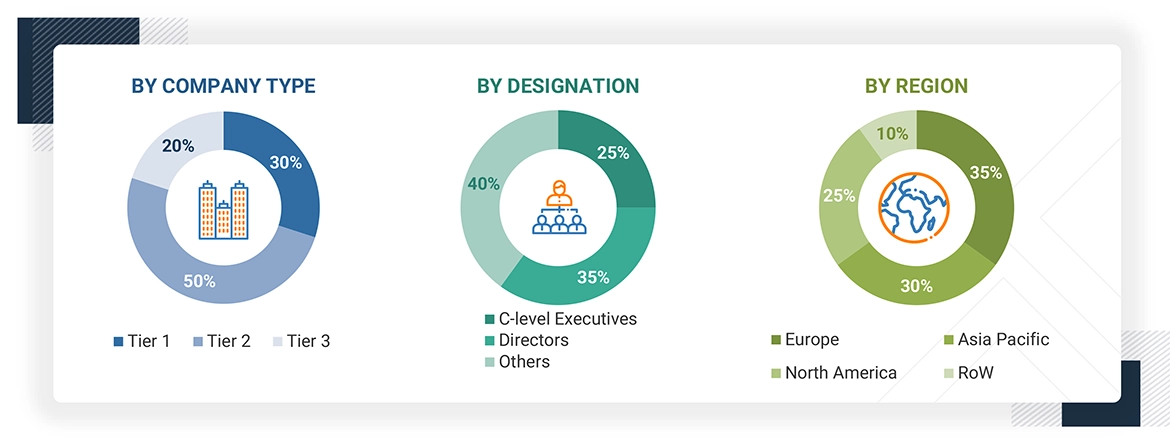
Extensive primary research has been conducted after understanding the AR glass market scenario through secondary research. Several primary interviews have been conducted with key opinion leaders from the demand- and supply-side vendors across four major regions—North America, Europe, Asia Pacific, and RoW. Approximately 25% of the primary interviews have been conducted with the demand-side vendors and 75% with the supply-side vendors. Primary data was collected mainly through telephonic interviews, which comprised 80% of the total primary interviews; questionnaires and emails were also used to collect the data.

After successful interaction with industry experts, brief sessions were conducted with highly experienced independent consultants to reinforce the primary research findings. This, along with the in-house subject matter experts’ opinions, has led us to the findings as described in the report.
AR Glass Market
 Size, and Share

Note: “Others” includes sales, marketing, and product managers

To know about the assumptions considered for the study, download the pdf brochure

Market Size Estimation

In the market engineering process, both top-down and bottom-up approaches and data triangulation methods have been used to estimate and validate the size of the AR glass market and other dependent submarkets. The research methodology used to estimate the market sizes includes the following:

  • Identifying top-line investments and spending in the ecosystem, and considering segment-level splits and major market developments
  • Identifying different stakeholders in the AR glass market that influence the entire market, along with participants across the supply chain
  • Analyzing major manufacturers in the AR glass market and studying their product portfolio
  • Analyzing trends related to the adoption of AR glass products
  • Tracking recent and upcoming market developments, including investments, R&D activities, product launches, expansions, acquisitions, partnerships, collaborations, agreements, and investments, as well as forecasting the market size based on these developments and other critical parameters
  • Carrying out multiple discussions with key opinion leaders to identify the adoption trends of AR glasses.
  • Segmenting the overall market into various other market segments
  • Validating the estimates at every level through discussions with key opinion leaders, such as chief executives (CXOs), directors, and operation managers, and finally with the domain experts at MarketsandMarkets

AR Glass Market : Top-Down and Bottom-Up Approach
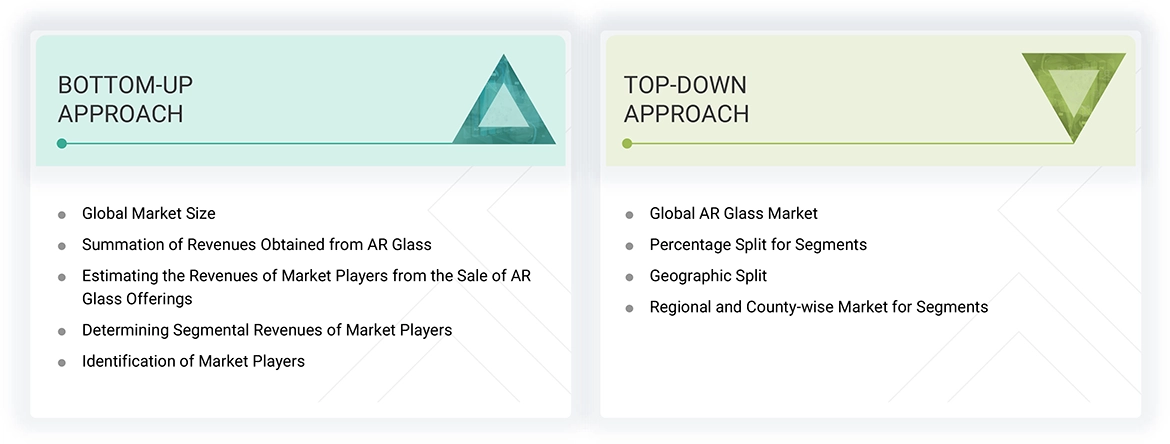
AR Glass Market Top Down and Bottom Up Approach

Data Triangulation

After arriving at the overall market size by the market size estimation process explained in the earlier section, the overall AR glass market has been divided into several segments and subsegments. To complete the overall market engineering process and arrive at the exact statistics for all segments, the data triangulation and market breakdown procedures have been used, wherever applicable. The data was triangulated by studying various factors and trends from the perspectives of demand and supply. Along with data triangulation and market breakdown, the market has been validated by top-down and bottom-up approaches.

Market Definition

Augmented reality (AR) glass encompasses wearable technology, such as smart eyewear or head-mounted displays (HMDs), designed to overlay digital elements onto the real-world environment. These devices offer interactive, real-time visualizations, enabling users to engage with their surroundings while seamlessly accessing digital content without using their hands.

The AR glass market comprises eyewear, smart glasses, and HMDs, available as tethered or standalone systems. These solutions are deployed in diverse use cases, such as remote support, equipment maintenance, surgical procedures, warehouse operations, design validation, training environments, and defense applications. By improving operational efficiency, situational awareness, and decision-making, AR Glass is revolutionizing workflows across industries such as healthcare, manufacturing, logistics, retail, automotive, and defense. As organizations increasingly invest in digital transformation, AR glass is an essential interface bridging the physical and digital worlds.

The AR glass market is segmented based on connectivity, component, technology, application, and region. In terms of connectivity, AR glasses are categorized into tethered and standalone types. Tethered glasses rely on external devices such as smartphones or PCs, while standalone glasses have built-in processors and operate independently. The component segment includes displays, sensors, lenses, processors & memory, controllers, cameras, cases, connectors, and other related parts. For technology, the market is divided into marker-based AR and markerless AR. Marker-based AR uses visual markers to trigger digital content, whereas markerless AR operates without markers, using environmental understanding. The application segment covers various sectors, such as consumer, commercial, enterprise, healthcare, aerospace and defense, automotive, energy, and other fields. This segmentation helps understand how AR glasses are used across different industries and how their components and technologies vary based on specific needs.

Key Stakeholders

  • AR Glass Manufacturers
  • Component Suppliers
  • Software & Platform Developers
  • Application Developers & Integrators
  • End-use Industries (Buyers/Users)
  • Distributors & Channel Partners
  • Research Institutions & Standard Bodies
  • Technology Investors
  • Government, Financial Institutions, and Investment Communities

Report Objectives

  • To describe and forecast the overall AR glass market, by connectivity, component, technology, and application in terms of value
  • To forecast the market, by connectivity, in terms of volume
  • To describe different types of AR glasses, namely, head-mounted and eyewear
  • To describe and forecast the market for four key regions: North America, Europe, Asia Pacific, and RoW, in terms of value
  • To provide detailed information regarding drivers, restraints, opportunities, and challenges influencing the growth of the market
  • To provide a detailed overview of the supply chain of the AR glass ecosystem, along with the average selling prices of the product type
  • To strategically analyze the ecosystem, Porter’s five forces, key stakeholders & buying criteria, technology analysis, investment and funding scenario, key conferences & events, tariffs and regulations, patent landscape, trade landscape, and case studies pertaining to the market under study
  • To strategically analyze micromarkets1 with regard to individual growth trends, prospects, and contributions to the overall market
  • To analyze opportunities in the market for stakeholders and provide a competitive landscape of the market
  • To analyze the impact of AI/Gen AI  and the US tariff on the AR glass market
  • To analyze competitive developments, such as product launches, expansions, partnerships, and collaborations, in the market
  • To strategically profile the key players in the market and comprehensively analyze their market ranking and core competencies

Available customizations:

With the given market data, MarketsandMarkets offers customizations according to the specific requirements of companies. The following customization options are available for the report:

Country-wise Information:

  • Country-wise breakdown for North America, Europe, Asia Pacific, and RoW

Company Information:

  • Detailed analysis and profiling of additional market players (up to five)

Key Questions Addressed by the Report

What was the global AR glass market size in 2024, and at what CAGR will it grow during the forecast period?

The AR glass market was valued at 1.09 billion in 2024 and is projected to reach USD 9.98 billion by 2030, at a CAGR of 59.0% from 2025 to 2030.

Who are the key players in the global AR glass market?

XReal, Inc. (China), Magic Leap, Inc. (US), Microsoft (US), Seiko Epson Corporation (Japan), and Rokid (US) are the key market players.

Which region is expected to hold the largest market share in 2025 and why?

North America is expected to hold the largest market share in the AR glass market due to strong enterprise adoption, technological leadership, and significant defense sector investments. US-based companies, including Microsoft, Magic Leap, RealWear Inc., Rokid, and Red Six Aerospace, are at the forefront of AR innovation, supported by government initiatives, such as IVAS and funding from agencies such as DARPA and NSF.

What are the primary forces fueling growth and the significant opportunities within the AR glass market?

Rising enterprise adoption, hands-free operational needs, and rapid advancements in display and sensor technologies drive the AR glass market. Major tech firms are investing heavily in scaling adoption. Opportunities lie in expanding use across healthcare, aerospace, and defense, alongside AI integration and remote collaboration tools, paving the way for broader, cross-industry deployment and intelligent AR solutions.

What are the prominent strategies adopted by market players?

Key players adopt strategies such as product launches, acquisitions, collaborations, partnerships, investments, agreements, and expansions to strengthen their position in the AR glass market.

What is the impact of Gen AI/AI on the AR glass market on a scale of 1–10 (1 - least impactful and 10 - most impactful)?

The impact is as follows: Smarter Real-Time Object Recognition & Context Awareness 9 Voice, Gesture, and Eye-Tracking AI Models for Natural UX 8 Faster and More Efficient Content Generation at Scale 7 Personalized User Experiences Through Gen AI 6

Personalize This Research

  • Triangulate with your Own Data
  • Get Data as per your Format and Definition
  • Gain a Deeper Dive on a Specific Application, Geography, Customer or Competitor
  • Any level of Personalization
Request A Free Customisation

Let Us Help You

  • What are the Known and Unknown Adjacencies Impacting the AR Glass Market
  • What will your New Revenue Sources be?
  • Who will be your Top Customer; what will make them switch?
  • Defend your Market Share or Win Competitors
  • Get a Scorecard for Target Partners
Customized Workshop Request

Custom Market Research Services

We Will Customise The Research For You, In Case The Report Listed Above Does Not Meet With Your Requirements

Get 10% Free Customisation

Growth opportunities and latent adjacency in AR Glass Market

DMCA.com Protection Status