Asia Pacific Anti-Counterfeit Packaging Market

Asia Pacific Anti-Counterfeit Packaging Market by Technology (Mass Encoding, RFID, Holograms, Forensic Marker, Tamper Evidence), End-use Industry (Food & Beverage, Pharmaceutical, Apparel & Footwear, Personal Care, Electronic) – Forecast to 2030




ASIA PACIFIC / CHINA ANTI-COUNTERFEIT PACKAGING MARKET
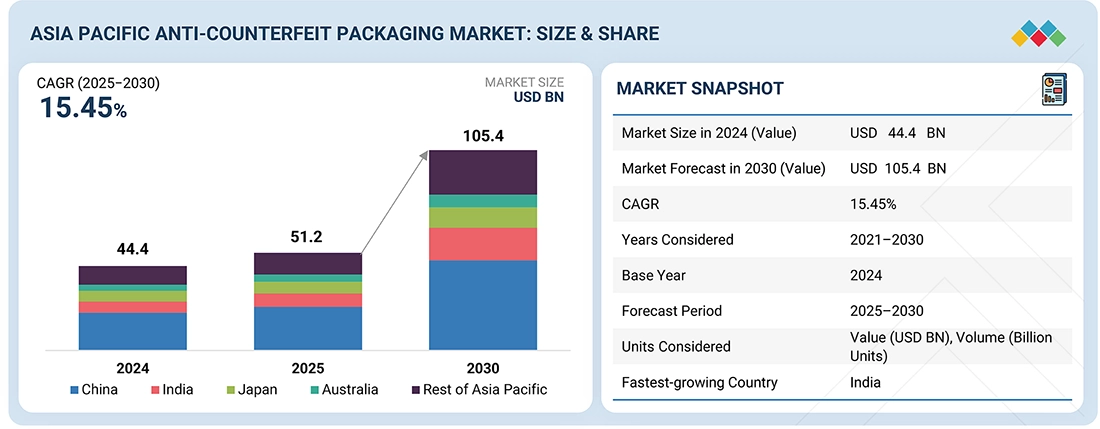
Source: Secondary Research, Interviews with Experts, MarketsandMarkets Analysis | Updated on : April 20, 2026
The Asia Pacific anti-counterfeit packaging market is projected to reach USD 105.4 billion by 2030 from USD 51.2 billion in 2025, at a CAGR of 15.45% from 2025 to 2030. Asia Pacific anti-counterfeit packaging market is on the rise due to escalating product fraud across pharmaceuticals, electronics, and FMCG sectors, coupled with stricter regulatory enforcement and rapid adoption of digital authentication technologies
China Anti-Counterfeit Packaging Market
China anti-counterfeit packaging market represents the largest national segment within the Asia Pacific Anti-Counterfeit Packaging Market, with China holding the largest share in 2024 among countries in the region, reflecting its leading position in demand for anti-counterfeit solutions. This prominence is driven by rising incidents of product counterfeiting across pharmaceuticals, electronics, and fast-moving consumer goods, which in turn compel manufacturers and brands to adopt advanced authentication and traceability technologies at scale. As part of the broader Asia Pacific market—which is projected to grow significantly through 2030—China’s market adoption encompasses technologies such as mass encoding, RFID, holograms, forensic markers, and tamper-evident systems to strengthen supply chain security and regulatory compliance. The combination of extensive manufacturing activities, regulatory emphasis on serialization and authentication, and escalating counterfeiting threats underpins China’s leadership and sustained growth in anti-counterfeit packaging within the region.
KEY TAKEAWAYS
-
By CountryChina is to hold the largest share in the market in 2024.
-
By TechnologyBy Technology, Mass Encoding accounted for the largest market share, at a CAGR of 12.56%, in terms of value.
-
By End-use IndustryBy End-use Industry, pharmaceutical to grow at the fastest rate between 2025 and 2030.
-
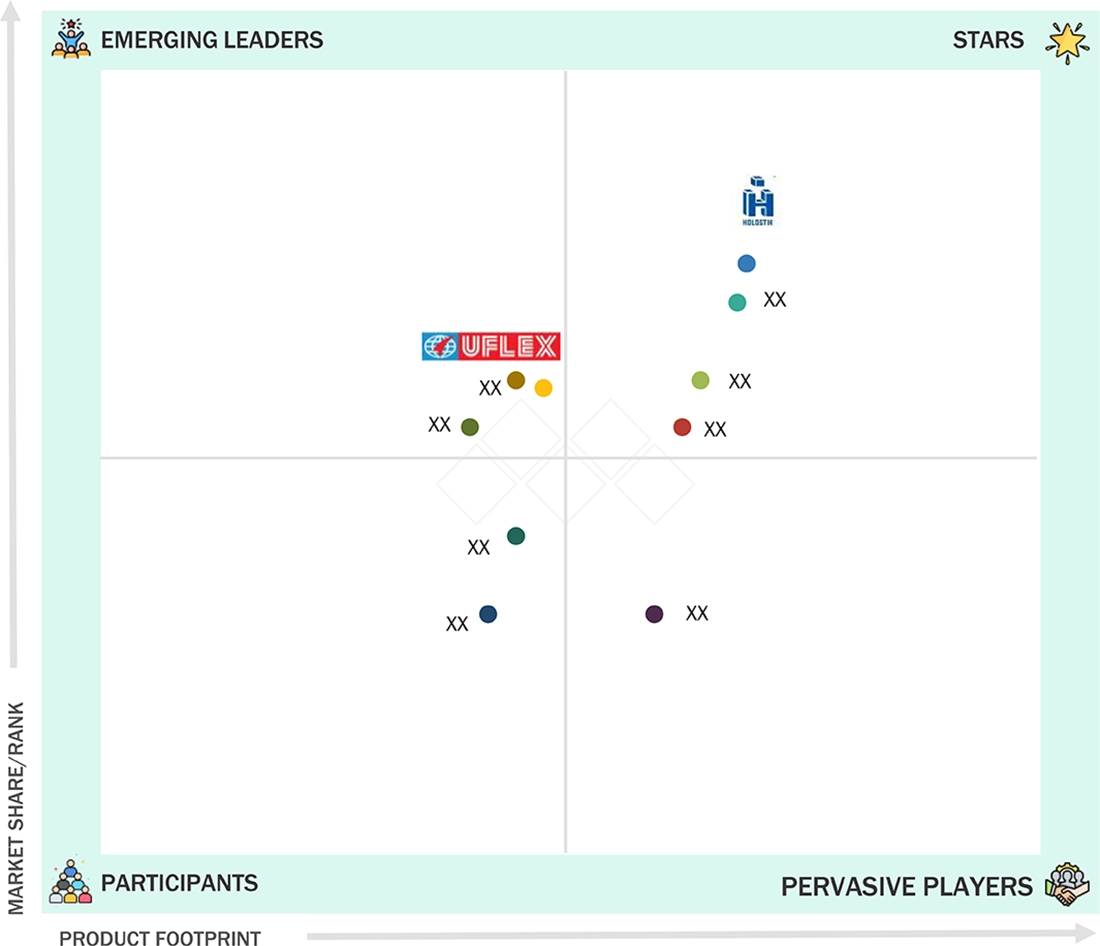
Competitive Landscape-Key playersHolostik (India), UFlex (India), SML Group Ltd. (China), Toppan Inc. (Japan) were identified as Star players in the market, as they have focused on innovation and have broad industry coverage, and strong operational & financial strength.
-
Competitive Landscape-StartupsShiner International Inc., Lipeng, Invengo, Unisto, Wonderpac among others have distinguished themselves among startups and SMEs due to their strong product portfolio and business strategy.
The rising demand for anti-counterfeit packaging in the Asia-Pacific region is driven by the rapid growth of pharmaceuticals, electronics, and luxury goods sectors, coupled with stringent regulatory compliance requirements and increasing incidences of product counterfeiting
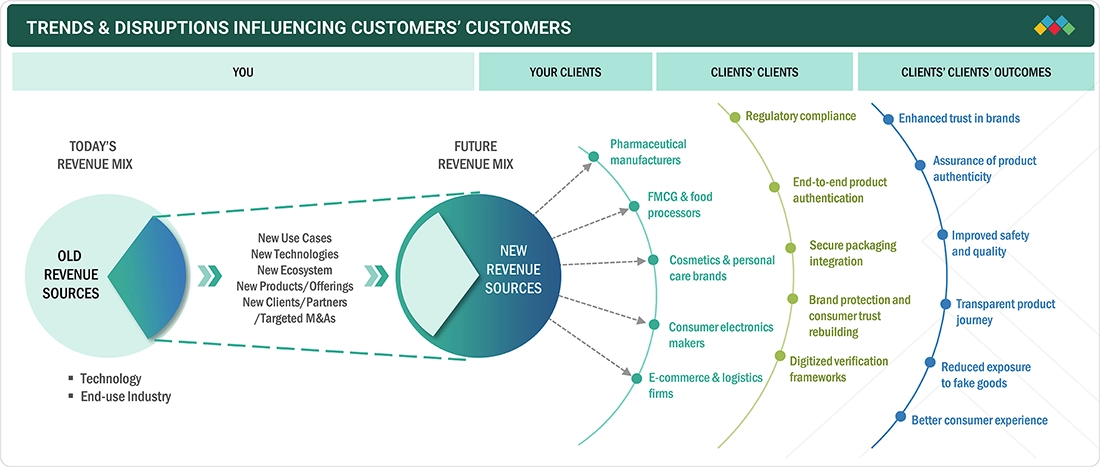
TRENDS & DISRUPTIONS IMPACTING CUSTOMERS' CUSTOMERS
Anti-counterfeit Packaging in Asia Pacific is trending toward regulatory compliance, end-to-end product authentication, secure packaging integration, brand protection and consumer trust rebuilding, digitized verification frameworks aligned with assurance of product authenticity and anticounterfeit awareness.
Source: Secondary Research, Interviews with Experts, MarketsandMarkets Analysis
MARKET DYNAMICS

Level
-
Rising counterfeit incidents across pharmaceuticals and FMCG

-
Expansion of e-commerce and cross-border online trade


Level
-
High implementation costs for advanced security solutions

-
Fragmented regulatory frameworks across APAC countries


Level
-
Government-led serialization programs in pharmaceuticals and excise goods

-
Rapid digitalization enabling QR, RFID, and blockchain solutions


Level
-
Lack of standardized authentication systems across the region

-
Supply chain complexity in rural and remote markets

Source: Secondary Research, Interviews with Experts, MarketsandMarkets Analysis
Driver: Rising counterfeit incidents across pharmaceuticals and FMCG
The growing number of counterfeit goods in the pharmaceutical industry and fast-moving consumer goods (FMCGs) is one of the largest factors driving growth in anti-counterfeit Packaging Market in Asia Pacific. Counterfeit Drugs, Supplements, Personal Care Products and FMCGs pose ethical challenges regarding both consumer safety and the integrity of brands. As such, Regulatory Bodies are increasing enforcement of anticounterfeit measures and manufacturers are under pressure to implement advanced security solutions including holograms, serialization, QR codes and tamper-evident seals. These solutions provide protection for both end users and the reputations of manufacturer brands, leading to an increasing demand for innovative anticounterfeit packaging solutions within both Pharmaceutical and FMCG categories throughout Asia Pacific.
Restraint: Fragmented regulatory frameworks across APAC countries
The Asia Pacific's anti-counterfeiting packaging market is restrained by inconsistent regulatory environments across the region. Each country has its own specific laws, standards, and enforcement procedures for verifying products, serialising them, and labelling them. For a manufacturer with operations in several different countries, navigating through the fragmented regulations creates a significant challenge with increased costs of compliance, delayed product launches, and a more difficult implementation of uniform solutions to combat counterfeiting. As a result, manufacturers are compelled to invest in many different types of packaging technologies as well as monitoring systems customised to comply with the distinct requirements of each nation, preventing large-scale implementation of anti-counterfeit technology and decreasing operational efficiency. Therefore, the lack of consistent regulations acts as a drag on the adoption of anti-counterfeit packaging in the region and limits the overall growth of the anti-counterfeit packaging market in the Asia Pacific.
Opportunity: Government-led serialization programs in pharmaceuticals and excise goods
In pharmaceuticals and excise goods, government serialization initiatives provide a major opportunity for growth in the Asia Pacific anti-counterfeit packaging sector. Governments across the Asia Pacific region have mandated that manufacturers introduce serialization and traceability measures in order to combat counterfeit medicine, alcoholic beverage and tobacco product sales. This means that manufacturers must implement new types of packaging technology, such as unique identifiers, barcodes, or QR codes, as well as tamper-proof features as part of their anticounterfeit packaging strategy, leading to increased demand for sophisticated anticounterfeit solutions. The adoption of these programs will not only enhance safety for consumers and increase compliance with existing regulations, but will also encourage additional research and development into new packaging technologies. Thanks to this regulatory impetus, this will help accelerate the expansion of anti-counterfeit solutions throughout the pharmaceutical and excise goods sectors in this region.
Challenge:Lack of standardized authentication systems across the region
A major challenge for the anti-counterfeit packaging market in the Asia Pacific region is the absence of a common authentication standard. In region there are no agreed standards to authenticate products such as through the use of QR codes, serialisation, RFID tags or holograms, manufacturers have much difficulty creating a reliable method of authenticating their product in different markets. Additionally, because there is no standard for authentication systems, manufacturers experience supply chain inefficiencies, an increase in expenses related to operational processes and lower levels of effectiveness in their anticounterfeiting programmes. Moreover, the lack of interoperability of authentication systems results in the inability to efficiently work together to develop new technologies. As such, the fragmented nature of authentication practices creates challenges for the growth of the anticounterfeit packaging market.
ASIA PACIFIC ANTI-COUNTERFEIT PACKAGING MARKET: COMMERCIAL USE CASES ACROSS INDUSTRIES
| COMPANY | USE CASE DESCRIPTION | BENEFITS |
|---|---|---|
 |
Mobile Product Authentication (MPA) labels with scratch-off codes deployed on pharmaceutical products across India, allowing consumers to verify authenticity via SMS. | -Enables instant verification at point of purchase, reducing counterfeit drug circulation. |
 |
Serialization and unique authentication codes printed on medicine packs for major Indian pharmaceutical producers, enabling verification via SMS and mobile apps. | -Strengthens supply chain security with product-level traceability. |
 |
Deployment of tamper-evident, serialized security labels for pharmaceutical exporters and contract packers in South Asia, with application in companies such as MSN Laboratories. | −Provides visible protection against tampering and product diversion. |
Logos and trademarks shown above are the property of their respective owners. Their use here is for informational and illustrative purposes only.
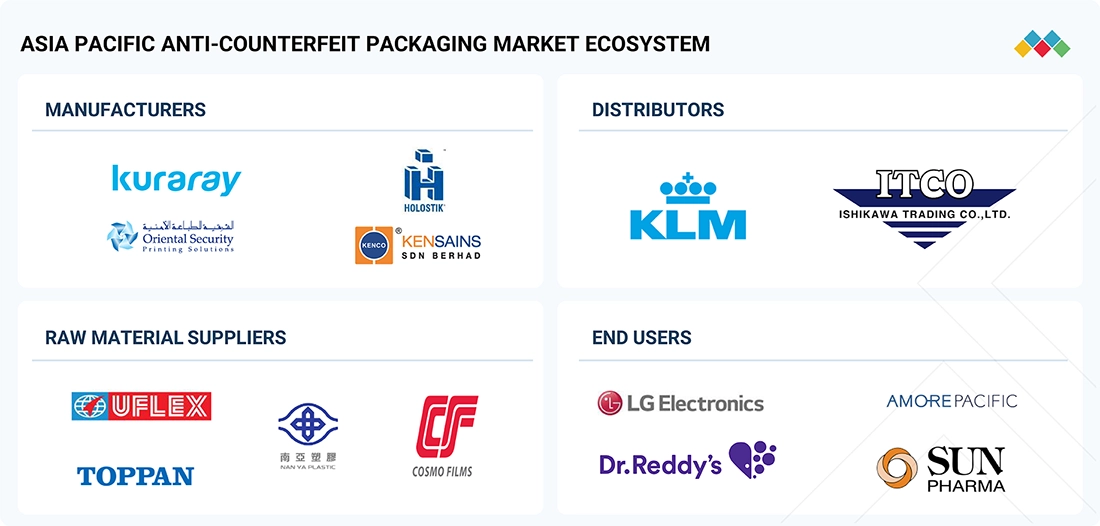
MARKET ECOSYSTEM
The Asia Pacific region's anti-counterfeiting packaging ecosystem features an interconnected network. Suppliers of raw materials produce the specialty films, security inks, and holographic substrates. The manufacturers convert those into secure labels, tamper-evident seals, and serialized packaging. Additionally, distributors provide solutions to various industries. As a result, end-users (pharmaceuticals, FMCG, electronics, cosmetics) utilize these solutions to protect their products, comply with regulations, and establish trust with their consumers.
Logos and trademarks shown above are the property of their respective owners. Their use here is for informational and illustrative purposes only.
MARKET SEGMENTS
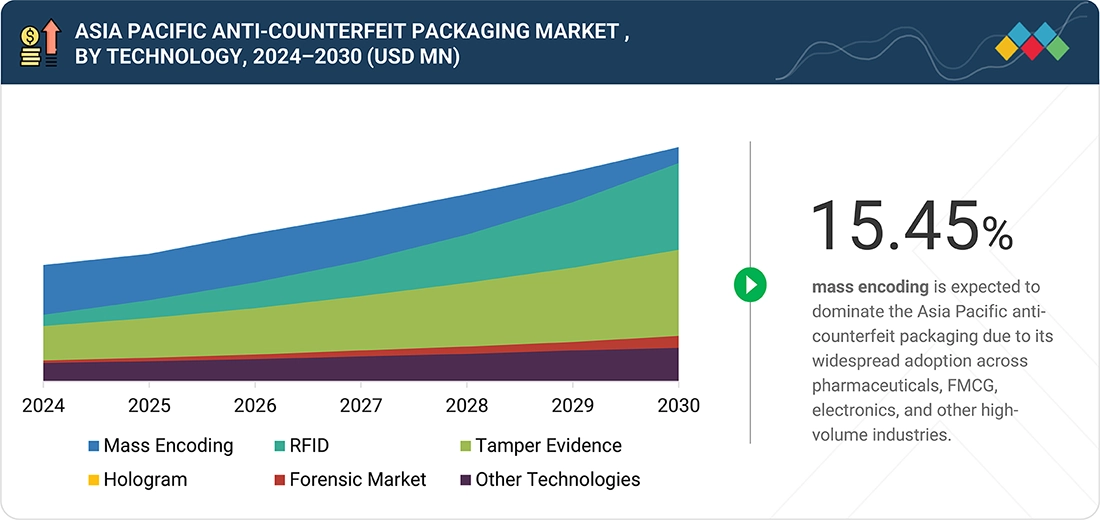
Source: Secondary Research, Interviews with Experts, MarketsandMarkets Analysis
Asia Pacific Anti-counterfeit Packaging Market, By Technology
The mass encoding segment accounts for the largest share of the Asia Pacific anti-counterfeit packaging market. The mass coding process, which uses serialized barcodes, QR codes and digital identifiers to identify each individual product unit and verify product authenticity, has proven to be one of the most effective solutions available for manufacturers of all sizes looking to authenticate their products on a large scale. Also, Mass encoding's compatibility with the regulations on serialized products, particularly in the pharmaceutical and excise goods markets, has been a key driver of Mass encoding's growing adoption by manufacturers across Asia Pacific. Furthermore, Mass encoding is inexpensive compared to other methods, can easily be integrated into existing packaging processes, and is a highly effective means of facilitating product verification via mobile or cloud-based technologies. For brands looking to improve transparency, traceability and deterrent effects against counterfeit products within their respective regions, Mass encoding is regarded as the "foundation" of an effective anti-counterfeit packaging strategy.
Asia Pacific Anti-counterfeit Packaging Market, By End-use Industry
The largest market segment for anti-counterfeiting packaging in Asia Pacific is pharmaceuticals due primarily to the growing drug manufacturing base as well as the high levels of Counterfeit Drugs available in the region. Countries, including but not limited to, India, China, & Southeast Asian nations have faced large-scale challenges concerning Counterfeit Drugs, leading to stricter regulatory enforcement of serialization, Tamper-Evident Packaging (TEP), & Digital Authentication Technologies (DAT). In addition, the vast majority of Pharmaceuticals produced in Asia Pacific are exported outside of Asia, therefore requiring compliance with Global Track & Trace Standards. Consequently, pharmaceutical companies will increase their spending on Advanced Security Solutions (ASS) in order to become compliant with Global Track & Trace Standards. Lastly, as the number of Online Pharmacy & Cross-Border Medicine Distribution businesses continues to grow, the need for Robust Verification Systems will increase. Hence, Patient Safety and Supply Chain Integrity continue to be the two Highest Priorities for Pharmaceutical Companies when it comes to Comprehensive Anti-Counterfeit Packaging Technologies.
REGION
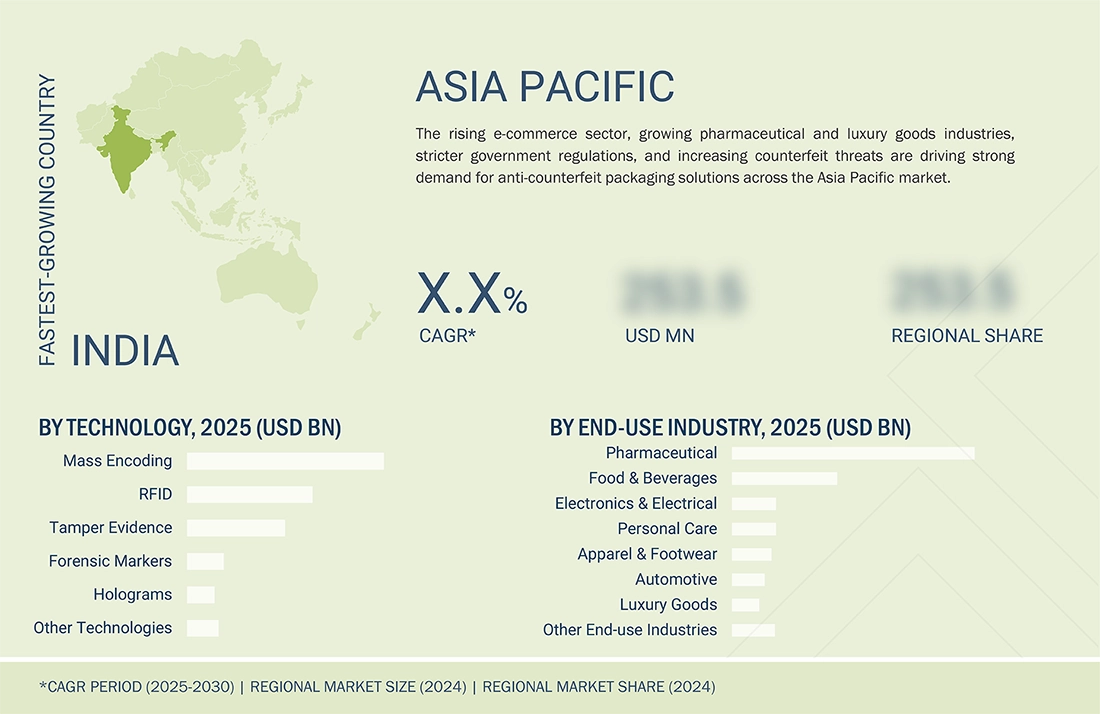
India to be fastest-growing region in Asia Pacific anti-counterfeit packaging market during forecast period
India has the fastest-growing market for anti-counterfeit packaging within the Asia Pacific region due to a growing manufacturing industry, increased consumer awareness, and a high level of exposure to counterfeiting threats as seen in pharmaceutical products, FMCG, Agrochemicals, automotive parts and electronic products. With India being a leading producer and exporter of pharmaceuticals, there has been faster adoption of serialized, QR coded authentication and tamper evident packaging solutions to meet domestic and global regulatory requirements. In addition, growth in the E-commerce and direct to consumer business models have increased the need for secure and traceable packages. Furthermore, government initiatives to support digital traceability and brand protection efforts, together with existing local anti-counterfeit packaging technology providers driving further technological advancement, all contribute to positioning India as an innovative growth market for anti-counterfeit packaging solutions within the Asia Pacific region.
ASIA PACIFIC ANTI-COUNTERFEIT PACKAGING MARKET: COMPANY EVALUATION MATRIX
In the Asia Pacific anti-counterfeit packaging market matrix, Holostik (Star) leads with a strong market share and extensive product footprint, driven by its advanced anticounterfeit solutions and wide regional presence. UFLEX (Emerging Leader) is gaining traction with its expertise in innovative packaging technologies and growing visibility across multiple end-use industries. While Holostik dominates through scale, diverse product offerings, and established client base, UFLEX demonstrates significant potential to move toward the leaders’ quadrant as demand for anticounterfeit packaging solutions in pharmaceuticals, FMCG, and excise goods continues to rise.
Source: Secondary Research, Interviews with Experts, MarketsandMarkets Analysis
KEY MARKET PLAYERS
- Holostik (India)
- UFlex (India)
- SML Group Ltd. (Hong Kong SAR, China)
- Holoflex (India)
- Toppan Inc. (Japan)
- DNP Imagingcomm Asia Sdn. Bhd. (Malaysia)
- Shenzhen ASY Anti-forgery Technology Development Co., Ltd. (China)
- SECUTAC (China)
- Holographic Label Sdn Bhd (Malaysia)
- Holosafe Security Labels Pvt. Ltd. (India)
MARKET SCOPE
| REPORT METRIC | DETAILS |
|---|---|
| Market Size in 2024 (Value) | USD 44.4 Billion |
| Market Forecast in 2030 (Value) | USD 105.4 Billion |
| Growth Rate | CAGR of 15.45% from 2025-2030 |
| Years Considered | 2021-2030 |
| Base Year | 2024 |
| Forecast Period | 2025-2030 |
| Units Considered | Value (USD Million/Billion), Volume (Billion units) |
| Report Coverage | Revenue forecast, company ranking, competitive landscape, growth factors, and trends |
| Segments Covered |
|
| Countries Covered | China, India, Japan, Australia, and Rest of Asia Pacific |
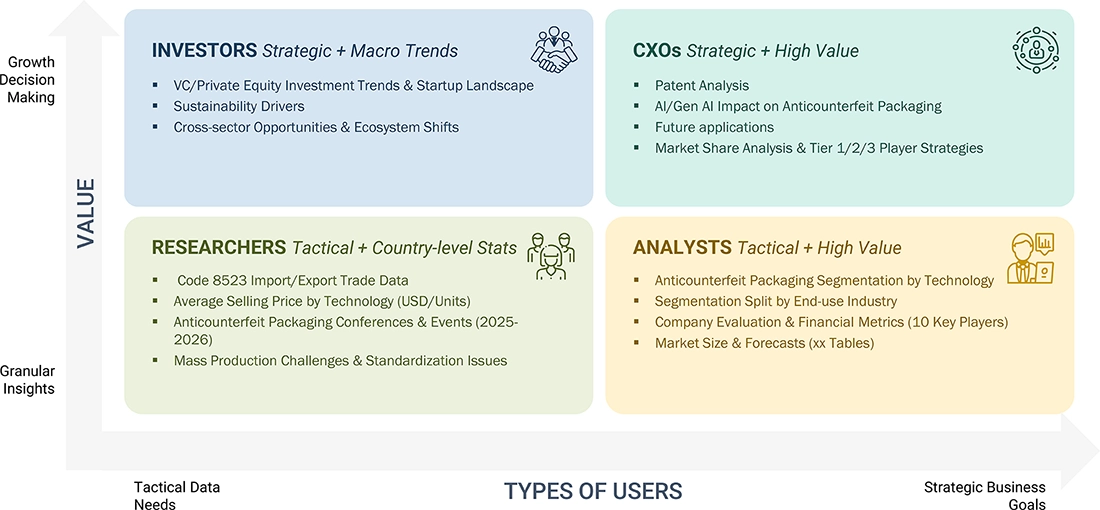
WHAT IS IN IT FOR YOU: ASIA PACIFIC ANTI-COUNTERFEIT PACKAGING MARKET REPORT CONTENT GUIDE
DELIVERED CUSTOMIZATIONS
We have successfully delivered the following deep-dive customizations:
| CLIENT REQUEST | CUSTOMIZATION DELIVERED | VALUE ADDS |
|---|---|---|
| Detailed study on North America Anti-counterfeit Packaging Market | Study conducted on US, Canada, and Mexico | Identified market opportunities in the region |
| Detailed study on Europe Anti-counterfeit Packaging Market | Study conducted on Germany, France, UK, Italy, Russia, Spain, Rest of Europe | Identified market opportunities in the region |
RECENT DEVELOPMENTS
- August 2025 : At the 12th Speciality Films & Flexible Packaging Global Business Summit & Exhibition Holostik exhibited its next-generation anti-counterfeit and eco-friendly packaging solutions. Key highlights included its award-winning paper-based hologram “PAPEROGRAM,” holographic paperboard, transparent holography (HRI / Allox), and UV-embossed films merging high security with sustainability
- March 2025 : At the 6th Traceability and Authentication Forum (TAF?2025) Holostik showcased its “phygital” anti-counterfeit solutions. The company underscored the need for an integrated approach combining advanced physical security (holograms, tamper-evident labels) with digital authentication (blockchain, track-and-trace) to safeguard supply chains and boost consumer trust across sectors
- May 2024 : UFlex Limited showcased new printing and packaging solutions at DRUPA 2024, including the ELISA-1308 CI Flexo Press, CAMCO Excel 1300 laminator, ReLAM recycling machine, and advanced holography-based anti-counterfeit solutions
Table of Contents
 Exclusive indicates content/data unique to MarketsandMarkets and not available with any competitors.
Methodology
The study involved four major activities for estimating the current size of the asia pacific asia pacific anti-counterfeit packaging market. Exhaustive secondary research was conducted to gather information on the market, the peer market, and the parent market. The next step was to validate these findings, assumptions, and sizes with the industry experts across the value chain of asia pacific anti-counterfeit packaging through primary research. Both the top-down and bottom-up approaches were employed to estimate the overall size of the asia pacific anti-counterfeit packaging market. After that, market breakdown and data triangulation procedures were used to determine the size of different segments and sub-segments of the market.
Secondary Research
In the secondary research process, various secondary sources such as Hoovers, Factiva, Bloomberg BusinessWeek, and Dun & Bradstreet were referred to, to identify and collect information for this study on the asia pacific anti-counterfeit packaging market. These secondary sources included annual reports, press releases & investor presentations of companies, white papers, certified publications, articles by recognized authors, regulatory bodies, trade directories, and databases.
Primary Research
Various primary sources from both the supply and demand sides of the asia pacific anti-counterfeit packaging market were interviewed to obtain qualitative and quantitative information. The primary sources from the supply-side included industry experts, such as Chief Executive Officers (CEOs), vice presidents, marketing directors, sales professionals, and related key executives from various leading companies and organizations operating in the asia pacific anti-counterfeit packaging industry.
To know about the assumptions considered for the study, download the pdf brochure
Market Size Estimation
Both the top-down and bottom-up approaches were used to estimate and validate the size of the asia pacific anti-counterfeit packaging market. These approaches were also used extensively to estimate the size of various dependent segments of the market. The research methodology used to estimate the market size included the following details:
- The key players were identified through extensive secondary research.
- The industry’s supply chain and market size, in terms of value, were determined through primary and secondary research processes.
- All percentage shares, split, and breakdowns were determined using secondary sources and verified through primary sources.
- All possible parameters that affect the markets covered in this research study were accounted for, viewed in extensive detail, verified through primary research, and analyzed to obtain the final quantitative and qualitative data.
- The research includes the study of reports, reviews, and newsletters of key industry players, along with extensive interviews with key officials, such as directors and marketing executives.
Data Triangulation
After arriving at the overall market size from the estimation process explained above, the total market was split into several segments and sub-segments. The data triangulation and market breakdown procedures were employed, wherever applicable, to complete the overall market engineering process and arrive at the exact statistics for all segments and sub-segments of the asia pacific anti-counterfeit packaging market. The data was triangulated by studying various factors and trends from both the demand- and supply-side.
In addition, the market size was validated by using both the top-down and bottom-up approaches. Then, it was verified through primary interviews. Hence, for every data segment, there are three sources—top-down approach, bottom-up approach, and expert interviews. The data were assumed to be correct when the values arrived at from the three sources matched.
Market Definition
Anti-counterfeiting involves various methods and techniques to protect products from being illegally duplicated, distributed, or sold. Asia pacific anti-counterfeit packaging encompasses any packaging that integrates features or technologies designed to prevent unauthorized parties from copying, tampering with, or diverting the product. These features can be visible, hidden, or forensic, based on the required level of security and verification. The technologies used in asia pacific anti-counterfeit packaging are mass encoding, RFID, holograms, forensic markers, and others. These technologies can be utilized in various types of packaging, such as bottles, cartons, and bags. They can either be integrated into the packaging materials themselves or added as separate components. The asia pacific anti-counterfeit packaging solution is widely used in the end-use industries such as pharmaceutical, personal care, and food & beverage.
Key Stakeholders
- Raw material suppliers
- Packaging manufacturers & suppliers
- Logistics & shipment companies
- Technology companies
- Traders & distributors of anti-counterfeit and authentication packaging
- Commercial R&D institutions
- Industry associations and regulatory bodies
- Retailers
- End users
Research Objectives
- To estimate and forecast the asia pacific anti-counterfeit packaging market, in terms of value and volume
- To provide detailed information about the major factors (drivers, restraints, opportunities, and challenges) influencing the market growth
- To define, describe, and forecast the market size, based on technology, end-use industry and region
- To forecast the market size along with segments and submarkets, in key regions: North America, Europe, Asia Pacific (APAC), Middle East & Africa (MEA), and South America along with their key countries
- To strategically analyze micro markets, with respect to individual growth trends, prospects, and their contribution to the total market
- To analyze growth opportunities in the market for stakeholders and provide details on the competitive landscape for market leaders
- To strategically profile key players and comprehensively analyze their market shares and core competencies
- To analyze competitive developments, such as acquisition, expansion, and new product development in the asia pacific anti-counterfeit packaging market
Available Customizations
With the given market data, MarketsandMarkets offers customizations according to client-specific needs.
The following customization options are available for the asia pacific anti-counterfeit packaging report:
Product Analysis
- Product matrix, which offers a detailed comparison of the product portfolio of companies
Regional Analysis
- Further analysis of the asia pacific anti-counterfeit packaging market for additional countries
Company Information
- Detailed analysis and profiling of additional market players (up to five)


Personalize This Research
- Triangulate with your Own Data
- Get Data as per your Format and Definition
- Gain a Deeper Dive on a Specific Application, Geography, Customer or Competitor
- Any level of Personalization
Let Us Help You
- What are the Known and Unknown Adjacencies Impacting the Asia Pacific Anti-Counterfeit Packaging Market
- What will your New Revenue Sources be?
- Who will be your Top Customer; what will make them switch?
- Defend your Market Share or Win Competitors
- Get a Scorecard for Target Partners

Custom Market Research Services
We Will Customise The Research For You, In Case The Report Listed Above Does Not Meet With Your Requirements
Get 10% Free CustomisationTESTIMONIALS
We at Nissan Chemicals Corporation have been clients of MarketsandMarkets for more than a year now. We recently consulted MarketsandMarkets for a study, the team at MarketsandMarkets was extremely professional and organized. The business insights were very detailed and aligned well with our expectations that really helped us formulate the Business Plans and device new strategies for development themes. MarketsandMarkets offers a unique combination of expertise and dedicated engagement model. Their research findings have helped us in designing our Pricing Strategy which will make it easier for us to predict the future sales and profits for the next ten years. We look forward to working with MarketsandMarkets in the future.
VP of Strategy & New Business Development
Leading Specialty Chemical Company
The MarketsandMarkets Engagement Model, composed of both the Knowledge Store and advisory custom research, has greatly helped us in understanding our markets and making strategic decisions. The Knowledge Store is a fast way to allow everyone in our organization to understand more about most any market they are interested in. The ability to then get custom research done and get answers to specific strategic questions and market insight has been spectacular. The Markets and Markets team feel more like colleagues than vendors and their services have helped us change our culture where statements of things like growth opportunities and competitive position are always backed by industry research.

Rich Gibson,
Director, Corporate Strategy
Milliken & Company,
Leading Industrial Manufacturer of specialty chemical, floor covering, performance and protective textile materials, and healthcaremilliken.com
MarketsandMarkets is a trusted resource that helps us to better understand markets that are near-adjacencies-whether its technology, value chain or geography. Their Knowledge Store platform provides a dashboard of markets and their characteristics which is easy to use and saves us time.
Adam Shaw,
Market Development and Strategy Manager
AdvanSix Inc. USA,
An American Leader in Chemicalswww.advansix.com
The Knowledge Store from MarketsandMarkets is a valuable tool which has helped my team acquire greater insight in to the end markets that our business serves. This has enabled us to help our company build stronger strategies throughout our planning process.
TOSHIO KINOSHITA
Senior Chif Consultion Research & Consulting Division
Mitsubishi Chemical Research Corporation,
Leading Manufacturer of Chemical Productswww.mitsubishichem-res.co.jp/en/

We recently engaged with MarketsandMarkets for a study, the team not only clearly understood our business objectives but was also extremely professional in the way they handled the entire project. The study was efficiently conducted in a phase-wise manner, and the engagement model furnished us with high-quality business insights that far exceeded our expectations at each phase. We were especially happy that MarketsandMarkets could provide us with both, an English as well as a Japanese version of the study. A special thanks to the Analyst Team and Client Services Team, whose fluency in Japanese enhanced our comfort level, as we could converse with them in our preferred language.
Independent entrepreneurs
Arrow Precision
We approached MarketsandMarkets for study on Proppants Market, and their work exceeded our expectations. The study conducted was comprehensive and enabled us to view the market through the various dimensions. In addition, the team was extraordinarily responsive throughout the process and resolved our queries on time. I strongly recommend MarketsandMarkets and will certainly consider them for additional market assessments we will need in the future.
Global engineering company, Japan
Deputy Manager,
Strategic Planning OfficeThe high-quality insights shared by the MarketsandMarkets team helped us understand the pharmaceutical plant designers in a specific geography. It also captured the risks that we may likely face in communicating with our potential partners. The study would enable us identify partners, which would impact our future growth.






Growth opportunities and latent adjacency in Asia Pacific Anti-Counterfeit Packaging Market