Asia Pacific Conveyor System Market

Asia Pacific Conveyor System Market by Industry (Retail & Distribution, Food & Beverage, Automotive, Electronic, Mining, Airport), Type (Belt, Roller, Overhead, Floor, Cable, Bucket) Component, Operation, and Region - Forecast to 2032




OVERVIEW
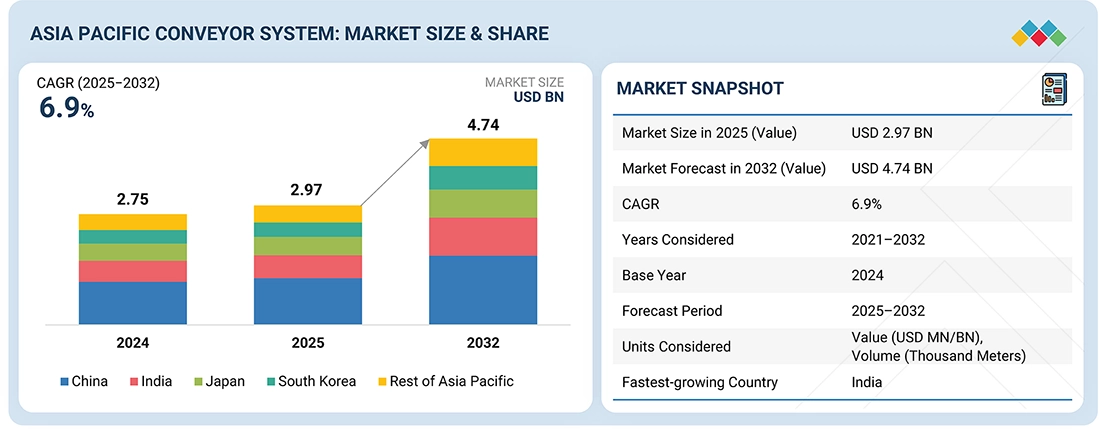
Source: Secondary Research, Interviews with Experts, MarketsandMarkets Analysis
The conveyor system market in the Asia Pacific is projected to grow from USD 2.97 billion in 2025 to USD 4.74 billion by 2032 at a CAGR of 6.9%. Asia Pacific 3PLs are expanding rapidly in India and Southeast Asia, leading to multi-site warehouse rollouts that rely on standardized conveyor modules and ongoing service contracts. This trend is creating steady repeat business for vendors and increasing the need for modular, easy-to-maintain conveyor platforms over custom-built systems. Demand is shifting strongly toward intralogistics conveyors for parcel handling, sortation, pallet movement, and belt–roller hybrid lines, driven by large e-commerce and 3PL companies building similar warehouse layouts across multiple locations. At the same time, ASEAN and Tier 2 Indian markets continue to be highly price-sensitive, maintaining demand for low-automation, basic conveyors and creating strong aftermarket opportunities in spare parts, maintenance items, and retrofit kits.
KEY TAKEAWAYS
-
By CountryThe conveyor system market in China accounted for a 39.2% market share in 2025.
-
By TypeThe floor type conveyor system is projected to register the highest CAGR of 12.3% during the forecast period.
-
By ComponentThe driving unit segment is projected to grow at the fastest rate from 2025 to 2032.
-
By OperationThe semi-automatic conveyor system segment is expected to dominate the market during the forecast period.
-
For Automotive Industry, By TypeFor the automotive industry, the floor type segment is expected to grow at the fastest rate from 2025 to 2032.
-
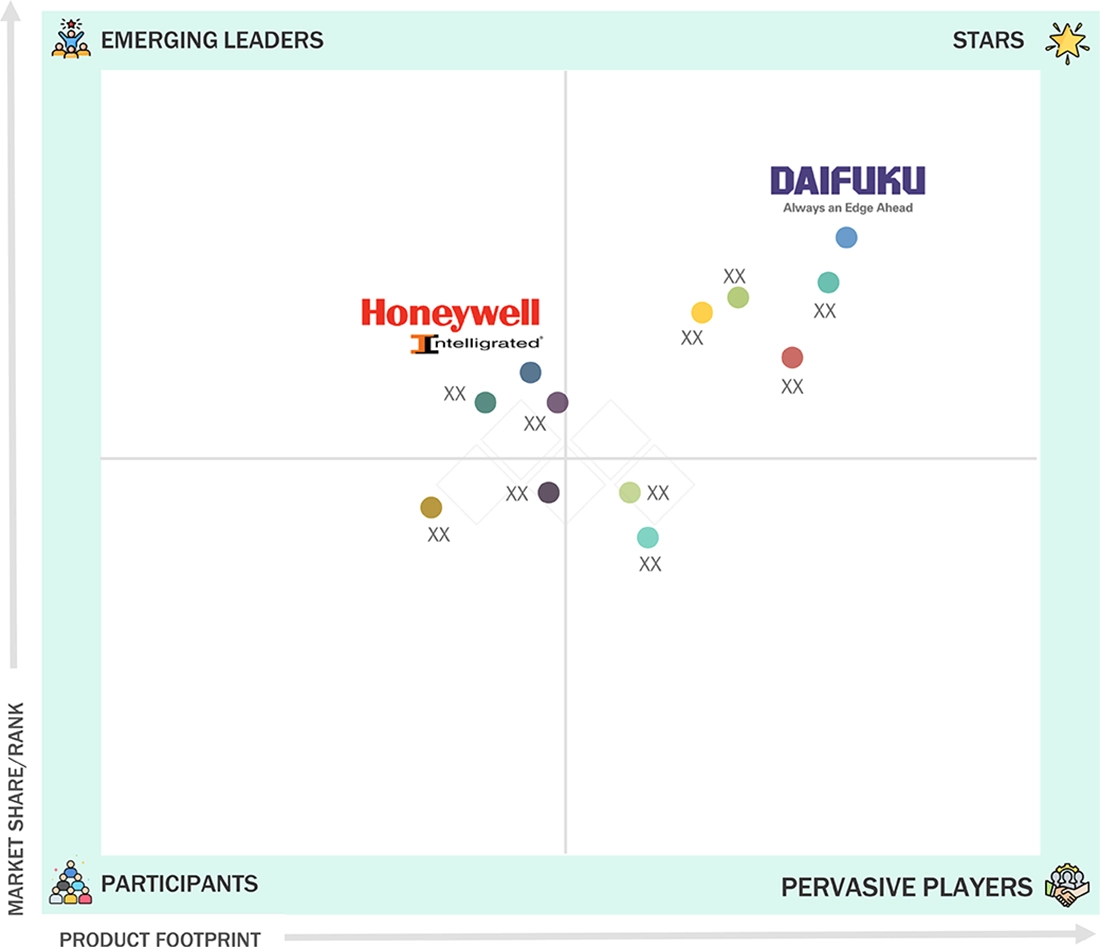
Competitive Landscape - Key PlayersDaifuku Co., Ltd. (Japan), Murata Machinery, Ltd. (Japan), and SSI Schaefer AG (Germany) were identified as some of the star players in the conveyor system market in the Asia Pacific, given their strong market share and product footprint.
-
Competitive Landscape - StartupsDEMATIC (US), Emerson Electric Co. (US), and Siemens AG (Germany), among others, have distinguished themselves among startups and SMEs by securing strong footholds in specialized niche areas, underscoring their potential as emerging market leaders.
The mining industry in India is accelerating the adoption of heavy-duty, high-lift conveyors and bucket-type systems to support deeper pits, higher tonnage movement, and increasingly remote project sites where reliability and dust-controlled transport are critical. Automotive OEMs across China, India, Japan, and Thailand are redesigning factories for mixed-model production, driving demand for modular roller conveyors, skillet lines, and AGV conveyor interfaces that support frequent platform updates. The food & beverage industry is investing in sanitary, corrosion-resistant conveyors with washdown-compatible drives as manufacturers scale ready to eat, cold-chain, and beverage bottling operations.
TRENDS & DISRUPTIONS IMPACTING CUSTOMERS' CUSTOMERS
Trends and disruptions in the conveyor system market in the Asia Pacific reveal the current and future trends. The conveyor system market in the Asia Pacific is witnessing a rapid shift toward modular, plug-and-play conveyor architectures that shorten installation cycles for e-commerce and 3PL rollouts. The adoption of smart drives, IoT sensors, and predictive maintenance layers is accelerating as operators integrate conveyors into broader warehouse execution systems. Additionally, localized manufacturing of motors, rollers, and controls in India and ASEAN is reshaping cost structures and reducing reliance on imported components.
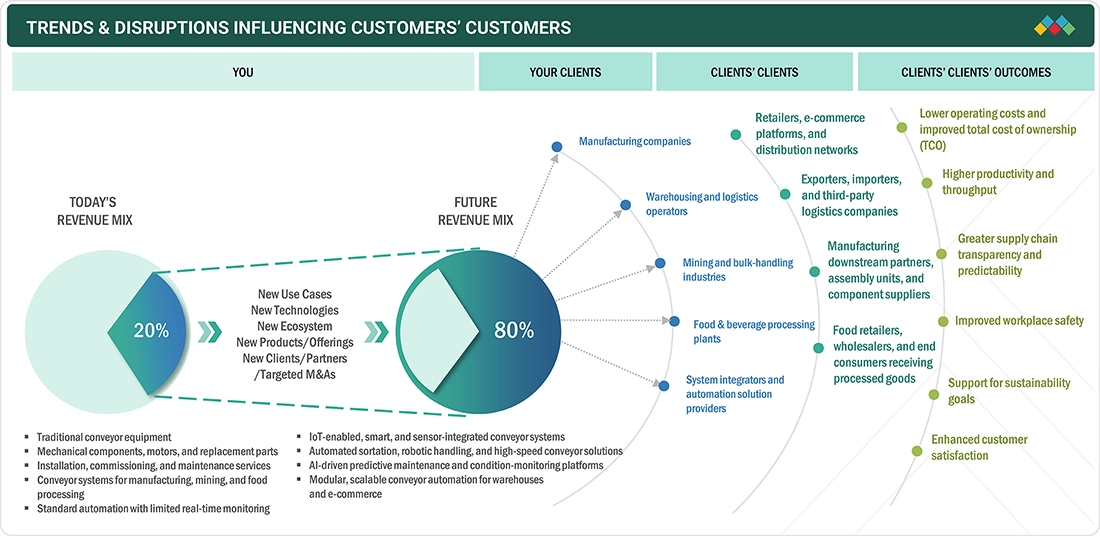
Source: Secondary Research, Interviews with Experts, MarketsandMarkets Analysis
MARKET DYNAMICS

Level
-
Industrial policy–led acceleration of supply chain modernization

-
E-commerce industry expansion driving high-throughput material flow systems


Level
-
Limited automation feasibility in highly specialized production and warehousing environments

-
Price sensitivity and fragmented automation maturity across ASEAN SME ecosystems


Level
-
Monetization of energy-efficient drives and predictive maintenance as lifecycle revenue streams

-
Strategic localization of Tier 2 manufacturing and channel networks in India and Southeast Asia


Level
-
Navigating fragmented regulatory, safety, and compliance frameworks

-
After-sales service delivery across remote and diverse geographies in Asia Pacific

Source: Secondary Research, Interviews with Experts, MarketsandMarkets Analysis
Driver: E-commerce industry expansion driving high-throughput material flow systems
E-commerce growth in the Asia Pacific is requiring distribution centers to manage a wide range of SKUs and sharp fluctuations in order volumes, leading them to invest in high-throughput conveyor and sortation systems that can scale without adding equivalent labor. Large marketplace operators and 3PLs are adopting modular, high-speed parcel conveyor designs across multiple sites, making throughput efficiency a key factor in their investment decisions.
Restraint: Limited automation feasibility in highly specialized production and warehousing environments
In the Asia Pacific, many specialized production and warehousing operations, such as low-volume contract manufacturing, custom assembly lines, and facilities handling irregular-sized goods, cannot justify fixed conveyor automation because their layouts often change and processes are not repeatable. These sites depend on flexible manual workflows, making conveyor systems uneconomical and keeping adoption low even as automation increases in the wider region.
Opportunity: Strategic localization of Tier 2 manufacturing and channel networks in India and Southeast Asia
Localizing Tier 2 manufacturing and distributor networks in India and Southeast Asia allows conveyor vendors to shorten import lead times, reduce system costs, and compete more effectively for mid-market intralogistics projects. Producing frames, rollers, and controls locally supported by regional service partners gives vendors a scalable way to win SME and 3PL contracts that global integrators often do not target.
Challenge: After-sales service delivery across remote and diverse geographies in Asia Pacific
After-sales service is challenging in the region because warehouses and production sites are spread across large, remote, and sometimes infrastructure-limited regions. Ensuring high system uptime requires widespread technician coverage, locally available spare parts, and faster service response models, capabilities that many conveyor vendors find difficult to scale consistently across India and ASEAN countries.
ASIA PACIFIC CONVEYOR SYSTEM MARKET: COMMERCIAL USE CASES ACROSS INDUSTRIES
| COMPANY | USE CASE DESCRIPTION | BENEFITS |
|---|---|---|
 |
Deploys automated conveyor solutions for airports and e-commerce fulfilment centers across Japan, China, and Southeast Asia, including baggage handling and high-throughput parcel sorting | Increases handling speed, improves operational accuracy, reduces labour dependency, and enhances peak-load management |
 |
Implements conveyor-integrated AS/RS and sortation systems for manufacturing and electronics assembly plants in Asia Pacific | Enables just-in-time production, optimizes material flow, and reduces WIP inventory |
 |
Provides modular conveyor systems for FMCG, retail, and food distribution hubs in China, India, and Australia | Improves order accuracy, accelerates picking operations, and scales with multi-format retail demand |
 |
Supplies motorized roller conveyors for parcel hubs, third-party logistics (3PLs), and pharmaceutical distribution facilities across Asia Pacific | Quiet, energy-efficient operations; lower maintenance; flexible expansion for high-volume sortation |
 |
Installs long-distance belt conveyors for cement, mining, and aggregates operations in India and Indonesia | Reduces material transport cost, enhances system reliability in harsh conditions, and minimizes environmental impact |
Logos and trademarks shown above are the property of their respective owners. Their use here is for informational and illustrative purposes only.
MARKET ECOSYSTEM
The conveyor system market ecosystem in the Asia Pacific includes belt manufacturers, system manufacturers, part manufacturers/component suppliers, and end users. Some of the major players in the conveyor system market in this region include Daifuku Co., Ltd. (Japan), Murata Machinery, Ltd. (Japan), SSI Schaefer AG (Germany), KUKA AG (Germany), and BEUMER Group (Germany).
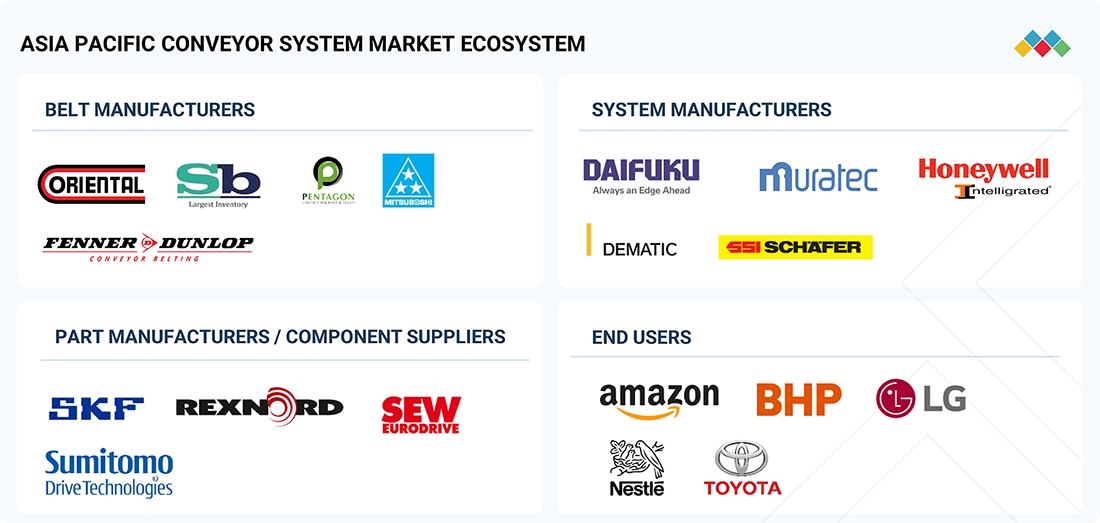
Logos and trademarks shown above are the property of their respective owners. Their use here is for informational and illustrative purposes only.
MARKET SEGMENTS
Source: Secondary Research, Interviews with Experts, MarketsandMarkets Analysis
Asia Pacific Conveyor System Market, By Type
Belt-type conveyors dominate the market in the Asia Pacific as they handle highly variable package sizes and mixed-load profiles common in e-commerce, FMCG, and industrial manufacturing. Their ability to support long-distance, continuous transport with lower noise, fewer transfers, and reduced maintenance makes them the preferred choice for large, high-throughput distribution centers being built across China, India, and Southeast Asia.
Asia Pacific Conveyor System Market, By Component
The driving unit leads the Asia Pacific conveyor component market as operators prioritize energy efficient motors, gearboxes, and variable-frequency drives to curb power consumption in high-throughput sites. Rising automation intensity also shifts procurement toward high-reliability drive units that support tighter speed control, longer duty cycles, and reduced downtime across expanding warehouse and manufacturing footprints.
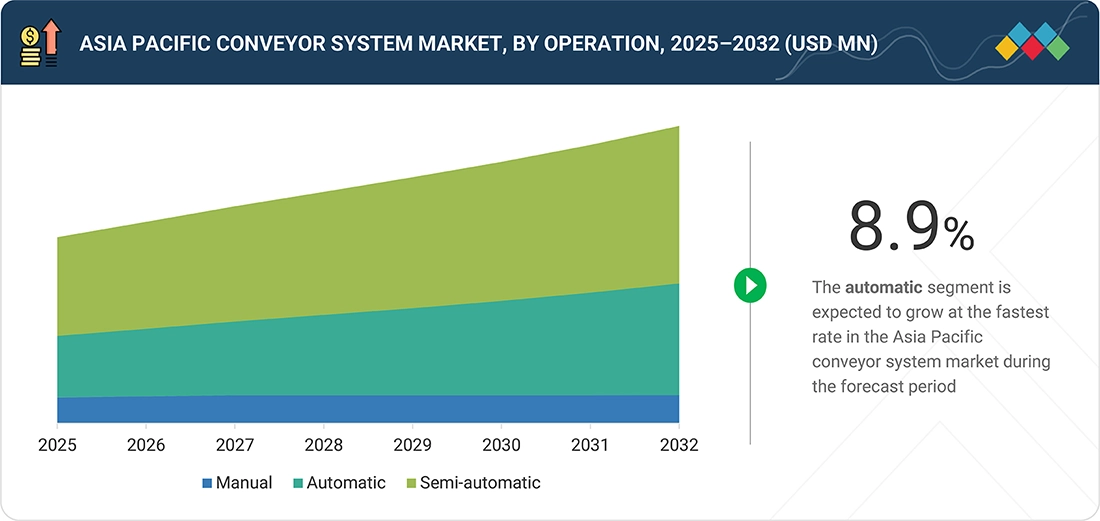
Asia Pacific Conveyor System Market, By Operation
Semi-automatic conveyor systems lead in the Asia Pacific as many warehouses and factories operate in cost-sensitive, labor-augmented environments that do not justify fully automated systems. These solutions offer the optimal balance of throughput, flexibility, and capital expenditure suitability for India, ASEAN, and Tier 2 Chinese facilities, where workflows frequently require human intervention alongside mechanized transport.
Asia Pacific Conveyor System Market For Airport Industry, By Type
Belt-type conveyor systems dominate the airport industry in the Asia Pacific as they deliver smooth, continuous handling of diverse baggage sizes while minimizing jams in high-volume terminals. Their suitability for long, curved, and multi-level layouts aligns with major airport expansion projects across the region, where reliability and fault-free flow are critical to passenger throughput targets.
Asia Pacific Conveyor System Market For Mining Industry, By Type
Bucket-type conveyor systems are expected to exhibit the fastest growth in the mining industry in the region, as operators expand high-lift and high-abrasion material transport in metal ore, coal, and aggregate operations, where conventional belts face durability limitations. Their ability to move bulk materials vertically and in enclosed paths supports new deep-pit, underground, and processing-plant configurations emerging in Indonesia and India.
Asia Pacific Conveyor System Market For Automotive Industry, By Type
Roller-type conveyor systems lead the automotive industry in the Asia Pacific as assembly plants require precise, stop-start movement of pallets, powertrains, and body-in-white units within configurable line layouts. Their modularity supports frequent model changeovers and mixed-production strategies adopted by OEMs in China, India, Thailand, and Japan, enabling efficient synchronization with robotic and semi-automated workstations.
REGION
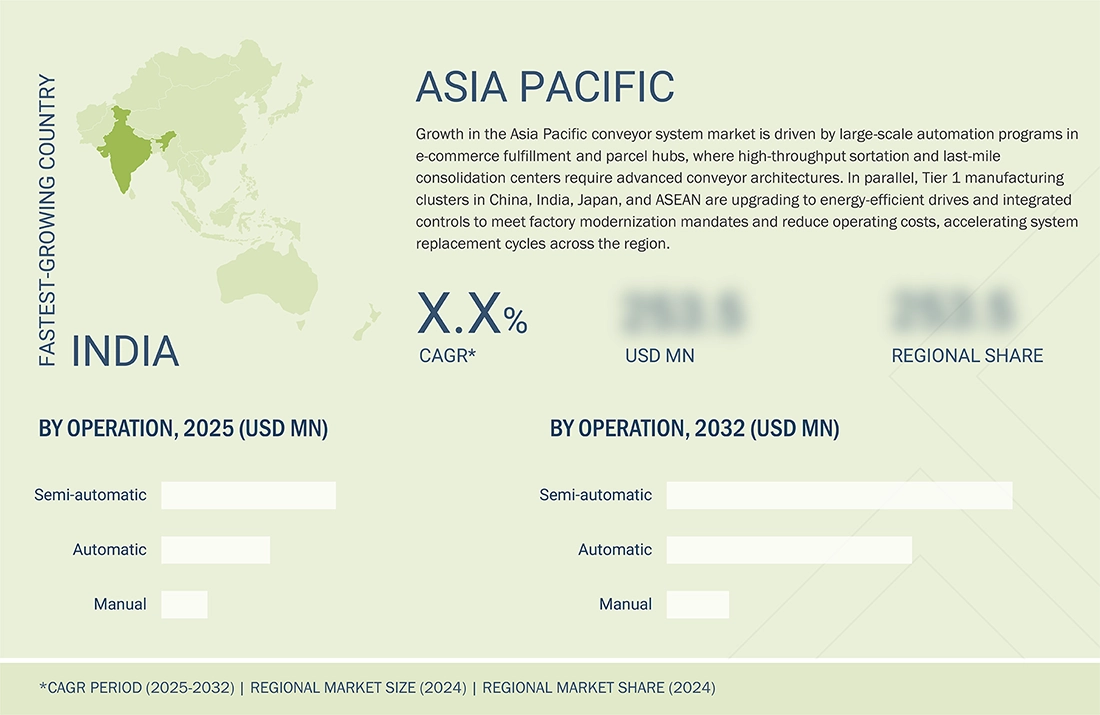
India to grow at fastest rate in Asia Pacific conveyor system market during forecast period
India is expected to grow at the fastest rate in the conveyor system market in the Asia Pacific as large e-commerce operators and retail chains accelerate greenfield warehouse construction with standardized conveyor and sortation layouts. Government-led manufacturing programs and industrial corridor development are expanding demand for mechanized material flow in electronics, automotive, and FMCG plants. A rapid shift toward organized warehousing, coupled with chronic labor variability, is pushing companies to semi-automated conveyor deployments. Additionally, localization of conveyor components, such as motors, rollers, and frames, improves affordability and shortens lead times, strengthening overall market adoption.
ASIA PACIFIC CONVEYOR SYSTEM MARKET: COMPANY EVALUATION MATRIX
In the Asia Pacific conveyor system market matrix, Daifuku Co., Ltd. (Star) leads with a strong presence and expertise in large-scale automated material-handling projects, driving market expansion and revenue growth through standardized intralogistics platforms, robust service networks, and high execution reliability. Honeywell Intelligrated (Emerging Leader) is gaining traction with advanced automation software, modular conveyor technologies, and strong integration capabilities for high-throughput e-commerce and 3PL environments. The company shows significant growth potential to progress toward the leaders’ quadrant as it expands its regional footprint and strengthens local solution delivery.
Source: Secondary Research, Interviews with Experts, MarketsandMarkets Analysis
KEY MARKET PLAYERS
- Daifuku Co., Ltd. (Japan)
- Murata Machinery, Ltd. (Japan)
- SSI Schaefer AG (Germany)
- KUKA AG (Germany)
- BEUMER Group (Germany)
- Honeywell Intelligrated Inc. (US)
- KNAPP AG (Germany)
- Bastian Solutions Inc. (US)
- FlexLink Systems, Inc. (Sweden)
- Interroll Holding AG (Germany)
- Kardex Group (Switzerland)
- Godrej Consoveyo Logistics Automation Ltd. (India)
MARKET SCOPE
| REPORT METRIC | DETAILS |
|---|---|
| Market Size Value in 2025 | USD 2.97 Billion |
| Revenue Forecast in 2032 | USD 4.74 Billion |
| Growth Rate | CAGR of 6.9% from 2025 to 2032 |
| Actual Data | 2021-2032 |
| Base Year | 2024 |
| Forecast Period | 2025-2032 |
| Units Considered | Volume (Thousand Meters) and Value (USD Million) |
| Report Coverage | Revenue forecast, company ranking, competitive landscape, growth factors, and trends |
| Segments Covered |
|
| Country-level Scope | China, India, Japan, South Korea, and Rest of Asia Pacific |
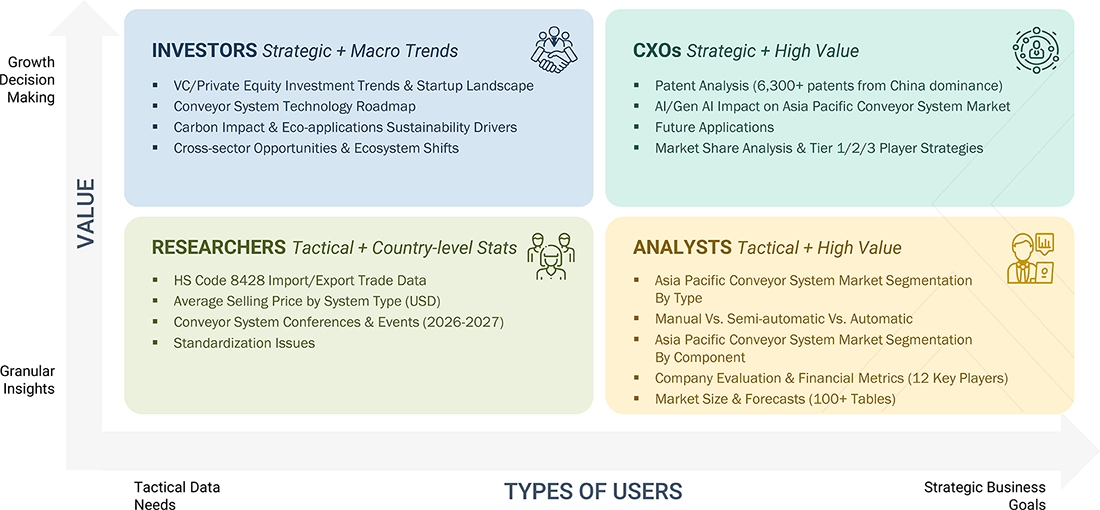
WHAT IS IN IT FOR YOU: ASIA PACIFIC CONVEYOR SYSTEM MARKET REPORT CONTENT GUIDE
DELIVERED CUSTOMIZATIONS
We have successfully delivered the following deep-dive customizations:
| CLIENT REQUEST | CUSTOMIZATION DELIVERED | VALUE ADDS |
|---|---|---|
| Global Conveyor OEM (Japan) |
|
|
| E-commerce Fulfillment Operator (India) |
|
|
| Food & Beverage Producer (South Korea) |
|
|
| Warehouse Automation Startup (China) |
|
|
| Investment Firm (Singapore) |
|
|
RECENT DEVELOPMENTS
- November 2025 : Somi Conveyor Beltings Limited secured an order valued at USD 0.37 million from the Steel Authority of India Limited (SAIL) to supply various grades of conveyor belts. The order covers 14,800 meters of HR-120 and M24 grade belts, with delivery scheduled by February 3, 2026.
- September 2025 : Fiji Airports awarded Alstef Group a contract to upgrade the baggage-handling system at Nadi International Airport, including new conveyor belt installations to improve throughput and reliability.
- August 2025 : Doppelmayr Group was awarded a contract to build a RopeCon system for the Aditya Alumina Refinery project in Kansariguda, Odisha, India. This will be the first RopeCon installation in India, and operations are expected to begin in Q3 2027 to transport bauxite. The aerial conveying system will span about 2,300 meters with a vertical drop of 241 meters, carrying 1,500 t/h of bauxite, and it will also have the capability to move tailings in the opposite direction.
- April 2025 : NTPC’s Pakri Barwadih coal mining project commissioned a 21-kilometer conveyor belt system to transport coal to the Hazaribag railway station, India. The system utilizes high-capacity steel cord belts, ranging from 1,800 mm to 2,200 mm in width, which are designed for their high tensile strength and reliability. With a carrying capacity of 2,750–4,000 tons per hour, the conveyor system supports high operational efficiency and consistent throughput.
Table of Contents
 Exclusive indicates content/data unique to MarketsandMarkets and not available with any competitors.
Methodology
The research study involved extensive secondary sources, such as company annual reports/presentations, industry association publications, magazine articles, directories, technical handbooks, World Economic Outlook, trade websites, technical articles, and databases, to identify and collect information on the Asia Pacific Conveyor System market. Primary sources, such as experts from related industries, automobile OEMs, and suppliers, were interviewed to obtain and verify critical information and assess the growth prospects and market estimations.
Secondary Research
Secondary sources for this research study include corporate filings, such as annual reports, investor presentations, and financial statements; trade, business, and professional associations; whitepapers, marklines, and the OICA (International Organization of Motor Vehicle Manufacturers); certified publications; articles by recognized authors; directories; and databases. Secondary data was collected and analyzed to determine the overall market size, further validated by primary research.
Primary Research
Extensive primary research was conducted after understanding the Asia Pacific Conveyor System market scenario through secondary research. Several primary interviews were conducted with market experts from the demand side (vehicle manufacturers, country-level government associations, and trade associations) and the supply side (Conveyor System and buses manufacturers, component providers, and system integrators). Primary data was collected through questionnaires, emails, and telephonic interviews. In the canvassing of primaries, various departments within organizations, such as sales, operations, and marketing, were covered to provide a holistic viewpoint in this report.
After interacting with industry experts, brief sessions were conducted with highly experienced independent consultants to reinforce the findings from the primaries. This, along with the in-house subject matter experts’ opinions, led to the findings described in this report.
Market Size Estimation
A detailed market estimation approach was followed to estimate and validate the volume and value of the Asia Pacific Conveyor System market and other submarkets, as mentioned below.
- Secondary research was done to identify key players in the Asia Pacific Conveyor System market. Their market share was determined through primary and secondary research.
- The research methodology included studying the annual and quarterly financial reports & regulatory filings of major market players and interviews with industry experts for detailed market insights.
- All major penetration rates, percentage shares, splits, and breakdowns for the Asia Pacific Conveyor System market across end users were determined using secondary sources and verified through primary sources.
- All key macro indicators affecting the revenue growth of the market segments and subsegments were accounted for, viewed in extensive detail, verified through primary research, and analyzed to get the validated and verified quantitative & qualitative data.
- The gathered market data was consolidated and added with detailed inputs, analyzed, and presented in this report.
Data Triangulation
After arriving at the overall market size through bottom-up approach, the Asia Pacific Conveyor System market was split into several segments and subsegments. Where applicable, the data triangulation procedure was employed to complete the overall market engineering process and arrive at the exact market value for key segments and subsegments. The extrapolated market data was triangulated by studying various macro indicators and regional trends from both the demand- and supply-side participants.
Market Definition
Conveyor System market: Britannica defines a conveyor as any device that provides mechanized movement of material, such as in a factory; it is used principally in industrial applications and on large farms, as well as in warehousing and freight handling for moving raw materials. Conveyors may be only a few inches in length, or they may be integrated systems several miles long.
Key Stakeholders
- Automation System Manufacturers
- Automotive Ancillary Players
- Automotive OEMs
- Conveyor Original Equipment Manufacturers (OEMs)
- Conveyor System Component Manufacturers
- Conveyor System Cybersecurity Providers
- Electronics Companies
- Food & Beverage Companies
- Industrial Machinery Insurance Providers
- Legal and Regulatory Authorities
- Mining Companies
- Raw Material Suppliers
- Sensor Manufacturers
- Software Providers
- Traders, Distributors, and Suppliers
Report Objectives
- To define, segment, analyze, and forecast the Asia Pacific Conveyor System market, in terms of volume (thousand meters) and value (USD million) between 2024 and 2030 based on:
- To segment and forecast the market size, by type (roller, pallet, overhead, tri-planar, bucket, floor, cable, crescent, and other types)
- To segment and forecast the market size, by operation (manual, automatic, and semi-automatic)
- To segment and forecast the market size, by component (aluminum profile, driving unit, extremity unit, and other components)
- To segment and forecast the market size for the airport industry, by type (belt, tri-planar, crescent, and other types)
- To segment and forecast the market size for the retail & distribution industry, by type (belt, roller, pallet, and other types)
- To segment and forecast the market size for the automotive industry, by type (overhead, floor, roller, and other types)
- To segment and forecast the market size for the mining industry, by type (belt, cable, bucket, and other types)
- To segment and forecast the market size for the electronics industry, by type (belt, roller, and other types)
- To segment and forecast the market size for the food & beverage industry, by sub-industry (meat & poultry, dairy, and other types)
- To segment and forecast the mining Asia Pacific Conveyor System market size, by application (open-pit mining and underground mining)
- To segment and forecast the mining Asia Pacific Conveyor System market size, by technology (drive, gearless, and automated)
- To provide detailed information about the factors influencing the market growth (drivers, challenges, restraints, and opportunities)
- To strategically analyze the market, considering individual growth trends, prospects, and contributions to the total market
-
To study the following factors with respect to the market:
- Supply Chain Analysis
- Ecosystem Analysis
- Technology Analysis
- Pricing Analysis
- Trade Data
- Case Study Analysis
- Patent Analysis
- Impact of Generative AI
- Regulatory Landscape
- Key Stakeholders and Buying Criteria
- Key Conferences and Events
- To determine the following with respect to the market:
- Market Share Analysis
- To analyze the competitive landscape and prepare a competitive leadership mapping/market quadrant for the global players operating in the Asia Pacific Conveyor System market
- To analyze recent developments, alliances, joint ventures, mergers & acquisitions, product launches, and other activities carried out by key participants in the Asia Pacific Conveyor System market
AVAILABLE CUSTOMIZATIONS
With the given market data, MarketsandMarkets offers customizations in accordance with a company’s specific needs.
RETAIL INDUSTRY ASIA PACIFIC CONVEYOR SYSTEM MARKET, BY TYPE (AT COUNTRY LEVEL)
- Belt
- Roller
- Pallet
Note: The segment would be further segmented by region
Company profiles
- Additional company profiles (up to five)


Personalize This Research
- Triangulate with your Own Data
- Get Data as per your Format and Definition
- Gain a Deeper Dive on a Specific Application, Geography, Customer or Competitor
- Any level of Personalization
Let Us Help You
- What are the Known and Unknown Adjacencies Impacting the Asia Pacific Conveyor System Market
- What will your New Revenue Sources be?
- Who will be your Top Customer; what will make them switch?
- Defend your Market Share or Win Competitors
- Get a Scorecard for Target Partners

Custom Market Research Services
We Will Customise The Research For You, In Case The Report Listed Above Does Not Meet With Your Requirements
Get 10% Free CustomisationTESTIMONIALS

JIM NAAS
PRODUCT DIRECTOR, WEASLER
Weasler Engineering, a CentroMotion organization
Global Provider of Industrial Actuation & Control Solutionswww.weasler.com
Our organization was interested in learning more about the attractiveness of a particular market space. We contacted MarketsandMarkets to help us based on previous positive experiences we had with them. The results did not disappoint! We discussed our objectives with them, and the team at MarketsandMarkets developed and executed a proposal that met our needs precisely. We were very impressed by their level of expertise, the quality of the analysis and their insightful recommendations. We would not hesitate in working with them again in the future.

Matt Kardel,
Vice President
Aptiv,
A global technology company that develops safer, greener and more connected solutions.www.aptiv.com
We contracted with
MarketsandMarkets to evaluate the value chain and potential go-to-market partners related to our
interest in the Fleet Management space. The team successfully completed the work on time and at the
pricing agreed. MarketsandMarkets listened and understood our objectives and collaborated well with
us to help us get the visibility we needed to make an investment.
We have subsequently used
MarketsandMarkets again related to Smart Cities to good results.






Growth opportunities and latent adjacency in Asia Pacific Conveyor System Market