Asia Pacific Electric Two-Wheeler Market

Asia Pacific Electric Two-Wheeler Market by Vehicle Type (E-Scooter/Moped, E-Motorcycle), Voltage Type, Motor (Hub, Mid-drive), Battery (Li-ion, Lead-acid), Motor Power, Technology (Battery, Plug-in), Vehicle Class, Usage, and Country - Forecast to 2032




OVERVIEW
Source: Secondary Research, Interviews with Experts, MarketsandMarkets Analysis
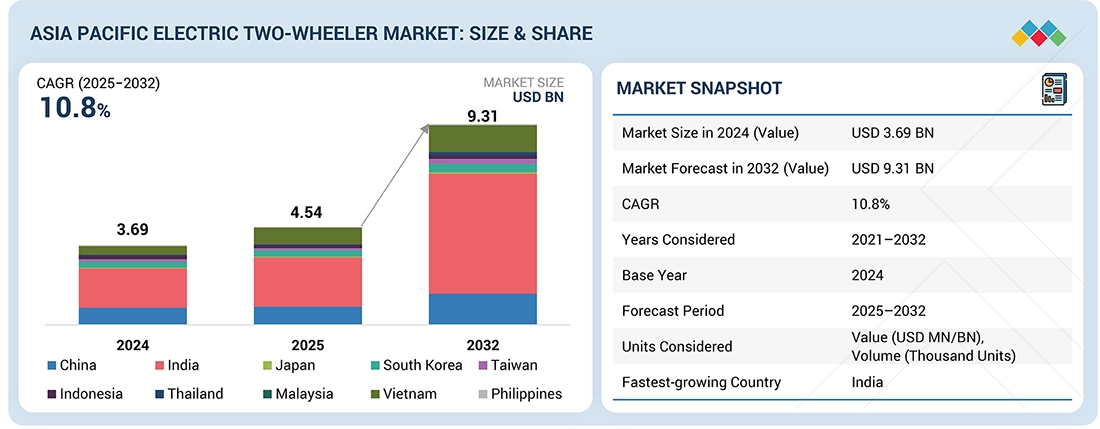
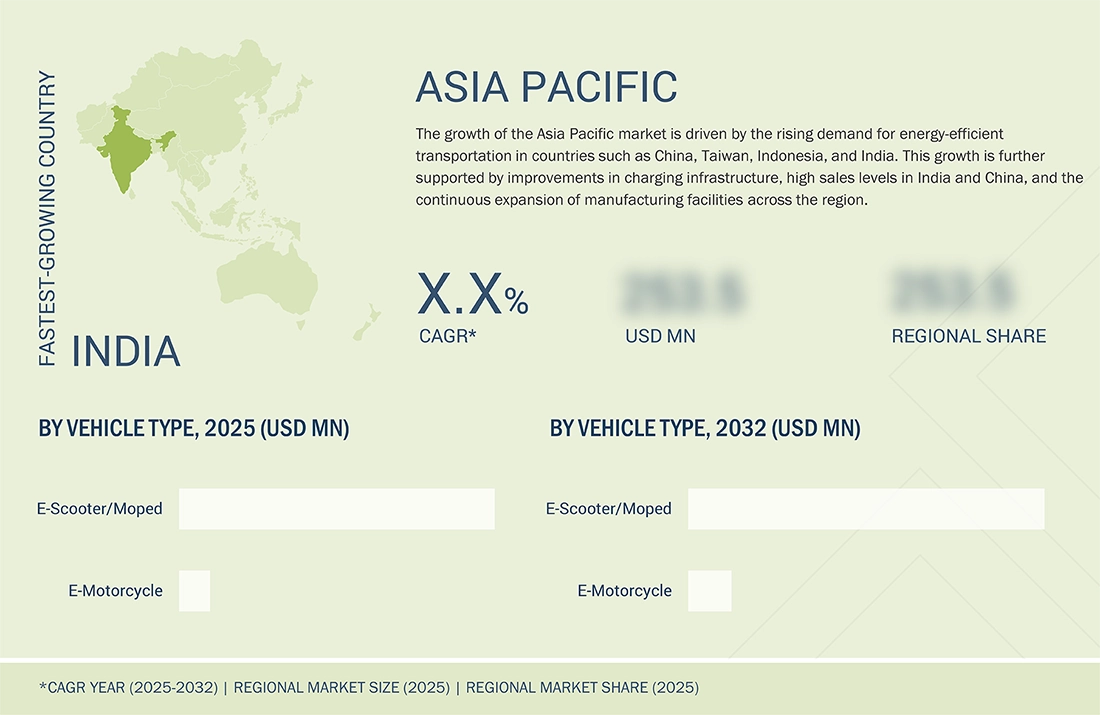
The Asia Pacific electric two-wheeler market size was valued at USD 4.54 billion in 2025 and is expected to reach USD 9.31 billion by 2032 at a CAGR of 10.8% during the forecast period 2025-2032. Market growth is mainly driven by rising demand from last-mile delivery and shared-mobility fleets. This shift pushes OEMs to focus on fleet-ready platforms, longer-lasting batteries, and built-in telematics for vehicle tracking and performance. Many manufacturers are improving cost-efficiency by adopting subscription-based or battery-as-a-service models, making EV ownership more accessible and affordable for commercial users. They are also using higher energy-density battery cells to extend range and boost performance. To reduce supply-chain risk and increase flexibility, OEMs often dual-source battery chemistries using cost-effective LFP batteries for mass-market models and higher-performance NMC cells for premium variants and design their platforms to support both.
KEY TAKEAWAYS
-
BY VEHICLE TYPEE-Scooter/Moped is expected to hold a larger market share during the forecast period.
-
BY VEHICLE CLASSLuxury class electric two-wheelers are expected to record the highest CAGR during the forecast period.
-
BY VOLTAGE TYPEThe 60V segment is expected to dominate the electric two-wheeler market during the forecast period.
-
BY DISTANCE COVEREDThe below 75 miles segment is expected to lead the electric two-wheeler market during the forecast period.
-
BY COUNTRYIndia is expected to register the fastest growth during the forecast period.
-
COMPETITIVE LANDSCAPEYadea (China), Gogoro (Taiwan), Ola Electric (India), and TVS (India) were identified as the key players in the electric two-wheeler market, given their strong market share and product footprint.
Manufacturers are increasingly localizing EV components, such as motors, battery management systems, and pack assembly, to lower production costs and meet domestic content rules. OEMs are also expanding their business models beyond simple vehicle sales, offering financing, battery-as-a-service (BaaS), over-the-air (OTA) updates, and connected services, which create recurring revenue instead of one-time income. Meanwhile, stricter safety and type-approval regulations, alongside emerging rules regarding battery end-of-life and second-life use, are prompting companies to redesign their products and establish reverse logistics and recycling networks
TRENDS & DISRUPTIONS IMPACTING CUSTOMERS' CUSTOMERS
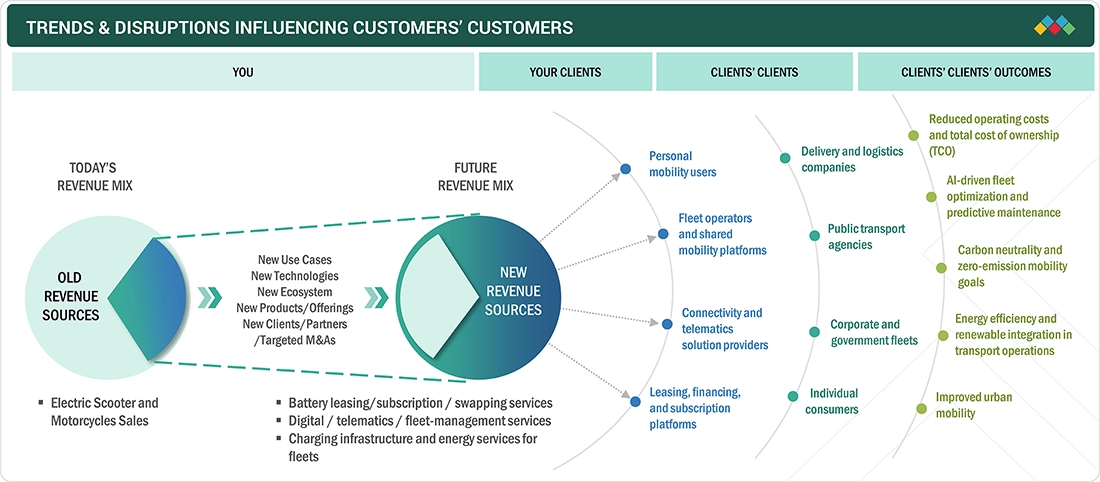
Trends and disruptions in the Asia Pacific electric two-wheeler market reveal a shift from one-time vehicle sales to service-oriented revenue models such as battery leasing, swapping, and fleet management solutions. This transition is driven by new technologies, ecosystem partnerships, and emerging use cases that cater to fleet operators, logistics companies, and public agencies, enabling lower total cost of ownership, AI-driven fleet optimization, and progress toward zero-emission mobility goals.
Source: Secondary Research, Interviews with Experts, MarketsandMarkets Analysis
MARKET DYNAMICS

Level
-
Strong government push through subsidies and bans on gasoline bikes

-
Lower operating and maintenance costs


Level
-
Inadequate public charging network in emerging markets

-
High initial purchase price of quality models


Level
-
Rapid growth of last-mile delivery and gig economy fleets

-
Scalability of battery swapping ecosystems


Level
-
Battery raw material dependence and price volatility

-
Lack of uniform safety and performance standards

Source: Secondary Research, Interviews with Experts, MarketsandMarkets Analysis
Driver: Strong government push through subsidies and bans on gasoline bikes
Countries like India (FAME subsidies and state-level rebates up to INR 40,000 per vehicle), Vietnam (100% import tax exemption on EVs), and Indonesia (RP 7 million direct subsidy) have made electric models more affordable than comparable 110–125 cc gasoline scooters at the point of purchase. Several cities (e.g., Delhi, Kathmandu, Jakarta) have also imposed or announced upcoming bans or restrictions on new gasoline two-wheelers in central zones, leaving consumers and fleet operators with little choice but to switch. This policy mix has driven a significant demand surge across price-sensitive Asia Pacific markets.
Restraint: Inadequate public charging network in emerging markets
Most riders charge at home overnight, but apartment residents, shift workers, and delivery riders in Tier-2/3 cities often lack dedicated parking or 15-amp outlets. Public or swappable stations are heavily concentrated in downtown metro areas, leaving long stretches of highways and smaller towns without options. This forces riders to limit their daily range or carry heavy spare batteries, reducing the practical appeal of electric two-wheelers in semi-urban and rural Asia.
Opportunity: Rapid growth of last-mile delivery and gig economy fleets
Food delivery and e-commerce platforms in India, Indonesia, Thailand, the Philippines, and Vietnam now employ millions of two-wheeler riders daily. Companies like Swiggy, Grab, Gojek, and Shopee are actively electrifying fleets to reduce fuel costs by 60–70% and fulfill their own net-zero commitments. This B2B segment purchases in bulk, signs long-term service contracts, and is willing to pay for telematics and swapping fees, creating a high-volume, high-margin channel that individual consumers cannot compete with.
Challenge: Lack of uniform safety and performance standards
Low-cost manufacturers flood markets with subpar cells, weak frames, and poor water ingress protection, causing frequent fire incidents during monsoon seasons. Each country has different testing standards (or none at all), so a model approved in Indonesia might be rejected in India and vice versa. This patchwork slows cross-border scale for reputable manufacturers, confuses buyers, and gives regulators frequent reasons to impose sudden bans or new rules, creating uncertainty for both OEMs and investors.
asia-pacific electric two-wheeler market: COMMERCIAL USE CASES ACROSS INDUSTRIES
| COMPANY | USE CASE DESCRIPTION | BENEFITS |
|---|---|---|
 |
Provides electric scooters for personal mobility and fleet operations in urban areas through app-based rentals and ownership models | Reduces carbon emissions, lowers per km travel cost, and supports shared mobility infrastructure |
 |
Offers connected smart scooters for individual and commercial users, integrated with telematics, navigation, and performance analytics | Enhances user experience through data-driven insights, improves vehicle efficiency, and enables predictive maintenance |
 |
Targets last-mile delivery and gig-economy fleet operators with purpose-built electric two-wheelers offering high load capacity | Expands into fleet segment, supports logistics electrification, and reduces operational expenses for delivery partners |
 |
Operates battery-swapping networks for shared and delivery fleets using swappable battery scooters | Eliminates charging downtime, boosts vehicle uptime, and scales urban electrification with modular energy solutions |
 |
Deploys battery-swapping electric scooters for personal and commercial users across cities in India | Increases accessibility through flexible ownership and reduces dependence on charging infrastructure |
Logos and trademarks shown above are the property of their respective owners. Their use here is for informational and illustrative purposes only.
MARKET ECOSYSTEM
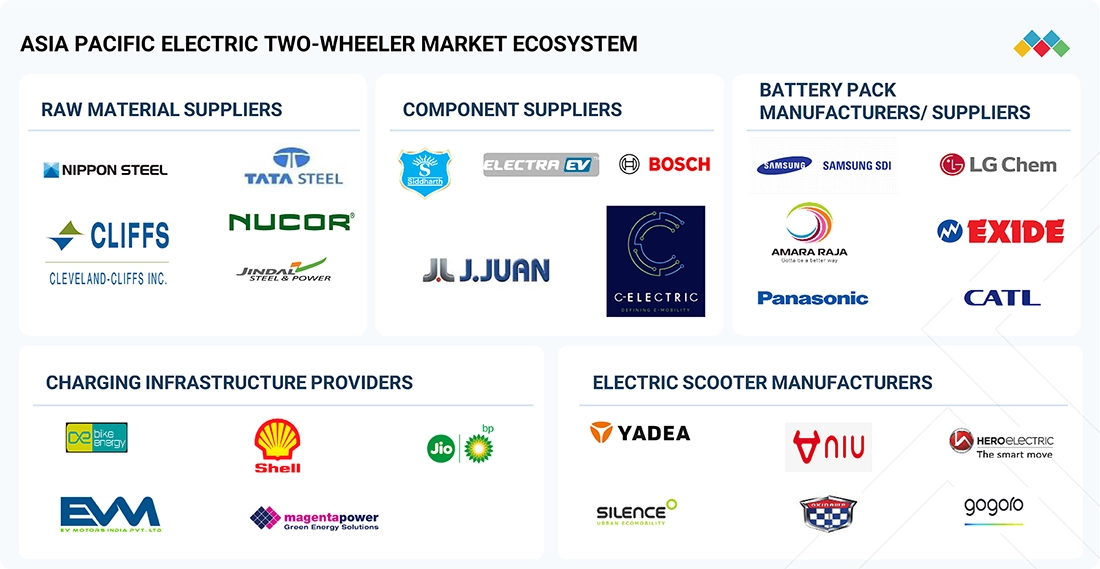
The Asia Pacific electric two-wheeler market ecosystem includes raw material suppliers, component suppliers, battery pack suppliers, charging infrastructure providers, and electric scooter manufacturers. Major electric scooter and motorcycle manufacturers include Ola Electric (India), Bajaj Auto Ltd. (India), TVS Motor Company (India), Ather Energy (India), and Yadea Technology Group Co., Ltd. (China).
Logos and trademarks shown above are the property of their respective owners. Their use here is for informational and illustrative purposes only.
MARKET SEGMENTS
Source: Secondary Research, Interviews with Experts, MarketsandMarkets Analysis
Asia Pacific Electic Two-Wheeler Market, By Battery Type
Lithium-ion batteries are set to dominate the market because of their higher energy density, lighter weight, and longer lifespan compared to lead-acid alternatives. The region’s rapid decrease in lithium-ion cell prices, fueled by large-scale production in China, India, and South Korea, along with the growth of domestic battery manufacturing and battery-swapping networks, has greatly improved affordability and enabled widespread adoption in mass-market electric mobility.
Asia Pacific Electic Two-Wheeler Market, By Distance Covered
The below 75-mile range leads the market because it appeals strongly to budget-conscious personal and commercial users. For individual riders, this range provides an affordable and practical option for short daily commutes, quick errands, and city travel. In commercial applications like hyperlocal delivery and small-scale shared mobility services, it helps reduce upfront costs, supports frequent short trips, and ensures effective fleet management with minimal charging needs.
Asia Pacific Electic Two-Wheeler Market, By Voltage
The 60V segment is expected to remain dominant, largely driven by its widespread use in popular scooter and moped models throughout the region. Continuous advancements in battery technology, such as increased energy density and faster charging, are further boosting its adoption, providing longer riding distances and quicker charging compared to traditional 48V systems. These advantages make 60V platforms ideal for Asia’s crowded urban areas and high daily usage.
Asia Pacific Electic Two-Wheeler Market, By Technology
Plug-in charging technology is backed by the widespread use of lithium-ion batteries and the convenience of charging at home and work. For daily commuters, plug-in models offer greater ease by reducing reliance on public swapping stations. Moreover, the widespread presence of standard electrical outlets across Asian homes and commercial areas makes plug-in charging an easy and affordable option for most users.
Asia Pacific Electic Two-Wheeler Market, By Vehicle Class
The prevalence of economy electric two-wheelers is driven by their affordability and widespread availability across urban and semi-urban areas. Their lower price points strongly attract cost-sensitive riders, including students, daily commuters, and first-time EV users. Supported by favorable government policies promoting sustainable mobility, this segment is experiencing rapid growth, with major Asian manufacturers increasingly expanding their product lines in the budget-friendly category.
Asia Pacific Electic Two-Wheeler Market, By Vehicle Type
The e-scooter/moped segment is expected to be larger than the e-motorcycle segment because of its affordability and heightened demand for budget-friendly everyday transportation. The flexibility, user-friendliness, and practical design have made electric scooters more popular among consumers compared to electric motorcycles.
Asia Pacific Electic Two-Wheeler Market, By Usage
The private segment is leading Asia’s e-scooter and electric motorcycle market, driven by increasing urbanization, higher fuel costs, and a growing demand for convenient personal mobility. In densely populated cities across China, India, Indonesia, and Vietnam, e-scooters provide an affordable and efficient option for daily commuting. Improved battery performance, widespread availability of charging stations, and supportive government incentives are further boosting private adoption throughout the region.
Asia Pacific Electic Two-Wheeler Market, By Motor Type
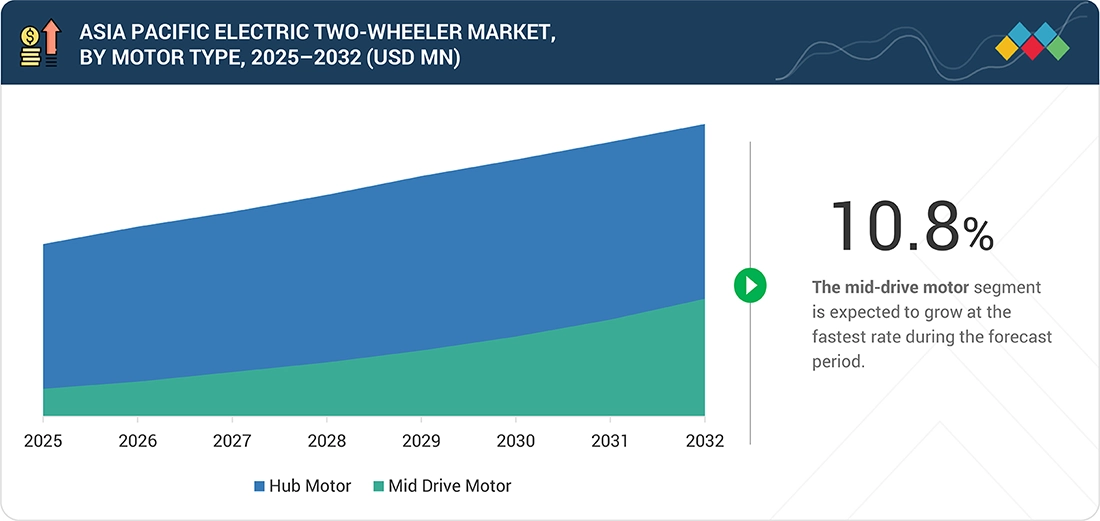
The use of hub motors in electric two-wheelers is rising due to their high efficiency, low maintenance, and strong performance. Meanwhile, the demand for mid-drive motors is growing in low-power electric two-wheelers because they provide better power delivery, longer range, and higher torque.
Asia Pacific Electic Two-Wheeler Market, By Motor Power
Advances in battery technology are allowing electric scooters with motor power above 3 kW to develop longer ranges, easing rider concerns about limited distance. Scooters with motors below 1.5 kW are lighter and easier to control, making them perfect for navigating crowded urban areas and fitting into tight parking spots.
REGION
Malaysia to grow at the fastest rate in the Asia Pacific electric two-wheeler market during the forecast period
Malaysia is emerging as one of the fastest-growing markets for electric two-wheelers in the Asia Pacific, driven by increasing demand for affordable and efficient mobility. With operating costs up to 70–80% lower than petrol models, e-scooters are gaining popularity among budget-conscious commuters. Government incentives, expanding charging networks, and growing interest in localized assembly are further accelerating adoption. Meanwhile, larger markets such as China, India, Taiwan, and Vietnam continue to scale up production and expand model options, thereby strengthening Asia’s position as the global hub for electric two-wheeler manufacturing and innovation, with Malaysia becoming an increasingly important contributor to this growth.
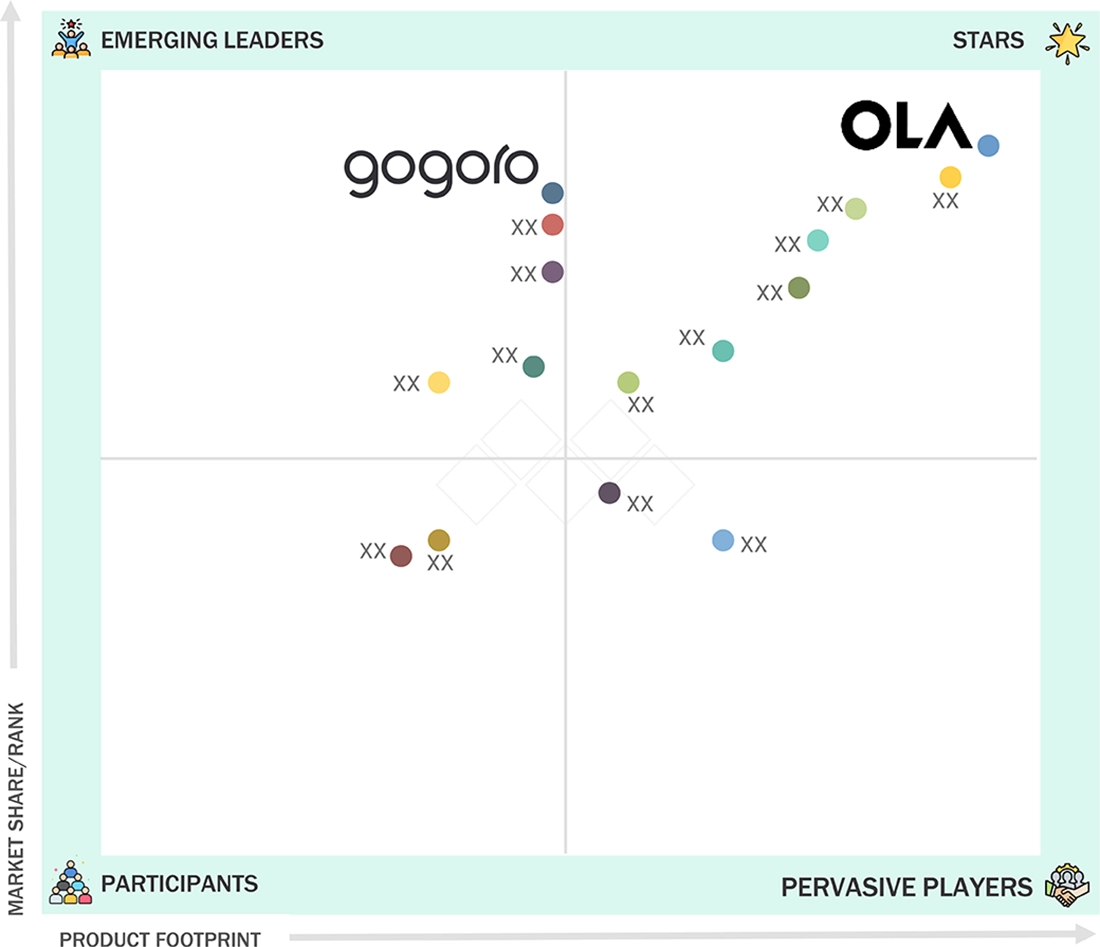
asia-pacific electric two-wheeler market: COMPANY EVALUATION MATRIX
In the Asia Pacific electric two-wheeler market, OLA Electric (Star) leads with a strong global presence and comprehensive electric two-wheeler offerings, driving market expansion and revenue growth through strategic partnerships and product launches. Gogoro (Emerging Leader) is gaining traction with its large-scale battery-swapping network, strategic collaborations with local OEMs, and technology licensing partnerships across Asia. The company shows strong growth potential to advance toward the leaders' quadrant.
Source: Secondary Research, Interviews with Experts, MarketsandMarkets Analysis
KEY MARKET PLAYERS
- OLA Electric (India)
- Bajaj Auto Ltd. (India)
- TVS Motor Company (India)
- Ather Energy (India)
- Yadea Technology Group Co.,Ltd. (China)
- GOGORO (Taiwan)
- HERO ELECTRIC (India)
- Niu International (China)
- Jiangsu Xinri E-Vehicle Co., Ltd. (China)
MARKET SCOPE
| REPORT METRIC | DETAILS |
|---|---|
| Market Size Value in 2024 | USD 3.69 BN |
| Revenue Forecast in 2032 | USD 9.31 BN |
| Growth Rate | CAGR of 10.8% from 2025–2032 |
| Actual Data | 2021–2032 |
| Base Year | 2024 |
| Forecast Period | 2025–2032 |
| Units Considered | Value (USD MN/BN) and Volume (Thousand Units) |
| Report Coverage | Revenue forecast, company ranking, competitive landscape, growth factors, and trends |
| Segments Covered |
|
| Country Level Scope | China, India, Japan, South Korea, Taiwan, Indonesia, Thailand, Malaysia, Vietnam, Phillippines, Others |
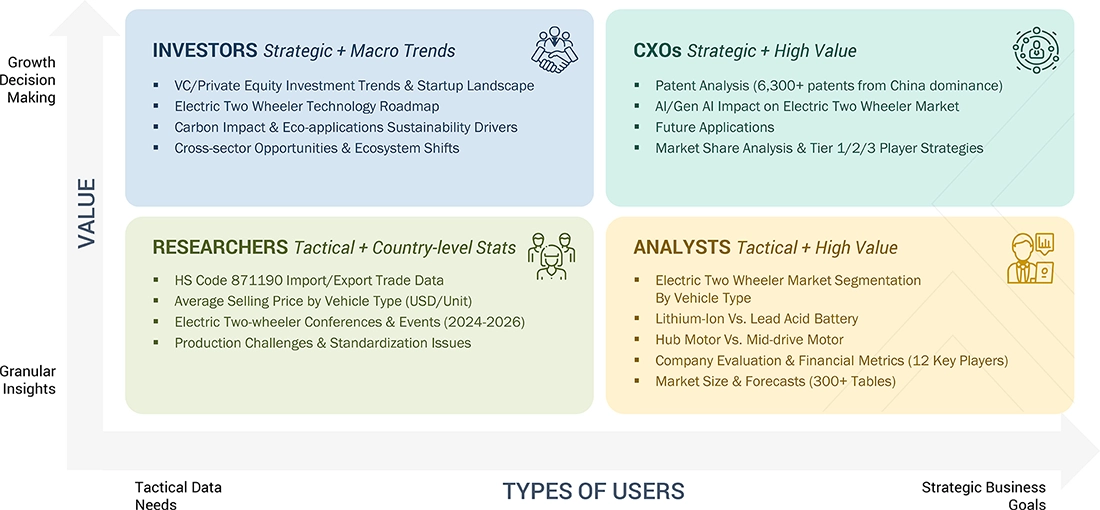
WHAT IS IN IT FOR YOU: asia-pacific electric two-wheeler market REPORT CONTENT GUIDE
DELIVERED CUSTOMIZATIONS
We have successfully delivered the following deep-dive customizations:
| CLIENT REQUEST | CUSTOMIZATION DELIVERED | VALUE ADDS |
|---|---|---|
| Two-Wheeler OEM (India) | Detailed competitor benchmarking for e-scooter pricing, features, charging tech, and motor specifications across top regional players. | Helps OEM refine product positioning, identify feature gaps, and optimize pricing strategy for target markets. |
| Battery Manufacturer (Japan) | Analysis of battery chemistry adoption trends (LFP, NMC) and country-wise demand for swappable vs. fixed batteries. | Supports investment decisions, improves product roadmap planning, and aligns battery development with regional OEM needs. |
| Charging Infrastructure Provider (Singapore) | Mapping of high-demand urban clusters and preferred charging models (plug-in vs. swapping). | Enables targeted rollout strategy, reducing capex and improving station utilization rates. |
| EV Fleet Operator (Indonesia) | Total cost of ownership (TCO) comparison between ICE and electric fleets, including charging downtime modelling. | Helps fleet owners optimize fleet mix, reduce operational costs, and improve route planning. |
| Component Supplier (Motor, Controller, BMS – Taiwan) | Localization assessment for component manufacturing, including supply chain risks and partner identification. | Accelerates market entry, reduces dependency on imports, and ensures competitive production costs. |
RECENT DEVELOPMENTS
- October 2025 : Indofast Energy partnered with e-Sprinto to deploy 20,000 electric two-wheelers in India by 2026. These vehicles will use Indofast Energy’s battery-swapping network, enabling riders to replace depleted batteries quickly and reduce downtime. The partnership aims to support last-mile delivery and gig workers, with plans to establish 2,750 swap stations and serve 150,000 vehicles by March 2026. The companies also plan to expand the network to 10,000 swap points across more than 40 cities within the next three years.
- September 2025 : SRIVARU Motors launched its new generation of electric two-wheelers, including the Alive scooter series—Alive Lite, Alive Plus, and Alive Elite—and the PRANA Class electric motorcycle. The Alive series is equipped with LiFePO4 batteries, regenerative braking, and smart digital displays. The top model, Alive Elite, offers a range of up to 155 km, fast charging, GPS, concierge support, and advanced anti-theft features, while the Alive Lite includes a lifetime battery warranty. The PRANA Class motorcycle comes with a 3.5 kWh LiFePO4 battery providing up to 170 km of range, powered by a 4,000 W motor delivering 50 Nm torque, and supports app-based connectivity.
- September 2025 : Ather Energy unveiled the EL platform, a next-generation electric scooter architecture developed using 2.6 million kilometres of real-world data. The platform includes a redesigned chassis, powertrain, and electronics system, enabling up to 15% faster assembly and twice-as-fast periodic servicing, with an extended service interval of 10,000 km. The company also introduced the Redux concept scooter, featuring a lightweight aluminium frame, 3D-printed seat, advanced body panels, adaptive ride dynamics, and a context-aware digital display.
- June 2025 : Ola Electric started rolling out its MoveOS 5 software update for the S1 scooter series and Roadster X motorcycles. The update brings several enhancements in performance, safety, and convenience across all Ola vehicle models. It upgrades the in-house Motor Control Unit (MCU) and introduces advanced battery management, improved regenerative braking, and better energy efficiency. Key new features include a DIY Mode that lets riders customize settings such as top speed, throttle response, and regenerative braking, along with additional modes like Road-Trip Mode and Easy Park for added flexibility.
Table of Contents
 Exclusive indicates content/data unique to MarketsandMarkets and not available with any competitors.
Methodology
This research study involved the extensive use of secondary sources, such as company annual reports/presentations, industry association publications, automotive magazine articles, directories, technical handbooks, the World Economic Outlook, trade websites, technical articles, and databases, to identify and collect information on the Asia Pacific Electric Two-Wheeler Market. In-depth interviews were conducted with various primary respondents, including key industry participants, subject-matter experts (SMEs), C-level executives of key market players (electric scooter and motorcycle manufacturers and suppliers), and industry consultants, among other experts, to obtain and verify critical qualitative and quantitative information and assess market prospects.
Secondary Research
In the secondary research process, various secondary sources were used to identify and collect information on the Asia Pacific Electric Two-Wheeler Market for this study. Secondary sources included annual reports, press releases, and investor presentations of companies; whitepapers, certified publications, and articles from recognized authors; directories; databases; and articles from recognized associations and government publishing sources.
Primary Research
Extensive primary research was conducted after understanding the market scenario through secondary research. Approximately 30% and 70% of primary interviews were conducted from the demand and supply sides, respectively. Primary data was collected through questionnaires, emails, and telephonic interviews. In the canvassing of primaries, various departments within organizations, such as sales, operations, and administration, were covered to provide a holistic viewpoint in the report.
In the canvassing of primaries, various departments within organizations, such as sales, operations, and marketing, were covered to provide a holistic viewpoint in the report. After interacting with industry experts, brief sessions were conducted with experienced independent consultants to reinforce the findings from the primaries. This, along with the opinions of in-house subject matter experts, led to the findings, as described in the remainder of this report.
Note: The tiers of companies are based on the supply chain of the market. Tier I companies are electric scooter and motorcycle providers. Other designations include design engineers, manufacturing engineers, and sales executives, among others.
Market Size Estimation
A bottom-up and top-down approach was used to estimate and validate the total size of the Asia Pacific Electric Two-Wheeler Market. This method was also used extensively to estimate the size of various subsegments in the market. The research methodology used to estimate the market size includes the following:
Data Triangulation
After arriving at the overall market size using the market size estimation processes as explained above, the market was split into several segments and subsegments. To complete the overall market engineering process and arrive at the exact statistics of each market segment and subsegment, data triangulation and market breakdown procedures were employed, wherever applicable. The data was triangulated by studying various factors and trends from both the demand and supply sides.
Market Definition
Electric scooters and motorcycles are plug-in two-wheeled vehicles that use electric motors to attain locomotion. The electricity is stored in a rechargeable battery, which drives electric motors. These vehicles are zero-emission electric motor-driven vehicles. The operating speed and top speed of electric two-wheelers are based on battery technology.
Scooters and mopeds are easy-to-operate two-wheelers with a step-through frame and a platform for the user’s feet. They are affordable, lightweight, and easy to commute on. On the other hand, motorcycles are heavier, faster, and bigger than scooters and mopeds. Depending on the requirements, these two-wheelers have different body designs and frames compared to scooters and mopeds. The electric versions of scooters and motorcycles are powered by electricity stored in their batteries.
Key Stakeholders
- Associations, Forums, and Alliances of Electric Scooters and Motorcycles
- Automobile Manufacturers
- Automotive Component Manufacturers
- Automotive Investors
- Battery Distributors
- Battery Manufacturers
- Charging Infrastructure Providers
- Charging Service Providers
- Distributors and Retailers of Electric Two-wheelers
- Electric Two-wheeler Charging Station Service Providers
- Electric Two-wheeler Cable Manufacturers
- Government Agencies and Policymakers
- Manufacturers of Electric Two-wheelers
- Manufacturers of Electric Two-wheeler Charging Poles
- Manufacturers of Electric Two-wheeler Components
- Raw Material Providers
Report Objectives
- To segment and forecast the Asia Pacific Electric Two-Wheeler Market size in terms of volume and value
- To define, describe, and forecast the market based on vehicle type, battery type, voltage type, vehicle class, technology, distance covered, usage, motor type, and motor power
- To forecast the market size with respect to key countries: China, India, Japan, South Korea, Taiwan, Malaysia and Others
- To provide detailed information regarding the major factors influencing the market growth (drivers, challenges, restraints, and opportunities)
- To analyze technological developments impacting the market
- To analyze opportunities for stakeholders and the competitive landscape for leaders in the Asia Pacific Electric Two-Wheeler Market
- To strategically analyze markets with respect to individual growth trends, prospects, and contributions to the total market
- To strategically profile key players and comprehensively analyze their market share and their core competencies
-
To study the following with respect to the market:
- Supply Chain Analysis
- Ecosystem Analysis
- Technology Analysis
- HS Code
- Case Study Analysis
- Patent Analysis
- Regulatory Landscape
- Key Conferences and Events
- Average Selling Price Analysis
- Buying Criteria
To track and analyze competitive developments, such as product developments and deals, undertaken by the key industry participants
Customization Options
With the given market data, MarketsandMarkets offers customizations in accordance with the company’s specific needs.
- Asia Pacific Electric Two-Wheeler Market, By Battery Type At Country Level (For Countries Covered In Report)
Company Information
- Profiling of additional market players (up to five)


Personalize This Research
- Triangulate with your Own Data
- Get Data as per your Format and Definition
- Gain a Deeper Dive on a Specific Application, Geography, Customer or Competitor
- Any level of Personalization
Let Us Help You
- What are the Known and Unknown Adjacencies Impacting the Asia Pacific Electric Two-Wheeler Market
- What will your New Revenue Sources be?
- Who will be your Top Customer; what will make them switch?
- Defend your Market Share or Win Competitors
- Get a Scorecard for Target Partners

Custom Market Research Services
We Will Customise The Research For You, In Case The Report Listed Above Does Not Meet With Your Requirements
Get 10% Free CustomisationTESTIMONIALS

JIM NAAS
PRODUCT DIRECTOR, WEASLER
Weasler Engineering, a CentroMotion organization
Global Provider of Industrial Actuation & Control Solutionswww.weasler.com
Our organization was interested in learning more about the attractiveness of a particular market space. We contacted MarketsandMarkets to help us based on previous positive experiences we had with them. The results did not disappoint! We discussed our objectives with them, and the team at MarketsandMarkets developed and executed a proposal that met our needs precisely. We were very impressed by their level of expertise, the quality of the analysis and their insightful recommendations. We would not hesitate in working with them again in the future.

Matt Kardel,
Vice President
Aptiv,
A global technology company that develops safer, greener and more connected solutions.www.aptiv.com
We contracted with
MarketsandMarkets to evaluate the value chain and potential go-to-market partners related to our
interest in the Fleet Management space. The team successfully completed the work on time and at the
pricing agreed. MarketsandMarkets listened and understood our objectives and collaborated well with
us to help us get the visibility we needed to make an investment.
We have subsequently used
MarketsandMarkets again related to Smart Cities to good results.






Growth opportunities and latent adjacency in Asia Pacific Electric Two-Wheeler Market