Asia Pacific EV Charging Station Market

Asia Pacific EV Charging Station Market by Application, Level of Charging, Charging Point, Charging Infrastructure, Operation, DC Fast Charging, Charge Point Operator, Connection Phase, Service, Installation, and Country - Forecast to 2032




OVERVIEW
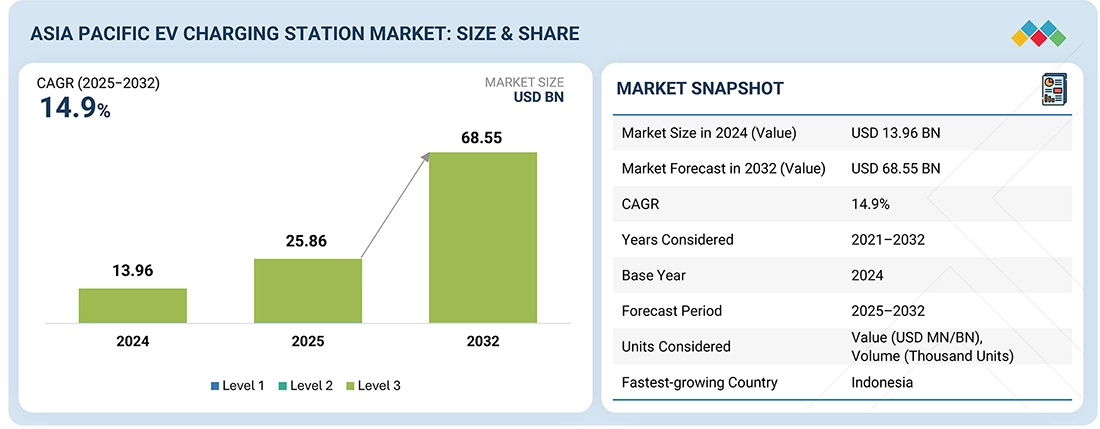
Source: Secondary Research, Interviews with Experts, MarketsandMarkets Analysis
The Asia Pacific EV charging station market is expected to grow from USD 25.86 billion in 2025 to USD 68.55 billion by 2032, registering a CAGR of 14.9%. This market is growing quickly with strong government support and private investments in infrastructure. Fast charging networks are expanding, and OEMs are partnering with charging infrastructure providers to improve accessibility.
KEY TAKEAWAYS
-
BY COUNTRYChina dominated the Asia Pacific EV charging station market with a share of 93.2% in 2024.
-
BY APPLICATIONThe public segment is expected to register the highest CAGR of 23.8% between 2025 and 2032.
-
BY CHARGE POINT OPERATORSChina is projected to grow at the fastest rate during the forecast period.
-
BY CHARGING INFRASTRUCTURE TYPEThe Type 2 segment is expected to dominate the market during the forecast period.
-
BY CHARGING POINT TYPEThe DC charging segment is expected to grow at the highest CAGR of 25.5% during the forecast period.
-
BY CHARGING SERVICE TYPEThe 3-Phase segment is expected to lead the market during the forecast period.
-
BY DC FAST CHARGING TYPEFast DC is expected to be the largest segment during the forecast period.
-
BY INSTALLATION TYPEThe fixed segment is projected to exhibit the fastest growth during the forecast period.
-
BY LEVEL OF CHARGINGThe Level 3 segment will grow the fastest during the forecast period.
-
BY OPERATIONThe Mode 4 segment will hold the highest share during the forecast period.
-
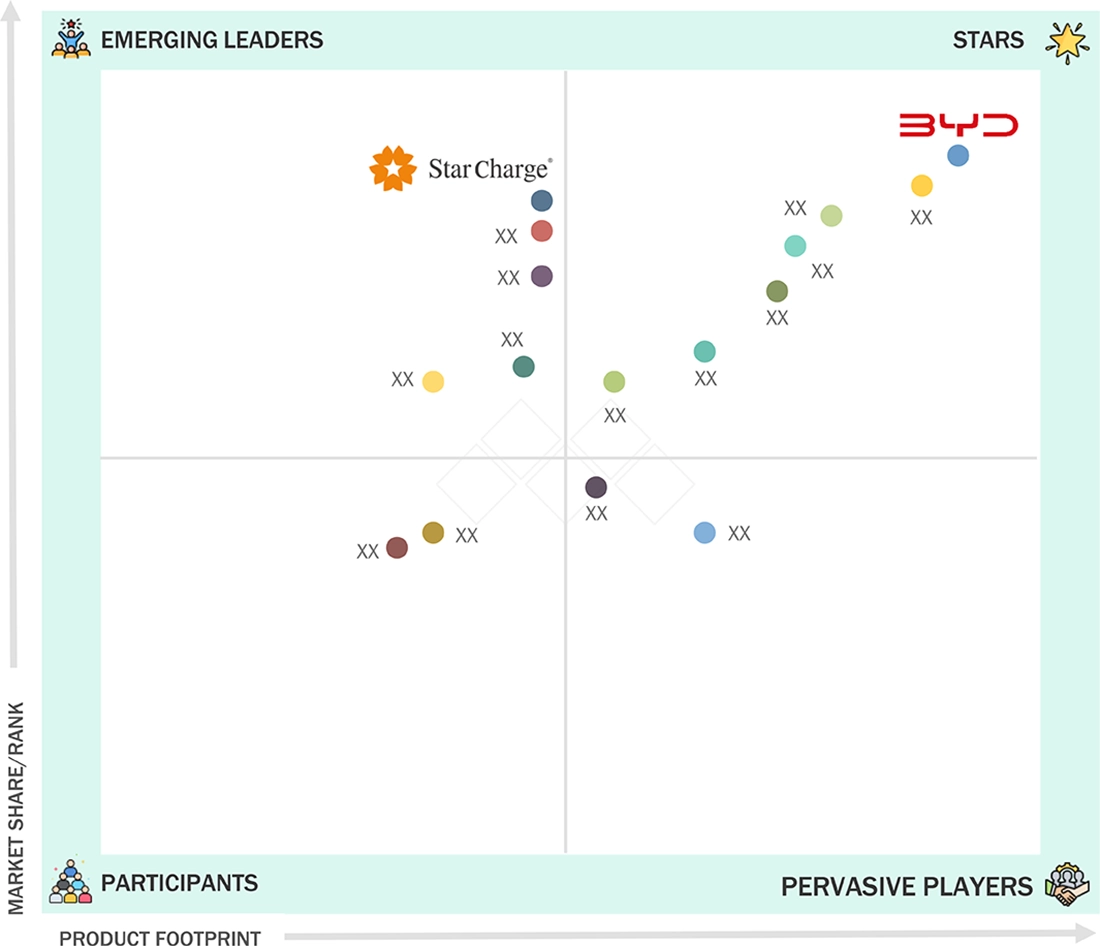
Competitive LandscapeDelta Electronics, Star Charge, Schneider Electric, Tata Power, and BYD were identified as the star players in the EV charging station market, given their strong market share and product footprint.
The Asia Pacific EV charging station market is evolving with substantial OEM-led investments, large-scale urban network rollouts, and integration into smart city infrastructure. Ultra-fast DC charging is scaling to match advanced EV capabilities, while fleet electrification and battery swapping are diversifying access models. These developments strengthen infrastructure readiness and support the transition to a sustainable transportation ecosystem.
TRENDS & DISRUPTIONS IMPACTING CUSTOMERS' CUSTOMERS
The Asia Pacific EV charging station market’s revenue mix is evolving, moving from chargers, installation, and maintenance to new growth areas. Rapid EV adoption and faster charging demand are driving revenue from ultrafast chargers, smart charging solutions, subscription services, and energy management offerings.
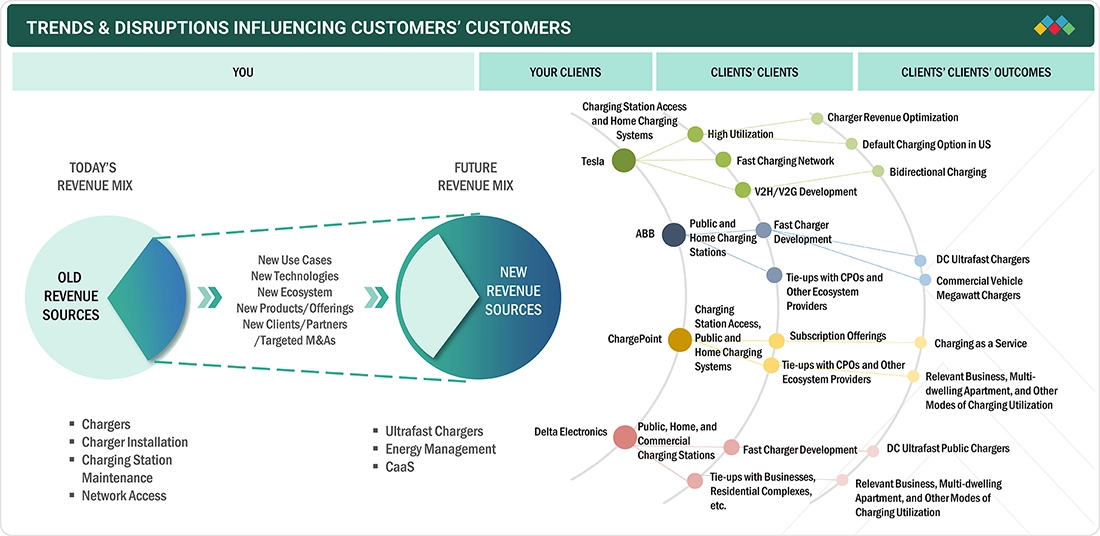
Source: Secondary Research, Interviews with Experts, MarketsandMarkets Analysis
MARKET DYNAMICS

Level
-
Government policies and subsidies

-
Rapid EV adoption and environmental awareness


Level
-
High capital expenditure

-
Grid infrastructure limitations


Level
-
Integration with renewable energy sources

-
Expansion in emerging markets


Level
-
Lack of standardization

-
Low utilization rates and profitability challenges for CPOs

Source: Secondary Research, Interviews with Experts, MarketsandMarkets Analysis
Driver: Government policies and subsidies
Government policies and subsidies play a pivotal role by providing financial incentives such as tax rebates, low-interest loans, and direct funding for installing charging stations, particularly in public spaces like highways and urban centers. The policy framework creates a stable environment for infrastructure growth, encouraging public-private partnerships that scale up the network faster than market forces alone could achieve, making EVs more practical for everyday use.
Restraint: Grid Infrastructure limitations
Grid infrastructure limitations arise from the aging and unevenly distributed electrical networks in rapidly urbanizing areas, where peak charging times could overload transformers and cause blackouts or voltage drops. Charging station operators must invest in energy storage solutions or demand-response systems as interim measures, which adds complexity and delays widespread rollout until grid modernization catches up.
Opportunity: Integration with renewable energy sources
Integration with renewable energy sources opens avenues for creating eco-friendly charging ecosystems where stations generate their own power via on-site solar panels or connect to microgrids, reducing dependence on fossil fuel-based electricity and mitigating carbon footprints. In a region with abundant sunlight and wind resources, such innovations can transform charging stations into profit centers through energy trading, while addressing local energy access challenges in remote or island areas.
Challenge: Lack of standardization
The lack of standardization stems from different global standards like CCS and CHAdeMO being adopted unevenly by automakers and infrastructure providers, leading to chargers that might not work with all vehicle models and forcing users to carry multiple adapters. Solving this would require collaboration among stakeholders to adopt unified protocols, but geopolitical tensions and proprietary interests often delay the process, preventing the market from maturing until a dominant standard emerges.
Asia Pacific EV Charging Station Market: COMMERCIAL USE CASES ACROSS INDUSTRIES
| COMPANY | USE CASE DESCRIPTION | BENEFITS |
|---|---|---|
 |
Charging for fleets and commercial properties, and chargers at retail locations to attract EV customers | Lowers TCO, increases station utilization, increases foot traffic, adds revenue stream |
 |
Deploying solar-integrated AC and DC chargers at commercial sites like malls and supermarkets in Southeast Asia, enabling on-site renewable energy generation for EV charging | Lowers electricity costs through self-generated power, reduces carbon footprint, and appeals to environmentally aware shoppers, increasing foot traffic and brand loyalty |
 |
Installing ultra-fast charging stations with battery storage for electric fleet vehicles in urban logistics hubs in China, supporting rapid charging for delivery operations | Accelerates vehicle turnaround times by up to 70%, cuts operational fuel expenses significantly, and contributes to zero-emission city logistics, aligning with national green policies |
Logos and trademarks shown above are the property of their respective owners. Their use here is for informational and illustrative purposes only.
MARKET ECOSYSTEM
The Asia Pacific EV charging station ecosystem includes manufacturers, operators, payment processors, mapping providers, and OEMs. Key players like BYD, Star Charge, and TELD hold the major market share. OEMs such as Hyundai, Toyota, and BYD are focusing on fleet electrification and decarbonization.
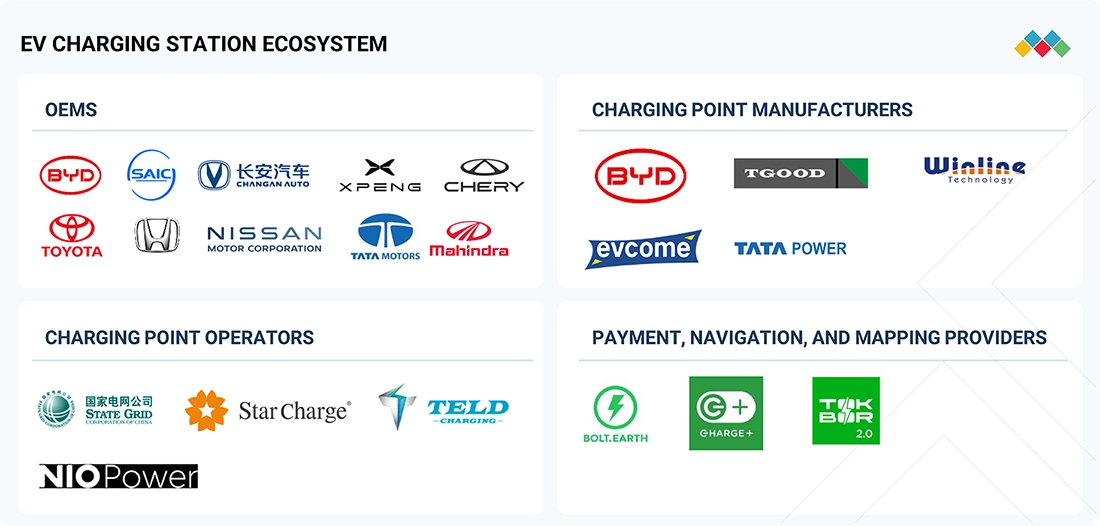
Logos and trademarks shown above are the property of their respective owners. Their use here is for informational and illustrative purposes only.
MARKET SEGMENTS
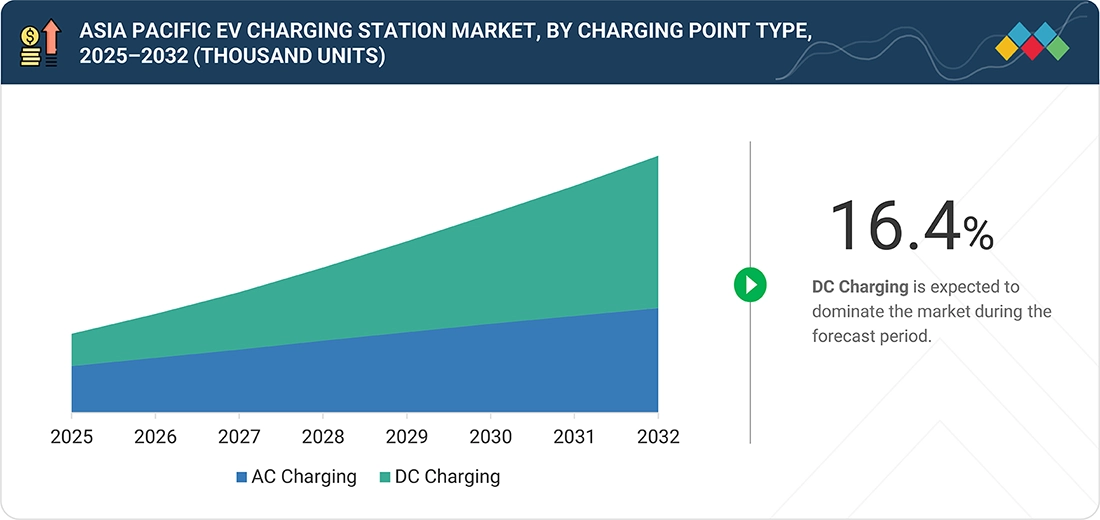
Source: Secondary Research, Interviews with Experts, MarketsandMarkets Analysis
Asia Pacific EV Charging Station Market, By Level of Charging
Level 3 chargers are expected to see the fastest growth due to their ability to charge EVs in under an hour, significantly reducing downtime for consumers and fleet operators. This demand is fueled by longer EV ranges, increased public charging needs, and supportive government policies. Key players like ABB are innovating with scalable Level 3 solutions, including megawatt systems for heavy-duty vehicles.
Asia Pacific EV Charging Station Market, By Charging Infrastructure Type
Type 2 connectors are the dominant AC standard for Level 2 EV charging in Asia Pacific, especially in Japan, India, Australia, and Southeast Asia, offering 7–22 kW speeds for residential and public use. China favors GB/T, but Type 2 adoption grows via exports and OEM integrations.
Asia Pacific EV Charging Station Market, By Charging Point Type
AC charging is prevalent due to its low cost and widespread installation in homes and workplaces. However, DC charging is expected to capture the majority market share during the forecast period, driven by faster charging speeds, growing demand for ultrafast charging, and increasing adoption in public and high-traffic locations. This shift is supported by expanding EV adoption and infrastructure upgrades.
Asia Pacific EV Charging Station Market, By DC Fast Charging Type
The DC Ultrafast 1 type is expected to hold the largest market share during the forecast period due to its established presence and compatibility with most EVs. Meanwhile, the DC Ultrafast 2 type is set for the fastest growth, driven by increasing demand for rapid charging, network expansion in high-traffic corridors, and adoption by new EV models supporting higher power levels.
REGION
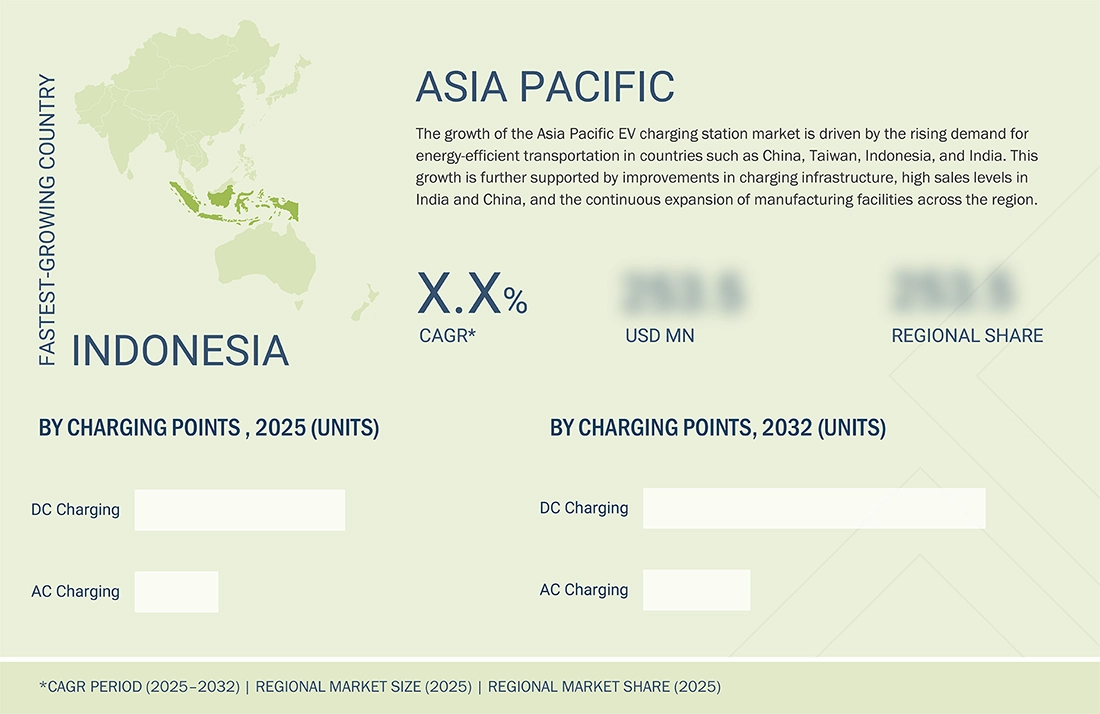
China is expected to be the largest country in the Asia Pacific EV charging station market during the forecast period.
China is set to remain the largest EV charging station market in Asia Pacific, with strong government support and rapid EV adoption driving demand. The country predominantly uses GB/T chargers, while DC fast charging is expanding quickly. BYD’s 1,000 kW supercharging plans, Huawei’s rollout of 100,000 ultrafast stations, and the Mercedes-Benz–BMW JV targeting 7,000 stations by 2026 highlight aggressive infrastructure growth. However, utilization rates at networks like StarCharge remain low, signaling challenges in efficiency despite large-scale expansion.
Asia Pacific EV Charging Station Market: COMPANY EVALUATION MATRIX
In the Asia Pacific EV charging station market, BYD (Star) leads with a strong market presence and extensive charging network, driving large-scale adoption across passenger and commercial EVs. Delta Electronics Inc. (Emerging Leader) is gaining momentum with new fast and smart charging solutions and strategic partnerships. It shows strong growth potential to advance toward the Stars quadrant.
Source: Secondary Research, Interviews with Experts, MarketsandMarkets Analysis
KEY MARKET PLAYERS
- BYD (China)
- TGOOD (China)
- Winline Technology (China)
- State Grid Corporation of China (China)
- Delta Electronics (Taiwan)
- StarCharge (China)
- EVCOME (China)
- SRE Power (China)
- Tata Power (India)
MARKET SCOPE
| REPORT METRIC | DETAILS |
|---|---|
| Market Size in 2024 (Value) | USD 13.96 BN |
| Market Forecast in 2032 (Value) | USD 68.55 BN |
| Growth Rate | CAGR of 14.9% from 2025–2032 |
| Years Considered | 2021–2032 |
| Base Year | 2024 |
| Forecast Period | 2025–2032 |
| Units Considered | Value (USD MN/BN), Volume (Thousand Units) |
| Report Coverage | Revenue forecast, company ranking, competitive landscape, growth factors, and trends |
| Segments Covered |
|
| Countries Covered | China, India, Japan, South Korea, Indonesia, Thailand, Singapore, Others |
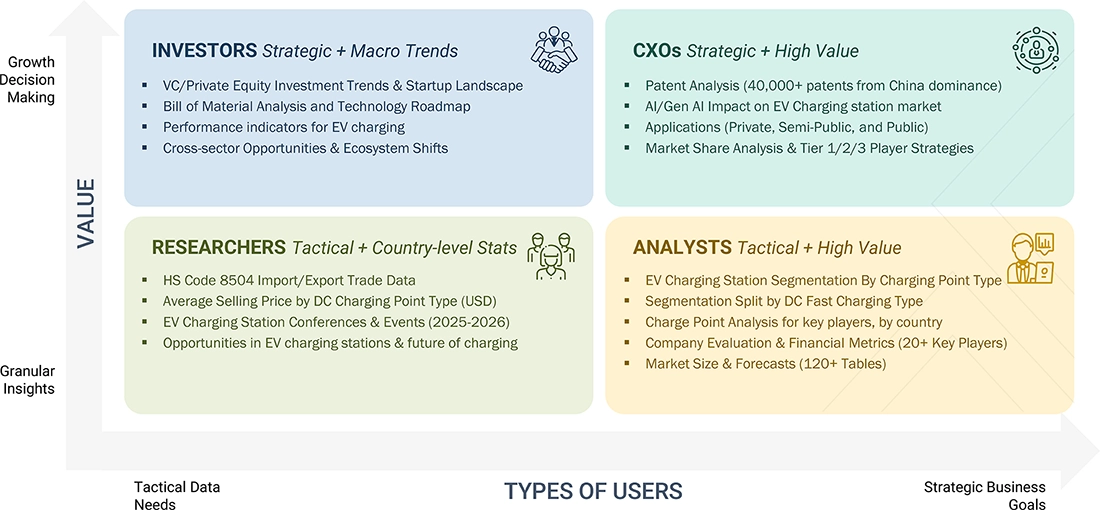
WHAT IS IN IT FOR YOU: Asia Pacific EV Charging Station Market REPORT CONTENT GUIDE
DELIVERED CUSTOMIZATIONS
We have successfully delivered the following deep-dive customizations:
| CLIENT REQUEST | CUSTOMIZATION DELIVERED | VALUE ADDS |
|---|---|---|
| Tier 1 EV infrastructure provider planning network expansion | EV charging station market sizing, segmentation by charger type, and regional demand forecast | Identified high-potential locations and optimal charger mix for deployment, enabling efficient network planning |
| Fleet operator planning depot electrification | Fleet charging infrastructure sizing and cost-benefit modeling | Optimized energy use, reduced operational costs, streamlined logistics |
| Automotive OEM assessing fleet electrification strategy | Analysis of public vs private charging infrastructure and integration with OEM vehicles | Provided insights on charger compatibility, utilization patterns, and strategic partnerships for fleets |
| Municipal authority planning public EV infrastructure | City-level EV adoption forecast, grid capacity mapping, and fast-charging station requirements | Supported regulatory compliance, grid stability, and optimized station placement to maximize utilization |
| DC charging provider planning for MCS charger development | Technology roadmap assessment, competitor activity scan, and heavy-duty EV adoption outlook | Guided product roadmap with clear visibility on megawatt charging demand and competitive positioning |
| European EV charging operator planning for LATAM entry | Regional EV adoption trends, policy landscape, and infrastructure readiness study | Enabled market entry planning with clarity on high-growth LATAM countries and partnership opportunities |
RECENT DEVELOPMENTS
- July 2025 : V-GREEN committed a USD 300 million investment, in partnership with Chargecore, ChargePoint, Amarta Group, and CVS, to deploy over 63,000 charging ports by the end of 2025 across key Indonesian provinces like Jabodetabek, Bandung, and Bali, accelerating the nation's EV transition.
- March 2025 : ESR Group launched its first integrated EV charging station facility in India's Taloja Industrial Park, powered entirely by renewable rooftop solar energy, marking a milestone in sustainable industrial charging infrastructure.
- March 2025 : BYD launched its Super e-Platform featuring megawatt flash charging technology, capable of 1,000 kW charging power and a 2 km/second peak charging speed. This launch includes an all-liquid-cooled Megawatt Flash Charging terminal system, and plans are to establish over 4,000 Megawatt Flash Charging stations in China.
- August 2024 : Delta Electronics signed an MoU with Tata Motors and ThunderPlus Solutions to install up to 250 new EV fast charging stations for light commercial vehicles across 50 Indian cities, including Delhi, Mumbai, and Bengaluru, targeting dealer locations and high-traffic routes to boost commercial EV adoption.
Table of Contents
 Exclusive indicates content/data unique to MarketsandMarkets and not available with any competitors.
Methodology
The study involved four major activities in estimating the current size of the Asia Pacific EV charging station market. Exhaustive secondary research was done to collect information on the market, the peer market, and the child markets. The next step was to validate these findings and assumptions and size them with industry experts across value chains through primary research. The top-down and bottom-up approaches were employed to estimate the complete market size. Thereafter, market breakdown and data triangulation processes were used to estimate the market size of segments and subsegments.
Secondary Research
In the secondary research process, various secondary sources such as company annual reports/presentations, press releases, industry association publications [for example, European Alternative Fuels Observatory (EAFO), European Automobile Manufacturers' Association (ACEA), China Association of Automobile Manufacturers (CAAM), International Organization of Motor Vehicle Manufacturers (OICA), Electrical Vehicle Charging Association (EVCA), National Highway Traffic Safety Administration (NHTSA), International Energy Association (IEA)], articles, directories, technical handbooks, trade websites, technical articles, and databases (for example, Marklines, and Factiva) have been used to identify and collect information useful for an extensive commercial study of the Asia Pacific EV charging station market.
Primary Research
Extensive primary research was conducted after acquiring an understanding of the Asia Pacific EV charging station market scenario through secondary research. Several primary interviews were conducted with market experts from both the demand (OEMs) and supply sides (Asia Pacific EV charging station manufacturers, service providers, and component manufacturers) across major regions: North America, Europe, the Middle East, Asia Pacific, and the Rest of the World. Approximately 24% and 76% of primary interviews were conducted from the demand and supply sides, respectively. Primary data was collected through questionnaires, emails, and telephonic interviews.
In the canvassing of primaries, various departments within organizations, such as sales, operations, and marketing, were covered to provide a holistic viewpoint in the report. After interacting with industry experts, brief sessions were conducted with highly experienced independent consultants to reinforce the findings from primaries. This, along with in-house subject matter experts’ opinions, led to the findings described in the remainder of this report.
To know about the assumptions considered for the study, download the pdf brochure
Market Size Estimation
Both top-down and bottom-up approaches were used to estimate and validate the total size of the market. These methods were also used extensively to estimate the size of various subsegments in the market. The research methodology used to estimate the market size includes the following:
Data Triangulation
After arriving at the overall market size—using the market size estimation processes as explained above—the market was split into several segments and subsegments. To complete the overall market engineering process and arrive at the exact statistics of each market segment and subsegment, data triangulation and market breakdown procedures were employed, wherever applicable. The data was triangulated by studying various factors and trends from both the demand and supply sides.
Market Definition
Asia Pacific EV charging station is electrical equipment used to charge plug-in electric vehicles. This equipment can charge an electric vehicle in 6-20 hours for normal charging (Level 1 & Level 2 charging) and approximately 15-60 minutes for fast/supercharging (Level 3 charging). EVs have different charging requirements and can be used with the required chargers. They allow the conversion of current for the vehicle to be easily charged and set up at homes, semi-public places, public charging stations, and a portable charging system.
Stakeholders
- Associations, Forums, and Alliances related to Asia Pacific EV Charging Stations
- Utility Companies
- Oil & Gas Companies
- Automobile Manufacturers
- Battery Distributors
- Battery Manufacturers
- Charging Infrastructure Providers
- Charging Service Providers
- Energy Storage Companies
- Environmental Groups
- EV Charging Pole Manufacturers
- EV Charging Network Operators
- Asia Pacific EV Charging Station Service Providers
- EV Component Manufacturers
- EV Distributors and Retailers
- EV Manufacturers
- Electric Utilities and Grid Operators
- Electrical Contractors
- Government Agencies and Policymakers
- Property Owners
Report Objectives
To define, describe, and forecast the Asia Pacific EV charging station market based on level of charging, charging service type, charge point operator, charging infrastructure type, charging point type, installation type, connection phase, application, DC fast charging type, operation, and region
- To segment and forecast the market size by volume (thousand units) and value (USD million) based on the level of charging (Level 1, Level 2, Level 3)
- To segment and forecast the market size by volume (thousand units) based on application (private, semi-public, public)
- To segment and forecast the market size by volume (thousand units) based on charging point type (AC charging, DC charging)
- To segment and forecast the market size by volume (thousand units) based on charging infrastructure type (CCS, CHAdeMO, Type 1, NACS, GB/T Fast, Type 2)
- To provide qualitative insights on electric bus charging type (off-board top-down pantographs, onboard bottom-up pantographs, charging via connectors)
- To provide qualitative insights on charging service type (EV charging services, battery swapping services)
- To segment and forecast the market size by volume (thousand units) based on charge point operator countries China, India, Japan, South Korea),
- To segment and forecast the market size by volume (thousand units) based on installation type (portable chargers, fixed chargers)
- To segment and forecast the market size by volume (thousand units) based on DC fast charging type (slow DC, fast DC, DC ultrafast 1, DC ultrafast 2)
- To segment and forecast the market size by volume (thousand units) based on operation (Mode 1, Mode 2, Mode 3, Mode 4)
- To segment and forecast the market size by volume (thousand units) based on connection phase (single phase, three phase)
-
To forecast the market size with respect to key countries China, India, Japan, South Korea),
- To provide detailed information regarding the major factors influencing the market growth (drivers, challenges, restraints, and opportunities)
- To strategically analyze the market with respect to individual growth trends, prospects, and contributions to the total market
- To study the following with respect to the market
- Value Chain Analysis
- Ecosystem Analysis
- Technology Analysis
- Case Study Analysis
- Patent Analysis
- Tariff & Regulatory Landscape
- Average Selling Price Analysis
- Buying Criteria
- Impact of AI
- Investment and Funding Scenario
- Trends and Disruptions Impacting Customer Business
- Bill of Materials
- Evolution of EV Charging
- Opportunities in EV Charging
- Future of Charging
- Key Stakeholders and Buying Criteria
- Performance Indicators for EV Charging
-
Power Booster in Charging Systems
- To strategically profile key players and comprehensively analyze their market shares and core competencies
- To track and analyze competitive developments such as deals, product developments, and other activities carried out by key industry participants
Available Customizations
With the given market data, MarketsandMarkets offers customizations in line with company-specific needs.
- Further breakdown for the Asia Pacific EV charging station market, by charging level, at the country level (for countries covered in the report)
- Further breakdown of the Asia Pacific EV charging station market, by DC charging type, at the country level (for countries covered in the report)
Company Information
- Profiles of additional market players (up to five)


Personalize This Research
- Triangulate with your Own Data
- Get Data as per your Format and Definition
- Gain a Deeper Dive on a Specific Application, Geography, Customer or Competitor
- Any level of Personalization
Let Us Help You
- What are the Known and Unknown Adjacencies Impacting the Asia Pacific EV Charging Station Market
- What will your New Revenue Sources be?
- Who will be your Top Customer; what will make them switch?
- Defend your Market Share or Win Competitors
- Get a Scorecard for Target Partners

Custom Market Research Services
We Will Customise The Research For You, In Case The Report Listed Above Does Not Meet With Your Requirements
Get 10% Free CustomisationTESTIMONIALS

JIM NAAS
PRODUCT DIRECTOR, WEASLER
Weasler Engineering, a CentroMotion organization
Global Provider of Industrial Actuation & Control Solutionswww.weasler.com
Our organization was interested in learning more about the attractiveness of a particular market space. We contacted MarketsandMarkets to help us based on previous positive experiences we had with them. The results did not disappoint! We discussed our objectives with them, and the team at MarketsandMarkets developed and executed a proposal that met our needs precisely. We were very impressed by their level of expertise, the quality of the analysis and their insightful recommendations. We would not hesitate in working with them again in the future.

Matt Kardel,
Vice President
Aptiv,
A global technology company that develops safer, greener and more connected solutions.www.aptiv.com
We contracted with
MarketsandMarkets to evaluate the value chain and potential go-to-market partners related to our
interest in the Fleet Management space. The team successfully completed the work on time and at the
pricing agreed. MarketsandMarkets listened and understood our objectives and collaborated well with
us to help us get the visibility we needed to make an investment.
We have subsequently used
MarketsandMarkets again related to Smart Cities to good results.






Growth opportunities and latent adjacency in Asia Pacific EV Charging Station Market