Asia Pacific Flexible Plastic Packaging Market

Asia Pacific Flexible Plastic Packaging Market by Material (Plastic, Aluminum Foil), By Packaging Type (Pouches, Rollstock, Bag, Film & Wraps), By Printing Technology, By Application (Food, Beverage, Pharma & Healthcare, Personal Care) - Forecast to 2030




OVERVIEW
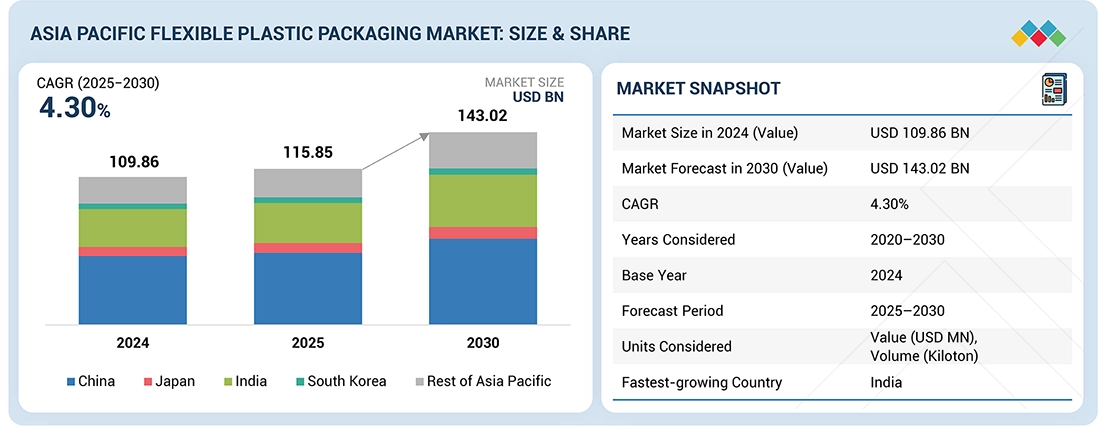
Source: Secondary Research, Interviews with Experts, MarketsandMarkets Analysis
The Asia Pacific flexible plastic packaging market is projected to grow from USD 115.85 billion in 2025 to USD 143.02 billion by 2030, at a CAGR of 4.3% during the forecast period. Asia Pacific flexible plastic packaging is on the rise due to various factors which are related to each other. The high rates of urbanization and population growth are serving as major pressures on packaged food, beverages, and consumer products that are used on a daily basis. Increased disposable income and growth in middle-class population in countries such as China, India, and the Southeast Asian countries are increasing consumption of convenience and branded products. The increasing rate of e-commerce and organized retail is pushing the need to have lightweight, durable, and cost-effective packaging methods. The benefits associated with flexible plastic packaging include long shelf life, protection of the product, and convenience during transportation.
KEY TAKEAWAYS
-
By CountryChina is to hold the largest share in the market in 2024.
-
By MaterialBy material, the plastic segment accounted for the largest market share.
-
By Packaging TypeBy packaging type, pouches segment accounted for the largest market share, at a CAGR of 3.38%, in terms of value.
-
By Printing technologyBy printing technology, flexography segment accounted for the largest market share.
-
By ApplicationBy application, food segment accounted for the largest market share, at a CAGR of 5.77%, in terms of value.
-
Competitive Landscape-Key playersThe market is driven by strategic deals, product launches, and expansions from leading players such as Amcor Plc (Switzerland; has Asia Pacific presence), UFlex Limited (India), Huhtamaki India Ltd. (India), SCG Packaging (SCGP) (Thailand), and TOPPAN Inc. (Japan). These companies are focusing on expanding manufacturing capacity and launching sustainable flexible packaging solutions.
-
Competitive Landscape-StartupEcoplast Ltd. (India), DAIBOCHI MALAYSIA (Malaysia), FlexiPack (Thailand), among others, are focusing on sustainable flexible plastic packaging and lightweight solutions
The food and beverage, pharmaceutical, and personal care sectors are also expanding, which is also contributing to an increase in the market growth. High-barrier films and smart packaging are developing with the help of technological advances improving the performance of the product. The market is also growing positively with the increasing utilisation of recyclable and mono-material packaging solution.
TRENDS & DISRUPTIONS IMPACTING CUSTOMERS' CUSTOMERS
The Asia Pacific flexible plastic packaging market is in a fast changing state due to the implementation of mono-material structure, development of advanced barrier technology, and EPR-compatible designs. Digital traceability, serialization, high-speed machinery and logistics productivity are driving more investment decisions in food, beverage, pharmaceutical, and personal care industries, and the volatility in resin prices still affects material choices. Such developments are increasing consumer value by increasing freshness, safety, convenience, sustainability awareness, and reduced transportation cost in key end-use categories.
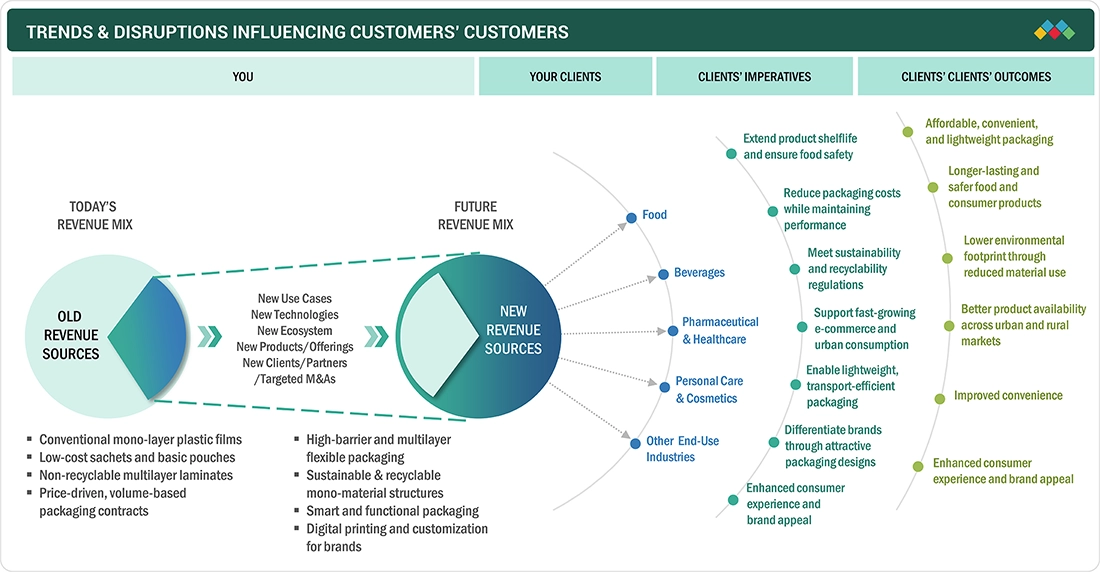
Source: Secondary Research, Interviews with Experts, MarketsandMarkets Analysis
MARKET DYNAMICS

Level
-
Rapid urbanization and rising consumer spending across major economies such as China, India, Indonesia, and Vietnam

-
Growth of e-commerce and online retail in Asia Pacific


Level
-
Environmental concerns and rising regulatory pressure

-
Volatility in raw material prices


Level
-
Growing adoption of recyclable and sustainable packaging

-
Rapid expansion of manufacturing capacity in emerging markets such as India, Vietnam, and Indonesia


Level
-
Intense market competition

-
Complexity in transitioning to sustainable alternatives

Source: Secondary Research, Interviews with Experts, MarketsandMarkets Analysis
Driver: Rapid urbanization and rising consumer spending across major economies such as China, India, Indonesia, and Vietnam
Asia Pacific is undergoing a tremendous urbanization, particularly in emerging economies like China, India, Indonesia and Vietnam. The rising middle-class populations and rising disposable income are putting pressure on the packaged food, personal care, and pharmaceutical products. The busy life in urban areas is compelling the demand towards a favor of a convenient, light, and easy-to-carry packaging format. Plastic packaging that is flexible can fulfil these requirements because it provides portability, long shelf life, and cost efficiency. Also, the growth of the organized retail and e-commerce platforms is further enhancing the growth of the market.
Restraint: Environmental concerns and rising regulatory pressure
Plastic waste has a significant environmental impact, which is a significant limitation to the Asia Pacific flexible plastic packaging market. Governments in the region are passing stringent policies against single-use plastics, recycling policies and producer responsibility (PRL). India, China, and Australia are some of the countries that are campaigning against plastic. These laws add to the compliance costs of manufacturers and ensure that some plastic materials are not used. Increased consumer awareness of sustainability is also acting against the brands that demand that they use less plastic.
Opportunity: Growing adoption of recyclable and sustainable packaging
The trend toward recyclable, biodegradable, and mono-material flexible packaging offers large growth opportunities. Owners of brands are shifting toward sustainable packaging solutions to address regulatory compliance and consumer demands. Recyclable films, bio-based plastics, and new recycling technologies also drive the market the Asia Pacific. Firms that are investing in rPET, rPE, and circular packaging are gaining a competitive advantage. This shift is likely to generate new sources of revenue and sustained market growth.
Challenge: Intense market competition
The flexible plastic packaging market in Asia Pacific is quite competitive with both global and many regional manufacturers. The sensitivity of prices in the new markets increases competition and exerts pressure on the profit margins. Cost competition is also a common practice among small and mid-sized players, which creates a challenge of differentiation. The speed of technological progress demands constant investment in machines and resources as well. To ensure quality, sustainability and also to be cost-efficient simultaneously is a major challenge that market players are grappling with.
ASIA PACIFIC FLEXIBLE PLASTIC PACKAGING MARKET: COMMERCIAL USE CASES ACROSS INDUSTRIES
| COMPANY | USE CASE DESCRIPTION | BENEFITS |
|---|---|---|
 |
UFlex Ltd., one of India’s leading flexible plastic packaging producers, developed an advanced multi-layer packaging solution for a major FMCG client aiming to improve product shelflife, reduce costs, and enhance brand visibility. By replacing the client’s traditional mono-layer packaging with high-barrier films, optimized laminates, and customized printing, UFlex delivered stronger protection against moisture, improved durability, and more attractive visuals suitable for India’s varied climate conditions. This upgrade reduced product spoilage, improved logistics efficiency, and supported wider distribution across the country. The project highlighted UFlex’s end-to-end innovation capabilities. | Improves product shelf life and freshness through high-barrier packaging that protects against moisture, oxygen, and contamination. Reduces material usage and overall packaging cost by replacing heavier rigid formats with lightweight flexible solutions. Enhances brand visibility and consumer appeal using advanced printing technologies that deliver superior clarity, color vibrancy, and design flexibility. |
Logos and trademarks shown above are the property of their respective owners. Their use here is for informational and illustrative purposes only.
MARKET ECOSYSTEM
The Asia Pacific flexible plastic packaging market is a highly connected ecosystem involving the raw material suppliers, the packaging manufacturers, distributors, and the end users. Polymer and resins manufacturers are the suppliers of raw materials including polyethylene, polypropylene and PET, which are regarded as the key inputs in the production of films, bags, and pouches. These materials are then converted by packaging manufacturers and converters into complete flexible packaging formats such as stand-up pouches, sachets, shrink films, wraps and mailing bags using advanced converting and printing equipment. The distributors and wholesalers are also important as they make sure that the standardized and customized packaging solutions are available in various regional markets. The overall demand is being driven by end users, especially the food, beverage, pharmaceutical, personal care, and retail users.
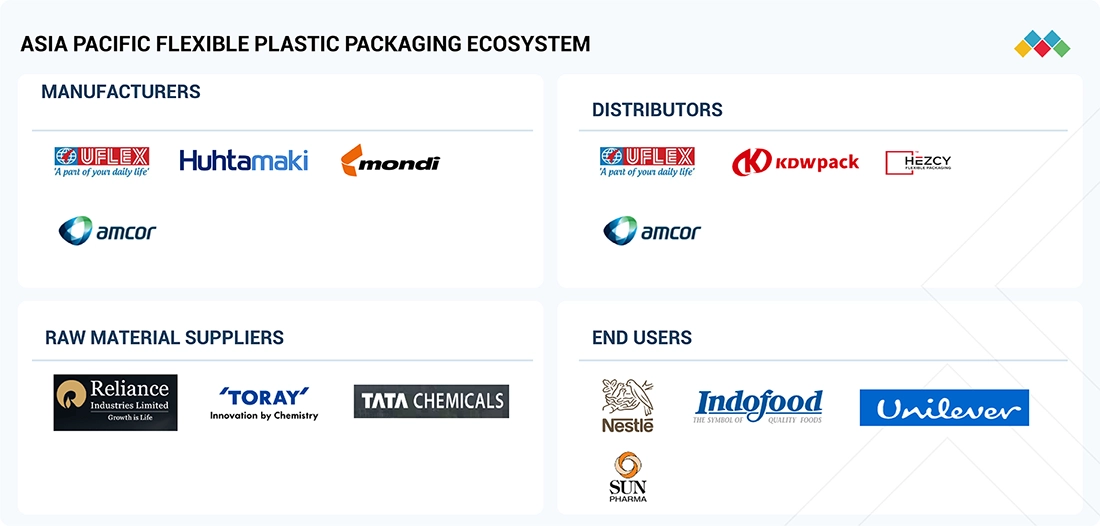
Logos and trademarks shown above are the property of their respective owners. Their use here is for informational and illustrative purposes only.
MARKET SEGMENTS
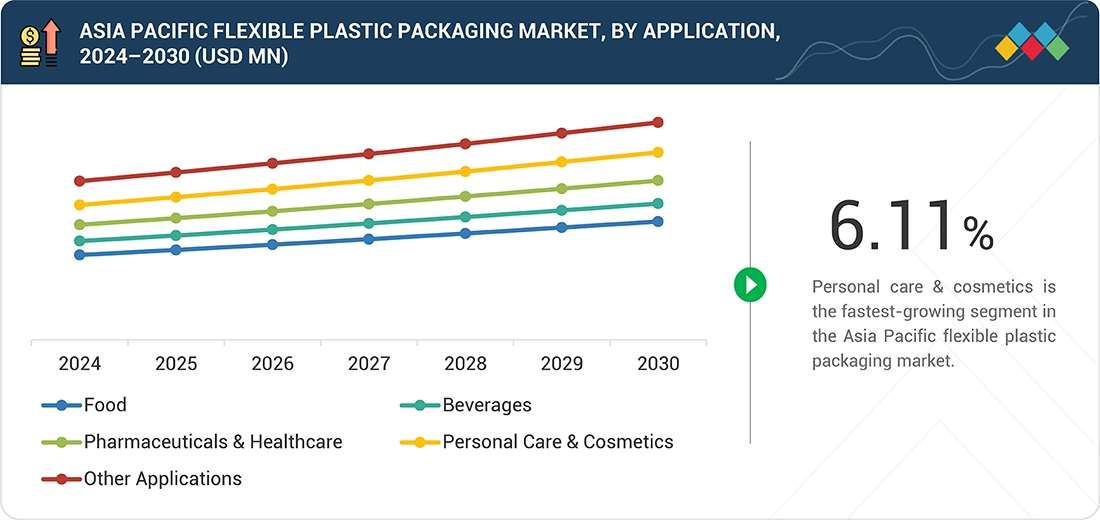
Source: Secondary Research, Interviews with Experts, MarketsandMarkets Analysis
Asia Pacific Flexible Plastic Packaging Market, by Material
The plastic material segment holds the largest share in the Asia Pacific flexible plastic packaging market, driven by its versatility, lightweight and cost-effectiveness. PET, polyethylene, and polypropylene are plastics that have good barrier properties to moisture and oxygen, hence can be used in a wide variety of applications. Their adaptability accommodates various packages such as pouches, wraps and films. It is easily processable and compatible with high-speed manufacturing lines increases adoption even more. Moreover, there has been a sustainable demand in the region through continued innovation of recyclable and mono-material plastics.
Asia Pacific Flexible Plastic Packaging Market, by Packaging Type
The pouches segment holds the largest share in the Asia Pacific flexible plastic packaging market, as it offers convenience and is more portable and offers efficient protection to the product. Food, beverages, personal care, and household products. Stand-up and spouted pouches are gaining more popularity. Pouches consume less material than rigid packaging, which means decreased costs and transportation costs. They are lightweight and hence enhance better logistics and reduce carbon footprint. Appealing shelf appearance and high printing quality further encourage a massive adoption.
Asia Pacific Flexible Plastic Packaging Market, by Printing Technology
Flexography dominates in the Asia Pacific as the leading printing technology, as it is a fast printing process and economical. It works better on big-volume packaging runs that are usually necessary for FMCG and food manufacturers. Flexography is compatible with printing on plastic films and flexible substances. The technology allows rapid drying of inks and high-quality prints, which minimize downtimes and wastes. The flexographic plates and inks have also been constantly improved, which has given an improved clarity to the images and color consistency.
Asia Pacific Flexible Plastic Packaging Market, by Application
The food segment is expected to have a significant market share in the Asia Pacific flexible plastic packaging market due to increased intake of packaged and processed food. The accelerating urbanization and lifestyle changes are escalating the need toward ready-to-eat, frozen, and snacks foods. Plastic packaging that is flexible has longer shelf life and contamination protection that is essential in food safety. Expanding e-commerce and food delivery services also increase the demand for packaging. Moreover, the increasing levels of middle-class populations as well as the evolving retail infrastructure in the region still favor the growth of the market.
REGION
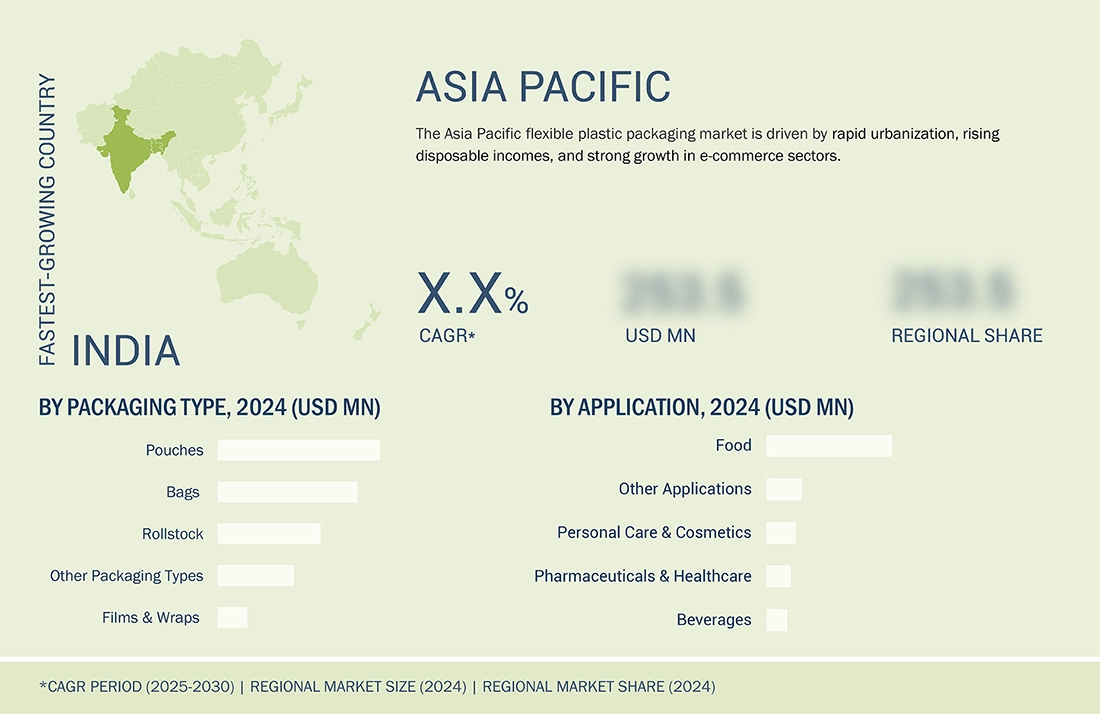
China to be largest market in Asia Pacific flexible plastic packaging market during forecast period
China is expected to dominate the Asia Pacific flexible plastic packaging market throughout the forecast period, driven by a huge consumer base and demand for food, beverage, and personal care types of industries. The flexible packaging business has high volume and low-cost production facilitated by the well-established manufacturing ecosystem and mass production capabilities of polymer in the country. The development of e-commerce and online food delivery is growing at a rapid pace, and this growth is driving more demand for lightweight yet durable and protective packaging systems. Also, continuous investment in high barrier films, new printing technologies, and recycling facilities is enhancing domestic capacities. The government policies that provide a positive environment in the area through encouraging the use of modern packaging and garbage management also contribute to the dominance of China in the regional market.
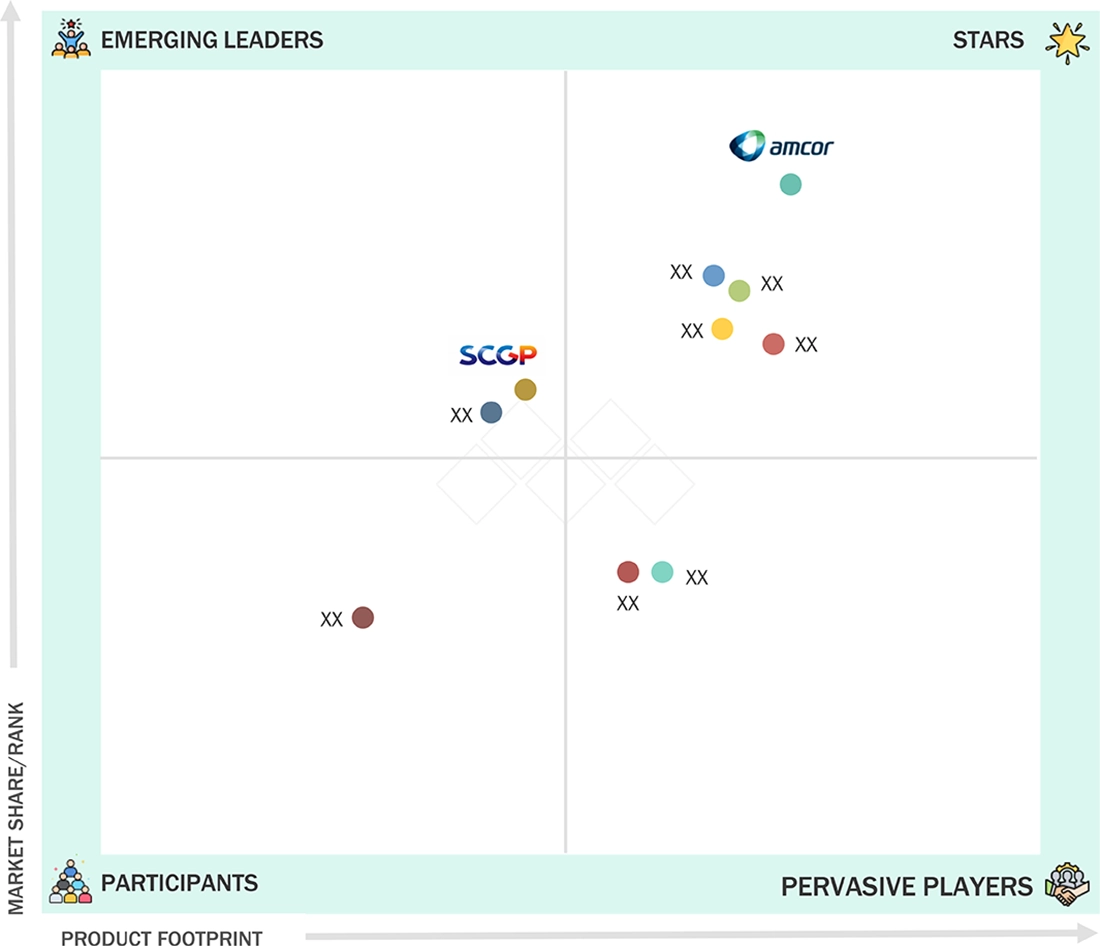
ASIA PACIFIC FLEXIBLE PLASTIC PACKAGING MARKET: COMPANY EVALUATION MATRIX
The Asia Pacific flexible plastic packaging market features a matrix of major players. Amcor (Star) leads with its wide regional presence, sustainable packaging innovations. SCG Packaging (Emerging Leader) is building momentum in the market as it is expanding its flexible packaging capacity throughout Southeast Asia and investing more in flexible packaging technologies that are recyclable and environmentally friendly.
Source: Secondary Research, Interviews with Experts, MarketsandMarkets Analysis
KEY MARKET PLAYERS
- UFlex Limited (India)
- Rengo Co., Ltd (Japan)
- Huhtamaki India Ltd. (India)
- Scientex Berhad (Malaysia)
- Amcor Plc (Switzerland)
- SCG Packaging (Thailand)
- Mondi (UK)
- TOPPAN Inc. (Japan)
- Guangdong Changxing Printing Service Co., Ltd. (China)
- TCPL Packaging Ltd. (India)
- Cosmo Films (India)
MARKET SCOPE
| REPORT METRIC | DETAILS |
|---|---|
| Market Size in 2024 (Value) | USD 109.86 Billion |
| Market Forecast in 2030 (Value) | USD 143.02 Billion |
| Growth Rate | CAGR of 4.3% from 2025-2030 |
| Years Considered | 2020-2030 |
| Base Year | 2024 |
| Forecast Period | 2025-2030 |
| Units Considered | Value (USD Billion), Volume (Kiloton) |
| Report Coverage | Revenue forecast, company ranking, competitive landscape, growth factors, and trends |
| Segments Covered |
|
| Countries Covered | China, Japan, India, South Korea, and Rest of Asis Pacific |
WHAT IS IN IT FOR YOU: ASIA PACIFIC FLEXIBLE PLASTIC PACKAGING MARKET REPORT CONTENT GUIDE
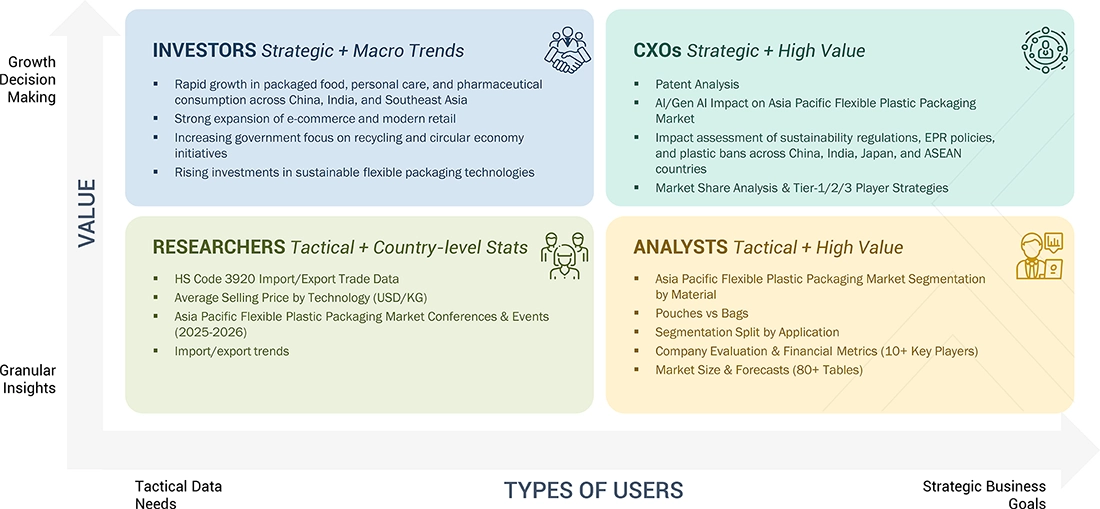
DELIVERED CUSTOMIZATIONS
We have successfully delivered the following deep-dive customizations:
| CLIENT REQUEST | CUSTOMIZATION DELIVERED | VALUE ADDS |
|---|---|---|
| Detailed study on North America Flexible Plastic Packaging Market | Study conducted on US, Canada, and Mexico | Identified market opportunities in the region |
| Detailed study on Europe Flexible Plastic Packaging Market | Study conducted on Germany, France, UK, Italy, Russia, Spain, Austria, Poland, and Rest of Europe | Identified market opportunities in the region |
RECENT DEVELOPMENTS
- March 2025 : UFlex Ltd. invested ?317 crore (USD 3.5 million) in advanced recycling technologies, including the establishment of two new recycling facilities in Noida. Together, these plants have a combined annual capacity to process 39,600 metric tons of plastic waste and will substantially increase the production of rPET and rPE materials for food-grade packaging applications.
Table of Contents
 Exclusive indicates content/data unique to MarketsandMarkets and not available with any competitors.
Methodology
The study involved four major activities for estimating the current size of the Asia Pacific Flexible Plastic Packaging Market. Exhaustive secondary research was conducted to collect information on the market, the peer product market, and the parent product group market. The next step was to validate these findings, assumptions, and sizes with the industry experts across the value chain of flexible plastic packaging through primary research. Both the top-down and bottom-up approaches were employed to estimate the overall size of the Asia Pacific Flexible Plastic Packaging Market. After that, market breakdown and data triangulation procedures were used to determine the size of different segments and sub-segments of the market.
Secondary Research
In the secondary research process, various secondary sources such as Hoovers, Factiva, Bloomberg BusinessWeek, and Dun & Bradstreet were referred, to identify and collect information for this study on the Asia Pacific Flexible Plastic Packaging Market. These secondary sources included annual reports, press releases & investor presentations of companies; white papers; certified publications; articles by recognized authors; regulatory bodies, trade directories, and databases.
Primary Research
The Asia Pacific Flexible Plastic Packaging Market comprises several stakeholders in the supply chain, which include raw material suppliers, processors, end-product manufacturers, buyers, and regulatory organizations. Various primary sources from the supply and demand sides of the markets have been interviewed to obtain qualitative and quantitative information. The primary participants from the demand side include key opinion leaders, executives, vice presidents, and CEOs of companies in the Asia Pacific Flexible Plastic Packaging Market. Primary sources from the supply side include associations and institutions involved in the flexible plastic packaging industry, key opinion leaders, and processing players.
Market Size Estimation
The bottom-up and top-down approaches have been used to estimate the Asia Pacific Flexible Plastic Packaging Market by packaging type, material, application, printing technology, and region. The research methodology used to calculate the market size includes the following steps:
- The key players in the industry and markets were identified through extensive secondary research.
- In terms of value, the industry’s supply chain and market size were determined through primary and secondary research processes.
- All percentage shares, splits, and breakdowns were determined using secondary sources and verified through primary sources.
- All possible parameters that affect the markets covered in this research study were accounted for, viewed in extensive detail, verified through primary research, and analyzed to obtain the final quantitative and qualitative data.
- The research included studying reports, reviews, and newsletters of top market players and extensive interviews with leaders such as directors and marketing executives to obtain opinions.
Data Triangulation
After arriving at the overall size of the Asia Pacific Flexible Plastic Packaging Market from the estimation process explained above, the total market was split into several segments and sub-segments. The data triangulation and market breakdown procedures were employed, wherever applicable, to complete the overall market engineering process and arrive at the exact statistics for all segments and subsegments. The data was triangulated by studying various factors and trends from both the demand and supply sides. Along with this, the market size was validated using both the top-down and bottom-up approaches.
Market Definition
Flexible plastic packaging refers to any packaging or any constituent part of packaging made from a thin, flexible plastic film or sheet. These can be molded into an infinite amount of shapes, including a pouch, bag, wrapper, shrink film, tube, or liner with the ability to hold all kinds of products. Its adaptability makes way for effective, space-efficient designs and can bend to various sizes and shapes. It is highly utilized in a wide array of industries for functional as well as aesthetic packaging solutions. Flexible packaging is a dynamic approach in packaging wherein products are packed in non-rigid materials to provide economical as well as customized solutions. Probably, flexible plastic packaging is among the most versatile, lightweight, and rigid packing options in use today. This innovative solution gives good barrier properties, shielding the products from moisture, oxygen, light, and any other environmental factors that can contribute to degradation and shortening of shelf life. The flexible plastic packaging is mostly used in food and beverages, pharmaceutical, and personal care industries. It ensures the protection of a product, reduces waste, and facilitates ease in terms of portability for consumers.
Stakeholders
- Flexible plastic packaging manufacturers
- Raw Material Suppliers
- Regulatory Bodies and Government agencies
- Flexible Packaging Traders, Distributors, and Suppliers
- Flexible Packaging End-use Industries
- Associations and Industrial Bodies
- Market Research and Consulting Firms
Report Objectives
- To define, describe, and forecast the size of the Asia Pacific Flexible Plastic Packaging Market in terms of value and volume.
- To provide detailed information regarding the key factors influencing the growth of the market (drivers, restraints, opportunities, and challenges).
- To forecast the market size based on material, packaging type, application, printing technology, and region.
- To strategically analyze micro markets with respect to individual growth trends, prospects, and contributions to the total market.
- To analyze the opportunities in the market for stakeholders and provide details of the competitive landscape for the market leaders.
- To strategically profile leading players and comprehensively analyze their key developments such as new product launches, expansions, and acquisitions in the Asia Pacific Flexible Plastic Packaging Market.
- To strategically profile key players and comprehensively analyze their market shares and core competencies2
- To study the impact of AI/Gen AI on the market under study, along with the macroeconomic outlook.


Personalize This Research
- Triangulate with your Own Data
- Get Data as per your Format and Definition
- Gain a Deeper Dive on a Specific Application, Geography, Customer or Competitor
- Any level of Personalization
Let Us Help You
- What are the Known and Unknown Adjacencies Impacting the Asia Pacific Flexible Plastic Packaging Market
- What will your New Revenue Sources be?
- Who will be your Top Customer; what will make them switch?
- Defend your Market Share or Win Competitors
- Get a Scorecard for Target Partners

Custom Market Research Services
We Will Customise The Research For You, In Case The Report Listed Above Does Not Meet With Your Requirements
Get 10% Free CustomisationTESTIMONIALS
We at Nissan Chemicals Corporation have been clients of MarketsandMarkets for more than a year now. We recently consulted MarketsandMarkets for a study, the team at MarketsandMarkets was extremely professional and organized. The business insights were very detailed and aligned well with our expectations that really helped us formulate the Business Plans and device new strategies for development themes. MarketsandMarkets offers a unique combination of expertise and dedicated engagement model. Their research findings have helped us in designing our Pricing Strategy which will make it easier for us to predict the future sales and profits for the next ten years. We look forward to working with MarketsandMarkets in the future.
VP of Strategy & New Business Development
Leading Specialty Chemical Company
The MarketsandMarkets Engagement Model, composed of both the Knowledge Store and advisory custom research, has greatly helped us in understanding our markets and making strategic decisions. The Knowledge Store is a fast way to allow everyone in our organization to understand more about most any market they are interested in. The ability to then get custom research done and get answers to specific strategic questions and market insight has been spectacular. The Markets and Markets team feel more like colleagues than vendors and their services have helped us change our culture where statements of things like growth opportunities and competitive position are always backed by industry research.

Rich Gibson,
Director, Corporate Strategy
Milliken & Company,
Leading Industrial Manufacturer of specialty chemical, floor covering, performance and protective textile materials, and healthcaremilliken.com
MarketsandMarkets is a trusted resource that helps us to better understand markets that are near-adjacencies-whether its technology, value chain or geography. Their Knowledge Store platform provides a dashboard of markets and their characteristics which is easy to use and saves us time.
Adam Shaw,
Market Development and Strategy Manager
AdvanSix Inc. USA,
An American Leader in Chemicalswww.advansix.com
The Knowledge Store from MarketsandMarkets is a valuable tool which has helped my team acquire greater insight in to the end markets that our business serves. This has enabled us to help our company build stronger strategies throughout our planning process.
TOSHIO KINOSHITA
Senior Chif Consultion Research & Consulting Division
Mitsubishi Chemical Research Corporation,
Leading Manufacturer of Chemical Productswww.mitsubishichem-res.co.jp/en/

We recently engaged with MarketsandMarkets for a study, the team not only clearly understood our business objectives but was also extremely professional in the way they handled the entire project. The study was efficiently conducted in a phase-wise manner, and the engagement model furnished us with high-quality business insights that far exceeded our expectations at each phase. We were especially happy that MarketsandMarkets could provide us with both, an English as well as a Japanese version of the study. A special thanks to the Analyst Team and Client Services Team, whose fluency in Japanese enhanced our comfort level, as we could converse with them in our preferred language.
Independent entrepreneurs
Arrow Precision
We approached MarketsandMarkets for study on Proppants Market, and their work exceeded our expectations. The study conducted was comprehensive and enabled us to view the market through the various dimensions. In addition, the team was extraordinarily responsive throughout the process and resolved our queries on time. I strongly recommend MarketsandMarkets and will certainly consider them for additional market assessments we will need in the future.
Global engineering company, Japan
Deputy Manager,
Strategic Planning OfficeThe high-quality insights shared by the MarketsandMarkets team helped us understand the pharmaceutical plant designers in a specific geography. It also captured the risks that we may likely face in communicating with our potential partners. The study would enable us identify partners, which would impact our future growth.






Growth opportunities and latent adjacency in Asia Pacific Flexible Plastic Packaging Market