Asia Pacific HVDC Transmission Market

Asia Pacific HVDC Transmission Market by LCC, VSC, CCC, Converter Stations, Transmission Cables, Point-to-point Transmission, Back-to-back Stations, Multi Terminal Systems, Bulk Power Transmission, and Interconnecting Grids – Forecast to 2030




OVERVIEW
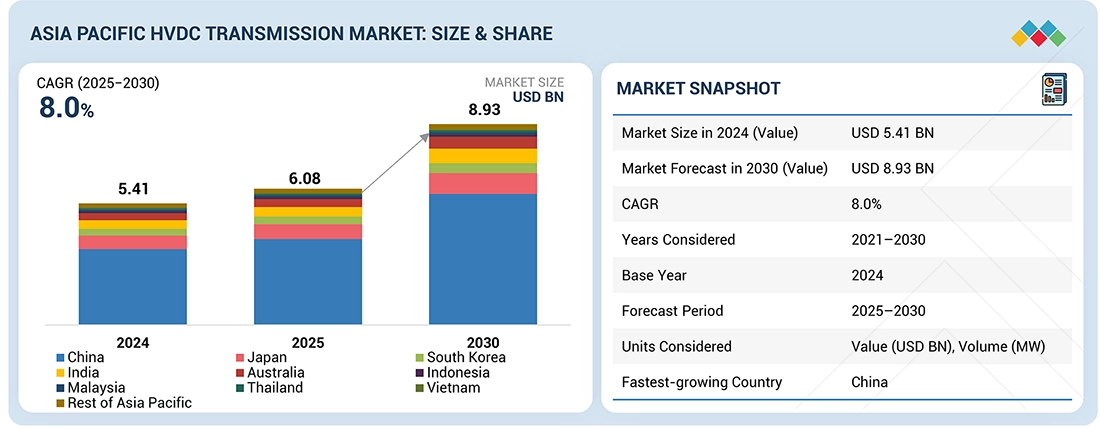
Source: Secondary Research, Interviews with Experts, MarketsandMarkets Analysis
The Asia Pacific HVDC transmission market is projected to grow from USD 6.08 billion in 2025 to USD 8.93 billion by 2030, at a CAGR of 8.0%. Rising investments in large-scale renewable energy projects, expanding long-distance transmission needs, and ongoing grid modernization initiatives are driving market growth. Additionally, increasing demand for efficient cross-border interconnections and reliable integration of offshore wind and remote solar resources is accelerating the adoption of HVDC technology across the region.
Market Size & Forecast
• 2025 Market Size: USD 6.08 Billion
• 2030 Projected Market Size: USD 8.93 Billion
• CAGR (2025-2030): 8.0%
• VSC Segment: Fastest Growth
• China: Growing CAGR
KEY TAKEAWAYS
-
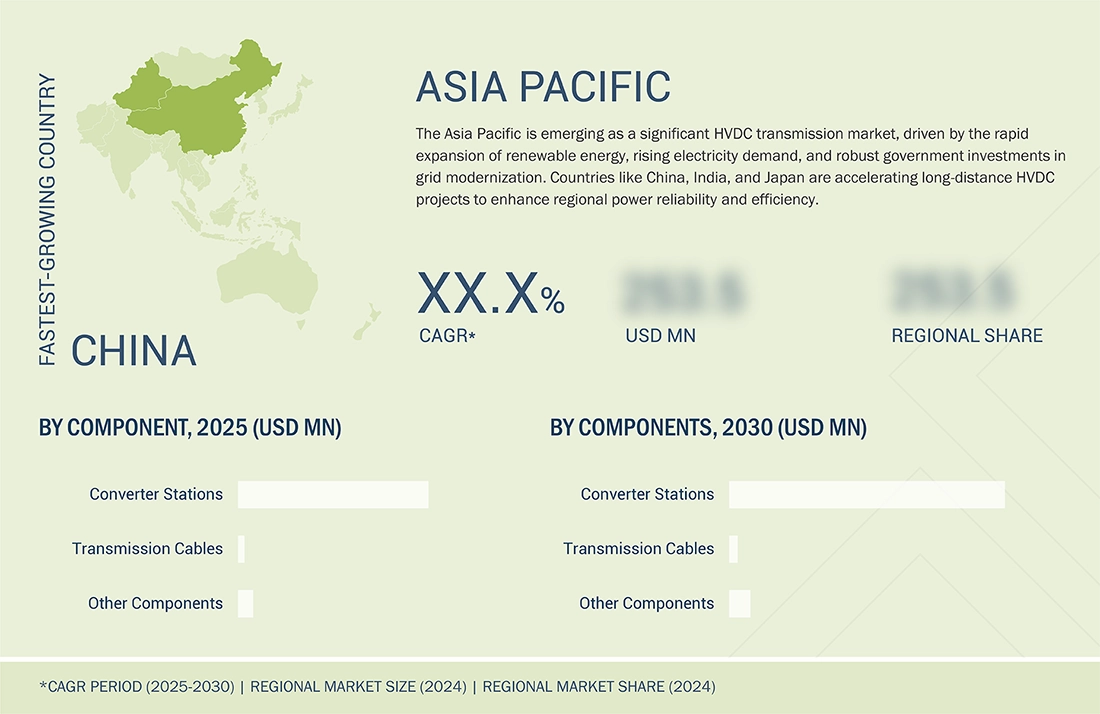
By CountryBy country, China is expected to dominate the market, growing at a CAGR of 8.8% during the forecast period.
-
By ComponentBy component, the converter station segment is expected to dominate the market.
-
By TechnologyBy technology, the VSC segment is expected to register the fastest growth.
-
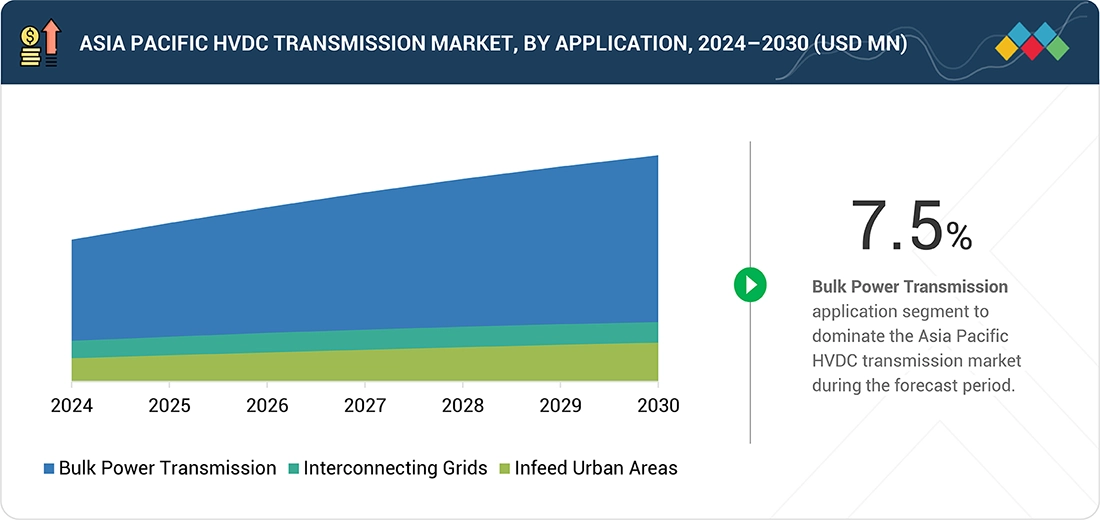
By ApplicationBy application, the bulk power transmission segment is expected to dominate the market.
-
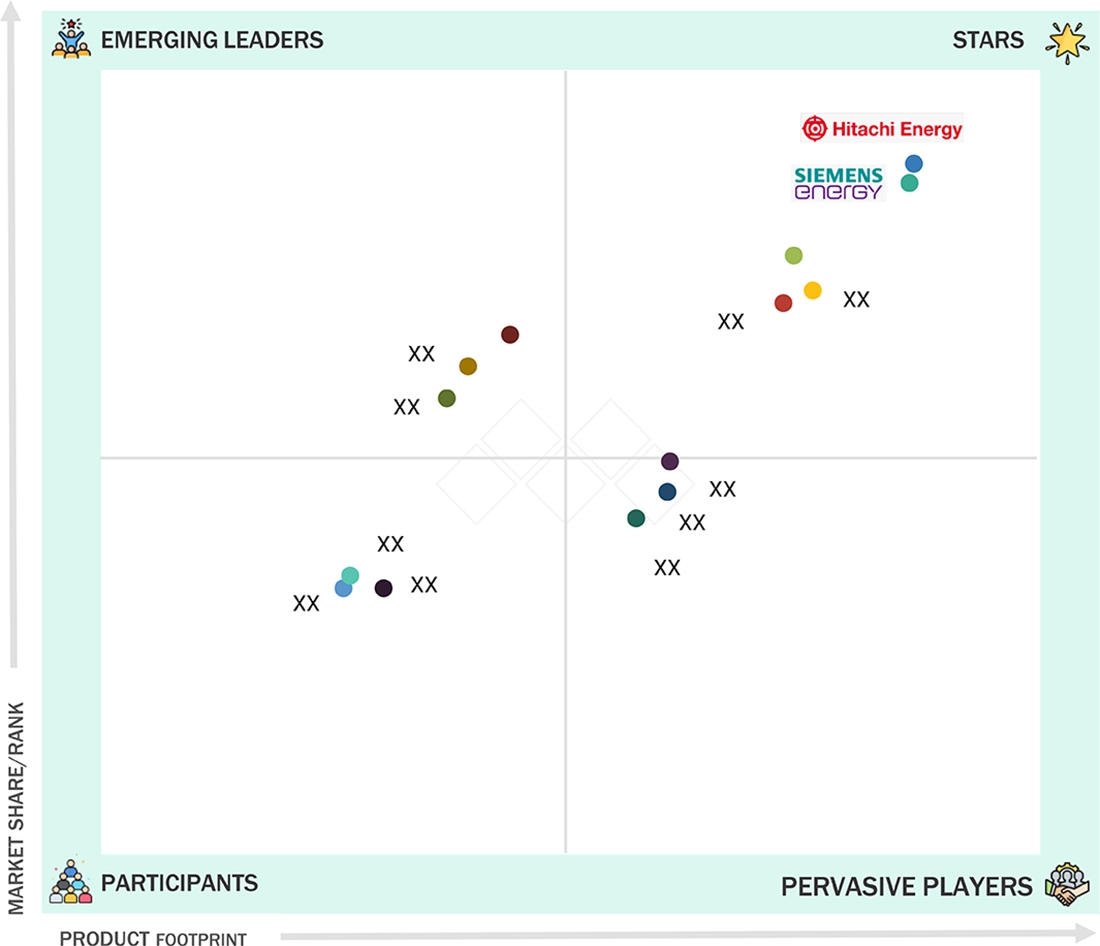
Competitive LandscapeCompanies such as Hitachi Ltd. and Siemens Energy are identified as some of the star players in the Asia Pacific HVDC transmission market, given their strong market share and product footprint.
-
Competitive LandscapeCompanies such as TBEA Co., Ltd., and EFACEC among others, have distinguished themselves among startups and SMEs by securing strong footholds in specialized niche areas, underscoring their potential as emerging market leaders
The Asia Pacific HVDC transmission market is experiencing steady growth, driven by the rising need for efficient long-distance power transmission, large-scale renewable energy integration, and strengthened grid stability across the region. Demand for advanced converter stations, high-capacity HVDC cables, and modern control & protection systems is increasing as governments prioritize grid modernization and decarbonization initiatives. Growing collaborations between HVDC technology providers, utilities, and EPC contractors, along with continued investment in ultra-high-voltage transmission corridors and offshore wind integration, are transforming the region’s power infrastructure and reshaping the Asia Pacific’s electricity transmission landscape.
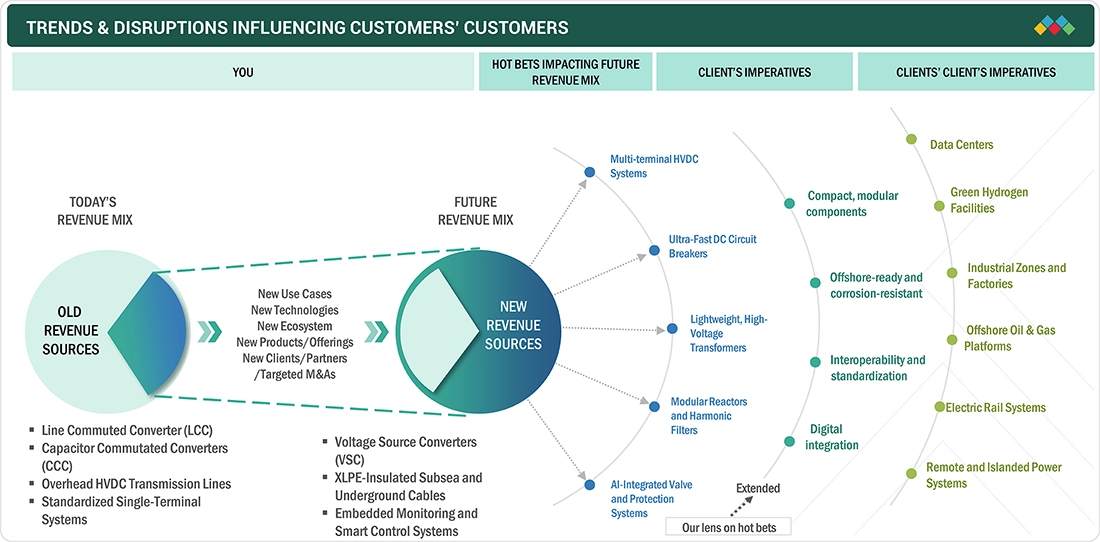
TRENDS & DISRUPTIONS IMPACTING CUSTOMERS' CUSTOMERS
The Asia Pacific HVDC transmission market is undergoing a significant revenue transformation, driven by the shift from legacy LCC and CCC systems to advanced VSC-based architectures with integrated smart monitoring and control. Manufacturers increasingly focus on developing compact, offshore-ready, digitally connected components to meet evolving grid demands. EPCs (Engineering, Procurement, and Construction) and TSOs (Transmission System Operator) prioritize standardized, low-maintenance solutions, while critical end users such as data centres, hydrogen production sites, and offshore platforms require highly reliable power infrastructure. Leading companies such as Hitachi Energy (Switzerland), Siemens Energy (Germany), Mitsubishi Electric (Japan), and GE Vernova (US) are at the forefront of innovation, developing next-generation HVDC technologies that support grid flexibility, high-voltage reliability, and digital integration. These dynamics are redefining global value chains and unlocking growth in high-value HVDC components.
Source: Secondary Research, Interviews with Experts, MarketsandMarkets Analysis
MARKET DYNAMICS

Level
-
Integration of VSC technology into HVDC systems

-
Global shift toward renewable energy sources


Level
-
High initial investment

-
Availability of substitute technologies


Level
-
Growing adoption of digital and automation technologies

-
Electrification of the transportation sector


Level
-
Interoperability issues due to lack of standardization

-
Complexities associated with obtaining necessary permits

Source: Secondary Research, Interviews with Experts, MarketsandMarkets Analysis
Driver: Integration of VSC technology into HVDC systems
The Asia Pacific HVDC market is gaining momentum with the increasing integration of Voltage Source Converter (VSC) technology, which enables greater flexibility, improved grid stability, and efficient power flow control. VSC-based HVDC systems are particularly beneficial for connecting offshore wind farms, remote renewable clusters, and weaker grids across the Asia Pacific, supporting the region’s push for modern, reliable, and resilient transmission infrastructure.
Restraint: High initial investment
High initial investment remains a significant restraint for the HVDC transmission market in the Asia Pacific, as the development of converter stations, advanced control systems, and long-distance transmission lines demands substantial upfront capital. Emerging economies often face budget limitations, making large-scale HVDC deployment challenging. Despite long-term cost savings and efficiency benefits, securing funding and justifying the initial expenditure can delay or restrict project execution.
Opportunity: Growing adoption of digital and automation technologies
The Asia Pacific HVDC transmission market is experiencing strong opportunities due to the rising adoption of digital and automation technologies, which enhance system monitoring, predictive maintenance, and operational reliability. Utilities across APAC are integrating smart grid solutions, advanced analytics, and AI-driven control systems to optimize HVDC performance. These innovations support higher renewable penetration, reduce downtime, and enable more efficient management of long-distance, high-capacity transmission networks.
Challenge: Interoperability issues due to lack of standardization
Interoperability challenges persist in the Asia Pacific HVDC market due to varying technical standards, regulatory frameworks, and equipment specifications across countries. The absence of uniform guidelines complicates cross-border power projects and the integration of multi-vendor systems. These gaps can lead to compatibility issues, higher engineering costs, and extended project timelines. Addressing standardization is essential to support seamless HVDC expansion and regional grid interconnection initiatives.
ASIA PACIFIC HVDC TRANSMISSION MARKET: COMMERCIAL USE CASES ACROSS INDUSTRIES
| COMPANY | USE CASE DESCRIPTION | BENEFITS |
|---|---|---|
 |
Utilizes HVDC components for large UHVDC corridors transmitting renewable energy from western provinces to high-demand eastern regions | Enables ultra-high-capacity transmission, reduces losses, and strengthens national clean-energy integration |
 |
Deploys HVDC converters, transformers, and cables for long-distance power transfer and renewable evacuation projects across India | Enhances grid stability, improves transfer efficiency, and supports large-scale renewable integration |
 |
Implements HVDC systems, including VSC components, for submarine cable links and interconnection between Japanese islands | Delivers stable power exchange, reduces grid congestion, and improves energy security |
 |
Uses HVDC converter stations and submarine cables for inter-island and offshore wind transmission projects | Provides efficient long-distance power transfer and supports expansion of offshore renewable capacity |
 |
Employs HVDC systems for offshore wind integration and to enhance interregional grid connectivity | Ensures reliable power delivery, supports renewable scaling, and minimizes grid variability |
Logos and trademarks shown above are the property of their respective owners. Their use here is for informational and illustrative purposes only.
MARKET ECOSYSTEM
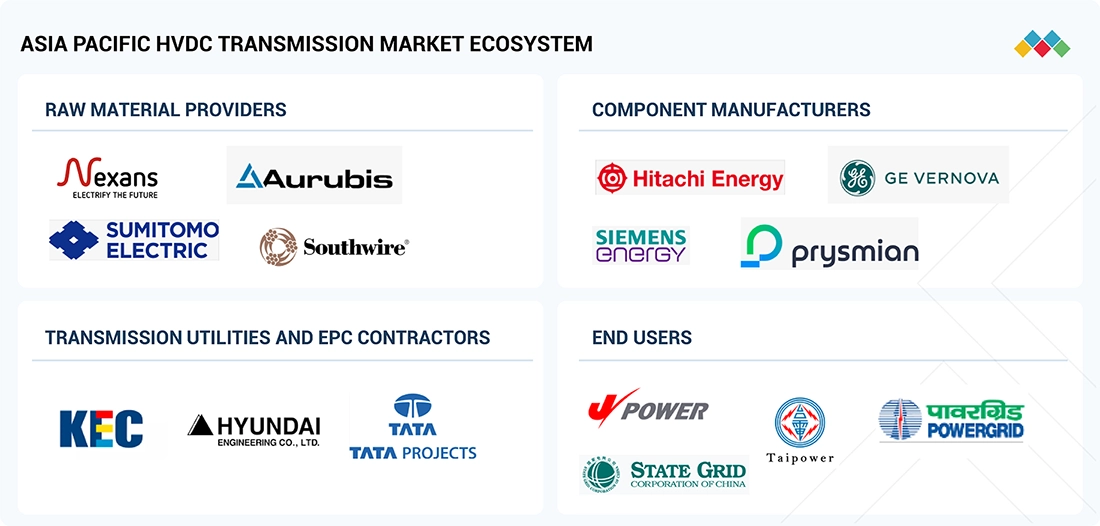
The Asia Pacific HVDC transmission ecosystem comprises raw material providers such as Nexans, Aurubis, Sumitomo Electric, and Southwire, along with leading component manufacturers including Hitachi Energy, Siemens Energy, GE Vernova, and Prysmian. Transmission utilities and EPC contractors like KEC International, Hyundai Engineering, and Tata Projects enable large-scale project execution. End users, including J Power, State Grid Corporation of China, Taipower, and Power Grid India, drive demand through investments in renewable integration and grid modernization.
Logos and trademarks shown above are the property of their respective owners. Their use here is for informational and illustrative purposes only.
MARKET SEGMENTS
Source: Secondary Research, Interviews with Experts, MarketsandMarkets Analysis
Asia Pacific HVDC Transmission Market, By Component
In 2024, converter stations remained the largest component segment in the Asia Pacific HVDC transmission market, driven by rising deployment of long-distance transmission corridors and large renewable integration projects. Their role in enabling efficient AC–DC conversion, grid stability, and flexible power flow makes them essential for offshore wind, cross-border interconnections, and ultra-high-voltage networks across China, India, Japan, and Southeast Asia. Increasing investments in VSC-based systems continue to strengthen segment dominance.
Asia Pacific HVDC Transmission Market, By Project Type
Point-to-point transmission remained the dominant project type in the Asia Pacific, driven by the region’s focus on high-capacity corridors that move renewable power from remote generation sites to major demand centres. Countries such as China and India rely on these links to efficiently transmit bulk energy across long distances. Their simpler configuration, lower cost, and proven reliability reinforce continued preference for point-to-point deployments.
Asia Pacific HVDC Transmission Market, By Technology
LCC technology maintained its position as the largest segment in the Asia Pacific due to widespread deployment in ultra-high-voltage DC projects in China and India. Its high power-handling capability and proven performance in long-distance bulk transmission make it the preferred technology for large interregional corridors. Continued expansion of UHVDC networks reinforces LCC’s leadership in the region.
Asia Pacific HVDC Transmission Market, By Application
Bulk power transmission continued as the largest application segment, supported by the region’s extensive long-distance power corridors that transport hydro, solar, and wind energy from the remote areas to industrial and urban load centres. China’s UHVDC projects and India’s renewable evacuation corridors exemplify the strong demand for high-capacity HVDC pathways across the Asia Pacific.
REGION
China to be fastest-growing country in Asia Pacific HVDC Transmission market during forecast period
The HVDC transmission market in the Asia Pacific experiences strong growth driven by the region’s rapid expansion of renewable energy capacity, increasing electricity demand, and rising need for efficient long-distance power transfer. Growing deployment of UHVDC corridors, offshore wind integration projects, and cross-border interconnections is supported by advancements in converter station technology, high-performance HVDC cables, and intelligent control systems. The presence of leading regional HVDC solution providers, accelerating investment in grid modernization, and expanding use of VSC-based systems for urban infeed and offshore applications continue to strengthen market growth across the region.
ASIA PACIFIC HVDC TRANSMISSION MARKET: COMPANY EVALUATION MATRIX
In the Asia Pacific HVDC transmission market matrix, Hitachi Ltd. (Star) and Siemens Energy (Star) lead with strong regional presence and advanced HVDC technology portfolios, driving large-scale adoption across renewable integration, cross-border transmission, urban infeed systems, and long-distance bulk power projects.
Source: Secondary Research, Interviews with Experts, MarketsandMarkets Analysis
KEY MARKET PLAYERS
- Hitachi, Ltd. (Japan)
- Siemens Energy (Germany)
- Mitsubishi Electric Corporation (Japan)
- GE Vernova (US)
- Prysmian Group (Italy)
- TOSHIBA CORPORATION (Japan)
- NKT A/S (Denmark)
- Nexans (France)
- LS ELECTRIC Co., Ltd. (South Korea)
- NR Electric Co., Ltd. (China)
MARKET SCOPE
| REPORT METRIC | DETAILS |
|---|---|
| Market Size in 2024 (Value) | USD 5.41 Billion |
| Market Forecast in 2030 (Value) | USD 8.93 Billion |
| Growth Rate | CAGR of 8.0% from 2025-2030 |
| Years Considered | 2021-2030 |
| Base Year | 2024 |
| Forecast Period | 2025-2030 |
| Units Considered | Value (USD Million/Billion), Volume (MW) |
| Report Coverage | Revenue forecast, company ranking, competitive landscape, growth factors, and trends |
| Segments Covered |
|
| Region Covered | Asia Pacific |
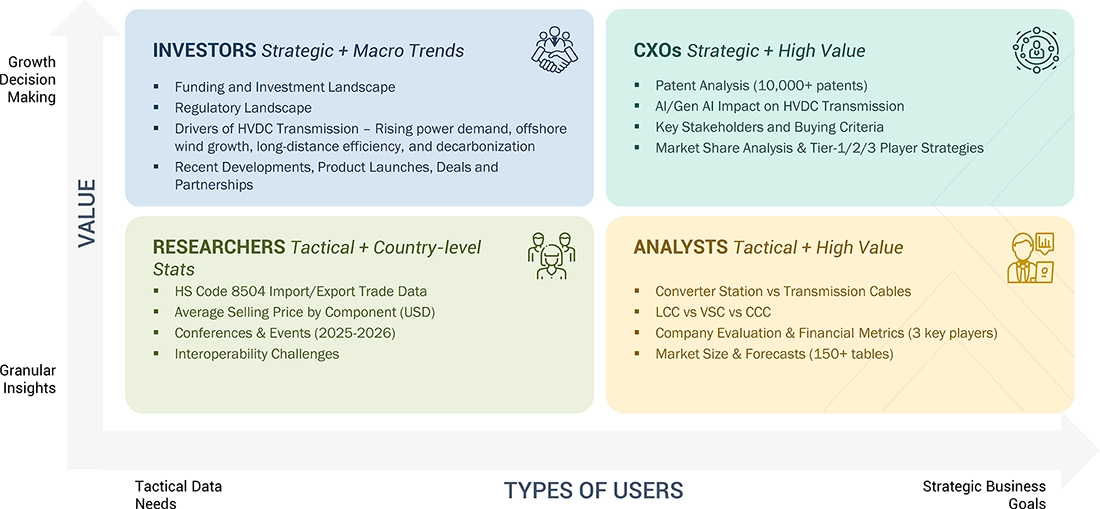
WHAT IS IN IT FOR YOU: ASIA PACIFIC HVDC TRANSMISSION MARKET REPORT CONTENT GUIDE
DELIVERED CUSTOMIZATIONS
We have successfully delivered the following deep-dive customizations:
| CLIENT REQUEST | CUSTOMIZATION DELIVERED | VALUE ADDS |
|---|---|---|
| HVDC Equipment Manufacturers |
|
|
| Transmission Utilities & Grid Operators |
|
|
| EPC Contractors & System Integrators |
|
|
| Cable & Material Suppliers |
|
|
| Energy Investors & Financial Institutions |
|
|
RECENT DEVELOPMENTS
- March 2025 : Prysmian Group (Italy) launched a 245?kV HVAC (High Voltage Alternating Current) dynamic cable system. This innovative solution is designed to enable efficient and reliable power transmission for floating offshore wind farms, addressing the mechanical and electrical challenges of dynamic subsea environments.
- August 2024 : Siemens Energy (Germany) partnered with Mitsubishi Electric Corporation (Japan) to jointly develop advanced DC switching station technologies and circuit breakers, enabling next-generation multi-terminal HVDC systems.
- May 2024 : Hitachi Energy Ltd. (Switzerland) entered a strategic collaboration with Grid United (US) under a capacity reservation agreement to deploy HVDC technology for interconnecting regional power grids in the US.
- COLUMN 'A' SHOULD BE IN TEXT FORMAT AND NOT DATE FORMAT :
Table of Contents
 Exclusive indicates content/data unique to MarketsandMarkets and not available with any competitors.
Methodology
The research study involved four major activities in estimating the size of the Asia Pacific HVDC Transmission Market. Exhaustive secondary research has been done to collect important information about the market and peer markets. The next step has been to validate these findings and assumptions and size them with the help of primary research with industry experts across the value chain. Both top-down and bottom-up approaches have been used to estimate the market size. After this, the market breakdown and data triangulation were adopted to estimate the market sizes of segments and sub-segments.
Secondary Research
In the secondary research process, various secondary sources were referred to identify and collect information required for this study. The secondary sources include annual reports, press releases, investor presentations of companies, white papers, and articles from recognized authors. Secondary research has been mainly done to obtain key information about the market's value chain, the pool of key market players, market segmentation according to industry trends, regional outlook, and developments from both market and technology perspectives..
The Asia Pacific HVDC Transmission Market report estimates the market size using both the top-down and bottom-up approaches, along with several other dependent submarkets. The major players in the market were identified using extensive secondary research, and their presence in the market was determined using secondary and primary research. All the percentage shares, splits, and breakdowns have been determined using secondary sources and verified through primary sources.
Primary Research
Extensive primary research has been conducted after understanding the Asia Pacific HVDC Transmission Market scenario through secondary research. Several primary interviews have been conducted with key opinion leaders from demand- and supply-side vendors across Asia Pacific. Approximately 25% of the primary interviews have been conducted with the demand-side vendors and 75% with the supply-side vendors. Primary data was collected mainly through telephonic interviews, which comprised 80% of the total primary interviews; questionnaires and emails were also used to collect the data.
After successful interaction with industry experts, brief sessions were conducted with highly experienced independent consultants to reinforce our primary research findings. This, along with the in-house subject matter experts' opinions, has led us to the findings as described in the report.
Market Size Estimation
In the market engineering process, both top-down and bottom-up approaches and data triangulation methods have been used to estimate and validate the size of the Asia Pacific HVDC Transmission Market and other dependent submarkets. The research methodology used to estimate the market sizes includes the following:
- Initially, focusing on top-line investments and spending in the ecosystem (segment-level splits and significant developments in the market have been considered)
- Identifying stakeholders in the Asia Pacific HVDC Transmission Market that influence the entire market and participants across the supply chain
- Analyzing major manufacturers and solution providers of HVDC transmission, as well as studying their product portfolios
- Analyzing trends related to the adoption of HVDC transmission components
- Tracking the recent and upcoming developments in the market that include investments, R&D activities, product launches, collaborations, mergers & acquisitions, and partnerships, as well as forecasting the market size based on these developments and other critical parameters
- Carrying out multiple discussions with key opinion leaders to identify the adoption trends of HVDC in the power transmission market
- Segmenting the overall market into various other market segments
- Validating the estimates at every level through discussions with key opinion leaders, such as chief executives (CXOs), directors, and operations managers, and finally with the domain experts at MarketsandMarkets
Data Triangulation
After arriving at the overall market size by the market size estimation process explained in the earlier section, the overall Asia Pacific HVDC Transmission Market has been divided into several segments and subsegments. The data triangulation and market breakdown procedures have been used to complete the overall market engineering process and arrive at the exact statistics for all segments, wherever applicable. The data has been triangulated by studying various factors and trends from both the demand and supply sides. Along with data triangulation and market breakdown, the market has been validated by top-down and bottom-up approaches.
Market Definition
HVDC Transmission refers to technologies and systems that enable the efficient transfer of electricity over long distances using high-voltage direct current. The market, segmented by components such as converter stations, transmission cables, and other components, represents a critical part of the global power transmission sector, enabling efficient, long-distance, and high-capacity electricity transfer. HVDC transmission systems efficiently deliver power over extended distances, employing overhead transmission lines, submarine cables, or underground cables. Using HVDC transmission technology for power is more economical than traditional AC lines, improving stability, reliability, and capacity. HVDC transmission systems are suited to such demands to address the ability to transmit electricity securely and stably between power networks operating at different frequencies. This asynchronous interconnection capability is precious for integrating renewable energy sources into the grid, as renewables often generate power at varying frequencies. Additionally, HVDC transmission systems provide operators with instantaneous and precise control over power flow, enhancing flexibility and suitability for modern power grid management.
Key Stakeholders
- HVDC Transmission Component Suppliers
- Electricity/Power Generating Companies.
- Electricity/Power Transmission Companies
- Electricity/Power Distribution Companies
- Power Grids Suppliers
- Power Project Consultants
- Government Procurement Organizations
- Turnkey Solution Providers
- Banks, Financial Institutions, Investors, and Venture Capitalists
- Research Organizations
- End Users
Report Objectives
- To describe and forecast the Asia Pacific high-voltage direct current (HVDC) transmission market by component, project type, technology, application, and region, in terms of value
- To describe and forecast the Asia Pacific high-voltage direct current (HVDC) transmission market by technology, in terms of volume
- To provide industry-specific information regarding the major drivers, restraints, opportunities, and challenges influencing the growth of the Asia Pacific HVDC Transmission Market
- To study the complete value chain and related industry segments for the Asia Pacific HVDC Transmission Market
- To strategically analyze the micromarkets concerning individual growth trends, prospects, and contributions to the total market
- To analyze trends/disruptions impacting customer business; pricing analysis; patents analysis; trade analysis (export and import scenario); tariff and regulatory landscape; Porter's five forces analysis; case studies; key stakeholders & buying criteria; technology analysis; ecosystem mapping; impact of artificial intelligence; impact of 2025 US tariff; and key conferences and events related to the Asia Pacific HVDC Transmission Market.
- To analyze opportunities in the market for various stakeholders by identifying the high-growth segments of the market
- To strategically profile the key players and comprehensively analyze their market position regarding ranking and core competencies, along with detailing the competitive landscape for the market leaders
- To analyze competitive developments, such as product launches/developments, expansions, acquisitions, partnerships, collaborations, agreements, and research and development (R&D) activities carried out by players in the Asia Pacific HVDC Transmission Market
Available Customizations:
With the given market data, MarketsandMarkets offers customizations according to the specific requirements of companies. The following customization options are available for the report:
Country-wise Information
- Country-wise breakdown for North America, Europe, Asia Pacific, and the Rest of the World
Company Information:
- Detailed analysis and profiling of additional market players (up to five)
Key Questions Addressed by the Report
What is the projected market value of the Asia Pacific HVDC Transmission market?
The Asia Pacific HVDC Transmission market is projected to reach a significant market value by the forecast period, driven by increasing investments in renewable energy integration and long-distance power transmission infrastructure.
Which region is expected to dominate the Asia Pacific HVDC Transmission market?
China is expected to dominate the Asia Pacific HVDC Transmission market due to large-scale grid expansion projects, high renewable energy capacity, and strong government support.
What are the key segments of the Asia Pacific HVDC Transmission market?
The market is segmented by component, technology, project type, and application, with converter stations and overhead transmission projects accounting for a major share.
Who are the major key players in the Asia Pacific HVDC Transmission market?
Major key players in the Asia Pacific HVDC Transmission market include ABB Ltd., Siemens Energy, Hitachi Energy Ltd., General Electric Company, and Mitsubishi Electric Corporation.
What factors are driving the growth of the Asia Pacific HVDC Transmission market?
The growth of the Asia Pacific HVDC Transmission market is driven by rising demand for efficient long-distance electricity transmission, increasing renewable energy projects, grid interconnection initiatives, and government investments in power infrastructure.


Personalize This Research
- Triangulate with your Own Data
- Get Data as per your Format and Definition
- Gain a Deeper Dive on a Specific Application, Geography, Customer or Competitor
- Any level of Personalization
Let Us Help You
- What are the Known and Unknown Adjacencies Impacting the Asia Pacific HVDC Transmission Market
- What will your New Revenue Sources be?
- Who will be your Top Customer; what will make them switch?
- Defend your Market Share or Win Competitors
- Get a Scorecard for Target Partners

Custom Market Research Services
We Will Customise The Research For You, In Case The Report Listed Above Does Not Meet With Your Requirements
Get 10% Free CustomisationTESTIMONIALS

Tetsuya Ohhira
Business Development Manager-Technology Business
Nikon Corporation,
Leading Japanese MNC specializing in optics and imaging productswww.nikon.com
MarketsandMarkets™ response
is quick. Their attitude is flexible and positive. Analyst Insights are globally considered and
significant. Client Services quickly respond to our inquiry and demand. Their wide range of global
surveys help us make our strategic plan.
We hope Knowledge Store will be easier to search
for a report.
VP - Marketing & Business Development
Leading Provider of Process Control Solutions
We engaged with MarketsandMarkets on a study to perform an analysis and recommend a Go-To-Market strategy for metrology and process control in the semiconductor market. The study was tailored to our targets and needs with well-defined milestones. Our overall experience with the MarketsandMarkets team was very good throughout the project in all aspects including the analysis methodologies used, the quality and depth of primary and secondary data sets, the professionalism and flexibility of the team and the ability to meet the target schedule and milestones. We want to thank MarketsandMarkets team for a job well done.






Growth opportunities and latent adjacency in Asia Pacific HVDC Transmission Market