Asia Pacific Hydrogen Storage Tanks and Transportation Market

Asia Pacific Hydrogen Storage Tanks and Transportation Market by Modular Storage System (Fuel Storage, Distribution Systems), Application (Vehicles, Railways, Marine, Stationary Storage, Trailers), Tank Type (Type 1, 2, 3, 4), Pressure - Forecast to 2030




OVERVIEW
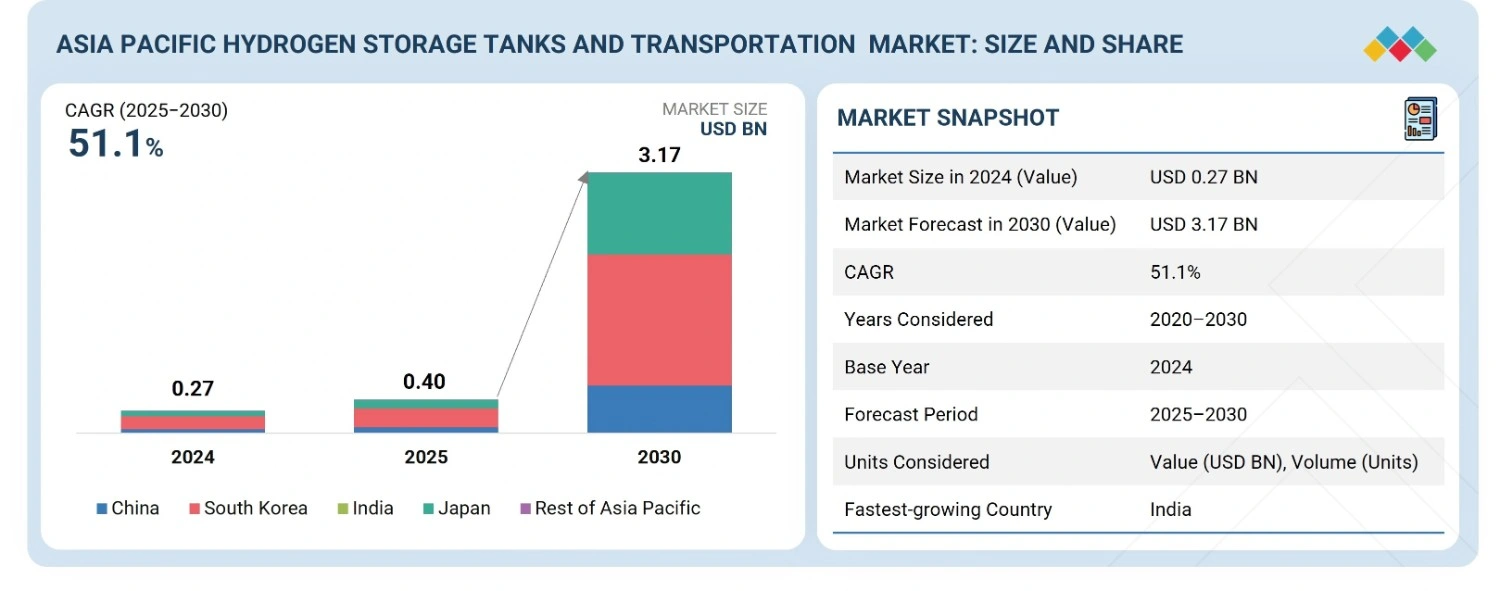
Source: Secondary Research, Interviews with Experts, MarketsandMarkets Analysis
The Asia Pacific hydrogen storage tanks and transportation market is projected to reach USD 3.17 billion by 2030 from USD 0.27 billion in 2024 at a CAGR of 51.1%, driven by increasing investments in hydrogen infrastructure, supportive government policies, and rising demand for hydrogen across mobility and industrial sectors. The market is supported by rapid industrialization, growing energy demand, and expansion of hydrogen production capacity across key countries such as China, Japan, and South Korea. Additionally, advancements in storage technologies, including modular and high-pressure systems, along with increasing focus on decarbonization and energy transition, are accelerating the need for efficient storage and long-distance transportation solutions. Expanding hydrogen supply chains and growing adoption of clean energy solutions further contribute to the development of the market across the region.
KEY TAKEAWAYS
-
BY MODULAR STORAGE SYSTEMHydrogen fuel storage systems accounted for a larger share of 93.8% of the Asia Pacific hydrogen storage tanks & transportation market, by modular storage system, in 2024.
-
By APPLICATIONVehicles applications are likely to record the highest CAGR of 52.3% during the forecast period due to the increasing adoption of fuel cell vehicles (FCVs) across passenger and commercial transportation, supported by government incentives and decarbonization targets.
-
BY TANK TYPEType 4 tank types accounted for the largest market share of 64.2% in 2024.
-
BY PRESSUREBased on pressure, the 200-500 bar segment is likely to record the highest CAGR during the forecast period.
-
BY COUNTRYIndia is expected to register the highest CAGR in the Asia Pacific hydrogen storage tanks & transportation market, driven by strong government initiatives, increasing investments in green hydrogen projects, and rising demand for clean energy across industrial and mobility sectors.
-
COMPETITIVE LANDSCAPE - KEY PLAYERSKey players such as Hexagon Purus (Norway), Worthington Enterprises (US), Plastic Omnium (France), Tenaris (US), and Luxfer Holdings PLC (UK) have formed strategic collaborations and project-based partnerships to explore hydrogen generation methods.
-
COMPETITIVE LANDSCAPE - STARTUPS/SMESDoosan Mobility Innovation (South Korea) and ALSAFE COMPANY (China) emerge as startups/SMEs in the Asia Pacific hydrogen storage tanks & transportation market, driven by their focus on innovative and low-carbon hydrogen solutions.
The Asia Pacific hydrogen storage tanks & transportation market is growing rapidly due to strong government support, increasing investments in hydrogen infrastructure, and rising demand from mobility and industrial sectors. Rapid industrialization, expanding hydrogen production capacity, and the need for efficient storage and transportation solutions are key drivers. Additionally, the region’s focus on decarbonization, energy security, and clean energy adoption is further accelerating market growth.
TRENDS & DISRUPTIONS IMPACTING CUSTOMERS' CUSTOMERS
The Asia Pacific hydrogen storage and transportation market is transitioning from traditional revenue streams based on compressed hydrogen storage (Type I/II steel tanks) and tube trailer transport toward advanced solutions such as liquid hydrogen (LH2) cryogenic storage and solid-state storage technologies. This shift is driven by the need for higher storage density, safer handling, and efficient long-distance hydrogen transport. At the same time, collaboration among hydrogen producers, industrial gas companies, EPC contractors, oil and gas firms, and logistics providers is supporting the development of scalable infrastructure, enabling reliable hydrogen supply, lower logistics costs, faster adoption, and stronger alignment with decarbonization initiatives.

Source: Secondary Research, Interviews with Experts, MarketsandMarkets Analysis
MARKET DYNAMICS

Level
-
Growing adoption of low-emission fuels

-
Rising deployment of hydrogen storage tanks in transportation applications


Level
-
Energy loss during hydrogen production

-
High cost of composite material-based tanks and strict regulatory approvals


Level
-
Advancements in storage technologies

-
Growing government programs to assist hydrogen economy growth


Level
-
High costs associated with blue hydrogen production

-
Safety concerns related to hydrogen storage and transportation

Source: Secondary Research, Interviews with Experts, MarketsandMarkets Analysis
Driver: Growing adoption of low-emission fuels
Low-emission fuels, including liquid and gaseous biofuels, as well as hydrogen and its derivatives, are pivotal for reducing emissions, particularly in sectors where direct electrification presents challenges or is economically unfeasible, such as heavy industry and long-distance transportation. Despite their significance, these cleaner fuel options only represented approximately 3% of global final energy consumption in 2023. Notably, hydrogen stands out for its cleaner combustion properties, containing less carbon than traditional fossil fuels and emitting fewer CO2 emissions. The production of hydrogen has been steadily increasing over time, propelled by the implementation of stricter environmental regulations and more demanding engine specifications.
Restraint: Energy loss during hydrogen production
Hydrogen's economic feasibility and environmental sustainability as an energy carrier are significantly impacted by energy loss during manufacturing. Hydrogen can be produced by a variety of techniques, including biomass gasification, electrolysis, and steam methane reforming (SMR). All methods have considerable energy requirements and related losses throughout the conversion processes, even if each one has its own unique benefits. In addition to raising operating expenses, the energy losses in hydrogen generation lessen the benefits hydrogen has for the environment as a clean energy source. Modern technology, more efficient processes, and the incorporation of renewable energy sources are all necessary to reduce these losses. The secret to boosting the efficiency of reactor designs, the creation of new materials, and catalyst optimization is research and development.
Opportunity: Advancements in storage technologies
Advancements in storage technologies can lead to increased efficiency in hydrogen tanks and transportation systems, allowing for better utilization of hydrogen as an energy carrier. Improved efficiency in hydrogen storage technologies and transportation systems is a crucial driver for the broader adoption of hydrogen as an energy carrier. These advancements enable more effective utilization of hydrogen, contributing to the overall viability and sustainability of hydrogen-based energy solutions. Storing hydrogen gas within metal cylinders via compression is a widely adopted method. However, it presents a significant challenge in the form of hydrogen embrittlement, which poses a considerable threat to the integrity of the storage vessels. Hydrogen embrittlement denotes the process by which hydrogen atoms permeate and weaken the structural integrity of the metal, leading to potential deterioration and safety hazards. As such, mitigating strategies are imperative to safeguard against this phenomenon and ensure the reliability and safety of hydrogen storage systems.
Challenges: High costs associated with blue hydrogen production
Green hydrogen is obtained from renewable resources or low-carbon power. Green hydrogen can assist energy-intensive, difficult-to-decarbonize industries and sectors, such as steel, chemical, transportation, shipping, and aviation, in achieving net-zero CO2 emissions. However, production prices must be reduced to make it affordable for all nations. Blue hydrogen, created from fossil fuels and carbon capture and storage, costs twice as much as green hydrogen (CCUS). CCUS is still the primary low-carbon hydrogen generation method. It is likely to remain the same as production costs are lower than for other low-carbon technologies, such as water electrolysis. Electrolysis is an established technology that has long been employed in some industrial processes, such as the creation of chlorine in the chlor-alkali process. The production of dedicated hydrogen has not yet gained widespread use. Currently, 30 kt of hydrogen is created exclusively through electrolysis yearly, or around 0.03% of all hydrogen produced. The level is low because electrolytic hydrogen production costs (USD 3– 8/kg H2) are higher than those from unrestricted fossil fuels (USD 0.5–1.7/kg H2).
ASIA PACIFIC HYDROGEN STORAGE TANKS AND TRANSPORTATION MARKET: COMMERCIAL USE CASES ACROSS INDUSTRIES
| COMPANY | USE CASE DESCRIPTION | BENEFITS |
|---|---|---|
 |
Nel Hydrogen aims to revolutionize hydrogen production and distribution for transit depots by implementing a novel approach. The company seeks to develop an efficient system that supports clusters of transit depot fueling sites. Specifically, it aims to produce green hydrogen at a low cost in regions that are abundant in renewable energy resources. This hydrogen will then be transported short distances to various fueling locations, facilitating easy swapping of full and empty trailers. The challenge lies in efficiently coordinating production, transportation, and distribution to meet the demands of multiple transit agencies while ensuring economic viability and environmental sustainability. | Nel Hydrogen's innovative strategy for low-cost green hydrogen production and efficient distribution presents a sustainable solution for supporting transit depot fueling sites. By installing an electrolyzer system with a capacity of 8,000 kg/day in an area abundant in renewable energy resources near the metro LA area, Nel secures a cost-effective Power Purchase Agreement (PPA) for hydrogen production. Transportation is optimized through the use of high-pressure trailers, facilitating uninterrupted supply to transit depots through seamless swapping and simultaneous filling at production and fueling sites. Leveraging renewable power ensures low carbon intensity, maximizing the value of Low Carbon Fuel Standard (LCFS) credits to offset operational costs. This approach is tailored to support four bus depots, each with a daily demand of 2,000 kg of hydrogen, thereby contributing to the transition toward clean energy transportation while addressing the specific challenges of transit depot fueling. Overall, Nel Hydrogen's integrated approach promises a sustainable and economically viable model for the hydrogen economy. |
 |
Honda Motor Company in Torrance, California, endeavored to create a smaller and more effective solar-hydrogen refueling station with the goal of making it suitable for household use. This station incorporates solar PV panels to generate electricity, enabling the production of hydrogen through electrolysis. While previous versions of Honda's refueling stations demonstrated progress in solar power technology, the newest iteration, introduced in early 2010, aimed to improve efficiency and affordability even further. Moreover, the station aimed to take advantage of emerging grid technologies such as net metering and smart grids to make the most efficient use of energy. | Honda Motor Company addressed the challenges and objectives by introducing a novel high-differential pressure electrolyzer in their new solar-hydrogen refueling station, eliminating the need for a compressor. This technological innovation resulted in a 25% improvement in system efficiency compared to previous iterations while simultaneously reducing the size and cost of critical components. The station's capacity and flow rate, albeit modest, were designed to produce 0.5 kg of hydrogen over an 8-hour period, deemed sufficient for a consumer with a consistent commute of 10,000 miles per year. Furthermore, the station was engineered to capitalize on net metering and anticipated smart grid advancements. By exporting surplus electrical power to the grid during daylight hours and drawing energy during off-peak times, the station optimally utilized resources, thereby enhancing sustainability and cost-effectiveness. Through this integrated approach, Honda Motor Company showcased a pioneering solution in sustainable transportation infrastructure, setting a benchmark for compact and efficient hydrogen refueling systems with potential household applications. |
Logos and trademarks shown above are the property of their respective owners. Their use here is for informational and illustrative purposes only.
MARKET ECOSYSTEM
The Asia Pacific hydrogen storage tanks & transportation ecosystem is structured across a well-integrated value chain, starting with raw material suppliers such as Owens Corning, Jushi, and PPG Industries, which provide critical inputs, such as composites and glass fiber, essential for high-pressure and lightweight storage solutions. These materials are utilized by storage tank providers, including Worthington Industries, Tenaris, and Hexagon Purus, who develop advanced hydrogen storage systems for various applications. The distribution layer is supported by players such as CATEC Gases, Pragma Industries, and Luxfer Gas Cylinders, enabling efficient movement of hydrogen through cylinders and transport systems. At the end-user level, companies including ElringKlinger, TotalEnergies, and Doosan drive demand through applications in mobility, energy, and industrial sectors, collectively contributing to the development of a scalable and efficient hydrogen storage and transportation infrastructure across the region.

Logos and trademarks shown above are the property of their respective owners. Their use here is for informational and illustrative purposes only.
MARKET SEGMENTS

Source: Secondary Research, Interviews with Experts, MarketsandMarkets Analysis
Asia Pacific Hydrogen Storage Tanks & Transportation Market, By Modular Storage System
By modular storage system, the market is segmented into hydrogen fuel storage systems and hydrogen distribution systems, with hydrogen fuel storage systems expected to register a higher CAGR, driven by increasing adoption of fuel cell vehicles and the growing need for efficient onboard hydrogen storage solutions across mobility applications.
Asia Pacific Hydrogen Storage Tanks & Transportation Market, By Application
By application, the market is segmented into vehicle, rail, and marine, with the vehicle segment expected to register the highest CAGR, driven by the rapid adoption of hydrogen fuel cell vehicles, supportive government incentives, and growing investments in hydrogen refueling infrastructure for both passenger and commercial mobility.
Asia Pacific Hydrogen Storage Tanks & Transportation Market, By Tank Type
By container storage capacity, the market is segmented into Type I, Type II, Type III, and Type IV, with Type IV holding the largest market share, driven by its lightweight composite structure, higher hydrogen storage efficiency, and growing adoption in mobility and high-pressure transport applications.
Asia Pacific Hydrogen Storage Tanks & Transportation Market, By Pressure
By pressure, the Asia Pacific hydrogen storage tanks & transportation market is segmented into below 200 bar, 200–500 bar, and above 500 bar segments, with the 200–500 bar segment is expected to register the highest CAGR, driven by its optimal balance between storage efficiency, safety, and cost-effectiveness for mobility and industrial applications.
REGION
China to be prominent market in Asia Pacific throughout forecast period
India is expected to register the highest CAGR in the Asia Pacific hydrogen storage tanks and transportation market, driven by strong government initiatives supporting green hydrogen development and increasing investments in clean energy infrastructure. Rising focus on hydrogen mobility, industrial decarbonization, and expansion of hydrogen production capacity are accelerating demand for efficient storage and transportation solutions. Additionally, supportive policy frameworks and growing investments in hydrogen supply chains are further contributing to market growth in the country.

ASIA PACIFIC HYDROGEN STORAGE TANKS AND TRANSPORTATION MARKET: COMPANY EVALUATION MATRIX
Hexagon Purus emerges as a star player in the Asia Pacific hydrogen storage tanks & transportation market, driven by its strong portfolio in lightweight composite cylinders, established partnerships, and growing presence in hydrogen mobility applications. Meanwhile, BNH Gas Tanks is emerging as a key leader, supported by its expanding product offerings and increasing focus on advanced storage solutions to cater to evolving hydrogen infrastructure needs.

Source: Secondary Research, Interviews with Experts, MarketsandMarkets Analysis
KEY MARKET PLAYERS
- Hexagon Purus (Norway)
- Worthington Enterprises (US)
- Plastic Omnium (France)
- Tenaris (US)
- Luxfer Holdings PLC (England)
- Marine Service Noord (Netherlands)
- UMOE Advanced Composites (Japan)
- BNH Gas Tanks LLP (India)
- Pragma Industries (France)
- Taizhan Strength Equipments Co., Ltd. (China)
- CALVERA HYDROGEN (Spain)
- Faber Italy (Italy)
- VAKO GMBH CO. KG (Germany)
- WELDSHIP (US)
- Advanced Structural Technologies (US)
- Mahytec (France)
- AMS Composite Cylinders (UK)
- Shijiazhuang Enric Gas Equipment Co., Ltd. (China)
- BayoTech (US)
- Doosan Mobility Innovation (South Korea)
- Quantum Fuel Systems LLC. (US)
- Steelhead Composites, Inc. (US)
- NPROXX (Netherlands)
- Composite Advanced Technologies, LLC. (US)
- ALSAFE COMPANY (China)
MARKET SCOPE
| REPORT METRIC | DETAILS |
|---|---|
| Market Size in 2024 (Value) | USD 0.27 BN |
| Market Forecast in 2030 (Value) | USD 3.17 BN |
| Growth Rate | CAGR of 51.1% from 2025-2030 |
| Years Considered | 2020-2030 |
| Base Year | 2023 |
| Forecast Period | 2025-2030 |
| Units Considered | Value (USD BN), Volume (Units) |
| Report Coverage | Revenue Forecast, Company Ranking, Competitive Landscape, Growth Factors, and Trends |
| Segments Covered | By Modular Storage System (Hydrogen Fuel Storage Systems and Hydrogen Distribution Systems), By Application (Vehicles, Railways, and Marine), By Tank Type (Type I, Type II, Type III, and Type IV), By Pressure (Below 200 Bar, 200-500 Bar, and Above 500 Bar) |
| Countries Covered | China, Japan, South Korea, India, and Rest of Asia Pacific |
WHAT IS IN IT FOR YOU: ASIA PACIFIC HYDROGEN STORAGE TANKS AND TRANSPORTATION MARKET REPORT CONTENT GUIDE

DELIVERED CUSTOMIZATIONS
We have successfully delivered the following deep-dive customizations:
| CLIENT REQUEST | CUSTOMIZATION DELIVERED | VALUE ADDS |
|---|---|---|
| Company profiling | Competitive Landscape & Key Player Benchmarking Customization |
|
RECENT DEVELOPMENTS
- June 2023 : Luxfer Gas Cylinders is advancing hydrogen cylinder technology for aviation applications, particularly for smaller aircraft and ground-support operations. The company is promoting the adoption of hydrogen storage systems as a cleaner alternative fuel solution, supporting the aviation sector’s transition toward lower carbon emissions. These initiatives align with the industry’s broader goal of achieving Jet Zero emissions by 2050, positioning hydrogen storage as a key enabler for more sustainable air transport.
- June 2023 : Plastic Omnium and Rein Hytech, a subsidiary of Shenergy Group, formed a 50/50 joint venture called PO-Rein. This cooperative company intends to expedite China's hydrogen development. The agreement is a strategic step to strengthen Plastic Omnium's footprint in the Chinese market, notably in the realm of hydrogen technology. By merging the experience of Plastic Omnium and Rein Hytech, the joint venture contributes to the development of high-pressure hydrogen containers, which is in line with China's rising need for hydrogen solutions.
- February 2023 : Hexagon Purus secured an order to deliver mobile hydrogen refueling stations and stationary storage solutions to Deutsche Bahn, the German national railway company. This development underscores the increasing importance of hydrogen as a clean and sustainable energy source for transportation. The order encompasses both mobile hydrogen refueling stations and stationary storage units, showcasing Hexagon Purus's versatility in providing comprehensive hydrogen.
- May 2022 : Plastic Omnium partnered with Hyliko, which provides solutions for transporters and logistics operators. The partnership's first phase includes an order for 315 high-pressure hydrogen vessels to equip 45 vehicles by the end of 2024. The companies also intend to collaborate on the development of new hydrogen storage systems, which will boost truck ranges by about 60%.
- December 2020 : Worthington Enterprises launched a bundle, Max9 Bundle. The new Max9 Bundle features a distinctive steel frame as well as a new cylinder configuration that boosts storage capacity by nearly a quarter while maintaining the traditional bundle footprint.
Table of Contents
 Exclusive indicates content/data unique to MarketsandMarkets and not available with any competitors.
Methodology
The study involved major activities in estimating the current size of the Asia Pacific Hydrogen Storage Tanks and Transportation Market. Exhaustive secondary research was done to collect information on the peer and parent markets. The next step was to validate these findings, assumptions, and sizing with industry experts across the value chain through primary research. Both top-down and bottom-up approaches were employed to estimate the total market size. Thereafter, market breakdown and data triangulation were used to estimate the market size of the segments and subsegments.
Secondary Research
This research study on the Asia Pacific Hydrogen Storage Tanks and Transportation Market involved the use of extensive secondary sources, directories, and databases, such as Hoover’s, Bloomberg, Factiva, IRENA, International Energy Agency, and Statista Industry Journal, to collect and identify information useful for a technical, market-oriented, and commercial study of the Asia Pacific Hydrogen Storage Tanks and Transportation Market . The other secondary sources included annual reports, press releases & investor presentations of companies, white papers, certified publications, articles by recognized authors, manufacturer associations, trade directories, and databases.
Primary Research
The Asia Pacific Hydrogen Storage Tanks and Transportation Market comprises several stakeholders, such as hydrogen storage tanks and transportation manufacturers, technology providers, and technical support providers in the supply chain. The demand side of this market is characterized by the rising demand for storage solutions in various applications such as energy, mobility, industrial, and transportation. The supply side is characterized by rising demand for contracts from the industrial sector and mergers & acquisitions among big players. Various primary sources from both the supply and demand sides of the market were interviewed to obtain qualitative and quantitative information. Following is the breakdown of primary respondents:

To know about the assumptions considered for the study, download the pdf brochure
Market Size Estimation
Both top-down and bottom-up approaches were used to estimate and validate the total size of the Asia Pacific Hydrogen Storage Tanks and Transportation Market. These methods were also used extensively to estimate the size of various subsegments in the market. The research methodology used to estimate the market size includes the following:
- The key players in the industry and market have been identified through extensive secondary research, and their market share has been determined through primary and secondary research.
- The industry’s value chain and market size, in terms of value, have been determined through both primary and secondary research processes.
- All percentage shares, splits, and breakdowns have been determined using secondary sources and verified through primary sources.
Asia Pacific Hydrogen Storage Tanks and Transportation Market : Top-Down and Bottom-Up Approach

Data Triangulation
After arriving at the overall market size from the above estimation process, the total market has been split into several segments and subsegments. Data triangulation and market breakdown processes have been employed to complete the overall market engineering process and arrive at the exact statistics for all the segments and sub-segments, wherever applicable. The data has been triangulated by studying various factors and trends from both the demand- and supply sides. Along with this, the market has been validated using both the top-down and bottom-up approaches.
Market Definition
Hydrogen can be stored or transported in cylinders, tubes, and cryogenic tanks as a compressed gas or cryogenic liquid for industrial usage or as a propellant in space missions. Hydrogen can be stored in three ways: as compressed gas in high-pressure tanks, as a liquid at -253°C in dewars, or in chemical form by reacting or adsorbing with chemicals or metal compounds. When resources run short, hydrogen stored in various forms can be recovered. In contrast to the energy held in batteries, which declines over time, hydrogen may be stored for extended periods.
Key Stakeholders
- Hydrogen Storage Tanks and Transportation Dealers and Suppliers
- Government and Research Organizations
- Power and Energy Associations
- Repairs and Maintenance Service Providers
- State and National Regulatory Authorities
- Research And Consulting Companies in the Clean Energy Generation Sector
- Organizations, Forums, Alliances, And Associations
- Industrial Authorities and Association
State and National Regulatory Authorities Objectives of the Study
- To define, describe, segment, and forecast the Asia Pacific Hydrogen Storage Tanks and Transportation Market size, by tank type, pressure, modular storage, material type and application, in terms of value.
- To forecast the Asia Pacific Hydrogen Storage Tanks and Transportation Market size, by tank type, and application in terms of volume.
- To forecast the market size across four key regions: North America, Europe, Asia Pacific, and RoW, along with country-level analysis, in terms of value and volume.
- To describe key elements required to manufacture a hydrogen storage tanks and transportation.
- To provide statistical data for installed hydrogen storage tanks and transportation for each region and country.
- To provide detailed information regarding key drivers, restraints, opportunities, and challenges influencing the market growth.
- To provide the supply chain analysis, trends/disruptions impacting customer business, market mapping, pricing analysis, and regulatory landscape pertaining to the Asia Pacific Hydrogen Storage Tanks and Transportation Market.
- To strategically analyze the ecosystem, standards and regulations, patent analysis, trade analysis, Porter’s five forces, and case studies pertaining to the market under study.
- To strategically analyze micromarkets1 with respect to individual growth trends, prospects, contributions to the overall market size.
- To analyze opportunities for stakeholders in the Asia Pacific Hydrogen Storage Tanks and Transportation Market and draw a competitive landscape for market players.
- To benchmark players within the market using the company evaluation matrix, which analyzes market players based on several parameters within the broad categories of business and product strategies.
- To compare the key market players with respect to the market share, product specifications, and applications.
- To strategically profile the key players and comprehensively analyze their market ranking and core competencies.
- To analyze competitive developments in the Asia Pacific Hydrogen Storage Tanks and Transportation Market, such as contracts, agreements, investments, expansions, product launches, partnerships, joint ventures, and collaborations.
Available Customizations:
With the given market data, MarketsandMarkets offers customizations according to the specific requirements of companies. The following customization options are available for the report:
Product Analysis
- Product Matrix, which provides a detailed comparison of the product portfolio of each company
Company Information
- Detailed analyses and profiling of additional market players


Personalize This Research
- Triangulate with your Own Data
- Get Data as per your Format and Definition
- Gain a Deeper Dive on a Specific Application, Geography, Customer or Competitor
- Any level of Personalization
Let Us Help You
- What are the Known and Unknown Adjacencies Impacting the Asia Pacific Hydrogen Storage Tanks and Transportation Market
- What will your New Revenue Sources be?
- Who will be your Top Customer; what will make them switch?
- Defend your Market Share or Win Competitors
- Get a Scorecard for Target Partners

Custom Market Research Services
We Will Customise The Research For You, In Case The Report Listed Above Does Not Meet With Your Requirements
Get 10% Free CustomisationTESTIMONIALS

Kimberly Murphy
GLOBAL MARKETING DIRECTOR
Bently Nevada,
Leading Condition Monitoring & Asset Protectionwww.bakerhughesds.com/bently-nevada

MarketsandMarkets™ showed consistent rigor for success and relentlessly worked with Bently Nevada stakeholders to positively impact go-to-market strategy. Their proactiveness and flexibility has been instrumental in achieving the objectives to grow our sales pipeline in key industrial markets.

DARRICK HUEBER
Business Development Leader
Nexus Controls LLC,
Leading Manufacturer of Automation System & Electrical Panelswww.bakerhughesds.com/nexus-controls

We partnered with MarketsandMarkets to expand our business further by tapping into new industrial segments. It was critical for us to gather crucial business insights about specific markets to achieve this goal. MarketsandMarkets engagement model and client services helped us provide those insights, it was really impressive and valuable for my business. The team was extremely flexible and helpful.

Mike Schoff
Global Industrial Commercial Strategy Leader
Nexus Controls LLC
Leading Manufacturer of Automation System & Electrical Panelswww.bakerhughesds.com/nexus-controls
We consulted MarketsandMarkets for potential Partner Identification. Overall, it was a good experience. The insights provided through interviews conducted by the team helped us put together the questionnaire required for discussion with the selected partners. Their ability to provide insights through interviews with customers in a timely manner was quite impressive.






Growth opportunities and latent adjacency in Asia Pacific Hydrogen Storage Tanks and Transportation Market