Asia Pacific In-Vehicle Infotainment Market

Asia Pacific In-Vehicle Infotainment Market By OS (Linux, QNX, Android), Connectivity (3G/4G, 5G), Vehicle Type (ICE, EV), Component (Infotainment, Display, Instrument Cluster, HUD), Application, Form, Display Size, Location- Forecast to 2032




OVERVIEW
Source: Secondary Research, Interviews with Experts, MarketsandMarkets Analysis
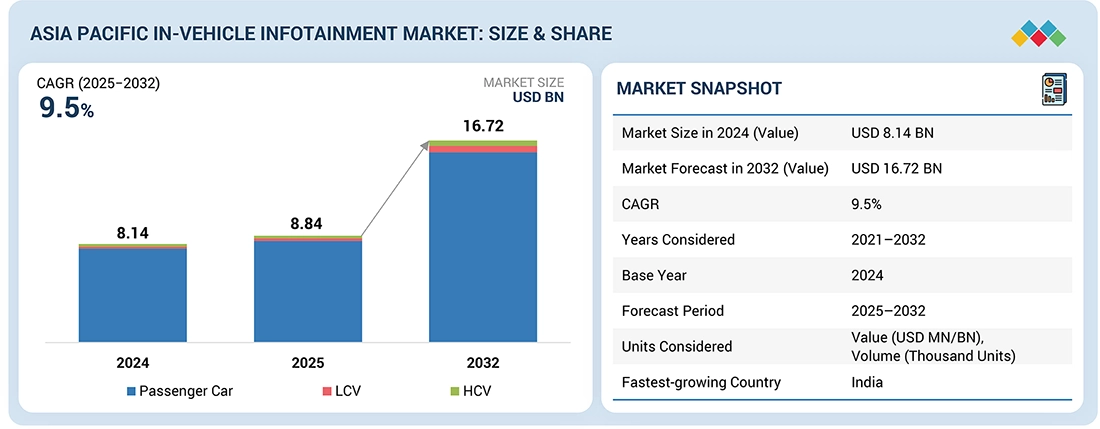
The Asia Pacific in-vehicle infotainment market is projected to reach USD 16.72 billion by 2032, from USD 8.84 billion in 2025, with a CAGR of 9.5% This growth is driven by the rising demand for connected vehicles, expanding adoption of digital cockpit platforms, and increasing integration of navigation, media, telematics, and smartphone-enabled features across modern vehicles.
KEY TAKEAWAYS
-
By CountryChina is estimated to account for a 50.5% revenue share in 2025.
-
By ComponentThe head-up display segment is expected to record the highest CAGR of 16.6% between 2025 and 2032.
-
By Vehicle TypeThe LCV segment is projected to exhibit the fastest growth from 2025 to 2032.
-
By, Form factorThe embedded segment is expected to dominate the market during the forecast period.
-
By ConnectivityThe 5G segment is expected to grow at the fastest rate during the forecast period.
-
By LocationThe front row segment is expected to hold the largest share.
-
By Operating SystemThe android segment is projected to grow at the fastest rate from 2025 to 2032.
-
By Display SizeThe >10" segment will grow the fastest during the forecast period.
-
Electric Vehicle Market, By TypeThe BEV segment is expected to grow at the highest CAGR of 15.0% during the forecast period.
-
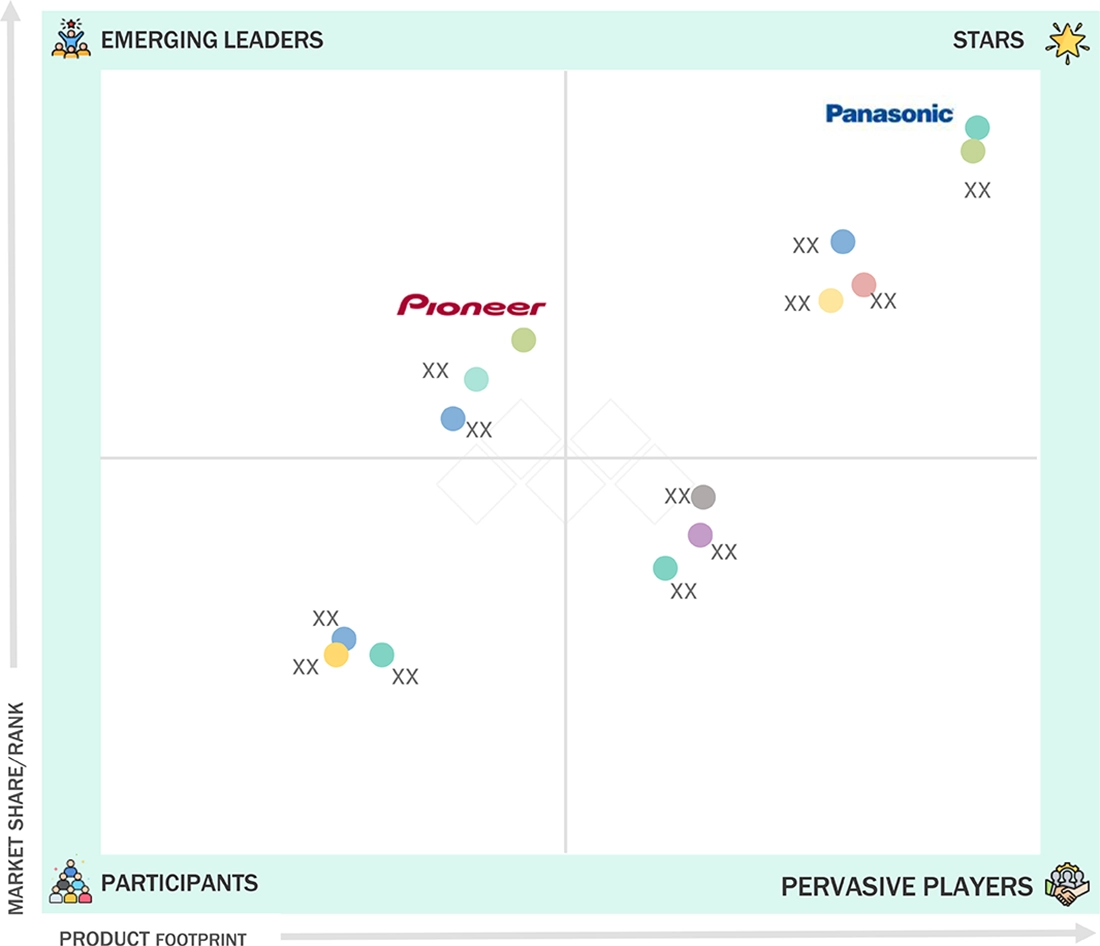
Competitive LandscapePanasonic Corporation (Japan) and Denso Corporation (Japan) were identified as the star players in the Asia Pacific in-vehicle infotainment market, given their strong market share and product footprint.
The Asia Pacific in-vehicle infotainment market is experiencing steady growth, driven by rising demand for connected vehicles, larger touchscreen interfaces, and integrated navigation, media, and telematics functions. Automakers are increasingly adopting advanced digital cockpit platforms to meet evolving safety, connectivity, and software requirements. New partnerships among OEMs, Tier-1 suppliers, and chipset providers, along with investments in 5G integration, Android Automotive OS, and OTA-enabled architectures, are accelerating the shift toward software-defined infotainment systems.
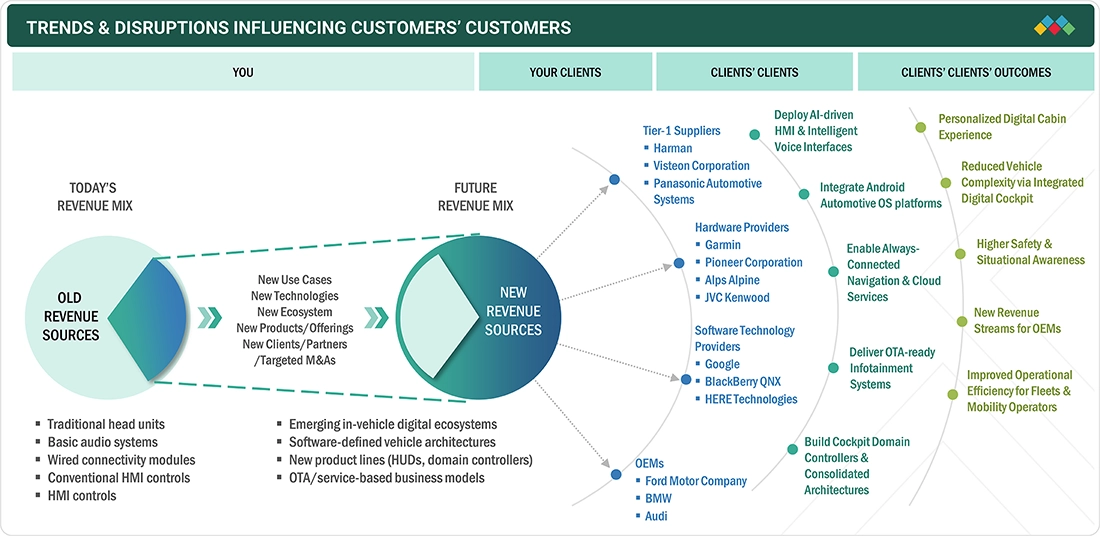
TRENDS & DISRUPTIONS IMPACTING CUSTOMERS' CUSTOMERS
Rapid urbanization, increased incomes, and widespread smartphone use across the Asia Pacific region are driving demand for seamless phone-to-car integration, local music/video apps, and multilingual voice assistants. With China, India, and ASEAN countries leading the world’s fastest vehicle growth, especially EVs, people now expect big panoramic screens, 5G connectivity, and OTA updates as standard. Strict local safety rules and consumer pressure are driving carmakers to deliver advanced digital cockpits more quickly than anywhere else, making Asia Pacific the global hotspot for next-generation infotainment through 2025.
Source: Secondary Research, Interviews with Experts, MarketsandMarkets Analysis
MARKET DYNAMICS

Level
-
Rise of connected and intelligent in-cabin ecosystem

-
Elevated demand for rear-seat entertainment


Level
-
Additional cost of annual subscriptions in infotainment systems

-
Lack of seamless connectivity


Level
-
Government mandates on telematics and e-call services

-
Emergence of 5G and AI technologies


Level
-
Cybersecurity challenges

Source: Secondary Research, Interviews with Experts, MarketsandMarkets Analysis
Driver: Elevated demand for rear-seat entertainment
Rising demand for rear-seat entertainment significantly drives the Asia Pacific in-vehicle infotainment market. Long urban commutes, the rise of middle-class families, and multi-generational households in China, India, and Southeast Asia are making multi-screen RSE a must-have in SUVs and MPVs. The ride-hailing boom (Didi, Grab, Ola) and robotaxi fleets further push personalized rear-seat streaming and gaming. EV charging downtime also turns rear seats into entertainment zones.
Restraint: Lack of seamless connectivity
Despite the rapid 5G rollout in cities, the lack of seamless connectivity remains a major restraint for the Asia Pacific in-vehicle infotainment market. Rural and suburban areas in India, Indonesia, Thailand, and western China suffer from weak or absent 4G/5G coverage, causing frequent dropouts in navigation, music streaming, and OTA updates. Cross-border travel exposes drivers to roaming gaps and incompatible network bands, while price-sensitive buyers resist expensive 5G modules. Different smartphone ecosystems (Android forks in China, diverse OS versions elsewhere) and inconsistent Bluetooth/Wi-Fi standards further break seamless mirroring and voice-assistant performance.
Opportunity: Government mandates on telematics and e-call services
Government mandates on telematics and e-call services are accelerating the adoption of advanced infotainment architecture. Regulations requiring automatic emergency response, location sharing, and real-time diagnostics are pushing OEMs to embed compliant, connected platforms across vehicle segments. These mandates create a scalable pathway for integrating richer infotainment features, expanding data-driven services, and strengthening the transition toward software-defined, safety-anchored vehicle ecosystems.
Challenge: Cybersecurity challenges
The shift toward connected and software-defined infotainment has intensified cybersecurity risks, exposing vehicles to potential breaches across cloud links, apps, and in-car networks. Rising attack surfaces, uneven security standards, and dependency on third-party integrations create vulnerabilities that can disrupt services or compromise user data. Ensuring end-to-end protection while managing compliance and upgrade costs has become a critical challenge for OEMs and suppliers as digital features scale across global vehicle platforms.
asia-pacific-in-vehicle-infotainment-market: COMMERCIAL USE CASES ACROSS INDUSTRIES
| COMPANY | USE CASE DESCRIPTION | BENEFITS |
|---|---|---|
 |
Integration of karaoke application in infotainment systems for passenger EVs like Atto 3 in China and Thailand (2024), allowing users to stream local content via a 15.6-inch rotating touchscreen | Enhances user engagement with region-specific entertainment, differentiates vehicles in competitive markets, and boosts subscription revenues from premium apps |
 |
Deployment of Visteon’s customized infotainment suite in Harrier and Safari SUVs across India (November 2024), featuring Android-based OS with OTA updates and AR navigation | Improves driver safety through real-time traffic integration, increases customer loyalty via seamless smartphone mirroring, and reduces aftermarket upgrade costs by 20% |
 |
Unveiling of holographic HUD-integrated infotainment in Kia EV9 for South Korean and Indian markets (January 2025), combining AR displays with voice AI for immersive navigation and media | Elevates premium user experience in EVs, mitigates range anxiety with charging visualizations, and supports OTA monetization for ongoing software enhancements |
 |
Launch of AI-powered cockpit in Galaxy series NEVs for Chinese and Southeast Asian exports (2024–2025), including multi-user profiles and 5G-enabled streaming on panoramic displays | Accelerates family-oriented adoption with personalized content, cuts development costs through shared platforms, and drives 44% NEV sales growth via intelligent features |
Logos and trademarks shown above are the property of their respective owners. Their use here is for informational and illustrative purposes only.
MARKET ECOSYSTEM
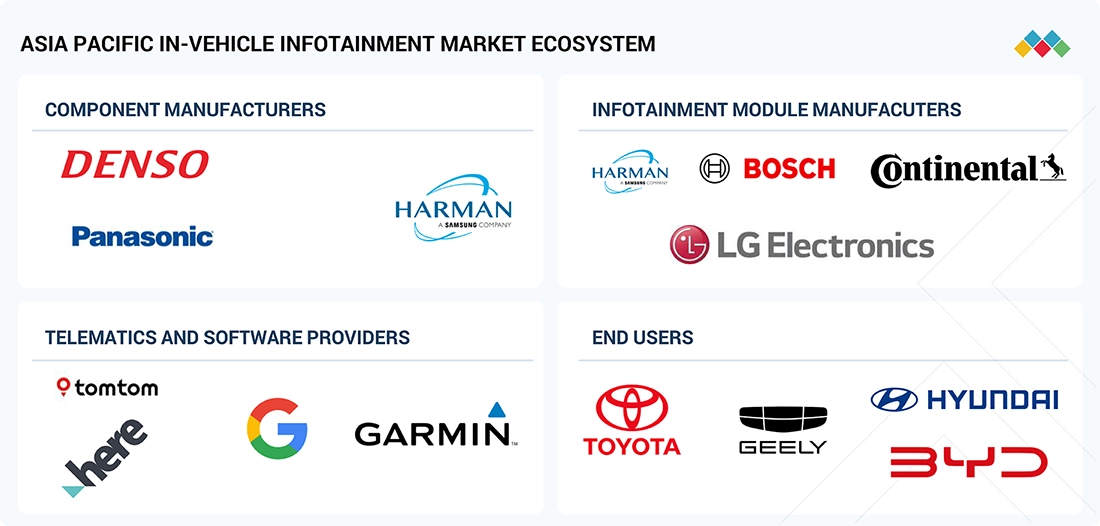
The Asia Pacific in-vehicle infotainment ecosystem comprises component and system manufacturers (Denso Corporation, Panasonic Corporation, Harman International), infotainment platform and module manufacturers (Alpine Electronics, Visteon Corporation, ECARX), and end users, primarily automotive OEMs (Toyota, BYD, Hyundai). Hardware elements such as displays, domain controllers, and connectivity modules are integrated with operating systems and software platforms to create digital cockpit systems for passenger and commercial vehicles. End users drive requirements for connectivity, personalization, and regulatory compliance, while manufacturers deliver high-compute, software-defined infotainment solutions that enable real-time navigation, media, and telematics.
Logos and trademarks shown above are the property of their respective owners. Their use here is for informational and illustrative purposes only.
MARKET SEGMENTS
Source: Secondary Research, Interviews with Experts, MarketsandMarkets Analysis
Asia Pacific In-Vehicle Infotainment Market, By Connectivity
The 3G/4G segment continues to dominate the Asia Pacific in-vehicle infotainment market because it offers the widest network coverage across urban, semi-urban, and rural areas. Automakers prefer 3G/4G since it provides stable speeds for navigation, music streaming, and connected-car features without the higher costs tied to 5G deployment. With a large existing base of 3G/4G-enabled vehicles and strong affordability, these networks remain the most practical choice for mass-market models.
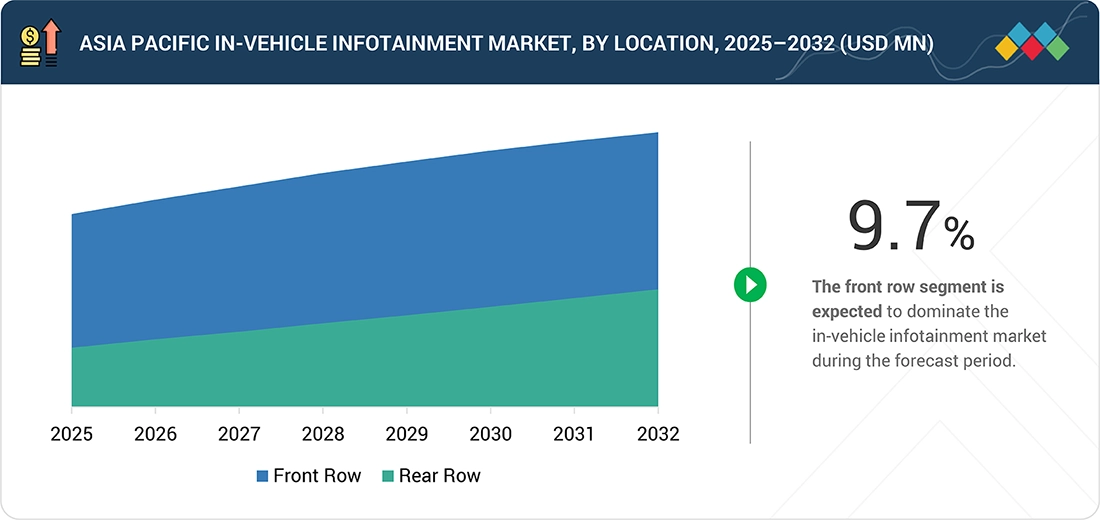
Asia Pacific In-Vehicle Infotainment Market, By Location
The front row segment holds a dominant position in the Asia Pacific in-vehicle infotainment market due to strong demand for integrated, driver-focused digital experiences. Consumers expect seamless access to navigation, voice assistants, smartphone mirroring, and multimedia features directly from the central display. Automakers are prioritizing advanced front-row systems as a key differentiator, especially in mid-range and premium models. The rise of connected cars and smart dashboards has further strengthened this segment’s lead, as drivers look for intuitive, distraction-free interfaces.
Asia Pacific In-Vehicle Infotainment Market, By Operating System
The Android segment dominates the Asia Pacific in-vehicle infotainment market due to its flexibility, affordability, and strong ecosystem support. Automakers favor Android-based systems because they allow easier customization, faster software updates, and seamless integration with popular apps and services. Consumers also benefit from a familiar interface, making the driving experience more intuitive. The availability of Android Automotive OS and widespread smartphone penetration in the region further strengthen its adoption.
Asia Pacific In-Vehicle Infotainment Market, By Vehicle Type
The passenger car segment holds a leading position in the Asia Pacific in-vehicle infotainment market, driven by rapid urbanization and increased vehicle ownership across emerging economies. Growing consumer expectations for connected and comfortable driving experiences have pushed automakers to integrate advanced infotainment systems into most passenger car models. SUVs and compact cars, in particular, are increasingly equipped with touchscreen displays, smartphone connectivity, and voice-enabled features. The strong presence of both global and regional OEMs also accelerates the adoption of modern in-vehicle infotainment solutions in this segment.
REGION
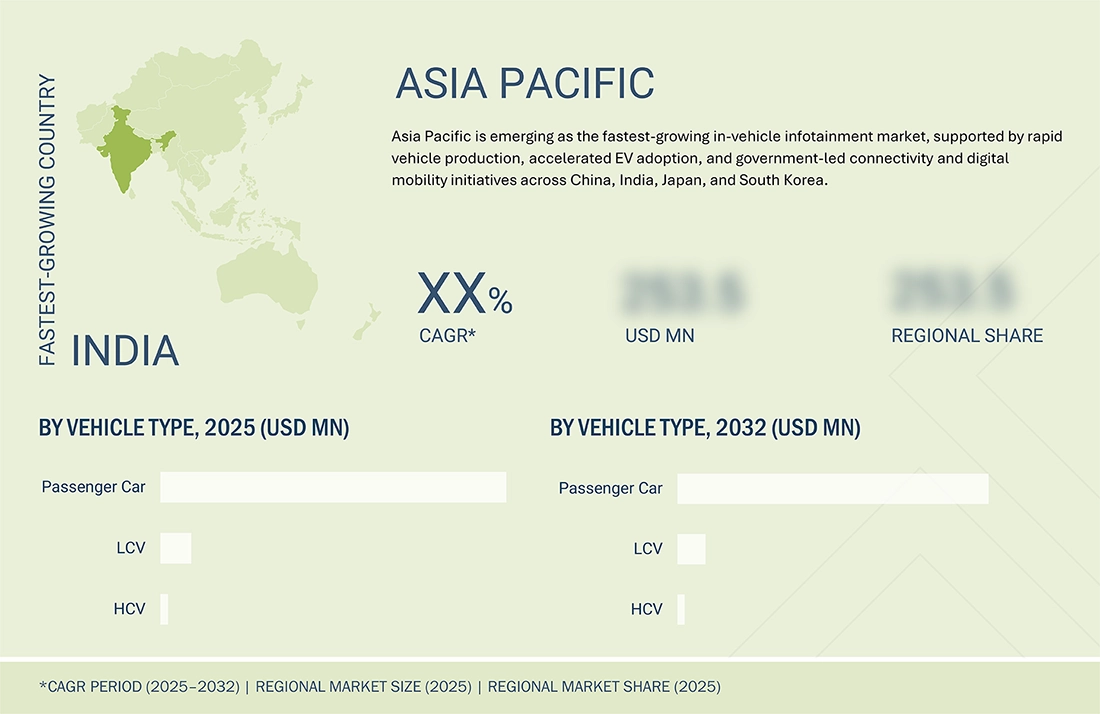
India to be fastest-growing country in Asia Pacific in-vehicle infotainment market during forecast period
India’s in-vehicle infotainment market is one of the fastest-growing globally, driven by rising vehicle sales, growing smartphone adoption, and increasing demand for connected driving experiences. Automakers are equipping entry- and mid-segment cars with touchscreen displays, Android Auto/Apple CarPlay, and voice-enabled features to meet evolving consumer expectations. The push toward connected cars by leading OEMs, along with growing interest in navigation, real-time traffic updates, and in-car entertainment, is accelerating adoption. The government's focus on digitalization and improved network connectivity further supports this momentum.
asia-pacific-in-vehicle-infotainment-market: COMPANY EVALUATION MATRIX
The Asia Pacific in-vehicle infotainment market is highly competitive, featuring a mix of global Tier-1 suppliers, fast-growing regional players, and software specialists. Traditional hardware leaders, such as Harman, Panasonic, Continental, Visteon, and Denso, compete with consumer electronics brands and nimble local OEM suppliers that offer cost-optimized modules for mass-market cars. Software and platform providers (such as Android Automotive, QNX, and Linux-based stacks) and app/ecosystem players add another layer of rivalry, as OEMs seek flexible, updatable systems. Competition centers on rapid feature delivery, cost efficiency, and seamless smartphone/cloud integration, while partnerships and M&A activity are common strategies to gain scale and local relevance.
Source: Secondary Research, Interviews with Experts, MarketsandMarkets Analysis
KEY MARKET PLAYERS
- PANASONIC CORPORATION (JAPAN)
- DENSO CORPORATION (JAPAN)
- PIONEER CORPORATION (JAPAN)
- VISTEON CORPORATION (USA) - `
- MITSUBISHI ELECTRIC CORPORATION (JAPAN)
- AISIN AW CO.LIMITED (JAPAN)
- ALPHINE ELECTRONICS INC. (JAPAN)
- HYUNDAI MOBIS (SOUTH KOREA)
- LG ELECTRONICS (SOUTH KOREA)
- DESAY SV AUTOMOTIVE (CHINA)
MARKET SCOPE
| REPORT METRIC | DETAILS |
|---|---|
| Market Size in 2024 (Value) | USD 8.14 BN |
| Market Forecast in 2032 (Value) | USD 16.72 BN |
| Growth Rate | CAGR of 9.5% from 2025–2032 |
| Years Considered | 2021–2032 |
| Base Year | 2024 |
| Forecast Period | 2025–2032 |
| Units Considered | Value (USD MN/BN), Volume (Thousand Units) |
| Report Coverage | Revenue forecast, company ranking, competitive landscape, growth factors, and trends |
| Segments Covered |
|
| Countries Covered | China, India, Japan, South Korea, Others |
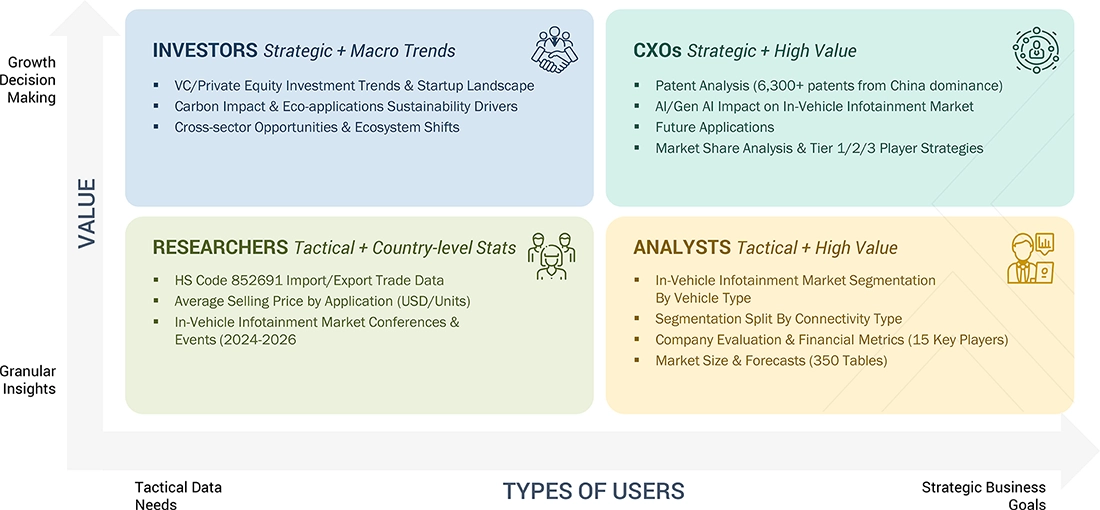
WHAT IS IN IT FOR YOU: asia-pacific-in-vehicle-infotainment-market REPORT CONTENT GUIDE
DELIVERED CUSTOMIZATIONS
We have successfully delivered the following deep-dive customizations:
| CLIENT REQUEST | CUSTOMIZATION DELIVERED | VALUE ADDS |
|---|---|---|
| Tier-1 System Suppliers | Comparative analysis of Harman, Panasonic, Desay SV, Visteon, LG, etc across capabilities, pricing, partnerships, OS strategies, and roadmap | Enables suppliers to position themselves better, refine go-to-market strategy, and identify partnership or acquisition opportunities |
| Leading automotive OEM | Mapping of OS penetration by country and vehicle class, feature expectations, localization (multiple Asian languages), and regulatory factors | Helps OEMs and software providers choose the right platform, plan localization, and build competitive IVI experiences |
RECENT DEVELOPMENTS
- November 2025 : Harman launched its Ready Display series (Neo QLED-based) certified HDR10+ Automotive; LG introduced the world’s first Dual-View OLED in-car display (two users see different content depending on viewing angle).
- August 2025 : Alps Alpine Co., LTD. launched a compact 2-pole 2-position switch for electric parking brakes, featuring silent operation (5dB quieter), 50% width reduction (W6.3×D8.5×H7.0 mm), 1.8N actuating force, IP6K7 protection, and 300,000-cycle durability for enhanced vehicle layout flexibility and EV compatibility.
- January 2025 : Pioneer Corporation launched an immersive in-vehicle audio system integrating Apple CarPlay with Spatial Audio and Dolby Atmos, using only four discrete amplifier channels and existing front/rear speakers for aftermarket and OEM applications, demonstrated in a mid-size sedan at CES 2025 ?.
Table of Contents
 Exclusive indicates content/data unique to MarketsandMarkets and not available with any competitors.
Methodology
Secondary Research
The secondary sources referred to the in-vehicle infotainment system market as directly dependent on vehicle production. Vehicle production volume is derived through secondary sources such as automotive industry organizations (Organisation Internationale des Constructeurs d'Automobiles (OICA), publications from government sources [such as country-level automotive associations and organizations, Organisation for Economic Co-operation and Development (OECD), World Bank, CDC, and Eurostat]; corporate filings (such as annual reports, investor presentations, and financial statements); and trade, paid repository. Historical production data has been collected and analyzed, and the industry trend is considered to arrive at the forecast, which is further validated by primary research.
Primary Research
In the primary research process, various primary sources from both supply and demand sides were interviewed to obtain qualitative and quantitative information on the market. The primary sources from the supply side included various industry experts, such as CXOs, Vice Presidents, Directors from business development, marketing, product development/innovation teams, and related key executives from various key companies. Various system integrators, industry associations, independent consultants/industry veterans, and key opinion leaders were also interviewed.
Primary interviews have been conducted to gather insights such as vehicle production forecast, in-vehicle infotainment system market forecast, future technology trends, and upcoming technologies in the market. Data triangulation of all these points was done with the information gathered from secondary research as well as model mapping. Stakeholders from the demand and supply sides have been interviewed to understand their views on the aforementioned points.
Primary interviews have been conducted with market experts from both the demand- (OEMs) and supply-side (in-vehicle infotainment system solution and service providers) players across four major regions, namely, North America, Europe, Asia Pacific, and the Rest of the World. Approximately 20% and 80% of primary interviews have been conducted from the demand and supply sides, respectively. Primary data has been collected through questionnaires, emails, and telephonic interviews. In the canvassing of primaries, we have strived to cover various departments within organizations, such as sales and operations, to provide a holistic viewpoint in our report.
After interacting with industry experts, we have also conducted brief sessions with highly experienced independent consultants to reinforce the findings from our primaries. This, along with the in-house subject matter experts’ opinions, has led us to the findings as described in the remainder of this report.
Market Size Estimation
A detailed market estimation approach was followed to estimate and validate the value of the in-vehicle infotainment system market and other dependent submarkets, as mentioned below.
- Key players in the market were identified through secondary research, and their Asia Pacific market ranking was determined through primary and secondary research.
- The research methodology included a study of annual and quarterly financial reports and regulatory filings of major market players (public), as well as interviews with industry experts for detailed market insights.
- All vehicle level penetration rates, percentage shares, splits, and breakdowns for the market were determined using secondary sources and verified through primary sources.
- All key macro indicators affecting the revenue growth of the market segments and subsegments were accounted for, viewed in extensive detail, verified through primary research, and analyzed to obtain validated and verified quantitative and qualitative data.
- The gathered market data was consolidated, enhanced with detailed inputs, analyzed, and presented in this report.
Market Definition
The in-vehicle Infotainment system aggregates all the infotainment functions of the vehicle, including tuner reception, media connectivity, audio playback, navigation, and HMI. It offers solutions such as audio/video entertainment and information content, including radio, media player, TV and video, telephony, navigation, speech control, apps, and connectivity features, which bring digital life right on the road.
Key Stakeholders
- In-vehicle Infotainment system manufacturers
- Parts and component suppliers
- Automotive OEMs
- R&D Department
- Automotive Association and Regulatory bodies
- Infotainment service providers
- Fleet owners
- Telecom companies
Report Objectives
-
To define, describe, and forecast the Asia-Pacific In-vehicle Infotainment Market in terms of value (USD million) and volume (thousand units), which includes the following segments:
- By Vehicle Type {Passenger Car, Light Commercial Vehicle (LCV), and Heavy Commercial Vehicle (HCV)}
- By Component (Infotainment Unit, Passenger Display, Instrument Cluster Display, and Head-Up Display)
- By Operating System (Android, Linux, QNX, Microsoft, and Others)
- By Application (Navigation, VPA, App Store, Music and Rear Seat)
- By Location (Front Row and Rear Row)
- By Connectivity (3G/4G and 5G)
- By Form (Embedded, Tethered, and Integrated)
- By Display Size (<5”, 5-10”, >10”)
- Retrofit, By Vehicle Type (Passenger Cars and Commercial Vehicles)
- Electric Vehicle, By Vehicle Type (Battery Electric vehicle, Plug-in Hybrid Electric Vehicle, and Fuel-Cell Electric Vehicle)
- By Region (Asia Pacific, Europe, North America, and RoW)
- To understand the dynamics (drivers, restraints, opportunities, and challenges) of the Asia-Pacific In-vehicle Infotainment Market
- To analyze the market ranking/share of key players operating in the market
- To understand the dynamics of market competitors in terms of hardware and software providers and distinguish them into visionary leaders, innovators, emerging companies, and dynamic differentiators according to their product portfolio and business strategy
- To analyze recent developments, collaborations, joint ventures, mergers & acquisitions, new product launches, and other activities carried out by key industry participants in the market
- To determine the average selling price (ASP) of in-vehicle infotainment and analyze revenue-missed scenarios
- To determine pessimistic scenarios, most likely scenarios, and optimistic scenarios related to the market
- To give a brief understanding of the Asia-Pacific In-vehicle Infotainment Market in the recommendations chapter
Available Customizations
Along with the given market data, MarketsandMarkets offers customizations in accordance with a company’s specific needs
In-vehicle Infotainment System Market, By Country And Components
-
Asia Pacific
- China
- India
- Japan
- South Korea
-
Europe
- Germany
- France
- Italy
- UK
- Spain
- Russia
-
North America
- US
- Canada
- Mexico
-
RoW
- Brazil
- South Africa
Electric Vehicle Infotainment Market, By Components
- Infotainment system
- Passenger Display


Personalize This Research
- Triangulate with your Own Data
- Get Data as per your Format and Definition
- Gain a Deeper Dive on a Specific Application, Geography, Customer or Competitor
- Any level of Personalization
Let Us Help You
- What are the Known and Unknown Adjacencies Impacting the Asia Pacific In-Vehicle Infotainment Market
- What will your New Revenue Sources be?
- Who will be your Top Customer; what will make them switch?
- Defend your Market Share or Win Competitors
- Get a Scorecard for Target Partners

Custom Market Research Services
We Will Customise The Research For You, In Case The Report Listed Above Does Not Meet With Your Requirements
Get 10% Free CustomisationTESTIMONIALS

JIM NAAS
PRODUCT DIRECTOR, WEASLER
Weasler Engineering, a CentroMotion organization
Global Provider of Industrial Actuation & Control Solutionswww.weasler.com
Our organization was interested in learning more about the attractiveness of a particular market space. We contacted MarketsandMarkets to help us based on previous positive experiences we had with them. The results did not disappoint! We discussed our objectives with them, and the team at MarketsandMarkets developed and executed a proposal that met our needs precisely. We were very impressed by their level of expertise, the quality of the analysis and their insightful recommendations. We would not hesitate in working with them again in the future.

Matt Kardel,
Vice President
Aptiv,
A global technology company that develops safer, greener and more connected solutions.www.aptiv.com
We contracted with
MarketsandMarkets to evaluate the value chain and potential go-to-market partners related to our
interest in the Fleet Management space. The team successfully completed the work on time and at the
pricing agreed. MarketsandMarkets listened and understood our objectives and collaborated well with
us to help us get the visibility we needed to make an investment.
We have subsequently used
MarketsandMarkets again related to Smart Cities to good results.






Growth opportunities and latent adjacency in Asia Pacific In-Vehicle Infotainment Market