Asia Pacific Lithium-ion Battery Market

Asia Pacific Lithium-ion Battery Market by Battery Type (NMC, LFP, LCO, LTO, LMO, NCA), Cell Type (Prismatic, Pouch, Cylindrical), Capacity (<50 kWh, 50–100 kWh, >100 kWh), EV, Energy Storage (Residential, Utilities), & Medical - Forecast to 2033




OVERVIEW
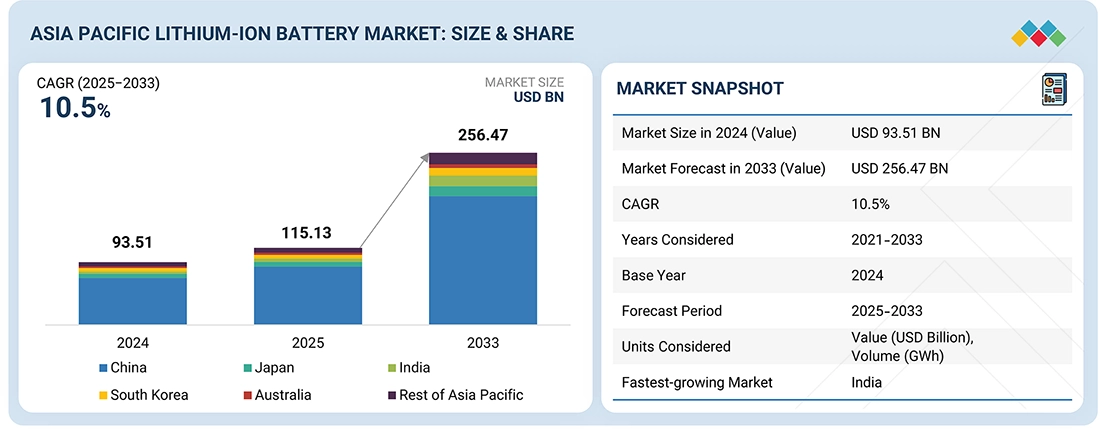
Source: Secondary Research, Interviews with Experts, MarketsandMarkets Analysis
The Asia Pacific lithium-ion battery market is projected to grow from USD 115.13 billion in 2025 to USD 256.47 billion by 2033, registering a CAGR of 10.5%. Growth is driven by a rapidly expanding hub for lithium-ion battery production, driven by strong demand across automotive, consumer electronics, and renewable energy sectors. The region has become an attractive automotive hub and a leading center for lithium-ion battery production, supported by the presence of several prominent electronics companies.
Market Size & Forecast
KEY TAKEAWAYS
-
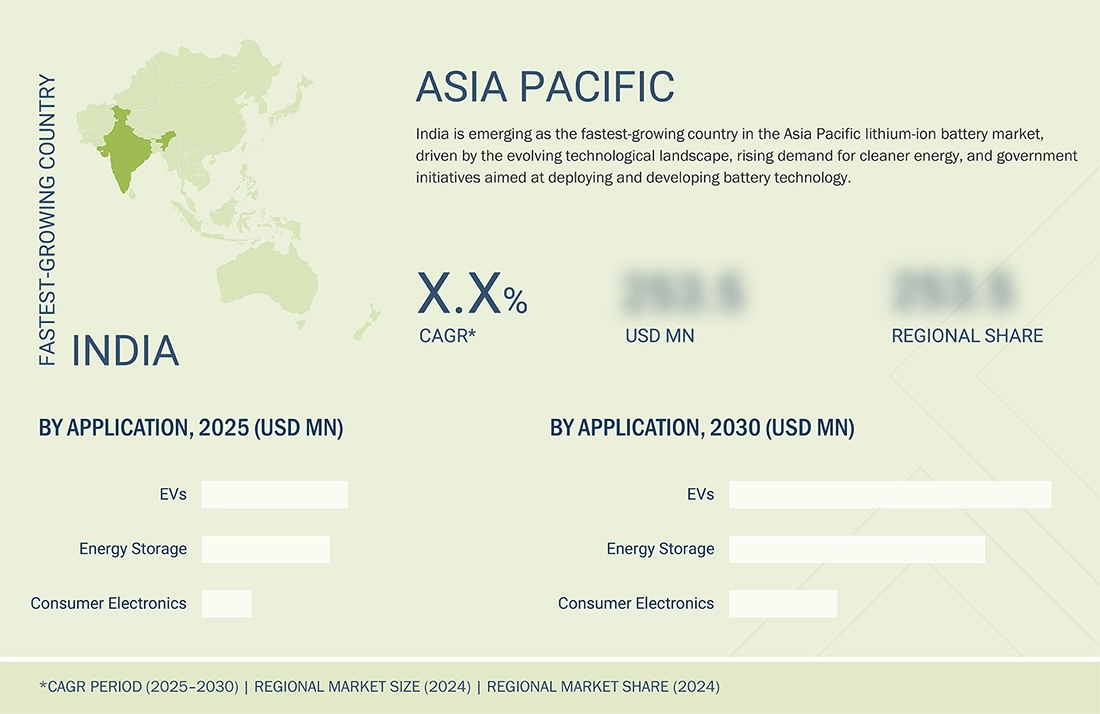
BY COUNTRYBy country, India is expected to register the highest growth rate of 16.5% during the forecast period.
-
BY BATTERY TYPEBy battery type, the LFP segment is expected to register the largest market share in 2033.
-
BY APPLICATIONBy application, the EV segment is expected to dominate the market in terms of market share.
-
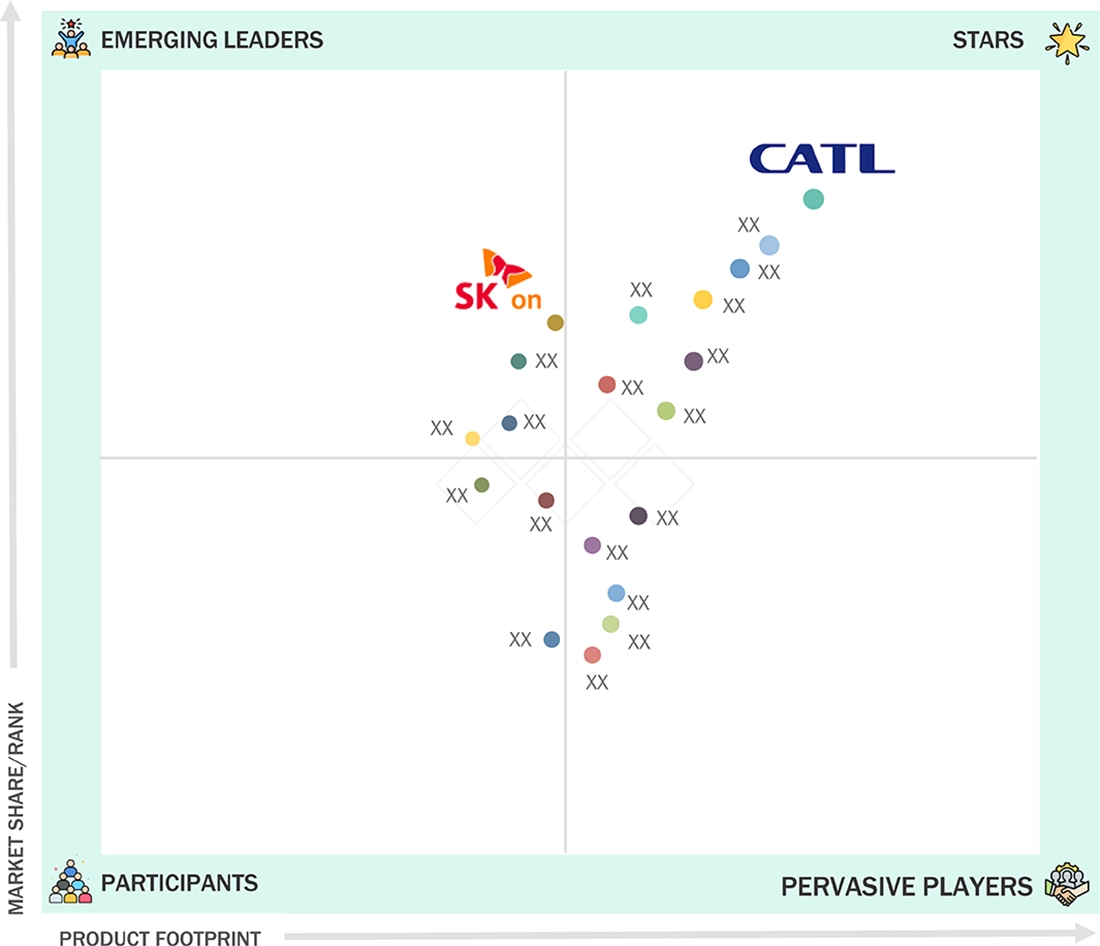
COMPETITIVE LANDSCAPE - KEY PLAYERSContemporary Amperex Technology Co., Ltd., BYD Company Ltd., and LG Energy Solution were identified as some of the star players in the Asia Pacific lithium-ion battery market, given their strong market share and product footprint.
-
COMPETITIVE LANDSCAPE - STARTUPS/SMESIpower Batteries Private Limited and Amperex Technology Limited, among others, have distinguished themselves among SMEs in the region by securing strong footholds in specialized niche areas, underscoring their potential as emerging market leaders.
Rapid growth in the Asia Pacific is driven by strong government incentives for electric vehicles, large-scale investments in lithium-ion battery manufacturing, and expanding renewable energy deployments across China, India, Japan, and South Korea.
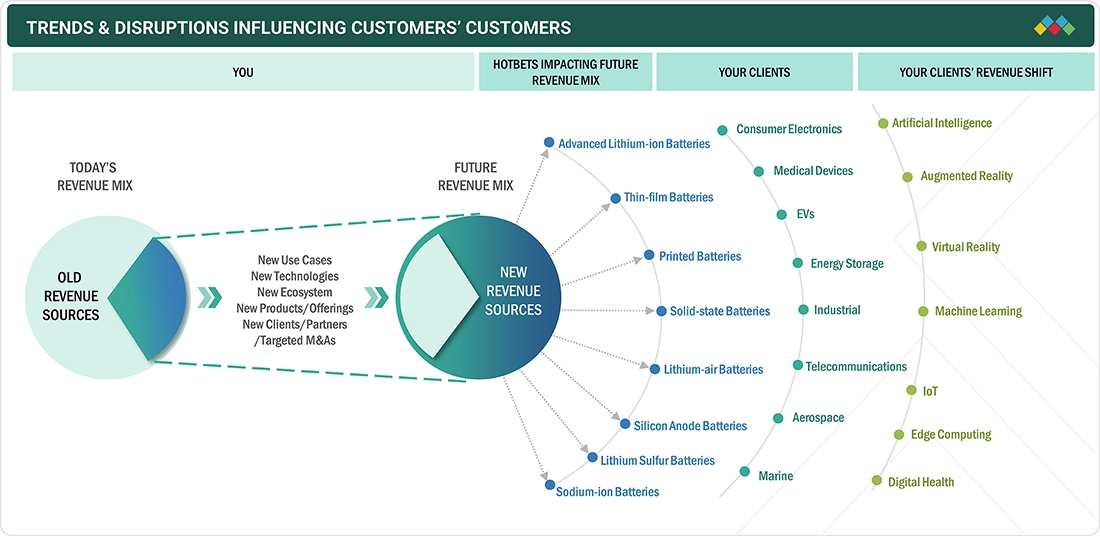
TRENDS & DISRUPTIONS IMPACTING CUSTOMERS' CUSTOMERS
The impact on customers’ businesses in the lithium-ion battery market stems from accelerating electrification trends and the growing need for sustainable energy solutions. The Asia Pacific region represents a rapidly expanding hub for lithium-ion battery production, driven by strong demand across automotive, consumer electronics, and renewable energy sectors.
Source: Secondary Research, Interviews with Experts, MarketsandMarkets Analysis
MARKET DYNAMICS

Level
-
Widespread deployment of battery-operated material handling equipment in industrial applications in Asia Pacific

-
Surging demand for wearables in India


Level
-
High recycling and disposal costs in Asia Pacific


Level
-
Anticipated decline in costs of Li-ion batteries

-
New era of renewable energy capacity and storage innovations in Asia Pacific


Level
-
Technical issues and battery performance-related challenges

-
Financial risks and market disruptions witnessed by battery manufacturers

Source: Secondary Research, Interviews with Experts, MarketsandMarkets Analysis
Driver: Widespread deployment of battery-operated material handling equipment in industrial applications in Asia Pacific
The rise in automation and e-commerce in the Asia Pacific is fueling the use of battery-operated forklifts and logistics systems. Lithium-ion batteries are preferred for their fast charging, higher efficiency, and lower maintenance in industrial environments.
Restraint: High recycling and disposal costs in Asia Pacific
Despite the rapid adoption of conventional recycling methods, such as pyrometallurgy, which involve high-temperature processes, these methods demand significant energy inputs and risk the loss of substantial quantities of valuable raw materials. This ultimately undermines the profitability of recycling operations.
Opportunity: Anticipated decline in costs of Li-ion batteries
As the cost of lithium-ion batteries decreases, it becomes more economically viable to use them in applications such as battery-operated industrial vehicles, electric vehicles, and energy storage systems.
Challenge: Technical issues and battery performance-related challenges
The lithium-ion battery market faces overcapacity challenges, leading to price wars, consolidation, and pressure on manufacturers to innovate or expand into less saturated international markets. Another key challenge is the aging and performance degradation of lithium-ion batteries.
Asia Pacific Lithium-ion Battery Market: COMMERCIAL USE CASES ACROSS INDUSTRIES
| COMPANY | USE CASE DESCRIPTION | BENEFITS |
|---|---|---|
 |
Advanced lithium-ion batteries for EVs and grid-scale storage | Advancing cell-to-pack integration for greater efficiency | Higher energy density, faster charging, strong temperature adaptability, and cost efficiency |
 |
Lithium-ion batteries for electric vehicles, energy storage, and consumer electronics | Extended driving range, stable performance, and improved energy efficiency |
 |
Proprietary Blade Battery technology for electric cars, buses, and commercial fleets | Enhanced safety with minimized thermal runaway risk, long service life, and optimized design for space utilization |
 |
Producing cylindrical and prismatic lithium-ion cells for EVs and hybrid vehicles | Key supplier to leading automakers | High energy density, reliable lifecycle performance, and proven scalability for mass-market electric mobility |
 |
Lithium-ion batteries for EVs, energy storage systems, and portable electronics | High energy density, improved safety, long lifespan, and compact form factor for diverse applications |
Logos and trademarks shown above are the property of their respective owners. Their use here is for informational and illustrative purposes only.
MARKET ECOSYSTEM
The Asia Pacific lithium-ion market is driven by a diverse ecosystem of raw material suppliers, component manufacturers, processors, and system integrators, which enables rapid scaling. A strong government focus on clean energy and electrification has boosted demand for advanced energy storage systems, driving the wider integration of lithium-ion solutions across renewables, grid applications, and mobility.
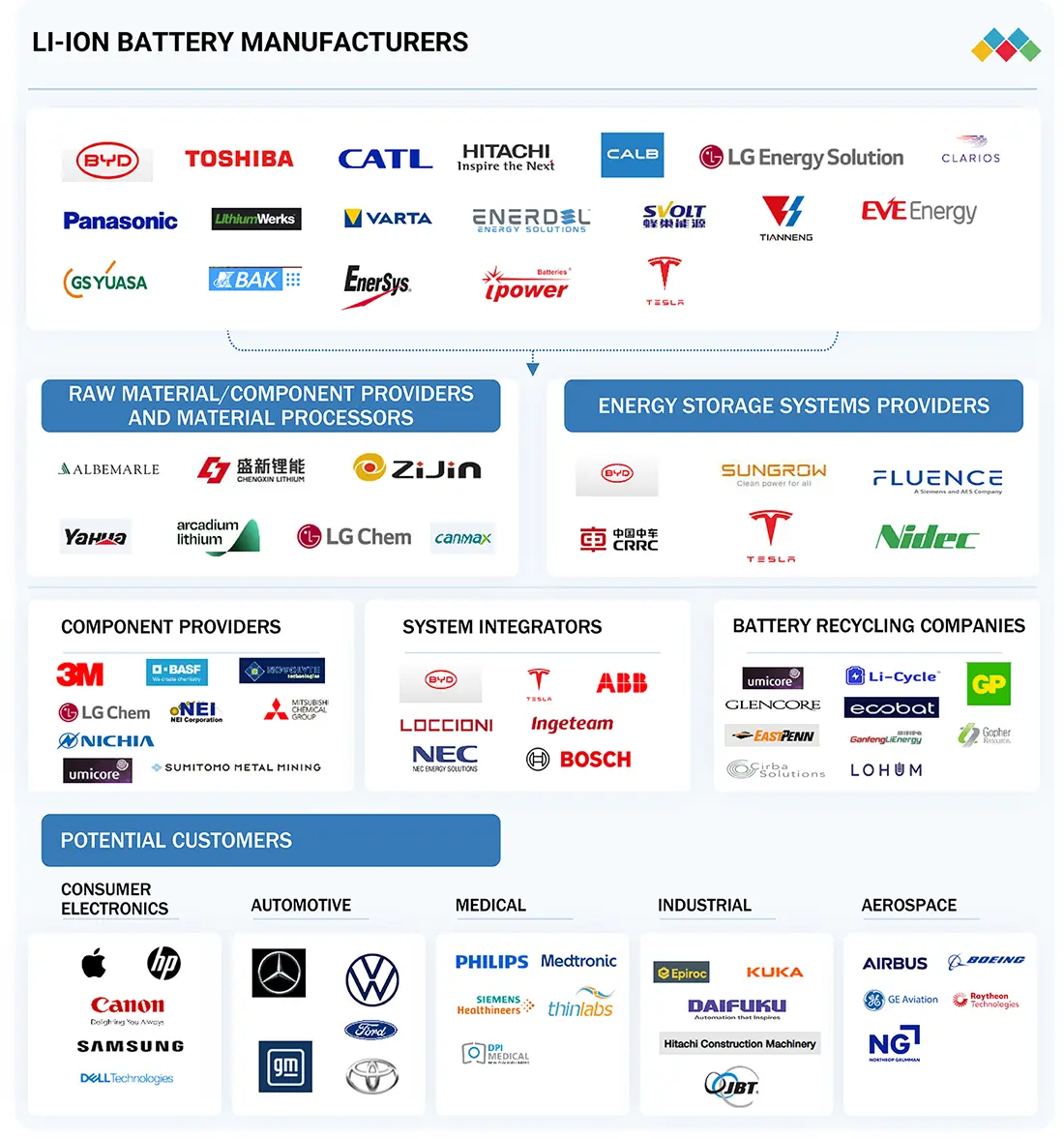
Logos and trademarks shown above are the property of their respective owners. Their use here is for informational and illustrative purposes only.
MARKET SEGMENTS
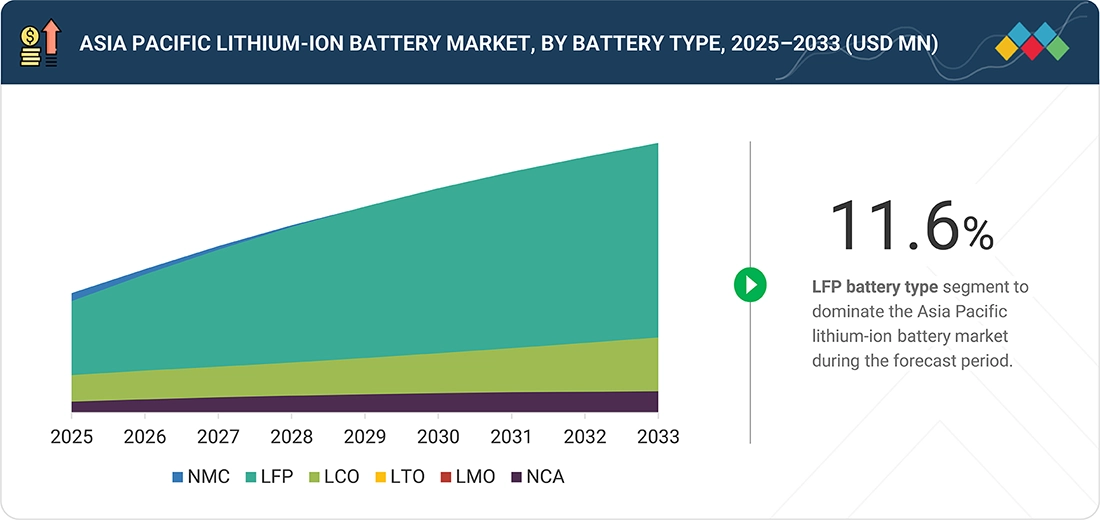
Source: Secondary Research, Interviews with Experts, MarketsandMarkets Analysis
Asia Pacific Lithium-ion Market, by Battery Type
The LFP segment is expected to experience the highest growth rate in the Asia Pacific lithium-ion battery market during the forecast period. The rapid growth of LFP batteries in the region is fueled by the surge in electric vehicle production, increasing demand for cost-effective energy storage, and robust manufacturing capabilities.
Asia Pacific Lithium-ion Market, by Application
The EV segment is anticipated to hold the largest share of the Asia Pacific lithium-ion battery market during the forecast period. The growth is driven by strong government incentives for electric vehicles and large-scale investments in lithium-ion battery manufacturing in the region.
REGION
India is expected to be the fastest-growing country in the Asia Pacific lithium-ion battery market during the forecast period
The Asia Pacific lithium-ion battery market is expected to experience rapid growth. This is driven by several factors, including advancements in technology, a rising demand for cleaner energy solutions, and government initiatives promoting the development and deployment of battery technology.
Asia Pacific Lithium-ion Battery Market: COMPANY EVALUATION MATRIX
In the Asia Pacific lithium-ion battery market matrix, CATL (China), LG Energy Solution (South Korea), and Samsung SDI (South Korea), lead with a strong market presence and a wide product portfolio, driving large-scale adoption across various applications.
Source: Secondary Research, Interviews with Experts, MarketsandMarkets Analysis
KEY MARKET PLAYERS
- LG Energy Solution (South Korea)
- Samsung SDI (South Korea)
- Panasonic Holdings Corporation (Japan)
- BYD COMPANY LTD (China)
- Contemporary Amperex Technology Co., Limited (China)
- BAK Power (China)
- CALB (China)
- Clarios (US)
- EnerSys (US)
- EVE Energy Co., Ltd. (China)
- Gotion (China)
- GS Yuasa Corporation (Japan)
- Mitsubishi Electric Corporation (Japan)
- SK Innovation Co., Ltd. (South Korea)
- Tesla (US)
- Toshiba Corporation (Japan)
MARKET SCOPE
| REPORT METRIC | DETAILS |
|---|---|
| Market Size in 2024 (Value) | USD 93.51 Billion |
| Market Forecast in 2033 (Value) | USD 256.47 Billion |
| Growth Rate | CAGR of 10.5% from 2025–2033 |
| Years Considered | 2021–2033 |
| Base Year | 2024 |
| Forecast Period | 2025–2033 |
| Units Considered | Value (USD Billion), Volume (GWh) |
| Report Coverage | Revenue Forecast, Company Ranking, Competitive Landscape, Growth Factors, and Trends |
| Segments Covered |
|
| Regional Scope | China, Japan, India, South Korea, Australia, Rest of Asia Pacific |
WHAT IS IN IT FOR YOU: Asia Pacific Lithium-ion Battery Market REPORT CONTENT GUIDE
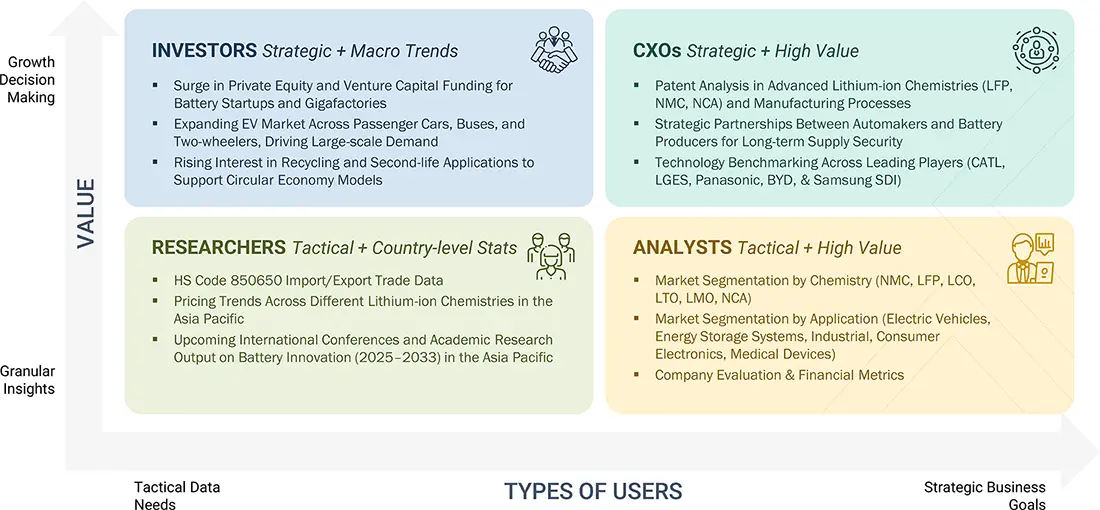
DELIVERED CUSTOMIZATIONS
We have successfully delivered the following deep-dive customizations:
| CLIENT REQUEST | CUSTOMIZATION DELIVERED | VALUE ADDS |
|---|---|---|
| Electric Vehicle (EV) OEM Based in Asia | Forecast of lithium-ion battery demand by chemistry (LFP, NMC, NCA) across 2W/3W, passenger EVs, and commercial EVs | Benchmarking of leading Asia Pacific cell manufacturers and their supply-chain integration strategies |
| Utility & Renewable Energy Developer in India | Market outlook for grid-scale and C&I energy storage batteries by application (renewables integration, peak shaving, & microgrids) | Comparative assessment of LFP vs. NMC suitability for high-temperature environments |
| Consumer Electronics Manufacturer in China | Detailed mapping of lithium-ion battery adoption in wearables, smartphones, and portable devices | Pricing trend analysis for pouch, prismatic, and high-density polymer cells in the Asia Pacific manufacturing hubs |
RECENT DEVELOPMENTS
- May 2025: CATL launched the TENER Stack, the world’s first 9MWh ultra-large capacity energy storage system, at Entry/Exit System (EES) Europe 2025 to address the growing global demand for high-density, flexible, and transportable energy storage solutions. Designed for utilities, developers, and industrial users, TENER Stack offers significant improvements in space utilization, energy efficiency, and cost-effectiveness. It supports applications such as AI data centers and industrial electrification.
- April 2025: CALB showcased its latest energy storage technologies at the 2025 ESIE Summit, where it announced the world’s first mass production of the 392 Ah cell and a 6.25 MWh liquid-cooled container system. Additionally, the company introduced the 314Gen2.0 ultra-long-cycle cell and the 640 Ah high-capacity cell, further emphasizing CALB’s extensive portfolio of advanced, reliable, and high-performance energy storage solutions.
- April 2025: CALB unveiled its latest energy storage technologies at the 2025 ESIE Summit, announcing the global mass production of its 392Ah cell and 6.25 MWh liquid-cooled container system. The company also introduced the 314Gen2.0 ultra-long-cycle cell and the 640Ah high-capacity cell, showcasing its broad portfolio of advanced, reliable, and high-performance energy storage solutions.
- October 2024: CATL introduced a new hybrid vehicle battery, the Freevoy Super Hybrid, capable of delivering over 400 kilometers of pure electric range and supports 4C superfast charging. This breakthrough technology marks a significant advancement in high-capacity EREV and PHEV batteries.
- April 2024: BAK Power introduced a new series of semi-solid lithium batteries. These batteries are characterized by high energy density, long cycle life, and enhanced safety. The company plans to integrate this technology into explosion-proof mobile communication devices, leveraging the batteries' superior safety performance, which has been demonstrated through rigorous testing.
Table of Contents
 Exclusive indicates content/data unique to MarketsandMarkets and not available with any competitors.
Methodology
The study involved four major activities in estimating the current size of the Asia Pacific lithium-ion battery market. Exhaustive secondary research has been conducted to gather information on the market, adjacent markets, and the overall -ion battery landscape. These findings, along with assumptions and projections, were validated through primary research involving interviews with industry experts and key stakeholders across the value chain. Both top-down and bottom-up approaches were utilized to estimate the overall market size. Subsequently, market breakdown and data triangulation techniques were applied to determine the sizes of various segments and subsegments. Two key sources, secondary and primary, were leveraged to conduct a comprehensive technical and commercial assessment of the Asia Pacific lithium-ion battery market.
Secondary Research
Various secondary sources have been referred to in the secondary research process to identify and collect important information for this study. The secondary sources include annual reports, press releases, and investor presentations of companies; white papers; journals and certified publications; and articles from recognized authors, websites, directories, and databases. Secondary research has been conducted to obtain key information about the industry’s supply chain, the market’s value chain, the total pool of key players, market segmentation according to the industry trends (to the bottom-most level), regional markets, and key developments from market- and technology-oriented perspectives. The secondary data has been collected and analyzed to determine the overall market size, further validated by primary research.
Primary Research
Extensive primary research was conducted after gaining knowledge about the current scenario of the Asia Pacific lithium-ion battery market through secondary research. This primary data was collected through questionnaires, emails, and telephone interviews.
To know about the assumptions considered for the study, download the pdf brochure
Market Size Estimation
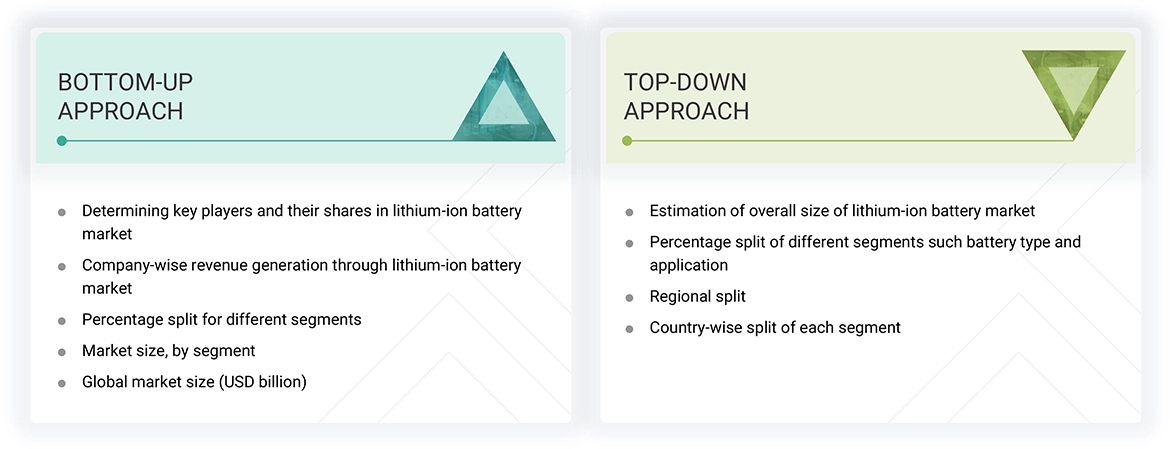
Both top-down and bottom-up approaches have been used to estimate and validate the total size of the Asia Pacific lithium-ion battery market. These methods have also been used extensively to estimate the size of various subsegments in the market. The following research methodology has been used to estimate the market size:
- Major players in the industry and markets were identified through extensive secondary research.
- The industry’s value chain and market size (in terms of value) were determined through primary and secondary research processes.
- All percentage shares, splits, and breakdowns were determined using secondary sources and verified through primary sources.
Asia Pacific Lithium-ion Battery Market : Top-Down and Bottom-Up Approach
Data Triangulation
After arriving at the overall size of the Asia Pacific lithium-ion battery market from the market size estimation process explained above, the total market has been split into several segments and subsegments. Data triangulation and market breakdown procedures have been employed, wherever applicable, to complete the overall market engineering process and arrive at the exact statistics for all segments and subsegments of the market. The data has been triangulated by studying various factors and trends from the demand and supply sides. Additionally, the market size has been validated using top-down and bottom-up approaches.
Market Definition
The Asia Pacific lithium-ion battery market includes a broad range of rechargeable battery technologies that use lithium ions as the core component for energy transfer. These batteries are widely used in applications such as electric vehicles (EVs), energy storage, consumer electronics, industrial machinery, and medical equipment. The market covers several chemistries, such as lithium iron phosphate (LFP), nickel manganese cobalt (NMC), lithium nickel cobalt aluminum oxide (NCA), lithium titanate oxide (LTO), lithium cobalt oxide (LCO) and lithium manganese oxide (LMO), each selected based on specific performance, safety, and cost requirements. Li-ion batteries are known for their high energy density, long service life, fast charging capability, and low maintenance. Market growth is primarily driven by the rising adoption of EVs, expanding renewable energy infrastructure, and increasing demand for compact and efficient power storage solutions across residential, commercial, and industrial sectors.
Key Stakeholders
- Asia Pacific lithium-ion battery manufacturers
- Government bodies and policymakers
- Standards organizations, forums, alliances, and associations
- Market research and consulting firms
- Raw material suppliers and distributors
- Research institutes and organizations
- Material and technology providers
- Battery cell and battery pack manufacturers
- Consumer electronics manufacturers
- Testing, inspection, and certification providers
- Distributors and resellers
Report Objectives
- To define, describe, and forecast the Asia Pacific lithium-ion battery market in terms of battery type, application, and region
- To forecast the lithium ion battery market, based on installed capacity (GWh)
- To provide detailed information regarding major factors influencing the market growth (drivers, restraints, opportunities, and challenges)
- To provide a detailed overview of the value chain of the Asia Pacific lithium-ion battery market.
- To strategically analyze micromarkets with respect to individual growth trends, prospects, and contributions to the Asia Pacific lithium-ion battery market
- To analyze opportunities in the market for stakeholders by identifying high-growth segments of the lithium ion battery market.
- To strategically profile key players and comprehensively analyze their market position in terms of ranking and core competencies, along with detailing the competitive landscape for market leaders
- To analyze competitive strategies, such as product launches, expansions, mergers and acquisitions, adopted by key market players in the Asia Pacific lithium-ion battery market.
Available customizations:
With the given market data, MarketsandMarkets offers customizations according to the company’s specific needs. The following customization options are available for the report:
Company Information:
- Detailed analysis and profiling of additional market players (up to 5)
Key Questions Addressed by the Report
What is the projected market value of the Asia Pacific lithium-ion battery market by 2033?
The Asia Pacific lithium-ion battery market is projected to reach approximately USD 256.47 billion by 2033, growing from about USD 115.13 billion in 2025 at a CAGR of 10.5% during the forecast period.
Which countries are key contributors in the Asia Pacific lithium-ion battery market?
China, India, Japan, and South Korea are key contributors in the Asia Pacific lithium-ion battery market, with India expected to register the highest growth rate in the region.
What are the key segments of the Asia Pacific lithium-ion battery market?
The key segments of the Asia Pacific lithium-ion battery market include battery type (NMC, LFP, LCO, LTO, LMO, NCA), cell type (prismatic, pouch, cylindrical), capacity-based categories (<50 kWh, 50–100 kWh, >100 kWh), and applications such as EVs, energy storage systems, industrial, consumer electronics, and medical.
Which segment holds a significant share or is expected to grow fastest in the Asia Pacific lithium-ion battery market?
The LFP (lithium iron phosphate) battery type segment is expected to register the largest share, while EV (electric vehicle) application is anticipated to dominate due to strong government incentives and rapid EV adoption across the region.
Who are the key players operating in the Asia Pacific lithium-ion battery market?
Key players operating in the Asia Pacific lithium-ion battery market include Contemporary Amperex Technology Co., Ltd. (CATL), BYD Company Ltd., LG Energy Solution, Samsung SDI, Panasonic Holdings Corporation, BAK Power, CALB, Clarios, EnerSys, EVE Energy, GS Yuasa, Mitsubishi Electric Corporation, SK Innovation, Tesla, and Toshiba Corporation.


Personalize This Research
- Triangulate with your Own Data
- Get Data as per your Format and Definition
- Gain a Deeper Dive on a Specific Application, Geography, Customer or Competitor
- Any level of Personalization
Let Us Help You
- What are the Known and Unknown Adjacencies Impacting the Asia Pacific Lithium-ion Battery Market
- What will your New Revenue Sources be?
- Who will be your Top Customer; what will make them switch?
- Defend your Market Share or Win Competitors
- Get a Scorecard for Target Partners

Custom Market Research Services
We Will Customise The Research For You, In Case The Report Listed Above Does Not Meet With Your Requirements
Get 10% Free CustomisationTESTIMONIALS

Tetsuya Ohhira
Business Development Manager-Technology Business
Nikon Corporation,
Leading Japanese MNC specializing in optics and imaging productswww.nikon.com
MarketsandMarkets™ response
is quick. Their attitude is flexible and positive. Analyst Insights are globally considered and
significant. Client Services quickly respond to our inquiry and demand. Their wide range of global
surveys help us make our strategic plan.
We hope Knowledge Store will be easier to search
for a report.
VP - Marketing & Business Development
Leading Provider of Process Control Solutions
We engaged with MarketsandMarkets on a study to perform an analysis and recommend a Go-To-Market strategy for metrology and process control in the semiconductor market. The study was tailored to our targets and needs with well-defined milestones. Our overall experience with the MarketsandMarkets team was very good throughout the project in all aspects including the analysis methodologies used, the quality and depth of primary and secondary data sets, the professionalism and flexibility of the team and the ability to meet the target schedule and milestones. We want to thank MarketsandMarkets team for a job well done.






Growth opportunities and latent adjacency in Asia Pacific Lithium-ion Battery Market