Asia Pacific Manufacturing Execution System (MES) Market

Asia Pacific Manufacturing Execution System (MES) Market by Offering (Software, Services), Deployment (On-premises, Cloud, Hybrid), Application (Production Management, Quality Management, Performance Analytics, Predictive Maintenance) - Forecast to 2030




OVERVIEW
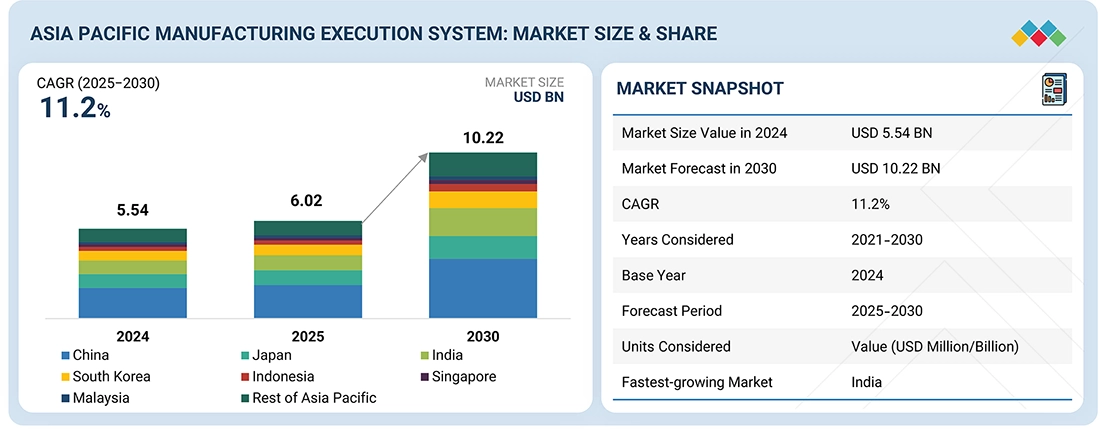
Source: Secondary Research, Interviews with Experts, MarketsandMarkets Analysis
The Asia Pacific MES market is projected to reach USD 10.22 billion by 2030, up from USD 6.02 billion in 2025, at a CAGR of 11.2% from 2025 to 2030. The Asia Pacific MES market is driven by accelerating smart factory initiatives, strong government support for digital manufacturing, the rapid expansion of electronics and automotive production, and rising demand for real-time visibility, quality control, and operational efficiency. The growing adoption of cloud and hybrid MES, along with increased investments in automation, further boosts regional growth.
Market Size & Forecast
KEY TAKEAWAYS
-
BY COUNTRYIndia is expected to dominate the market, growing at a CAGR of 13.3% during the forecast period.
-
BY OFFERINGThe services segment is expected to register the highest CAGR of 12.1% during the forecast period.
-
BY DEPLOYMENTThe on-premises segment is expected to dominate the market in terms of market share.
-
BY END USERThe automotive industry segment is expected to dominate in terms of value during the forecast period.
-
COMPETITIVE LANDSCAPE - KEY PLAYERSYokogawa Electric Corporation (Japan), Siemens (Germany), and Dassault Systèmes (France) were identified as some of the star players in the Asia Pacific MES market, given their strong market share and product footprint.
-
COMPETITIVE LANDSCAPE - STARTUPS/SMESCerexio (Singapore) and Miracom, Inc. (South Korea) have distinguished themselves among SMEs by securing strong footholds in specialized niche areas, underscoring their potential as emerging market leaders.
The Asia Pacific MES market is primarily driven by China, Japan, India, and South Korea, among other countries. Rapid smart-factory adoption, strong government digitalization programs, rising automation demand, and expanding electronics, automotive, and pharmaceutical manufacturing are driving the growth of the manufacturing execution system in the Asia Pacific region.
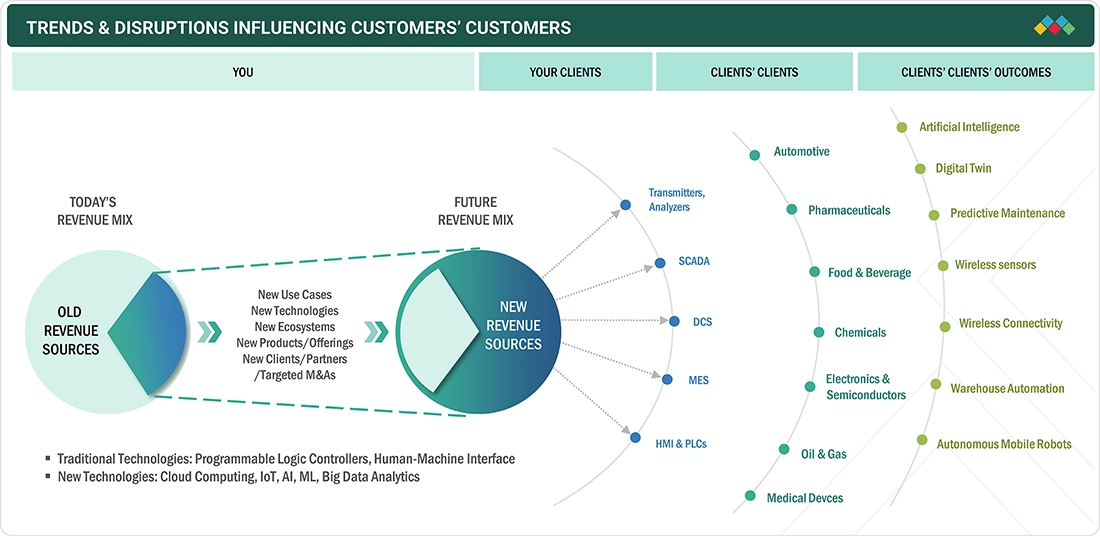
TRENDS & DISRUPTIONS IMPACTING CUSTOMERS' CUSTOMERS
The Asia Pacific MES market is witnessing strong trends driven by the accelerated adoption of Industry 4.0 and 5.0, the integration of AI, IIoT, and digital twins, and a growing preference for cloud and hybrid MES architectures. Semiconductor, electronics, and pharmaceutical manufacturers are increasingly embracing predictive analytics, advanced quality management, and autonomous production optimization. Key disruptions include rapid deployment of low-code MES platforms, rising use of edge MES for real-time decision-making, and growing cybersecurity mandates across China, Japan, India, and South Korea. The shift toward multi-plant digital orchestration and cross-factory data harmonization is reshaping MES strategies in the region.
Source: Secondary Research, Interviews with Experts, MarketsandMarkets Analysis
MARKET DYNAMICS

Level
-
Rapid smart-factory adoption across China, Japan, and South Korea

-
Government-led digitalization initiatives across Asia Pacific countries


Level
-
Complex integration of MES with legacy OT/ERP systems in China, India, and Indonesia,

-
Shortage of skilled OT-IT integration workforce, particularly across Asian economies such as Vietnam and Indonesia


Level
-
Rapid adoption of cloud and hybrid MES in Japan, Singapore, and South Korea

-
AI/ML-driven MES gaining rapid traction in China and India


Level
-
Rising cybersecurity and data-sovereignty concerns across Asia Pacific

-
High cost of deployment and lengthy validation cycles vital end-use sectors

Source: Secondary Research, Interviews with Experts, MarketsandMarkets Analysis
Driver: Rapid smart-factory adoption across China, Japan, and South Korea
APAC MES growth is strongly driven by the aggressive modernization of smart factories led by China, Japan, and South Korea. These countries are investing heavily in robotics, IIoT, AI-enabled production systems, and digital twins to boost productivity and global competitiveness. Government-backed programs—such as China’s “Made in China 2025,” Japan’s Society 5.0, and Korea’s Smart Manufacturing Innovation Strategy—accelerate the uptake of MES for real-time visibility, automated quality control, and production optimization. High-value verticals, including electronics, automotive, and semiconductors, rely on MES for precision, speed, and global supply chain compliance.
Restraint: Complex integration of MES with legacy OT/ERP systems in China, India, and Indonesia
A key restraint in the Asia-Pacific MES market is the difficulty of integrating modern MES platforms with outdated legacy OT, PLC, SCADA, and ERP systems, particularly in China, India, and Indonesia. Many factories operate with decades-old equipment that has limited interoperability, inconsistent data maturity, and proprietary communication protocols. Integration efforts become costly and time-consuming, often requiring custom middleware and extended downtime. SMEs in these regions also face budget constraints and workforce skill gaps, which further delay MES rollouts and slow down the pace of digital transformation.
Opportunity: Rapid adoption of cloud and hybrid MES in Japan, Singapore, and South Korea
Japan, Singapore, and South Korea are emerging as hotspots for cloud and hybrid MES adoption due to advanced digital infrastructure, high 5G penetration, and strong government support for Industry 4.0/5.0 initiatives. Manufacturers in sectors such as electronics, pharmaceuticals, medical devices, and precision engineering are increasingly shifting to cloud-based MES to reduce IT overheads, accelerate deployment, and enable centralized multi-site monitoring. Hybrid architectures support both on-premise control and cloud-based analytics, enabling real-time insights, predictive quality, and scalable operations—driving strong MES market expansion.
Challenge: Rising cybersecurity and data-sovereignty concerns across vital end-use sectors
As digital manufacturing expands across the APAC region, cybersecurity threats and data sovereignty requirements have become major challenges for MES deployments. Industries such as semiconductors, pharmaceuticals, energy, and automotive are concerned about operational disruptions from ransomware, OT intrusions, and IP theft. Countries, including China, India, and Vietnam, have introduced strict data-localization laws, which complicate cross-border MES cloud architectures. Manufacturers must invest in secure-by-design MES platforms, segmented OT networks, encryption, and compliance frameworks. These increasing security and regulatory pressures slow cloud MES adoption and increase the cost of digital transformation.
ASIA PACIFIC MANUFACTURING EXECUTION SYSTEM (MES) MARKET: COMMERCIAL USE CASES ACROSS INDUSTRIES
| COMPANY | USE CASE DESCRIPTION | BENEFITS |
|---|---|---|
 |
Yokogawa’s MES solutions, including production management, batch control, and quality tracking, are widely deployed in APAC process industries such as oil & gas, petrochemicals, power, and pharmaceuticals. MES supports integration with DCS/SCADA, batch sequencing, real-time production visibility, and digital work instructions. | Enhances production continuity, reduces batch cycle times, improves regulatory compliance, and optimizes plant-wide performance. Seamless OT–MES integration lowers downtime and increases operational reliability for complex, continuous processes common in APAC manufacturing. |
 |
Siemens Opcenter is used across discrete manufacturing, including electronics, automotive, aerospace, and machinery production in China, Japan, South Korea, India, and Southeast Asia. It supports production planning, execution, genealogy tracking, quality inspection, and digital twin-based optimization. | Provides end-to-end visibility, faster NPI cycles, and improved quality consistency. Strong compatibility with automation hardware and PLM accelerates smart-factory transformation. Ideal for high-volume electronics and automotive hubs across the Asia Pacific. |
 |
DELMIA Apriso MES is widely used in aerospace, defense, automotive, industrial equipment, and life sciences manufacturing across the APAC region. It supports global operations management, shop-floor control, quality, traceability, and synchronization of multi-site production environments. | Enables global standardization, improved traceability, and harmonized workflows across multi-plant networks. Enhances agility, compliance, and digital continuity with strong integration to 3DEXPERIENCE PLM and simulation platforms |
 |
Applied Materials offers advanced MES and automation software for semiconductor fabs and display panel manufacturing. The SmartFactory suite supports equipment automation, wafer/lot tracking, yield management, and predictive optimization for highly complex, high-precision environments in Taiwan, South Korea, Japan, and China. | Delivers ultra-high throughput, reduced wafer defect rates, and optimized fab productivity. Strengthens real-time decision-making in mission-critical semiconductor operations, enabling faster time-to-yield and lower production variability. |
Logos and trademarks shown above are the property of their respective owners. Their use here is for informational and illustrative purposes only.
MARKET ECOSYSTEM
The Asia Pacific MES ecosystem comprises MES software vendors, automation providers, cloud platforms, and system integrators, enabling end-to-end digital manufacturing. Collaboration among equipment suppliers, IT/OT integrators, and industry-specific solution partners supports rapid smart-factory deployment. Strong government programs, rising digital investments, and expanding manufacturing clusters further strengthen the region’s MES ecosystem.
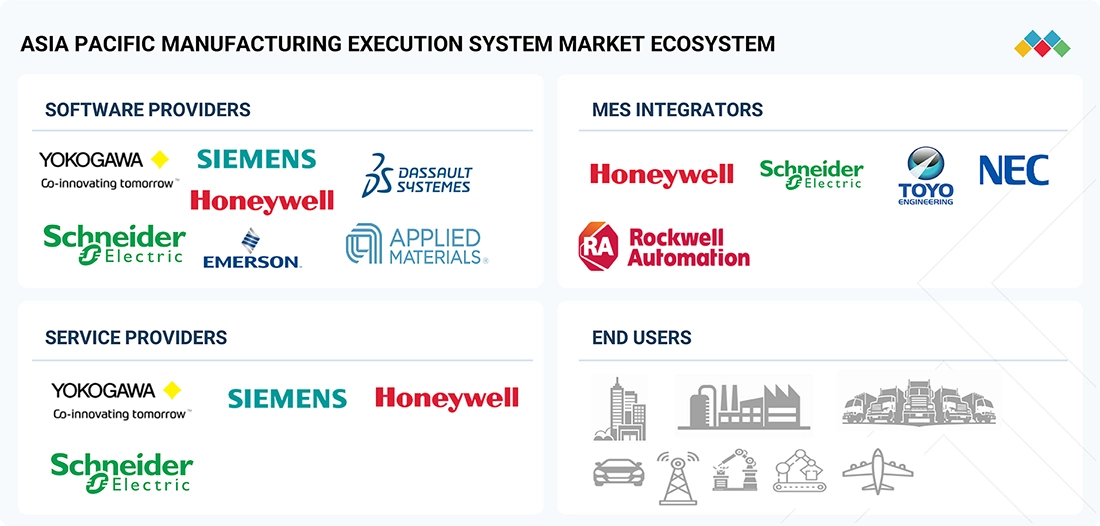
Logos and trademarks shown above are the property of their respective owners. Their use here is for informational and illustrative purposes only.
MARKET SEGMENTS

Source: Secondary Research, Interviews with Experts, MarketsandMarkets Analysis
Asia Pacific Manufacturing Execution System Market, By Offering
The services segment is expected to dominate the Asia Pacific manufacturing execution system market as manufacturers increasingly rely on system integration, consulting, customization, and ongoing support to enable smooth digital transformation. Complex brownfield environments in China, India, Japan, and Southeast Asia require extensive integration with legacy OT/ERP systems, driving demand for expert services. Additionally, rising adoption of cloud and hybrid MES architectures boosts the need for managed services, maintenance, upgrades, and cybersecurity support, making services essential for scalable, compliant, and efficient MES implementations across the region.
Asia Pacific Manufacturing Execution System Market, By Deployment
The on-premises deployment segment is expected to dominate the Asia Pacific MES market due to strict data security requirements, strong control needs, and the prevalence of large, complex manufacturing facilities across China, Japan, South Korea, and India. Industries such as electronics, automotive, semiconductors, and pharmaceuticals prefer on-premise MES to ensure low latency, high reliability, and seamless integration with proprietary OT systems. Additionally, regulatory compliance, IP protection concerns, and limited cloud adoption in critical sectors further strengthen demand for robust on-site MES infrastructures.
Asia Pacific Manufacturing Execution System Market, By Industry
The automotive industry is expected to dominate the Asia Pacific MES market due to the region’s massive vehicle production hubs in China, Japan, India, and South Korea, as well as the rapid expansion of EV and battery manufacturing. Automakers rely on MES for real-time production visibility, quality traceability, robotics coordination, and multi-plant synchronization. The shift toward smart, modular, and high-precision manufacturing, combined with stringent regulatory and safety standards, drives strong adoption of MES. Additionally, growing investments in EV gigafactories significantly accelerate MES deployments across the automotive value chain.
REGION
India is expected to be the fastest-growing country across the Asia Pacific MES market during the forecast period
India is expected to record the fastest CAGR in the Asia Pacific MES market due to rapid industrial digitalization, strong manufacturing expansion, and accelerated adoption of automation across sectors such as automotive, electronics, pharmaceuticals, textiles, and food processing. The country’s large base of brownfield factories is undergoing rapid modernization, creating strong demand for MES to enhance real-time production visibility, operational efficiency, batch traceability, and quality compliance. The growth of India’s pharma and life sciences sector, driven by global export demand, biosimilar manufacturing, and vaccine production, further boosts MES adoption for GMP compliance and electronic batch records. Increasing investments from global OEMs and contract manufacturers are also creating new MES opportunities, particularly in electronics and EV supply chains.
ASIA PACIFIC MANUFACTURING EXECUTION SYSTEM (MES) MARKET: COMPANY EVALUATION MATRIX
In the Asia Pacific MES market matrix, Yokogawa Electric Corporation, Siemens, and Dassault Systèmes (Star) lead with a strong market presence and a wide product portfolio, driving large-scale adoption across various industries, including automotive, chemicals, and pharmaceuticals, among others.
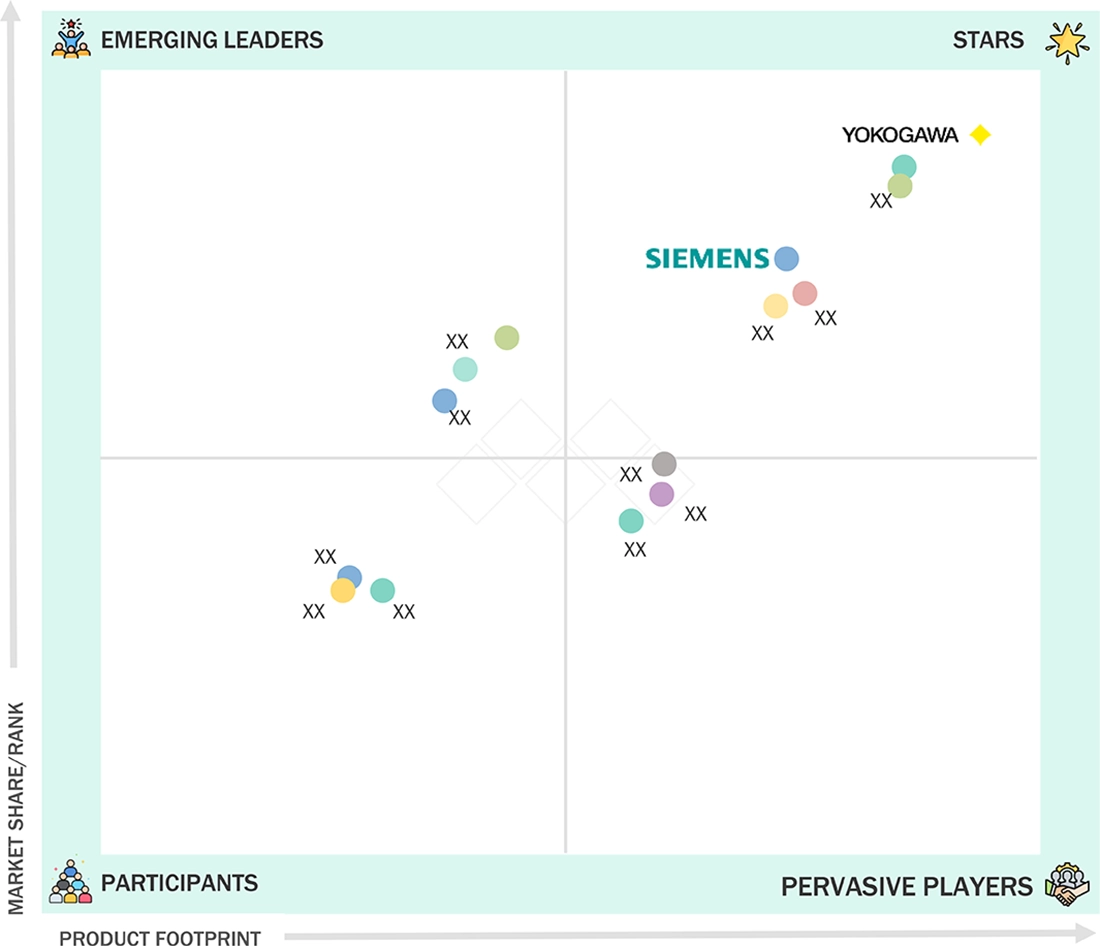
Source: Secondary Research, Interviews with Experts, MarketsandMarkets Analysis
KEY MARKET PLAYERS
- Yokogawa Electric Corporation (Japan)
- Siemens (Germany)
- Dassault Systèmes (France)
- ABB (Switzerland)
- SAP SE (Germany)
- Schneider Electric (France)
- Rockwell Automation (US)
- Honeywell International Inc.(US)
- Emerson Electric Co (US)
- Applied Materials Inc (US)
MARKET SCOPE
| REPORT METRIC | DETAILS |
|---|---|
| Market Size in 2024 (Value) | USD 5.54 Billion |
| Market Forecast in 2030 (Value) | USD 10.22 Billion |
| Growth Rate | CAGR of 11.2% from 2025–2030 |
| Years Considered | 2021–2030 |
| Base Year | 2024 |
| Forecast Period | 2025–2030 |
| Units Considered | Value (USD Billion/Million) |
| Report Coverage | Revenue forecast, company ranking, competitive landscape, growth factors, and trends |
| Segments Covered |
|
| Country Scope | China, Japan, India, South Korea, Malaysia, Indonesia, Singapore, Rest of Asia Pacific |
WHAT IS IN IT FOR YOU: ASIA PACIFIC MANUFACTURING EXECUTION SYSTEM (MES) MARKET REPORT CONTENT GUIDE
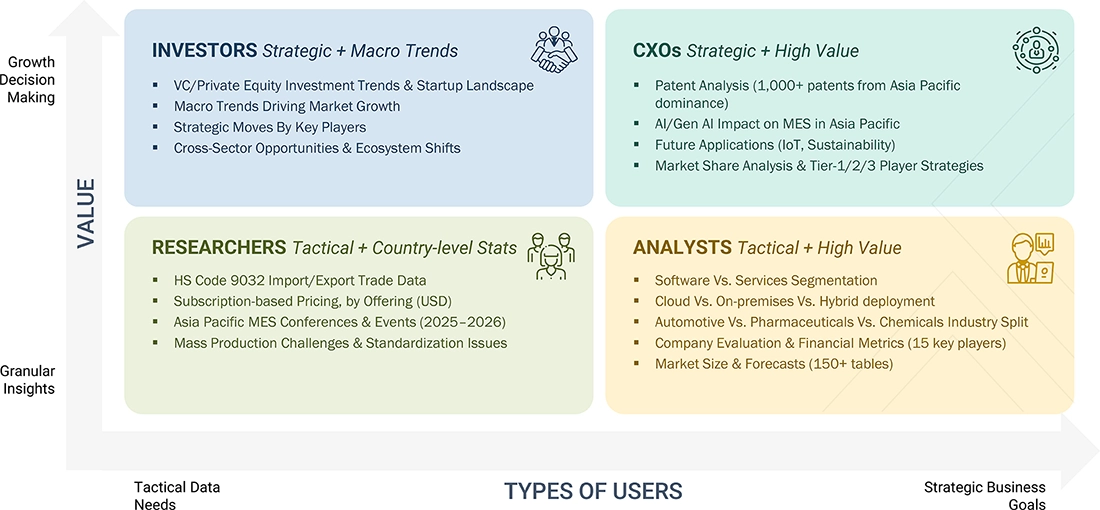
DELIVERED CUSTOMIZATIONS
We have successfully delivered the following deep-dive customizations:
| CLIENT REQUEST | CUSTOMIZATION DELIVERED | VALUE ADDS |
|---|---|---|
| Japan-based Automotive & EV Manufacturer |
|
|
| India-based Pharmaceutical & Biopharma Firm |
|
|
| Singapore-based Food & Beverage Multisite Producer |
|
|
| China-based Industrial Equipment & Machinery OEM |
|
|
RECENT DEVELOPMENTS
- January 2025, : Transcosmos signed a memorandum of agreement (MOU) for a strategic partnership with Yokogawa China Co., Ltd. The two signed an MOU to collaborate on consulting and IT/OT solutions for smart manufacturing, lean production, and MES/smart-factory readiness, expanding Yokogawa’s MES/automation footprint in China/Asia-Pacific.
- October 2025, : Yokogawa Electric Corporation announced the global release of OpreX Batch MES, a product in the OpreX Asset Operations and Optimization family. OpreX Batch MES is a manufacturing execution system (MES) package intended for use in batch plants that produce specialty and fine chemicals.
- January 2024. : Siemens launched manufacturing execution systems (MES) software. Powered by Mendix’s low-code technology, this software empowers manufacturers with unprecedented agility. This innovative solution redefines manufacturing across diverse industries.
Table of Contents
 Exclusive indicates content/data unique to MarketsandMarkets and not available with any competitors.
Methodology
The study involved four major activities in estimating the current size of the Asia Pacific Manufacturing Execution System (MES) Market. Exhaustive secondary research has been done to collect information on the market, peer market, and parent market. To validate these findings, assumptions, and sizing with industry experts across the value chain through primary research has been the next step. Both top-down and bottom-up approaches have been employed to estimate the complete market size. After that, market breakdown and data triangulation methods have been used to estimate the market size of segments and subsegments. Two sources of information—secondary and primary—have been used to identify and collect information for an extensive technical and commercial study of the Asia Pacific Manufacturing Execution System (MES) Market.
Secondary Research
Various secondary sources have been referred to in the secondary research process to identify and collect information important for this study. The secondary sources include annual reports, press releases, and investor presentations of companies; white papers; journals and certified publications; and articles from recognized authors, websites, directories, and databases. Secondary research has been conducted to obtain key information about the industry’s supply chain, the market’s value chain, the total pool of key players, market segmentation according to the industry trends (to the bottom-most level), regional markets, and key developments from market- and technology-oriented perspectives. The secondary data has been collected and analyzed to determine the overall market size, further validated by primary research.
Primary Research
Extensive primary research was conducted after gaining knowledge about the current scenario of the Asia Pacific Manufacturing Execution System (MES) Market through secondary research. Several primary interviews were conducted with experts from the demand and supply sides across Europe. This primary data was collected through questionnaires, emails, and telephonic interviews.
Market Size Estimation
Both top-down and bottom-up approaches have been used to estimate and validate the total size of the Asia Pacific Manufacturing Execution System (MES) Market. These methods have also been used extensively to estimate the size of various subsegments in the market. The following research methodology has been used to estimate the market size:
- Major players in the industry and markets have been identified through extensive secondary research.
- The industry’s value chain and market size (in terms of value) have been determined through primary and secondary research processes.
- All percentage shares, splits, and breakdowns have been determined using secondary sources and verified through primary sources.
Data Triangulation
After arriving at the overall size of the Asia Pacific Manufacturing Execution System (MES) Market from the market size estimation process explained above, the total market has been split into several segments and subsegments. Data triangulation and market breakdown procedures have been employed, wherever applicable, to complete the overall market engineering process and arrive at the exact statistics for all segments and subsegments of the market. The data has been triangulated by studying various factors and trends from both the demand and supply sides. Along with this, the market size has been validated using both top-down and bottom-up approaches..
Market Definition
Manufacturing Execution Systems (MES) refers to software designed to maximize real-time factory production management by integrating operational technology (OT) with information technology (IT). Unlike enterprise resource planning (ERP) systems, MES offers granular visibility, control, and coordination of the manufacturing process at the shop floor level. These systems maximize production efficiency through optimized monitoring, quality assurance, workflow automation, and compliance with regulatory requirements.
Propelled by Industry 4.0, smart manufacturing, and real-time analytics needs, MES solutions assist manufacturers in minimizing downtime, enhancing agility, and maximizing the use of resources. Industries such as automotive, electronics, pharmaceuticals, aerospace, and food & beverage depends on MES for smooth production, supply chain synchronization, and improved decision-making.
Key Stakeholders
- Associations and regulatory authorities (especially responsible for developing standards related to plant maintenance)
- Government bodies, venture capitalists, and private equity firms
- Automation consultants
- Automation system integrators
- ERP developers
- MES distributors and providers
- Process and discrete industries
- Research organizations and consulting companies
- Technology providers
- Technology investors, standards organizations, forums, alliances, and associations
Report Objectives
- To describe, segment, and forecast the overall Asia Pacific Manufacturing Execution System (MES) Market, by deployment mode, offering, application, and industry, in terms of value.
- To describe the applications and leveraging entities of manufacturing execution systems and software.
- To provide an overview of the recent trends in the market.
- To provide detailed information regarding the drivers, restraints, opportunities, and challenges influencing the growth of the market.
- To analyze the supply chain, trends/disruptions impacting customers’ business, market/ecosystem map, pricing analysis, and regulatory landscape pertaining to Asia Pacific Manufacturing Execution System (MES) Market.
- To strategically analyze micromarkets with respect to individual growth trends, prospects, and contributions to the overall market size.
- To analyze opportunities in the market for stakeholders and provide a competitive landscape of the market.
- To strategically profile the key players and comprehensively analyze their market positions in terms of their ranking and core competencies, along with detailing the competitive landscape for market leaders,
- To analyze competitive developments, such as product launches, acquisitions, collaborations, agreements, and partnerships, in the Asia Pacific Manufacturing Execution System (MES) Market.
- To provide ecosystem analysis, case study analysis, patent analysis, technology analysis, value chain analysis, trends/disruptions impacting customer business, the impact of AI/Gen AI, key conferences and events, pricing analysis, Porter’s five forces analysis, and regulations pertaining to the market under study.
- To provide a macroeconomic outlook based on all the regions in the region chapter.
Available Customizations
With the given market data, MarketsandMarkets offers customizations according to the company’s specific needs. The following customization options are available for the report:
Company Information:
- Detailed analysis and profiling of additional market players (up to 5)
Key Questions Addressed by the Report
What is the projected market size of the Asia Pacific manufacturing execution system (MES) market?
The Asia Pacific MES market is projected to grow from USD 6.2 billion in 2025 to USD 11.2 billion by 2030, at a CAGR of 12.5%.
Which country leads the Asia Pacific MES market?
China leads the market due to rapid industrialization and strong adoption of smart manufacturing technologies.
Which deployment segment is gaining traction in the MES market?
The cloud-based deployment segment is gaining traction due to scalability, flexibility, and lower upfront costs.
Which industry segment is expected to grow significantly?
The electronics and semiconductor industry segment is expected to grow significantly due to increasing production complexity and demand for precision manufacturing.
Who are the key players in the Asia Pacific MES market?
Key players include Siemens AG, Rockwell Automation, ABB Ltd., Schneider Electric, and Honeywell International Inc..


Personalize This Research
- Triangulate with your Own Data
- Get Data as per your Format and Definition
- Gain a Deeper Dive on a Specific Application, Geography, Customer or Competitor
- Any level of Personalization
Let Us Help You
- What are the Known and Unknown Adjacencies Impacting the Asia Pacific Manufacturing Execution System (MES) Market
- What will your New Revenue Sources be?
- Who will be your Top Customer; what will make them switch?
- Defend your Market Share or Win Competitors
- Get a Scorecard for Target Partners

Custom Market Research Services
We Will Customise The Research For You, In Case The Report Listed Above Does Not Meet With Your Requirements
Get 10% Free CustomisationTESTIMONIALS

Tetsuya Ohhira
Business Development Manager-Technology Business
Nikon Corporation,
Leading Japanese MNC specializing in optics and imaging productswww.nikon.com
MarketsandMarkets™ response
is quick. Their attitude is flexible and positive. Analyst Insights are globally considered and
significant. Client Services quickly respond to our inquiry and demand. Their wide range of global
surveys help us make our strategic plan.
We hope Knowledge Store will be easier to search
for a report.
VP - Marketing & Business Development
Leading Provider of Process Control Solutions
We engaged with MarketsandMarkets on a study to perform an analysis and recommend a Go-To-Market strategy for metrology and process control in the semiconductor market. The study was tailored to our targets and needs with well-defined milestones. Our overall experience with the MarketsandMarkets team was very good throughout the project in all aspects including the analysis methodologies used, the quality and depth of primary and secondary data sets, the professionalism and flexibility of the team and the ability to meet the target schedule and milestones. We want to thank MarketsandMarkets team for a job well done.






Growth opportunities and latent adjacency in Asia Pacific Manufacturing Execution System (MES) Market