Asia Pacific Paints & Coatings Market

Asia Pacific Paints & Coatings Market by Resin Type (Acrylic, Alkyd, Epoxy, Polyurethane, Fluoropolymer, Vinyl, Polyester), Technology (Waterborne Coatings, Solvent-borne Coatings, Powder Coatings), End Use (Architectural, Industrial), Country - Forecast to 2030




OVERVIEW
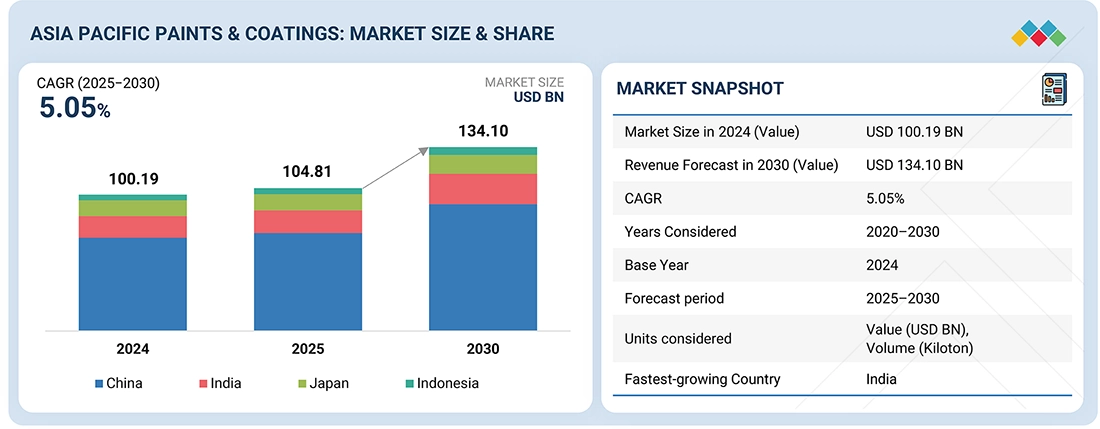
Source: Secondary Research, Interviews with Experts, MarketsandMarkets Analysis
The Asia Pacific paints & coatings market is projected to reach USD 134.10 billion by 2030, growing from USD 104.81 billion in 2025 at a CAGR of 5.05% between 2025 and 2030. The market is projected to witness robust expansion, driven by rapid urbanization, industrialization, and rising infrastructure investment across major economies such as China, India, Japan, and Southeast Asia. It remains the world’s largest consumer of paints and coatings, supported by booming construction activity, strong automotive production, growth in appliance manufacturing, and increasing demand for protective and marine coatings. Market growth is further accelerated by the rising adoption of high-performance, durable, and sustainable coating technologies, especially as governments tighten regulations on VOC emissions and promote environmentally friendly products. The shift toward water-borne, low-VOC, high-solids, and bio-based formulations is gaining momentum as manufacturers and end users prioritize greener solutions. Continuous innovation in resin chemistries, pigment dispersion technologies, and advanced functional additives is enhancing corrosion protection, weatherability, energy efficiency, and aesthetic performance, positioning Asia Pacific as a dynamic, fast-growing, and innovation-led coatings market.
KEY TAKEAWAYS
-
By CountryIndia dominated the Asia Pacific paints & coatings market, accounting for a 55.8% share in 2024.
-
By Resin TypeBy resin type, the polyurethane resin segment is projected to be achieve the highest CAGR (10.17%) of the Asia Pacific architectural paints & coatings market during the forecast period.
-
By TechnologyBy technology, the powder coatings segment is projected to register the highest CAGR of 10.26% and 11.50% in the architectural and industrial Asia Pacific's paints & coatings, respectively, between 2025 and 2030.
-
By End-Use IndustryThe industrial segment accounted for a larger share than the architectural segment in 2024.
-
Competitive Landscape - Key PlayersNippon Paint Holdings Co., Ltd., Kansai Paint Co., Ltd., and Asian Paints Limited stand out as dominant participants in the Asia Pacific paints & coatings market, supported by their extensive offerings and established industry reach.
-
Competitive Landscape - StartupsBerger Paints India Limited, Shalimar Paints, and SACAL International Group Ltd. are gaining visibility in specialized segments and have identified themselves among startups/SMEs to position them as promising up-and-coming players in the market.
The Asia Pacific paints & coatings market is expected to grow strongly over the coming years, supported by rising demand across architectural, automotive, industrial, and protective coating applications. The region’s growth is driven by large-scale residential and commercial construction, accelerating infrastructure development, and expanding manufacturing output across China, India, Japan, South Korea, and Southeast Asia. End users are increasingly prioritizing high-performance, low-VOC, and sustainable coating technologies, further accelerating the shift toward water-borne, powder, high-solids, and UV-curable systems.
TRENDS & DISRUPTIONS IMPACTING CUSTOMERS' CUSTOMERS
The impact on businesses in the Asia Pacific paints & coatings market is driven by the dynamic nature of end users and the ongoing reinvention within the industry. Key clients include architectural contractors, automotive OEMs, industrial manufacturers, marine and protective coating applicators, as well as a rapidly growing DIY consumer base, all of which represent significant application segments in the region. Several trends are shaping this market. These include increasing emphasis on sustainability and VOC compliance standards. Also, there is a notable shift towards waterborne, high-solids, and bio-based technologies, alongside the growth of automation in manufacturing. Additionally, the adoption of digital color-matching and precision-application systems is transforming the formulation, sourcing, and operational processes in the industry. These disruptions have a direct impact on the revenue of coating producers and tier 1 suppliers of raw materials, resulting in changes to procurement patterns and product development cycles for resins, pigments, and additives. Consequently, these factors also affect the overall profitability of companies involved in the Asia Pacific paints and coatings value chain.
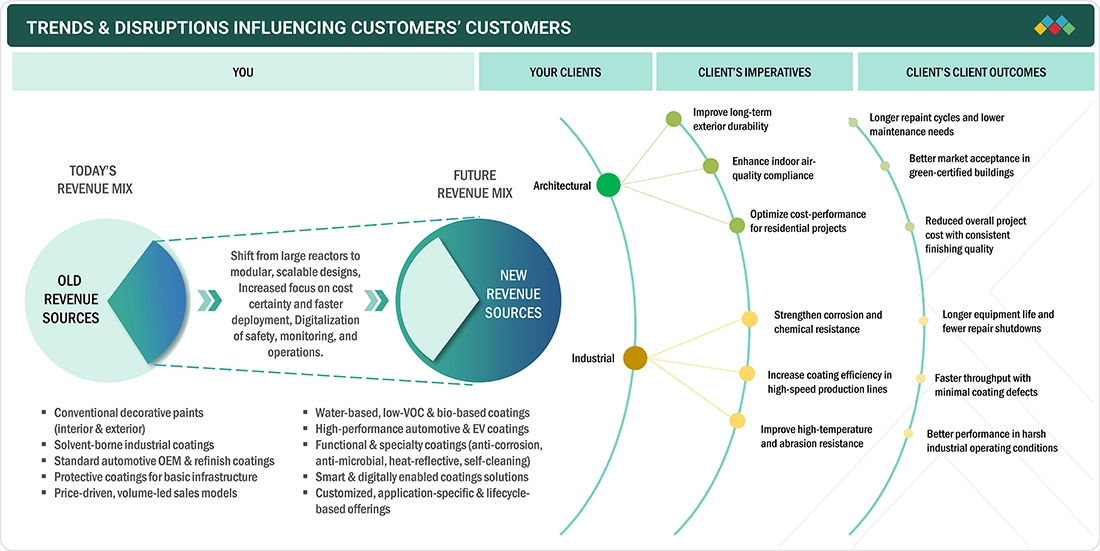
Source: Secondary Research, Interviews with Experts, MarketsandMarkets Analysis
MARKET DYNAMICS

Level
-
Rapid urbanization and infrastructure development across emerging economies

-
Growing popularity of elastomeric coatings in tilt-up concrete in building & construction industry


Level
-
Difficulty in obtaining thin films in powder coatings

-
Fluctuating raw material prices and supply chain volatility


Level
-
Increasing applications of fluoropolymers in building & construction industry

-
Growing adoption of eco-friendly, water-borne, and low-VOC technologies


Level
-
Regulatory diversity and compliance complexity across APAC countries

Source: Secondary Research, Interviews with Experts, MarketsandMarkets Analysis
Driver: Rapid urbanization and infrastructure development across emerging economies
The Asia Pacific region is experiencing strong growth in construction and infrastructure development, driven by rapid urbanization, rising disposable incomes, and large-scale government investments in housing, transportation, smart cities, and industrial expansion. Countries such as China, India, Indonesia, Vietnam, and the Philippines are leading with massive residential and commercial construction activity, which is fueling the demand for architectural and protective coatings. Additionally, growth in the automotive, electronics, marine, and manufacturing sectors boosts consumption of high-performance industrial coatings. This structural economic expansion makes Asia Pacific the fastest-growing market globally for paints and coatings.
Restraints: Fluctuating raw material prices and supply chain volatility
The Asia Pacific paints & coatings market faces significant challenges due to volatile prices of key raw materials, such as titanium dioxide, acrylic monomers, epoxies, solvents, and specialty additives. Many countries in the region depend heavily on imported chemicals, making them vulnerable to price fluctuations, currency instability, and global supply chain disruptions. Geopolitical tensions, freight cost surges, and dependence on China for chemical intermediates further strain procurement. These fluctuations increase production costs for coating manufacturers, reduce profit margins, and create pricing pressure across both architectural and industrial segments.
Opportunities: Growing adoption of eco-friendly, water-borne, and low-VOC technologies
As environmental awareness increases and regulatory frameworks tighten across key APAC markets, the demand for sustainable, low-VOC, and water-borne coatings is rising. Countries such as China, Japan, South Korea, Australia, and increasingly India are adopting stricter emission standards for paints and coating formulations. This shift is encouraging the development of water-borne, high-solids, powder, and bio-based coatings across decorative, automotive, and industrial applications. Manufacturers investing in green chemistry, clean production technologies, and environmentally responsible formulations are positioned to capture significant market opportunities as sustainability becomes a mainstream purchasing criterion.
Challenges: Regulatory diversity and compliance complexity across APAC countries
Unlike more harmonized markets, the Asia Pacific region faces a highly fragmented regulatory landscape, with each country enforcing distinct standards for VOC limits, chemical safety, labeling, and environmental compliance. Navigating varying frameworks—from China’s tightening environmental policies to Japan’s chemical control laws and India’s emerging VOC guidelines—creates operational complexity for global and regional paint manufacturers. Adapting formulations and production processes to meet country-specific regulations increases time-to-market, raises compliance costs, and complicates cross-border product standardization. This diverse regulatory environment remains a major challenge for achieving consistent quality and scale across the region.
ASIA PACIFIC PAINTS & COATINGS MARKET: COMMERCIAL USE CASES ACROSS INDUSTRIES
| COMPANY | USE CASE DESCRIPTION | BENEFITS |
|---|---|---|
 |
Decorative/architectural coatings for residential and commercial buildings across India, South Asia, and parts of the Middle East and ASEAN | Market-leading decorative share in India with strong brand pull, wide dealer network | Growth in premium low-odor and washable interior ranges that capture rising middle-class spend |
 |
Decorative, automotive, and industrial coatings with strong positions in China, Southeast Asia, and Japan | Leadership in decorative in several Asian countries | Deep localization of products and shades | Active innovation in low-VOC, anti-bacterial, and environmentally friendly paints for urban markets? |
 |
Automotive OEM and refinish, industrial, and decorative coatings with key bases in Japan, India, and other APAC markets. | Strong relationship with Japanese and local OEMs | High-performance corrosion-resistant and appearance coatings, and regional R&D to adapt to humid and coastal conditions |
 |
Decorative brands and industrial/protective coatings serving construction, marine, and manufacturing across China, India, Southeast Asia, and Australasia | Global technology portfolio tailored to APAC climates, color, and design expertise | Expansion of water-borne and high-solids systems to meet tightening environmental rules |
Logos and trademarks shown above are the property of their respective owners. Their use here is for informational and illustrative purposes only.
MARKET ECOSYSTEM
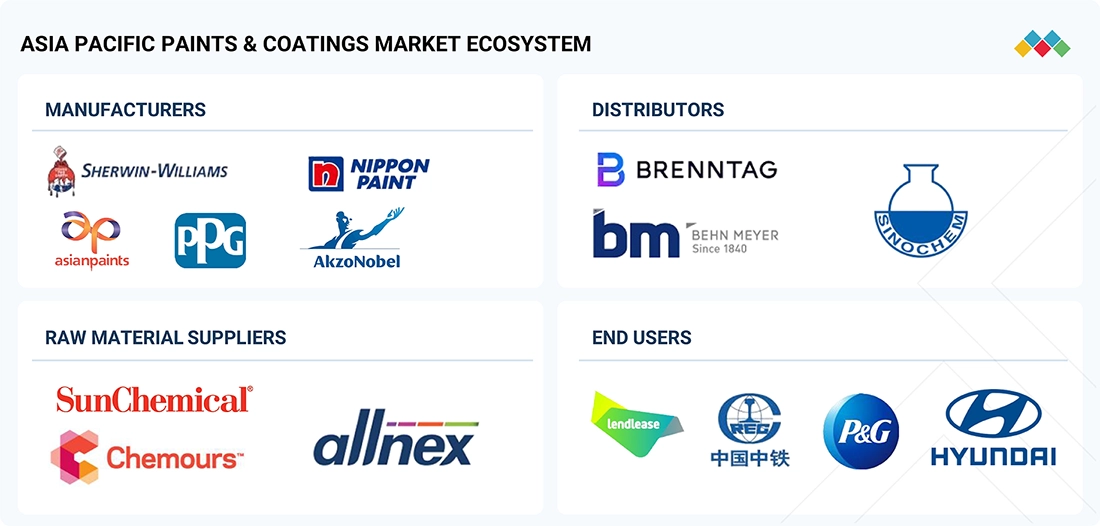
The Asia Pacific paints & coatings ecosystem consists of a wide network of interconnected stakeholders, including raw material suppliers, formulation manufacturers, distributors, applicators, and diverse end-use industries. Raw material suppliers, such as Sun Chemical, Allnex, and Chemours, deliver critical inputs including pigments, resins, additives, and bio-based materials to these coating formulators. Distributors, such as Brenntag, connect manufacturers to markets by handling inventory, blending services, and logistics across the region. They provide value-added services like repacking and regional delivery, bridging manufacturers and end users in fast-expanding markets. Manufacturers, including Sherwin-Williams, Nippon Paint, PPG, Asian Paints, and AkzoNobel, produce specialized formulations for architectural, automotive, industrial, protective, and marine applications tailored to Asia Pacific demands. These companies emphasize low-VOC, high-performance coatings to meet regulatory and sustainability goals. End users, such as P&G and Hyundai, rely on coatings for durability, corrosion resistance, and aesthetics in the automotive, electronics, and industrial sectors. The ecosystem supports these industries through reliable access to customized, compliant products amid evolving standards.
Logos and trademarks shown above are the property of their respective owners. Their use here is for informational and illustrative purposes only.
MARKET SEGMENTS
Source: Secondary Research, Interviews with Experts, MarketsandMarkets Analysis
Asia Pacific Paints & Coatings Market, By Resin Type
The epoxy resins segment accounted for the largest share in the Asia Pacific industrial paints & coatings market in 2024. This resin provides outstanding corrosion resistance, chemical resistance, strong adhesion, and long-term durability required for applications across automotive manufacturing, electronics, marine, heavy machinery, metal fabrication, and industrial equipment. At the same time, it dominates the Asia Pacific architectural paints and coatings market, driven by its excellent color retention, UV stability, low VOC compatibility, affordability, and suitability for water-borne formulations. These properties make acrylic-based coatings the preferred choice for interior and exterior decorative applications across rapidly urbanizing markets, such as China, India, Japan, and Southeast Asia.
Asia Pacific Paints & Coatings Market, By Technology
Water-borne coatings dominate the Asia Pacific architectural paints & coatings market, supported by stricter VOC norms, rising demand for low-odor and eco-friendly products, and strong adoption across residential and commercial construction. Their easy application, fast drying, and excellent color retention make them the preferred choice in rapidly urbanizing markets. Solvent-borne coatings led the Asia Pacific industrial paints & coatings market in 2024 due to their superior durability, chemical resistance, and strong adhesion required in automotive, marine, metal fabrication, and heavy machinery applications. Despite growing sustainability pressures, many industrial users continue to rely on solvent-borne systems for performance in demanding operating environments.
Asia Pacific Paints & Coatings Market, By End-Use Industry
The residential segment, driven by rapid urbanization, large-scale housing construction, and rising repainting activities, accounted for the largest share of the Asia Pacific architectural paints & coatings market in 2024. Strong growth in China, India, Indonesia, and Vietnam, coupled with increasing demand for affordable, long-lasting decorative coatings, continues to fuel consumption across interior and exterior applications. Meanwhile, the wood segment accounted for a major share of the Asia Pacific industrial paints & coatings market in 2024. This growth was supported by the region’s expanding furniture manufacturing, cabinetry production, flooring, and millwork sectors. The need for durable, moisture-resistant, and aesthetically enhanced finishes in high-volume wood products drives substantial use of industrial coatings across Asia Pacific.
REGION
China accounted for the largest share of the Asia Pacific paints & coatings market in 2024
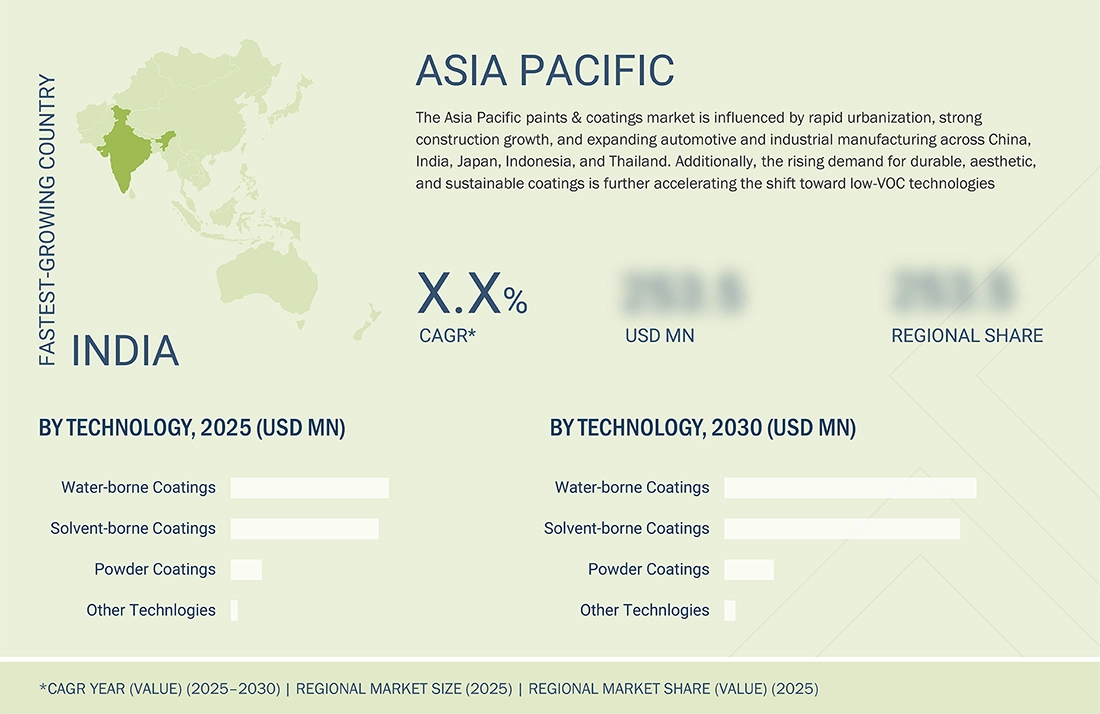
China accounted for the largest share of the Asia Pacific paints & coatings market in 2024 due to its massive construction activity, strong automotive and industrial base, and high demand for architectural and protective coatings. On the other hand, India is projected to be the fastest-growing market in the region during the forecast period, driven by rapid urbanization, expanding housing and infrastructure projects, and rising adoption of premium and eco-friendly coatings.
ASIA PACIFIC PAINTS & COATINGS MARKET: COMPANY EVALUATION MATRIX
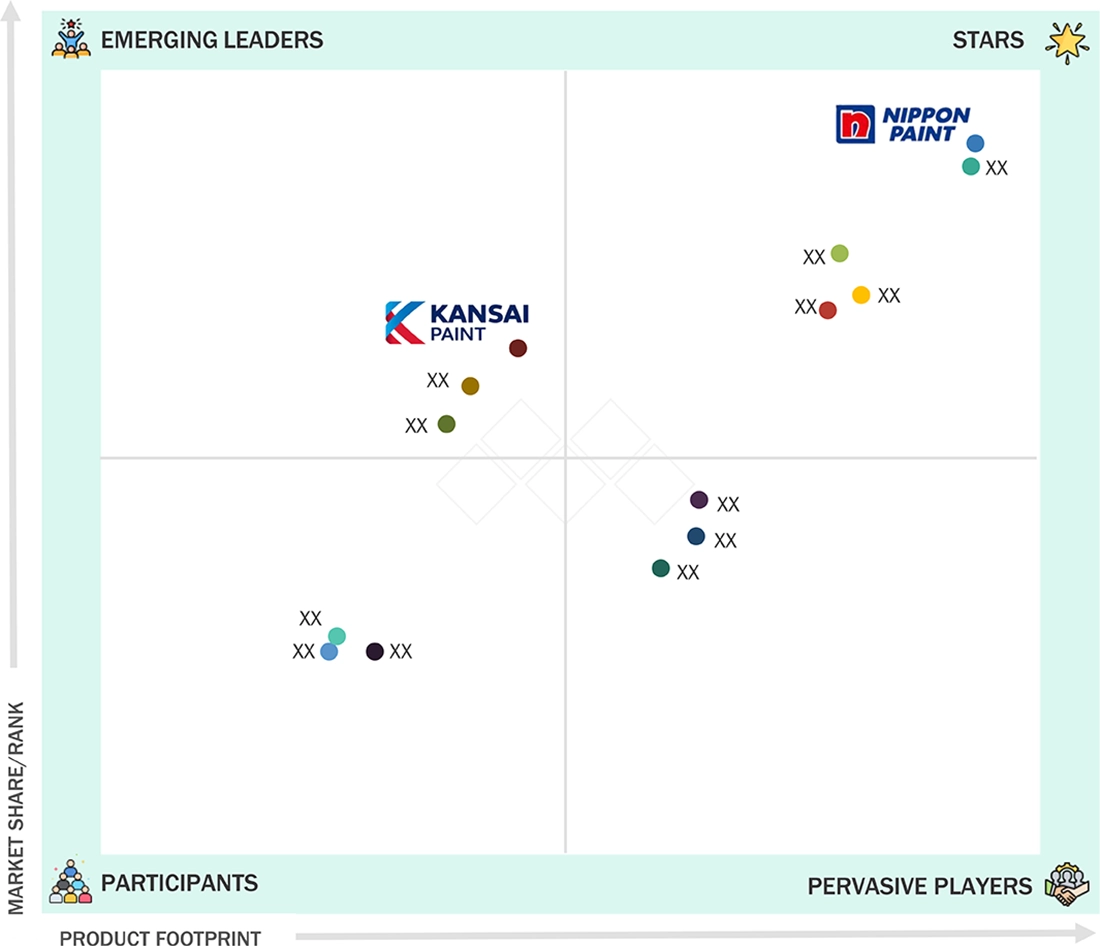
In the Asia Pacific paints & coatings market evaluation matrix, Nippon Paint (Star) leads with a strong market share and extensive regional footprint, driven by its broad decorative and industrial coatings portfolio widely adopted across residential construction, infrastructure, automotive, and general industrial applications. On the other hand, Kansai Paint (Emerging Player) is gaining visibility through its growing presence in automotive and industrial coatings and its focus on performance-driven and sustainable solutions, strengthening its position via technological advancements and strategic regional expansion. While Nippon Paint dominates through scale, brand strength, and a diversified product offering, Kansai Paint demonstrates strong potential to move toward the leaders’ quadrant as demand for high-performance, eco-friendly, and application-specific coatings continues to rise across the Asia Pacific region.
Source: Secondary Research, Interviews with Experts, MarketsandMarkets Analysis
KEY MARKET PLAYERS
- Nippon Paint Holdings Co. Ltd. (Japan)
- Kansai Paint Co., Ltd. (Japan)
- Akzo Nobel N.V. (Netherlands)
- Asian Paints Limited (India)
- The Sherwin-Williams Company (US)
- Axalta Coating Systems LLC (US)
- RPM International Inc. (US)
- BASF (Germany)
- Jotun A/S (Norway)
- Hempel A/S (Denmark)
MARKET SCOPE
| REPORT METRIC | DETAILS |
|---|---|
| Market Size in 2024 (Value) | USD 100.19 Billion |
| Revenue Forecast in 2030 (Value) | USD 134.10 Billion |
| CAGR | 5.05% from 2025–2030 |
| Years Considered | 2020–2030 |
| Base Year | 2024 |
| Forecast Period | 2025–2030 |
| Units Considered | Value (USD Billion), Volume (Kiloton) |
| Report Coverage | Revenue forecast, company ranking, competitive landscape, growth factors, and trends |
| Segments Covered |
|
| Countries Covered | China, India, Japan, Indonesia, Thailand |
WHAT IS IN IT FOR YOU: ASIA PACIFIC PAINTS & COATINGS MARKET REPORT CONTENT GUIDE
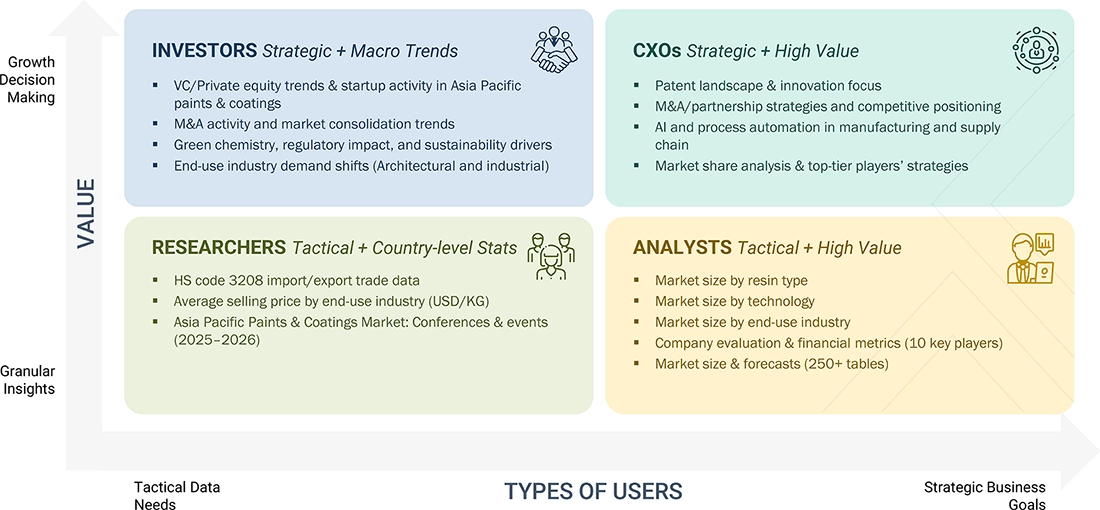
DELIVERED CUSTOMIZATIONS
We have successfully delivered the following deep-dive customizations:
| CLIENT REQUEST | CUSTOMIZATION DELIVERED | VALUE ADDS |
|---|---|---|
| Asia Pacific Raw Material Supplier of Paints & Coatings |
|
|
| Asia Pacific Raw Material Supplier of Paints & Coatings |
|
|
RECENT DEVELOPMENTS
- September 2025 : Asia Paints announced an investment of around USD 240 million (?2,000 crore) to establish a major new greenfield manufacturing facility in Indore, Madhya Pradesh, India, while focusing on water-based paints. Its public statements implied a broader move to increase capacity for all coatings, including potential future powder product lines.
- August 2025 : PPG Industries Inc. renewed its India joint ventures, PG Asian Paints Pvt. Ltd. and Asian Paints PPG Pvt. Ltd., for 15 years through 2041, covering automotive OEM, refinish, industrial, protective & marine, packaging, and powder coatings to capture India’s manufacturing growth while leveraging combined technology and the partner’s nationwide footprint.
- July 2025 : RPM International, Inc., through its platform markets in APAC, opened its largest Asia plant, expanding protective and industrial coatings capacity (including future powder expansion plans) in Serendah, Selangor, to support regional industrial and infrastructure growth.
Table of Contents
 Exclusive indicates content/data unique to MarketsandMarkets and not available with any competitors.
Methodology
The study involved four major activities in order to estimate the current size of the Asia Pacific Paints & Coatings Market . Exhaustive secondary research was conducted to gather information on the market. The next step was to conduct primary research to validate these findings, assumptions, and sizing with the industry experts across the value chain. Both top-down and bottom-up approaches were used to estimate the total market size. The market size of segments and subsegments was then estimated using market breakdown and data triangulation.
Secondary Research
Secondary sources include annual reports of companies, press releases, investor presentations, white papers, articles by recognized authors, and databases, such as D&B, Bloomberg, Chemical Weekly, and Factiva; and publications and databases from associations.
Primary Research
Extensive primary research was carried out after gathering information about Asia Pacific Paints & Coatings Market through secondary research. In the primary research process, experts from the supply and demand sides have been interviewed to obtain qualitative and quantitative information and validate the data for this report. Questionnaires, emails, and telephonic interviews were used to collect primary data. Primary sources from the supply side include industry experts, such as chief executive officers (CEOs), vice presidents (VPs), marketing directors, technology and innovation directors, and related key executives from various key companies and organizations operating in the Asia Pacific Paints & Coatings Market . Primary interviews were conducted to elicit information such as market statistics, revenue data collected from the products and services, market breakdowns, market size estimations, market forecasting, and data triangulation. Primary research also assisted in comprehending the various trends associated to resin type, technology, end-use industry, and region.
The Breakup of Primary Research:
To know about the assumptions considered for the study, download the pdf brochure
|
COMPANY NAME |
DESIGNATION |
|
The Sherwin-Williams Company |
Sales Manager |
|
PPG Industries, Inc. |
Project Manager |
|
AkzoNobel N. V. |
Individual Industry Expert |
|
RPM International, Inc. |
Manager |
Market Size Estimation
The following information is part of the research methodology used to estimate the size of the Asia Pacific Paints & Coatings Market . The market sizing of the Asia Pacific Paints & Coatings Market was undertaken from the demand side. The market size was estimated based on market size for paints & coatings in various technology.
To know about the assumptions considered for the study, Request for Free Sample Report
Data Triangulation
After arriving at the overall market size, the market has been split into several segments. To complete the overall market engineering process and arrive at the exact statistics for all segments, the data triangulation and market breakdown procedures have been employed, wherever applicable. The data was triangulated by studying various factors and trends from the demand and supply sides. Along with this, the market size was validated using both the top-down and bottom-up approaches.
Market Definition
Paints & coatings are generally applied to surfaces of stationary structures, such as bridges, buildings, and roads, or parts of stationary structures that include facades, pavements, and pre-fabricated materials. These coatings can be used for protection and esthetic purposes.
Key Stakeholders
- End User
- Raw Material Suppliers
- Senior Management
- Procurement Department
Report Objectives
- To define, describe, and forecast the size of the Asia Pacific Paints & Coatings Market in terms of value and volume
- To provide detailed information about the drivers, restraints, opportunities, and challenges influencing the growth of the market
- To forecast the market size by Resin Type, Technology, and End-use Industry
- To forecast the market size with respect to five main regions: North America, Europe, Asia Pacific, South America, and Middle East & Africa
- To strategically analyze micro-markets with respect to individual growth trends, prospects, and their contribution to the overall market
- To analyze the opportunities in the market for stakeholders and provide a competitive landscape for the market leaders
- To analyze competitive developments in the market, such as Merger, Acquisitions, and expansions
- To strategically profile the key players and comprehensively analyze their market shares and core competencies
Available Customizations
MarketsandMarkets offers the following customizations for this market report:
- Additional country-level analysis of the Asia Pacific Paints & Coatings Market
- Profiling of additional market players (up to 5)
Product Analysis
- Product matrix, which provides a detailed comparison of the product portfolio of each company in the Asia Pacific Paints & Coatings Market


Personalize This Research
- Triangulate with your Own Data
- Get Data as per your Format and Definition
- Gain a Deeper Dive on a Specific Application, Geography, Customer or Competitor
- Any level of Personalization
Let Us Help You
- What are the Known and Unknown Adjacencies Impacting the Asia Pacific Paints & Coatings Market
- What will your New Revenue Sources be?
- Who will be your Top Customer; what will make them switch?
- Defend your Market Share or Win Competitors
- Get a Scorecard for Target Partners

Custom Market Research Services
We Will Customise The Research For You, In Case The Report Listed Above Does Not Meet With Your Requirements
Get 10% Free CustomisationTESTIMONIALS
We at Nissan Chemicals Corporation have been clients of MarketsandMarkets for more than a year now. We recently consulted MarketsandMarkets for a study, the team at MarketsandMarkets was extremely professional and organized. The business insights were very detailed and aligned well with our expectations that really helped us formulate the Business Plans and device new strategies for development themes. MarketsandMarkets offers a unique combination of expertise and dedicated engagement model. Their research findings have helped us in designing our Pricing Strategy which will make it easier for us to predict the future sales and profits for the next ten years. We look forward to working with MarketsandMarkets in the future.
VP of Strategy & New Business Development
Leading Specialty Chemical Company
The MarketsandMarkets Engagement Model, composed of both the Knowledge Store and advisory custom research, has greatly helped us in understanding our markets and making strategic decisions. The Knowledge Store is a fast way to allow everyone in our organization to understand more about most any market they are interested in. The ability to then get custom research done and get answers to specific strategic questions and market insight has been spectacular. The Markets and Markets team feel more like colleagues than vendors and their services have helped us change our culture where statements of things like growth opportunities and competitive position are always backed by industry research.

Rich Gibson,
Director, Corporate Strategy
Milliken & Company,
Leading Industrial Manufacturer of specialty chemical, floor covering, performance and protective textile materials, and healthcaremilliken.com
MarketsandMarkets is a trusted resource that helps us to better understand markets that are near-adjacencies-whether its technology, value chain or geography. Their Knowledge Store platform provides a dashboard of markets and their characteristics which is easy to use and saves us time.
Adam Shaw,
Market Development and Strategy Manager
AdvanSix Inc. USA,
An American Leader in Chemicalswww.advansix.com
The Knowledge Store from MarketsandMarkets is a valuable tool which has helped my team acquire greater insight in to the end markets that our business serves. This has enabled us to help our company build stronger strategies throughout our planning process.
TOSHIO KINOSHITA
Senior Chif Consultion Research & Consulting Division
Mitsubishi Chemical Research Corporation,
Leading Manufacturer of Chemical Productswww.mitsubishichem-res.co.jp/en/

We recently engaged with MarketsandMarkets for a study, the team not only clearly understood our business objectives but was also extremely professional in the way they handled the entire project. The study was efficiently conducted in a phase-wise manner, and the engagement model furnished us with high-quality business insights that far exceeded our expectations at each phase. We were especially happy that MarketsandMarkets could provide us with both, an English as well as a Japanese version of the study. A special thanks to the Analyst Team and Client Services Team, whose fluency in Japanese enhanced our comfort level, as we could converse with them in our preferred language.
Independent entrepreneurs
Arrow Precision
We approached MarketsandMarkets for study on Proppants Market, and their work exceeded our expectations. The study conducted was comprehensive and enabled us to view the market through the various dimensions. In addition, the team was extraordinarily responsive throughout the process and resolved our queries on time. I strongly recommend MarketsandMarkets and will certainly consider them for additional market assessments we will need in the future.
Global engineering company, Japan
Deputy Manager,
Strategic Planning OfficeThe high-quality insights shared by the MarketsandMarkets team helped us understand the pharmaceutical plant designers in a specific geography. It also captured the risks that we may likely face in communicating with our potential partners. The study would enable us identify partners, which would impact our future growth.






Growth opportunities and latent adjacency in Asia Pacific Paints & Coatings Market