Asia Pacific Plasticizer Market

Asia Pacific Plasticizer Market by Type (Phthalate, Non-phthalate), Application (Floor & Wall Coverings, Wires & Cables, Coated Fabrics), End-use Industry (Construction, Automotive, Electronics, Healthcare, Packaging), and Country - Forecast to 2030




OVERVIEW
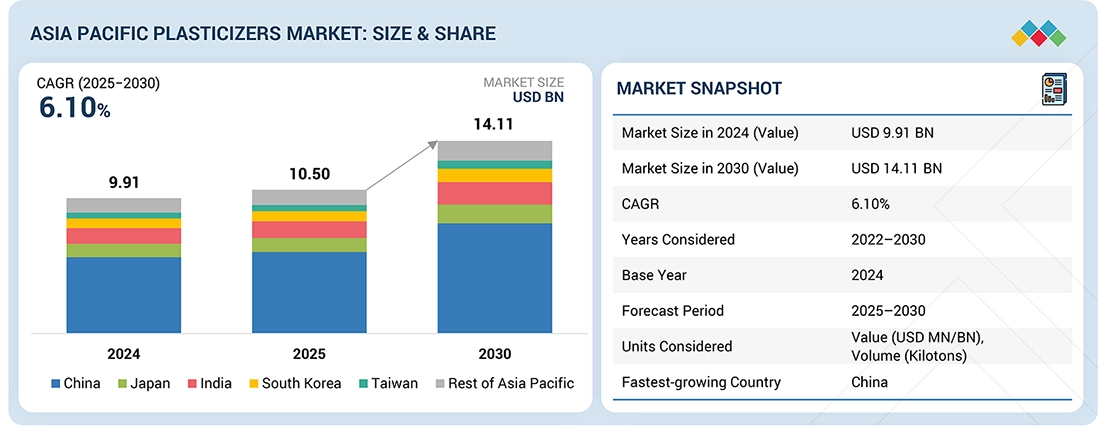
Source: Secondary Research, Interviews with Experts, MarketsandMarkets Analysis
The Asia Pacific plasticizers market is expected to expand steadily over the forecast period, supported by rising demand for flexible PVC. This demand is the major factor that is driving the use of plasticizers in the construction, automotive, packaging, consumer goods, and electrical sectors. Rapid urbanization is a key driver of the chain reaction, as the region's urban population is expected to grow from nearly 2.5 billion in 2023 to 3.4 billion by 2050, thereby tripling the need for housing, transport, and infrastructure. The need for PVC-based products such as cables, flooring, wall coverings, pipes, and films, which are plasticizer-dependent for performance and flexibility, is increasing because of this domino effect. The rising middle-class income levels in the emerging economies such as China, India, Indonesia, and Vietnam are causing a higher demand for quality consumer goods, appliances, and vehicles that, in turn, lead to higher plasticizer consumption. As a result, the Asia Pacific market continues to see strong growth, which is supported by the development of bio-based and high-performance plasticizer technologies, as well as the expansion of PVC processing capacity.
KEY TAKEAWAYS
-
By CountryChina dominates the Asia Pacific plasticizers market with a share of 56.7% in 2025.
-
By TypeBy type, the phthalate plasticizers segment is expected to register the highest CAGR of 6.09% from 2025 to 2030, in terms of value.
-
By ApplicationBy application, the flooring and wall segment is expected to register the highest CAGR of 6.01% from 2025 to 2030, in terms of value.
-
Competitive Landscape - Key PlayersUPC Technology Corporation, NAN YA PLASTICS CORPORATION, LG Chem, Aekyung Petrochemical, and Shandong Hongxin Chemicals were recognized as star players in the Asia-Pacific Plasticizers market for their focus on innovation, broad industry coverage, and strong operational and financial strength.
-
Competitive Landscape- StartupsDIC Corporation, Jiangsu Zhengdan, and Kao Corporation, among others, have distinguished themselves among startups and SMEs due to their strong product portfolio and business strategy.
The Asia Pacific plasticizers market is benefitting from strong growth, mostly due to rapid industrialization in the region, an increase in PVC consumption, and the expansion of the infrastructure sector. As per the industry and development agencies for the region, Asia Pacific is the main contributor to the global production and consumption of PVC, with the application of the material in construction, automotive, wire & cable, flooring, packaging, and consumer goods. Demand is boosted by the region's rapid urbanization, which is expected to account for more than half of the global urban population growth by 2050, and is also driven by the expansion of power distribution and real estate projects that are dominated by the use of flexible PVC. Simultaneously, regulatory scrutiny and consumer safety awareness are causing the phased out of phthalate and non-phthalate safer high-performance plasticizers usage, mainly in sensitive areas like toys, medical products, and food-contact materials. This situation provides opportunities for the manufacturers of compliant, cost-effective, and application-specific formulations to cooperate with the PVC compounders and extend their local production to be able to meet the performance and regulatory requirements of different countries. By manufacturing bio-based and low-VOC plasticizers, giving technical support to PVC converters, and tailoring their products to various end-use sectors in the region, companies can still broaden their influence.
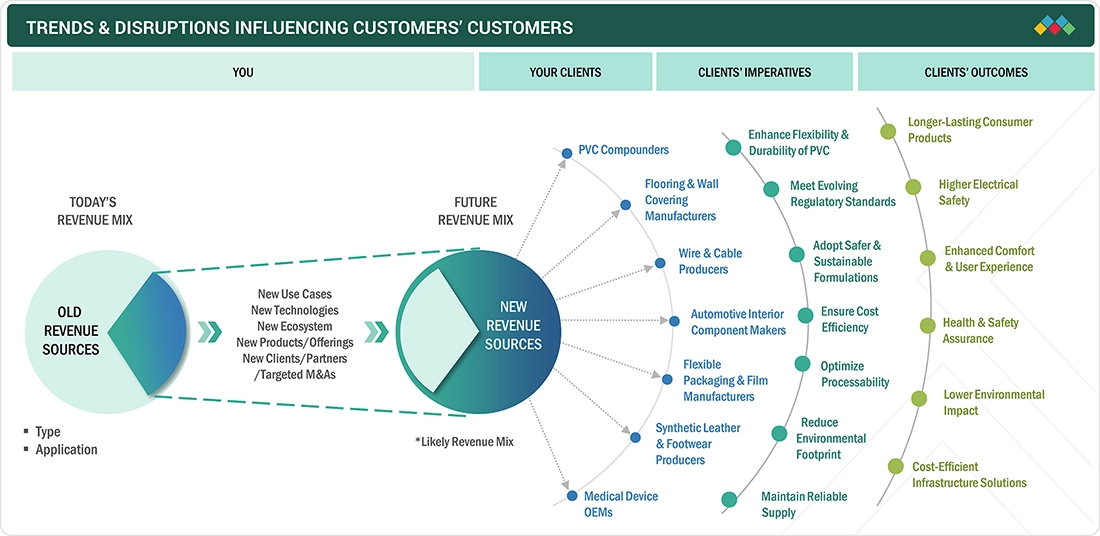
TRENDS & DISRUPTIONS IMPACTING CUSTOMERS' CUSTOMERS
The influence on end-use sectors in the Asia Pacific plasticizers market has been primarily driven by increasing industrial output, faster infrastructure development, and the growing use of flexible PVC for various applications. Key end-use segments include construction materials (such as flooring, roofing membranes, and pipes), automotive interiors, wiring harnesses, wire and cable insulation, consumer goods, medical products, and packaging. Rapid urbanization, expansion of power distribution networks, higher automotive production, and increased demand for durable and flexible plastics are major drivers of growth. Regulatory changes favoring safer and environmentally friendly formulations, especially for medical, childcare, and food-contact uses, are accelerating the shift to non-phthalate and high-performance plasticizers. Variations in raw material availability, increasing production capacity in China and Southeast Asia, and evolving national safety standards directly impact product consumption and pricing.
Source: Secondary Research, Interviews with Experts, MarketsandMarkets Analysis
MARKET DYNAMICS

Level
-
Growing demand for flexible PVC in construction, automotive, and wires & cables

-
Rapid growth in electrical infrastructure and renewable energy cable installations


Level
-
Stringent regulatory restrictions on phthalates

-
Health and environmental concerns associated with legacy phthalates


Level
-
Rising shift toward non-phthalate and bio based plasticizers

-
Expansion of regional manufacturing and export hubs in India, China, and Southeast Asia


Level
-
Volatility in raw material prices (alcohols, acids, petrochemicals)

-
Compliance burdens with global standards (REACH, RoHS, China GB/T)

Source: Secondary Research, Interviews with Experts, MarketsandMarkets Analysis
Driver: Growing demand for flexible PVC in construction, automotive, and wires & cables
The Asia Pacific plasticizers market is growing quickly due to high demand for PVC applications across sectors like flooring, cables, automotive interiors, and consumer goods. The region accounts for over 60% of global PVC consumption, driven by large-scale urbanization in China, India, Indonesia, and Vietnam. Besides metro rail networks, public housing, smart city projects, and industrial parks are major sources of construction activity, increasing the need for flexible PVC in pipes, flooring, roofing membranes, profiles, and insulation. Additionally, production of middle to high-end passenger cars in Asia Pacific (more than 50 million vehicles in 2023) further boosts the demand for plasticized polymers used in dashboards, door trims, underbody coatings, and synthetic leather. Rapid electrification is also driving cable demand, and rising consumer spending supports growth in footwear, toys, and household products. These trends collectively strengthen the demand for both general-purpose (phthalate) and specialty (adipate, trimellitate, benzoate) plasticizers throughout the region.
Restraint: Stringent regulatory restrictions on phthalates
Asia Pacific markets are quite aggressive in tightening regulations of phthalate plasticizers, mainly DEHP, DBP, BBP, and DIBP, due to their being classified as reproductive toxicants and environmental pollutants by major jurisdictions. China has broadened restrictions concerning its GB/T and RoHS frameworks, prohibiting certain high-risk phthalates in the electronics, toys, and consumer products sectors. India has enacted BIS standards and toy safety regulations that limit phthalate content in toys to less than 0.1% across various categories. Moreover, Japan, South Korea, and Australia have similar requirements to EU REACH and worldwide RoHS directives; consequently, producers are going to the non-phthalate alternatives such as DINCH, DOTP, and citrate plasticizers. These regulatory demands put a strain on company budgets for compliance and, as a result, drive reformulation throughout the value chain, thereby limiting the growth of the phthalate legacy segments and accelerating the shift towards environmentally friendly alternatives.
Opportunity: Rising shift toward non-phthalate and bio-based plasticizers
There is a significant move among manufacturers in the Asia Pacific region to use non-phthalate (DOTP, DINCH, DEHT) and bio-based plasticizers (citrate esters, epoxidized plant oils, isosorbide derivatives) of high performance. The reason for such a change is a demand for products with low VOC, and that meet strict toxicology standards, especially in indoor flooring, wallcoverings, automotive interiors, medical devices, and food contact packaging. Big PVC processors in China, Japan, South Korea, and India are making use of different formulations to be compliant with the requirements of the export market (EU REACH, U.S. CPSIA). Countries in Southeast Asia, like Malaysia, Thailand, and Vietnam, are turning into viable production centers for palm oil-derived epoxidized plasticizers. These transformations open up enormous possibilities for producers to increase their sustainable solutions, lessen their regulatory risks, and gain access to the premium markets.
Challenge: Volatility in raw material prices
The expense of the principal feedstocks, like 2-ethylhexanol, phthalic anhydride, adipic acid, and bio-based oils, remains quite volatile in the Asia Pacific region due to factors such as changes in global crude oil prices, refinery outages, export restrictions, and shipping disruptions. The price trends across the whole region are largely influenced by China's significant but quite volatile oxo alcohol capacity, while India and Southeast Asia are still dependent on imports for various intermediates. The fluctuation is affecting production planning, contract pricing with PVC processors, and inventory management. As plasticizers account for 30-40% of the total PVC compound costs, any raw material price fluctuation will have a tremendous impact on the profitability of the flooring, cables, automotive, and packaging value chains.
ASIA PACIFIC PLASTICIZER MARKET: COMMERCIAL USE CASES ACROSS INDUSTRIES
| COMPANY | USE CASE DESCRIPTION | BENEFITS |
|---|---|---|
 |
DIC supplies phthalate-free plasticizers to PVC flooring manufacturers in Japan and Southeast Asia for use in luxury vinyl tiles (LVT), sheet flooring, and wallcoverings in commercial buildings, hospitals, and retail spaces. | Improved flexibility and durability of PVC flooring, compliance with indoor air-quality standards, reduced VOC emissions, and enhanced performance under high foot-traffic conditions. |
 |
KLJ’s chlorinated paraffin (CP) and phthalate plasticizers are widely used by wire & cable manufacturers in India, Bangladesh, and Sri Lanka for commercial power distribution cables, appliance cords, and telecommunications wiring. | Enhanced flame retardancy, improved insulation flexibility, cost-efficient formulation options, and reliable performance under varying temperature and humidity conditions in APAC climates. |
 |
Kao supplies specialty adipate and trimellitate plasticizers to automotive interior component manufacturers in Japan and Thailand, used in dashboards, door panels, synthetic leather, and soft PVC trims. | High heat stability, long-term plasticization, odor reduction, and compliance with automotive VOC requirements, improving cabin comfort and material lifespan. |
Logos and trademarks shown above are the property of their respective owners. Their use here is for informational and illustrative purposes only.
MARKET ECOSYSTEM
An ecosystem map for the Asia Pacific plasticizers market reveals a closely connected value chain, which is the primary infrastructure of the region's expanding flexible PVC and polymer-processing industries. The ecosystem consists of suppliers of the primary raw materials, such as oxo-alcohols, phthalic anhydride, adipic acid, citrates, and bio-based feedstocks that are sold to producers of phthalate and non-phthalate plasticizers. These plasticizer producers supply PVC compounders, resin processors, and formulators with the necessary materials to produce cables, flooring, films, automotive interiors, medical tubing, and consumer goods. Distributors and regional chemical suppliers that provide on-time delivery, regulatory compliance, and technical support to converters complete the network. End-use sectors like construction, automotive, electrical & electronics, packaging, and healthcare are the major consumers; thus, they decide the consumption based on the performance, cost, and regulatory requirements. As a result, government agencies, environmental regulators, and standards bodies, therefore, determine the market direction by prohibiting the use of certain phthalates and giving allowances for safer, high-purity alternatives.
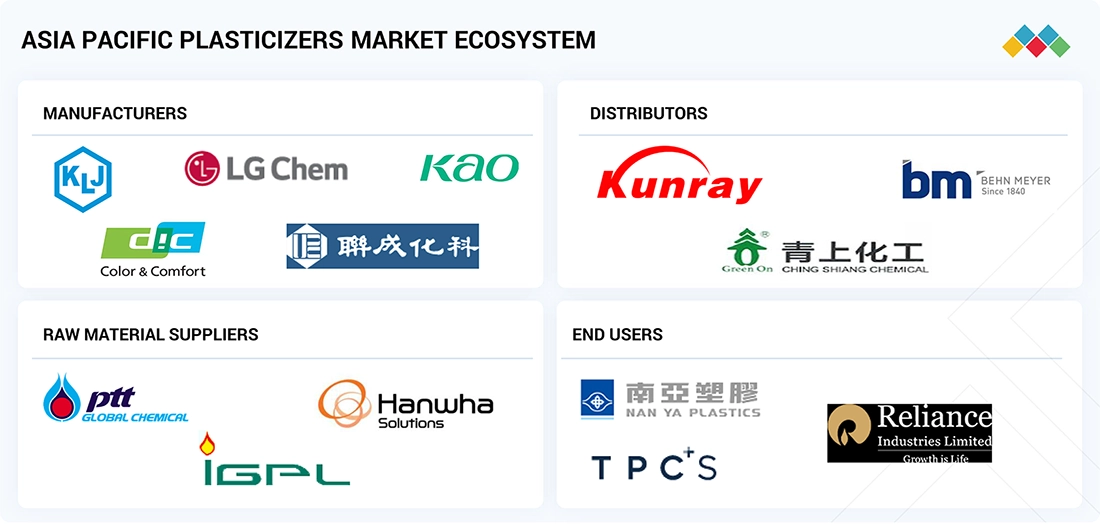
Logos and trademarks shown above are the property of their respective owners. Their use here is for informational and illustrative purposes only.
MARKET SEGMENTS
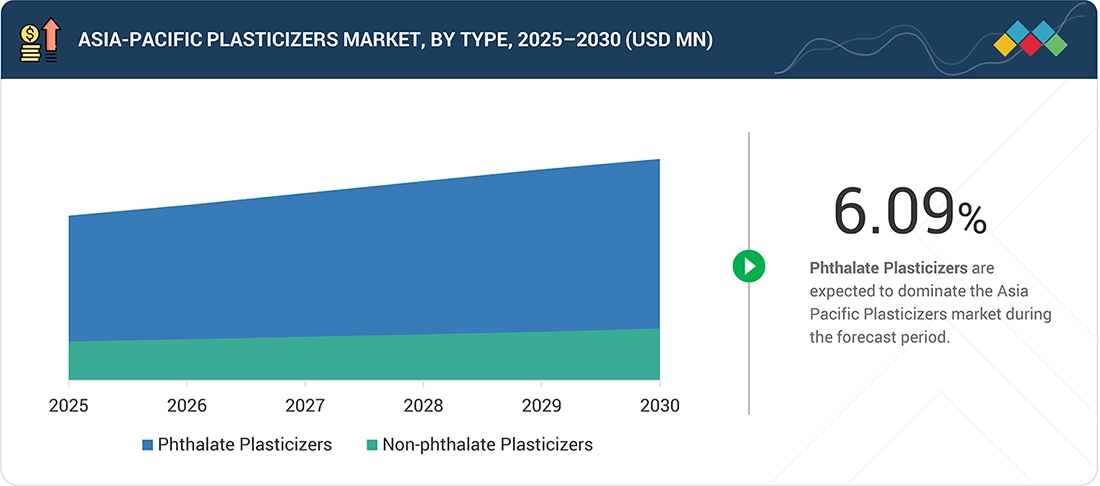
Source: Secondary Research, Interviews with Experts, MarketsandMarkets Analysis
Asia Pacific Plasticizers Market, By Type
Phthalate plasticizers held the biggest share of the Asia Pacific market in 2024, mainly due to their high demand in flexible PVC applications, cheapness, and a well-established production capacity spread across China, South Korea, Japan, and Southeast Asia. The most commonly used grades, such as DEHP, DINP, and DIDP, have remained the most suitable for wires & cables, automotive interiors, synthetic leather, and consumer goods, which have been supported by mature supply chains and high-volume PVC processing industries in the region. In spite of the increasing regulatory scrutiny, the low price, wide compatibility with PVC formulations, and gradually increasing use in construction and industrial sectors have helped them to maintain their leading position in the market.
Asia Pacific Plasticizers Market, By Application
The flooring and wall covering segment was at the forefront of the plasticizers market in 2024, which was mainly caused by rapid urbanization, the large-scale residential and commercial construction, and the strong growth of the vinyl flooring adoption in China, India, and ASEAN countries. Flexible PVC-based floor tiles, sheets, and wall panels need a considerable amount of plasticizer to be able to make them durable, soft, and resistant to wear, thus making this segment the major consumer of both phthalate and non-phthalate plasticizers. The segment's leadership in the Asia Pacific region was additionally backed by increasing investments in infrastructure, the redevelopment of aging buildings, and a rising preference for cost-efficient, easy-to-install resilient flooring.
REGION
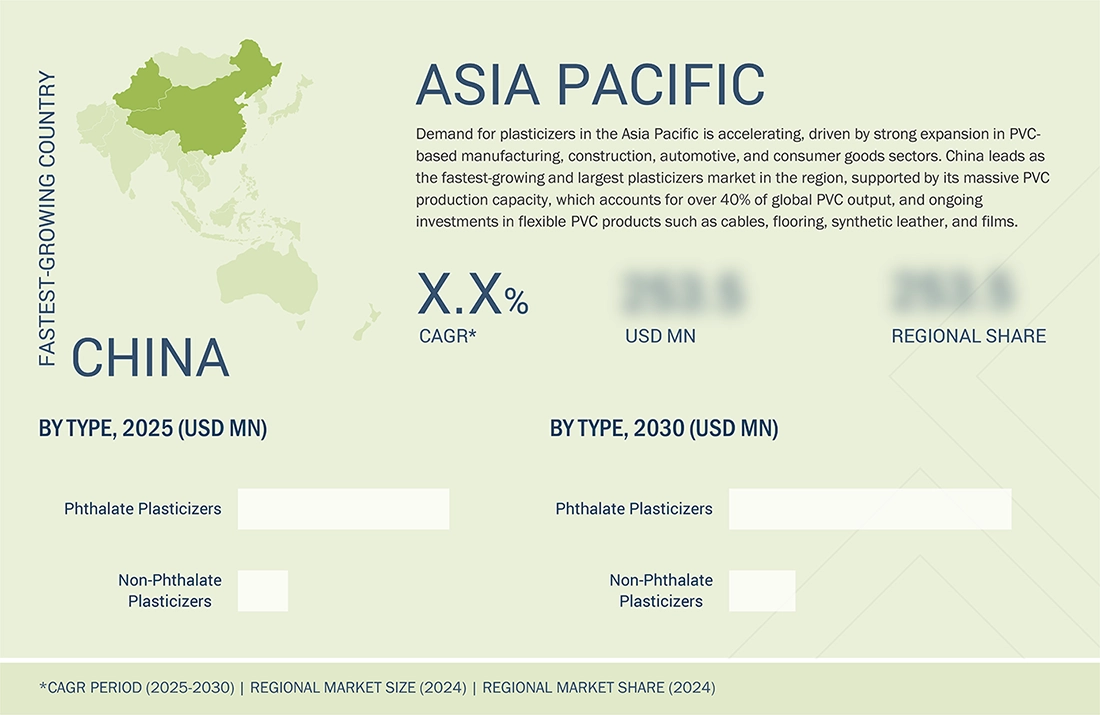
China to be the fastest-growing country in the Asia Pacific plasticizers market during the forecast period
China will probably be the largest market for plasticizers, as the Asia Pacific region is expected to grow quickly. This growth is driven by the rapid development of industries such as PVC, cables, flooring, leather, and construction. In 2024, China contributed about one-third of the world's total PVC production, with over 40% of the global capacity, and continues to expand its investments in non-phthalate and high-performance plasticizers for injection moldings. Supportive government policies are encouraging the production of environmentally friendly chemicals through regulations like China RoHS 2 and GB 4806 for food contact applications. Meanwhile, the plasticizer industry in the automotive, electronic, and construction sectors is also growing. Although phthalates face strict regulations, demand for flexible PVC applications remains high. As a result, manufacturers are developing new products, such as eco-friendly, high-purity, and low-migration plasticizers. Combined with urbanization, industrial modernization, and rising exports to REACH-compliant markets, China is emerging as the fastest-growing and most dynamic market for plasticizers in the Asia Pacific region.
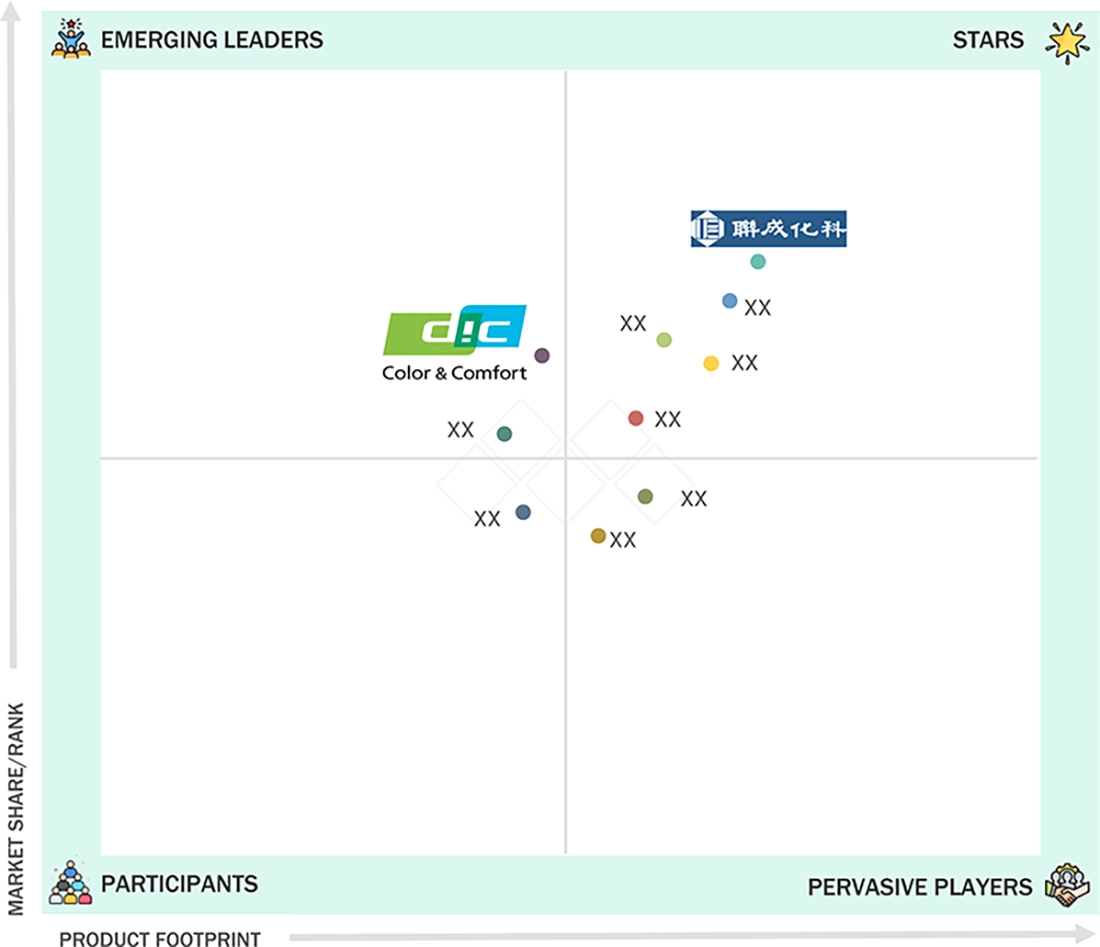
ASIA PACIFIC PLASTICIZER MARKET: COMPANY EVALUATION MATRIX
UPC Technology Corporation (Star) is at the forefront of the Asia Pacific plasticizers market with a wide range of phthalate and non-phthalate plasticizers. Besides, its deep integration with the upstream petrochemical intermediates and its large-scale manufacturing abilities in both China and Taiwan are a few of the other factors that have contributed to its leadership. Its well-established supply relationships with PVC processors that cover flooring, cables, synthetic leather, and packaging films segments make it a dominant regional supplier. The company's continuous commitment to high-purity and environmentally safer alternatives, along with its cost-effective export capabilities, are some of the factors that extend its leadership position in the Asia Pacific market. DIC Corporation (Emerging Leader) is intensively developing its footprint in the Asia Pacific plasticizers market through a transformation towards high-performance, eco-friendly specialty plasticizers, which are in line with global regulatory trends. The company is using the advantage of its strong presence in Japan and Southeast Asia to increase the production of non-phthalate and application-specific plasticizers for automotive interiors, electronics, PVC compounds, and packaging. By focusing on R&D, specialty chemistries, and collaborations with downstream manufacturers, DIC is able to become the most preferred supplier of premium, value-added plasticizer applications in the region, thus increasing its market share, which is a direct consequence of the growing demand for sustainable, low-VOC materials.
Source: Secondary Research, Interviews with Experts, MarketsandMarkets Analysis
KEY MARKET PLAYERS
- UPC Technology Corporation (Taiwan)
- NAN YA PLASTICS CORPORATION (Taiwan)
- LG Chem (South Korea)
- Aekyung Chemical (South Korea)
- Shandong Hongxin Chemicals (China)
- DIC Corporation (Japan)
- Jiangsu Zhengdan Chemical Industry Co., Ltd. (China)
- Kao Corporation (Japan)
- Shandong Qilu Plasticizers Co., Ltd. (China)
- KLJ Group (India)
MARKET SCOPE
| REPORT METRIC | DETAILS |
|---|---|
| Market Size in 2024 (Value) | USD 9.91 BN |
| Market Size in 2030 (Value) | USD 14.11 BN |
| CAGR | 6.10% |
| Years Considered | 2022–2030 |
| Base Year | 2024 |
| Forecast Period | 2025–2030 |
| Units Considered | Value (USD MN), Volume (Kilotons) |
| Report Coverage | Revenue forecast, company ranking, competitive landscape, growth factors, and trends |
| Segments Covered |
|
| Countries Covered | China, India, Japan, South Korea, Taiwan, Rest of Asia Pacific |
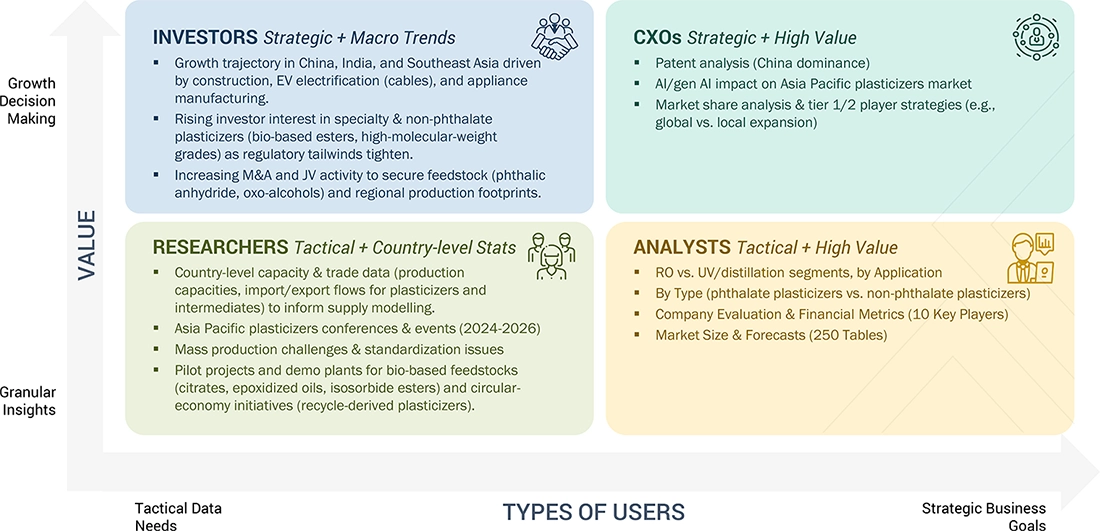
WHAT IS IN IT FOR YOU: ASIA PACIFIC PLASTICIZER MARKET REPORT CONTENT GUIDE
DELIVERED CUSTOMIZATIONS
We have successfully delivered the following deep-dive customizations:
| CLIENT REQUEST | CUSTOMIZATION DELIVERED | VALUE ADDS |
|---|---|---|
| Asia Pacific plasticizers market assessment (Phthalate & Non-Phthalate) |
|
|
| Benchmarking of phthalate plasticizer producers in Asia Pacific |
|
|
| Benchmarking of non-phthalate (eco-friendly) plasticizer manufacturers |
|
|
RECENT DEVELOPMENTS
- August 2024 : BASF and UPC signed a Memorandum of Understanding (MoU) aimed at long-term collaboration on the supply of plasticizer alcohols (2-Ethylhexanol and N-Butanol) and catalysts for phthalic and maleic anhydride production, supporting UPC’s regional plasticizer supply, especially in South China.
- December 2023 : Aekyung Chemical acquired a 50% stake in VPCHEM, giving it control of Vietnam’s only plasticizer-manufacturing facility. This increased Aekyung’s annual plasticizer capacity from 550,000 tons (400,000 tons Korea + 150,000 tons China) to 660,000 tons.
Table of Contents
 Exclusive indicates content/data unique to MarketsandMarkets and not available with any competitors.
Methodology
The study involved major activities in estimating the current size of the Asia Pacific Plasticizer market. Exhaustive secondary research was done to collect information on the peer and parent markets. The next step was to validate these findings, assumptions, and sizing with industry experts across the value chain through primary research. Both top-down and bottom-up approaches were employed to estimate the complete market size. Thereafter, market breakdown and data triangulation were used to estimate the market size of the segments and subsegments.
Secondary Research
In the secondary research process, various sources, such as annual reports, press releases, investor presentations of companies, white papers, certified publications, articles from recognized authors, and databases, were considered for identifying and collecting information for this study. Secondary research was mainly conducted to obtain key information about the supply chain of the industry, monetary chain of the market, the total number of market players, market classification and segmentation according to industry trends to the bottom-most level, regional markets, and key developments from both market- and technology-oriented perspectives.
Primary Research
In the primary research process, various primary sources from both supply and demand sides were interviewed to obtain qualitative and quantitative information for this report. Primary sources from the supply side include industry experts, such as chief executive officers (CEOs), vice presidents (VPs), marketing directors, technology and innovation directors, consultants, and related key executives from major companies and organizations operating in the market. Primary sources from the demand side include lab technicians, technologists, and sales/purchase managers in the industry. Following is the breakdown of primary respondents:
To know about the assumptions considered for the study, download the pdf brochure
Market Size Estimation
Both top-down and bottom-up approaches were used to estimate and validate the total size of the Asia Pacific Plasticizer market. These methods were also used extensively to estimate the size of various subsegments in the market. The research methodology used to estimate the market size includes the following:
- The key players in the industry and market have been identified through extensive secondary research, and their market share in the respective regions have been determined through both primary and secondary research.
- The industry’s value chain and market size, in terms of value, have been determined through primary and secondary research processes.
- All percentage shares, splits, and breakdowns have been determined using secondary sources and verified through primary sources.
Data Triangulation
After arriving at the overall market size from the estimation process explained above, the total market has been split into several segments and subsegments. To complete the overall market engineering process and arrive at the exact statistics for all the segments and subsegments, the data triangulation and market breakdown processes have been employed, wherever applicable. The data has been triangulated by studying various factors and trends from both the demand- and supply sides. Along with this, the market has been validated using both the top-down and bottom-up approaches.
Definition
Plasticizer are low molecular weight compounds added to other polymeric substances to aid polymer processing and impart flexibility, plasticity, softness, and reduce brittleness. They are primarily used in PVC cables, PVC resins, wire jacketing, vinyl flooring, medical equipment, automobile parts, and others. Plasticizers make the polymer solution more suitable for various applications such as films & coatings.
The key stakeholders of the plasticizers market include Raw Material Suppliers, Manufacturers (Plasticizer Manufacturers), Plasticizer Traders, Distributors, and Suppliers, End-use Industry Participants, Government and Research Organizations, Associations and Industrial Bodies, Research and Consulting Firms, Research & Development (R&D) Institutions, Environmental Support Agencies.
Objectives of the Study
- To define, describe, segment, and forecast the Asia Pacific Plasticizers market size, by technology, meter type, component, and application
- To provide detailed information on the major drivers, restraints, opportunities, and industry-specific challenges influencing the growth of the Asia Pacific Plasticizers market
- To strategically analyze the Asia Pacific Plasticizers market with respect to individual growth trends, prospects, and contributions of each segment to the market
- To analyze market opportunities for stakeholders and provide a detailed competitive landscape for market leaders
- To strategically profile key players and comprehensively analyze their market ranking and core competencies
- To track and analyze competitive developments such as new product developments, contracts & agreements, investments & expansions, and mergers & acquisitions in the Asia Pacific Plasticizers market
Available Customizations:
With the given market data, MarketsandMarkets offers customizations as per the client’s specific needs. The following customization options are available for this report:
Geographic Analysis
- Further breakdown of region or country-specific analysis
Company Information
- Detailed analyses and profiling of additional market players (up to 5)


Personalize This Research
- Triangulate with your Own Data
- Get Data as per your Format and Definition
- Gain a Deeper Dive on a Specific Application, Geography, Customer or Competitor
- Any level of Personalization
Let Us Help You
- What are the Known and Unknown Adjacencies Impacting the Asia Pacific Plasticizer Market
- What will your New Revenue Sources be?
- Who will be your Top Customer; what will make them switch?
- Defend your Market Share or Win Competitors
- Get a Scorecard for Target Partners

Custom Market Research Services
We Will Customise The Research For You, In Case The Report Listed Above Does Not Meet With Your Requirements
Get 10% Free CustomisationTESTIMONIALS

We at Nissan Chemicals Corporation have been clients of MarketsandMarkets for more than a year now. We recently consulted MarketsandMarkets for a study, the team at MarketsandMarkets was extremely professional and organized. The business insights were very detailed and aligned well with our expectations that really helped us formulate the Business Plans and device new strategies for development themes. MarketsandMarkets offers a unique combination of expertise and dedicated engagement model. Their research findings have helped us in designing our Pricing Strategy which will make it easier for us to predict the future sales and profits for the next ten years. We look forward to working with MarketsandMarkets in the future.
VP of Strategy & New Business Development
Leading Specialty Chemical Company
The MarketsandMarkets Engagement Model, composed of both the Knowledge Store and advisory custom research, has greatly helped us in understanding our markets and making strategic decisions. The Knowledge Store is a fast way to allow everyone in our organization to understand more about most any market they are interested in. The ability to then get custom research done and get answers to specific strategic questions and market insight has been spectacular. The Markets and Markets team feel more like colleagues than vendors and their services have helped us change our culture where statements of things like growth opportunities and competitive position are always backed by industry research.

Rich Gibson,
Director, Corporate Strategy
Milliken & Company,
Leading Industrial Manufacturer of specialty chemical, floor covering, performance and protective textile materials, and healthcaremilliken.com
MarketsandMarkets is a trusted resource that helps us to better understand markets that are near-adjacencies-whether its technology, value chain or geography. Their Knowledge Store platform provides a dashboard of markets and their characteristics which is easy to use and saves us time.
Adam Shaw,
Market Development and Strategy Manager
AdvanSix Inc. USA,
An American Leader in Chemicalswww.advansix.com
The Knowledge Store from MarketsandMarkets is a valuable tool which has helped my team acquire greater insight in to the end markets that our business serves. This has enabled us to help our company build stronger strategies throughout our planning process.
TOSHIO KINOSHITA
Senior Chif Consultion Research & Consulting Division
Mitsubishi Chemical Research Corporation,
Leading Manufacturer of Chemical Productswww.mitsubishichem-res.co.jp/en/

We recently engaged with MarketsandMarkets for a study, the team not only clearly understood our business objectives but was also extremely professional in the way they handled the entire project. The study was efficiently conducted in a phase-wise manner, and the engagement model furnished us with high-quality business insights that far exceeded our expectations at each phase. We were especially happy that MarketsandMarkets could provide us with both, an English as well as a Japanese version of the study. A special thanks to the Analyst Team and Client Services Team, whose fluency in Japanese enhanced our comfort level, as we could converse with them in our preferred language.
Independent entrepreneurs
Arrow Precision
We approached MarketsandMarkets for study on Proppants Market, and their work exceeded our expectations. The study conducted was comprehensive and enabled us to view the market through the various dimensions. In addition, the team was extraordinarily responsive throughout the process and resolved our queries on time. I strongly recommend MarketsandMarkets and will certainly consider them for additional market assessments we will need in the future.
Global engineering company, Japan
Deputy Manager,
Strategic Planning OfficeThe high-quality insights shared by the MarketsandMarkets team helped us understand the pharmaceutical plant designers in a specific geography. It also captured the risks that we may likely face in communicating with our potential partners. The study would enable us identify partners, which would impact our future growth.






Growth opportunities and latent adjacency in Asia Pacific Plasticizer Market