Asia Pacific Private 5G Market

Asia Pacific Private 5G Market, by Offering (RAN, Base Station, Antenna, Core Network, Edge Server, Gateway, Delivery Network, Network Management, Managed Services), Spectrum Allocation (Licensed, Shared), Frequency (Low, Mid, mmWave) - Forecast to 2030




OVERVIEW
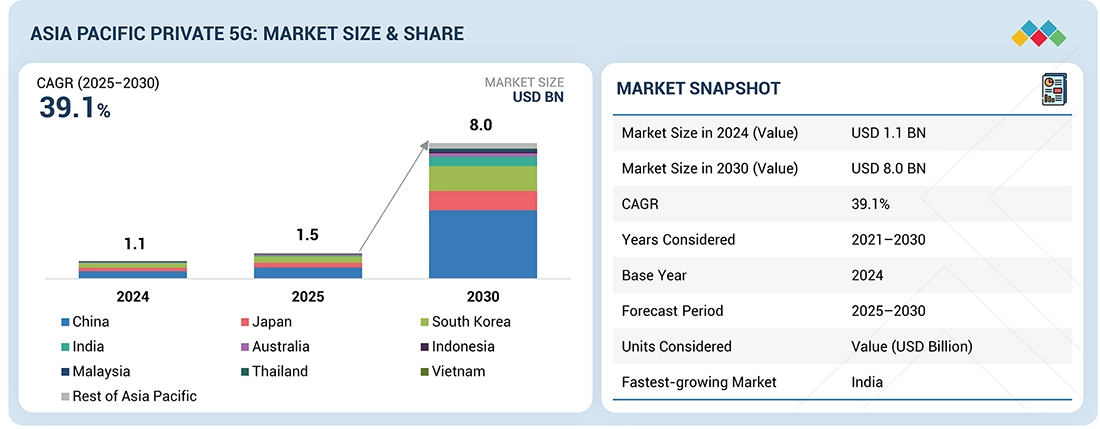
Source: Secondary Research, Interviews with Experts, MarketsandMarkets Analysis
The Asia Pacific Private 5G market is projected to grow from USD 1.5 billion in 2025 to USD 8.0 billion by 2030, at a CAGR of 39.1% from 2025 to 2030. The market is driven by large-scale digital transformation across manufacturing, logistics, and smart infrastructure, supported by strong government-led 5G industrial policies in countries such as China, Japan, India, and South Korea. Rising investments in automation, IoT adoption, and Industry 4.0 initiatives are increasing demand for reliable, low-latency connectivity tailored to enterprise environments.
KEY TAKEAWAYS
-
BY COUNTRYBy country, China is expected to dominate the market, at a CAGR of 43.2% during the forecast period.
-
BY VERTICALBy vertical, the energy & utilities segment is expected to register the highest CAGR during the forecast period.
-
BY NETWORK TYPEBy network type, the non-standalone 5G segment is expected to dominate in terms of market share.
-
BY FREQUENCY BANDBy frequency band, the mid-band segment is expected to register the highest CAGR.
-
BY SPECTRUM ALLOCATIONBy spectrum allocation, the unlicensed/shared spectrum segment is expected to dominate the market during the forecast period.
-
BY ORGANIZATION TYPEBy organization type, the small and medium enterprises segment is expected to grow at the highest CAGR of ~43-45% during the forecast period.
-
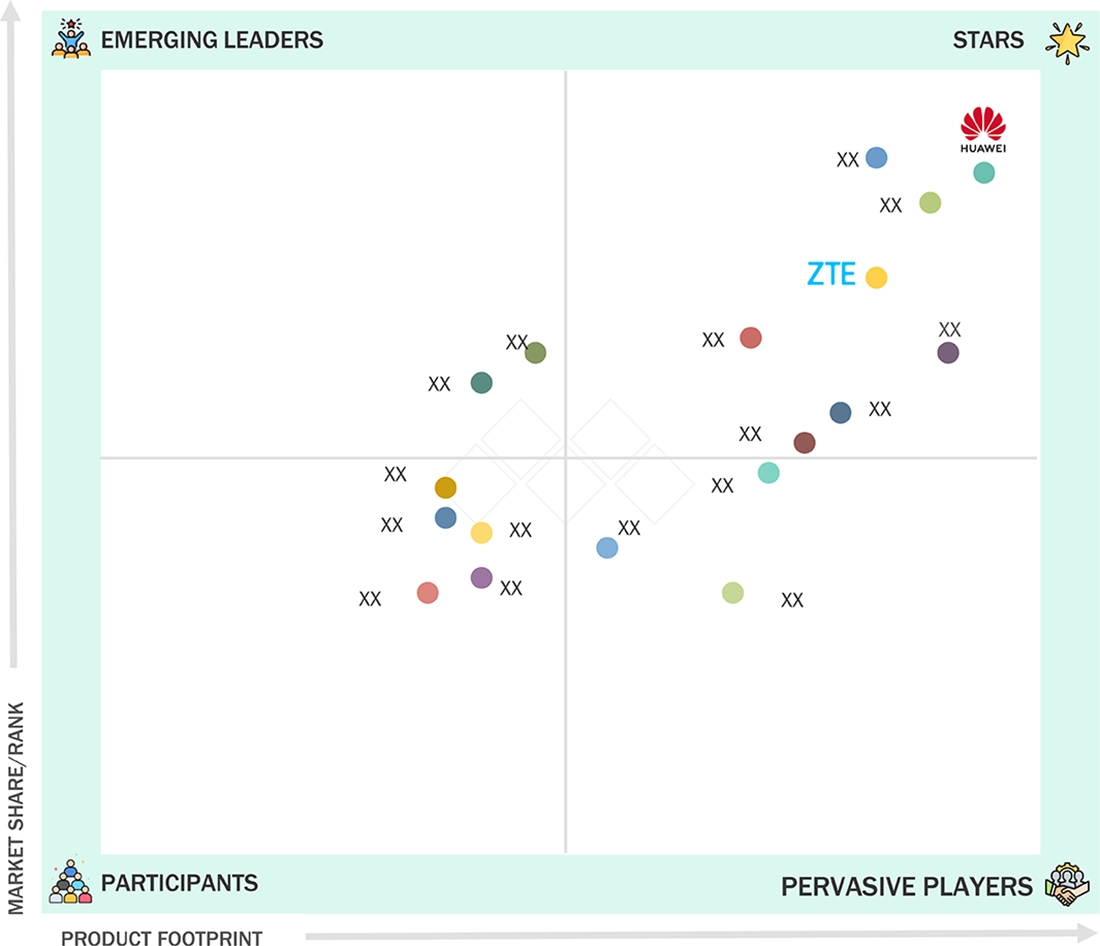
COMPETITIVE LANDSCAPE - KEY PLAYERSHuawei Technologies Co., Ltd., Samsung, ZTE Corporation, and NEC Corporation were identified as some of the star players in the Asia Pacific private 5G market, given their strong market share and product footprint.
-
COMPETITIVE LANDSCAPE - STARTUPS/SMESNiral Networks and Tidalwave Technologies Pvt. Ltd., among others, have distinguished themselves among SMEs by securing strong footholds in specialized niche areas, underscoring their potential as emerging market leaders.
Countries such as China, Japan, and South Korea are major contributors to the Asia-Pacific Private 5G market. Rapid adoption of automation, IoT, and smart manufacturing solutions in these economies is accelerating demand for secure, high-performance private networks. Governments across the region are actively supporting industrial digitalization through targeted 5G policies, enterprise spectrum allocation, and public–private partnerships, enabling deployments in manufacturing, logistics, energy, and smart city projects.
TRENDS & DISRUPTIONS IMPACTING CUSTOMERS' CUSTOMERS
Trends and disruptions are reshaping the private 5G market in the Asia Pacific region. The rapid digitalization across manufacturing, logistics, mining, and utilities is increasing the demand for secure, low-latency connectivity to support automation, robotics, and AI-enabled operations. Government-led initiatives in countries such as China, Japan, and South Korea are accelerating spectrum availability and private network policies, resulting in faster adoption.
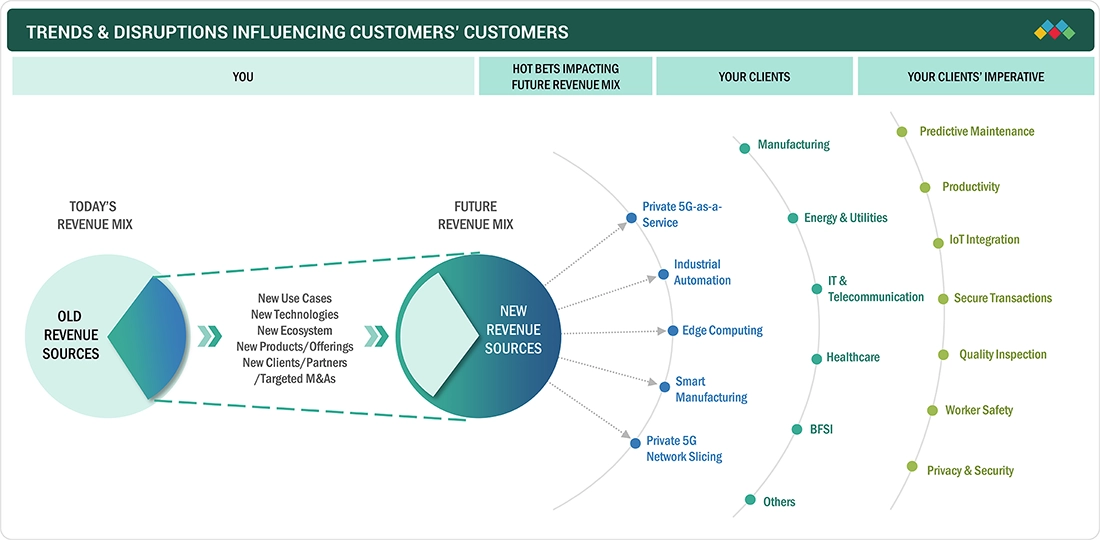
Source: Secondary Research, Interviews with Experts, MarketsandMarkets Analysis
MARKET DYNAMICS

Level
-
Rapid Industrial Digitalization and Smart Manufacturing Adoption

-
Strong Government Support and Infrastructure Investment


Level
-
High Infrastructure Deployment Costs

-
Limited Spectrum Availability in Certain Markets


Level
-
Expansion into emerging verticals beyond manufacturing

-
Expansion of private 5G-as-a-service


Level
-
Limited enterprise understanding and commercialization maturity

-
Competition from alternative technologies

Source: Secondary Research, Interviews with Experts, MarketsandMarkets Analysis
Driver: Rapid Industrial Digitalization and Smart Manufacturing Adoption
The Asia Pacific private 5G market is gaining momentum as enterprises accelerate digital transformation and shift toward smart manufacturing. Countries such as China, Japan, and South Korea are leading deployments to enable automation, robotics, and connected factory operations. Government support and national digitalization initiatives are further pushing industrial-grade 5G adoption.
Restraint: High Infrastructure Deployment Costs
Despite growing interest, high infrastructure deployment costs continue to slow adoption across Asia Pacific. Private 5G requires significant spending on radios, core networks, integration layers, and edge computing. These costs remain a barrier, especially for mid-sized enterprises that lack budget flexibility or clear ROI justification for large-scale 5G modernization.
Opportunity: Expansion into emerging verticals beyond manufacturing
There is strong potential for private 5G expansion beyond manufacturing into sectors such as energy & power, healthcare, mining, utilities, transportation and logistics, and smart ports across the Asia Pacific region. As service-based deployment models mature and technology ecosystems deepen, enterprises in new verticals are expected to adopt private 5G to support automation, predictive analytics, and mission-critical connectivity.
Challenge: Limited enterprise understanding and commercialization maturity
Limited enterprise understanding and low commercialization maturity remain key challenges in the Asia Pacific region. Many organizations lack clarity on deployment models, integration complexity, and long-term value creation. This knowledge gap, combined with varying readiness levels across countries, continues to delay large-scale rollouts despite growing interest and ecosystem development.
ASIA PACIFIC PRIVATE 5G MARKET: COMMERCIAL USE CASES ACROSS INDUSTRIES
| COMPANY | USE CASE DESCRIPTION | BENEFITS |
|---|---|---|
 |
Huawei deployed a private 5G network for a smart manufacturing facility in Guangdong, China. The deployment integrated automated guided vehicles (AGVs), AI-based visual inspection systems, and real-time equipment monitoring to improve industrial automation and operational continuity. | The network delivered low latency, high-capacity connectivity enabling real-time automation, reduced production downtime, improved product inspection accuracy, and enhanced overall factory efficiency. |
 |
Samsung implemented a private 5G network for a shipyard in Busan, South Korea to support autonomous cranes, immersive worker safety systems, and remote equipment diagnostics integrated with IoT sensors. | The deployment reduced labor-intensive manual work, improved worker safety with real-time hazard alerts, and enhanced operational reliability through predictive maintenance. |
 |
ZTE deployed a private 5G solution in a logistics hub in Shenzhen, enabling smart warehouse functions, including connected robotics, real-time asset tracking, and automated sorting supported by edge computing. | The system improved supply chain visibility, reduced order processing time, lowered operational costs, and enhanced overall logistics throughput efficiency. |
 |
NEC implemented a Private 5G network in a Japanese smart campus environment to support autonomous security drones, real-time streaming from surveillance cameras, and digital learning applications requiring high bandwidth. | The deployment improved campus security response time, enhanced user connectivity for digital education, and supported next-generation smart campus initiatives aligned with Japan’s digital transformation priorities. |
 |
NTT DATA deployed a private 5G network supporting remote healthcare applications across a hospital network in Tokyo. The system integrated robotic surgery assistance, high-resolution medical imaging transfer, and remote patient monitoring. | The deployment improved healthcare service delivery through reliable low-latency communication, enabled remote diagnostics, reduced patient wait times, and supported future AI-enabled medical innovation. |
Logos and trademarks shown above are the property of their respective owners. Their use here is for informational and illustrative purposes only.
MARKET ECOSYSTEM
The Asia Pacific private 5G ecosystem comprises diverse stakeholders, including chipset manufacturers, network vendors, cloud platforms, and system integrators that enable end-to-end deployment. The market is supported by specialized managed service providers that offer customization, orchestration, and lifecycle support for enterprise-grade 5G networks. This layered ecosystem accelerates large-scale adoption across industries such as manufacturing, logistics, and smart infrastructure.
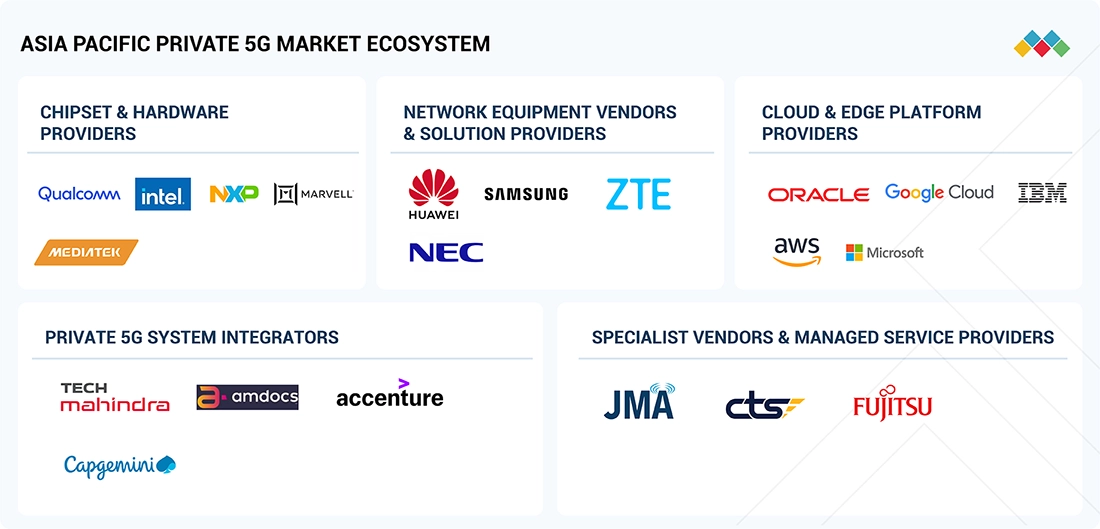
Logos and trademarks shown above are the property of their respective owners. Their use here is for informational and illustrative purposes only.
MARKET SEGMENTS

Source: Secondary Research, Interviews with Experts, MarketsandMarkets Analysis
Asia Pacific Private 5G Market, By Network Type
Non-standalone 5G currently dominates the Asia-Pacific market as enterprises prioritize faster deployment timelines and cost-effective rollouts. Many organizations leverage existing 4G infrastructure while gradually transitioning to fully standalone environments as network maturity, device ecosystems, and regulatory readiness improve across key markets, including China, Japan, India, and South Korea.
Asia Pacific Private 5G Market, By Frequency Band
The mid-band spectrum is expected to grow at the fastest rate across the Asia-Pacific region during the forecast period. Its balance of high performance and wide coverage makes it well-suited for industrial automation, logistics, smart manufacturing, and public-sector deployments. Countries in the region are accelerating mid-band allocation as part of national digital and 5G industrialization strategies.
Asia Pacific Private 5G Market, By Spectrum Allocation
Unlicensed and shared spectrum hold the largest market share, as enterprises prefer flexible licensing structures that manage costs and provide deployment autonomy. Countries such as Japan, Australia, and India are advancing shared spectrum frameworks to make private 5G adoption accessible to SMEs and large-scale industrial projects without relying solely on telecom operators.
Asia Pacific Private 5G Market, By Organization Size
Small and medium enterprises are expected to grow at the fastest CAGR as the region sees increased adoption of Industry 4.0 use cases, automation, and digital infrastructure modernization. Governments and ecosystem partners are offering targeted subsidies, sandbox environments, and deployment-as-a-service models to accelerate the integration of private 5G capabilities.
Asia Pacific Private 5G Market, By Vertical
The energy & utilities sector is expected to grow at the highest CAGR over the forecast period, as grid modernization, renewable energy expansion, smart metering, and remote operations drive investment in high-reliability networks. Private 5G is enabling automation of critical infrastructure, remote monitoring, and real-time operational control across power, oil & gas, and water management environments.
REGION
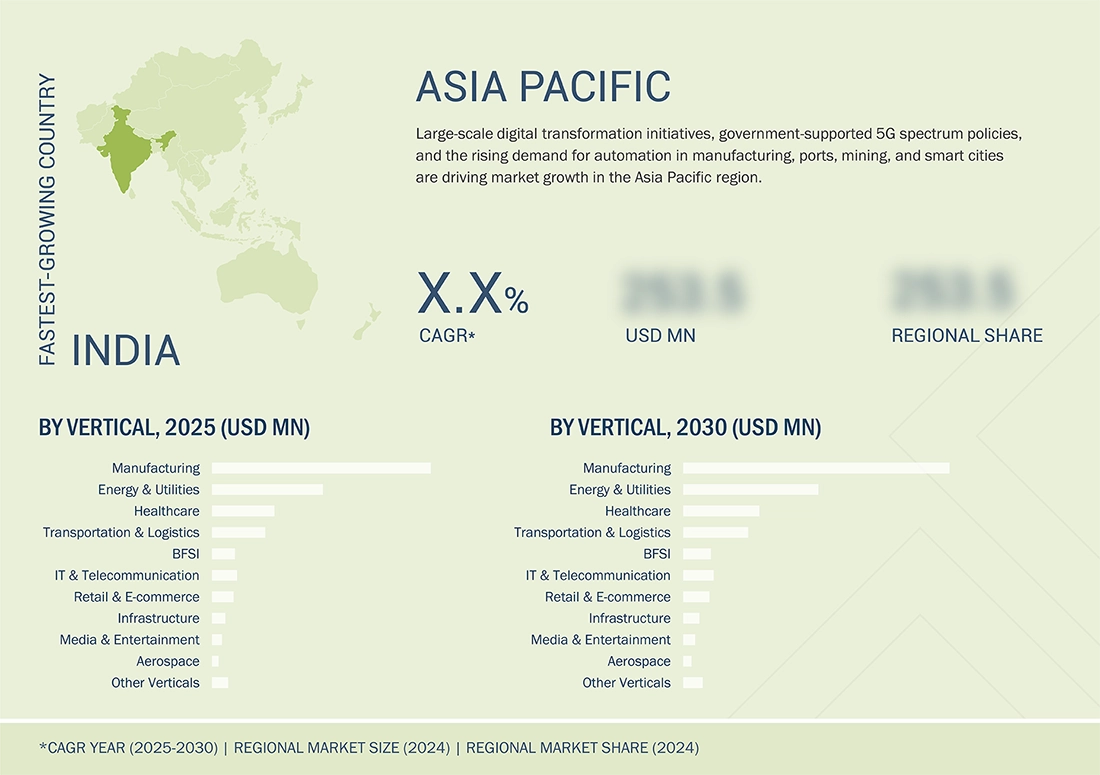
India is expected to be the fastest-growing country across the Asia Pacific private 5G market during the forecast period.
The private 5G market in the Asia Pacific region is evolving rapidly as enterprises move from pilot deployments to scaled industrial use cases. The region’s growth is supported by expanding ecosystem collaboration among telecom operators, hyperscalers, equipment vendors, and system integrators. Manufacturing hubs in China, Japan, and South Korea continue to lead adoption, while emerging markets such as India and Southeast Asia are accelerating through policy reforms and localized spectrum models. Private 5G is increasingly deployed to support autonomous systems, digital twins, asset tracking, and mission-critical communications across logistics, mining, ports, and utilities.
ASIA PACIFIC PRIVATE 5G MARKET: COMPANY EVALUATION MATRIX
In the Asia Pacific private 5G market matrix, Huawei Technologies Co., Ltd. (Star) leads with a strong market presence and a wide product portfolio, driving large-scale adoption across various verticals, including manufacturing and energy & power.
Source: Secondary Research, Interviews with Experts, MarketsandMarkets Analysis
KEY MARKET PLAYERS
- Huawei Technologies Co., Ltd. (China)
- Samsung (South Korea)
- ZTE Corporation (China)
- NEC Corporation (Japan)
- NTT DATA Group Corporation (Japan)
- Telefonaktiebolaget LM Ericsson (Sweden)
- Nokia (Finland)
- Cisco Systems, Inc. (US)
- Ciena Corporation (US)
- AT&T (US)
MARKET SCOPE
| REPORT METRIC | DETAILS |
|---|---|
| Market Size in 2024 (Value) | USD 1.1 Billion |
| Market Forecast in 2030 (Value) | USD 8.0 Billion |
| Growth Rate | CAGR of 39.1% from 2025–2030 |
| Years Considered | 2021–2030 |
| Base Year | 2024 |
| Forecast Period | 2025–2030 |
| Units Considered | Value (USD Billion) |
| Report Coverage | Revenue forecast, company ranking, competitive landscape, growth factors, and trends |
| Segments Covered |
|
| Regional Scope | Asia Pacific (China, Japan, South Korea, India, Australia, Indonesia, Malaysia, Thailand, Vietnam) |
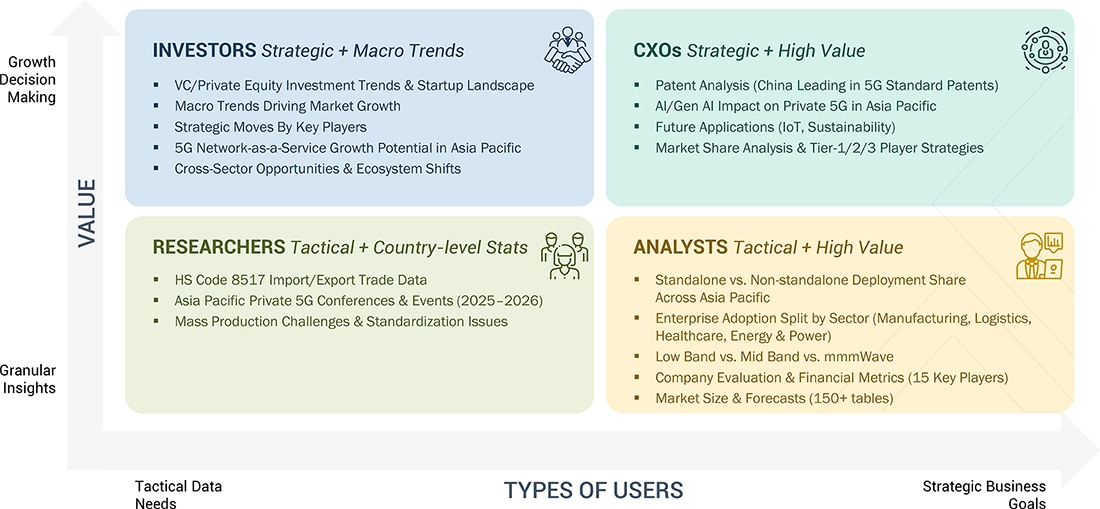
WHAT IS IN IT FOR YOU: ASIA PACIFIC PRIVATE 5G MARKET REPORT CONTENT GUIDE
DELIVERED CUSTOMIZATIONS
We have successfully delivered the following deep-dive customizations:
| CLIENT REQUEST | CUSTOMIZATION DELIVERED | VALUE ADDS |
|---|---|---|
| Telecom Equipment Vendor |
|
|
| Leading Mobile Network Operator |
|
|
| Industrial System Integrator |
|
|
| US-Based Private 5G Startup |
|
|
| Europe-Based Leading Private 5G Provider |
|
|
RECENT DEVELOPMENTS
- May 2025 : ZTE Corporation entered into a strategic partnership with XLSMART, the newly merged entity of PT XL Axiata Tbk, PT Smartfren, and Telecom Jbk, to advance Indonesia's digital infrastructure. The collaboration focuses on deploying 5G and green energy solutions to enhance network integration, service quality, and nationwide digital connectivity.
- May 2024 : Samsung and O2 Telefónica have launched Germany's first commercial site in Landsberg am Lech, Bavaria, using Samsung's 5G VRAN and Open RAN solution. This marks the debut of Samsung's VRAN technology in a German commercial network, with expansion planned to seven additional sites.
- June 2023 : Huawei Technologies Co., Ltd. announced plans to launch a complete set of 5.5G network equipment for commercial use in 2024. It is an end-to-end solution that includes comprehensive evolution and upgrades of 5.5G, F5.5G, and Net5.5G.
Table of Contents
 Exclusive indicates content/data unique to MarketsandMarkets and not available with any competitors.
Methodology
The study used four major activities to estimate the market size of private 5G. Exhaustive secondary research was conducted to gather information on the market and its peer and parent markets. The next step was to validate these findings, assumptions, and sizing with industry experts across the value chain through primary research. Both top-down and bottom-up approaches were employed to estimate the total market size. Finally, market breakdown and data triangulation methods were utilized to estimate the market size for different segments and subsegments.
Secondary Research
The research methodology used to estimate and forecast the size of the Asia Pacific Private 5G Market began with the acquisition of data related to the revenues of key vendors in the market through secondary research. Various secondary sources have been referred to in the secondary research process to identify and collect information for this study. Secondary sources include annual reports, press releases, and investor presentations of companies; white papers, journals, certified publications, and articles by recognized authors; websites; directories; and databases. Secondary research has mainly been used to obtain key information about the value chain of the Asia Pacific Private 5G Market, key players, market classification, and segmentation according to the industry trends to the bottom-most level, geographic markets, and key developments from both market and technology-oriented perspectives. The secondary research referred to for this research study involves various white papers like Cisco Private 5G Security White Papers and GDIT White Paper. Moreover, the study involved extensive use of secondary sources, directories, and databases, such as Hoovers, Bloomberg Businessweek, and Factiva, to identify and collect valuable information for a technical, market-oriented, and commercial study of the Asia Pacific Private 5G Market.
Primary Research
In the primary research process, various primary sources from both the supply and demand sides have been interviewed to obtain the qualitative and quantitative information relevant to this report. Primary sources from the supply side include key industry participants, subject-matter experts (SMEs), and C-level executives and consultants from various key companies and organizations in the private 5G ecosystem. After the complete market engineering (including calculations for market statistics, market breakdown, market size estimations, market forecasting, and data triangulation), extensive primary research has been conducted to verify and validate the critical market numbers obtained. Several primary interviews have been conducted with market experts from the demand and supply-side players across Asia Pacific. Primary data has been collected through questionnaires, emails, and telephone interviews. In the canvassing of primaries, various departments within organizations, such as sales, operations, and administration, were covered to provide a holistic viewpoint in our report. This and the opinions of in-house subject matter experts have led us to the findings described in the remainder of this report.
Market Size Estimation
Both top-down and bottom-up approaches were utilized to estimate and validate the size of the Asia Pacific Private 5G Market and its submarkets. Secondary research was conducted to identify the key players in the market, and primary and secondary research was used to determine their market share in specific regions. The entire process involved studying top players' annual and financial reports and conducting extensive interviews with industry leaders such as CEOs, VPs, directors, and marketing executives. Secondary sources were used to determine all percentage shares and breakdowns, which were verified through primary sources. All parameters that could impact the markets covered in this research study were accounted for, analyzed in detail, verified through primary research, and consolidated to obtain the final quantitative and qualitative data.
Data Triangulation
Once the overall size of the Asia Pacific Private 5G Market was determined using the methods described above, it was divided into multiple segments and subsegments. Market engineering was performed for each segment and subsegment using market breakdown and data triangulation methods, as applicable, to obtain accurate statistics. To triangulate the data, various factors and trends from the demand and supply sides were studied. The market was validated using both the top-down and bottom-up approaches.
Market Definition
The Private 5G Market comprises a diverse range of network infrastructure and deployment models designed to deliver secure, low-latency and high-speed connectivity tailored to enterprise environments. By network type, it includes non-standalone 5G and standalone 5G, offering different levels of network independence and control. Deployment is further classified by cloud models such as private/dedicated cloud, public cloud, and hybrid cloud, enabling flexibility in data handling and scalability.
Hardware components essential for private 5G include Radio Access Network (RAN), Core Network, Backhaul & Transport, and Edge Computing Infrastructure. These systems collectively enable real-time communication, ultra-reliable connectivity, and localized data processing, which are crucial for high-performance industrial applications. Industries such as manufacturing, energy, logistics, and healthcare leverage private 5G to support mission-critical operations, automation, and intelligent edge computing.
Key Stakeholders
- Telecom Equipment Providers
- Private 5G Network Operators
- Cloud and Edge Computing Providers
- Private 5G System Integrators
- Private Enterprises
- Government & Regulatory Bodies
- Semiconductor and Chipset Manufacturers
- IT Infrastructure Providers
Report Objectives
- To estimate and forecast the size of the Asia Pacific Private 5G Market, in terms of value, based on offering, network type, cloud models, organization size, spectrum allocation, frequency band, vertical, and region
- To provide detailed information regarding major factors such as drivers, restraints, opportunities, and challenges influencing market growth
- To provide a detailed overview of the private 5G value chain
- To strategically analyze micromarkets regarding individual market trends, growth prospects, and contributions to the total market
- To strategically profile key players and comprehensively analyze their market position in terms of ranking and core competencies, along with a detailed competitive landscape for the market leaders
- To analyze major growth strategies such as product launches/developments and acquisitions adopted by the key market players to enhance their market position
- To analyze the impact of the macroeconomic factors impacting the Asia Pacific Private 5G Market
- To assess the impact of AI on the growth and adoption of the Asia Pacific Private 5G Market
Available customizations:
With the given market data, MarketsandMarkets offers customizations according to the specific requirements of companies. The following customization options are available for the report:
- Detailed analysis and profiling of additional market players (up to 5)
- Additional country-level analysis of the Asia Pacific Private 5G Market
Product Analysis
- Product matrix, which provides a detailed comparison of the product portfolio of each company in the Asia Pacific Private 5G Market


Personalize This Research
- Triangulate with your Own Data
- Get Data as per your Format and Definition
- Gain a Deeper Dive on a Specific Application, Geography, Customer or Competitor
- Any level of Personalization
Let Us Help You
- What are the Known and Unknown Adjacencies Impacting the Asia Pacific Private
- What will your New Revenue Sources be?
- Who will be your Top Customer; what will make them switch?
- Defend your Market Share or Win Competitors
- Get a Scorecard for Target Partners

Custom Market Research Services
We Will Customise The Research For You, In Case The Report Listed Above Does Not Meet With Your Requirements
Get 10% Free CustomisationTESTIMONIALS

Tetsuya Ohhira
Business Development Manager-Technology Business
Nikon Corporation,
Leading Japanese MNC specializing in optics and imaging productswww.nikon.com
MarketsandMarkets™ response
is quick. Their attitude is flexible and positive. Analyst Insights are globally considered and
significant. Client Services quickly respond to our inquiry and demand. Their wide range of global
surveys help us make our strategic plan.
We hope Knowledge Store will be easier to search
for a report.
VP - Marketing & Business Development
Leading Provider of Process Control Solutions
We engaged with MarketsandMarkets on a study to perform an analysis and recommend a Go-To-Market strategy for metrology and process control in the semiconductor market. The study was tailored to our targets and needs with well-defined milestones. Our overall experience with the MarketsandMarkets team was very good throughout the project in all aspects including the analysis methodologies used, the quality and depth of primary and secondary data sets, the professionalism and flexibility of the team and the ability to meet the target schedule and milestones. We want to thank MarketsandMarkets team for a job well done.






Growth opportunities and latent adjacency in Asia Pacific Private