Asia Pacific Smart Factory Market

Asia Pacific Smart Factory Market by Component (Industrial Sensors, Industrial Robots, Industrial 3D Printers, Machine Vision Systems), Solution (SCADA, Manufacturing Execution System, Plant Asset Management, Industrial Safety) - Forecast to 2032




OVERVIEW
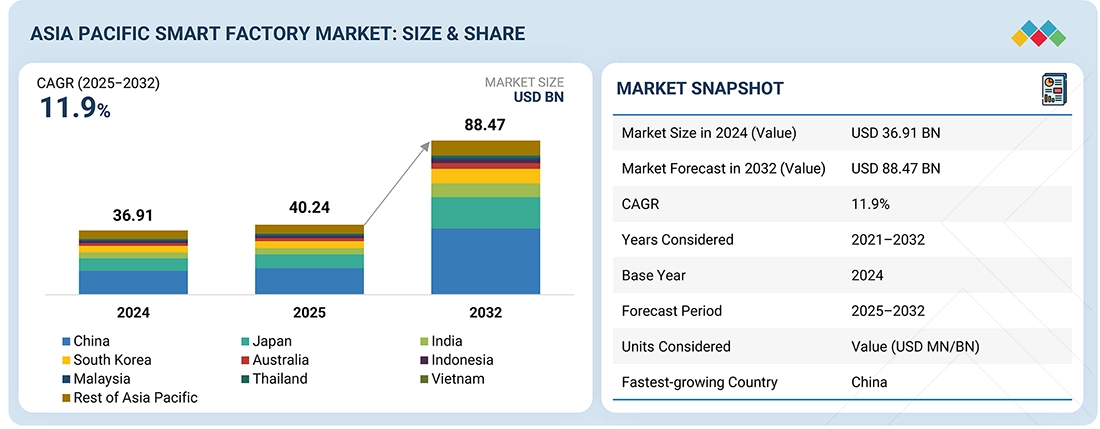
Source: Secondary Research, Interviews with Experts, MarketsandMarkets Analysis
The Asia Pacific smart factory market is projected to reach USD 88.47 billion by 2032, from USD 40.24 billion in 2025, with a CAGR of 11.9%. The market is growing rapidly as manufacturers invest in automation, robotics, and digital factory technologies to support large-scale production. Strong demand from automotive, electronics, EV, and process industries continues to accelerate adoption across the region.
KEY TAKEAWAYS
-
BY COUNTRYChina dominated the Asia Pacific smart factory market with a 37.8% share in 2025.
-
BY COMPONENTThe industrial 3D printers segment is expected to record a CAGR of 15.6% during the forecast period.
-
BY SOLUTIONManufacturing execution systems led the Asia Pacific smart factory market in 2025.
-
BY INDUSTRYProcess industries held the largest share of the Asia Pacific smart factory market in 2025.
-
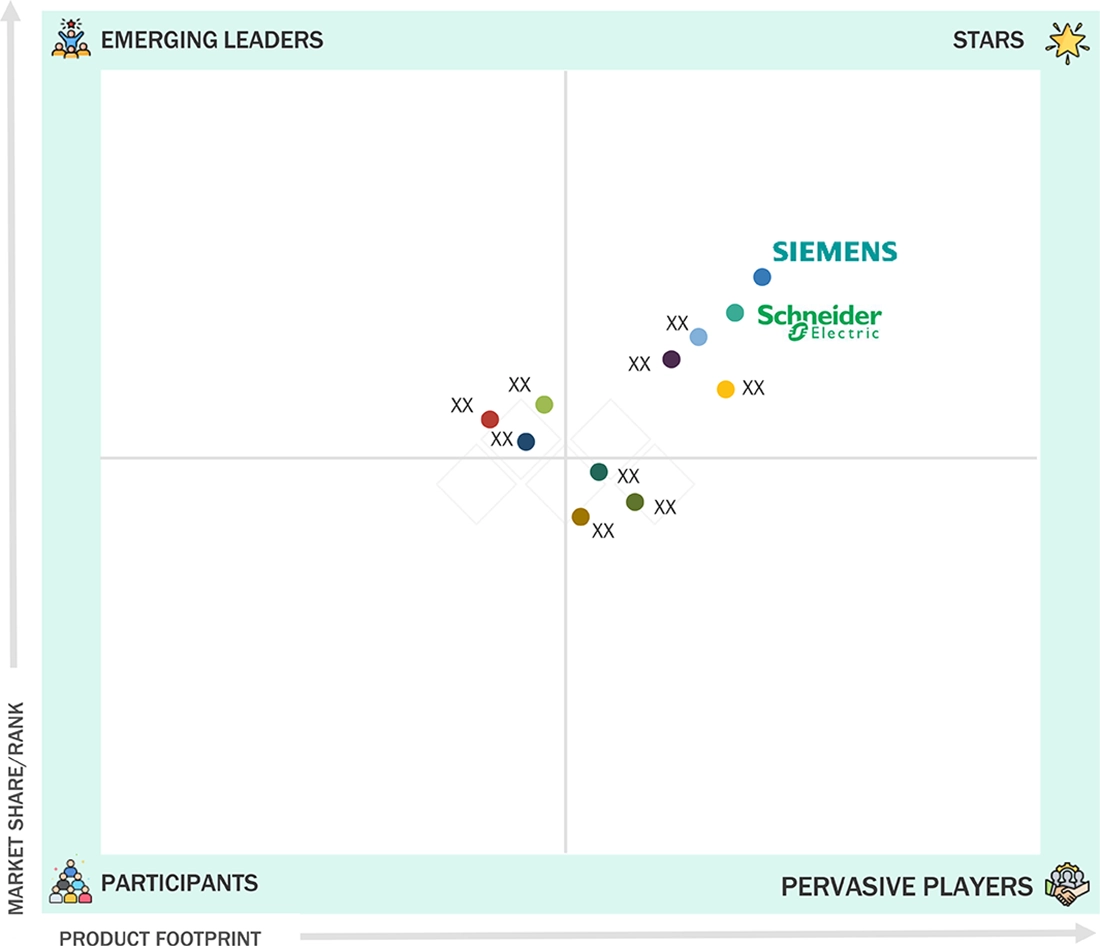
Competitive Landscape - KEY PLAYERSSiemens, Schneider Electric, and ABB were identified as the star players in the Asia Pacific smart factory market, given their strong market share and product footprint.
-
Competitive Landscape - STARTUPS/SMESJFE Engineering Corporation, Rapyuta Robotics, and HollySys Group, among others, have distinguished themselves among start-ups and SMEs by securing strong footholds in specialized niche areas, underscoring their potential as emerging market leaders.
The Asia Pacific smart factory market is experiencing strong growth as manufacturers expand production capacity and adopt advanced automation to improve efficiency and scalability. Rising investments in robotics, industrial AI, and connected factory systems are supporting high-volume manufacturing across key economies.
TRENDS & DISRUPTIONS IMPACTING CUSTOMERS' CUSTOMERS
The Asia Pacific smart factory market is undergoing a rapid shift as manufacturers move from conventional automation toward intelligent, connected, and data-driven production environments. Emerging trends such as industrial robotics, industrial AI, edge computing, digital twins, and advanced control systems are reshaping manufacturing operations and revenue models across the region. These technologies are enabling high-volume, high-precision production in industries such as automotive, electronics, semiconductors, food & beverage, and pharmaceuticals. Advances in machine vision, industrial software, and smart asset management are accelerating adoption across both greenfield and brownfield facilities.
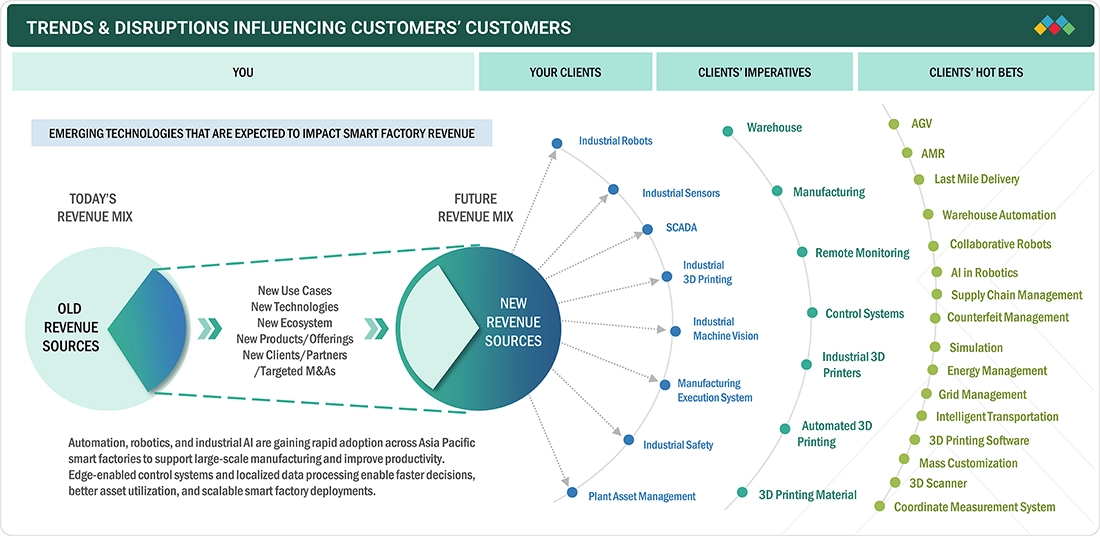
Source: Secondary Research, Interviews with Experts, MarketsandMarkets Analysis
MARKET DYNAMICS

Level
-
Rapid expansion of manufacturing capacity across China, India, Japan, and Southeast Asia

-
Strong demand from automotive, electronics, semiconductor, and EV manufacturing


Level
-
High initial investment for automation and digital factory systems

-
Integration challenges with legacy manufacturing infrastructure


Level
-
Rise of industrial AI, robotics, and edge computing in high-volume production

-
Adoption of digital twins and advanced analytics for production optimization


Level
-
Ensuring interoperability among diverse automation platforms and vendors

-
Scaling smart factory deployments beyond pilot projects

Source: Secondary Research, Interviews with Experts, MarketsandMarkets Analysis
Driver: Rapid expansion of manufacturing capacity across China, India, Japan, and Southeast Asia
Manufacturing capacity across Asia Pacific is expanding rapidly as companies scale production to meet domestic and export demand. New investments in automotive, electronics, EVs, and industrial equipment are increasing the need for automated and connected factory systems. Smart factory technologies are being adopted to improve throughput, consistency, and operational control across large-scale production environments.
Restraint: High initial investment for automation and digital factory systems
Implementing smart factory solutions requires substantial upfront spending on automation hardware, software, and system integration. Many small and mid-sized manufacturers face budget constraints when upgrading legacy facilities. This often leads to phased deployments, slowing full-scale adoption across the region.
Opportunity: Rise of industrial AI, robotics, and edge computing in high-volume production
High-volume manufacturing environments in Asia Pacific are increasingly adopting industrial AI, robotics, and edge computing to improve efficiency. These technologies enable real-time monitoring, predictive maintenance, and faster decision-making at the shop-floor level. Growing focus on productivity and cost optimization is creating strong opportunities for advanced smart factory solutions.
Challenge: Ensuring interoperability among diverse automation platforms and vendors
Asia Pacific factories often use a mix of automation systems from different vendors across production lines. Integrating these platforms into a unified digital factory architecture remains complex and time-consuming. Achieving interoperability while maintaining system reliability and cybersecurity continues to be a key challenge for manufacturers.
ASIA PACIFIC SMART FACTORY MARKET: COMMERCIAL USE CASES ACROSS INDUSTRIES
| COMPANY | USE CASE DESCRIPTION | BENEFITS |
|---|---|---|
 |
Developed a smart factory prototype at its Automation Park in Thailand using 5G connectivity, AMRs, and AR/VR to support automated inspections and flexible production, serving as a reference model for manufacturers in the Eastern Economic Corridor (EEC). | Enhanced automation and operational performance, while providing a scalable blueprint for industrial modernization in Thailand. |
 |
Implemented intelligent manufacturing at its Xiamen Hub in China with robotic assembly lines, automated warehouses, robot-guided vehicles, and welding robots, including automated switchgear panel assembly. | Reduced delivery times by over 50%, lowered energy consumption per revenue unit, improved product quality, and increased production efficiency and safety. |
 |
Deployed data-driven sustainability solutions at its Asia Pacific manufacturing facility in Singapore using FactoryTalk Energy Manager, machine learning, and automated energy optimization. | Achieved significant energy savings, reduced emissions, improved workforce efficiency, and established a scalable sustainability model for other plants. |
 |
Established a smart factory in Batam, Indonesia, integrating IIoT sensors, predictive alarms, augmented reality, and EcoStruxure Machine for real-time monitoring and preventive maintenance. | Reduced maintenance effort, waste, and downtime while improving delivery performance, energy efficiency, and sustainability outcomes. |
|
|
Deployed ABB Ability Smart Sensors at food processing facilities in Singapore and Malaysia to enable wireless motor condition monitoring and predictive maintenance. | Minimized unplanned downtime, extended equipment life, reduced maintenance costs, and improved operational reliability. |
Logos and trademarks shown above are the property of their respective owners. Their use here is for informational and illustrative purposes only.
MARKET ECOSYSTEM
The Asia Pacific smart factory market ecosystem is supported by a strong mix of global and regional technology providers working closely with large manufacturing end users. The ecosystem spans automation hardware, industrial software, robotics, control systems, and digital manufacturing platforms, enabling high-volume and cost-efficient production. Demand is driven by industries such as automotive, electronics, consumer goods, and food processing that require scalable, flexible, and data-driven operations. Close collaboration between solution providers and manufacturers is accelerating smart factory adoption across both new and existing production facilities in the region.
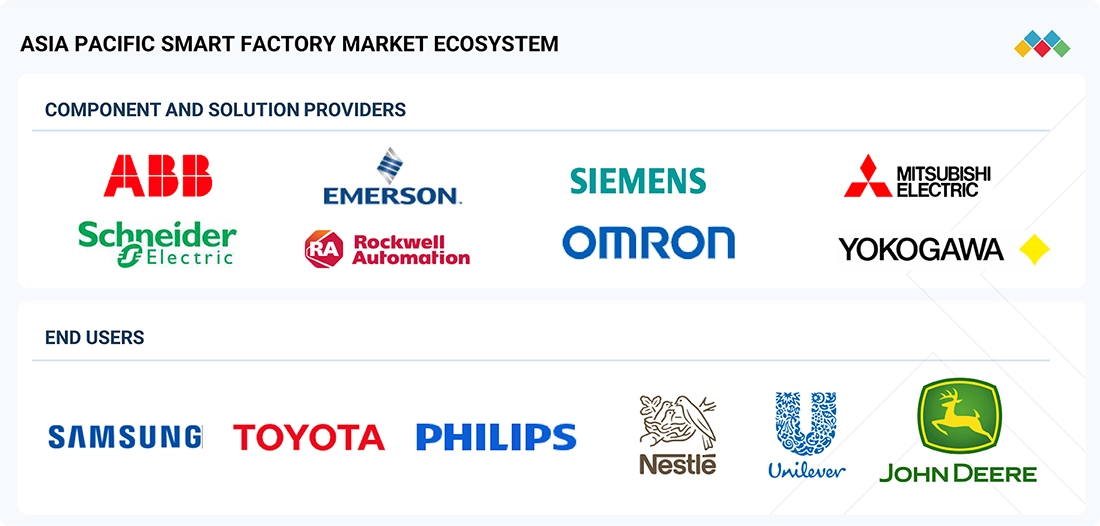
Logos and trademarks shown above are the property of their respective owners. Their use here is for informational and illustrative purposes only.
MARKET SEGMENTS
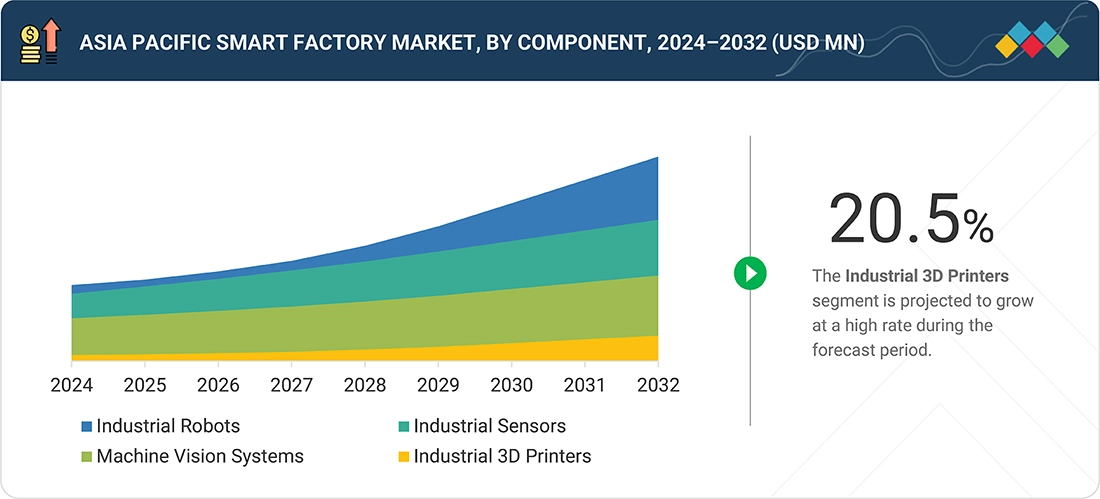
Source: Secondary Research, Interviews with Experts, MarketsandMarkets Analysis
Asia Pacific Smart Factory Market, By Component
Industrial 3D printers are expected to grow at a high CAGR in the Asia Pacific smart factory market as manufacturers adopt additive manufacturing for tooling, prototyping, and low-volume production. Strong demand from automotive, electronics, and industrial equipment manufacturing is driving adoption across the region. Increasing focus on design flexibility, faster product development, and localized production further supports growth. Expanding investments in advanced materials and production-grade printers are accelerating market uptake.
Asia Pacific Smart Factory Market, By Solution
Manufacturing execution systems held the largest share of the Asia Pacific smart factory market in 2025 due to their critical role in coordinating shop-floor operations. These platforms enable real-time production monitoring, quality management, and traceability across large-scale manufacturing facilities. Strong adoption across automotive, electronics, and process industries has reinforced their leadership. Integration with automation systems and enterprise software continues to drive widespread deployment.
Asia Pacific Smart Factory Market, By Industry
Process industries dominate the Asia Pacific smart factory market, supported by sustained automation investments across chemicals, energy, oil & gas, food & beverage, and pharmaceuticals. These industries require continuous operations, high reliability, and strict safety standards, increasing reliance on advanced control and monitoring systems. Smart factory solutions help improve asset performance, reduce downtime, and optimize energy usage. Ongoing capacity expansions across the region continue to drive adoption.
REGION
China to grow at high rate during forecast period
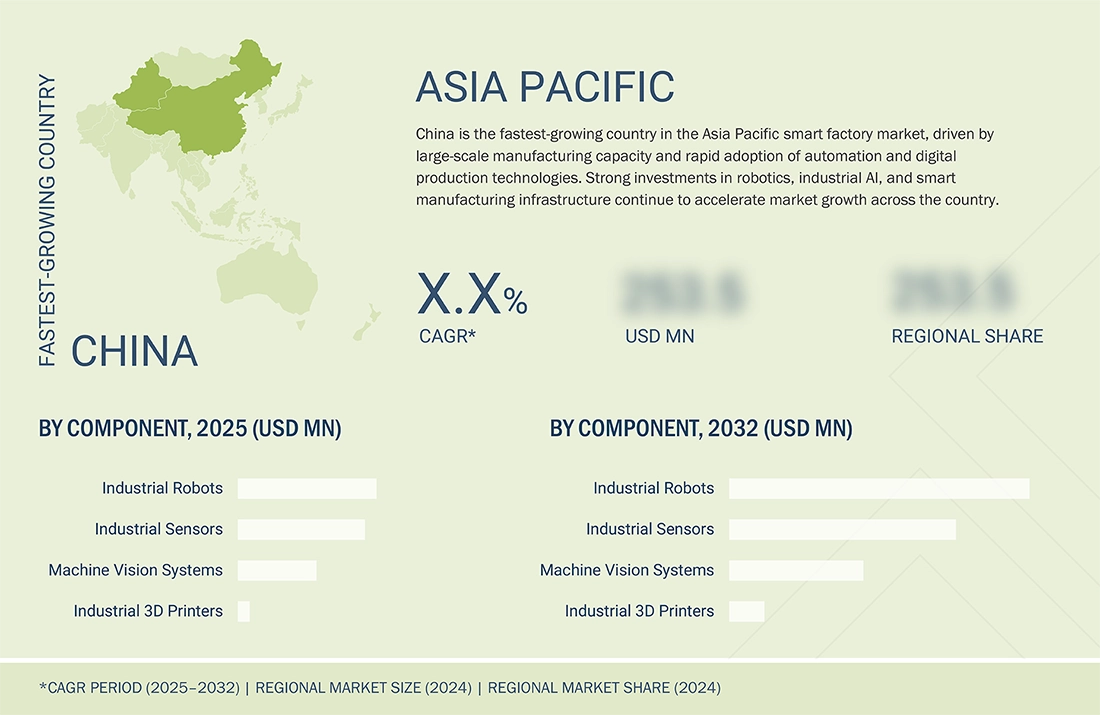
China is expected to grow at a high rate in the Asia Pacific smart factory market, driven by its large manufacturing base and rapid automation adoption. Substantial investments in robotics, industrial AI, and digital production systems are accelerating smart factory deployments. Expansion across automotive, electronics, and high-precision manufacturing sectors continues to support robust market growth.
ASIA PACIFIC SMART FACTORY MARKET: COMPANY EVALUATION MATRIX
Siemens AG and Schneider Electric emerge as leading players in the Asia Pacific smart factory market based on their strong SCADA portfolios, extensive regional presence, and deep integration with automation and industrial software platforms. Their SCADA solutions are widely adopted across high-volume manufacturing, process industries, and infrastructure projects, supporting real-time monitoring, control, and data-driven decision-making. Broad deployment across automotive, electronics, energy, and process manufacturing positions these companies at the forefront of SCADA-led smart factory adoption across Asia Pacific.
Source: Secondary Research, Interviews with Experts, MarketsandMarkets Analysis
KEY MARKET PLAYERS
- ABB (Switzerland)
- Emerson Electric Co. (US)
- GE Vernova (US)
- Siemens AG (Germany)
- Rockwell Automation Inc. (US)
- Schneider Electric (France)
- Honeywell International Inc. (US)
- Mitsubishi Electric Corporation (Japan)
- Endress+Hauser Group Services AG (Switzerland)
- Yokogawa Electric Corporation (Japan)
- FANUC Corporation (Japan)
- ONLY THE FIRST FIVE NEED TO BE HYPERLINKED!
MARKET SCOPE
| REPORT METRIC | DETAILS |
|---|---|
| Market Size in 2024 (Value) | USD 36.91 BN |
| Market Forecast in 2032 (Value) | USD 88.47 BN |
| Growth Rate | CAGR of 11.9% from 2025 to 2032 |
| Years Considered | 2021–2032 |
| Base Year | 2024 |
| Forecast Period | 2025–2032 |
| Units Considered | Value (USD MN/BN) |
| Report Coverage | Revenue Forecast, Company Ranking, Competitive Landscape, Growth Factors, and Trends |
| Segments Covered |
|
| Countries Covered | China, Japan, India, South Korea, Australia, Indonesia, Malaysia, Thailand, Vietnam, Rest of Asia Pacific |
WHAT IS IN IT FOR YOU: ASIA PACIFIC SMART FACTORY MARKET REPORT CONTENT GUIDE
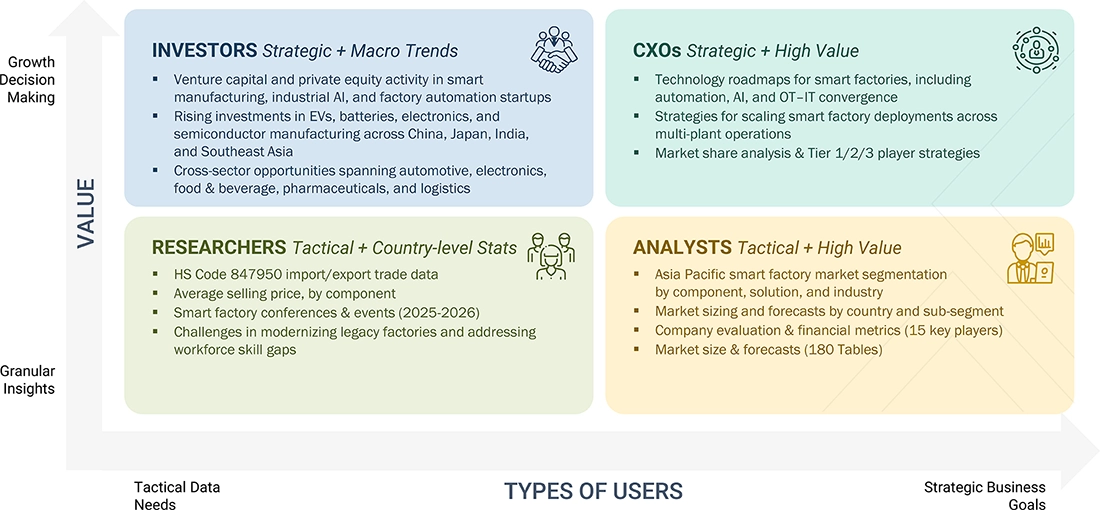
DELIVERED CUSTOMIZATIONS
We have successfully delivered the following deep-dive customizations:
| CLIENT REQUEST | CUSTOMIZATION DELIVERED | VALUE ADDS |
|---|---|---|
| Comprehensive Smart Factory Ecosystem Mapping (APAC) | Conducted detailed mapping of the Asia Pacific smart factory ecosystem covering automation hardware, industrial software, robotics, sensors, industrial networks, additive manufacturing, and digital platforms across China, Japan, India, and ASEAN | Provides holistic visibility into ecosystem structure, regional interdependencies, and growth pockets, supporting market entry and expansion decisions |
| Competitive Benchmarking of Automation Vendors | Benchmarked global and APAC-headquartered automation providers based on product portfolios, SCADA/MES capabilities, robotics integration, regional footprint, and end-user adoption | Strengthens competitive intelligence, enables objective vendor comparison, and supports partnership and acquisition strategies |
| Country-Level Market Assessment | Assessed smart factory adoption, investment trends, and demand dynamics across major APAC markets including China, Japan, India, South Korea, and Southeast Asia | Helps prioritize high-growth countries, refine regional strategies, and optimize resource allocation |
| Industry-Specific Use Case Analysis | Evaluated high-value smart factory use cases across automotive, electronics, semiconductor, EV, food & beverage, and pharmaceuticals manufacturing | Identifies revenue-generating opportunities, sharpens industry focus, and strengthens go-to-market planning |
| Supply Chain Localization & Resilience Assessment | Evaluated localization trends, near-shoring initiatives, and smart factory investments supporting resilient APAC supply chains | Supports strategic planning for reduced lead times, supply continuity, and regional manufacturing resilience |
RECENT DEVELOPMENTS
- July 2025 : Schneider Electric acquired the remaining 35% stake in its Indian joint venture from Temasek for EUR 5.5 billion, reinforcing its position in the Asia Pacific smart factory market and enhancing capabilities in electrical and automation solutions for manufacturing.
- July 2025 : ABB launched three new robot families tailored for mid-sized manufacturers in China, supporting the shift toward smart, high-end manufacturing with faster deployment and lower costs in the Asia Pacific region.
- July 2025 : ASTAR and Siemens signed an MoU to advance smart and sustainable manufacturing solutions, with Siemens as the first technology partner for ASTAR's Smart and Sustainable Advanced Manufacturing initiative.
- June 2025 : Jinggong Holding Group Co., Ltd. and Yokogawa Electric Corporation signed a multi-faceted strategic partnership for mutual business development in smart manufacturing, focusing on energy and chemical sectors in China and the Asia Pacific.
- March 2025 : Mitsubishi Electric established a Factory Automation (FA) Business Headquarters in China to expand its smart manufacturing operations, including local manufacturing, sales, and service for the growing Asia Pacific market.
Table of Contents
 Exclusive indicates content/data unique to MarketsandMarkets and not available with any competitors.
Methodology
The research study involved four major steps in estimating the size of the Asia Pacific Smart Factory Market . Exhaustive secondary research has been done to collect important information about the market and peer markets. The next step has been to validate these findings and assumptions and size them with the help of primary research with industry experts across the value chain. Both top-down and bottom-up approaches have been used to estimate the market size. After this, the market breakdown and data triangulation approaches have been adopted to estimate the market sizes of segments and subsegments.
Secondary Research
Various secondary sources were referred to in the secondary research process to identify and collect the information required for this study. These sources include annual reports, press releases, investor presentations of companies, white papers, and articles from recognized authors. Secondary research was mainly done to obtain key information about the market’s value chain, the pool of key market players, market segmentation according to industry trends, regional outlook, and developments from market and technology perspectives.
In the Asia Pacific Smart Factory Market report, the market size has been estimated using the top-down and bottom-up approaches, along with several other dependent submarkets. The major players in the market were identified using extensive secondary research, and their presence in the market was determined using secondary and primary research. All the percentage splits and breakdowns have been determined using secondary sources and verified through primary sources.
Primary Research
Extensive primary research has been conducted after understanding the Asia Pacific Smart Factory Market scenario through secondary research. Several primary interviews have been conducted with key opinion leaders from demand- and supply-side vendors across four major regions—North America, Europe, Asia Pacific, and RoW. Approximately 40% of the primary interviews were conducted with the demand-side vendors and 60% with the supply-side vendors. Primary data has been collected mainly through telephonic interviews, which consist of 80% of the total primary interviews; questionnaires and emails have also been used to collect the data.
After successful interaction with industry experts, brief sessions were conducted with highly experienced independent consultants to reinforce the findings of our primary research. This, along with the in-house subject matter experts’ opinions, led us to the findings described in the report. The breakdown of primary respondents is as follows:
Market Size Estimation
In the complete market engineering process, top-down and bottom-up approaches and several data triangulation methods have been used to estimate and forecast the overall market segments and subsegments listed in this report. The key players in the market have been identified through secondary research, and their market shares in the respective regions have been determined through primary and secondary research. This entire procedure includes the study of annual and financial reports of the top market players and extensive interviews for key insights (quantitative and qualitative) with industry experts (CEOs, VPs, directors, and marketing executives).
All percentage shares, splits, and breakdowns have been determined using secondary sources and verified through primary sources. All the parameters affecting the markets covered in this research study have been accounted for, viewed in detail, verified through primary research, and analyzed to obtain the final quantitative and qualitative data. This data has been consolidated and supplemented with detailed inputs and analysis from MarketsandMarkets and presented in this report.
Bottom-Up Approach
- Identifying various industries using or expected to deploy different types of smart factory solutions at their facilities
- Analyzing use cases across regions and companies
- Estimating the size of the Asia Pacific Smart Factory Market based on the demand from these industries and companies
- Tracking the ongoing and upcoming installation contracts, acquisitions, expansions, and product launches by various companies, and forecasting the market based on these developments and other critical parameters
- Conducting multiple discussions with key opinion leaders to understand smart factory components and solutions by companies in these industries, and analyzing the breakdown of the scope of work carried out by each major company providing smart factory components
- Arriving at the market estimates by analyzing the country-wise sales of smart factory solutions to companies, and combining this data to get the regional market estimates
- Verifying and cross-checking the estimates at each level through discussions with key opinion leaders, including CEOs, directors, operations managers, and domain experts at MarketsandMarkets
- Studying various paid and unpaid information sources, such as annual reports, press releases, and white papers
Top-Down Approach
- Information related to the revenue of key manufacturers and providers of smart factory components and solutions was studied and analyzed to estimate the size of the Asia Pacific Smart Factory Market .
- Multiple discussions were conducted with key opinion leaders to understand the demand for smart factory components and analyze the break-up of the scope of work carried out by each major company.
- Revenue, geographic presence, key industries served, and the diverse offerings of all identified players in the Asia Pacific Smart Factory Market were studied to estimate and arrive at the percentage split of different market segments.
- All major players in the Asia Pacific Smart Factory Market were identified through secondary research and verified through brief discussions with industry experts.
- Multiple discussions were conducted with key opinion leaders of all major companies involved in developing smart factory solutions to validate the market split based on component, solution, industry, and region.
- Geographic splits were estimated through secondary sources based on factors such as the number of players offering smart factory solutions in a specific country or region, and the industries for which these players offer solutions.
Data Triangulation
After arriving at the overall market size from the estimation process explained above, the overall market has been split into several segments and subsegments. The data triangulation procedure has been employed wherever applicable to complete the overall market engineering process and arrive at the exact statistics for all segments and subsegments. The data has been triangulated by studying various factors and trends from both the demand and supply sides. Additionally, the market size has been validated using top-down and bottom-up approaches.
Market Definition
A smart factory is a highly digitalized and automated production system connected throughout all the production processes in a facility. It can self-optimize performance across a broad network, self-adapt to changing production conditions and requirements in real time, and autonomously run an entire production system. The main advantage of a smart factory is its ability to evolve with the changing needs of the organization. A smart factory uses a network to connect the virtual and physical elements of the production process to manufacturing operations. It represents an autonomous manufacturing environment that can handle any technical issues in real time during production using fragmented information and communication structures for the optimum management of production processes.
Key Stakeholders
- End Users
- Government Bodies, Venture Capitalists, and Private Equity Firms
- Smart Factory Manufacturers
- Smart Factory Solution & Component Distributors
- Smart Factory Industry Associations
- Professional Service/Solution Providers
- Research Institutions and Organizations
- Standards, Organizations, and Regulatory Authorities in Asia Pacific Smart Factory Market
- System Integrators
- Technology Consultants
Report Objectives
- To describe and forecast the Asia Pacific Smart Factory Market , in terms of value, based on component, solution, and industry, in terms of value
- To provide detailed information regarding the drivers, restraints, opportunities, and challenges influencing market growth
- To provide a detailed overview of the smart factory value chain and ecosystem
- To strategically analyze micromarkets with respect to individual growth trends, prospects, and contributions to the total market
- To strategically profile the key players and comprehensively analyze their market positions in terms of ranking and core competencies
- To analyze competitive developments, such as product launches, acquisitions, collaborations, agreements, and partnerships, in the Asia Pacific Smart Factory Market
- To provide ecosystem analysis, case study analysis, patent analysis, technology analysis, key conferences and events, Porter’s five forces analysis, regulatory landscape, impact of AI/Gen AI, and impact of the 2025 US Tariff on the Asia Pacific Smart Factory Market Available customizations:
With the given market data, MarketsandMarkets offers customizations according to the specific requirements of companies. The following customization options are available for the report:
- Detailed analysis and profiling of additional market players based on various blocks of the supply chain
Key Questions Addressed by the Report
What is the projected market value of the Asia Pacific Smart Factory market?
The Asia Pacific Smart Factory market is projected to reach a significant market value by the forecast period, driven by increasing adoption of Industry 4.0 and industrial automation technologies.
Which region is expected to dominate the Asia Pacific Smart Factory market?
China is expected to dominate the Asia Pacific Smart Factory market due to strong manufacturing capabilities, government initiatives, and rising investments in digital transformation.
What are the key segments of the Asia Pacific Smart Factory market?
The market is segmented by component, solution, industry, and country, with industrial robotics, machine vision, and manufacturing applications accounting for a major share.
Who are the major key players in the Asia Pacific Smart Factory market?
Major key players in the Asia Pacific Smart Factory market include Siemens AG, ABB Ltd., Schneider Electric, Mitsubishi Electric Corporation, and Rockwell Automation, Inc.
What factors are driving the growth of the Asia Pacific Smart Factory market?
The growth of the Asia Pacific Smart Factory market is driven by rising demand for operational efficiency, increasing adoption of IoT and AI technologies, growing labor costs, and expanding smart manufacturing initiatives.


Personalize This Research
- Triangulate with your Own Data
- Get Data as per your Format and Definition
- Gain a Deeper Dive on a Specific Application, Geography, Customer or Competitor
- Any level of Personalization
Let Us Help You
- What are the Known and Unknown Adjacencies Impacting the Asia Pacific Smart Factory Market
- What will your New Revenue Sources be?
- Who will be your Top Customer; what will make them switch?
- Defend your Market Share or Win Competitors
- Get a Scorecard for Target Partners

Custom Market Research Services
We Will Customise The Research For You, In Case The Report Listed Above Does Not Meet With Your Requirements
Get 10% Free CustomisationTESTIMONIALS

Tetsuya Ohhira
Business Development Manager-Technology Business
Nikon Corporation,
Leading Japanese MNC specializing in optics and imaging productswww.nikon.com
MarketsandMarkets™ response
is quick. Their attitude is flexible and positive. Analyst Insights are globally considered and
significant. Client Services quickly respond to our inquiry and demand. Their wide range of global
surveys help us make our strategic plan.
We hope Knowledge Store will be easier to search
for a report.
VP - Marketing & Business Development
Leading Provider of Process Control Solutions
We engaged with MarketsandMarkets on a study to perform an analysis and recommend a Go-To-Market strategy for metrology and process control in the semiconductor market. The study was tailored to our targets and needs with well-defined milestones. Our overall experience with the MarketsandMarkets team was very good throughout the project in all aspects including the analysis methodologies used, the quality and depth of primary and secondary data sets, the professionalism and flexibility of the team and the ability to meet the target schedule and milestones. We want to thank MarketsandMarkets team for a job well done.






Growth opportunities and latent adjacency in Asia Pacific Smart Factory Market