Asia Pacific Multimodal Transport Market

Asia Pacific Multimodal Transport Market by Configuration (Two-Mode, Three-Mode, Hybrid/ Other), End-use Industry (Retail, Food & Beverages, Pharmaceuticals & Healthcare, Chemical & Materials, Manufacturing), Solution, Service, Country - Forecast to 2032




OVERVIEW
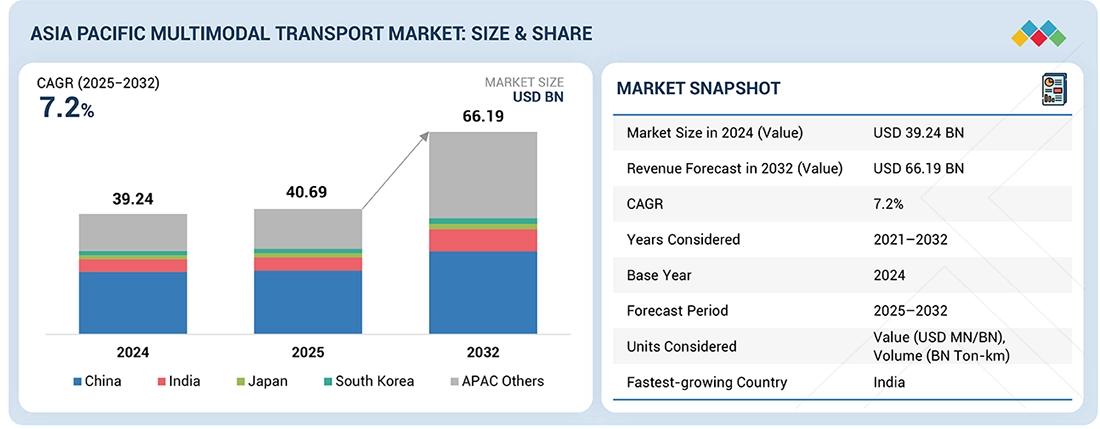
Source: Secondary Research, Interviews with Experts, MarketsandMarkets Analysis
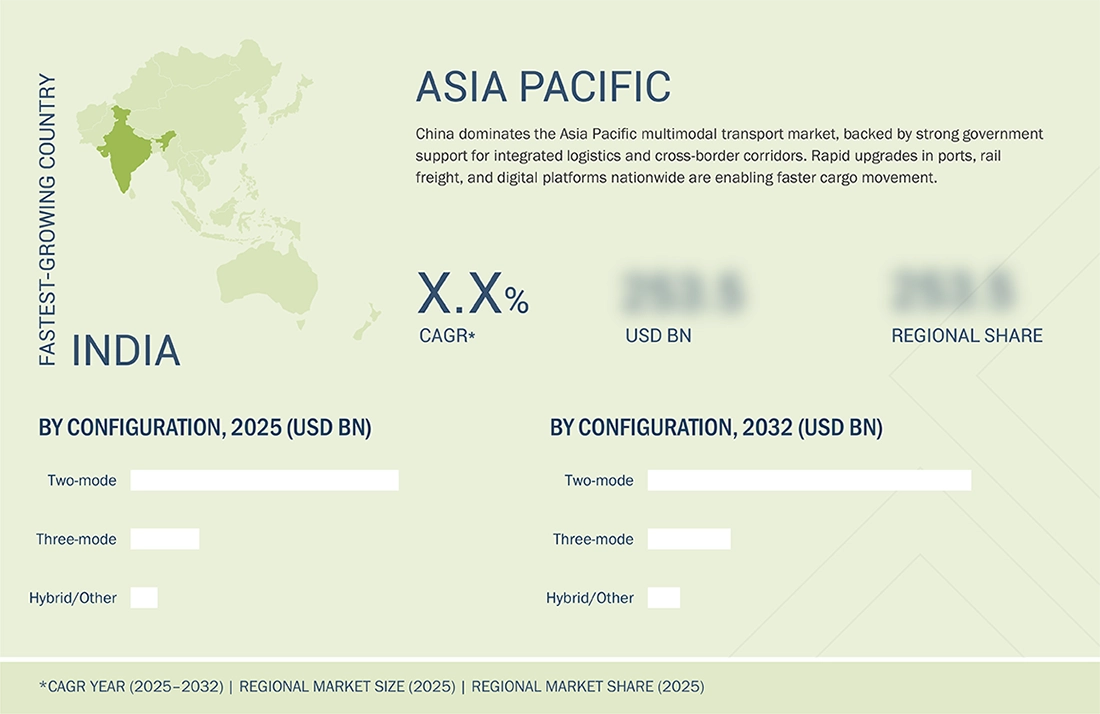
The Asia Pacific multimodal transport market is expected to reach USD 66.19 billion by 2032, from USD 40.69 billion in 2025, with a CAGR of 7.2%. This growth is underpinned by a surge in cross-border trade across emerging economies in Asia, major investments in port, rail, and road infrastructure, and the rise of integrated end-to-end logistics networks that connect manufacturing hubs with export gateways and domestic consumption centers. Rapid e-commerce growth, increased intra-regional trade, and the relocation of manufacturing (near-shoring) across Southeast Asia are further fueling demand for efficient multimodal shipments.
KEY TAKEAWAYS
-
BY CONFIGURATIONThe two-mode segment is expected to dominate the market during the forecast period.
-
BY END-USE INDUSTRYRetail is expected to be the fastest-growing segment during the forecast period.
-
BY COUNTRYChina is expected to be the largest market for multimodal transport in Asia Pacific during the forecast period.
-
COMPETITIVE LANDSCAPESinotrans Limited (China) leads the Asia Pacific multimodal transport market, followed by Allcargo Logistics (India) and LX Pantos (South Korea), positioned as key strategic players.
In the Asia-Pacific region, multimodal transport is being transformed by digital integration, as real-time cargo tracking, IoT-enabled asset monitoring, and unified documentation systems now enable smoother coordination across sea, rail, road, and inland waterway networks. At the same time, expanding port-rail-road connectivity and upgraded freight-corridor infrastructure are connecting manufacturing hubs, ports, and inland markets — cutting transit times while raising shipment density. Meanwhile, wider adoption of AI-driven route-planning and freight-orchestration tools helps logistics providers optimise cost, time, and modal mix — making supply chains more efficient and resilient.
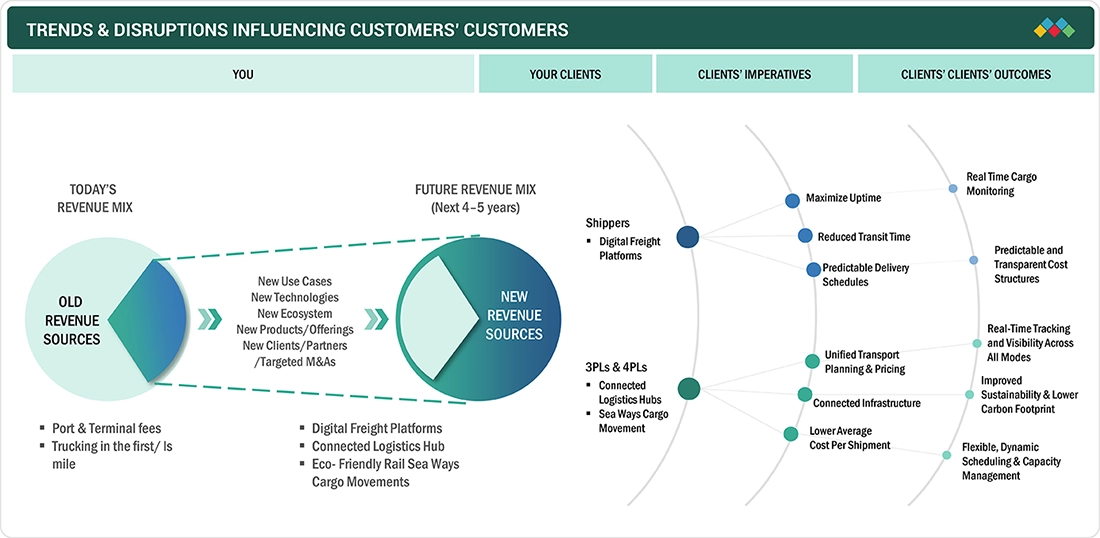
TRENDS & DISRUPTIONS IMPACTING CUSTOMERS' CUSTOMERS
The Asia Pacific multimodal logistics landscape is evolving from conventional freight forwarding and standalone warehousing toward digitally integrated and service-driven models. Traditional reliance on manual documentation is being replaced by coordinated port–rail–road systems and advanced data-sharing networks that improve visibility and reduce inefficiencies. Emerging technologies such as AI-based route optimization, IoT-enabled tracking, and automated handoff management are transforming operations, enabling faster and more reliable cross-border movement. Additionally, sustainability goals and government-led modal shift programs are accelerating the transition toward seamless, low-emission multimodal logistics frameworks.
Source: Secondary Research, Interviews with Experts, MarketsandMarkets Analysis
MARKET DYNAMICS

Level
-
Ongoing rollout of ambitious transnational infrastructure programs

-
Unprecedented boom in online retail in emerging markets


Level
-
High capital cost

-
Extended payback period


Level
-
Rapid advances in digital technologies

-
Governments' focus on building dedicated freight railway corridors


Level
-
Persistent differences in container dimensions and pallet specifications

Source: Secondary Research, Interviews with Experts, MarketsandMarkets Analysis
Driver: Ongoing rollout of ambitious transnational infrastructure programs
The ongoing rollout of ambitious transnational infrastructure programs, especially those connecting China to Europe and deepening links across Southeast Asia, has dramatically boosted the volume of goods moving across the continent, making it far more practical and cost-effective to combine ocean shipping, high-speed rail networks, and modern highway systems into a single seamless journey rather than depending on any one mode alone.
Restraint: Extended payback period
Large multimodal infrastructure initiatives typically require 10 to 15 years or longer before generating enough revenue to recover the original investment, and this extended payback period makes private investors hesitant to commit funds unless substantial government guarantees, subsidies, or public-private partnership frameworks are firmly in place.
Opportunity: Rapid advances in digital technologies
Rapid advances in digital technologies, ranging from AI that optimizes routing and predicts delays to blockchain platforms that provide tamper-proof documentation and IoT devices that offer real-time temperature and location tracking, are creating an unprecedented opportunity to transform fragmented Asian supply chains into highly transparent, responsive, and efficient multimodal networks.
Challenges: Persistent differences in container dimensions and pallet specifications
Persistent differences in container dimensions, pallet specifications, rail loading gauges, truck weight limits, and cargo-securing practices among Asian countries and sometimes even within the same country cause repeated delays, extra handling costs, and occasional damage every time freight must be shifted from one transport mode to another at intermodal terminals.
ASIA PACIFIC MULTIMODAL TRANSPORT MARKET: COMMERCIAL USE CASES ACROSS INDUSTRIES
| COMPANY | USE CASE DESCRIPTION | BENEFITS |
|---|---|---|
 |
A Taiwanese electronics manufacturer ships time-sensitive components from its Batam, Indonesia factory to Los Angeles Airport (LAX) via a sea-air multimodal solution, short ocean voyage to Singapore's free port (avoiding customs duties), followed by air freight to LAX. | Achieves 20–30% cost savings over direct air shipments from Batam (which are sporadic and expensive); reduces transit time to 3–5 days while maintaining product integrity for just-in-time manufacturing needs. |
 |
Transporting general cargo from Huaihua in Hunan Province, China, to Hanoi, Vietnam, using a rail-truck multimodal route that maintains the same container throughout the cross-border journey over 15 days. | Offers 15–25% lower rates than traditional ocean freight; ensures careful handling and no container repacking for time-sensitive shipments, enhancing reliability and reducing damage risks in ASEAN corridors. |
 |
Partnering with Schneider Electric to establish industry-first multimodal shipping bridges from Asian manufacturing hubs (e.g., China and Vietnam) to North American destinations, combining ocean freight for bulk legs with air for urgent segments in electronics and industrial equipment supply chains. | Enables up to 50% reduction in GHG emissions through optimized mode shifts; scales decarbonization for high-volume exports while cutting overall logistics costs by 10–15% via efficient intermodal hubs. |
Logos and trademarks shown above are the property of their respective owners. Their use here is for informational and illustrative purposes only.
MARKET ECOSYSTEM
The market ecosystem for multimodal transport is shaped by four interconnected participant groups that enable end-to-end cargo movement. Multimodal transport operators act as the central coordinators, managing mode combinations, routing, and service execution under a single contract. Infrastructure and terminal operators provide the backbone through ports, rail terminals, inland depots, and logistics parks that support smooth handoffs across modes. Technology providers enable digital visibility, documentation, and control-tower integration, improving reliability and decision-making. End-use industries such as manufacturing, retail, and chemicals & materials drive demand patterns, influencing lane selection, service intensity, and network expansion priorities.
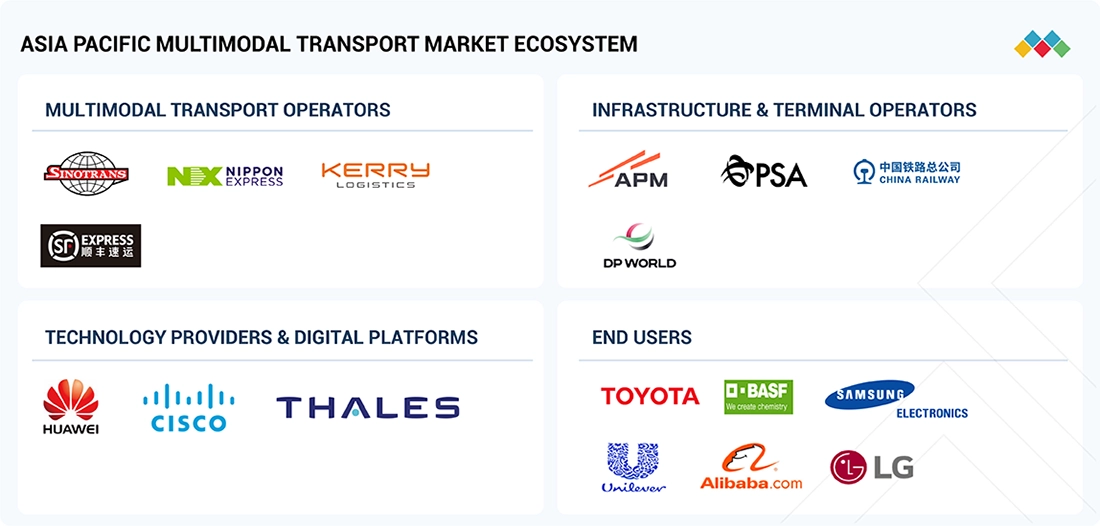
Logos and trademarks shown above are the property of their respective owners. Their use here is for informational and illustrative purposes only.
MARKET SEGMENTS
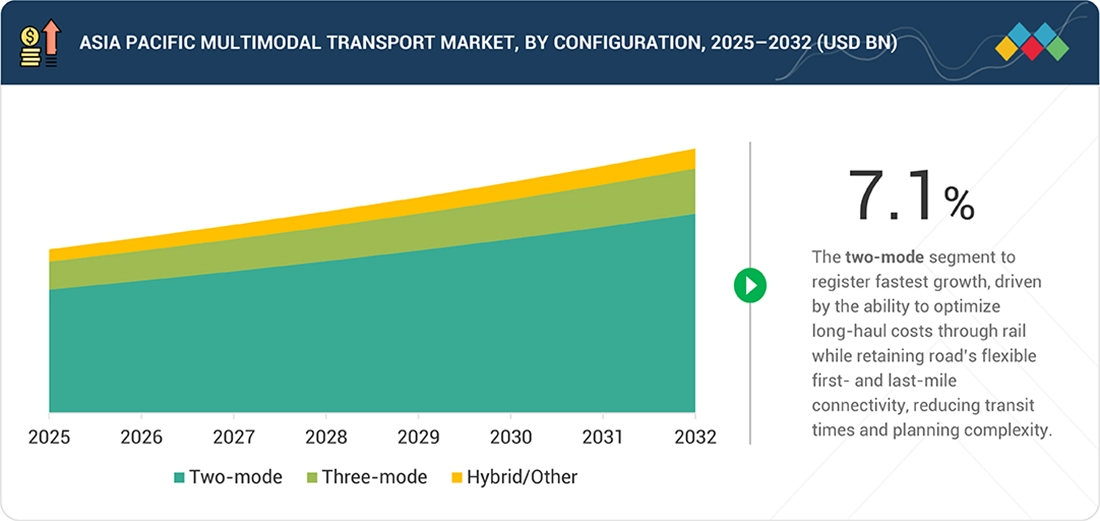
Source: Secondary Research, Interviews with Experts, MarketsandMarkets Analysis
Asia Pacific Multimodal Transport Market, By Configuration
Two-mode transport configurations continue to gain prominence in multimodal logistics due to their optimal mix of cost efficiency, reliability, and flexibility. By combining the long-distance capabilities of rail or sea with the agility of road transport for first- and last-mile delivery, they offer a seamless solution for both regional and cross-border trade. Their growing use in manufacturing, retail, and pharmaceutical logistics reflects the need for simplified coordination, faster scalability, and improved service consistency across supply chains.
Asia Pacific Multimodal Transport Market, By End-use Industry
Manufacturing is the largest end-use industry in the multimodal transport market, supported by frequent shipments and the steady flow of raw materials and finished products across regional and global supply chains. The industry increasingly relies on cost-effective rail–road and road–sea networks to maintain just-in-time and just-in-sequence production systems. Continuous investments in industrial corridors, export-oriented manufacturing, and supplier network expansion are further strengthening manufacturing’s position as the leading driver of multimodal freight activity.
REGION
China to be the largest market for multi modal transport market during forecast period
China is expected to hold the largest share of the Asia Pacific multimodal transport market, driven by strong export-led manufacturing and dense trade corridors across the country. Massive investments in port modernization, rail–road integration, and inland logistics parks are accelerating multimodal capacity and network efficiency. Rapid growth in regionalized supply chains, cross-border e-commerce, and near-shoring within Asia continues to reinforce the region’s leadership. Ongoing government initiatives such as digital documentation mandates and multimodal policy incentives are further boosting adoption and long-term market momentum.
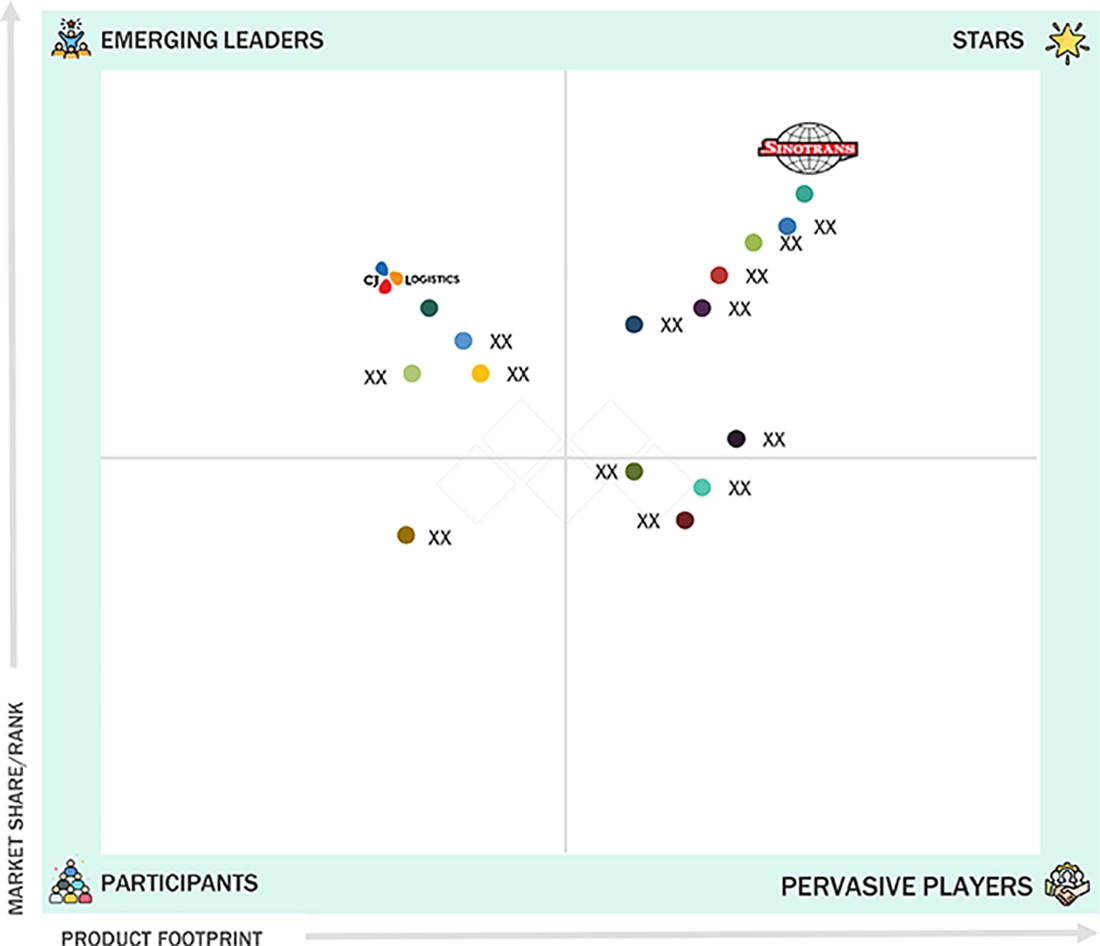
ASIA PACIFIC MULTIMODAL TRANSPORT MARKET: COMPANY EVALUATION MATRIX
In the Asia Pacific multimodal transport market matrix, Sinotrans (Star) leads with its extensive global network, integrated freight forwarding and warehousing capabilities, and strong multimodal orchestration across rail, road, and sea routes, driving large-scale adoption for end-to-end logistics and cross-border flow optimization. GEODIS (Emerging Leader) is gaining momentum through accelerated expansion in contract logistics, enhanced visibility platforms, and growing multimodal service offerings, demonstrating strong potential to advance toward the Leaders' Quadrant.
Source: Secondary Research, Interviews with Experts, MarketsandMarkets Analysis
KEY MARKET PLAYERS
- Sinotrans Ltd. (China)
- Nippon Express Co., Ltd. (Japan)
- Kerry Logistics Network Limited (Hong Kong)
- NIPPON EXPRESS HOLDINGS (Japan)
- CJ Logistics (South Korea)
- Marubeni Corporation (Japan)
- SF Express (China)
- Yamato holdings Co., Ltd. (Japan)
- SITC International Holdings Co., Ltd. (Hong Kong)
- Blue Dart Express Limited (India)
- JWD InfoLogistics Public Company Limited (Thailand)
MARKET SCOPE
| REPORT METRIC | DETAILS |
|---|---|
| Market Size in 2024 (Value) | USD 39.24 BN |
| Market Forecast in 2032 (Value) | USD 66.19 BN |
| Growth Rate | CAGR of 7.2% from 2025–2032 |
| Years Considered | 2021–2032 |
| Base Year | 2024 |
| Forecast Period | 2025–2032 |
| Units Considered | Value (USD MN/BN), Volume (BN Ton-km) |
| Report Coverage | Revenue forecast, company ranking, competitive landscape, growth factors, and trends |
| Segments Covered |
|
| Countries Covered | China, India, Japan, South Korea, Others |
WHAT IS IN IT FOR YOU: ASIA PACIFIC MULTIMODAL TRANSPORT MARKET REPORT CONTENT GUIDE
DELIVERED CUSTOMIZATIONS
We have successfully delivered the following deep-dive customizations:
| CLIENT REQUEST | CUSTOMIZATION DELIVERED | VALUE ADDS |
|---|---|---|
| Multimodal Transport Operator | • Go-to-market assessment for new players • Global competitor benchmarking | • Informed launch strategy • Prioritized partnerships for various players |
| Shipper | • Mode-mix feasibility assessment for China–Europe and intra-Asia flows | • Reduced transport spends with stable service levels • Better planning accuracy and risk-reduced supply chain |
| 3PL / 4PL Logistics Provider | • Value-added services benchmarking (consolidation, returns, e-documentation) • Digital capability gap assessment for visibility and control-tower integration | • Strengthened differentiation in customer bids • Faster onboarding of multimodal clients |
| Multimodal Transport Operator | • Digital readiness assessment for visibility, e-documentation, and control-tower integration • Adoption roadmap for phased multimodal digitalization | • Faster exception handling and reduced manual workload |
RECENT DEVELOPMENTS
- March 2025 : Sinotrans partnered with Alibaba to integrate multimodal services for cross-border e-commerce, combining sea-rail for Belt and Road routes to Central Asia, reducing transit times by 15%.
- June 2025 : NIPPON EXPRESS HOLDINGS announced a joint venture with CJ Logistics for ASEAN multimodal hubs, focusing on air-rail-sea for electronics exports from Japan to Vietnam and Thailand.
- March 2025 : Kerry Logistics Network Limited acquired a majority stake in French forwarder Business By Air SAS to enhance Europe-Asia multimodal links via air-sea.
Table of Contents
 Exclusive indicates content/data unique to MarketsandMarkets and not available with any competitors.
Methodology
The research study extensively utilizes secondary sources, including company annual reports/presentations, industry association publications, magazine articles, directories, technical handbooks, the World Economic Outlook, trade websites, technical articles, and databases, to identify and collect information on the Asia Pacific Multimodal Transport Market. In-depth interviews have been conducted with various primary sources, experts from related industries, multimodal operators, and service providers, to obtain and verify critical information, as well as assess the growth prospects and market estimations.
Secondary Research
Secondary sources for this research study include corporate filings, such as annual reports, investor presentations, and financial statements; trade, business, and professional associations; whitepapers and trade-related journals; certified publications; articles by recognized authors; directories; and databases. Secondary data have been collected and analyzed to determine the overall market size, which has been further validated by primary research.
Primary Research
Extensive primary research has been conducted following the development of a comprehensive understanding of the Asia Pacific Multimodal Transport Market through secondary research. Multiple interviews have been held with stakeholders from both the demand and supply sides. Demand-side participants include manufacturers, retail and e-commerce logistics teams, and global shippers responsible for planning inbound and outbound distribution. Supply-side respondents comprise freight forwarders, integrated logistics providers, port and terminal operators, rail and inland transport companies, and industry associations involved in corridor development and policy. Approximately one-third of interviews have represented the demand side, while the remaining share has come from service providers and infrastructure operators. Primary insights have been collected through structured questionnaires, virtual discussions, and email interactions with experts in network planning, procurement, digital transformation, and operations, capturing their perspectives on service requirements, capacity constraints, technology adoption, and future investment priorities.
Following these interviews, brief validation sessions have been conducted with independent logistics consultants, and the findings have been further reviewed by in-house subject matter specialists to ensure accuracy and alignment with industry developments.
Market Size Estimation
As outlined below, a comprehensive market estimation methodology has been applied to assess and validate the volume and value of the Asia Pacific Multimodal Transport Market, as well as its associated subsegments.
- Mapped country-level freight transport volumes (in billion ton-kilometers) using data from national transport authorities, logistics associations, paid databases, and global sources such as the World Bank, UNCTAD, and OECD
- Calculated multimodal freight penetration for each country and region based on mapped freight movement and modal usage patterns
- Developed multimodal freight forecasts using macroeconomic indicators, international trade growth, infrastructure investments, logistics performance indices, and government initiatives supporting intermodal connectivity and sustainable transport
- Derived market segments by mapping across transport modes (road, rail, sea, air) and evaluating freight volumes, network connectivity, infrastructure capacity, and integration efficiency for each country/region
- Refined segment estimates using insights from primary interviews with logistics providers, infrastructure operators, and industry experts
- Aggregated country-level freight volumes to determine total regional multimodal transport volumes
- Converted volumes to market value by multiplying average freight rates (USD per ton or TEU) for each mode with corresponding multimodal freight volumes at the country level
- Summed regional and service type values to derive the final market size for the Asia Pacific Multimodal Transport Market
Data Triangulation
After determining the overall market size using the outlined methodology, the Asia Pacific Multimodal Transport Market has been further segmented across configuration types, end-use industries, and regions. A data triangulation process has been applied to validate these breakdowns and ensure accuracy in the final market figures. This involved cross-verifying extrapolated estimates through multiple lenses, including regional trade flows, infrastructure capacity, policy developments, and service adoption trends, utilizing inputs from both demand-side stakeholders (shippers and manufacturers) and supply-side participants (logistics providers and corridor operators). By reconciling insights from secondary datasets, primary interviews, and macro-economic indicators, the final values for each segment and subsegment have been refined to reflect a consistent and reliable market assessment./p>
Market Definition
Multimodal Transport Market refers to the integrated movement of freight using two or more modes of transportation, such as road, rail, air, or inland waterways, under a single contract or operator with standardized units, such as containers (20ft or 40ft), to ensure seamless handoffs. Multimodal transport enables efficient transit across multiple transport systems, reducing handling time, transit delays, and overall logistics costs. Multimodal transport leverages the strengths of each mode, combining flexibility, cost efficiency, and environmental benefits to optimize end-to-end supply chain operations. This approach is increasingly adopted in global trade, urban mobility, and logistics networks, supported by growing infrastructure investments, digital tracking systems, and sustainable transportation initiatives. Rail manages the longest leg in multimodal freight transport, accounting for the bulk of freight volume.
Key Stakeholders
- Government & Regulatory Bodies
- Infrastructure Developers & Operators
- Logistics & Transport Service Providers
- Technology & Solution Providers
- Financial & Investment Institutions
- Trade Associations & Multilateral Organizations
- End-use Industries
Report Objectives
- To analyze and forecast the Asia Pacific Multimodal Transport Market in terms of volume (billion-ton-km) and value (USD billion) from 2025 to 2032
-
To segment and forecast the Asia Pacific Multimodal Transport Market size in terms of volume and value based on the following:
- By configuration type (two-mode, three-mode, hybrid/others)
- By end-use industry (retail, food & beverages, chemicals & materials, pharmaceuticals & healthcare, manufacturing, oil & gas, and other end-use industries)
- By country (China, India, Japan, South Korea and Others)
- To understand the dynamics (drivers, restraints, opportunities, and challenges) of the market
- To analyze the evaluation matrix of leading players operating in the market
- To strategically analyze the key player strategies and company revenue analysis of key players in the market from 2021 to 2025
-
To study the following aspects of the report
- Trends/Disruptions Impacting Asia Pacific Multimodal Transport Market
- Market Ecosystem
- Technology Analysis
- Patent Analysis
- Regulatory Landscape
- Case Study Analysis
- Key Stakeholders and Buying Criteria
- Key Conferences and Events
- Pricing Analysis
- Macroeconomic Outlook
- Company Valuation and Financial Metrics
- Brand and Product Comparison
- To strategically profile the key players and comprehensively analyze their market share and core competencies
- To track and analyze competitive developments such as deals (joint ventures, mergers & acquisitions, partnerships, collaborations), product developments and launches, and other activities undertaken by the key industry participants
Available Customizations:
With the given market data, MarketsandMarkets offers customizations in accordance with the company's specific needs.
- Additional Company Profiles (Up to 5)
- Asia Pacific Multimodal Transport Market, By Container Freight, At Regional Level


Personalize This Research
- Triangulate with your Own Data
- Get Data as per your Format and Definition
- Gain a Deeper Dive on a Specific Application, Geography, Customer or Competitor
- Any level of Personalization
Let Us Help You
- What are the Known and Unknown Adjacencies Impacting the Asia Pacific Multimodal Transport Market
- What will your New Revenue Sources be?
- Who will be your Top Customer; what will make them switch?
- Defend your Market Share or Win Competitors
- Get a Scorecard for Target Partners

Custom Market Research Services
We Will Customise The Research For You, In Case The Report Listed Above Does Not Meet With Your Requirements
Get 10% Free CustomisationTESTIMONIALS

JIM NAAS
PRODUCT DIRECTOR, WEASLER
Weasler Engineering, a CentroMotion organization
Global Provider of Industrial Actuation & Control Solutionswww.weasler.com
Our organization was interested in learning more about the attractiveness of a particular market space. We contacted MarketsandMarkets to help us based on previous positive experiences we had with them. The results did not disappoint! We discussed our objectives with them, and the team at MarketsandMarkets developed and executed a proposal that met our needs precisely. We were very impressed by their level of expertise, the quality of the analysis and their insightful recommendations. We would not hesitate in working with them again in the future.

Matt Kardel,
Vice President
Aptiv,
A global technology company that develops safer, greener and more connected solutions.www.aptiv.com
We contracted with
MarketsandMarkets to evaluate the value chain and potential go-to-market partners related to our
interest in the Fleet Management space. The team successfully completed the work on time and at the
pricing agreed. MarketsandMarkets listened and understood our objectives and collaborated well with
us to help us get the visibility we needed to make an investment.
We have subsequently used
MarketsandMarkets again related to Smart Cities to good results.






Growth opportunities and latent adjacency in Asia Pacific Multimodal Transport Market