Automotive Aramid Fiber Market

Automotive Aramid Fiber Market By Type (Para-Aramid, Meta-Aramid), Application (Brake Pads & Clutch Facings, Reinforced Tires, Hoses, Belts, & Gaskets, Racing Vehicle Components, Heat Shields & Insulation), and Region - Global Forecast to 2030




OVERVIEW
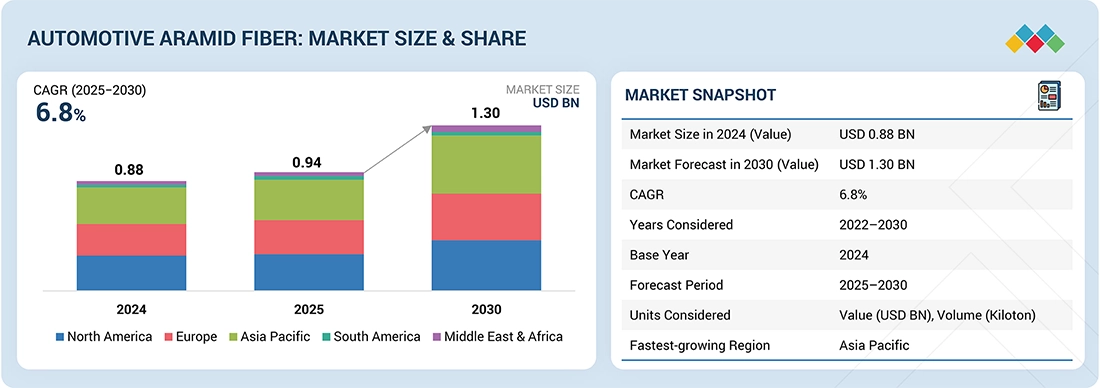
Source: Secondary Research, Interviews with Experts, MarketsandMarkets Analysis
The automotive aramid fiber market is predicted to reach USD 1.30 billion by 2030 from USD 0.94 billion in 2025, registering a CAGR of 6.8% during the forecast period. The automotive aramid fiber market is booming due to increasing demands from electric vehicles, high-performance safety systems, and lightweight structural components. Countries are investing substantial amounts of money into electric vehicle infrastructure and green mobility policies, significantly increasing the demand for thermal resistance and electrical insulation solutions, particularly in battery systems. The trends toward electrification and sustainability, along with the impact of advanced manufacturing, position the automotive aramid fiber market for significant growth as the automotive industry evolves to the next generation of mobility platforms. In April 2023, DuPont introduced their brand, Kevlar EXO, a revolutionary para-aramid fiber and its biggest innovation in over 50 years. Offering superior ballistic protection, lighter weight, enhanced flexibility and durability, Kevlar EXO is optimized for soft body armor used by military, law enforcement and emergency responders. Leading the shift to advanced automotive materials are premier aramid fiber brands such as Kevlar (DuPont), Twaron and Technora (Teijin), HERACRON (Kolon Industries), and ARAWIN (Toray). These trusted names are increasingly specified by global OEMs and Tier 1 suppliers renowned for their outstanding mechanical strength and thermal stability driving innovation in lightweight structural parts, battery thermal management, and enhanced vehicle safety systems.
KEY TAKEAWAYS
-
By RegionAsia Pacific dominated the automotive aramid fiber market, with 33.4% in 2024.
-
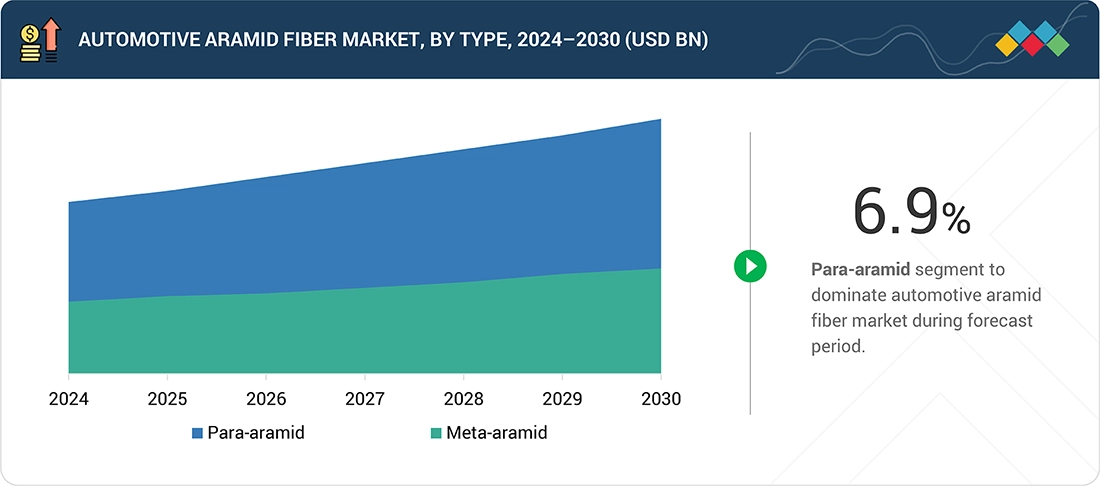
By TypeBy type, para-aramid is projected to be the fastest-growing segment in the automotive aramid fiber market, at a rate of 6.9% from 2025 to 2030.
-
By ApplicationBy application, brake pads & clutch facings are the largest segment, accounting for 27.3% in 2024.
-
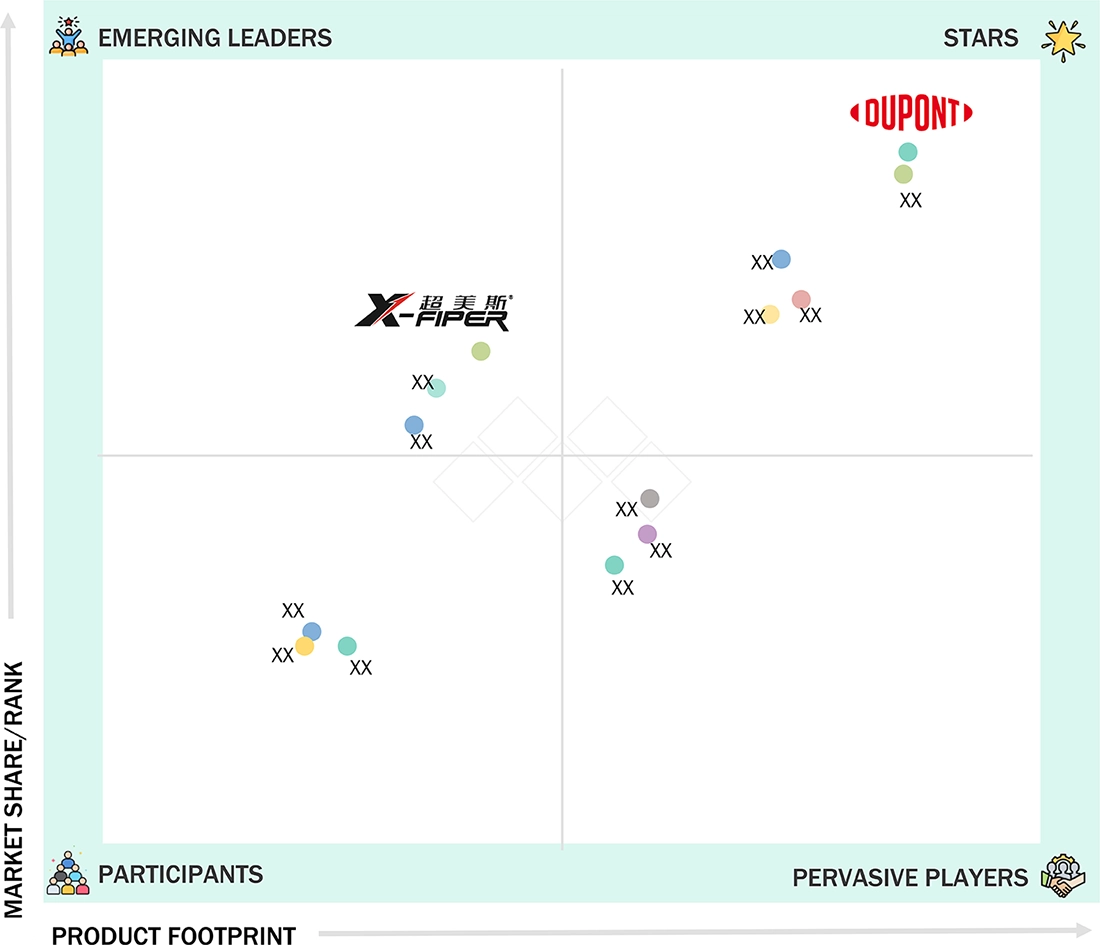
Competitive Landscape - Key PlayersDuPont, TEIJIN LIMITED, Kolon Industries, Inc., and Yantai Tayho Advanced Materials Co., Ltd., were identified as the star players in the automotive aramid fiber market (global), due to their strong market share and product footprint.
-
Competitive Landscape - StartupsAramid HPM, LLC, Shanghai J&S New Materials Co., Ltd, and YF International bv, among others, have distinguished themselves among startups and SMEs by securing strong footholds in specialized niche areas.
The automotive aramid fiber market is growing rapidly due to rising demand for lightweight, durable, and heat-resistant materials in vehicle manufacturing. Para-aramid and meta-aramid fibers are increasingly used in brake pads, tires, hoses, insulation, and composites for their strength and thermal stability. With the shift toward electric and efficient vehicles, aramid fibers help meet stringent safety and emission standards. Their use in lightweight and high-performance components supports improved fuel efficiency, sustainability, and overall vehicle reliability.
TRENDS & DISRUPTIONS IMPACTING CUSTOMERS' CUSTOMERS
The influence on consumers' business stems from evolving customer trends and disruptions. In the automotive aramid fiber market, clients such as Toyota Motor Corporation, Ford Motor Company, and General Motors prioritize superior material strength, durability, and efficiency. Their key imperatives include lightweight design, thermal stability, and electrification, aligning with their clients' demands for enhanced vehicle safety, reduced emissions, and reliable performance. This underscores the critical role of aramid fibers in fostering innovation, operational reliability, and sustainability within the automotive sector.
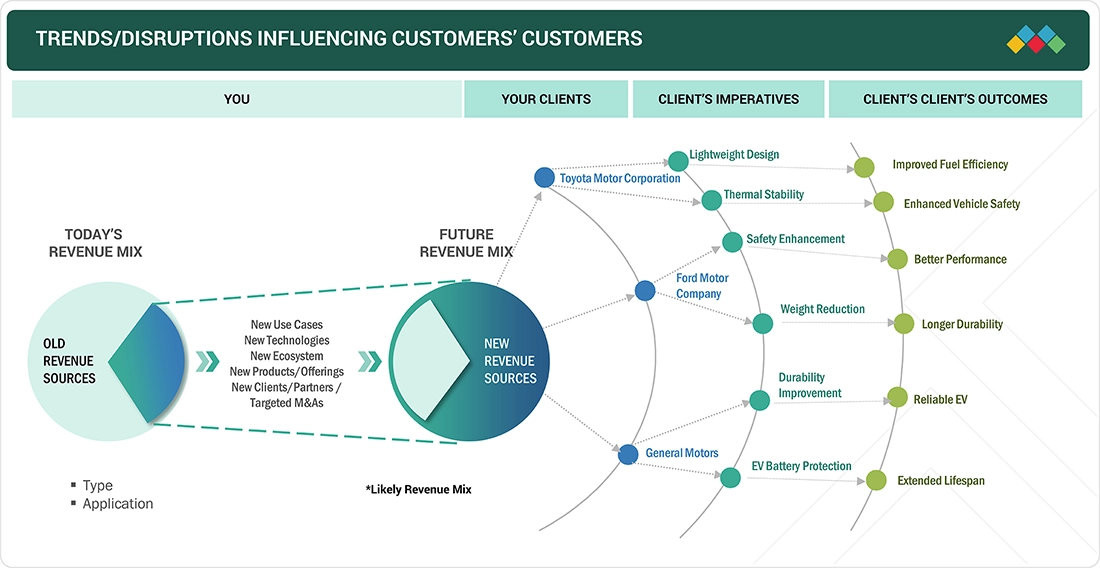
Source: Secondary Research, Interviews with Experts, MarketsandMarkets Analysis
MARKET DYNAMICS

Level
-
Rising need for lightweight materials enabling significant emission reductions in vehicles

-
Rapid expansion of electric vehicles


Level
-
High production cost

-
Processing and machining complexities


Level
-
Research and development in bio-based and recyclable aramid fibers

-
Stringent safety and emission regulations


Level
-
Supply chain disruptions

-
Worker safety concerns

Source: Secondary Research, Interviews with Experts, MarketsandMarkets Analysis
Driver: Rising need for lightweight materials enabling significant emission reductions in vehicles
The growing demand for lightweight materials to curb vehicle emissions is driving the expansion of the automotive aramid fiber market. With the global automotive industry under increasing pressure to comply with stricter emission regulations and climate targets, vehicle weight reduction has become essential for improving fuel efficiency and cutting CO2 emissions. The International Energy Agency reported that energy-related CO2 emissions hit a record 37.8 Gt in 2024, with the transport sector contributing around 36-37%, and road transport alone producing 3.8 Gt in 2023. Lightweighting offers tangible benefits; the US Department of Energy notes that a 10% weight reduction can enhance fuel economy by 6-8%. Para-aramid fibers, 40-50% lighter than steel yet highly strong, are increasingly used in automotive crash structures, brake parts, underbody shields, and composite panels, particularly in EVs, boosting energy efficiency and battery performance. Key automotive aramid fiber brands include Kevlar (DuPont), Twaron and Technora (Teijin), Heracron (Kolon Industries), Tametar and NEWSTAR (Yantai Tayho). Although relatively costly, these fiber brands are increasingly used to improve vehicle performance, efficiency, and safety, particularly in electric and hybrid vehicles that demand lightweight materials.
Restraint: High production cost
High production costs remain a major restraint for the automotive aramid fiber market, driven by complex, resource-intensive manufacturing processes and the use of costly aromatic polyamides. Producing para-aramid and meta-aramid fibers requires specialized equipment, precise conditions, and adherence to strict environmental standards, all of which raise production expenses. As a result, aramid fibers are considerably more expensive than conventional materials like steel or nylon. This cost barrier limits their adoption mainly to high-performance and premium vehicles, while mass-market automakers, particularly in cost-sensitive regions, avoid their use. Additionally, the small number of large-scale producers creates supply constraints and price pressures, further restricting widespread application in the automotive sector.
Opportunity: Research and development in bio-based and recyclable aramid fibers
Research and development in bio-based and recyclable aramid fibers offer a major growth opportunity for the automotive aramid fiber market amid rising sustainability demands and stricter environmental regulations. Conventional aramid fibers, though strong and heat-resistant, are petroleum-based and difficult to recycle, creating environmental challenges. Bio-based alternatives made from renewable sources can reduce carbon footprints while maintaining performance standards. Recyclable aramid fibers further support circular economy goals by enabling reuse and material recovery, lowering waste and long-term costs. For automakers, adopting these sustainable materials enhances brand value, regulatory compliance, and alignment with green manufacturing trends—particularly in Europe and North America, where eco-friendly innovations and closed-loop production are increasingly prioritized.
Challenge: Supply chain disruptions
The automotive aramid fiber market faces notable challenges from supply chain disruptions, largely due to the specialized and complex nature of aramid fiber production. These fibers are made from advanced synthetic polymers, such as poly-para-phenylene terephthalamide, which depend on specific chemical precursors and sophisticated processing technologies. Since these raw materials are sourced from a limited number of global suppliers, the supply chain is highly sensitive to geopolitical tensions, trade restrictions, and shortages. Any interruption in the supply of these critical inputs can delay production, extend lead times, and increase manufacturing costs, posing risks to market growth and operational efficiency.
automotive-aramid-fiber-market: COMMERCIAL USE CASES ACROSS INDUSTRIES
| COMPANY | USE CASE DESCRIPTION | BENEFITS |
|---|---|---|
 |
Creates Kevlar aramid fibers for automotive batteries, hoses, belts, tires, and brakes, boosting safety and performance | Strong, lightweight, durable, improves safety and handling |
 |
Produces Twaron aramid fibers for tires, hoses, and belts, reinforcing rubber and reducing tire weight for efficiency | Durable, heat-resistant, stable, enhances grip and wear |
 |
Makes Heracron aramid fibers for hoses, belts, tire cords, brake pads, linings, clutches, and gaskets in high-performance vehicles | Strong, heat-resistant, quiet, boosts braking and longevity |
 |
Supplies Taparan para-aramid and Newstar meta-aramid fibers for tires, hoses, brake pads, clutches, and shock absorbers | Heat-resistant, strong, durable, excels in high temperatures |
Logos and trademarks shown above are the property of their respective owners. Their use here is for informational and illustrative purposes only.
MARKET ECOSYSTEM
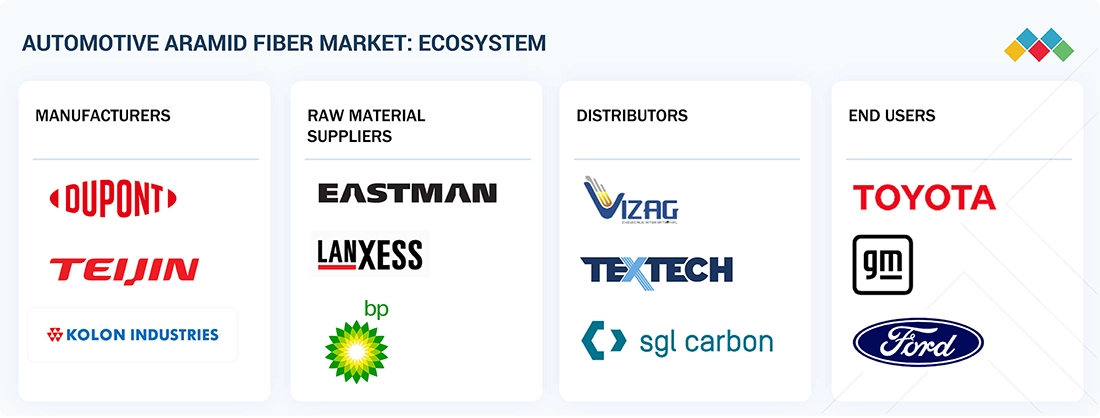
The automotive aramid fiber market ecosystem consists of raw material suppliers (Eastman Chemical Company, British Petroleum, LANXESS AG), manufacturers (DuPont, TEIJIN LIMITED, Kolon Industries, Inc.), distributors (Vizag Chemicals, SGL Carbon, Tex Tech Industries) and end users (Toyota Motor Corporation, Ford Motor Company, General Motors). Raw material suppliers provide high-performance polymer precursors and intermediates essential for aramid synthesis. Manufacturers convert these into high-strength fibers and composites through polymerization, spinning, and finishing processes. Distributors facilitate global reach by offering customized forms such as fabrics, yarns, and prepregs. End users integrate aramid fibers into brake pads, belts, body armor, and lightweight structural components.
Logos and trademarks shown above are the property of their respective owners. Their use here is for informational and illustrative purposes only.
MARKET SEGMENTS
Source: Secondary Research, Interviews with Experts, MarketsandMarkets Analysis
Automotive Aramid Fiber Market, By Type
Para-aramid fiber is expected to be the fastest-growing segment of the automotive aramid fiber industry due to its mechanical advantages over other fibers and its recent use in various critical vehicle systems. Para-aramids boast the highest tensile strength-to-weight ratio, outstanding heat resistance, and excellent dimensional stability. These remarkable properties make para-aramids appealing for performance applications, including brake linings, clutch linings, belts, gaskets, and reinforcement materials for tires and other composite materials. Some major para-aramid fiber brands for automotive applications are Kevlar (DuPont), Twaron & Technora (Teijin), HERACRON (Kolon Industries), Mictron (Toray), and TAPARAN (Yantai Tayho Advanced Materials Co., Ltd.).
Automotive Aramid Fiber Market, By Application
Brake pads and clutch facings dominate the automotive aramid fiber market due to their high demand for superior heat resistance, friction stability, and durability under extreme conditions. Aramid fibers, especially para-aramid, provide excellent wear resistance, thermal stability, and mechanical strength, ensuring reliable performance, longer component life, and enhanced safety in braking and transmission systems.
REGION
Asia Pacific to be fastest-growing region in global automotive aramid fiber market during forecast period
The automotive aramid fiber market is projected to experience the highest demand and growth in Asia Pacific, driven by rapid industrialization and new automotive production increases, particularly in China, India, Japan, and Southeast Asia. Accelerating this market's radical growth are government initiatives supporting the development of lightweight vehicles and stricter emissions regulations that are heightening the need for advanced materials, including aramid fibers, to meet fuel economy requirements. This trend is supported by national initiatives like China’s “Made in China 2025” and India’s “Automotive Mission,” which emphasize regional materials innovation and focus on electrifying automobiles. These initiatives encourage local manufacturers to adopt aramid fiber composites in structural components, battery protection, and insulation systems.

automotive-aramid-fiber-market: COMPANY EVALUATION MATRIX
DuPont is the star player in the automotive aramid fiber market due to its pioneering innovations, strong global presence, and flagship Kevlar brand known for unmatched heat resistance, strength, and reliability. Its extensive R&D and partnerships with major OEMs reinforce its leadership. X-FIPER NEW MATERIAL CO., LTD is an emerging leader, rapidly expanding with cost-effective aramid solutions, localized production, and increasing adoption across Asia’s growing automotive manufacturing base.
Source: Secondary Research, Interviews with Experts, MarketsandMarkets Analysis
KEY MARKET PLAYERS
- DuPont (US)
- TEIJIN LIMITED (Tokyo)
- Kolon Industries, Inc. (South Korea)
- HYOSUNG (South Korea)
- Yantai Tayho Advanced Materials Co., Ltd. (China)
- TORAY INDUSTRIES, INC. (Japan)
- X-FIPER NEW MATERIAL CO., LTD (China)
- Huvis Corp. (South Korea)
- China National Bluestar (Group) Co, Ltd. (China)
- AFChina (China)
MARKET SCOPE
| REPORT METRIC | DETAILS |
|---|---|
| Market Size in 2024 (Value) | USD 0.88 Billion |
| Market Forecast in 2030 (Value) | USD 1.30 Billion |
| Growth Rate | CAGR of 6.8% from 2025-2030 |
| Years Considered | 2022-2030 |
| Base Year | 2024 |
| Forecast Period | 2025-2030 |
| Units Considered | Value (USD Million/Billion), Volume (Kiloton) |
| Report Coverage | Revenue forecast, company ranking, competitive landscape, growth factors, and trends |
| Segments Covered |
|
| Regions Covered | North America, Asia Pacific, Europe, South America, Middle East & Africa |
WHAT IS IN IT FOR YOU: automotive-aramid-fiber-market REPORT CONTENT GUIDE

DELIVERED CUSTOMIZATIONS
We have successfully delivered the following deep-dive customizations:
| CLIENT REQUEST | CUSTOMIZATION DELIVERED | VALUE ADDS |
|---|---|---|
| Automotive Manufacturer | Supplier evaluation and capability assessment for aramid fibers in tire reinforcement and brake systems. | Identifying top suppliers based on performance, compliance, and cost optimization. |
| Material Manufacturer | Performance testing and technical comparisons of aramid fibers for hoses, belts, and clutch applications. | Highlighting value-added differentiation and supporting specifications for diverse end-use sectors. |
| Automotive Component Supplier | Analysis of aramid fiber properties for thermal, abrasion, and chemical resistance in harnesses and gaskets. | Enabling qualification for safety-critical uses and mapping advanced grades for targeted adoption. |
RECENT DEVELOPMENTS
- June 2024 : Kolon Industries formed a strategic partnership with a major Chinese automotive manufacturer to strengthen its position in the rapidly growing Chinese market for friction materials.
- March 2024 : DuPont launched a new Kevlar grade specifically designed for EV battery thermal barriers, enhancing its position in the growing electric vehicle market.
- September 2023 : Teijin expanded its Twaron production capacity by 25% at its Emmen plant in the Netherlands to increase supply for European automotive customers.
Table of Contents
 Exclusive indicates content/data unique to MarketsandMarkets and not available with any competitors.
Methodology
The study involved four major activities to estimate the current size of the global automotive aramid fiber market. Extensive secondary research was conducted to collect information on the market, the peer product market, and the parent product group market. The next step was to validate these findings, assumptions, and sizes with industry experts across the automotive aramid fiber value chain through primary research. Both the top-down and bottom-up approaches were employed to estimate the overall size of the automotive aramid fiber market. After that, market breakdown and data triangulation procedures were used to determine the size of different segments and sub-segments of the market.
Secondary Research
In the secondary research process, various secondary sources such as Hoovers, Factiva, Bloomberg BusinessWeek, and Dun & Bradstreet were referred to, to identify and collect information for this study on the automotive aramid fiber market. These secondary sources included annual reports, press releases & investor presentations of companies; white papers; certified publications; articles by recognized authors; regulatory bodies, trade directories, and databases.
Primary Research
The automotive aramid fiber market involves several stakeholders in the supply chain, including raw material suppliers, equipment suppliers, distributors, end-product manufacturers, buyers, and regulatory organizations. Various primary sources from both the supply and demand sides of the market have been interviewed to gather qualitative and quantitative information. Key participants from the demand side consist of opinion leaders, executives, vice presidents, and CEOs of companies in the automotive aramid fiber market. Sources from the supply side include associations and institutions related to the automotive aramid fiber market, opinion leaders, and processing players.
Market Size Estimation
The bottom-up and top-down approaches have been used to estimate the automotive aramid fiber market by fiber type, application type, vehicle type, and region. The research methodology used to calculate the market size includes the following steps:
- The key players in the industry and markets were identified through extensive secondary research.
- In terms of value, the industry’s supply chain and market size were determined through primary and secondary research processes.
- All percentage shares, splits, and breakdowns were determined using secondary sources and verified through primary sources.
- All possible parameters that affect the markets covered in this research study were accounted for, viewed in extensive detail, verified through primary research, and analyzed to obtain the final quantitative and qualitative data.
- The research included studying reports, reviews, and newsletters of top market players and extensive interviews with leaders, such as directors and marketing executives, to obtain opinions.
Automotive Aramid Fiber Market : Top-Down and Bottom-Up Approach
Data Triangulation
After arriving at the overall size of the automotive aramid fiber market from the estimation process explained above, the total market was split into several segments and sub-segments. The data triangulation and market breakdown procedures were employed, wherever applicable, to complete the overall market engineering process and arrive at the exact statistics for all segments and subsegments. The data was triangulated by studying various factors and trends from both the demand and supply sides. Along with this, the market size was validated using both the top-down and bottom-up approaches.
Market Definition
Automotive aramid fiber refers to a class of high-performance synthetic fibers used in various automotive applications due to their exceptional strength, heat resistance, and lightweight properties. Derived from aromatic polyamides, aramid fibers are primarily used in components such as brake pads, clutches, tires, belts, gaskets, and protective clothing. In the automotive industry, these fibers help enhance durability, improve fuel efficiency, and meet stringent safety and emission standards. Major automotive aramid fiber brands include Kevlar (DuPont), Twaron, Technora (Teijin), Heracron (Kolon Industries), Arawin (Toray), Tametar, NEWSTAR (Yantai Tayho), and X-Fiper (X-Fiper New Material).
Key Stakeholders
- Automotive Aramid Fiber Manufacturers
- Raw Material Suppliers
- Equipment suppliers
- Regulatory Bodies and Government Agencies
- Distributors and Suppliers
- End-Use Industries
- Associations and Industrial Bodies
Report Objectives
- To define, describe, and forecast the size of the automotive aramid fiber market in terms of value and volume.
- To provide detailed information regarding the key factors influencing the growth of the market (drivers, restraints, opportunities, and challenges).
- To forecast the market size based on fibre type, vehicle type, application, and region.
- To forecast the market size for the five main regions—North America, Europe, Asia Pacific (APAC), South America, and the Middle East & Africa (MEA), along with their key countries.
- To strategically analyze micro markets with respect to individual growth trends, prospects, and contributions to the total market.
- To analyze the opportunities in the market for stakeholders and provide details of the competitive landscape for the market leaders.
- To strategically profile leading players and comprehensively analyze their key developments, such as new product launches, expansions, and deals in the automotive aramid fiber market.
- To strategically profile key players and comprehensively analyze their market shares and core competencies.
- To study the impact of AI/Gen AI on the market under study, along with the macroeconomic outlook.
Available Customizations:
With the given market data, MarketsandMarkets offers customizations per the specific needs of companies.
The following customization options are available for the report:
Product Analysis
- Product matrix, which provides a detailed comparison of the market for different sources of automotive aramid fiber.
Regional Analysis
- Further breakdown of a country with respect to the automotive aramid fiber market.
Company Information
- Detailed analysis and profiling of additional market players
Key Questions Addressed by the Report
Which are the major companies in the automotive aramid fiber market?
Major companies in the automotive aramid fiber market are DuPont (US), Teijin Limited (Japan), Kolon Industries Inc. (South Korea), and Hyosung Corporation (South Korea), among others.
Which end users in the automotive aramid fiber market are likely to exhibit the highest CAGR during the forecast period?
Automotive component manufacturers are expected to witness the highest CAGR due to increasing demand for lightweight and high-strength materials.
Which applications in the automotive aramid fiber market are likely to drive growth over the coming years?
Tire reinforcement, brake pads, and composite automotive components are likely to drive market growth during the forecast period.
What are the drivers and opportunities for the automotive aramid fiber market?
Growing demand for lightweight vehicles, increasing focus on fuel efficiency, and rising adoption of advanced composite materials are the major drivers and opportunities of the automotive aramid fiber market.
What are the restraints and challenges for the players in the automotive aramid fiber market?
High production costs and limited availability of raw materials are the major challenges faced by market players.


Personalize This Research
- Triangulate with your Own Data
- Get Data as per your Format and Definition
- Gain a Deeper Dive on a Specific Application, Geography, Customer or Competitor
- Any level of Personalization
Let Us Help You
- What are the Known and Unknown Adjacencies Impacting the Automotive Aramid Fiber Market
- What will your New Revenue Sources be?
- Who will be your Top Customer; what will make them switch?
- Defend your Market Share or Win Competitors
- Get a Scorecard for Target Partners

Custom Market Research Services
We Will Customise The Research For You, In Case The Report Listed Above Does Not Meet With Your Requirements
Get 10% Free CustomisationTESTIMONIALS
We at Nissan Chemicals Corporation have been clients of MarketsandMarkets for more than a year now. We recently consulted MarketsandMarkets for a study, the team at MarketsandMarkets was extremely professional and organized. The business insights were very detailed and aligned well with our expectations that really helped us formulate the Business Plans and device new strategies for development themes. MarketsandMarkets offers a unique combination of expertise and dedicated engagement model. Their research findings have helped us in designing our Pricing Strategy which will make it easier for us to predict the future sales and profits for the next ten years. We look forward to working with MarketsandMarkets in the future.
VP of Strategy & New Business Development
Leading Specialty Chemical Company
The MarketsandMarkets Engagement Model, composed of both the Knowledge Store and advisory custom research, has greatly helped us in understanding our markets and making strategic decisions. The Knowledge Store is a fast way to allow everyone in our organization to understand more about most any market they are interested in. The ability to then get custom research done and get answers to specific strategic questions and market insight has been spectacular. The Markets and Markets team feel more like colleagues than vendors and their services have helped us change our culture where statements of things like growth opportunities and competitive position are always backed by industry research.

Rich Gibson,
Director, Corporate Strategy
Milliken & Company,
Leading Industrial Manufacturer of specialty chemical, floor covering, performance and protective textile materials, and healthcaremilliken.com
MarketsandMarkets is a trusted resource that helps us to better understand markets that are near-adjacencies-whether its technology, value chain or geography. Their Knowledge Store platform provides a dashboard of markets and their characteristics which is easy to use and saves us time.
Adam Shaw,
Market Development and Strategy Manager
AdvanSix Inc. USA,
An American Leader in Chemicalswww.advansix.com
The Knowledge Store from MarketsandMarkets is a valuable tool which has helped my team acquire greater insight in to the end markets that our business serves. This has enabled us to help our company build stronger strategies throughout our planning process.
TOSHIO KINOSHITA
Senior Chif Consultion Research & Consulting Division
Mitsubishi Chemical Research Corporation,
Leading Manufacturer of Chemical Productswww.mitsubishichem-res.co.jp/en/

We recently engaged with MarketsandMarkets for a study, the team not only clearly understood our business objectives but was also extremely professional in the way they handled the entire project. The study was efficiently conducted in a phase-wise manner, and the engagement model furnished us with high-quality business insights that far exceeded our expectations at each phase. We were especially happy that MarketsandMarkets could provide us with both, an English as well as a Japanese version of the study. A special thanks to the Analyst Team and Client Services Team, whose fluency in Japanese enhanced our comfort level, as we could converse with them in our preferred language.
Independent entrepreneurs
Arrow Precision
We approached MarketsandMarkets for study on Proppants Market, and their work exceeded our expectations. The study conducted was comprehensive and enabled us to view the market through the various dimensions. In addition, the team was extraordinarily responsive throughout the process and resolved our queries on time. I strongly recommend MarketsandMarkets and will certainly consider them for additional market assessments we will need in the future.
Global engineering company, Japan
Deputy Manager,
Strategic Planning OfficeThe high-quality insights shared by the MarketsandMarkets team helped us understand the pharmaceutical plant designers in a specific geography. It also captured the risks that we may likely face in communicating with our potential partners. The study would enable us identify partners, which would impact our future growth.






Growth opportunities and latent adjacency in Automotive Aramid Fiber Market