Automotive Dashcam Market

Automotive Dashcam Market by OE and Aftermarket Product Type (Front Dashcam, Front+Rear Dashcam, Front+Rear+In-cabin Dashcam), Technology (Basic, Advanced, Smart), Video Quality, EV Type, Distribution Channel, and Region – Global Forecast to 2033



OVERVIEW

Source: Secondary Research, Interviews with Experts, MarketsandMarkets Analysis
The Automotive Dashcam market is projected to grow from USD 4.40 billion in 2026 to USD 6.55 billion by 2033, at a CAGR of 5.8% during the forecast period.. The EV automotive dashcam market is projected to grow from USD 414.1 million in 2026 to USD 1,202.3 million by 2033, at a CAGR of 16.1%. The automotive dashcam market is expanding as rising concerns around vehicle security and theft prevention are increasing the adoption of drive recorders across passenger and commercial vehicles, while growing preference for high-resolution video capture and parking surveillance is strengthening the demand for advanced event recording systems. At the same time, the growth of e-commerce platforms is improving product accessibility, while the expansion of ride-hailing and fleet operations is accelerating the deployment of drive recorders for continuous monitoring and liability management. The market is also shifting toward connected dashcams with cloud storage and subscription models, supported by integration of AI-driven features such as driver monitoring and real-time alerts, enhancing the transition from basic recording devices to intelligent event recording systems.
Automotive Dashcam Market Size and Forecast:
- Market Size Value in 2025: USD 4.18 Billion
- Market Size Value in 2026: USD 4.40 Billion
- Revenue Forecast in 2033: USD 6.55 Billion
- Growth Rate: CAGR of 5.8% from 2026 to 2032
- Data available from 2022 to 2033
- Base year: 2025
- Forecast period: 2026–2033
- Largest Growing Region: Asia Pacific
- Units Considered: Value (USD Billion), Volume (Units)
Key Automotive Dashcam Market Trends and Insights
- Automotive Dashcam Market Growth: Growth is driven by increasing concerns regarding road safety, rising vehicle ownership, growing insurance adoption, and increasing demand for video-based evidence in accident investigations.
-
Connected Technology Impact: Modern dashcams leverage AI, cloud connectivity, GPS tracking, ADAS features, and real-time video monitoring to enhance driving safety and fleet management capabilities.
- Growing Trends: The Automotive Dashcam market is witnessing increased adoption of 4K dashcams, dual-channel recording systems, AI-powered driver monitoring, cloud-enabled storage solutions, and integrated ADAS functionalities.
- Growth Opportunities: Opportunities are driven by expanding connected vehicle ecosystems, rising commercial fleet digitization, increasing demand for insurance telematics, and advancements in AI-powered video analytics technologies.
KEY TAKEAWAYS
-
MARKET SNAPSHOT:
Market Size (2025): USD 4.18 Billion
Current Market Size (2026): USD 4.40 Billion
Projected Market Size (2033): USD 6.55 Billion
CAGR (2026–2033): 5.8% -
SEGMENT LEADERSHIP:
-
By RegionBy region, Asia Pacific is projected to lead the automotive dashcam market during the forecast period. It is projected to grow from USD 2.29 billion in 2026 to USD 3.51 billion in 2033 at a CAGR of 6.3%.
-
By OE Product TypeBy OE product type, the OE front+rear dashcam segment is projected to lead the market during the forecast period. This segment is projected to grow from USD 282.3 million in 2026 to USD 452.8 million in 2033 at a CAGR of 7.0%.
-
By Product Type AftermarketBy product type aftermarket, the front+rear + in-cabin segment is projected to be the fastest-growing from 2026 to 2033, at a CAGR of 8.8%.
-
By OE TechnologyBy OE technology, the advanced dashcam segment is projected to lead the market during the forecast period. This segment is projected to grow from USD 159.1 million in 2026 to USD 235.5 million in 2033 at a CAGR of 5.8%.
-
By Technology AftermarketBy technology aftermarket, the aftermarket smart dashcam segment is projected to be the fastest-growing from 2026 to 2033, at a CAGR of 6.9%.
-
By OE Video QualityBy OE video quality, the high-definition dashcam segment is projected to lead the market during the forecast period. This segment is projected to grow from USD 157.7 million in 2026 to USD 235.8 million in 2033 at a CAGR of 5.9%.
-
By Video Quality AftermarketBy video quality aftermarket, the full HD & 4k segment is projected to be the fastest-growing from 2026 to 2033, at a CAGR of 7.4%.
-
By OE Vehicle TypeBy OE vehicle type, the passenger car segment is projected to be the fastest-growing from 2026 to 2033, at a CAGR of 6.8%.
-
By Vehicle Type AftermarketBy vehicle type aftermarket, the aftermarket passenger segment is projected to lead the market during the forecast period. This segment is projected to grow from USD 3.97 million in 2026 to USD 5.86 million in 2033 at a CAGR of 5.7%.
-
By Distribution ChannelBy distribution channel, the aftermarket segment is projected to grow from USD 4.07 billion in 2026 to USD 6.03 billion in 2033 at a CAGR of 5.8%.
-
By OE EV TypeBy OE EV type, the OE BEV segment is projected to be the largest and fastest-growing from 2026 to 2033, at a CAGR of 11.9%.
-
By EV Type AftermarketBy EV type aftermarket, the BEV aftermarket segment is projected to lead the market during the forecast period. This segment is projected to grow from USD 135.4 million in 2026 to USD 472.4 million in 2033 at a CAGR of 19.5%.
-
MARKET OUTLOOK & COMPETITIVE LANDSCAPE:
-
Competitive Landscape - Key PlayersThe automotive dashcam Market is dominated by global players, such as Robert Bosch GmbH (Germany), Denso (Japan), Magna International (Canada), Valeo (France), and Garmin (US).
-
Competitive Landscape - Startups/SMEsThinkware Corporation (South Korea), Pittasoft Co. Ltd (South Korea), 70mai Co. Ltd (China), and Ficosa (Spain) are the leading progressive companies in the automotive dashcam market.
The automotive dashcam market is gaining traction due to increasing integration of drive recorders within vehicle electronics and camera-based safety systems, particularly as automakers expand the use of front cameras and surround-view systems that can support event-recording functions. Rising consumer preference for high-clarity video capture, including full HD and 4K resolution, is improving the adoption of advanced event recorders across both OE and aftermarket channels. In parallel, growing concerns around vehicle theft, vandalism, and parking incidents are driving the demand for continuous and parking mode recording capabilities. Advancements in storage efficiency, supercapacitor-based power systems, and seamless mobile connectivity are further enhancing reliability and ease of use, supporting the transition toward more sophisticated and dependable drive recorder solutions across vehicle segments.
TRENDS & DISRUPTIONS IMPACTING CUSTOMERS' CUSTOMERS
The automotive dashcam market is transitioning from basic recording devices to intelligent, connected safety systems with cloud backup. Currently, revenues are largely driven by front dashcam and front+rear dashcam with standard HD recording and cloud storage. However, growth is expected to come from multi-channel, high-resolution systems integrated with AI, cloud connectivity, and telematics platforms. OEMs are gradually integrating dashcams into premium and mid-segment vehicles, focusing on enhanced safety, compliance, and seamless vehicle integration. At the same time, the aftermarket continues to dominate, driven by accident disputes and insurance fraud, as fleet operators, ride-hailing platforms, and logistics companies adopt dashcams for operational visibility and risk management. This dual channel growth is enabling manufacturers to diversify offerings across price points and customer segments, while also building recurring revenue streams through software and data services. Dashcam manufacturers are prioritizing improvements in video quality, especially in low-light conditions, along with reliable continuous recording and secure data handling. For fleet and telematics players, the focus is on real-time insights, seamless integration with existing systems, scalability, and minimizing the total cost of ownership.

Source: Secondary Research, Interviews with Experts, MarketsandMarkets Analysis
MARKET DYNAMICS

Level
-
Increasing demand for usage-based insurance and accident dispute resolution through video evidence

-
Expansion of ride-hailing and fleet operations


Level
-
Privacy regulations such as GDPR

-
Protection regulation limiting usage in major automotive markets


Level
-
Shift toward connected dashcams with cloud storage and subscription models

-
Integration of AI features such as driver monitoring


Level
-
Hardware commoditization leading to margin pressure

-
Ensuring cybersecurity and data protection

Source: Secondary Research, Interviews with Experts, MarketsandMarkets Analysis
Driver: Increasing demand for usage-based and accident disputes driving need for video evidence
Rising instances of insurance fraud, staged accidents, and disputed liability cases are strengthening the role of dashcams as a reliable source of objective evidence. In many markets, both individual consumers and fleet operators are increasingly adopting dashcams to safeguard against false claims and reduce financial exposure. Video footage helps establish fault more clearly, improving claim transparency and supporting faster resolution. Further, the evolution of usage-based insurance with a recording function is reinforcing adoption. Insurers are increasingly leveraging driving data, and in some cases video inputs, to assess risk profiles, incentivize safer driving, and enable more accurate premium pricing. Dashcams, especially when integrated with telematics, support this shift by providing contextual insights beyond traditional data points, positioning them as an enabling device within next-generation insurance frameworks.
Restraint: Privacy regulations such as GDPR
Strict privacy and data protection regulations, particularly in Europe, impose clear limitations on how dashcams can record, store, and share video footage. Requirements around consent, purpose limitation, and restrictions on capturing identifiable individuals or public spaces create uncertainty for users, often discouraging continuous recording. In several countries, improper usage can lead to legal penalties, which further restricts widespread adoption in the aftermarket. For manufacturers and sellers, these regulations increase complexity in product design and go-to-market strategy, requiring features such as data masking, limited recording modes, or user-controlled activation. This reduces feature standardization across regions and slows adoption compared to more permissive markets such as North America and Asia, where regulatory barriers are relatively low.
Opportunity: Shift toward connected dashcams with cloud storage and subscription models
The aftermarket dashcam market is moving from standalone recording devices toward connected solutions that offer cloud storage, remote access, and real-time alerts. This shift enhances user convenience by enabling instant access to footage, backup storage, and features such as live streaming and emergency notifications. As connectivity becomes a standard expectation, dashcams are increasingly positioned as part of the broader connected vehicle ecosystem. This transition also enables players to move beyond one-time hardware sales to recurring revenue models through subscriptions for cloud storage, AI features, and premium services. For fleet operators, connected dashcams provide centralized monitoring and data management, while for consumers, they offer added security and ease of use. This creates a clear pathway for value migration from hardware to software and services, improving long-term monetization potential.
Challenge: Ensuring cybersecurity and data protection
As dashcams are coming up with connected features, with cloud storage, app integration, and remote access, they are becoming a part of the broader IoT ecosystem, increasing exposure to cybersecurity risks. These include unauthorized access, data breaches, and potential misuse of recorded footage, particularly in fleet and enterprise deployments where sensitive data is involved. Any security lapse can directly impact user trust and brand credibility. At the same time, ensuring secure data transmission, storage, and access requires continuous investment in encryption, firmware updates, and compliance with data protection standards. This adds to product complexity and cost, especially for aftermarket players operating on thin margins. As connected features become standard, cybersecurity is no longer optional but a critical requirement for sustained adoption and regulatory compliance.
AUTOMOTIVE DASHCAM MARKET: COMMERCIAL USE CASES ACROSS INDUSTRIES
| COMPANY | USE CASE DESCRIPTION | BENEFITS |
|---|---|---|
 |
Integration of dashcam functionality with ADAS systems for enhanced situational awareness and safety validation | Bosch camera systems record critical driving scenarios to support ADAS validation and post incident analysis |
 |
Fleet and commercial vehicle monitoring through integrated drive recorders with telematics linkage | A logistics operator uses Denso drive recorder to monitor driver performance and capture accident evidence |
 |
Multi camera systems integrated into vehicles for surround view recording and driver monitoring | An OEM deploys Magna camera modules to enable 360 degree recording and in cabin monitoring for safety applications |
 |
Vision systems combining recording, ADAS support, and driver monitoring for safety and compliance | Valeo systems capture front and interior video to support driver monitoring and regulatory compliance in mobility services |
 |
Personal vehicle safety and incident documentation through compact, high-resolution, GPS-enabled dashcams | A driver uses the Garmin Dash Cam series for continuous front recording and automatic incident capture with GPS location tagging |
Logos and trademarks shown above are the property of their respective owners. Their use here is for informational and illustrative purposes only.
MARKET ECOSYSTEM
The automotive dashcam market ecosystem is structured across four segments, where component suppliers such as Sony Corporation, OmniVision Technologies, and Mobileye are supplying image sensors and processing chips that define video quality and enable AI-driven capabilities, while software providers including Lytx Inc., Aptiv PLC, and Seeing Machines are enabling video analytics, driver monitoring, and cloud connectivity, transforming dashcams into intelligent and connected systems; OE and aftermarket manufacturers such as Garmin Ltd., Panasonic Corporation, Hyundai Mobis, Thinkware Corp., 70mai Co. Ltd., and Nextbase are integrating hardware and software into single, dual, and multi-channel products with features such as 4K recording, parking surveillance, and AI alerts, while automotive OEMs including Mercedes-Benz, BMW Group, and BYD Company are embedding dashcam functionality within vehicle camera and ADAS systems to support safety, liability management, and user experience, collectively driving a shift from basic recording devices to integrated, intelligent, and connected vehicle vision systems.

Logos and trademarks shown above are the property of their respective owners. Their use here is for informational and illustrative purposes only.
MARKET SEGMENTS

Source: Secondary Research, Interviews with Experts, MarketsandMarkets Analysis
Automotive Dashcam Market, By OE Product Type
The front + rear OE integrated dashcam segment accounted for the largest share due to the shift from basic evidence capture toward full vehicle coverage. OEMs are responding to increasing consumer expectations for multi-angle recording, especially in urban driving conditions where rear-end collisions, parking damage, and hit-and-run incidents are frequent. Unlike front-only systems, dual-channel setups enable complete event reconstruction, which is becoming a key requirement for insurance validation and legal protection. At the same time, OEMs are optimizing hardware integration by leveraging existing rear view and parking cameras, reducing incremental costs and accelerating adoption across mid to premium vehicle segments. This cost rationalization, combined with rising safety awareness, is positioning front and rear systems as the standard OE offering rather than a premium add on.
Automotive Dashcam Market, By Product Type Aftermarket
Smart dashcams are the fastest-growing segment in the aftermarket technology category, driven by increasing demand for connected, AI-enabled solutions that can be installed across any vehicle, irrespective of brand or model. Consumers and fleet operators are increasingly prioritizing real-time access to video, remote monitoring, and driver behavior analytics through mobile applications. The ability to retrofit features such as cloud storage, live streaming, GPS tracking, and AI-based alerts into existing vehicles is accelerating adoption, particularly among ride-hailing drivers and commercial fleets. In addition, the growing availability of subscription-based cloud services and app ecosystems is supporting continuous engagement and recurring revenue, further strengthening the segment’s growth trajectory.
Automotive Dashcam Market, By OE Technology
Advanced dashcams continue to represent the largest OEM segment, supported by ongoing upgrades in ADAS-aligned camera platforms and multi-camera integration strategies. OEMs are increasingly standardizing high-resolution front cameras with recording capability as part of safety and compliance packages, especially in Europe and Asia. Continuous improvements in image processing, low-light performance, and system integration are enabling broader deployment across mid and premium vehicle segments. For instance, in February 2025, Magna International advanced its next-generation front camera systems for OEMs, integrating higher resolution imaging with onboard video recording capabilities within a single ADAS module. This development is enabling automakers to leverage existing camera hardware for both driver assistance and incident recording, supporting cost-efficient deployment of advanced dashcam functionality across mid and premium vehicle segments.
Automotive Dashcam Market, By Technology Aftermarket
Smart dashcams are the largest and fastest growing segment in the aftermarket technology category, driven by increasing consumer demand for connected, AI-enabled, and feature-rich solutions that can be installed across any vehicle, irrespective of brand or model. Rising adoption of video telematics, growing awareness of driver behavior monitoring, and demand for real-time access to vehicle data through mobile applications are accelerating uptake. The ability to retrofit advanced capabilities such as cloud storage, live streaming, GPS tracking, and AI-based alerts into existing vehicles is positioning smart dashcams as a high-value upgrade, particularly among ride-hailing drivers, fleet operators, and tech-savvy consumers. Expansion of subscription-based services and app ecosystems is further supporting recurring revenue models and sustained growth in this segment.
Automotive Dashcam Market, By OE Video Quality
A primary driver is the ability to leverage existing forward-facing ADAS cameras for recording purposes, eliminating the need for additional dedicated dashcam hardware. This reduces component redundancy and simplifies system integration within the vehicle’s electronic architecture. HD resolution is sufficient for both lane detection, object recognition, and basic video recording, making it an optimal compromise. This approach minimizes incremental cost while expanding functionality. Modern vehicles are operating on distributed ECUs and in vehicle networks with defined bandwidth limits. High definition provides adequate video clarity while maintaining manageable data rates, which is critical for real-time processing and storage.
Automotive Dashcam Market, By Video Quality Aftermarket
Full HD and 4K dashcams accounted for the largest share and are projected to register the fastest growth in the aftermarket due to a clear shift from basic recording toward evidence-grade, feature-rich, and connected solutions. Consumers and fleet operators are increasingly requiring high-resolution footage for insurance claims, fraud detection, and legal disputes. Full HD and 4K footage enables clear identification of license plates, faces, and incident details, directly improving claim validation outcomes. Premium video quality is closely integrated with advanced features such as AI-based driver alerts, cloud storage, remote monitoring, GPS tagging, and event detection. This bundling is increasing average selling prices and accelerating adoption in the aftermarket.
Automotive Dashcam Market, By OE Vehicle Type
Passenger cars held the largest share in the OE integrated dashcam segment, as OEMs are leveraging existing ADAS camera infrastructure and infotainment systems to enable recording functionality at minimal incremental cost. High production volumes in passenger cars are allowing OEMs to standardize camera hardware across multiple variants, making it commercially viable to embed dashcam features even in mid-segment vehicles. At the same time, strong consumer demand for in-vehicle safety, accident documentation, and parking surveillance is driving adoption, particularly in urban environments with high traffic density and insurance claim complexity. Regulatory acceptance and widespread usage in countries such as China, South Korea, and Russia are further supporting penetration, where in vehicle video recording is increasingly considered a standard safety feature.
Automotive Dashcam Market, By Vehicle Type Aftermarket
Commercial vehicles are emerging as the fastest-growing segment in the aftermarket dashcam market, driven by the need to reduce operational risk, improve driver accountability, and control insurance costs. Fleet operators are increasingly adopting multi-channel dashcams integrated with telematics to monitor driver behavior such as harsh braking, overspeeding, and fatigue, which directly impacts accident rates and fuel efficiency. The shift toward organized logistics, e-commerce-driven delivery expansion, and higher vehicle utilization is increasing exposure to road incidents, pushing companies to deploy real time video monitoring systems. In addition, insurers are incentivizing fleets equipped with dashcams through faster claims processing and premium reductions, strengthening the business case for large scale deployment.
Automotive Dashcam Market, By OE EV Type
Battery-electric vehicles are leading OEM-integrated dashcam adoption due to their camera-dense architectures, centralized computing, and connected software platforms that enable recording features at minimal incremental hardware cost. OEMs are leveraging existing ADAS cameras to offer built-in recording, parking surveillance, and cloud-linked video services, while also aligning with subscription-based revenue models and insurance-driven use cases. For instance, Tesla enables dashcam functionality through its Autopilot camera suite, Hyundai Motor Company integrates “Built in Cam” in Ioniq 5, and NIO supports always on recording and cloud storage in models such as ET5 and ET7, collectively reinforcing faster adoption in BEVs compared to other powertrain segments.
Automotive Dashcam Market, By EV Type Aftermarket
Battery electric vehicles are typically positioned at higher average selling prices compared to equivalent ICE models, which is increasing owner focus on asset protection and post-incident evidence capture, thereby driving stronger adoption of high-resolution aftermarket dashcams. In addition, BEV architectures are increasingly centralized and software-driven, enabling easier integration of auxiliary electronics through stable power management systems and minimal engine noise interference, which is improving video clarity and device reliability. Increasing exposure to urban charging infrastructure and public parking environments is also raising the risk of vandalism and minor collisions, further strengthening the need for continuous surveillance solutions.
Automotive Dashcam Market, By Distribution Channel
Aftermarket is leading the automotive dashcam market due to strong price accessibility, wide product availability, and faster feature innovation compared to OEM channels. Consumers and fleet operators are adopting aftermarket solutions as they offer flexible installation across all vehicle types without dependency on factory fitment. Increasing road congestion, higher accident rates, and rising insurance fraud cases are pushing demand for video evidence, directly driving dashcam adoption at scale. In parallel, rapid advancements in video quality, AI-based alerts, cloud connectivity, and multi-channel recording are being introduced faster by aftermarket players, accelerating replacement cycles and upgrades. Strong distribution through e-commerce platforms and offline automotive accessory networks is further improving reach, especially in high-volume markets such as the Asia Pacific, where cost sensitivity is high, and OEM penetration remains limited.
REGION
Asia Pacific is the largest and fastest-growing in the automotive dashcam market
Asia Pacific is leading the automotive dashcam market due to strong growth in connected vehicle ecosystems, increasing integration of camera-based safety features, and improving affordability driven by local manufacturing and sensor cost reduction. Adoption is accelerating across both passenger and fleet segments as OEMs and aftermarket players are aligning dashcams with ADAS, infotainment, and telematics platforms, while logistics and mobility operators are standardizing deployment for driver monitoring and operational visibility. Insurance-led use cases in countries such as Japan and South Korea are further strengthening demand through video-based claims validation and risk assessment. Companies such as 70mai are expanding ADAS-enabled connected models like A500S and A810 for mass market adoption, while Pioneer Corporation and Hyundai Mobis are advancing connected and factory integrated dual channel dashcams, supporting both driving and parking surveillance use cases.

AUTOMOTIVE DASHCAM MARKET: COMPANY EVALUATION MATRIX
Robert Bosch GmbH is categorized as a Star Player in the automotive dashcam market, as the company is maintaining strong positioning in OE-integrated camera and recording systems through its expertise in ADAS, sensors, and vehicle electronics, enabling seamless integration of dashcam functionality within front camera modules to support reliable event recording, safety validation, and compliance across vehicle platforms, while Pioneer Corporation is recognized as an Emerging Leader, as the company is expanding its presence through advanced aftermarket dashcams with high-resolution recording, dual channel configurations, and connected features, focusing on enhancing user experience and capturing growing demand across key regions.

Source: Secondary Research, Interviews with Experts, MarketsandMarkets Analysis
KEY MARKET PLAYERS
- Robert Bosch
- Denso
- Magna International
- Valeo
- Garmin
- Vantrue
- Escort
- JVCKENWOOD Corporation
- Portable Multimedia (Nextbase)
- MITAC Digital Technology Corporation
- Pioneer
- Hyundai Mobis
MARKET SCOPE
| REPORT METRIC | DETAILS |
|---|---|
| Market Size in 2026 (Value) | USD 4.40 Billion |
| Market Forecast in 2033 (Value) | USD 6.55 Billion |
| Growth Rate | CAGR of 5.8% during 2026–2033 |
| Years Considered | 2022–2033 |
| Base Year | 2025 |
| Forecast Period | 2026-2033 |
| Units Considered | Volume (Thousand Units), Value (USD Million) |
| Report Coverage | Revenue Forecast, Competitive Landscape, Company Share, Growth Factors and Trends |
| Segments Covered |
|
| Regional Scope | Asia Pacific, North America, Europe, Rest of the World |
WHAT IS IN IT FOR YOU: AUTOMOTIVE DASHCAM MARKET REPORT CONTENT GUIDE

DELIVERED CUSTOMIZATIONS
We have successfully delivered the following deep-dive customizations:
| CLIENT REQUEST | CUSTOMIZATION DELIVERED | VALUE ADDS |
|---|---|---|
| OE vs aftermarket segmentation clarity | Created distinct analysis frameworks for OE-integrated and aftermarket dashcams with no overlap in drivers, adoption patterns, and use cases | Helps stakeholders align product strategy and channel focus effectively |
| Identification of key growth drivers | Mapped demand drivers such as insurance-linked adoption, fleet safety requirements, ADAS integration, and rising fraud detection needs | Supports strategic positioning and messaging for different customer segments |
| Product level benchmarking | Analyzed specific models across OE and aftermarket such as BlackVue DR970X LTE Plus II and Garmin Dash Cam series based on features, resolution, and connectivity | Enables feature gap analysis and supports product development roadmaps |
| Technology segmentation and evolution | Categorized market into Basic, Advanced, and Smart dashcams including AI-based analytics, cloud connectivity, and ADAS integration | Helps in understanding technology shift toward intelligent and connected solutions |
| Application level insights | Mapped use cases across front recording, dual channel, and in-cabin monitoring with relevance to passenger and commercial vehicles | Supports targeted solution development for fleets, ride hailing, and personal vehicles |
| Regional market deep dive | Delivered detailed insights for Asia Pacific, Europe, North America, and the Rest of the World with country-level drivers and examples | Assists in regional expansion planning and localization strategies |
| Regulatory and insurance impact analysis | Assessed impact of data privacy laws, video recording regulations, and insurance incentives across key countries | Reduces compliance risk and identifies policy-driven growth opportunities |
| Supply chain and ecosystem mapping | Identified key stakeholders, including component suppliers, OEMs, aftermarket brands, and software providers | Enhances understanding of value chain dependencies and partnership scope |
| Pricing and feature trend analysis | Evaluated pricing variations across SD, HD, and 4K dashcams along with feature bundling trends | Supports pricing strategy optimization and competitive positioning |
| Strategic recommendations | Provided actionable insights on entry strategy, product positioning, and channel focus | Enables informed business decisions and faster market entry |
RECENT DEVELOPMENTS
- January 2026 : Valeo partnered with Seeing Machines to unveil advanced in-cabin monitoring solutions with AI-enabled cameras supporting driver and occupant monitoring, including inward-facing video recording capabilities.
- January 2026 : Vantrue introduced Pilot 2 as a professional-grade dash cam system with a four-camera setup including thermal lens, 1440p front and rear cameras, and 1080p interior camera. It supports up to 1TB storage, HUD display, fatigue alerts, and AI processing using the Novatek chipset for enhanced safety performance.
- January 2026 : Vantrue launched Falcon 2, a motorcycle dashcam designed with Bluetooth, Wi-Fi connectivity, and tire pressure monitoring integration. It provides a compact recording solution tailored for two wheel vehicles and is expected to support connected safety features.
- November 2025 : The company launched the Dash Cam X Series, featuring up to 4K video recording, HDR imaging, and ADAS alerts such as forward collision warning and lane departure alerts. The product includes voice control, GPS tracking, and cloud connectivity, enhancing video clarity and driver assistance capabilities.
- April 2025 : MiTAC Digital Technology Corporation launched an integrated video telematics solution combining dashcams with CAN bus data analytics for fleet management. The system supports real-time video recording, driver behavior monitoring, and data-driven insights through connected platforms.
Table of Contents
 Exclusive indicates content/data unique to MarketsandMarkets and not available with any competitors.
Methodology
The study involved four major activities in estimating the current size of the automotive dashcam market. Exhaustive secondary research was done to collect information on the market, the peer market, and the parent market. The next step was to validate these findings, assumptions, and sizing with the industry experts across value chains through primary research. A top-down approach was employed to estimate the complete market size. Thereafter, market breakdown and data triangulation processes were used to estimate the market size of segments and subsegments.
Secondary Research
Secondary sources referred to for this research study included automotive dashcam industry organizations; corporate filings such as annual reports, investor presentations, and financial statements; trade and business whitepapers and databases; and articles from recognized associations and government publishing sources. The secondary data was collected and analyzed to arrive at the overall market size, which was further validated by primary research.
Primary Research
Extensive primary research has been conducted after acquiring an understanding of this market scenario through secondary research. Several primary interviews have been conducted with market experts from the demand- and supply-side OEMs (in terms of component supply, country-level government associations, and trade associations) and component manufacturers across four major regions, namely, Asia Pacific, Europe, North America, and the Rest of the World. Approximately 60% and 40% of primary interviews have been conducted from the demand and supply side, respectively. Primary data has been collected through questionnaires, emails, LinkedIn, and telephone interviews. In the canvassing of primaries, we have strived to cover various departments within organizations, such as sales, operations, and administration, to provide a holistic viewpoint in our report.
Brief sessions with highly experienced independent consultants were conducted to reinforce findings from primaries after interacting with industry experts. This, along with the in-house subject matter experts’ opinions, led to the findings, as described in the remainder of this report.
In the primary research process, various primary sources from the supply and demand sides were interviewed to obtain qualitative and quantitative information for the report. The primary sources from the supply side included industry experts, such as Vice Presidents (VPs), marketing directors, technology and innovation directors, and related key executives from various key companies and organizations. The primary sources from the demand side included end users, such as Chief Information Officers (CIOs), consultants, service professionals, technicians, technologists, and managers at public and investor-owned utilities.
Breakdown of Primaries

Note: Others include purchase and sales managers, marketing managers, and product managers.
To know about the assumptions considered for the study, download the pdf brochure
Market Size Estimation
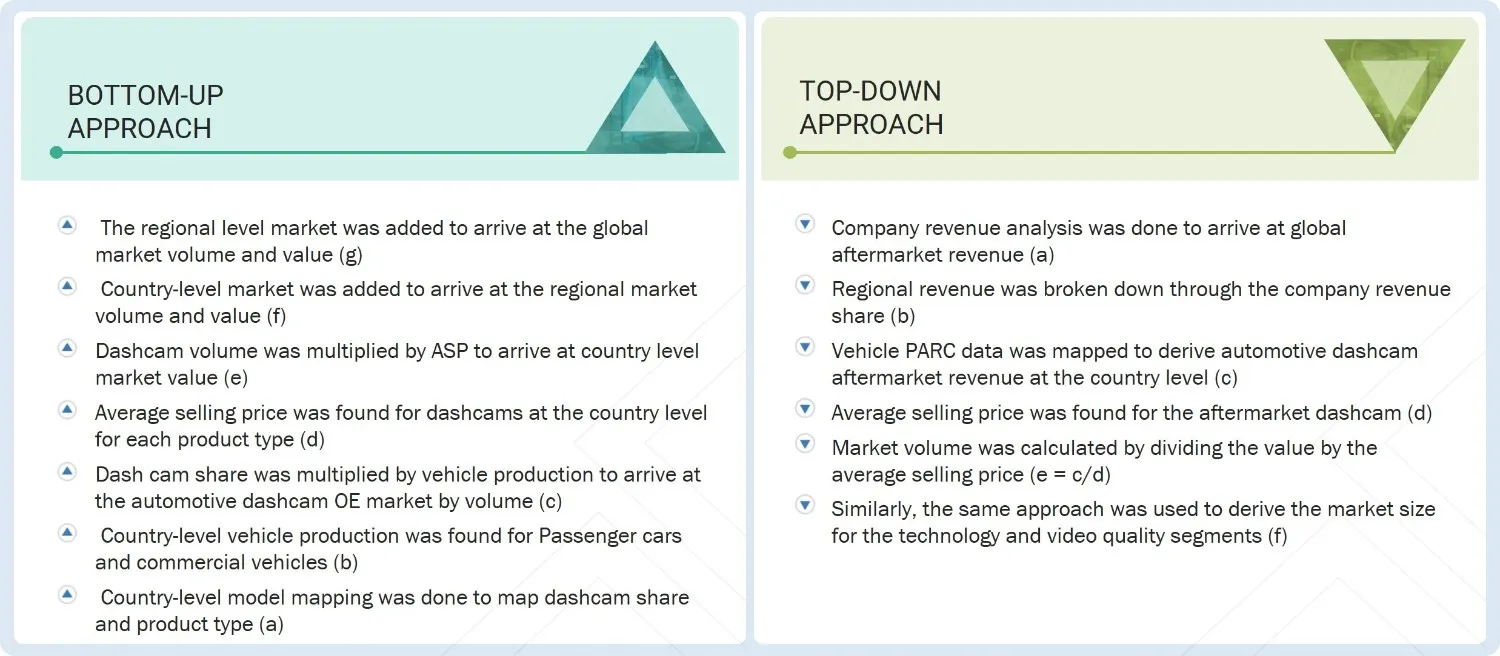
The automotive dashcam OE market is estimated using a bottom-up methodology, where country-level model mapping is conducted to determine dashcam share across product types, followed by assessment of vehicle production for passenger cars and commercial vehicles at the country level. The dashcam penetration rate is applied to vehicle production to derive OE dashcam volume, after which average selling prices are determined for each product category at the country level. The calculated volume is multiplied by the corresponding average selling price to arrive at country level market value, which is then aggregated to derive the regional market size, and further consolidated to estimate the global market volume and value.
The automotive dashcam aftermarket market is estimated using a top-down approach, where company revenue analysis is conducted to derive the global aftermarket revenue, which is then distributed across regions based on company-level revenue share. Vehicle parc data is mapped to estimate country-level aftermarket revenue, reflecting installation potential across existing vehicles. Average selling prices for aftermarket dashcams are determined, and market volume is calculated by dividing the market value by the average selling price. The same methodology is applied to further segment the market by technology and video quality, ensuring consistent estimation across all categories.
Automotive Dashcam Market : Top-Down and Bottom-Up Approach
Data Triangulation
After arriving at the overall market size using the market size estimation processes as explained above, the market was split into several segments and subsegments. To complete the overall market engineering process and arrive at the exact statistics of each market segment and subsegment, data triangulation and market breakdown procedures were employed, wherever applicable. The data was triangulated by studying various factors and trends from both the demand and supply sides.
Market Definition
A dash cam, or dashboard camera, is a video recording device that’s mounted onto the dashboard or windshield of a vehicle. In the trucking industry, dash cams have become increasingly popular as a means of recording evidence in the event of an accident or other incident on the road. These devices are designed to capture video footage of the road ahead, as well as the driver and passengers in the vehicle.
Report Objectives
- To segment and forecast the automotive dashcam market in terms of volume (thousand units) and value (USD million)
- OE Product Type (Front Dashcam, Front + Rear Dashcam, Front + Rear + In cabin Dashcam)
- Aftermarket Product Type (Front Dashcam, Front + Rear Dashcam, Front + Rear + In cabin Dashcam)
- OE Technology (Basic, Advanced, Smart)
- Aftermarket Technology (Basic, Advanced, Smart)
- OE Video Quality (Standard Definition, High Definition, Full HD & 4K)
- Aftermarket Video Quality (Standard Definition, High Definition, Full HD & 4K)
- OE Vehicle Type (Passenger Car, Commercial Vehicle)
- Aftermarket Vehicle Type (Passenger Car, Commercial Vehicle)
- OE EV Type (BEV, PHEV)
- EV Type Aftermarket (BEV, PHEV)
- Distribution Channel (OE, Aftermarket)
- Region (Asia Pacific, Europe, North America, and the Rest of the World)
- To analyze regional markets for growth trends, prospects, and their contribution to the overall market
- To define, describe, and forecast the size of the automotive dashcam market with respect to growth trends and prospects, and determine the contribution of the segments to the total market
- To provide detailed information regarding the major factors (drivers, challenges, restraints, and opportunities) influencing market growth
- To strategically analyze markets with respect to individual growth trends, prospects, and contribution to the total market
- To analyze opportunities for stakeholders and the competitive landscape for market leaders
- To study the following with respect to the market -
- Supply chain analysis
- Ecosystem analysis
- Pricing analysis
- Technology analysis
- HS code
- Case study analysis
- Patent analysis
- Impact of 2025 India-EU Trade Deal
- Regulatory landscape
- Key stakeholders and buying criteria
- Funding, by application
- Key conferences & events
- To strategically profile key players and comprehensively analyze their market share and core competencies
- To analyze the impact of AI on the market
- To track and analyze competitive developments such as deals (mergers & acquisitions, partnerships, collaborations), product developments, and other activities carried out by key industry participants
Available customizations:
With the given market data, MarketsandMarkets offers customizations in line with company-specific needs.
- Automotive dashcam market, by application, at the regional level (For regions covered in the report)
- Automotive dashcam market, by vehicle type, at the country level (For the countries not covered in the report)
Company Information
- Profiling of Additional Market Players (Up to 5)
Key Questions Addressed by the Report
What is the current market size of the Automotive Dashcam Market, and how is it expected to grow?
The Automotive Dashcam Market is projected to grow from USD 4.40 billion in 2026 to USD 6.55 billion by 2033, at a CAGR of 5.8% during the forecast period.
What are the key factors driving the growth of the Automotive Dashcam Market?
The market is driven by rising concerns over vehicle security, increasing adoption of dashcams by fleet operators, expanding e-commerce sales, and growing demand for AI-enabled and connected dashcam solutions.
Which region is expected to dominate the Automotive Dashcam Market during the forecast period?
Asia Pacific is expected to dominate the Automotive Dashcam Market due to increasing connected vehicle adoption, strong local manufacturing, and rising demand from passenger and fleet vehicles.
What are the latest trends shaping the Automotive Dashcam Market?
Key trends include AI-powered driver monitoring, cloud-connected dashcams, 4K video recording, ADAS integration, and multi-channel recording systems.
Who are the leading companies in the Automotive Dashcam Market, and what strategies are they adopting?
Leading companies such as Robert Bosch GmbH, Denso, Magna International, Valeo, and Garmin are focusing on AI innovation, connected dashcam technologies, strategic partnerships, and advanced safety features to strengthen their market position.


Personalize This Research
- Triangulate with your Own Data
- Get Data as per your Format and Definition
- Gain a Deeper Dive on a Specific Application, Geography, Customer or Competitor
- Any level of Personalization
Let Us Help You
- What are the Known and Unknown Adjacencies Impacting the Automotive Dashcam Market
- What will your New Revenue Sources be?
- Who will be your Top Customer; what will make them switch?
- Defend your Market Share or Win Competitors
- Get a Scorecard for Target Partners

Custom Market Research Services
We Will Customise The Research For You, In Case The Report Listed Above Does Not Meet With Your Requirements
Get 10% Free CustomisationTESTIMONIALS

JIM NAAS
PRODUCT DIRECTOR, WEASLER
Weasler Engineering, a CentroMotion organization
Global Provider of Industrial Actuation & Control Solutionswww.weasler.com
Our organization was interested in learning more about the attractiveness of a particular market space. We contacted MarketsandMarkets to help us based on previous positive experiences we had with them. The results did not disappoint! We discussed our objectives with them, and the team at MarketsandMarkets developed and executed a proposal that met our needs precisely. We were very impressed by their level of expertise, the quality of the analysis and their insightful recommendations. We would not hesitate in working with them again in the future.

Matt Kardel,
Vice President
Aptiv,
A global technology company that develops safer, greener and more connected solutions.www.aptiv.com
We contracted with
MarketsandMarkets to evaluate the value chain and potential go-to-market partners related to our
interest in the Fleet Management space. The team successfully completed the work on time and at the
pricing agreed. MarketsandMarkets listened and understood our objectives and collaborated well with
us to help us get the visibility we needed to make an investment.
We have subsequently used
MarketsandMarkets again related to Smart Cities to good results.
- China Automotive Dashcam Market
- India Automotive Dashcam Market
- Japan Automotive Dashcam Market
- South Korea Automotive Dashcam Market
- Germany Automotive Dashcam Market
- France Automotive Dashcam Market
- Italy Automotive Dashcam Market
- Spain Automotive Dashcam Market
- UK Automotive Dashcam Market
- Canada Automotive Dashcam Market
- Mexico Automotive Dashcam Market
- US Automotive Dashcam Market
- Brazil Automotive Dashcam Market
- South Africa Automotive Dashcam Market
- Rest Of Europe Automotive Dashcam Market
- Rest Of Asia Pacific Automotive Dashcam Market






Growth opportunities and latent adjacency in Automotive Dashcam Market