Automotive Plasticizers Market

Automotive Plasticizers Market by Type (Phthalates, Non-phthalates), Application (Interior Components, Exterior Components), End User (OEM, Aftermarket), and Region – Global Forecast to 2030




OVERVIEW
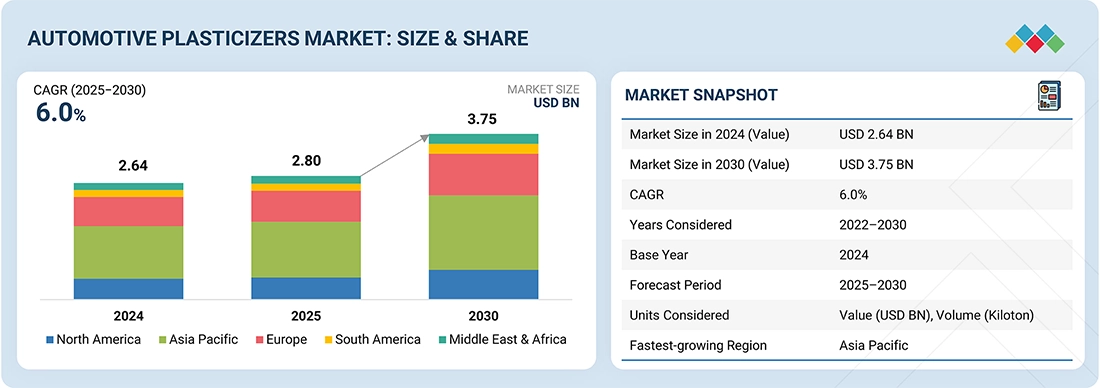
Source: Secondary Research, Interviews with Experts, MarketsandMarkets Analysis
The automotive plasticizers market is estimated to grow from USD 2.80 billion in 2025 to USD 3.75 billion by 2030, at a CAGR of 6.0% during the forecast period. The market is gradually expanding due to the increasing demand for flexible polymer materials, particularly PVC-based components, for vehicle interiors, exteriors, and wiring systems in the latest models. Plasticizers are essential for enhancing the flexibility, durability, processing capabilities, and overall performance of automotive plastics, making them necessary for a wide range of applications, including interior trims, underbody coatings, seals, gaskets, and wire and cable insulation. The growth in car production in the Asia Pacific region, rising investments in the EV sector, and the ongoing shift toward lightweight, cost-effective polymer materials are driving demand for plasticizers. Additionally, the growing concern for low-VOC, easily regulated, and environmentally friendly products is prompting changes in product offerings, leading to faster adoption of non-phthalate and bio-based plasticizers over conventional phthalates.
KEY TAKEAWAYS
-
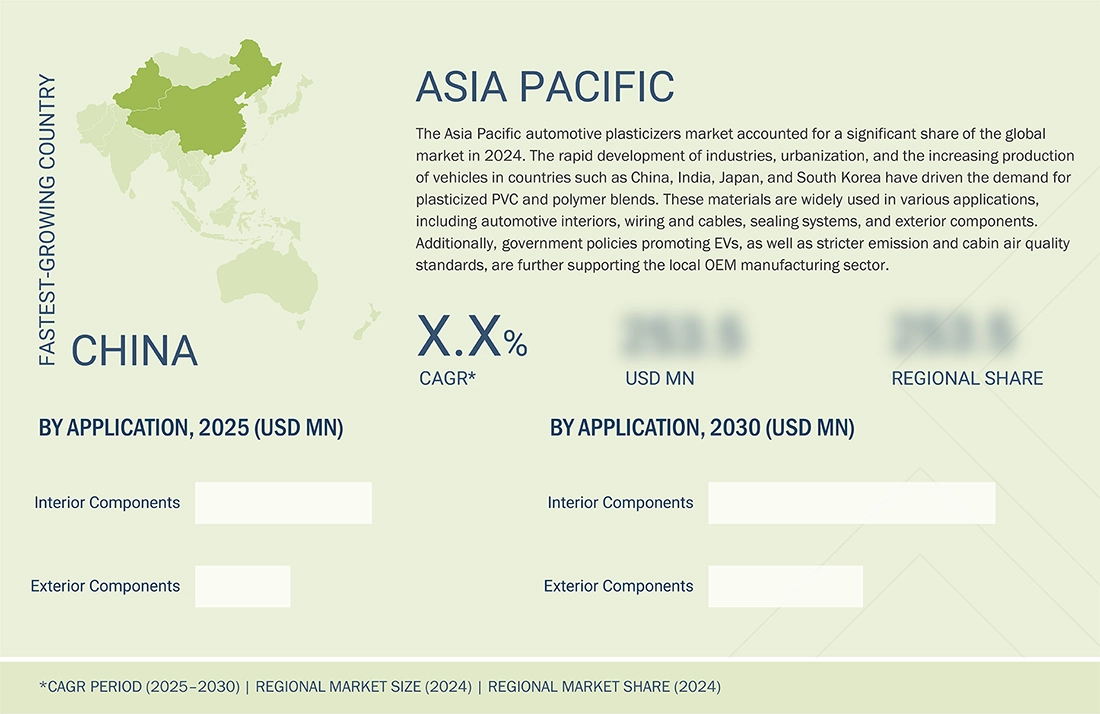
By RegionBy region, the Asia Pacific accounted for the largest share of 40.14% of the automotive plasticizers market in 2024.
-
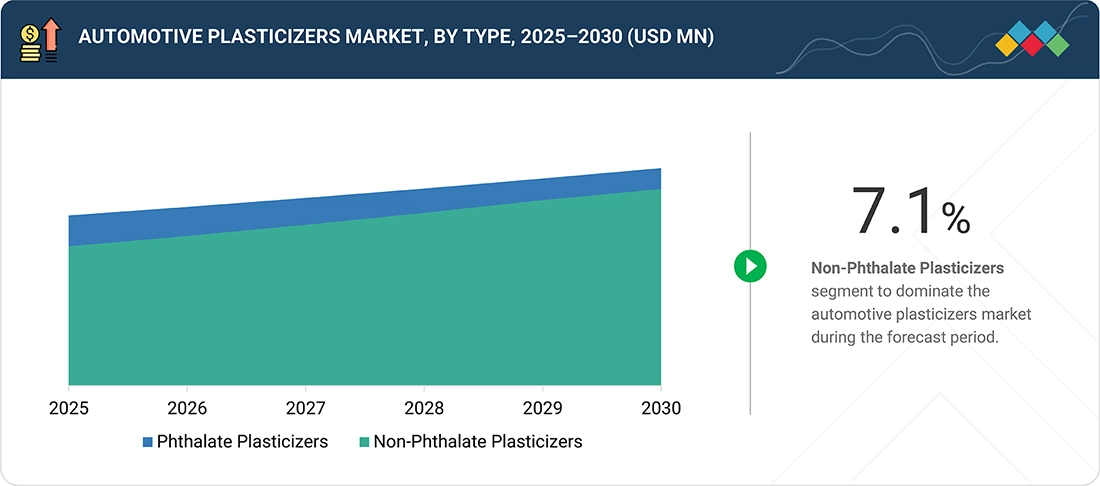
By TypeBy type, the non-phthalate plasticizers segment is expected to register the highest CAGR of 7.7% during the forecast period.
-
By ApplicationBy application, the interior components segment is expected to dominate the market, growing at the highest CAGR of 7.1% during the forecast period.
-
By End UserBy end user, the OEM segment is expected to dominate the market during the forecast period.
-
By ApplicationBy application, the paints & coatings segment is projected to grow at the fastest rate from 2025 to 2030.
-
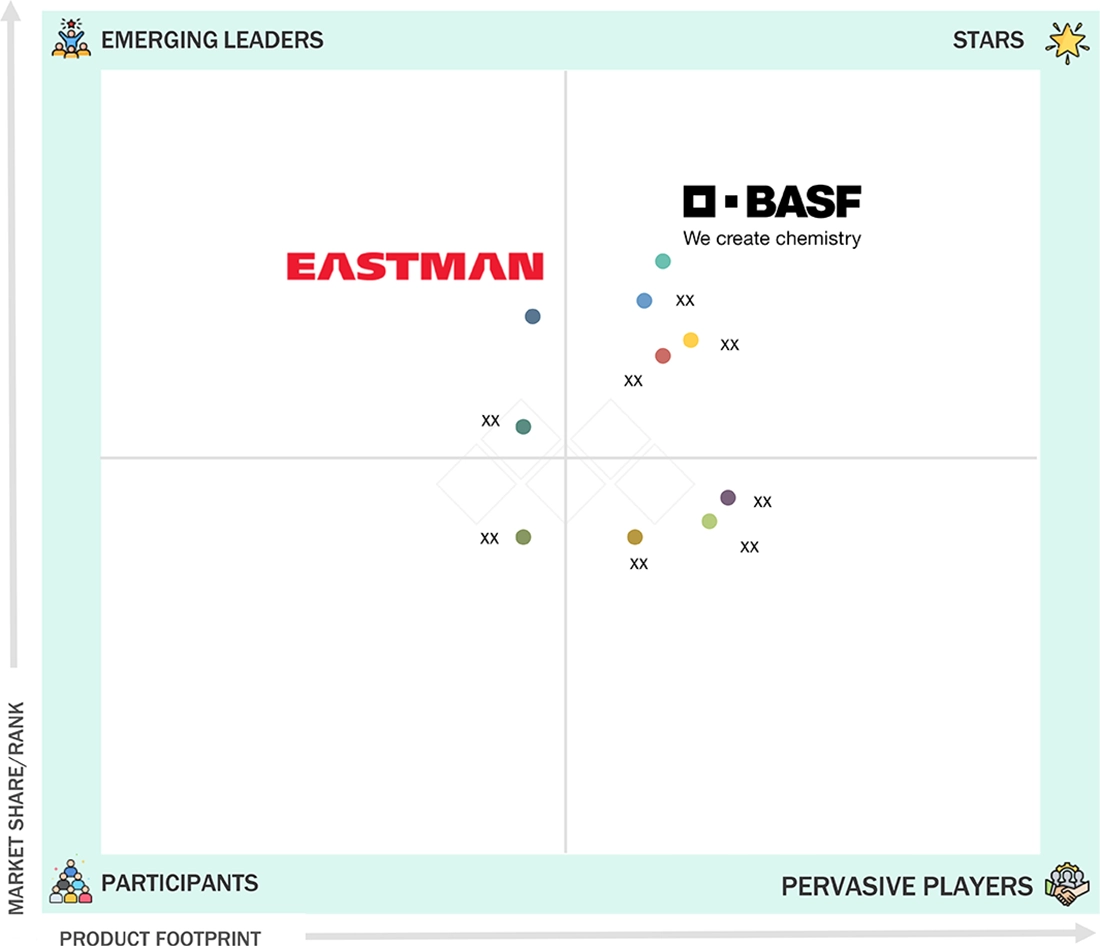
Competitive Landscape - Key PlayersBASF , Eastman Chemical Company, Evonik Industries, and LG Chem were identified as Star players in the automotive plasticizers market, as they have focused on innovation and offer broad portfolios.
-
Competitive Landscape - StartupsKLJ Group, Adeka Corporation, UPC Technology, and Polynt have distinguished themselves among emerging players due to their specialized product lines and expanding market presence.
Automotive plasticizers are essential additives that enhance the flexibility, strength, and manufacturability of PVC and other polymers commonly used in car components, including interiors, exteriors, and electrical systems. Without these additives, soft-touch surfaces, vibration-damping components, cable insulation, sealing systems, synthetic leather, and protective films would not be possible in both conventional and electric vehicles. Regulatory agencies such as the European Chemicals Agency (ECHA), the US Environmental Protection Agency (EPA), and various national bodies across Asia are imposing increasingly strict regulations regarding phthalate content, VOC emissions, and material safety under frameworks like REACH, RoHS, and ELV directives. In response to these regulatory pressures, as well as automakers’ commitments to transitioning toward low-migration, non-phthalate, and high-performance plasticizer technologies, there is a rapid shift toward environmentally safer, thermally stable, and low-odor formulations. Additionally, as EV platforms continue to grow, demand for advanced plasticizers that offer excellent electrical insulation, heat resistance, and long-term stability is increasing. This shift is significantly changing the landscape of innovation within the automotive plastics value chain.
TRENDS & DISRUPTIONS IMPACTING CUSTOMERS' CUSTOMERS
The consumer-focused sectors of the automotive plasticizers market are expected to be impacted by shifts in material preferences, the implementation of stringent global chemical regulations, and rapid advancements in automotive manufacturing technologies. OEMs and Tier 1/2 suppliers primarily represent the key players in this area, known as "Hotbets." This group is complemented by local parts and components manufacturers, which include a wide range of aftermarket and service-oriented industry participants. Significant target sectors include automotive interiors, soft touch components, exterior sealing systems, underbody coatings, wire insulation, and flooring materials, particularly in elastomer-based specialty segments. One major factor influencing this market is stricter restrictions on VOCs and phthalates, driving heightened demand for non-phthalate, low-migration, and REACH-compliant plasticizers. Additionally, the rise of lightweight vehicles and EV platforms is significantly affecting procurement strategies and material qualification protocols across the automotive value chain. OEMs prioritize plasticizer systems that are environmentally friendly, odor-free, and thermally stable. These systems not only ensure safety but also help improve air quality inside vehicles and extend their useful life, even at higher temperatures. Changes in functional and regulatory requirements affect consumption patterns in key application segments, which, in turn, impact the revenue streams of hotbets that rely heavily on plasticizers to deliver flexibility, durability, and processing efficiency in PVC and elastomer-based components.
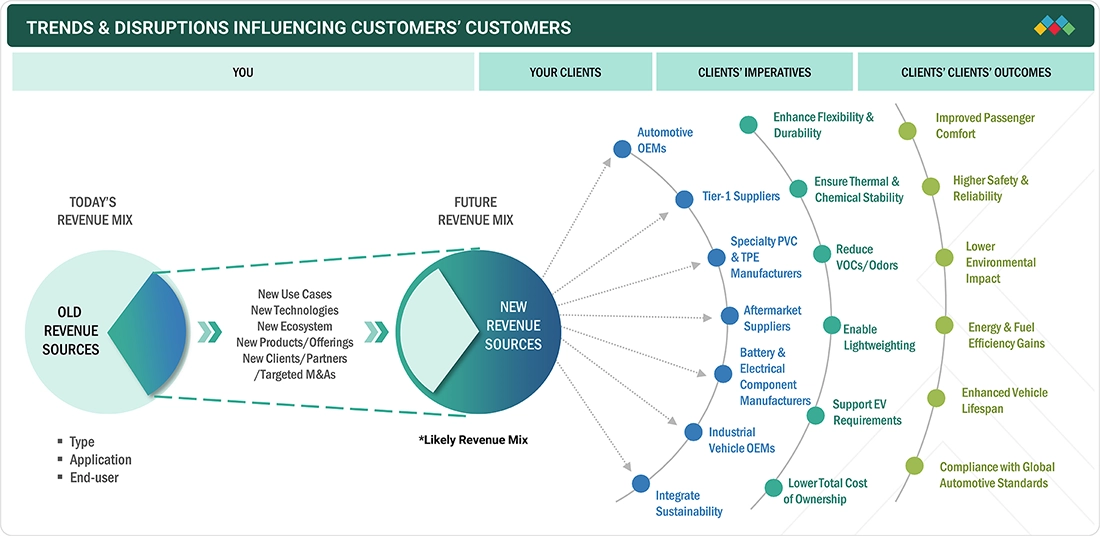
Source: Secondary Research, Interviews with Experts, MarketsandMarkets Analysis
MARKET DYNAMICS

Level
-
Growing demand for flexible PVC components in vehicles

-
Rising production of EVs and hybrid vehicles


Level
-
Regulatory restrictions on phthalates

-
Volatility in raw material prices


Level
-
Rapid adoption of non-phthalate & bio-based plasticizers

-
Growth in EV wiring & cable applications


Level
-
Supply chain disruptions in specialty chemicals

-
Technical performance issues at high temperatures

Source: Secondary Research, Interviews with Experts, MarketsandMarkets Analysis
Driver: Growing demand for flexible PVC components in vehicles
The global automotive plasticizers market is slowly expanding as automobile producers are progressively incorporating flexible PVC in their products, such as interior trims, wire & cable insulation, flooring, underbody coatings, and sealing systems. The shift toward lighter vehicles with more electronic components is the primary driver of increased demand for flexible, durable, and thermally stable materials. Specifically, the rise of EVs is the primary driver of the growing demand for plasticizers, as these vehicles feature long wiring harnesses and require heat-resistant, low-migration plasticizer systems. Flexible PVC is an excellent choice for this application because it offers greater resilience, better processability, and greater cost-effectiveness. As a result, it is widely used in both OEM and aftermarket applications. These trends are driving a global increase in demand for plasticizers.
Restraint: Regulatory restrictions on phthalates
Stricter environmental laws, such as REACH (EU) and CPSIA (US), as well as various OEM-specific material compliance standards, are exerting significant pressure on the global market. A large number of traditional phthalates, such as DEHP, DBP, BBP, DINP, and DIDP, are likely to be limited or phased out completely due to their toxicity, potential for migration, and potential for human exposure in vehicle interiors. Car manufacturers are increasingly requiring suppliers to use low-VOC, odorless, and environmentally friendlier products, forcing suppliers to quickly move to terephthalates (DOTP), trimellitates, polymeric plasticizers, and bio-based products. The costs of meeting regulations, the difficulties of reformulating, and the long qualification cycles limit the pace of market growth and its profitability.
Opportunity: Rapid adoption of non-phthalate & bio-based plasticizers
Growing environmental expectations, sustainability commitments from global OEMs, and the demand for safer cabin air quality present a significant opportunity for non-phthalate plasticizers. Specifically, EV manufacturers are leading the push for the rapid adoption of these innovative formulations in applications like wiring systems, lightweight interiors, and soft-touch surfaces. Suppliers who invest in green chemistry, renewable feedstocks, and next-generation polymeric plasticizers are well-positioned to capture a substantial share of this emerging market from competitors. Materials such as DOTP, DINCH, citrate esters, and bio-based alternatives are becoming increasingly popular due to their low migration, high thermal stability, and regulatory compliance advantages.
Challenge: Supply chain disruptions in specialty chemicals
Despite attempts to bring the global plasticizers supply chain back to normal, it remains highly vulnerable to fluctuations in petrochemical feedstock supply, political tensions, difficulties in the movement of goods, and the uneven distribution of production capacity across regions. When it comes to non-phthalate specialty plasticizers, the current situation is challenging. Their production relies heavily on complex, multi-step synthesis processes and is limited to a few manufacturing locations worldwide for materials like trimellitates, DINCH, and polymeric variants. This reliance exposes OEMs and Tier-1 suppliers to procurement risks, long lead times, and price volatility. Additionally, the industry faces the challenge of scaling production to meet the rapidly growing demand for EVs. To address these issues, companies are compelled to diversify their manufacturing locations, consider backward integration, and strengthen their supply chains.
AUTOMOTIVE PLASTICIZERS MARKET: COMMERCIAL USE CASES ACROSS INDUSTRIES
| COMPANY | USE CASE DESCRIPTION | BENEFITS |
|---|---|---|
 |
A major European automotive interiors supplier adopted BASF’s Hexamoll DINCH and Palatinol DOTP plasticizers for dashboards, instrument panels, and flexible PVC trim profiles, replacing legacy phthalates. | Achieved full REACH & OEM phthalate-free compliance, reduced fogging/odor by 40–50%, improved UV aging stability, and enhanced surface softness for premium interior tactile feel. |
 |
A global wire-harness manufacturer integrated Evonik’s ELATUR CH non-phthalate plasticizer for flexible PVC insulation and sheathing in high-temperature automotive wiring used in EVs and hybrid vehicles. | Delivered higher thermal stability (up to 135°C), improved migration resistance, 20% longer cable life under thermal cycling, and compliance with stringent OEM low-VOC cabin air quality specifications. |
 |
A North American producer of underbody & sound-damping sheets switched to Eastman’s Benzoflex and Eastman 168 non-phthalate plasticizers for PVC and TPE blends used in NVH (noise, vibration, harshness) control applications. | Achieved 15–20% higher flexibility at low temperatures, improved acoustic damping, 30–40% reduction in VOC emissions, and enhanced long-term heat resistance for the EV platform. |
 |
A global automotive flooring and mat supplier transitioned to UPC’s non-phthalate DEHT/DOTP plasticizers for mass-scale production of PVC matting, door sills, and protective interior coverings. | Achieved superior wear resistance, 10–15% cost optimization in high-volume production, lower fogging levels, and better recyclability aligned with circular automotive material mandates. |
Logos and trademarks shown above are the property of their respective owners. Their use here is for informational and illustrative purposes only.
MARKET ECOSYSTEM
The automotive plasticizers ecosystem comprises raw material suppliers (ExxonMobil Chemical, LG Chem, BASF SE, Eastman Chemical Company, Evonik Industries), plasticizer manufacturers (BASF, Evonik Industries AG, UPC Technology Corp., Perstorp, LG Chem), distributors (Azelis, Brenntag, IMCD Group, Univar Solutions LLC), and end users (Toyota, Volkswagen Group, Hyundai Mobis, Lear Corporation, Faurecia/Forvia). The global petrochemical and chemical industries are prepared to supply the essential core feedstocks, such as alcohols (2-EH, IPA), phthalic anhydride, adipic acid, and specialty esters, from their supergiant plants. Plasticizer manufacturers face the challenge of transforming these precursors into both phthalate and non-phthalate esters (e.g., DOTP, DINCH, DEHT, DIDP, ATBC) by effectively utilizing esterification technologies that adhere to global standards such as REACH, ELV, RoHS, and OEM low-VOC cabin air quality requirements. Distributors play a vital role in maintaining and supporting customer relationships through activities such as formulation guidance, logistics, safety compliance, and ensuring supply chain continuity in regions with stringent regulations. End users deeply integrate plasticizers into their products, which include applications like automotive interior trim, PVC flooring, dashboards, door panels, wire and cable insulation, underbody coatings, synthetic leather, and sealants. In these applications, plasticizers provide important features such as flexibility, softness, heat resistance, long-term durability, and migration control.
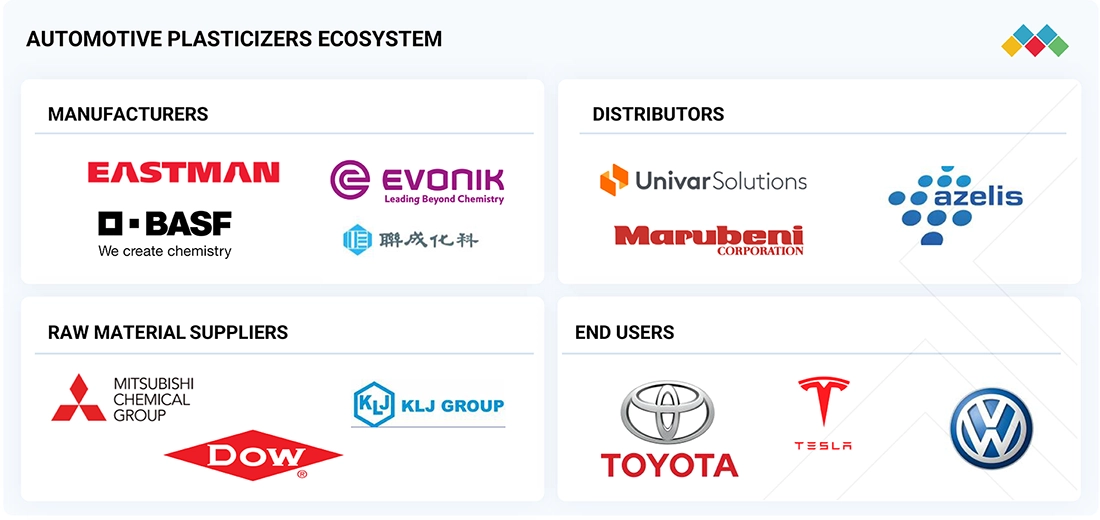
Logos and trademarks shown above are the property of their respective owners. Their use here is for informational and illustrative purposes only.
MARKET SEGMENTS
Source: Secondary Research, Interviews with Experts, MarketsandMarkets Analysis
Automotive Plasticizers Market, by Type
Non-phthalate plasticizers are expected to account for the largest share of the automotive plasticizers market as a result of the worldwide trend of using eco-friendly and safe materials that are in line with the necessary regulations. The main factors leading to the substitution of phthalates such as DOP/DEHP and DBP, with their substitutes like DOTP, DINCH, ATBC, adipates, and trimellitates, are the imposition of very stringent regulations on traditional phthalates (e.g., DOP/DEHP, DBP) by global regulations such as REACH, RoHS, ELV Directive, China's MIIT standards, and OEM-specific VOC requirements. Non-phthalate plasticizers are more thermally stable, exhibit lower migration and improved aging resistance, and provide better cabin air quality, among other advantages, making them the best choice for automotive interiors such as PVC trim, dashboards, instrument panels, door panels, flooring, and seating. As automakers are increasingly turning to low-VOC interiors, EV-compatible materials, and recyclable polymer systems, the market for non-phthalate plasticizers is expanding rapidly.
Automotive Plasticizers Market, by Application
Due to developments in electric vehicles, initiatives to reduce weight, and increasing demands for interior comfort, the interior components segment is expected to become the leading area of growth in the automotive plasticizers market. Plasticized PVC-based materials are commonly used in various applications, including instrument panels, dashboards, door trims, surface skins, synthetic leather, seat coverings, underbody coatings, and exterior polymer profiles. Key characteristics of these materials include flexibility, durability, and performance at low temperatures. The shift toward softer, premium-touch interior surfaces and the adoption of high-performance vinyl for scratch resistance and thermal stability are driving growth in this segment. Additionally, electric vehicle manufacturers are increasingly using heat-stable, low-VOC plasticized materials for battery protection films, wire insulation, and sealing systems. This segment's expansion is supported by stringent OEM cabin air-quality standards, the demand for weather-resistant materials, and a growing emphasis on designing quiet, vibration-reducing components. These factors rely heavily on advanced plasticizer technologies.
Automotive Plasticizers Market, by End User
In the global automotive plasticizers market, the OEM segment is expected to register the fastest growth. OEMs, particularly in the passenger vehicle and electric vehicle (EV) sectors, require large quantities of plasticized PVC and polymer blends for applications such as interior trims, flooring, seat coverings, wire harnessing, cable insulation, gaskets, and sealing systems. The growth of this segment can be attributed to increasing consumer expectations for comfort, noise reduction, and soft-touch interiors, along with heightened regulatory and OEM requirements for materials that are low in volatile organic compounds (VOCs), low-fogging, and odor-compliant. In contrast, the aftermarket segment is stable but growing at a slower pace, as it primarily focuses on replacement and retrofit applications for older vehicles. Meanwhile, the OEM segment benefits from new-vehicle production, electrification trends, lightweighting initiatives, and the widespread adoption of advanced materials.
REGION
AUTOMOTIVE PLASTICIZERS MARKET: COMPANY EVALUATION MATRIX
BASF (Star) holds a leading position in the global automotive plasticizers market, supported by a broad portfolio of non-phthalate and high-performance phthalate alternatives, such as DOTP, DINCH, and specialty adipates that are used in interiors, wiring insulation, dashboards, seating, and underbody coatings. BASF can provide low-migration, heat-resistant, and low-VOC plasticizers on a large scale through its strong global manufacturing network, state-of-the-art R&D capabilities, and long-term collaborations with automotive OEMs and Tier-1 suppliers. These features enable large-volume industrial applications and compliance with strict regional and OEM regulations. Eastman Chemical Company (Emerging Leader) is quickly gaining recognition in the industry. The primary reason for this rise in reputation is the company’s commitment to producing bio-based, non-phthalate plasticizers as well as high-performance specialty formulations for EV wiring, flexible PVC interiors, and synthetic leather applications. The company is expanding its product line by introducing application-specific plasticizers that offer thermal stability, migration resistance, UV and weathering durability, and regulatory compliance. This positions Eastman to meet the evolving requirements of electrified vehicles and premium passenger car interiors.
Source: Secondary Research, Interviews with Experts, MarketsandMarkets Analysis
KEY MARKET PLAYERS
- BASF (Germany)
- ExxonMobil Chemical Company (US)
- Evonik Industries AG (Germany)
- Eastman Chemical Company (US)
- LG Chem (South Korea)
- Arkema (France)
- Perstorp Holding AB (Sweden)
- UPC Technology Corporation (Taiwan)
- NAN YA PLASTICS CORPORATION (Taiwan)
- Aekyung Chemical (South Korea)
MARKET SCOPE
| REPORT METRIC | DETAILS |
|---|---|
| Market Size in 2024 (Value) | USD 2.64 Billion |
| Market Forecast in 2030 (Value) | USD 3.75 Billion |
| Growth Rate | CAGR of 6.0% from 2025 to 2030 |
| Years Considered | 2022–2030 |
| Base Year | 2024 |
| Forecast Period | 2025–2030 |
| Units Considered | Value (USD Billion), Volume (Kiloton) |
| Report Coverage | Revenue Forecast, Company Ranking, Competitive Landscape, Growth Factors, and Trends |
| Segments Covered |
|
| Regions Covered | North America, Asia Pacific, Europe, South America, Middle East & Africa |
WHAT IS IN IT FOR YOU: AUTOMOTIVE PLASTICIZERS MARKET REPORT CONTENT GUIDE
DELIVERED CUSTOMIZATIONS
We have successfully delivered the following deep-dive customizations:
| CLIENT REQUEST | CUSTOMIZATION DELIVERED | VALUE ADDS |
|---|---|---|
| Global Automotive Plasticizers Manufacturer |
|
|
| Automotive Interior & Trim Manufacturer |
|
|
| Wire Harness, Cable, & Seal Manufacturer |
|
|
RECENT DEVELOPMENTS
- August 2025 : UPC Technology Corporation increased non-phthalate plasticizer production capacity by about 22% to meet the rising demand for safer plasticizers in the wiring of the car, the dashboards, and the interior trims, which is a reflection of the general industry changes toward non-phthalate formulations.
- February 2025 : BASF unveiled biomass-balanced and chemically recycled Palatinol DOTP Advantage 50 and Palatinol DOTP Cycled plasticizers at its plants in Texas and Ontario, emphasizing the company’s commitment to carbon footprint reduction and the expansion of sustainable PVC plasticizer sources for automotive interiors and flexible applications.
- June 2024 : Eastman Chemical Company invested USD 100 million in a plan to expand its US plasticizer plant, with a focus on increased production of non-phthalate plasticizers for the automotive and construction sectors.
Table of Contents
 Exclusive indicates content/data unique to MarketsandMarkets and not available with any competitors.
Methodology
The study involved major activities in estimating the current size of the North America Plasticizers market. Exhaustive secondary research was done to collect information on the peer and parent markets. The next step was to validate these findings, assumptions, and sizing with industry experts across the value chain through primary research. Both top-down and bottom-up approaches were employed to estimate the complete market size. Thereafter, market breakdown and data triangulation were used to estimate the market size of the segments and subsegments.
Secondary Research
In the secondary research process, various sources, such as annual reports, press releases, investor presentations of companies, white papers, certified publications, articles from recognized authors, and databases, were considered for identifying and collecting information for this study. Secondary research was mainly conducted to obtain key information about the supply chain of the industry, monetary chain of the market, the total number of market players, market classification and segmentation according to industry trends to the bottom-most level, regional markets, and key developments from both market- and technology-oriented perspectives.
Primary Research
In the primary research process, various primary sources from both supply and demand sides were interviewed to obtain qualitative and quantitative information for this report. Primary sources from the supply side include industry experts, such as chief executive officers (CEOs), vice presidents (VPs), marketing directors, technology and innovation directors, consultants, and related key executives from major companies and organizations operating in the market. Primary sources from the demand side include lab technicians, technologists, and sales/purchase managers in the industry. Following is the breakdown of primary respondents:
Market Size Estimation
Both top-down and bottom-up approaches were used to estimate and validate the total size of the North America Plasticizers market. These methods were also used extensively to estimate the size of various subsegments in the market. The research methodology used to estimate the market size includes the following:
- The key players in the industry and market have been identified through extensive secondary research, and their market share in the respective regions have been determined through both primary and secondary research.
- The industry’s value chain and market size, in terms of value, have been determined through primary and secondary research processes.
- All percentage shares, splits, and breakdowns have been determined using secondary sources and verified through primary sources.
Data Triangulation
After arriving at the overall market size from the estimation process explained above, the total market has been split into several segments and subsegments. To complete the overall market engineering process and arrive at the exact statistics for all the segments and subsegments, the data triangulation and market breakdown processes have been employed, wherever applicable. The data has been triangulated by studying various factors and trends from both the demand- and supply sides. Along with this, the market has been validated using both the top-down and bottom-up approaches.
Definition
Plasticizers are low molecular weight compounds added to other polymeric substances to aid polymer processing and impart flexibility, plasticity, softness, and reduce brittleness. They are primarily used in PVC cables, PVC resins, wire jacketing, vinyl flooring, medical equipment, automobile parts, and others. Plasticizers make the polymer solution more suitable for various applications such as films & coatings.
The key stakeholders of the North America plasticizers market include Raw Material Suppliers, Manufacturers (Plasticizer Manufacturers), Plasticizer Traders, Distributors, and Suppliers, End-use Industry Participants, Government and Research Organizations, Associations and Industrial Bodies, Research and Consulting Firms, Research & Development (R&D) Institutions, Environmental Support Agencies.
Objectives of the Study
- To define, describe, segment, and forecast the North America Plasticizers market size, by technology, meter type, component, and application
- To provide detailed information on the major drivers, restraints, opportunities, and industry-specific challenges influencing the growth of the North America Plasticizers market
- To strategically analyze the North America Plasticizers market with respect to individual growth trends, prospects, and contributions of each segment to the market
- To analyze market opportunities for stakeholders and provide a detailed competitive landscape for market leaders
- To strategically profile key players and comprehensively analyze their market ranking and core competencies
- To track and analyze competitive developments such as new product developments, contracts & agreements, investments & expansions, and mergers & acquisitions in the North America Plasticizers market
Available Customizations:
With the given market data, MarketsandMarkets offers customizations as per the client’s specific needs. The following customization options are available for this report:
Geographic Analysis
- Further breakdown of region or country-specific analysis
Company Information
- Detailed analyses and profiling of additional market players (up to 5)


Personalize This Research
- Triangulate with your Own Data
- Get Data as per your Format and Definition
- Gain a Deeper Dive on a Specific Application, Geography, Customer or Competitor
- Any level of Personalization
Let Us Help You
- What are the Known and Unknown Adjacencies Impacting the Automotive Plasticizers Market
- What will your New Revenue Sources be?
- Who will be your Top Customer; what will make them switch?
- Defend your Market Share or Win Competitors
- Get a Scorecard for Target Partners

Custom Market Research Services
We Will Customise The Research For You, In Case The Report Listed Above Does Not Meet With Your Requirements
Get 10% Free CustomisationTESTIMONIALS
We at Nissan Chemicals Corporation have been clients of MarketsandMarkets for more than a year now. We recently consulted MarketsandMarkets for a study, the team at MarketsandMarkets was extremely professional and organized. The business insights were very detailed and aligned well with our expectations that really helped us formulate the Business Plans and device new strategies for development themes. MarketsandMarkets offers a unique combination of expertise and dedicated engagement model. Their research findings have helped us in designing our Pricing Strategy which will make it easier for us to predict the future sales and profits for the next ten years. We look forward to working with MarketsandMarkets in the future.
VP of Strategy & New Business Development
Leading Specialty Chemical Company
The MarketsandMarkets Engagement Model, composed of both the Knowledge Store and advisory custom research, has greatly helped us in understanding our markets and making strategic decisions. The Knowledge Store is a fast way to allow everyone in our organization to understand more about most any market they are interested in. The ability to then get custom research done and get answers to specific strategic questions and market insight has been spectacular. The Markets and Markets team feel more like colleagues than vendors and their services have helped us change our culture where statements of things like growth opportunities and competitive position are always backed by industry research.

Rich Gibson,
Director, Corporate Strategy
Milliken & Company,
Leading Industrial Manufacturer of specialty chemical, floor covering, performance and protective textile materials, and healthcaremilliken.com
MarketsandMarkets is a trusted resource that helps us to better understand markets that are near-adjacencies-whether its technology, value chain or geography. Their Knowledge Store platform provides a dashboard of markets and their characteristics which is easy to use and saves us time.
Adam Shaw,
Market Development and Strategy Manager
AdvanSix Inc. USA,
An American Leader in Chemicalswww.advansix.com
The Knowledge Store from MarketsandMarkets is a valuable tool which has helped my team acquire greater insight in to the end markets that our business serves. This has enabled us to help our company build stronger strategies throughout our planning process.
TOSHIO KINOSHITA
Senior Chif Consultion Research & Consulting Division
Mitsubishi Chemical Research Corporation,
Leading Manufacturer of Chemical Productswww.mitsubishichem-res.co.jp/en/

We recently engaged with MarketsandMarkets for a study, the team not only clearly understood our business objectives but was also extremely professional in the way they handled the entire project. The study was efficiently conducted in a phase-wise manner, and the engagement model furnished us with high-quality business insights that far exceeded our expectations at each phase. We were especially happy that MarketsandMarkets could provide us with both, an English as well as a Japanese version of the study. A special thanks to the Analyst Team and Client Services Team, whose fluency in Japanese enhanced our comfort level, as we could converse with them in our preferred language.
Independent entrepreneurs
Arrow Precision
We approached MarketsandMarkets for study on Proppants Market, and their work exceeded our expectations. The study conducted was comprehensive and enabled us to view the market through the various dimensions. In addition, the team was extraordinarily responsive throughout the process and resolved our queries on time. I strongly recommend MarketsandMarkets and will certainly consider them for additional market assessments we will need in the future.
Global engineering company, Japan
Deputy Manager,
Strategic Planning OfficeThe high-quality insights shared by the MarketsandMarkets team helped us understand the pharmaceutical plant designers in a specific geography. It also captured the risks that we may likely face in communicating with our potential partners. The study would enable us identify partners, which would impact our future growth.






Growth opportunities and latent adjacency in Automotive Plasticizers Market