Automotive Sodium-ion Battery Market Size, Share & Analysis

Automotive Sodium-ion Battery Market by Battery Type (Sodium-sulfur Batteries, Sodium Salt Batteries, and Advanced Sodium-ion Batteries), Technology (Aqueous Sodium-ion Technology and Non-aqueous Sodium-ion Technology), Capacity (Below 10 kWh, 10 to 40 kwh And Above 40 kWh), End Use (Electric 2-wheeler, Electric 3-wheeler, Passenger Electric Vehicles, and Light Commercial Vehicles), and Region – Automotive Sodium-ion Battery Market Forecast to 2033




OVERVIEW
Source: Secondary Research, Interviews with Experts, MarketsandMarkets Analysis
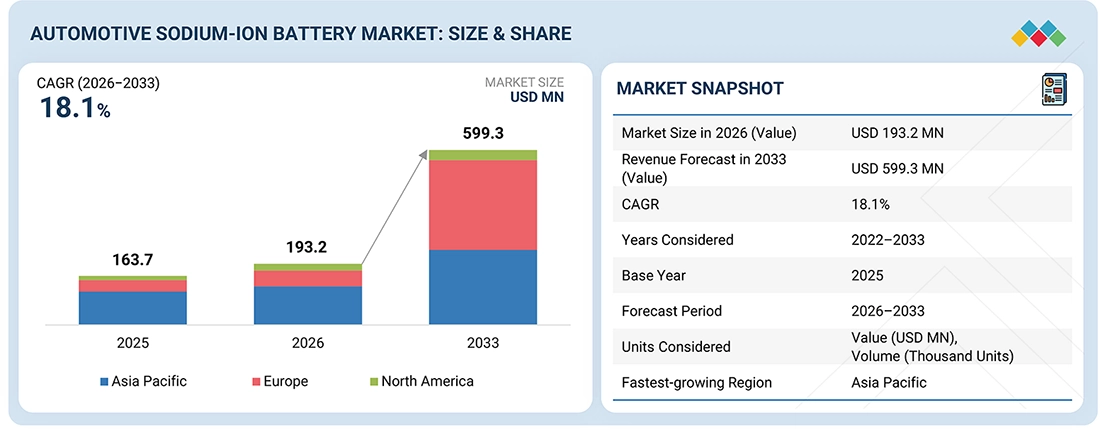
The automotive sodium-ion battery market is projected to grow from USD 193.2 million in 2026 to USD 599.6 million by 2033, at a CAGR of 18.1%. The automotive sodium-ion battery market is advancing as manufacturers pursue lower battery costs, enhanced material security, and scalable production pathways to support mass-market adoption of electric vehicles. Sodium-ion chemistry is emerging as a strategic alternative to lithium-based systems due to the abundance and low cost of sodium salts, which reduces exposure to lithium, cobalt, and nickel supply volatility while strengthening long-term supply chain stability. The technology aligns particularly well with compact passenger vehicles, urban mobility platforms, electric 2-wheelers, and light commercial fleets operating within short-to-medium-range duty cycles, especially in the 10 to 40 kWh capacity band, where moderate energy density is sufficient. In addition, non-aqueous sodium-ion cells can be produced using modified lithium-ion manufacturing infrastructure, enabling faster commercialization with lower capital requirements. Continuous improvements in cathode materials, thermal stability, low-temperature performance, and cycle life are narrowing the performance gap with lithium iron phosphate batteries, positioning sodium-ion as a complementary chemistry within multi-battery strategies adopted by automotive OEMs seeking cost efficiency, production flexibility, and accelerated electrification.
Market Size and Forecast:
- Market Size Value in 2025: USD 163.7 Billion
- Market Size Value in 2026: USD 193.2 Billion
- Revenue Forecast in 2033: USD 599.3 Billion
- Growth Rate: CAGR of 18.1% from 2026 to 2033
- Data available from 2022 to 2033
- Base year: 2025
- Forecast period: 2026–2033
Key Market Trends and Insights
- Market Growth: Growth is driven by rising demand for cost-effective sodium-ion batteries and increasing EV adoption.
-
IoT Impact: AI integration is enhancing battery performance, safety, and lifecycle management in automotive sodium-ion battery systems.
- Growing Trends: The market is witnessing growing adoption of sodium-ion batteries as a cost-effective and resilient alternative to lithium-based battery technologies.
- Growth Opportunities: Opportunities are emerging from the use of sodium-ion batteries across both EV and energy storage applications.
KEY TAKEAWAYS
-
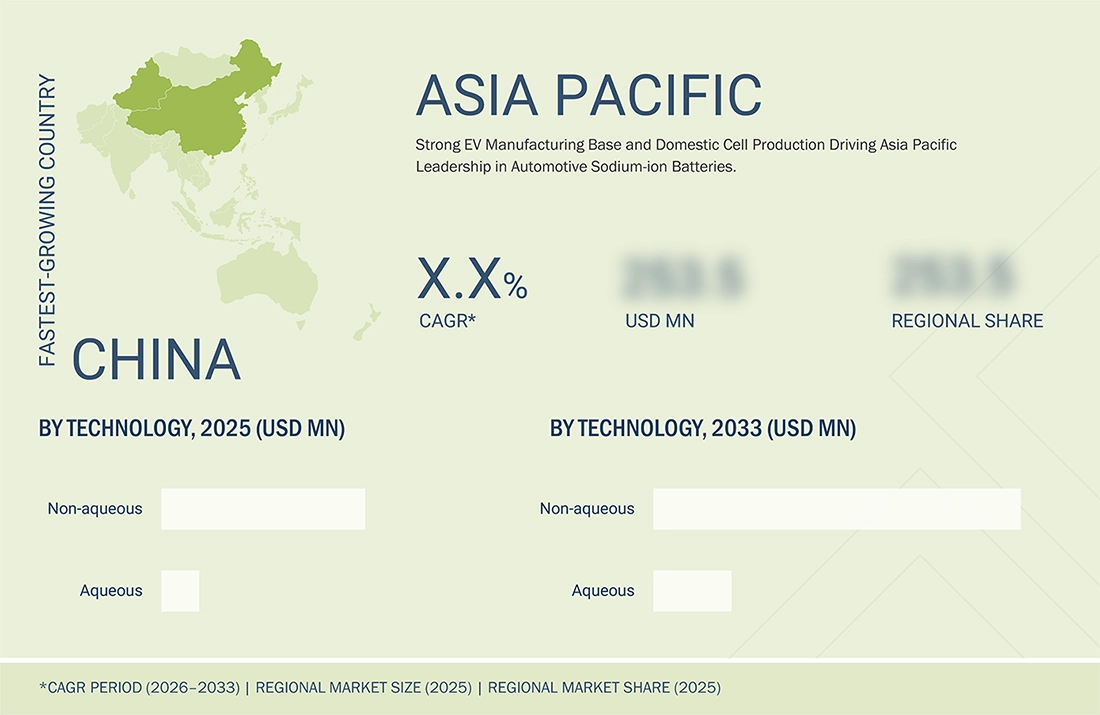
By RegionAsia Pacific is the largest and fastest-growing market, growing from USD 175.7 million in 2026 to USD 479.7 million by 2033, at a CAGR of 16.1%.
-
By Battery CapacityBased on the battery capacity segment, 10 to 40 kWh segment is expected to record a 14.3% CAGR from 2026 to 2033 in the automotive sodium-ion battery market.
-
By Battery TypeBy battery type segment, sodium-sulfur batteries are likely to capture 70% share of the total market share in 2026.
-
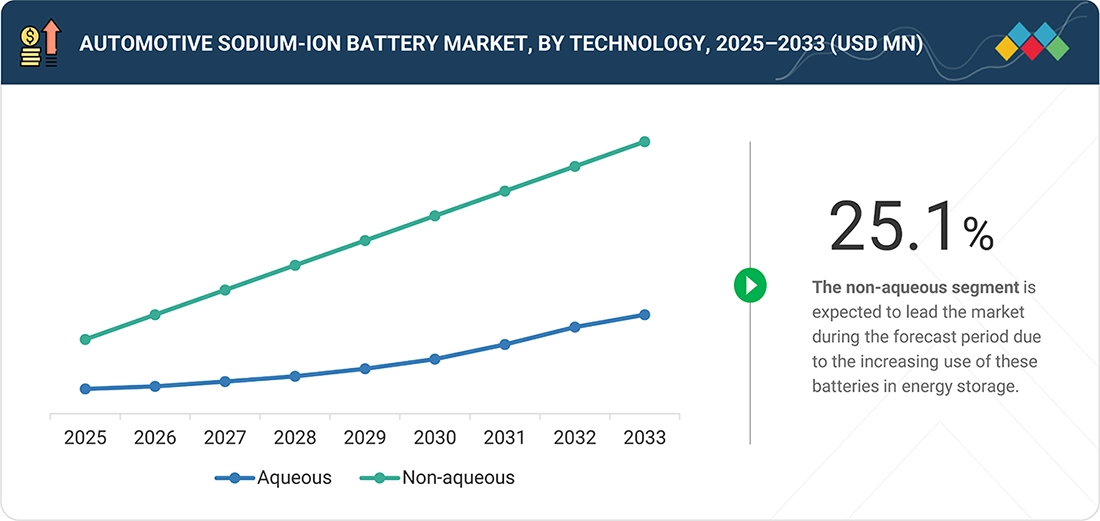
By TechnologyBy technology segment, the non-aquesous sodium ion segment is expected to lead the market by reaching USD 380.2 million in 2033.
-
By Vehicle TypeBy vehicle type segment, passenger electric vehicles are expected to record a CAGR of 16.8% from 2026 to 2033.
Commercialization of automotive sodium-ion batteries is advancing due to compatibility with modified lithium-ion manufacturing infrastructure. Cell architectures using non-aqueous sodium-ion chemistry can leverage existing production lines with minimal reconfiguration, reducing capital intensity for battery manufacturers. This manufacturing advantage is accelerating pilot-scale production and vehicle integration programs. At the same time, ongoing improvements in cathode materials such as Prussian White and layered oxide systems are narrowing the performance gap with lithium-iron phosphate batteries, enabling broader automotive validation.
TRENDS & DISRUPTIONS IMPACTING CUSTOMERS' CUSTOMERS
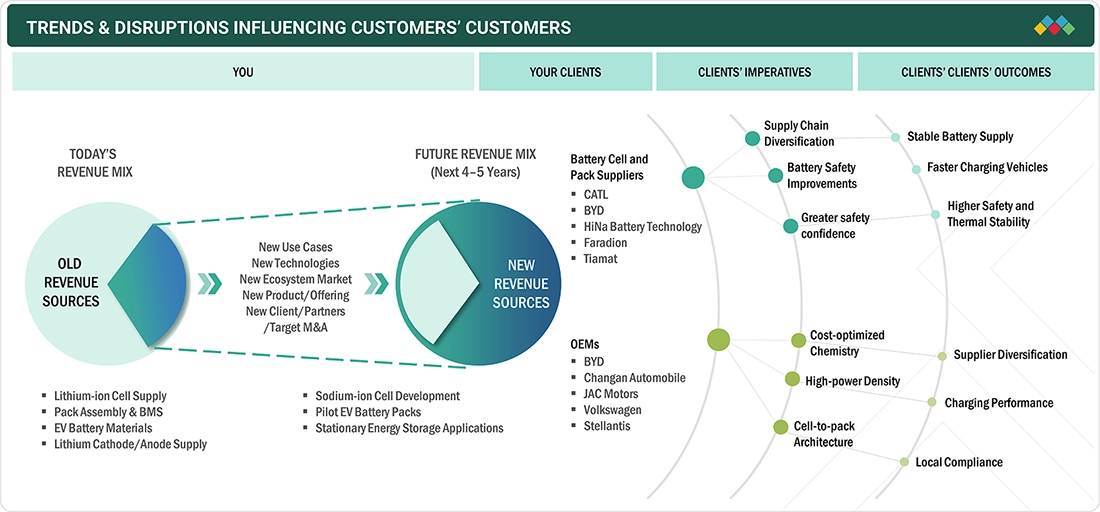
In automotive sodium-ion battery ecosystem, cell and pack suppliers are moving beyond traditional battery manufacturing to become strategic technology partners for automotive OEMs. Battery developers such as CATL, BYD, Faradion, and Tiamat Energy are expanding capabilities in sodium-ion cell chemistry, pack architecture, and cost-optimized materials to enable scalable EV integration. At the same time, automakers including Tesla, Geely, and General Motors are exploring alternative battery technologies to address cost pressures, lithium supply constraints, and the need for reliable performance in diverse operating conditions. These developments are driving outcomes such as lower battery costs, improved supply chain resilience, enhanced safety stability, and broader affordability of electric vehicles, positioning sodium-ion technology as a complementary pathway supporting the next phase of EV market expansion.
Source: Secondary Research, Interviews with Experts, MarketsandMarkets Analysis
MARKET DYNAMICS

Level
-
Reduced dependency on critical minerals

-
Growing EV adoption in cost-sensitive markets


Level
-
Lower energy density than lithium-ion batteries

-
Limited supplier ecosystem


Level
-
Stationary energy storage integration with EV ecosystem

-
Advancements in sodium battery chemistry


Level
-
Battery chemistry design challenges

-
Uncertain long-term performance data

Source: Secondary Research, Interviews with Experts, MarketsandMarkets Analysis
Driver: Reduced dependency on critical minerals
Lithium-ion battery supply chains depend on geographically concentrated resources. Sodium-based chemistry reduces exposure to lithium and cobalt supply risks, which attracts OEMs and governments seeking more stable battery supply chains.
Restraint: Lower energy density than lithium ion batteries
Current sodium-ion batteries typically deliver lower energy density, which limits driving range. This restricts their use in long-range passenger vehicles.
Opportunity: Stationary energy storage integration with EV ecosystem
Urban mobility vehicles such as small passenger cars, electric 2-wheelers, and 3-wheelers are early applications due to moderate range requirements and high cost sensitivity. Manufacturers can use sodium-ion batteries for both EVs and grid storage applications. This allows battery producers to scale up manufacturing capacity more quickly.
Challenge: Battery chemistry design challenges
Battery chemistry design poses a key challenge in the automotive sodium-ion battery market, as developers work to balance energy density, cycle life, safety, and cost to meet automotive performance requirements. Compared with lithium-ion systems, sodium-ion batteries offer lower energy density, which increases battery pack size and limits vehicle range, while material choices for cathodes, anodes, and electrolytes are still undergoing optimization for long-term stability and durability. Achieving stable electrochemical performance, efficient ion transport, and long cycle life under demanding automotive operating conditions remains a critical focus for battery developers.
AUTOMOTIVE SODIUM ION BATTERY MARKET: COMMERCIAL USE CASES ACROSS INDUSTRIES
| COMPANY | USE CASE DESCRIPTION | BENEFITS |
|---|---|---|
.svg) |
Deploying sodium-ion batteries in entry-level passenger EVs and hybrid battery pack configurations for large-scale automotive production | Reduces battery pack cost and lowers exposure to lithium supply volatility while enabling scalable manufacturing |
 |
Integrating sodium-ion chemistry into affordable electric vehicle platforms for domestic and emerging markets | Supports cost competitive vehicle pricing with stable thermal performance and improved material availability |
 |
Providing sodium-ion battery solutions for electric 2-wheelers and compact urban vehicles | Enhances safety and offers competitive energy density suited for short range mobility applications |
 |
Supplying sodium-ion battery packs for small electric vehicles and low-speed commercial platforms | Enables economical fleet electrification with reliable performance in short-distance operations |
 |
Developing high-power sodium-ion cells for hybrid vehicles and specialty automotive segments | Delivers fast-charging capability and strong low-temperature operation for demanding duty cycles |
Logos and trademarks shown above are the property of their respective owners. Their use here is for informational and illustrative purposes only.
MARKET ECOSYSTEM
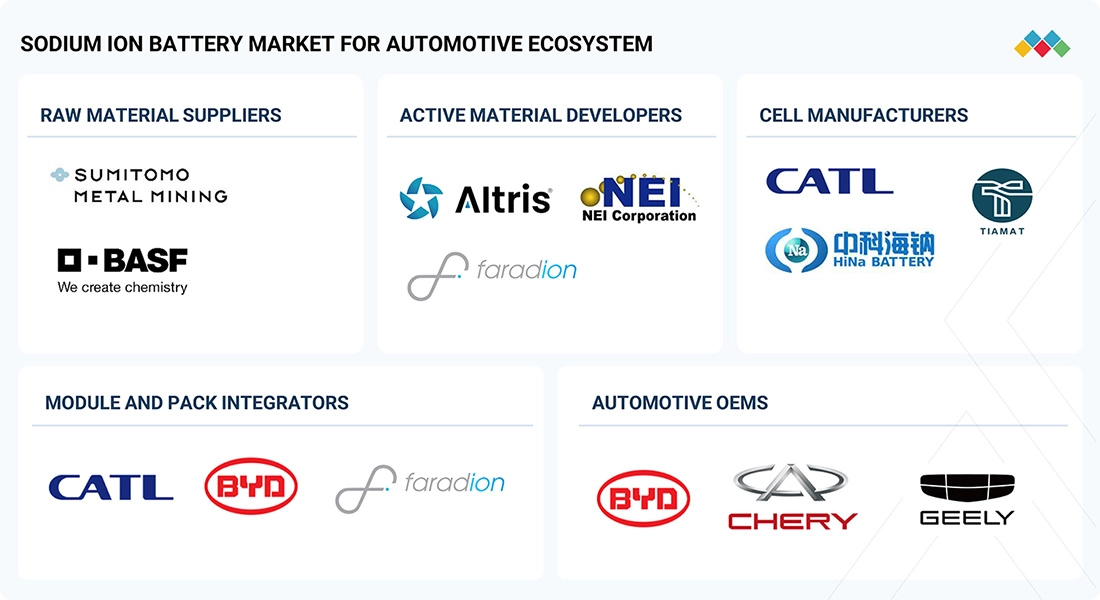
The tutomotive sodium-ion battery ecosystem consists of multiple stages across the battery value chain. It begins with raw material suppliers such as Sumitomo Metal Mining and BASF that provide essential materials for battery production. Active material developers, including Faradion, Altris, and NEI Corporation, focus on developing cathode and anode materials used in sodium-ion batteries. These materials are then used by cell manufacturers such as CATL, HiNa Battery Technology, and Tiamat to produce battery cells. The cells are further assembled into battery modules and packs by integrators such as CATL, BYD, and Faradion. Finally, automotive OEMs, including BYD, Geely, and Chery, integrate these battery packs into electric vehicles, completing the ecosystem from material supply to EV deployment.
Logos and trademarks shown above are the property of their respective owners. Their use here is for informational and illustrative purposes only.
MARKET SEGMENTS
Source: Secondary Research, Interviews with Experts, MarketsandMarkets Analysis
Sodium Ion Battery Market for Automotive, Battery Type
Sodium-sulfur batteries are leading the battery type segment of the automotive sodium-ion battery market because they offer high energy density while using low-cost, widely available materials such as sodium and sulfur. This chemistry supports a lower battery production cost than lithium-based systems that depend on expensive metals such as cobalt or nickel. In addition, sodium-sulfur batteries are demonstrating long cycle life and stable performance, which supports their suitability for large-scale automotive battery applications and contributes to their broader adoption in this segment.
Sodium Ion Battery Market for Automotive, Battery Capacity
The 10 to 40 kWh battery capacity segment is leading the market because this range is widely used in small electric vehicles and electric 3-wheelers, which account for a large share of EV sales in several emerging markets. Sodium-ion batteries are currently being adopted in vehicles that require moderate driving range and lower battery costs, making the 10 to 40 kWh range suitable for urban mobility applications. This capacity range also supports lower vehicle cost and efficient energy usage, which aligns with the design requirements of compact passenger EVs, urban delivery vehicles, and electric 3-wheelers.
Sodium Ion Battery Market for Automotive, Technology
Non-aqueous sodium-ion batteries are likely to dominate the market because they offer higher energy density and better voltage stability than aqueous systems, which are essential for automotive applications. Non-aqueous electrolytes allow wider operating temperature ranges and longer cycle life, supporting reliable performance in EVs. These characteristics make non-aqueous sodium-ion batteries more suitable for commercial deployment in electric vehicles, where driving range, efficiency, and durability are key considerations.
Sodium Ion Battery Market for Automotive, Vehicle Type
Passenger electric vehicles are leading in the vehicle type segment of the market because this category accounts for the largest share of global electric vehicle production and adoption. Automakers are increasingly evaluating sodium-ion batteries for passenger EVs as a cost-efficient alternative to lithium-ion batteries, particularly for entry-level and mid-range models where affordability is a key purchase factor. In addition, passenger EVs are being produced at significantly higher volumes than other electric vehicle categories, which is supporting greater integration of emerging battery chemistries such as sodium-ion in this segment.
REGION
Asia Pacific is expected to lead automotive sodium-ion battery market
Asia Pacific is expected to lead the market, primarily due to the strong concentration of battery manufacturing capacity and electric vehicle production in China. China is scaling sodium-ion cell development through companies such as BYD Company Limited and Hina Battery Technology Co., Ltd., supported by domestic supply chain access to sodium-based raw materials and established lithium-ion manufacturing infrastructure that can be adapted for sodium chemistries. High electric vehicle production volumes, policy support for alternative battery chemistries, and active pilot commercialization programs are accelerating local deployment. This combination of manufacturing scale, policy alignment, and early commercialization activity is positioning Asia Pacific as the dominant regional market.
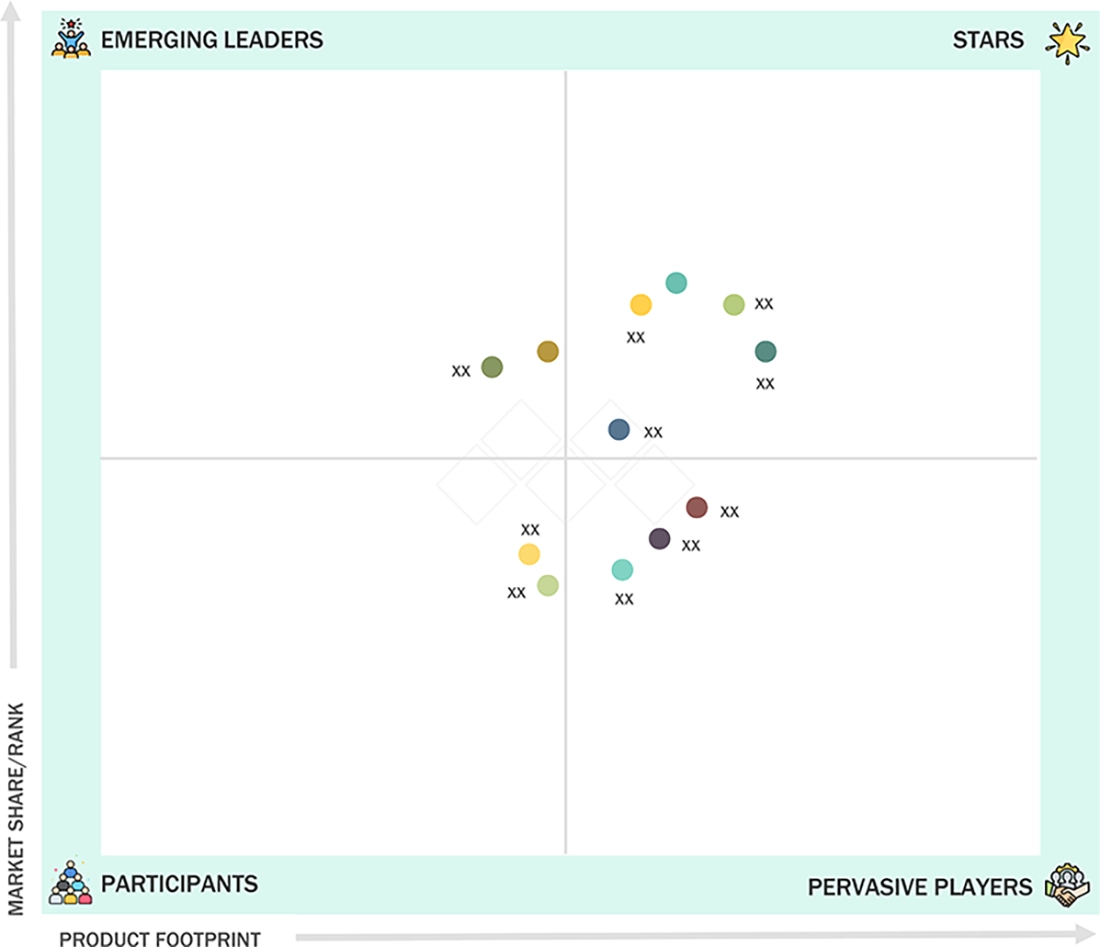
AUTOMOTIVE SODIUM ION BATTERY MARKET: COMPANY EVALUATION MATRIX
In the automotive sodium-ion battery market, Contemporary Amperex Technology Co Ltd (CATL) (Star) leads as CATL is a global leader in new energy technology, specializing in EV and energy storage batteries. Its energy storage batteries support renewable energy integration and various applications. Through battery material recycling, CATL ensures resource sustainability. The company has also released its first-generation sodium-ion battery. At the end of 2023, its first 11 GWh-scale sodium-ion battery production line started. Another 10 GWh is expected by 2030. Natron Energy (Emerging Leader) focuses on transforming industrial power use by providing efficient, environmentally friendly energy storage solutions. Notably, Natron's sodium-based battery chemistry allows for rapid recharge in just 8 minutes, with a cycle lifetime of 50,000 cycles and UL 1973 certification for safety. Natron's solutions cater to various industries, such as EV fast charging, and aim to optimize energy usage.
Source: Secondary Research, Interviews with Experts, MarketsandMarkets Analysis
KEY MARKET PLAYERS
- Contemporary Amperex Technology Co., Limited (China)
- BYD Company Limited (China)
- Faradion Limited (United Kingdom)
- Hina Battery Technology Co., Ltd. (China)
- Tiamat SAS (France)
- AMTE Power plc (United Kingdom)
- Natron Energy, Inc. (United States)
- Altris AB (Sweden)
- Aquion Energy, Inc. (United States)
- NGK Insulators, Ltd. (Japan)
- Northvolt AB (Sweden)
- Blackstone Resources AG (Switzerland)
MARKET SCOPE
| REPORT METRIC | DETAILS |
|---|---|
| Market Size in 2025 (Value) | USD 163.7 Million |
| Market Forecast in 2033 (Value) | USD 599.6 Million |
| CAGR | 18.1% |
| Years Considered | 2022–2033 |
| Base Year | 2025 |
| Forecast Period | 2026–2033 |
| Units Considered | USD Million |
| Report Coverage | Revenue forecast, company ranking, competitive landscape, growth factors, and trends |
| Segments Covered | By Battery Type (Sodium-sulfur Batteries, Sodium Salt Batteries, and Advanced Sodium-ion Batteries), Technology (Aqueous and Non-aqueous), Capacity (Below 10 kwh, 10 To 40 kwh, and Above 40 kwh), End Use (Electric 2-wheelers, Electric 3-wheelers, Passenger Electric Vehicles, and Light Commercial Vehicles) |
| Regions Covered | North America, Asia Pacific, and Europe |
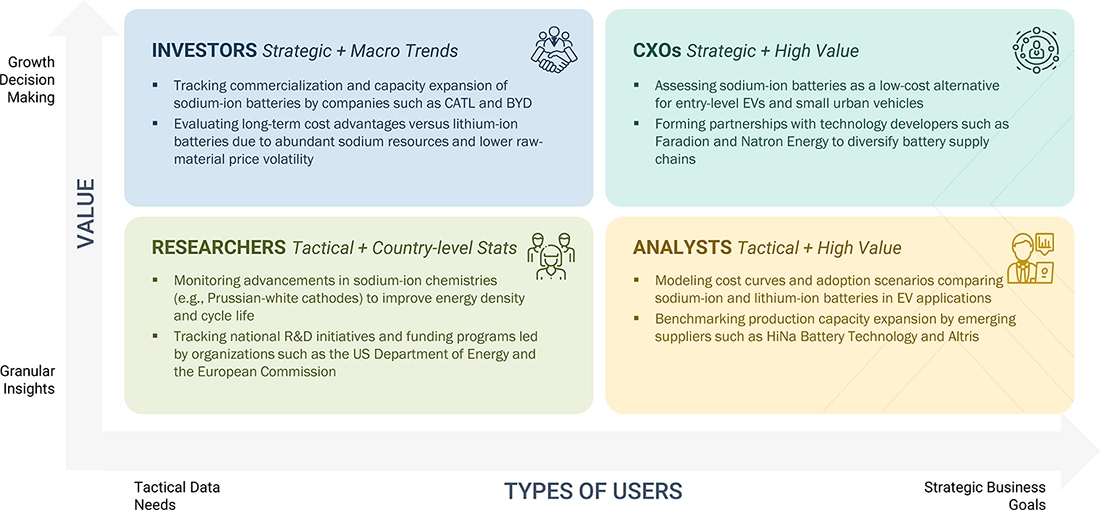
WHAT IS IN IT FOR YOU: AUTOMOTIVE SODIUM ION BATTERY MARKET REPORT CONTENT GUIDE
RECENT DEVELOPMENTS
- November 2025 : Guangde Qingna Technology Co., Ltd. entered into an agreement to set up a 20 GWh sodium-ion battery manufacturing plant in the Suining Economic and Technological Development Zone, Sichuan Province, China.
- April 2025 : CATL launched three new electric vehicle battery products: the Freevoy Dual Power Battery, Naxtra, described as the first mass-produced sodium-ion batteries, and the second-generation Shenxing superfast charging battery.
- March 2025 : HiNa Battery Technology Co., Ltd. introduced a sodium-ion battery solution tailored for commercial vehicles, engineered to provide extended service life, fast charging capability, and reliable operation across a broad temperature range. The portfolio includes four battery products, with two configured for urban passenger transport applications and two designed to support logistics and cargo operations.
- March 2025 : Elecom Co., Ltd., headquartered in Osaka, launched a consumer-grade sodium-ion mobile power bank. The 9,000 mAh device supports up to 45 W of output via USB-C Power Delivery and 18 W via USB-A. The company states that its sodium-ion chemistry delivers up to 5,000 charge cycles, compared with around 500 cycles typically seen in lithium-ion batteries, while also providing improved safety and stable performance at temperatures as low as minus 35 degrees Celsius.
Table of Contents
 Exclusive indicates content/data unique to MarketsandMarkets and not available with any competitors.
Methodology
The research uses extensive secondary sources, such as company annual reports/presentations, industry association publications, magazine articles, directories, technical handbooks, World Economic Outlook, trade websites, technical articles, and databases, to identify and collect information on the Automotive Sodium Ion Battery Market . Primary sources, such as experts from related industries, OEMs, and suppliers, have been interviewed to obtain and verify critical information and assess the growth prospects and market estimations.
Secondary Research
Secondary sources for this research study include corporate filings, such as annual reports, investor presentations, and financial statements; trade, business, and professional associations; whitepapers and electric vehicles and EV Battery-related journals; certified publications; articles by recognized authors; directories; and databases. Secondary data has been collected and analyzed to determine the overall market size, further validated by primary research.
Primary Research
After understanding the Automotive Sodium Ion Battery Market scenario through secondary research, extensive primary research has been conducted. Primary interviews have been conducted with market experts from both demand and supply sides across North America, Europe, and Asia Pacific. Approximately 43% of interviews have been conducted from the demand side, while 57% of primary interviews have been conducted from the supply side. The primary data has been collected through questionnaires, emails, and telephone interviews.
In the canvassing of primaries, various departments within organizations, such as sales and operations, have been covered to provide a holistic viewpoint in this report. Primary sources from the supply side include various industry experts, such as CXOs, vice presidents, directors from business development, marketing, product development/innovation teams, and related key executives from various key companies. Various system integrators, industry associations, independent consultants/industry veterans, and key opinion leaders have also been interviewed.
To know about the assumptions considered for the study, download the pdf brochure
Market Size Estimation
Multiple approaches were adopted for estimating and forecasting the web content management market. The first approach involves estimating the market size by companies’ revenue generated through the sale of WCM products.
Market Size Estimation Methodology- Top-down approach
Both top-down and bottom-up approaches were used to estimate and validate the total size of the Automotive Sodium Ion Battery Market . These methods were also used extensively to estimate the size of various subsegments in the market.
Data Triangulation
After arriving at the overall market size of the global market through the methodology mentioned above, this market was split into several segments and subsegments. The data triangulation and market breakdown procedures were employed to complete the overall market engineering process and arrive at the exact market value data for the key segments and sub-segments, wherever applicable. The extrapolated market data was triangulated by studying various macro indicators and regional trends from both the demand and supply-side participants.
Market Definition
According to the Batteries Directive 2006/66/EC, batteries are defined as any source of electrical energy generated by direct conversion of chemical energy and consisting of one or more primary battery cells (non-rechargeable) or one or more secondary battery cells (rechargeable). An EV battery is a rechargeable battery used to power BEVs), PHEVs, and HEVs. An EV battery usually comprises numerous small, individual cells arranged in series or parallel to achieve the desired voltage and capacity.
Stakeholders
- Automotive OEMs
- Battery-related Service Providers
- End Users
- EV Battery Casing Manufacturers
- EV Component Manufacturers
- EV Battery Manufacturing Organizations
- EV Battery Cell Manufacturing Organizations
- EV Battery Pack Manufacturing Organizations
- EV Battery Raw Material Miners and Suppliers
- EV Battery Raw Material Refinery Companies
- EV Infrastructure Component Manufacturers
- EV Infrastructure Developers
- Government Bodies (who directly and indirectly provide incentives, aid, and orders to EV manufacturers)
- Manufacturers of Electric Vehicles (EVs)
- Regulatory Bodies
- Traders and Distributors of Electric Vehicles
- Traders, Distributors, and Suppliers of EV Battery Components
Report Objectives
- To analyze and forecast the Automotive Sodium Ion Battery Market in terms of volume (thousand units) and value (USD million) from 2024 to 2035
-
To segment the market by Battery Capacity, Battery Form, Battery Type, Lithium-ion Battery Component, Material Type, Method, Propulsion, Vehicle Type, and Region
- To segment and forecast the market by Battery Capacity (<50 kWh, 51-110 kWh, 111-200 kWh, 201-300 kWh, and >301 kWh)
- To segment and forecast the market by Battery Form (Prismatic, Pouch, and Cylindrical)
- To segment and forecast the market by Battery Type (Lithium-ion, Nickel-metal Hydride, Solid-state, and Sodium-ion)
- To segment and forecast the market by Lithium-ion Battery Component (Negative electrode, Positive electrode, Electrolyte, and Separator)
- To segment and forecast the market by Material Type (Cobalt, Lithium, Natural Graphite, Manganese, Iron, Phosphate, and Nickel)
- To segment and forecast the market by Method (Wire Bonding, Laser Bonding, and Ultrasonic Metal Welding)
- To segment and forecast the market by Propulsion (Battery Electric Vehicles, Plug-In Hybrid Electric Vehicles, Fuel Cell Electric Vehicles, and Hybrid Electric Vehicles)
- To segment and forecast the market by Vehicle Type (Passenger Cars, Vans/Light Trucks, Medium & Heavy Trucks, Buses, and Off-highway Vehicles)
- To forecast the market by Region (North America, Europe, and Asia Pacific)
- To identify and analyze key drivers, challenges, restraints, and opportunities influencing the market growth
- To strategically analyze the market for individual growth trends, prospects, and contributions to the total market
-
To study the following with respect to the market
- Pricing Analysis
- Investment and Funding Scenario
- Value Chain Analysis
- Ecosystem Analysis
- Technology Analysis
- HS Code
- Case Study Analysis
- Patent Analysis
- Regulatory Landscape
- Key Stakeholders and Buying Criteria
- Key Conferences and Events
- To strategically profile the key players and comprehensively analyze their market share and core competencies
- To analyze the impact of AI on the market
- To track and analyze competitive developments such as deals, product launches/developments, expansions, and other activities undertaken by the key industry participants
Available Customizations
With the given market data, MarketsandMarkets offers customizations in accordance with the company's specific needs.
- Additional Company Profiles (Up to 5)
- Global Automotive Sodium Ion Battery Market , By Propulsion Type, at Country Level
- Global Automotive Sodium Ion Battery Market , By Propulsion Type at Vehicle Type Level


Personalize This Research
- Triangulate with your Own Data
- Get Data as per your Format and Definition
- Gain a Deeper Dive on a Specific Application, Geography, Customer or Competitor
- Any level of Personalization
Let Us Help You
- What are the Known and Unknown Adjacencies Impacting the Automotive Sodium-ion Battery Market
- What will your New Revenue Sources be?
- Who will be your Top Customer; what will make them switch?
- Defend your Market Share or Win Competitors
- Get a Scorecard for Target Partners

Custom Market Research Services
We Will Customise The Research For You, In Case The Report Listed Above Does Not Meet With Your Requirements
Get 10% Free CustomisationTESTIMONIALS

JIM NAAS
PRODUCT DIRECTOR, WEASLER
Weasler Engineering, a CentroMotion organization
Global Provider of Industrial Actuation & Control Solutionswww.weasler.com
Our organization was interested in learning more about the attractiveness of a particular market space. We contacted MarketsandMarkets to help us based on previous positive experiences we had with them. The results did not disappoint! We discussed our objectives with them, and the team at MarketsandMarkets developed and executed a proposal that met our needs precisely. We were very impressed by their level of expertise, the quality of the analysis and their insightful recommendations. We would not hesitate in working with them again in the future.

Matt Kardel,
Vice President
Aptiv,
A global technology company that develops safer, greener and more connected solutions.www.aptiv.com
We contracted with
MarketsandMarkets to evaluate the value chain and potential go-to-market partners related to our
interest in the Fleet Management space. The team successfully completed the work on time and at the
pricing agreed. MarketsandMarkets listened and understood our objectives and collaborated well with
us to help us get the visibility we needed to make an investment.
We have subsequently used
MarketsandMarkets again related to Smart Cities to good results.






Growth opportunities and latent adjacency in Automotive Sodium-ion Battery Market